The only way to teach children right from wrong

“Right” and “wrong” are social conventions that differ among societies. Canibals think eating people is just fine. Aztecs supposedly enjoyed ripping out hearts. Slavery was de rigueur in America. You were not born knowing right from wrong. You learned from your family and friends. You learned from your schools and other outside sources.

There is only one way to teach children right from wrong. Children must be taught what is right and taught what is wrong. They must be taught the truth.

So, for instance, if your family and friends were bigots — — i.e. intolerant of people because of their race, religion, or sexual orientation — and your schools said nothing about bigotry, you probably would have become a bigot. Why would your family and friends teach you bigotry? Because their families and friends taught them bigotry, a chain extending down through the generations, families and friends teaching bigotry as a standing tradition. Why would your schools say nothing? Perhaps because of laws that prevented them from teaching you right from wrong, for fear you would find such teaching “uncomfortable.” Although you, like most people, probably harbor some forms of bigotry in your heart, you probably also agree that bigotry, in general, is a sin. How do we solve that dichotomy and break the historical chain? I was reminded of that question when some years ago, on a visit to Germany, I toured the Dachau concentration camp.
Dachau’s commandant, Theodor Eicke, introduced a system of regulations which inflicted brutal punishments on prisoners for the slightest offenses, while scientists there conducted cruel experiments. Prisoners were subjected to injections of malaria and tuberculosis, and the untold thousands that died from hard labor or torture were routinely burned in the on-site crematorium. As Allied units approached, at least 25,000 prisoners from the Dachau camp system were force-marched south. During these death marches, the Germans shot anyone who could no longer continue; many also died of starvation, hypothermia, or exhaustion. When American forces liberated Dachau, they found more than 30 railroad cars filled with bodies.
I was able to tour the camp because the German government neither hid nor denied the existence of the horrors committed there. In fact, they use the camp as a reminder of the past, to help prevent a repeat. A movie describing in detail, the horrors of the camp, is shown to daily busloads of German school children as a right-vs.-wrong lesson. The German people, but for a small minority, do not celebrate the misdeeds of Naziism. There are no statues of Hitler in Germany. The Holocaust is revealed and decried. The Germans do not fear admitting this dark period of their history. In fact, they actively teach it. I think of that approach to the shameful parts of Germany’s heritage when I compare it to the American — or rather, the right-wing — approach to the horrors of our past and even of our present.Nearly 100 Confederate Monuments Removed In 2020, Report Says; More Than  700 Remain : NPR Slavery was an abomination that was celebrated by statues which, at long last, were pulled down despite claims of “Southern heritage.” And today, in America, “well-meaning, good citizens,” protest against teaching the parts of our past that shame us. Their stated concern is that such reminders and revelations would make their children “uncomfortable.” But ignorance is uncomfortable. Bigotry is uncomfortable. Denial does not change reality. Today, our black families continue to undergo hardship. No, it isn’t of Holocaust levels, but still is terribly destructive and wholly unnecessary in our wealthy nation. GOP advocated denial is the worst approach because it teaches no lessons. It condemns us to repeat the sins of the past.

“Those who cannot remember the past are condemned to repeat it.” George Santayana, The Life of Reason, 1905. From the series Great Ideas of Western Man.

We neither can, nor should try, to erase the blemishes of our past. Nor should anyone blame our children for our sins or for the sins of those who came before us. Leveling such blame would, in itself, be bigotry. The purpose of teaching history is not to lay blame or to create guilt, but to help us know our own successes and foibles, and the circumstances that can move a nation to bigotry and hatred. We are not pure. No nation is. Pretending purity is blindness and naivete. Let us be honest with ourselves. To some degree, we all receive mistreatment at times, but in America people of color have been, and still are, disproportionately mistreated.  We allow the teaching of the Holocaust, and even have museums dedicated to that education. Few object, because it was the Germans, and to a degree, the Poles, Austrians, French and others who committed those crimes. But the teaching of racism in America is an anathema to some Americans, because it is we, or more correctly, some of us, who are the perpetrators. And to hide that historical fact, we countenance angry denial. This brings us to something called “Critical Race Theory,” perhaps the most reviled yet least understood and least taught academic subject in education.
Critical race theory (CRT) is an academic concept that is more than 40 years old. The core idea is that race is a social construct, and that racism is not merely the product of individual bias or prejudice, but also something embedded in legal systems and policies. One example: In the 1930s, government officials literally drew lines around areas deemed poor financial risks, often explicitly due to the racial composition of inhabitants. Banks subsequently refused to offer mortgages to Black people in those areas. Scholars who study critical race theory in education look at how policies and practices in K-12 education contribute to persistent racial inequalities in education, and advocate for ways to change them. Among the topics they’ve studied: racially segregated schools, the underfunding of majority-Black and Latino school districts, disproportionate disciplining of Black students, barriers to gifted programs and selective-admission high schools, and curricula that reinforce racist ideas.
Solving racial inequalities first requires admitting that they exist and then admitting that they should be solved.  And that requires study. Sadly, there are those who deny any study is necessary, deny such inequalities exist to be solved, and claim any such equalities are the fault of the Black students — a “blame-the-victim” rationalization. The Catholic confessional begins, “Forgive me father for I have sinned.” The confession of sin is the first necessary step for absolution. Without realization and confession, the sin compounds. The Germans seem to have understood that the denial of sin is in itself a sin. “Forgive America, father, for we have sinned.” Those are the words of the truly moral, truly righteous. An evil man, like Donald Trump, would have you deny the obvious. He would have you deny the clear fact that people of color have received worse treatment in America than white Christians. That denial compounds the evil. For you who are religious, here is are reminders:
John 1:9 If we confess our sins, he is faithful and just to forgive us our sins and to cleanse us from all unrighteousness. James 5:16 Therefore, confess your sins to one another and pray for one another, that you may be healed.  Proverbs 28:13 Whoever conceals his transgressions will not prosper, but he who confesses and forsakes them will obtain mercy. Psalm 32:5 I acknowledged my sin to you, and I did not cover my iniquity; I said, “I will confess my transgressions to the Lord,” and you forgave the iniquity of my sin. Romans 3:23 For all have sinned and fall short of the glory of God James 4:17 So whoever knows the right thing to do and fails to do it, for him it is sin.
Perhaps you are one of those rare souls who has not sinned and has not felt bigotry in your heart. But to deny, or even to countenance the sins of others against strangers is in itself a sin. Discomfort is not an excuse for denial. Children must be taught about the existence of sin so they can recognize it and learn to avoid it. Without this teaching, the children can be sucked into sin by evil persons. We are not born bigots. We learn to be bigots, unless we first learn about the evils of bigotry. The people who object to the teaching of racism in America often blame their children’s sensitivity. But this is a false excuse. The real reason is, they are ashamed of our past, and want to bury it. But the past has become the present, and it cannot be buried so long as it still lives. The only way to end the shame is to recognize it and to speak against it, else it will not only continue but multiply. Perhaps, the real problem lies not in the reluctance to admit that bigotry exists but rather in the fear of the cures. “Affirmative action” often has involved establishing racial quotas or preferences to “even out” representation in school admissions or job hiring. The problem here is that it invariably requires the less qualified to take precedence over the more qualified, and always will be seen as unfair. Affirmative action” also stigmatizes the very people it is supposed to help — the “You got in only because you are black” appearance, which further adds to the bigotry rather than reducing it. Once we recognize the bigotry problem itself, and once we determine to solve it, the solution lies not at the top but at its foundation: Money and poverty, i.e. the income/wealth/power Gap at the bottom of the financial scale. Lacking money, such minorities as Blacks and Latins suffer poorer primary schools, more crime, less family stability, poorer housing, poorer nutrition, and a desperate culture, where immediate needs take precedence over future plans. These all lead to poorer primary-school academic results which, in turn, lead to less-educated older students and less qualified job- and college applicants. The solution lies not in taking from the top to give to the bottom (which always will be fought by America’s most powerful), or in giving solely to the bottom (which will be viewed as unfair by America’s middle). Rather, the solution is to lift the lower levels far enough above subsistence so that the problems of poorer primary schools, more crime, less family stability, poorer housing, poorer nutrition, and desperation culture cease to impact even the least fortunate among us. This would be a “rising tide” approach that lifts all boats. Examples can be found in the “Ten Steps to Prosperity” (below). For example:
  1. Eliminate the FICA tax
  2. Offer free Medicare to All who want it.
  3. Offer Social Security to All who want it.
  4. Offer free College to All who want it.
Offering the same money to everyone, regardless of current income or wealth, will not affect the lifestyles of the rich, but can lift the poor to levels where school and job achievements are seen as being in reach. It will not evoke cries of “unfairness” and “discomfort” that currently plague the accurate teaching of America’s history.

———-///———-

[Why would any sane person take dollars from the economy and give them to a federal government that has the infinite ability to create dollars?] Rodger Malcolm Mitchell Monetary Sovereignty Twitter: @rodgermitchell Search #monetarysovereignty Facebook: Rodger Malcolm Mitchell

……………………………………………………………………..

THE SOLE PURPOSE OF GOVERNMENT IS TO IMPROVE AND PROTECT THE LIVES OF THE PEOPLE.

The most important problems in economics involve:
  1. Monetary Sovereignty describes money creation and destruction.
  2. Gap Psychology describes the common desire to distance oneself from those “below” in any socio-economic ranking, and to come nearer those “above.” The socio-economic distance is referred to as “The Gap.”
Wide Gaps negatively affect poverty, health and longevity, education, housing, law and crime, war, leadership, ownership, bigotry, supply and demand, taxation, GDP, international relations, scientific advancement, the environment, human motivation and well-being, and virtually every other issue in economics. Implementation of Monetary Sovereignty and The Ten Steps To Prosperity can grow the economy and narrow the Gaps: Ten Steps To Prosperity:
  1. Eliminate FICA
  2. Federally funded Medicare — parts A, B & D, plus long-term care — for everyone
  3. Social Security for all
  4. Free education (including post-grad) for everyone
  5. Salary for attending school
  6. Eliminate federal taxes on business
  7. Increase the standard income tax deduction, annually. 
  8. Tax the very rich (the “.1%”) more, with higher progressive tax rates on all forms of income.
  9. Federal ownership of all banks
  10. Increase federal spending on the myriad initiatives that benefit America’s 99.9% 
The Ten Steps will grow the economy and narrow the income/wealth/power Gap between the rich and the rest.

MONETARY SOVEREIGNTY

MMT’s divorce from reality: Jobs Guarantee and inflation fear

Modern Monetary Theory (MMT) is a cousin to Monetary Sovereignty (MS), in that both concepts acknowledge the indisputable fact that the U.S. federal government’s ability to spend is not constrained by the availability of funds.
Modern monetary theory and Monopoly money : r/wallstreetbets
Neither the federal government nor any federal agency can run out of money unless Congress wants it to. Federal “Trust Funds” are a lie to prevent you from receiving federal benefits.
In short, the Monetarily Sovereign federal government cannot run short of dollars. It cannot “go broke.” It neither needs nor uses tax dollars. Similarly, no agency of the federal government (Medicare, Medicaid, Social Security, et al) can run short of dollars unless Congress wants it to. Even if all federal tax collections were $0, the government could continue spending, forever. This is true of all sovereign issuers of a sovereign currency. Federal taxes do not pay for federal spending. The federal government pays for all spending by creating new dollars. Federal tax dollars are destroyed upon receipt.

Alan Greenspan: “A government cannot become insolvent with respect to obligations in its own currency.”

Ben Bernanke: “The U.S. government has a technology, called a printing press (or, today, its electronic equivalent), that allows it to produce as many U.S. dollars as it wishes at essentially no cost.”

Quote from Ben Bernanke when, as Fed chief, he was on 60 Minutes: Scott Pelley: Is that tax money that the Fed is spending? Ben Bernanke: It’s not tax money… We simply use the computer to mark up the size of the account.

Statement from the St. Louis Fed: “As the sole manufacturer of dollars, whose debt is denominated in dollars, the U.S. government can never become insolvent, i.e., unable to pay its bills. In this sense, the government is not dependent on credit markets to remain operational.”

Press Conference: Mario Draghi, President of the ECB, 9 January 2014 Question: I am wondering: can the ECB ever run out of money? Mario Draghi: Technically, no. We cannot run out of money.

Sadly, MMT believers go astray with two false beliefs: MMT’s Jobs Guarantee and the belief that federal deficit spending can cause inflation. I. JOBS GUARANTEE Briefly, JG is just what it sounds like: The government guarantees it will find or provide (it’s not clear which) a job for anyone who wants a job. We have published many articles describing the foolishness of that proposal. Rather than repeat the many, many reasons why the JG is naive, wrongheaded, and damaging, we’ll just provide you with these references:
How the MMT “Jobs Guarantee” ignores humanity. MMT’s “Jobs Guarantee”: The final nail in the coffin of this naive, foolish program One more reason why the MMT Jobs Guarantee is a con job The MMT Jobs Guarantee con job More proof the MMT’s “Jobs Guarantee” can’t work The Jobs Guarantee (JG) mouse Another word on MMT’s Jobs Guarantee and “The Rise Of Bullshit Jobs” Life in a Jobs Guarantee (JG) World The JG (Jobs Guarantee) vs the GI (Guaranteed Income) vs the EB (Economic Bonus) Why Modern Monetary Theory’s Jobs Guarantee is like the EU’s euro: A beloved solution to the wrong problem. Will people still work if the government gives them money?
Now, circumstances have arrived to demonstrate reality in the face of MMT’s academic ignorance.
All those people quitting jobs, where are they going? Kristin Schwab, Oct 28, 2021 You may have heard the news that last week’s initial unemployment claims fell to a new pandemic low. But even though layoffs are decreasing, it’s also true that lots of workers are leaving their jobs and lots of employers are still having trouble filling them. So, where are the workers who are leaving jobs going? Right now, it is statistically more difficult to become a receptionist than to get into Harvard. That’s according to data from ZipRecruiter, where Julia Pollak is chief economist. “I have a lot of bad news for job seekers in certain occupations. Some are much more competitive even,” Pollak said. Some of these jobs are specialized or senior roles, but a lot of them are what Pollak calls pleasant jobs with predictable schedules, such as in customer service or communications — and fields like airport security.
Guess what, MMT? People aren’t simply mindless pegs to be fitted into crap-job holes as JG would do. Human beings have desires. They want — no, demand — good jobs: Good pay, good conditions, good futures. MMT’s JG program, designed by academics who have not experienced reality, relies on people being so desperate they will take any job offered. When people are selective about their lives, JG falls apart.
“So, jobs where you have some degree of prestige, perhaps a uniform and a union looking out for your interests,” Pollak said. The growing interest in jobs that are more stable and offer better pay and benefits makes sense when you compare them to jobs that require similar skills and are begging people to come back — think less predictable or less protected industries like trucking and restaurants.
Imagine that, MMT, people want stability, better pay, and better benefits, not what a federal JG bureaucracy offers them.
“If you’re a worker at a restaurant and suddenly the restaurant is short-staffed, it’s going to be that much harder for you to actually manage your shift,” said Daniel Zhao, an economist at Glassdoor. People are tired, burned out and fed up. And a lot of them are looking for a new work-from-home lifestyle. Glassdoor said searches for remote roles is up more than 350% in the last year. Whether everyone can get one is a different story.
The paternalistic Jobs Guarantee was a depression-era solution, that is as appropriate as a hand-crank calculator in today’s computer age. Sadly, MMT still doesn’t get it. Instead of JG nonsense, we finally are leaning toward Step #3 of the Ten Steps to Prosperity: Social Security for All. II SOCIAL SECURITY FOR ALL The following article calls it, “Guaranteed Basic Income” (GBI). Different name, same fundamental concept: Instead of finding crap jobs for the poor, simply give people money.
Guaranteed basic income is coming By Alice Yin and John Byrne Chicago Tribune, The Tribune’s Gregory Pratt contributed Thousands of struggling Chicago residents will receive monthly cash payments from the city of Chicago as it becomes home to one of the largest guaranteed income programs in the U.S. Mayor Lori Lightfoot’s $31.5 million basic income program is just a sliver of the total $16.7 billion budget, which will be buoyed by federal COVID-19 relief funds and won City Council approval Wednesday. Few details of the pilot have been hammered out yet, except that 5,000 households will receive $500 per month for a year — with no strings attached. The lowest-income residents who suffered financial blows from the COVID-19 pandemic will be the focus. When the funds go out, Chicago will join a contingent of American cities that have warmed up to the concept of guaranteed income. Once deemed a pipe dream in mainstream politics, the idea of handing unconditional cash directly to those in need has particularly gained steam during the coronavirus-fueled recession, when most Americans saw multiple rounds of stimulus checks and other temporary social safety net expansions. However, guaranteed income pilots have launched before the pandemic too, such as in Stockton, California, under former Mayor Michael Tubbs. The program doled out $500 monthly payments to a small subset of low-income families. In June 2020, Tubbs started the coalition Mayors for a Guaranteed Income, which now has more than 50 mayors on board, more than two dozen of whom are piloting the concept in some form. Though Lightfoot has touted her proposal as the largest in U.S. history, Los Angeles is in the process of implementing its own guaranteed income pilot targeting 3,000 households with $1,000 a month for a year. Andrew Yang, a Democratic presidential candidate in 2020, has also championed a more far-reaching version of cash assistance known as universal basic income, which would go out to all adults regardless of means.
Rather than insisting on the Puritanical demand that people must labor in order to survive (i.e JG), more enlightened city governments recognize that at least at some basic level, poverty is harmful to the whole nation, and Americans have a right to live. The irony is that monetarily non-sovereign cities (which are financially limited) are doing it rather than the Monetarily Sovereign federal government, which is financially unlimited. But that is why the efforts are so small, with just a few thousand households receiving benefits.
Not all Chicago aldermen were on board with Lightfoot’s plan. Her overall budget passed 35-15, with some of the opposition pointing to the basic income program. Southwest Side Ald. Matt O’Shea said after the vote that the pilot won’t work because “in two years, we won’t be able to afford it.” He’d rather see resources spent on boosting child care and “getting people back to work,” he said. “Just giving money out to people when there’s tens of thousands of jobs in our city right now, that’s not something I can support,” O’Shea said.
But that is the whole point. There are “tens of thousands of jobs” people don’t want. Arrogant academic snobs claim the “underclass” should be grateful to work crap jobs for crap wages. Those are Gap Psychology words. They serve only to widen the Gap between the rich and those below. JG is cruel and ignorant. It dooms people to failure. It is bad economics. Giving people money turns them into consumers whose spending helps the entire economy. Apparently, people are tired of the “work ’til you drop” routine. They have the strange desire to lead pleasant lives, no matter what the rich tell them. If people won’t work, it’s not because of laziness, as the rich love to claim. It’s because the jobs are unattractive.
Back in March, when aldermen held a hearing on a proposal over direct monthly checks, caucus chairman Jason Ervin said it would be a “slap in the face” to proceed with guaranteed income before setting up a reparations programs for descendants of slaves.
That’s a perfect example of the old, “We can’t do this before we do that” stalling routine. It’s like this: “We can’t feed them until we clothe them, and we can’t clothe them until we house them, and we can’t house them until we educate them, and we can’t educate them until we give them free healthcare, and we can’t afford to give them free healthcare until we raise taxes — and we can’t raise taxes because no one wants that. “So we can’t do anything. Sorry.”
One of City Council’s loudest voices for direct cash assistance has been Northwest Side Ald. Gilbert Villegas, who said his mother received a monthly $800 stipend through the Social Security survivors death benefits program after his father died. Villegas introduced a proposal ordinance this spring that largely resembled Lightfoot’s plan of $500 monthly payments to 5,000 households, but it did not pass.
Villegas’s mother received benefits from a federal agency, that is funded from an unlimited source. City governments are not unlimited sources.
Still, Villegas said he’s prepared to go all-in on helping work out the details of Lightfoot’s program. He wants an eligibility threshold of households earning 300% or less of the federal poverty level, and Chicago Public Schools families should be prioritized, he said.
The problem with income eligibility programs is they are expensive to administer, unfair to those who barely miss out, and subject to cheating.
Though most guaranteed income programs are still nascent, researchers have examined the effects — with limitations. The current pilots in place are narrow in size and duration, said Carmelo Barbaro, executive director of the University of Chicago Inclusive Economy Lab. Still, there is promise in further investigating the results because unlike other safety-net programs, direct cash assistance is simpler to implement, he said. “Broadly accessible and unconditional cash transfers like Chicago’s guaranteed income pilot are intended to address those limitations of existing programs,” Barbaro wrote in an email. “The cost of such programs is higher, but the benefits could also be higher.”
No deductible, comprehensive Social Security for All is affordable for the federal government (as are all federal expenses). It would be simple to administer, and massively beneficial to the economy.
University of Pennsylvania professor Ioana Marinescu, an economist who has also studied such programs, said the early signs show that some of the outcomes feared by critics may not have materialized. A 2014 research review on the effect of cash transfers on alcohol and tobacco purchases, for example, found virtually no change in or even a decrease in spending on these so-called temptation goods. “There’s advantages to cash in terms of flexibility,” Marinescu said. “There could be drawbacks if you’re worried that people misuse the cash. But that doesn’t seem to be the case based on the empirical evidence.”
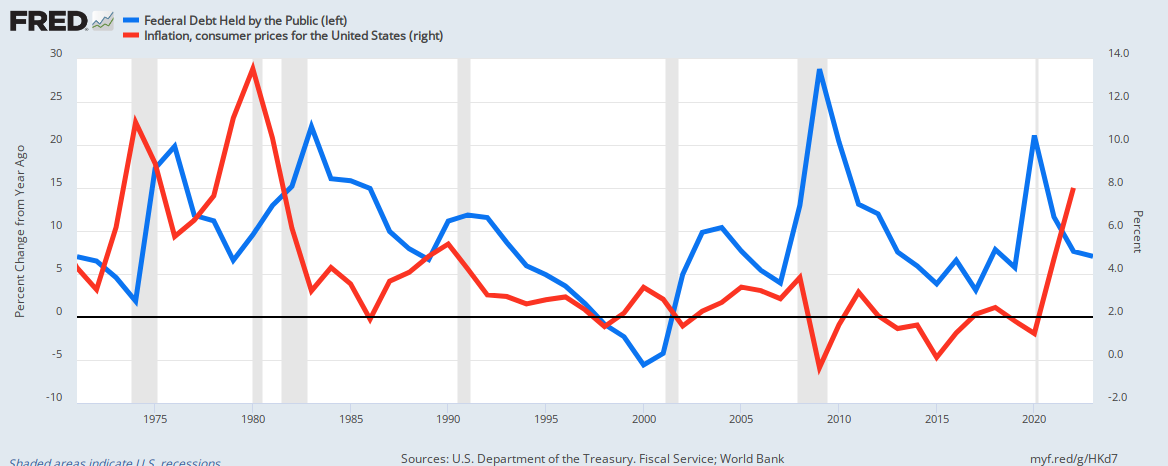
The rich like to portray the poor as ignorant sloths who will use any extra money for drinking, gambling, smoking, and drugs. That gives the rich a fake excuse to widen the Gap and thereby make themselves richer. Republicans, the party of the rich, invariably vote against money for the poor. (The Gap is what makes the rich rich. Without the Gap, no one would be rich. We all would be the same. The wider the Gap, the richer the rich are.) The lack of money is the biggest problem in any economy. The best way to cure that problem is to give people money. The rich hate it, and invent excuses for not doing it, because they don’t want the Gap between the rich and the rest to be narrowed. III Inflation Contrary to popular myth, inflation never is caused by “too much” federal deficit spending. Inflation always is caused by shortages of key goods and services.
There is no correlation between federal deficit spending (blue line) and inflation (red line).
Today’s inflation is related to shortages of energy, labor, food, and computer chips. Inflation actually can be cured by additional federal spending to pay for scarce goods and services. In Summary
  1. The Monetarily Sovereign federal government has infinite access to dollars. Neither the government nor any agency of the government can run short of dollars unless Congress wants that to happen.
  2. Federal taxes do not “pay for” federal spending. Federal spending is paid for by the creation of new dollars, which the government has the infinite ability to do.
  3. Federal spending does not cause inflation. Inflation is caused by the scarcity of key goods and services. Federal spending can cure inflation by paying for scarce goods and services.
  4. America is not short of jobs. America is short of good jobs. Modern Monetary Theory’s Jobs Guarantee will solve zero problems, and in fact exacerbate a “crap jobs” economy.
  5. Poverty, the lack of money, is bad for the American economy. Poverty is not cured by bad jobs, but rather by putting money in the hands of the impoverished. This creates new consumers, whose purchases grow the economy,  which grows businesses that are able to provide attractive jobs.
It all begins putting with money into the hands of the people, which the U.S. federal government has the infinite ability to provide. Rodger Malcolm Mitchell Monetary Sovereignty Twitter: @rodgermitchell Search #monetarysovereignty Facebook: Rodger Malcolm Mitchell

……………………………………………………………………..

THE SOLE PURPOSE OF GOVERNMENT IS TO IMPROVE AND PROTECT THE LIVES OF THE PEOPLE.

The most important problems in economics involve:
  1. Monetary Sovereignty describes money creation and destruction.
  2. Gap Psychology describes the common desire to distance oneself from those “below” in any socio-economic ranking, and to come nearer those “above.” The socio-economic distance is referred to as “The Gap.”
Wide Gaps negatively affect poverty, health and longevity, education, housing, law and crime, war, leadership, ownership, bigotry, supply and demand, taxation, GDP, international relations, scientific advancement, the environment, human motivation and well-being, and virtually every other issue in economics. Implementation of Monetary Sovereignty and The Ten Steps To Prosperity can grow the economy and narrow the Gaps: Ten Steps To Prosperity:
  1. Eliminate FICA
  2. Federally funded Medicare — parts A, B & D, plus long-term care — for everyone
  3. Social Security for all
  4. Free education (including post-grad) for everyone
  5. Salary for attending school
  6. Eliminate federal taxes on business
  7. Increase the standard income tax deduction, annually. 
  8. Tax the very rich (the “.1%”) more, with higher progressive tax rates on all forms of income.
  9. Federal ownership of all banks
  10. Increase federal spending on the myriad initiatives that benefit America’s 99.9% 
The Ten Steps will grow the economy and narrow the income/wealth/power Gap between the rich and the rest.

MONETARY SOVEREIGNTY

Heritage Foundation: Ignorant, stupid, or traitors? You choose.

Are the writers for the right-wing Heritage Foundation ignorant, stupid, or merely traitors to America? Read the following excerpts and you decide:

Commentary: Dealing with America’s Olympic-sized debt problem

Image result for Rachel Greszler and David Ditch. Size: 316 x 160. Source: www.buckscountycouriertimes.com
Rachel Greszler is a research fellow in economics at The Heritage Foundation. David Ditch is a researcher specializing in transportation issues for Heritage’s Hermann Center for the Federal Budget.
Rachel Greszler and David Ditch, The Heritage Foundation on Aug 5, 2021 Most Americans realize the federal government spent a lot of money, including three rounds of so-called “stimulus payments” that most households received. But those $3,200 worth of individual checks pale in comparison to total spending. If ordinary Americans had spent like the federal government did in 2020, the median household that earns $68,703 would have spent $131,620 and put $62,917 on the credit card, despite already being $541,287 in debt.
In our previous post, “Debt is not debt; deficits are not deficits; the government never borrows; gold never backed the dollar; inflation is not caused by federal spending,” we describe how charlatans use homonyms to deceive you. Via ignorance, stupidity, or malice, the writers for the Heritage Foundation prove our point by attempting to confuse federal finances with personal finances. The two are as completely different as flypaper is from the daily paper.
As of 2021, the U.S. debt comes out to roughly $220,000 per household. That’s enough to buy about eight years’ worth of groceries, gas, clothing, and housing for the typical household.
The above is a completely meaningless and misleading comparison, that is supposed to shock you, but not to inform you. You are not, and never will be liable for the so-called, misnamed federal “debt.” It isn’t a debt, and no one is liable for it.
And even that figure doesn’t include the unfunded liabilities of Social Security and Medicare. Without a significant reduction in the size of those programs, each household’s total debt is actually over $660,000. That’s equal to the cost of a median family home, a new car, plus over five years’ worth of a typical household’s income.
Utter nonsense. All federal liabilities are “unfunded” until the government funds them by creating dollars, ad hoc. The real purpose of the article is to groom you for acquiescence to right-wing calls for Social Security and Medicare cuts. But even if the FICA tax were eliminated, the federal government could support Social Security for All and a comprehensive Medicare for All, forever. Then follow more meaningless comparisons, all designed only to be shocking. Your household will not ever pay a single penny to pay off the so-called federal “debt.”
However, even this massive a debt doesn’t seem all that bad. Interest rates are low, and the federal government has had little problem seemingly borrowing into oblivion without consequence. (The same could be said of Greece before a financial crisis ensued.)
The fact that interest rates are low is yet more meaningless tripe. The U.S. government sets interest rates at any level it chooses, and it pays interest by creating new dollars, ad hoc, which it has the infinite ability to do. And by the way, Greszler and Ditch, is it ignorance, stupidity, or traitorousness that causes you to compare the Monetarily Sovereign United States (which has the unlimited ability to create its own sovereign currency, the dollar) with the monetarily non-sovereign Greece (which has no sovereign currency)?
But our currently low interest rate payments—equal to over $2,500 per household in 2021, or the cost of about 6 months’ worth of groceries—are on track to rise to about $6,400 per household in 2031. That’s four months of mortgage payments.
Again, more designed-to-deceive, meaningless, false equivalences between federal finances and personal finances
And that’s the equivalent of an interest-only mortgage. Those costs don’t even begin to reduce the principal amount of debt.
The so-called federal “debt” is not a debt in the usual sense. It is the total of deposits into Treasury Security accounts (similar to safe deposit boxes) which are no burden whatsoever on the government or on future taxpayers.
While ordinary Americans aren’t allowed to take out mortgages or open up new credit cards in their children’s names, the federal government does this every day.
Yet even more ignorant, stupid, or intentionally deceptive false comparisons between federal finances and personal finances. The Heritage fraud goes on and on.
The share of debt for a child born this year was $66,874. And that debt is on track to rise every year, reaching $111,552 by the time they’re 18 and either start working or head off to college. It will then hit $191,768 by the time they’re 30 and potentially raising young children.
The above implies that future children will have to pay for the so-called “debt.” It is a lie of the first order. No one will pay for the “debt” because it is not debt. It is deposits that will be paid off as they always have been: By simply returning the dollars in those T-security accounts.
Fortunately, it’s not too late to prevent the nation from going broke.
It is impossible for the United States to “go broke.” Being Monetarily Sovereign (unlike Greece), the U.S. has the unlimited ability to create dollars. If needed, it could press one computer key and create a trillion dollars tomorrow.
Congress should cut out wasteful spending such as corporate welfare and excessive compensation for federal bureaucrats.
The Heritage Foundation, being right-wing, now complains about “corporate welfare.” Do they mean the Republicans’ tax cuts for businesses? And really, how many federal bureaucrats receive “excessive compensation”? Of course, the whole thing is meaningless, because all federal deficit spending, even so-called “wasteful” spending, benefits everyone by adding stimulus dollars to the economy.
Congress should stop shirking their responsibilities by placing an increasing amount of federal spending on autopilot, and instead seek to reform programs like Social Security and Medicare that are on a path to bankruptcy.
I have no idea what “autopilot” means in this context. I suspect the authors don’t know, either. But none of it matters. The real purpose is to make you believe Social Security and Medicare should be cut. That is the goal of The Party of the Rich, the Republicans. The rich, who support Heritage Foundation, always want to widen the Gap between the rich and the rest. The wider the Gap, the richer are the rich. It’s known as Gap Psychology — the desire to widen the income/wealth/power Gap below, and to narrow the Gap above. So they repeatedly warn that Social Security and Medicare soon will run short of money, despite their being a federal agency that has available to them, infinite dollars. Neither the federal government, nor any agency of the federal government, can go bankrupt unless Congress and the President want them to.
Congress should focus on core federal responsibilities and clear away countless programs that benefit narrow interest groups at the expense of the public good.
The elderly and the poor — are they what Heritage considers to be “narrow interest groups”?? Or aren’t the rich — Heritage’s buddies — who really comprise the narrow interest groups?
Congress should recognize our looming debt disaster and step away from shortsighted spending plans.
Still “looming.” Debt-nuts like Heritage have been making the same “disaster” claim for more than 80 years, yet here we are, with the strongest economy in U.S. history.
Big problems like the unsustainable national debt won’t be solved quickly or easily. However, Congress must begin to take fiscal responsibility seriously as soon as possible.
The “unsustainable” national debt has been growing massively, and sustaining, since 1940, while organizations like Heritage have been crying “Wolf” again, and again, and again.
Otherwise, a Greece-like fate may await us.
And the article ends appropriately, with one, final, false comparison of monetarily non-sovereign Greece vs. Monetarily Sovereign America. The Big Lie is alive and well at Heritage. Even, an organization as devoted to advancing the interests of the rich vs. the rest, should be embarrassed by the above article. It is so wrongheaded and misleading as to be written by fools and approved by traitors. They do more to hurt America than do the most devoted Russian, Iranian, and Chinese spies. Perhaps The Heritage Foundation should be renamed The Benedict Arnold Foundation. Rodger Malcolm Mitchell Monetary Sovereignty Twitter: @rodgermitchell Search #monetarysovereignty Facebook: Rodger Malcolm Mitchell

……………………………………………………………………..

THE SOLE PURPOSE OF GOVERNMENT IS TO IMPROVE AND PROTECT THE LIVES OF THE PEOPLE.

The most important problems in economics involve:
  1. Monetary Sovereignty describes money creation and destruction.
  2. Gap Psychology describes the common desire to distance oneself from those “below” in any socio-economic ranking, and to come nearer those “above.” The socio-economic distance is referred to as “The Gap.”
Wide Gaps negatively affect poverty, health and longevity, education, housing, law and crime, war, leadership, ownership, bigotry, supply and demand, taxation, GDP, international relations, scientific advancement, the environment, human motivation and well-being, and virtually every other issue in economics. Implementation of Monetary Sovereignty and The Ten Steps To Prosperity can grow the economy and narrow the Gaps: Ten Steps To Prosperity:
  1. Eliminate FICA
  2. Federally funded Medicare — parts A, B & D, plus long-term care — for everyone
  3. Social Security for all
  4. Free education (including post-grad) for everyone
  5. Salary for attending school
  6. Eliminate federal taxes on business
  7. Increase the standard income tax deduction, annually. 
  8. Tax the very rich (the “.1%”) more, with higher progressive tax rates on all forms of income.
  9. Federal ownership of all banks
  10. Increase federal spending on the myriad initiatives that benefit America’s 99.9% 
The Ten Steps will grow the economy and narrow the income/wealth/power Gap between the rich and the rest.

MONETARY SOVEREIGNTY

INFLATION! No, no, it isn’t the stimulus.

INFLATION! You can hear it now, can’t you? The sound of hands wringing in concert. The GOP is owned by the very rich. And the rich are terrified that you ever-so-slightly will narrow the Gap between you and them. So their GOP flunkees, having already given a huge tax deduction to their rich patrons, now will tell you that the Democrats’ stimulus packages are wrecking the economy and causing not just inflation, but hyperinflation. It’s all a great big fat lie, a repeated myth designed to calm your requests for more stimulus dollars to flow to your benefit. It goes like this:
  1. Because the unemployment benefits are too generous, people won’t come back to work. So the GOP solution is to cut benefits, thereby starving people into working for low pay at unpleasant jobs.
  2. The inflation theory is that increasing the supply of dollars when the demand for dollars remains constant, reduces the value of the dollar, and that reduction is known as “inflation.”
    Whip Whipping Hand - Free vector graphic on Pixabay
    The GOP solution to inflation and unemployment.
Nice hypotheses, except:
  1. There is a way to pay people good wages and also encourage work, and
  2. The value of dollars does not decrease just because the supply increases.
Dollars are not like oranges, oil, or opera tickets. Money is a unique commodity. Increase the supply and people want still more. Give a person a million or a billion, and he will want yet another million or billion. Ask Jeff Bezos, Elon Musk, Mark Zuckerberg, or Warren Buffet. They all still work — for money. The one thing that affects the demand for money is the reward for owning money, i.e. interest rates, and that effect is modest. So, though interest rates today are quite low, the demand for dollars remains high. As I have demonstrated in previous posts, inflations have not been caused by federal deficits. Nor have hyperinflations. All have been caused by shortages.

Inflations are caused by shortages, not by money supply.

If deficit spending (red line) caused inflations (blue line) you would expect to see the two lines reasonably parallel. But there seems to be no relationship between the lines. Cuts in deficit spending lead to recessions (gray bars).
The shortages that most likely to lead to inflations involve food, energy, and personnel.
 Consumer prices surge again, rising 5% over the past year By Martin Crutsinger Associated Press WASHINGTON — American consumers absorbed another surge in prices in May — a 0.6% increase over April and 5% over the past year, the biggest 12-month inflation spike since 2008. The May rise in consumer prices that the Labor Department reported Thursday reflected a range of goods and services now in growing demand as people increasingly shop, travel, dine out and attend entertainment events in a rapidly reopening economy. The increased consumer appetite is bumping up against a shortage of components, from lumber and steel to chemicals and semiconductors, that supply such key products as autos and computer equipment, all of which has forced up prices. And as consumers increasingly venture away from home, demandhas spread from manufactured goods to services — airline fares, for example, along with restaurant meals and hotel prices — raising inflation in those areas, too. Among specific items in May, prices for used vehicles, which had surged by a record 10% in April, shot up an additional 7.3% and accounted for one-third of May’s overall price jump. The price of new cars, too, rose 1.6% — the largest one-month increase since 2009. The jump in new and used vehicle prices reflects supply chain problems that have caused a shortage of semiconductors. The lack of computer chips has limited production of new cars, which, in turn, has reduced the supply of used cars. As demand for vehicles has risen, prices have followed. But higher prices were evident in a wide variety of categories in May, including household furnishings, which rose 0.9%, driven by a record jump in the price of floor coverings. Airline fares rose 7% after having increased 10.2% in April. Food prices rose 0.4%, with beef prices jumping 2.3%. Energy costs, though unchanged in May, are still up 56.2% in the past year.
The problem isn’t excessive money. Furnishings, floor coverings, airline tickets, beef, and oil prices all reflect the lack of production or availability, which in turn reflects the lack of demand during COVID-19. Only now, is supply beginning to grow to meet demand.
From the cereal maker General Mills to Chipotle Mexican Grill to the paint maker Sherwin-Williams, a range of companies have been raising prices or plan to do so, in some cases to make up for higher wages they’re now paying to keep or attract workers.
The GOP’s solution to the shortage of workers is to stop paying unemployment compensation. For the benefit of the rich, the GOP wishes to starve the people until they are forced to return to low wages and poor working conditions. That “solution” is a disgusting, medieval approach when a modern solution is available. The solution is not for the federal government to pay the unemployed instead of salaries, but rather for the government to pay everyone in addition to salaries. Don’t compensate people for staying home. Compensate people for being people. Institute Social Security for all. That way, there would be no temptation to stay home (when salaries are lower than the unemployment pay), and the public would be enriched, which means the entire economy would be enriched.
This week, for example, Chipotle Mexican Grill announced it was boosting menu prices by roughly 4% to cover the cost of raising its workers’ wages. In May, Chipotle had said that it would raise wages for its restaurant workers to reach an average of $15 an hour by the end of June. Andrew Hunter, a senior U.S. economist at Capital Economics, noted that the price category that covers restaurant meals jumped 0.6% last month. He took that as evidence that labor shortages at restaurants, hotels and other service sector companies are beginning to fuel wage and price increases.
The best cure for inflation, i.e. the best cure for shortages, is for the federal government to spend more either to obtain and distribute the scarce goods or to encourage the production of the scarce goods. Rather than paying people to be unemployed, let employment serve as the marginal reward for labor. And finally, the purpose of federal taxes is not to supply money to the federal government, which already has the unlimited ability to create money. The purpose of federal taxes is to discourage what the government doesn’t want by taxing it, and to encourage what the government does want by giving tax breaks. So why does the federal government tax businesses? To discourage the profits that pay salaries? It makes no sense. Rather than discouraging business profits by taxing, encourage business profits and salaries by eliminating business taxes. Punishing the poor to send them back to work, is a solution only in the eyes of the rich and the GOP. SUMMARY
  1. Federal deficit spending does not cause inflations. Shortages of goods and services cause inflations.
  2. Cuts in federal deficit spending lead to recessions and depressions.
  3. A Monetarily Sovereign federal government can prevent/cure inflations by more spending to cure shortages
  4. Paying people not to work (unemployment compensation) should be eliminated in favor of Social Security for All.
  5. The purpose of federal taxes is not to provide the government with spending money, but rather to discourage what the federal government wishes to limit.
  6. Federal taxes on businesses should be eliminated
Rodger Malcolm Mitchell Monetary Sovereignty Twitter: @rodgermitchell Search #monetarysovereignty Facebook: Rodger Malcolm Mitchell ………………………………………………………………………………………………………………………………

THE SOLE PURPOSE OF GOVERNMENT IS TO IMPROVE AND PROTECT THE LIVES OF THE PEOPLE.

The most important problems in economics involve:
  1. Monetary Sovereignty describes money creation and destruction.
  2. Gap Psychology describes the common desire to distance oneself from those “below” in any socio-economic ranking, and to come nearer those “above.” The socio-economic distance is referred to as “The Gap.”
Wide Gaps negatively affect poverty, health and longevity, education, housing, law and crime, war, leadership, ownership, bigotry, supply and demand, taxation, GDP, international relations, scientific advancement, the environment, human motivation and well-being, and virtually every other issue in economics. Implementation of Monetary Sovereignty and The Ten Steps To Prosperity can grow the economy and narrow the Gaps: Ten Steps To Prosperity:
  1. Eliminate FICA
  2. Federally funded Medicare — parts A, B & D, plus long-term care — for everyone
  3. Social Security for all
  4. Free education (including post-grad) for everyone
  5. Salary for attending school
  6. Eliminate federal taxes on business
  7. Increase the standard income tax deduction, annually. 
  8. Tax the very rich (the “.1%”) more, with higher progressive tax rates on all forms of income.
  9. Federal ownership of all banks
  10. Increase federal spending on the myriad initiatives that benefit America’s 99.9% 
The Ten Steps will grow the economy and narrow the income/wealth/power Gap between the rich and the rest.

MONETARY SOVEREIGNTY