Donald Trump has been begging for a Nobel Peace Prize, laughable at all levels. If, however, there were a Nobel Prize for Stupidity, he would be a favorite.
Trump has opted for “beautiful clean coal”, which is neither beautiful nor clean. While beauty is subjective, cleanliness is measurable. Coal combustion produces carbon dioxide, sulfur dioxide, nitrogen oxides, particulates, and potentially toxic residues. Not only is coal dirty, but it is a more expensive way to produce electricity than solar power.
Solar’s competitive advantage no longer depends entirely on environmental arguments or subsidies. Technological improvements and manufacturing scale have fundamentally changed electricity generation costs.
The September 2026 Scientific American magazine contains an independent economic analysis that supports solar’s economics. Solar panels have improved in efficiency, manufacturing costs have plummeted, and the fuel—sunlight—is free. The articles also report that, in May 2026, solar generated more U.S. electricity than coal for the first time in a single month.
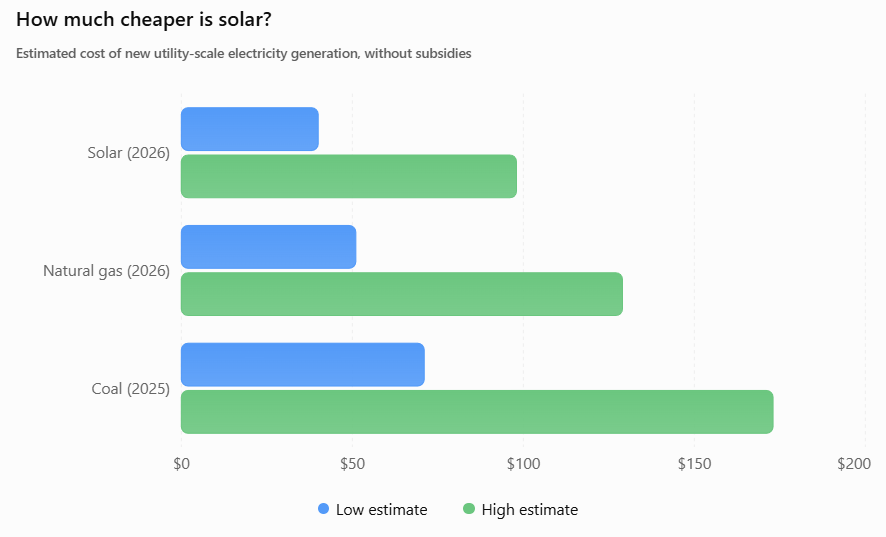
The International Renewable Energy Agency provides an even broader perspective. Its July 2026 report found that the worldwide average cost of newly commissioned utility-scale solar was approximately $44 per megawatt-hour, or 4.4 cents per kilowatt-hour. Onshore wind averaged just 3.3 cents.
|
Energy source |
Cost per megawatt-hour |
Cents per kilowatt-hour |
|---|---|---|
|
Onshore wind (global average) |
$33 |
3.3¢ |
|
Solar (global average) |
$44 |
4.4¢ |
|
Natural gas, combined-cycle (U.S. range) |
$51–$129 |
5.1–12.9¢ |
|
Coal (U.S. range, 2025) |
$71–$173 |
7.1–17.3¢ |
More than 90% of new renewable projects were cheaper than the least expensive new fossil-fuel alternative in their respective markets. Why has solar become so inexpensive? Three developments explain much of the transformation.
Manufacturing scale. China and other countries developed enormous solar manufacturing capacity, reducing the cost per panel.
Better technology. Modern cells convert more sunlight into electricity, requiring less land, wiring, and supporting equipment for the same output.
No fuel expense. Once installed, a solar farm doesn’t need daily deliveries of coal or natural gas. Solar’s greatest weakness remains its intermittency. Electricity production declines with clouds and stops at night. Batteries, transmission lines, flexible demand, and other generators help maintain reliable service.
What about Trump’s coal policy? Coal has genuine advantages: It is storable on-site, and a coal plant can generate electricity at night or during prolonged cloudy weather. But calling it clean ignores its emissions and environmental consequences.
The economics also have shifted against constructing new coal plants. Lazard’s July 2026 report concluded that renewable energy remains the most cost-competitive category of new electricity generation in the United States, even without subsidies.
Tariffs, financing costs, and supply-chain problems have recently increased renewable construction costs.
So, the argument for preserving some existing coal capacity during a transition can be defensible. But, the argument for building a new generation of coal plants because coal is inherently cheaper than solar is much harder to sustain.
There’s a direct connection to the argument that inflation is fundamentally a problem of shortages.
Electricity is an essential input into virtually every part of the economy. Increasing its supply at lower cost potentially reduces production costs across many industries.
And because solar has no fuel expense, greater solar generation also can reduce exposure to volatile fossil-fuel prices.
Government investment in electricity generation, transmission, and storage can increase productive capacity rather than merely increase monetary demand. That does not guarantee that every such investment reduces inflation; timing, construction bottlenecks, and financing matter. But it is a concrete example of how expanding supply can relieve price pressure.
The irony is that a president who emphasizes cheap American energy is promoting coal while treating one of the cheapest sources of new electricity as an adversary.
And sunlight has one additional advantage over coal: Nobody has figured out how to impose a fuel surcharge on the sun.
The U.S. has fallen way behind China in solar production and solar-related patents.
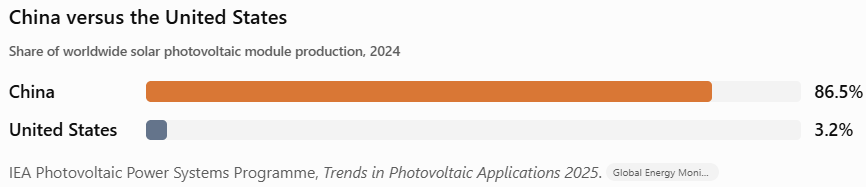
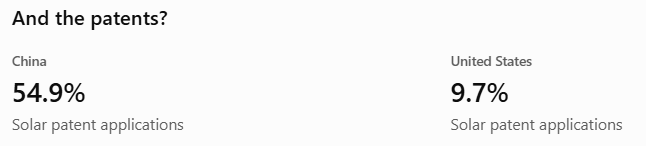
The magnitude of China’s lead is frightening.
China doesn’t merely lead the United States in solar manufacturing; it dominates the global industry. It also leads in the number of solar-related patent applications.
China’s advantage extends beyond finished panels. The International Energy Agency’s 2026 analysis estimates that China controls approximately 85% of solar supply-chain production capacity and 95% of photovoltaic wafer capacity.
And the patents? They show that China accounted for roughly 5.7 times the American share of published solar patent applications. Patent quantity isn’t the same as patent quality, but the disparity is substantial.
WIPO The IEA’s 2026 innovation report also identifies China as the global leader in patenting perovskite solar cells, an important emerging technology.
The strategic irony is that America pioneered much of the science underlying modern photovoltaics. Bell Labs demonstrated the first practical silicon solar cell in 1954. But China subsequently made solar manufacturing a strategic industrial priority, combining research, investment, manufacturing scale, and supply-chain integration.
The United States still has important solar research capabilities and a growing domestic manufacturing sector. But China’s enormous lead can’t be reversed simply by imposing tariffs.
And the market is hardly standing still. In 2025, China installed approximately 415 gigawatts of new solar capacity, compared with 43 gigawatts in the United States—almost ten times as much.
America now must buy Chinese solar panels. Worse, America has surrendered the research, manufacturing expertise, and industrial infrastructure associated with a major energy technology. That is a huge economic and strategic loss.
And we must not forget, there are serious environmental consequences as we poison the air our children breathe and the water they drink.
While China builds the next generation of solar technology, America debates whether coal is beautiful.
Falling far behind China in renewable electricity is just one example of how the Republican Party has been making America “great” again — by cancelling research and development support for renewable energy and supporting dirty, expensive coal fossil fuels.
Perhaps they could burn more “woke” books to keep us warm. And as foreign powers exert ever more control over oil supplies, be sure to fuel your car with Republican coal.
Rodger Malcolm Mitchell

