By Christopher Anstey and Yash Roy, Bloomberg News
The federal budget deficit hit $1.97 trillion for the first 11 months of the fiscal year, one of the highest such figures on record and leaving the debt burden heading within a few years to levels unseen in U.S. history.
Translation: The federal government pumped $1.97 trillion growth dollars into the economy for the first 11 months of the fiscal year.
Anstey and Roy’s first sentence encapsulates much of the misunderstanding about federal deficit spending. It implies that federal deficits have adverse economic outcomes, when exactly the opposite is true. Adding net dollars to the economy helps it grow, and taking net dollars from the economy is recessionary.
Economists call falling tax collections and rising federal payments during recessions “automatic stabilizers.” In other words, we have given a respectable economic name to the inconvenient fact that taking fewer dollars out of the economy and putting more dollars into it helps prevent the economy from shrinking.
The federal “debt” is neither debt nor a burden on anyone. It merely is the total of deposits into Treasury Security Accounts, the purposes of which are:
- Provide a safe investment for unused dollars and
- To help the Fed control interest rates by setting a base rate.
The misnamed “debt” is not borrowing; it does not provide spending money to the federal government. The government actually creates its spending dollars by spending. It works like this:
To pay a creditor, the federal government tells the creditor’s bank to increase the balance in the creditor’s checking account. When the bank does as it is told, that act creates new dollars. This is the primary way the federal government creates dollars, and it can do so without limit.
Spending for fiscal 2026 to date totaled $6.81 trillion, up 3%, while revenues were $4.85 trillion, also 3% higher on an adjusted basis from 2025.
Gross Domestic Product = Federal Spending + Non-federal Spending + Net Exports. Thus, that 3% spending increase helped grow the economy.
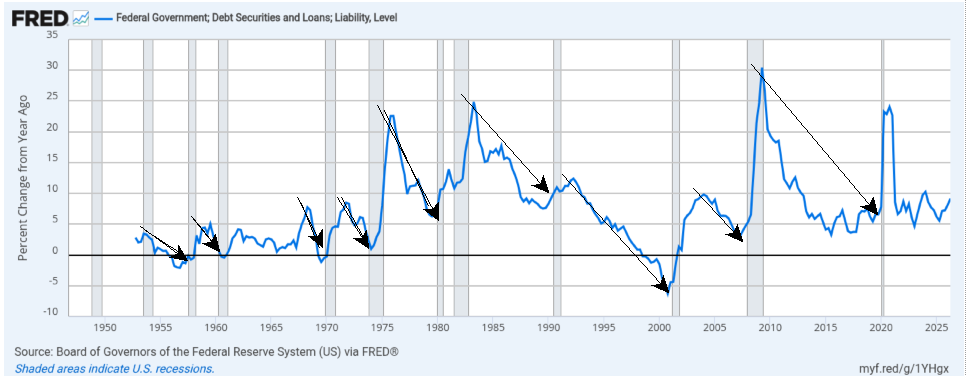
Recessions follow periods of reduced federal deficit growth. During recessions, federal deficits increase both because tax collections fall and because federal payments rise. Both changes leave more net federal dollars in the private sector, helping support spending and economic recovery.
As for inflation, the Fed will increase interest rates, which will raise prices while simultaneously pumping more federal growth dollars into the economy. Ponder that a bit.
Rodger Malcolm Mitchell
 #Monetary Sovereignty - Mitchell