The Fed traditionally raises interest rates to counter inflation. But there are opposing forces at work.
Raising rates makes things more expensive, which by definition is inflationary. But raising rates may inhibit borrowing, which can reduce demand, which can ease scarcity. That’s the hypothesis. What is the stronger effect?
That is one of the central unresolved practical questions in macroeconomics: Higher interest rates simultaneously create inflationary forces and disinflationary forces. The issue is which dominates, under what conditions, and with what time lag.
The inflationary side of rate hikes: Raising rates directly raises costs throughout the economy.
Examples:
Mortgages become more expensive.
Business loans cost more,
Credit-card interest rises,
Auto loans rise,
Landlords face higher financing costs,
Companies pass borrowing costs into prices when possible.
Government interest payments rise.
Interest payments turn into income for households, banks, and bondholders, all of which boost demand—or in “Fed speak,” heat up the economy.
In the 1970s, the U.S. saw sluggish growth, rising unemployment, and high inflation all at once. This surprised economists, as postwar models assumed inflation and unemployment moved in opposite directions.
Instead, both rose together, driven by factors like oil shocks, energy shortages, supply disruptions, geopolitical tensions, and wage-price spirals.
The Fed responded with very high interest rates under Paul Volcker, but this caused severe recession and unemployment that negatively affected the 95% lower wealth group while growing the fortunes of the 5% greater wealth people.
By contrast, from roughly the 1990s through pre-COVID years, the U.S. experienced a long economic expansion with relatively low unemployment, combined with low and stable inflation, technological productivity gains, globalization, cheap imports, and strong supply growth.
That period contradicted the simplistic idea that low unemployment produces inflation. In fact, central banks repeatedly underestimated how low unemployment could go without inflation accelerating.
Higher rates therefore increase certain prices mechanically. Numbers 1-6 (ab0ve) reduce GDP, i.e., are recessive. Number 7 increases GDP, therefore, is expansive. Note however that recession is not the opposite of inflation, nor is expansion equal to inflation. We can have inflation together with recession (“stagflation”)
In short, the Fed views inflation as a “too-much-money” problem and so, tries to cure inflation by recessing the economy. The strange idea is that if you make the vast majority of the people poorer, they will buy less food and oil (the main drivers of inflation), while high interest rates make wealthy bond owners richer.
Which effect is stronger? Historically, the answer appears to be that interest rate increases are mostly inflationary, especially for housing, financing costs, and business costs, and do nothing to increase the supply of energy and food.
Inflation is driven mainly by oil shocks, supply-chain breakdowns, war, food shortages, housing shortages, pandemic disruptions. In those cases, raising rates does not produce more oil, more food, more chips, more housing, or more shipping capacity.
It may even worsen supply by discouraging investment.
For example, post-pandemic inflation involved major supply disruptions, energy shocks, and logistics problems. Rate hikes could not solve those. That is why Biden successfully fought inflation by passing legislation that would increase the supply of energy (especially renewable), as well as supply chain, infrastructure, and other shortages.
Fossil-fuel shocks repeatedly drive inflation, so reducing dependence on volatile oil and gas markets could reduce future inflation vulnerability.
(Trump has increased, decreased, increased, decreased, and increased tariffs as his whimsical approach to economic planning and inflation.)
1. If energy shortages repeatedly precede major inflation episodes, why do we raise interest rates to reduce demand, rather than trying to expand the energy supply?
2. Why has Trump reduced support for renewables like solar, wind, geothermal, and water, and instead focused on coal and oil that pollute our air and water, and will become increasingly expensive as sources dwindle?
3. What are the economic effects of reducing demand (“cooling” the economy)?
Answers:
If your only tool is a hammer, every problem looks like a nail to be hammered. The Fed’s primary tool is interest rates, so every supply problem asks for a demand solution.
trump’s main considerations are his family’s fortune, votes, and self-aggrandizement. He receives more money from oil interests than from solar interests.
Reducing the demand for oil, housing, food (food??), cars, infrastructure, R&D, etc., by definition, is recessive, both short term and long term. Economic growth requires increased spending. (GDP=Total Spending + Net Exports).
In economics, one key context is Monetary Sovereignty, The U.S. government is Monetarily Sovereign. It controls the dollar, can create unlimited amounts with a keystroke, and can set its value against anything else.
Over the years, the government repeatedly and arbitrarily has changed the dollar’s official value compared to gold and silver.
Along those lines, many words and phrases you hear every day might not mean what you—or even the speaker—think they do. Here are a few:
I. Federal government DEBT (sometimes confusingly called the “national” debt). Ask any politician, and they will tell you, “The U.S. federal debt is the total amount the federal government owes or has borrowed and not yet repaid.”
This is not correct. The U.S. government, being the issuer of the dollar, never borrows dollars. It creates dollars by spending them.
The federal government pays for things by instructing banks, via check or wires, to increase the balance in a checking account. When a bank obeys those instructions, new dollars are created.
Federal debt is the total of outstanding Treasury bills, notes and bonds. They represent deposits — not loans — into Treasury accounts, similar to bank savings accounts.
These T-securities do not provide the federal government with dollars, but rather:
Provide a safe place to store unused dollars and
To help the fed control interest rates by creating a “base” interest rate.
Treasury securities do not represent borrowing by the federal government. Federal “debt” is not a financial burden on the government.
If the federal government wished, it could pay off the entire federal “debt” today simply by returning the dollars held in the T-bill, T-note, and T-bond accounts.
II. A Federal DEFICIT is the difference between tax collections and spending. Because the federal government has the infinite ability to create dollars (by instructing banks to increase balances), federal deficits do not burden the federal government.
In fact, federal deficits benefit America by adding growth dollars to the economy. Gross Domestic Product (GDP) = Federal Spending + Nonfederal Spending + Net Exports.
When the government fails to run sufficient deficits, the economy goes into recessions or depressions, which are cured by increased deficit spending.
A federal deficit is an economic surplus.
III. A Treasury BILL (T-bill) is about the same as a dollar BILL Both are backed by the full faith and credit of the U.S. government. There are just two key differences:
The T-bill has a maturity date; the dollar bill doesn’t.
The T-bill pays interest; the dollar bill doesn’t.
Issuing trillions of dollars in T-bills is no more a financial burden than issuing trillions of dollars in dollar bills, i.e. none at all. Worries about the size of the federal DEBT are the same as worrying about the number of dollars in existence.
Strangely, you hear that the people own two many T-securities, but never that the people own too many dollars.
IV. Treasury NOTE and Treasury BOND (T-note, T-bond). In the private sector (which includes businesses and state and local governments) the words “note” and “bond” denote borrowing.
The federal government does not borrow, and the words “note” and “bond” merely describe longer term versions of T-bills. T-notes and T-bonds. Like T-bills, they do not provide the federal government with dollars and are not a financial burden on the federal government.
The current federal DEBT, which is composed of T-BILLS, T-NOTES, and T-BONDS, totals nearly $35 trillion dollars, today, yet it is no greater a risk or burden than it was in 1940, when the federal “DEBT” totaled only about $40 billion dollars.
Every time you hear or read concerns about the size of the federal DEBT, understand this: The source of those concerns either is ignorant about federal finances, or is trying to deceive. There are no other alternatives.
V. TAXPAYER DOLLARS State and local governments spend taxpayer dollars. The federal government does not spend taxpayer dollars.
That is one fundamental difference between a Monetarily Sovereign government (the U.S., Canada, Australia, Japan, the UK and others) vs. a monetarily non-sovereign entity (state/local governments, euro-using governments, businesses, and individuals).
A monetarily non sovereign government can run short of the money it uses. A Monetarily Sovereign government cannot run short. For example, France, Germany, and Spain can run short or euros. The European Union, which is Monetarily Sovereign, cannot run short of euros, and the U.S. cannot run short of dollars.
Keep these facts in mind as you read the following:
VI. The DEBT/GDP ratio. Here is what you falsely are being told by those who are ignorant or lying about federal finances:
“The debt-to-GDP ratio shows a country’s total public debt as a percentage of GDP. The ratio gives an indication of how manageable a country’s debt is given its economic output. A high debt-to-GDP ratio can have several economic consequences:
Crowding out private investment: Government borrowing competes with private sector capital, potentially slowing economic growth Hoover Institution.
Rising interest costs: More taxpayer dollars are allocated to servicing debt rather than public investment thepolicycircle.org.
Fiscal sustainability concerns: Economists warn that ratios above 90–100% in advanced economies may reduce growth and increase default risk if not managed us-debt-clock.com+1.
Policy challenges: Reducing the ratio would require significant deficit reduction, either through spending cuts or revenue increases, potentially over multiple decades.
The above comments are false, and worse than being false, they are misleading to the average person. There is zero relationship between a Monetarily Sovereign government’s ability to “manage” debt, i.e. pay creditors.
Federal “debt” does not “crowd out” anything. The government does not borrow, and it’s deficit spending (which is how “debt” increases) actually adds growth dollars to the economy.
Rising interest costs do not use taxpayer dollars and do not service federal debt. New dollars are created to pay interest, and these new dollars increase economic growth.
The Debt/GDP ratio has no meaning or predictive value for a Monetarily Sovereign government. Whether the ratio is 10%, 100%, or 1000% is meaningless with regards to default risk, economic growth, or any other economic measure.
Reducing the ratio is unnecessary, unwise, and does not require spending cuts. If the federal government chose, it could reduce the ratio to 0%, merely by not issuing any more T-securities. It could do that simultaneously with increased spending.
The following statement also is false and misleading:
This occurs as tax revenues typically increase in line with economic activity. If debt rises faster than GDP, the interest on those debts will consume more tax revenue, leaving less for other spending. Ultimately, this will act as a drag on GDP growth, and eventually, the government may not repay the debt.
The author of the above statement either is ignorant about federal financing or is purposely trying to deceive. There are no alternatives. Federal tax revenue does not pay for interest or for anything else. The purpose of federal taxes is to:
1. Control the economy by taxing what the government wishes to restrict and and by giveing tax breaks to what the government wishes to reward.
2. Assure demand for the U.S. dollar by requiring dollars to be used to pay taxes.
Federal taxes do not fund federal spending; state/local taxes do fund state/local spending. Federal spending is funded by money creation.
If you understand that simple concept, you understand more than most people, including many economists.
VII. Trade deficit A trade “deficit” means a nation’s imports are greater than its exports, based on the currency it uses.
Contrary to popular belief, a trade deficit can be good or bad depending on context.
You run a trade deficit with every retailer you buy from—the grocery store, butcher, cleaner, movie theater, and so on—because you purchase more from them than they do from you. Is that bad?
Not at all; you simply exchange the dollars you’ve earned for goods and services. America’s trade deficits come from giving dollars—created with a few keystrokes—in return for valuable goods and services.
All Monetarily Sovereign governments should run ongoing trade deficits, the bigger the better.With just a few federal computer keys pressed, we receive food, clothing, cars, energy, and countless other goods and services.
Why would any informed American want to change that? The negative connotations of the word “deficit” confuse those who don’t understand Monetary Sovereignty.
VIII. Trust fund We often are told that the Social Security and Medicare “trust funds” are running low on dollars, so taxes will have to be raised or benefits reduced. This is not true.
Federal “trust funds” are quite different from their private-sector counterparts, making the name misleading.
While “trust fund” suggests a secure source of funding, in the federal context it’s really just an accounting tool that tracks money coming in and going out for certain programs.
In private-sector trust funds, receipts are deposited and managed by trustees who invest the assets for the benefit of specified recipients. With federal trust funds, the government doesn’t set aside the money or invest it in private assets. Instead, it records receipts as credits in the fund and pools them with other Treasury collections to be spent.
The federal government controls these accounts and can change their purposes, adjust collections, and modify spending through legislation.
It has complete authority over the balances and can determine the funds’ solvency whenever it chooses. Social Security and Medicare “trust funds” are fully under federal control, regardless of FICA tax contributions. Even without collecting any FICA taxes, Congress could ensure their solvency simply by passing a law.
Note that no “trust funds” back the finances of the White House, Congress, the Supreme Court, the military branches, or countless other federal agencies, yet we don’t hear talk of the White House and others becoming “insolvent.”
Although “trust funds” were originally designed to ensure solvency, they actually undermine it by promoting the false notion that taxes need to be raised or benefits cut.
IX. Tariffs. Most Americans do not realize that tariffs, both import and export, are taxes on importers, i.e. sales taxes on consumers.
In America, tariffs are shared between sellers and consumers, adding to the overall cost of sales. Whether for exports or imports, tariffs turn governments into unnecessary middlemen in transactions.
In an untariffed sale, the buyer pays the full selling price to the seller, who then uses it for expenses and profit. In a tariffed sale, a portion of the selling price goes to the government. In both cases, the buyer ends up paying more while the seller takes home less, and dollars are removed from the private sector.
The private economy sacrifices money to the Monetarily Sovereign government, which has the infinite ability to create money. Visualize pouring your drinking water into the Pacific Ocean. That is the effect of tariffs.
Repeated transactions can remove massive amounts of money from the private sector, while causing prices to increase.
Fortunately, President Trump’s lack of economic understanding is matched by his ineptitude. His steep tariffs drive up prices, leading to inflation, which doesn’t “revive American manufacturing.”
Taking money from the private sector also is recessionary, leading to stagflation. Trump aims to adopt a protectionist stance toward U.S. business, but the goal should be to supportindustry rather than to punish consumers.
Industries can be supported through:
tax breaks for specific sectors
direct federal payments to selected industries, or
funding purchases from them.
Trump has taken the opposite approach, leaving those unfamiliar with federal finance confused by his false claims.
IN SUMMARY
Terms like “debt,” “deficit,” “surplus,” “borrow,” “owe,” “taxpayer’s money,” “pay for,” “bills, notes, and bonds,” and “trust funds” can have different meanings depending on the situation. Their interpretation shifts based on whether they refer to a Monetarily Sovereign federal government or a monetarily non-sovereign entity like you and me.
So, just as the term “feeling blue,” has a different meaning depending on context, so does federal “debt.” It doesn’t mean the federal government is “in debt” or becoming insolvent.
Just remember, federal taxes do not fund federal spending; state/local taxes do fund state/local spending. Federal spending is funded by money creation.
Fundamentally, Trump’s power is derived from hatred — hatred of all those who are not white, Christian, males, who worship Trump no matter what he does.
And hatred always is derived from fear. You cannot hate someone without some level of fear.
So, Trump is a fear-monger, and the people who follow him best are the people who fear most what he fears most.
It is his paranoia, his fears, his weaknesses, ignorance, his lack of human compassion that makes him evil.
The irony is that his followers fear being “taken over” by the blacks, browns, yellows, reds, gays, liberals, non-Christians, the poor, women, immigrants and “deep state,” and instead have voluntarily given themselves over to a madman.
Talk about leaping from the frying pan into the fire.
I’m sorry for the length of this, but it’s too important for editing. Dean Blundell is a terrific writer and he wrote a magnificent article. I don’t want to mess it up.
Note the headline:
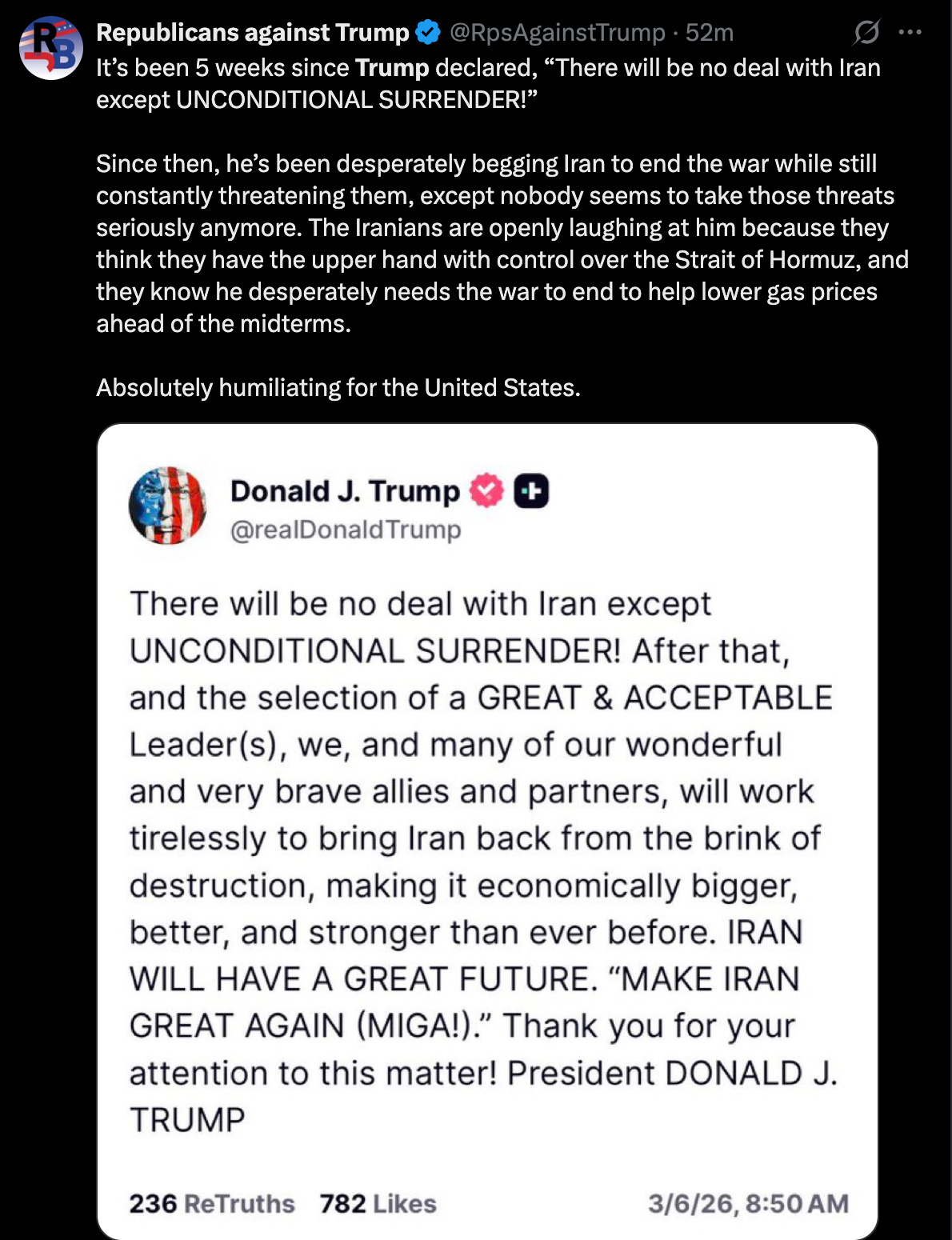
Trump Has Officially Lost The War In Iran And The Great Energy Collapse Of 2026 Is Coming.
The article will tell you how a damn fool President, his damn fool assistants, and a damn fool Republican Party managed to inherit the most powerful military the world had ever known — and destroy it.
First, they fired the generals. To win a war, you cut off the enemy’s head. Mission accomplished Trump and his flunkies started with that when Trump claimed that he knew more than the generals. (Definition: “These experienced, educated warriors won’t obey me, just because I am in inexperienced, uneducated, semi-literate draft dodger.”)
Then, the damn fools failed to make the most rudimentary plans, by not allowing for the obvious fact that Iran would block the Strait of Hormuz. How the hell could they not have planned for that?
Then, the damn fools expended massive amounts of ordnance because they believed the mullahs would simply throw up their hands and surrender. So, at this moment, America’s military is weaker than it has been in decades, and more decades will pass before it comes back to strength.
Meanwhile, the damn fool Republican Party, like the useless sheep they are, went along with the egomaniacal psychopath, and failed to do precisely what they were elected to do: Be a check on an arrogant, greedy, dishonest, incompetent womanizing, pedophile, but simply rubber stamped his every crooked notion.
And let us not ignore the Republican branch of the Supreme Court that, a couple centuries after we fought to free ourselves from a king , invented an extreme version of the “unitary executive theory” giving Trump nearly royal powers. And boy did he grab them. With both hands. His mantra: “Show me the money,”
And if you think all this is harsh or unwarranted, read Dean Blundell’s article, remember it when you phone your Congress person, and keep remembering it in November when you vote.
Bob Kagan just declared “checkmate” on America in Iran while the US prepares to fall off an energy cliff in the next two weeks. You should probably buy an EV soon. by Dean Blundell
May 11, 2026
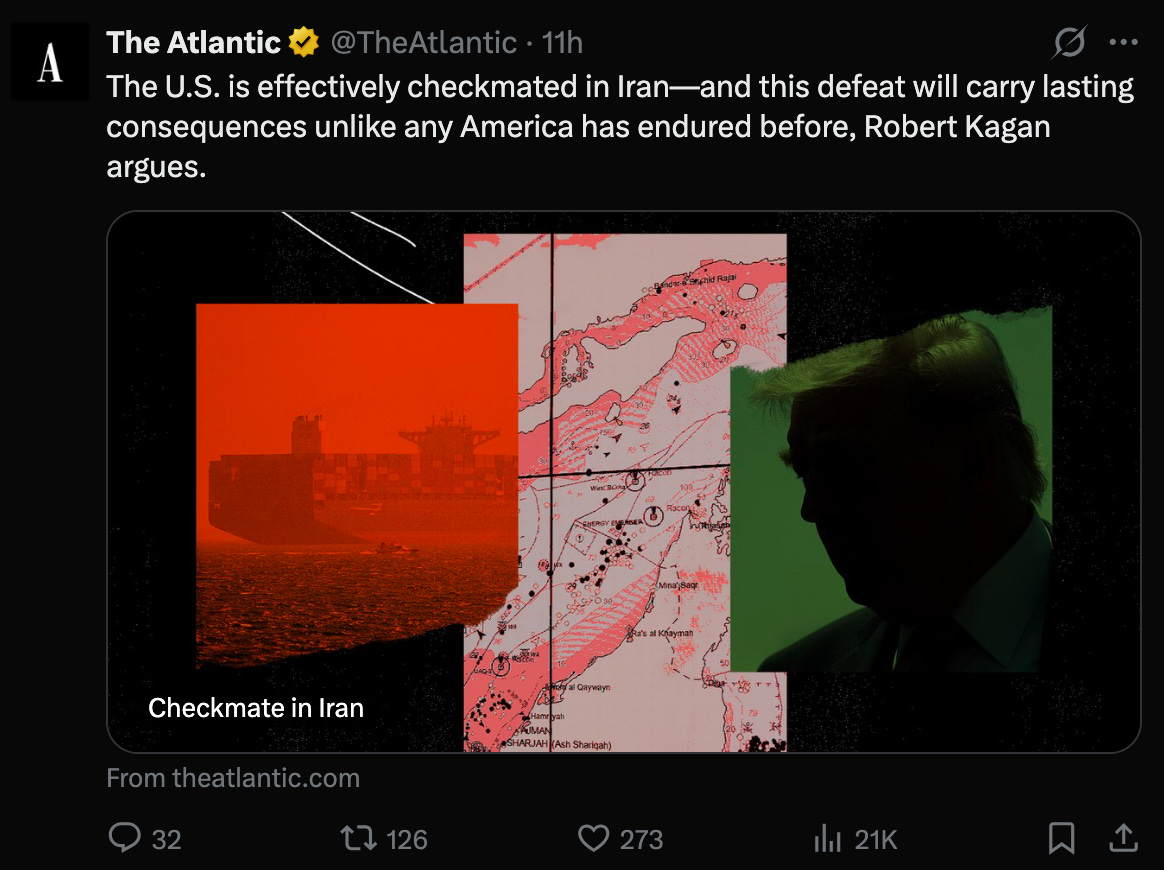
On Saturday, Robert Kagan — yes, that Robert Kagan, co-founder of the Project for the New American Century, husband of Victoria Nuland, brother of Frederick Kagan, in-house philosopher of every American war of the last thirty years — published a piece in The Atlantic titled “Checkmate in Iran.” In it, he writes that the United States has suffered “a total defeat in a conflict, a setback so decisive that the strategic loss could be neither repaired nor ignored.”
This is the man who was Dick Cheney’s strategic-affirmation hotline. This is the magazine that has functionally never met a U.S. military intervention it couldn’t dress up in tweed. And what they are telling you, in language they would have called “defeatist” and “unpatriotic” in any other decade, is that America just lost — not a battle, not a campaign, but its position in the world.
When Ronald McDonald tells you the burgers are bad, the burgers are very, very bad.
And here’s the part that should make every American sit down on the kitchen floor: while Kagan was filing his postmortem from the strategic comfort of The Atlantic‘s opinion section, the actual world — the one with gas pumps and grocery stores and refineries and freight rates — was already living inside the consequences.
Sri Lanka is rationing fuel by QR code. Pakistan is on a four-day work week. India has six to ten days of strategic reserve left. South Korea is on odd-even driving. Japan is into its second emergency reserve release of the year.
And in the United States, the country whose Defense (now “War”) Secretary went on television in February and told the cameras Iran would “capitulate or be obliterated,” gas is heading north, and the strategic petroleum reserve is being drained into the largest coordinated IEA release in history.
This is what a war of choice looks like when the choice was made by frauds happy to burn down their own country to move markets and stroke their fragile egos.
Let’s walk through it.
I. The war Trump told you would take a weekend
Cast your mind back — and it doesn’t have to go far, because it’s been barely seventy days — to February 28, 2026. That was the night the Trump administration, in concert with Israel, launched Operation Epic Fury: a coordinated air and maritime campaign that, in the span of seventy-two hours, killed the Supreme Leader of Iran, destroyed the Iranian Navy, flattened large parts of Iran’s defense industrial base, and assassinated a generation of Iranian military leadership.
Trump, on Truth Social, declared “Peace Through Strength” before the dust had settled on the first rubble piles. Pete Hegseth — the Secretary of War, as he insists on being called now, because the man cannot get through a press conference without LARPing — went to a Pentagon lectern and announced, with his usual cocktail of bravado and analytical depth (none), that Iran had “no defence industry, no ability to replenish.”
He left out one detail. Iran didn’t need a defence industry to do what it did next. It needed a map.
On March 4, six days into the war Hegseth said was already won, the Islamic Revolutionary Guard Corps announced that the Strait of Hormuz was closed. Not “contested.” Not “restricted.” Closed. “Not a litre of oil,” in their phrasing, would pass without Tehran’s permission.
Any ship attempting transit “linked to the United States and Israel or their allies” would be treated as “a legitimate target.” Within forty-eight hours, war-risk insurance premiums had quintupled. Within seventy-two hours, the AIS transponders on the world’s largest tankers had gone dark and the strait — which on a normal day moves roughly twenty percent of the world’s seaborne oil and a comparable share of its LNG — had effectively gone silent.
The Joint Chiefs, to their credit, had warned Trump this would happen.According to multiple reports, the briefings before Epic Fury included explicit warnings that Iran’s likely response was to close the strait.
Trump’s recorded reaction was, more or less, that Iran would “capitulate” and that if they didn’t, “we’ll just open it back up.”
We have not opened it back up. We cannot open it back up. That sentence is the entire story.
II. What Kagan actually admitted (and what he still can’t say)
Kagan’s piece is remarkable not for what it predicts but for what it concedes. Strip out the strategic-class voice and the Atlantic-house cadence, and what you have is a confession. Let me lay out his admissions in plain English:
One. This isn’t Vietnam. This isn’t Afghanistan. Those, in his words, “did not do lasting damage to America’s overall position in the world.” This one, he says flatly, is “of an entirely different character. It can neither be repaired nor ignored.”
Two. Iran is not going to give Hormuz back. Not “won’t this year.” Not “won’t unless we negotiate harder.” Won’t, full stop. As Kagan puts it: Iran will now “be able not only to demand tolls for passage, but to limit transit to those nations with which it has good relations.”
The freedom-of-navigation regime that has structured global oil since the Carter Doctrine — the entire premise on which the United States justified its Persian Gulf basing posture for forty years — is over. There is a permission regime now, and the permission comes from Tehran.
Three. The Gulf monarchies have to accommodate Iran. Kagan: “the United States will have proved itself a paper tiger, forcing the Gulf and other Arab states to accommodate Iran.” Translation: every Saudi and Emirati prince who watched the U.S. fail to defend their refineries and shipping lanes is, right now, on the phone with Tehran working out their new arrangement.
Which is to say: the security architecture the United States spent half a century building in the Gulf is liquidating itself in real time.
Four. The U.S. Navy cannot reopen the strait. This is the one I want you to dwell on for a second, because it is the single most explosive admission in the piece. Kagan: “If the United States with its mighty Navy can’t or won’t open the strait, no coalition of forces with just a fraction of the Americans’ capability will be able to, either.” The defense secretary of Germany, Boris Pistorius, said almost the same thing more bluntly: What does Trump expect a handful of European frigates to do that the powerful U.S. Navy cannot?
Read that as the obituary it is. The U.S. asked its allies to clean up its mess and the allies looked back and said, with what?
Five. America’s weapons stocks are gone. “Just a few weeks of war with a second-rank power,” Kagan writes — and savor the words second-rank power coming from the patron saint of regime change — “have reduced American weapons stocks to perilously low levels, with no quick remedy in sight.”
If you are sitting in Taipei, or Seoul, or Warsaw, reading this paragraph in The Atlantic this weekend, you are not feeling more secure. You are feeling considerably less.
Six. Allied credibility, gone. American security guarantees, falsified. China and Russia, vindicated. Kagan barely says this part — he can’t, not quite, not in The Atlantic — but it sits in his sentences like a body under floorboards.
What he cannot say, of course, is how we got here. Because he got us here. He, his wife, his brother, every co-signatory of every PNAC letter from 1997 onward, every think-tank fellow who spent the last quarter-century turning Iran into the indispensable enemy. There is not a syllable of introspection in his piece, not a flicker of “perhaps thirty years of maximum pressure forged the adversary that just checkmated us.” The smoke is everywhere, and the arsonist is bewildered by the smell.
And what does he propose? You will laugh. You will laugh, and then you will not laugh.
A bigger war. Specifically: “engage in a full-scale ground and naval war to remove the current Iranian regime, and then to occupy Iran.” A man who has just written 4,000 words explaining that the U.S. Navy cannot reopen a twenty-one-mile-wide waterway against a power he calls second-rank, concludes that the answer is to invade and occupy a country of 90 million people sitting on the most defensible mountain terrain in Western Asia.
The arsonist’s solution to the fire is a bigger fire.
III. Meanwhile, in the real world: the global oil crisis, country by country
Strategic analysis is one thing. The strategic analyst can write his piece, walk to the corner café in Washington, order a flat white, and not have to think about where the diesel came from that powered the truck that delivered the milk. But the rest of the planet is currently doing exactly that math, and the math is ugly.
Here is the world, as of this morning:
Sri Lanka is on full nationwide fuel rationing. QR codes are issued per vehicle. Schools and universities are on conservation schedules. This is not a forecast. This is now.
Pakistan has implemented a four-day work week for both the public and private sectors. Markets are closing early. Remote work is being pushed at scale to reduce commuting demand.
India has somewhere between six and ten days of Strategic Petroleum Reserve left. Total stocks across the system are around sixty days, but panic buying is climbing exponentially, and the government is scrambling for emergency imports from anywhere it can find barrels, which increasingly means Russia, which is increasingly happy to oblige.
South Korea is on mandatory odd-even driving for the public sector, voluntary for everyone else, with price-cap incentives. The country has imposed a five-month export ban on naphtha.
Japan is into its second major release from emergency strategic reserves this year. The first one ran in March. They are now drawing down what they had told the IEA was a 230-day cushion.
The United Kingdom is in price-shock mode. Targeted aid packages have been rolled out for heating-oil users. Windfall tax legislation is back on the table. Anti-gouging enforcement is active.
Germany has extended petrol and diesel tax cuts and is rolling out employer-funded fuel bonuses.
France has launched targeted fuel discounts and accelerated energy-voucher distribution to high-mileage drivers, transport workers, fishermen, and the agricultural sector.
South Africa has slashed the fuel levy. Queues at stations continue.
Turkey has cut its special consumption tax on fuel.
Brazil has scrapped diesel taxes and is subsidizing producers and importers directly.
Australia has halved excise duty, launched a national “Every Little Bit Helps” conservation campaign, and is offering business-support loans for fuel-affected sectors.
The United States is participating in the largest coordinated strategic release in IEA history — 400 million barrels — alongside state-level gas-tax relief that the administration is now openly considering extending nationally.
China, the world’s largest crude importer, is doing what China always does in a crisis: pulling up the drawbridge. Massive domestic reserves are being held back, refined-oil exports are banned, and domestic price controls are clamped on. Beijing has been quietly buying every spot cargo it can find from Russia and Venezuela at a discount, because of course they have.
And that’s with a partial IEA-coordinated drawdown of historic scale running in parallel. Now read the next part carefully, because this is where it stops being a chart and starts being your life.
A leading oil-and-gas analyst — Eric Nuttall at Ninepoint Partners, talking to Bloomberg — said over the weekend, and I quote the framing as I encountered it: “We’re not talking months or quarters. In the next couple of weeks, you will have to rationalize demand by more than during COVID.” His characterization, not mine: this is potentially “the largest energy crisis in modern history,” and the rationing — demand rationing, the kind we have not seen in the United States since 1973 — is “weeks away.”
Weeks. Not months. Not the abstract medium term. Weeks.
You should be looking at your driveway differently right now.
IV. Why this isn’t going to “just resolve.”
I want to take a moment here because the temptation among American readers will be to assume this is a temporary disturbance. That some combination of (a) Iran “blinking,” (b) Trump finding a face-saving deal, (c) Saudi Arabia opening the taps, or (d) the U.S. Navy “doing something” will end this in the next news cycle.
It will not. Here is why.
Iran has no incentive to relinquish Hormuz. None. Zero. The Strait is now their single most valuable strategic asset — far more valuable than the nuclear program they nominally fought the war over, far more valuable than any of the proxies they’ve used as leverage in the past.
Iran’s parliament speaker, Ghalibaf, has already said publicly that “the Strait of Hormuz situation won’t return to its pre-war status.” That’s not bravado. That’s policy.
Iran has spent forty years being told it has no leverage; it now has the single most important piece of leverage in the global economy. The next regime — and there will be one; the air war killed enough of the old leadership to guarantee turnover — will inherit that leverage and use it. To imagine they’d simply hand it back is to misunderstand what just happened.
The Gulf monarchies can no longer defy Iran. The Saudi refinery network, the Emirati ports, the Qatari LNG terminals — every one of them sits within easy range of Iranian missiles, drones, and proxies, and every one of them just watched the United States fail to defend Israel’s most strategic sites, fail to protect U.S. bases in the UAE and Bahrain, and fail to reopen a strait that is the lifeline of their entire economy.
The security guarantee was empirically falsified. Riyadh and Abu Dhabi are not going to stake their national survival on a guarantor that just demonstrated it cannot guarantee. They’re going to cut deals. They are already cutting deals.
The U.S. military physically cannot reopen the strait. This is the part that should be making people slam their fists on the table. The U.S. Navy is, in absolute terms, the most powerful naval force in human history. And it just spent thirty-eight days of “major combat operations” against a power Kagan himself describes as “second-rank” — and it depleted its weapons stocks to “perilously low levels” doing it.
“Project Freedom,” the Navy’s new and increasingly euphemistic operation to escort commercial ships through Hormuz one at a time, has gotten two ships through in a week. Two. The pre-war average was 130 per day.
When Rubio described Project Freedom on Tuesday, he called it a “first step” toward establishing a “protective bubble.” A bubble. They are protecting a bubble in a strait that used to be a highway.
And no coalition is coming. Boris Pistorius said it plainly. The British and French ministries are saying it less plainly but no less clearly. The South Koreans, asked by Trump on Truth Social to “join the mission,” responded with a polite “we’ll review the proposal,” which, in diplomatic English, means “we will not be joining the mission.”
The Japanese are too busy draining their own reserves to staff a naval deployment to the strait. India is buying Russian oil. China, the country with the largest stake in Hormuz traffic by a wide margin, is conspicuously absent — and conspicuously uninterested in cleaning up an American mess that Beijing did not make and is, frankly, enjoying.
The U.S. asked the world for help. The world looked at the situation, did the math, and discovered the deeply uncomfortable fact that the United States, for the first time in eighty years, is not actually capable of underwriting global energy security. Which means the world is, right now, restructuring itself around that fact.
This is not a news cycle. This is a regime change. It just isn’t the regime change Trump and Hegseth had in mind.
V. Trump and Hegseth: the fraud is the policy
Let’s be precise about what we’re indicting here, because it matters.
This is not an unforeseeable disaster. This is not a black swan. Every single thing that has happened was specifically forecast by the Joint Chiefs in the pre-war briefings, by the analysts at every major think tank that wasn’t run by a Kagan, by veterans of every previous U.S. engagement in the Gulf, by Iran itself in public statements going back twenty years.
The Strait of Hormuz scenario was so well-modelled that it has its own Wikipedia category. The administration did it anyway.
Why? Because Trump needed a win. Because Hegseth needed to look like a defense secretary. Because the political logic of the Trump second term — domestic chaos at home, declining poll numbers, a base growing restive — required a foreign adventure with a clear villain and a quick, telegenic resolution.
The Bush years called it a “splendid little war.” Hegseth, at the lectern, called Operation Midnight Hammer (the precursor strikes in 2025) “the most complex and secretive military operation in history,” a claim so historically illiterate it should have ended his tenure on the spot.
It didn’t. He’s still there. He’s still calling himself Secretary of War. He is still going to Pentagon lecterns and announcing that ceasefires aren’t broken when missiles are flying, that operations aren’t offensive when ships are burning, that Iran has been “obliterated” when the price of diesel just hit $7.40 a gallon in Los Angeles.
The man is a cable-news personality wearing a Pentagon suit. The job he holds requires the most rigorous strategic and logistical mind in the U.S. government. He has neither.
And the consequences of that mismatch are now being absorbed, in real time, by every working person on this planet who drives to work, takes a bus to school, runs a small business that requires deliveries, eats food that was grown with nitrogen fertilizer, or lives in a country whose economy runs on imported diesel.
Which is, give or take, all of us.
This war was illegal. There was no congressional authorization for hostilities of this scale. There was no UN authorization. There was no credible imminent threat. There was a President who wanted a war, a defense secretary who wanted a press conference, and a national security apparatus that — exactly as Kagan and his cohort spent thirty years training it to do — said yes.
And the people who said yes are now writing 4,000-word essays in The Atlantic about how surprising it all is.
VI. What you should do this week
I don’t normally write practical sections. This is not normally that kind of newsletter. But Nuttall said “weeks,” and Sri Lanka and Pakistan and South Korea are not waiting, and the IEA reserve drawdown is not infinite, and I think the people who read me deserve plain talk about plain things.
So:
If you have been considering an EV, the math just changed. I’m not telling you what to do with your savings. I’m telling you that the marginal cost of every additional week of internal-combustion ownership is now meaningfully higher than it was last month, and the marginal benefit of electrification — the ability to keep moving when the gas station has a line around the block, or has run dry, or is rationing fills — has gone up correspondingly. If your charging situation allows it, this is the moment the calculus tipped.
If you can stockpile food staples that depend on diesel-intensive distribution, do it now. Not panic-buying. Just sensible household reserves. The fertilizer supply shock — recall that the Persian Gulf accounts for 30-35% of global urea exports and a comparable share of ammonia — will hit grain prices on a six-to-nine-month lag, but it will hit. Beans, rice, oats, frozen proteins. Standard preparedness, not bunker prep.
If your job depends on supply chains that move physical goods, have the conversation with your employer this week about contingency planning. Air freight in particular is going to keep escalating — jet fuel is up 95% from pre-war levels in North America, and there is no near-term relief vector.
If you’re an American, call your congressional representatives about the War Powers Resolution. There is no congressional authorization for what is happening in the Persian Gulf right now.There has never been one.
Project Freedom is being run on the legal fumes of an Epic Fury authorization that Rubio himself said is over. The legal architecture under all of this is, in technical terms, vapour.
If you’re a journalist or analyst: read the Kagan piece. Read it twice. Note what is missing — the morality, the introspection, the human cost, the named dead. Note also what is present — the strategic admission that the neoconservative project is finished. It is a document of historical importance, and it deserves to be read both as a confession and as a warning.
If you’re outside the United States: you’ve already done your math. You’re rationing. You’re stockpiling. You’re hedging. You don’t need my advice. You do, perhaps, need to know that there are Americans paying attention. Not enough of us. But some.
VII. The smoke
I want to close with the line that has been rattling around my head since I read Kagan on Saturday, because I think it captures the whole thing.
The arsonist smells the smoke.
For thirty years, a particular set of people in Washington — Kagan, Nuland, Frederick Kagan, every signatory on every PNAC letter, every fellow at every think tank with “American” or “Defence” or “Security” in its name — argued that the United States had to dominate the Middle East militarily.
That regime change in Iraq would democratize the region. That maximum pressure on Iran would either topple the regime or render it harmless. That the U.S. could indefinitely underwrite the security of the Gulf monarchies. That American weapons, American intelligence, American naval power, and American resolve were sufficient to keep the global energy system humming on American terms forever.
Every one of those propositions has now been empirically falsified. In real time. In a span of seventy days. By a war that was supposed to be the culmination of the project and turned out instead to be its obituary.
And the man who is, in many ways, the chief architect of the worldview that produced this disaster has just sat down in the pages of The Atlantic and written, in so many words, we lost.
He still cannot bring himself to say we caused it. He still cannot bring himself to mention the dead — the 165 schoolgirls killed in a single strike, the thousands of Iranian civilians under the bombs, the workers on the burning tankers, the port crews in Bahrain, the bus passengers in Tel Aviv, the soldiers from a dozen countries.
None of them appear in his piece. For him, this is a strategic chess problem on which the pieces happen to be people.
But the strategic chess problem is the moral problem. They’re not separate. A war waged by frauds, sold by frauds, run by frauds, and lost by frauds is a moral catastrophe before it is a strategic one— and the strategic catastrophe follows directly from the moral one, because the same incapacity to think clearly that produced the lies also produced the operational blunders, and the same hubris that ignored the warnings about Hormuz also ignored the warnings about the human cost.
Trump is going to spend the next six months trying to spin a defeat. Hegseth is going to spend the next six months giving press conferences in which the word “obliterated” appears more often than the word “actually.” The cable networks will oscillate between manufactured outrage and manufactured optimism. The reserve will keep draining. The lines at the pump will get longer. The shipping rates will climb. The fertilizer numbers will work their way into the price of bread.
And somewhere in Washington, Bob Kagan is having a glass of wine and feeling, perhaps for the first time in his adult life, a flicker of something that resembles fear. Not for the schoolgirls. Not for the truck drivers in Karachi. Not for the families in Sri Lanka issuing their QR codes. For the project. For the thirty-year edifice he helped build, which has just collapsed on its own foundations in front of him.
The arsonist smells the smoke. And he is, finally, just barely, beginning to understand that the house was his.
Americans now have to live through the consequences, and those consequences are going to suck for MONTHS. Maybe years.
So stock up, kids.
Finally, to the friends I have lost because I dared to tell you the truth about Trump, I apologize. I have come to realize now that nothing — no argument, no facts, no phrasing — could have changed your minds, so why did I even try, when all I accomplished was to upset you?
That was unwise of me. In the future, we’ll just talk about sports.



 #Monetary Sovereignty - Mitchell