The 50 U.S. states each have a great many financial obligations, which they satisfy in one of several ways:
Income taxes
Sales taxes
Tolls and user fees
Borrowing
Lotteries
Cheating creditors by late or non-paying of debt
Take some. There’s plenty more where that came from.
It all is an unnecessary routine that has been foisted not only on the states but on the counties, cities, and the other political subdivisions of America.
All of the above-noted sources of money tend to be regressive, with sales taxes, tolls, user fees, and lotteries being dramatically so.
But a solution to the insufficient, inefficient, regressive money collection is available, and even has been tested successfully.
Flush states bask in fiscal sunshineBy David A. Lieb Associated PressJEFFERSON CITY, Mo. — Just a year ago, the financial future looked bleak for state governments as governors and lawmakers scrambled to cut spending amid the coronavirus recession that was projected to pummel revenue.They laid off state workers, threatened big cuts to schools and warned about canceling or scaling back building projects, among other steps.
States, counties, and cities are responsible for financing education, grades K through 12. Why is this a state responsibility?
The reason may be partly historical, with the original colonies each being entities unto themselves, and the subsequent federal government not understanding the power and availability of Monetary Sovereignty.
Unlike our current, Monetarily Sovereign, federal government, the states do not have a sovereign currency, and therefore do not share the federal government’s unlimited ability to create a sovereign currency.
The states can, and regularly do, run short of the federal government’s sovereign currency: the U.S. dollar.
This ability by the federal government to create unlimited dollars has been hidden from the general public for almost the entire 245 years of America’s life.
But no longer.
Today, many of those same states are flush with cash, and lawmakers are passing budgets with record spending. Money is pouring into schools, social programs and infrastructure.At the same time, many states are socking away billions of dollars in savings.“It’s definitely safe to say that states are in a much better fiscal situation than they anticipated,” said Erica MacKellar, a fiscal analyst with the National Conference of State Legislatures.Spending plans for the budget year that begins July 1 are up 10% or more in states spanning from Florida and Maryland to Colorado, Utah and Washington.In Oklahoma, pandemic uncertainties last year prompted lawmakers to trim $1.3 billion from their anticipated general revenue. That resulted in across-the-board cuts for public education and most state services.This year, the new budget is up nearly 18%. That includes money to reduce class sizes in kindergarten anid first grade, funding for a new children’s behavioral health center and new incentives for businesses to make movies in Oklahoma. The Republican-led Legislature even set aside money to cut individual and corporate income tax ratesand expand tax credits for a school choice program.“Last year: shaky foundation. This year: solid foundation,” said Republican state Sen. Roger Thompson, chairman of the chamber’s budget-writing committee.
Think of it. The states went from the impoverished cutting of education and building projects (roads, dams, schools, etc.) to spending for education, social programs, infrastructure, services, business incentives, along with tax cuts and savings.
How did this magic happen?
Many states experienced a similar turnaround. Fiscal analysts cite a variety of reasons.The federal government poured billions of dollars into state coffers through a series of pandemic relief packages. Federal aid also sent billions more to households and businesses that, in turn, pumped money into the economy.Consumer spending rebounded to shore up sales tax revenue, and state income taxes were bolstered by a strong stock market and high-wage earners who kept working remotely while others were laid off.The result is that states now face “a very promising fiscal and economic outlook over the next couple of years,” said Justin Theal, a state fiscal research officer at The Pew Charitable Trusts.
And there it is. The federal government is like the billionaire uncle; the states, counties, and cities are like his impoverished nieces and nephews.
In the last 12 months, the billionaire uncle finally opened his purse, and with no sacrifice on his part, took his nieces and nephews, and their children and grandchildren out of poverty.
The federal government has the unlimited ability to take the states and their residents out of unnecessary financial distress. As the former chairman of the Fed said:
The $212 billion budget enacted in New York is up almost 10% over the previous one. Federal COVID-19 relief provided the bulk of that growth. But state spending still is up by 3.8% in the new budget, according to Gov. Andrew Cuomo’s administration.New York’s bigger budget includes a $1.4 billion boost in basic aid for schoolsand a $1.3 billion plan to overhaul Penn Station.Florida’s record $101.5 billion budget is up roughly 11%, with bonuses for teachers, police and firefighters, and new construction projects at schools and colleges.Lawmakers decided they had money to spare, expanding sales tax breaks for school and hurricane supplies and creating a new tax-free week to buy museum and concert tickets and recreational gear for camping, fishing and surfing.Florida is among several states that amplified their 2021-22 budgets with at least part of their share of a $195 billion state aid package from the recent American Rescue Plan Act signed by President Joe Biden.
All those worthwhile projects to improve the lives of Americans, and there is nothing to prevent them, except Congress and the President.
Many Republicans in Congress had criticized the Biden relief plan as excessive, especially in the amount of money going to state governments.
Why is it termed”excessive”?
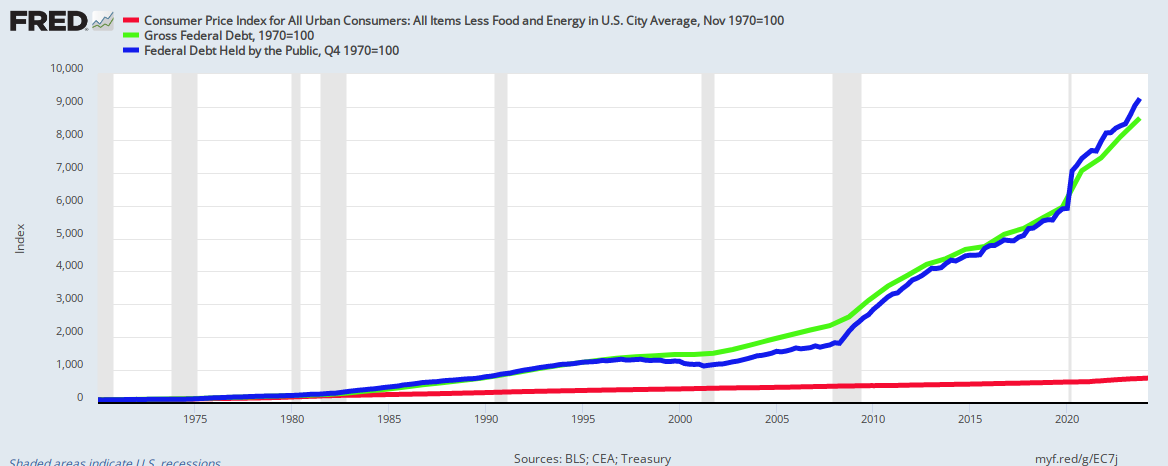
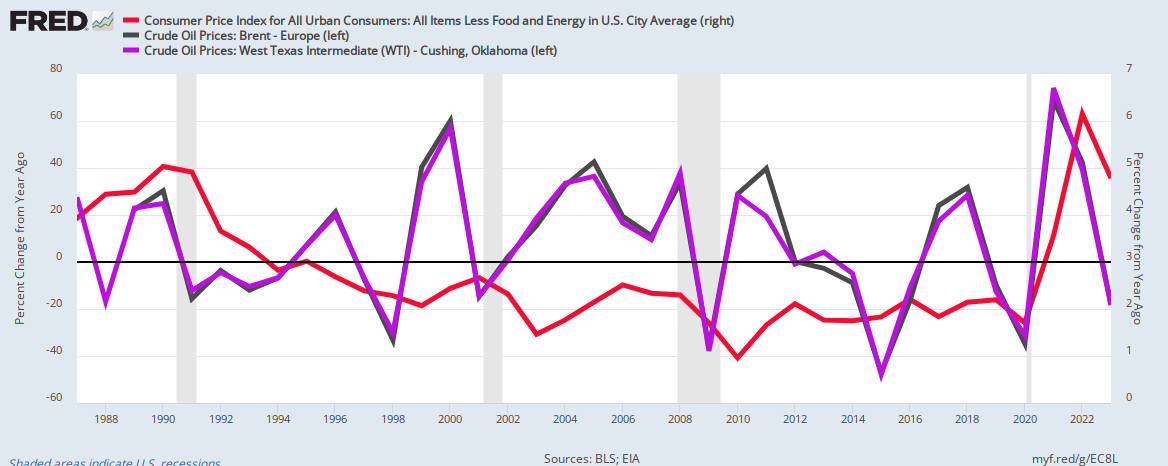
One excuse often given by debt-scarers is that federal spending will cause inflation. In previous papers, we have shown that scarcity, not spending, is the root cause of all inflations.
Every inflation in history has been caused by a scarcity of key elements, most often food and/or energy.
While federal debt (blue and green lines) has risen massively, inflation (red) has risen moderately.There is no relationship between annual changes in federal debt (blue and green) vs. annual changes in inflation.There is a close relationship between annual changes in the prices of oil (blackand purple) and inflation (red)
Another excuse is that federal spending is “socialism.” It isn’t.
Socialism is government (or the nation as a whole) ownership and control over production, distribution, and exchange. Merely handing money to the states, would not be socialism. Not even close.
America does have some socialism. The development of the atomic bomb was socialism. The government owned and controlled every step. Federal benefits are not socialism.
Another concern is that the state governments will spend the money unwisely. But that concern merely expresses the desire for socialism, i.e. federal control.
Sen. Bob Rankin, a Republican member of the Legislature’s Joint Budget Committee, said he is concerned about how that additional $3.8 billion of federal aid will be spent.“I’m afraid that we are spending money and making commitments that we will not be able to sustain once that one-time federal money goes away,” he said.
But rather than worry about the federal money going away, the politicians should be pushing for the federal money never to go away.
The fundamental purpose of government — the only reason why people create governments — is to protect and improve the lives of the people.
Governments are formed solely to be the servants of the people. We do not form any organization with the hope and intention that we will be ruled. Quite the opposite. We want to be served.
If ever a government stops protecting and improving the lives of the people, that government should be replaced with one that does.
The U.S. government has all the power and tools it needs in order to improve our lives. We do not want the dubious pleasure of being taxed. Rather we should want to tax the federal government.
After all, the federal government has no need for our tax dollars. It has infinite dollars at its disposal. It is we who can run short of dollars.
The people and the states, all being monetarily non-sovereign, should levy a per-capita tax on the federal government, to pay for our protection and our life improvement.
If the people do it, we might want to call it Social Security for All.
Rodger Malcolm Mitchell
Monetary SovereigntyTwitter: @rodgermitchellSearch #monetarysovereignty Facebook: Rodger Malcolm Mitchell ………………………………………………………………………………………………………………………………
THE SOLE PURPOSE OF GOVERNMENT IS TO IMPROVE AND PROTECT THE LIVES OF THE PEOPLE.
Gap Psychology describes the common desire to distance oneself from those “below” in any socio-economic ranking, and to come nearer those “above.” The socio-economic distance is referred to as “The Gap.”
Wide Gaps negatively affect poverty, health and longevity, education, housing, law and crime, war, leadership, ownership, bigotry, supply and demand, taxation, GDP, international relations, scientific advancement, the environment, human motivation and well-being, and virtually every other issue in economics.Implementation of Monetary Sovereignty and The Ten Steps To Prosperity can grow the economy and narrow the Gaps:
Ten Steps To Prosperity:
The sole purpose of government is to improve and protect the lives of the people.
Most people would like to have more money. This includes many of the rich, who already have more money than they can spend, but seem motivated to have even more.
The sole purpose of government is to improve and protect the lives of the people.
Gap Psychology describes the human desire to distance oneself from those below, on any social scale, and to approach those above.
Thus, growing “richer” requires widening the Gap. This involves not only gaining more for oneself but also depressing others.
Either approach widens the Gap.
That is why the rich, and the Republican Party of the rich, seem so adamant that giving people money will disincentivize people to work.
Strangely, or perhaps not so strangely, the rich do not feel the “disincentive” applies to them, for they generally claim to work just a hard as always, no matter how much more money they own.
Their story is that the poor and middle-classes are congenitally lazy, who only will labor if whipped by hunger, homelessness, or other deprivations.
The fact that millions of people work at demanding, or even dangerous jobs, for low or moderately low pay, does not seem to occur to those who claim that if people are given money, they will refuse to work.
It is a lie, or if not a lie, then at least an ivory tower misunderstanding by academics.
Ask a police officer or a fire-fighter or a public school teacher why they work. It is in the nature of human beings that most of us like to work, and we feel such emotions as worthlessness and boredom when we are not working.
In fact, lack of “something to do” is a major problem for retirees.
All of the above is the hypothesis. Here is some fact:
The city of Stockton, California, embarked on a bold experiment two years ago: It decided to distribute $500 a month to 125 people for 24 months — with no strings attached and no work requirements.
The people were randomly chosen from neighborhoods at or below the city’s median household income, and they were free to spend the money any way they liked. Meanwhile, researchers studied what impact the cash had on their lives.
The results from the first year of the experiment, which spanned from February 2019 to February 2020, are now in. And they’re extremely encouraging for its participants, and for advocates who see unconditional cash transfers as an effective way to help people escape poverty.
The most eye-popping finding is that the people who received the cash managed to secure full-time jobs at more than twice the rate of people in a control group, who did not receive cash.
Within a year, the proportion of cash recipients who had full-time jobs jumped from 28 percent to 40 percent. The control group saw only a 5 percent jump over the same period.
When confronted with a non-intuitive result, you surely must wonder, “How can that be? How would giving people money increase their desire to work for money?”
The researchers wrote in their report that the money gave recipients the stability they needed to set goals, take risks, and find new jobs.
In other words, when you’re drowning, all you can think about is staying afloat in the moment. That focus on the now, occupies all your energy and resources.
But if you are given a boat, you now can begin to think about getting food, shelter from the elements, finding land, signaling potential rescuers, etc.
One man in his 30s had been eligible for a real estate license for over a year but hadn’t gotten it because he just couldn’t afford to take time off work. Thanks to the freedom offered by the extra $500 per month, he said, his life was “converted 360 degrees … because I have more time and net worth to study … to achieve my goals.”
That’s a short-term example, but it also works in the longer term. Many intelligent youngsters do not stay in school, because their families need money now. So they are forced to find whatever low-paying jobs they can.
Eventually, these low-level jobs are the first to disappear. During any period or hard times, the under-educated are the first to need unemployment compensation.
Given money, they can continue in school, and find even better jobs, and/or create their own companies. They will be less likely to need unemployment compensation, later.
In the research done to date, unconditional cash does not tend to disincentivize work. In several programs — from Alaska and North Carolina in the US, to Finland and Spain in Europe — it has had no effect on employment either way.
In some cases, it seems to embolden people with an entrepreneurial bent; for instance, in Japan, initial survey results have shown that recipients are 3.9 times more interested in launching a new business.
Employment aside, there are clear benefits to unconditional cash programs. The Stockton experiment shows that getting unconditional cash tends to boost happiness, health, school attendance, and trust in social institutions, while reducing crime.
At its basic level, giving people money reduces their poverty, and crime, especially street crime, is an outgrowth of poverty.
(In the Stockton experiment, money) recipients spent most on necessities like food (37 percent), home goods and clothes (22 percent), utilities (11 percent), and car costs (10 percent). They spent less than 1 percent on alcohol or cigarettes.
These numbers offer a counter to harmful stereotypes and faulty assumptions: that people who become poor get that way because they’re bad at rational decision-making and self-control, and that they’ll blow free money on frivolous things or addictive substances. The evidence does not support these beliefs.
As part of its obligation “to improve and protect the lives of the people” government should give people money. This notion has been criticized on moral grounds. It’s as though not helping a drowning person will force a sink-or-swim mentality, which somehow is morally better.
But, allowing someone to drown is the ultimate immorality.
Here are excerpts from an article describing results around the world.
Everywhere basic income has been tried Which countries have experimented with basic income — and what were the results?
By Sigal Samuel Updated Oct 20, 2020.
The general idea — that the government should give every citizen a regular infusion of free money with no strings attached — has been around since the 16th century. But it’s recently experienced a remarkable resurgence: Advocates ranging from tech billionaire Mark Zuckerberg to libertarian economist Milton Friedman to former Democratic presidential candidate Andrew Yang have endorsed it.
Many people, who otherwise might favor such a plan, are reluctant to “give money to people who don’t need it.” This belief is founded on two concerns:
The false belief that federal taxes fund federal spending, while in fact no one — not you, not me, not our grandchildren — ever pay for federal spending. The concern, “Why should my money go to rich people?” does not apply to Monetarily Sovereign federal spending. The government creates, from thin air, all the dollars it spends.
The legitimate belief that federal spending should help narrow the Gap between the rich and the rest. I suggest that the simplicity of “Give the same amount to everyone” is far more actionable, and just a fair, as an income-based (or wealth-based?). The rich always find a way to game the system, and they would game this system, too.
Alaska: Since 1982, the state has given each citizen an annual check just for being alive, effectively wiping out extreme poverty. The money — which can range from around $2,000 per person when oil prices are high to $1,000 in cheaper gas years — comes from the Alaska Permanent Fund, a state-owned investment fund financed by oil revenues.
Economists investigated whether the payment was leading people to work less and found that “the dividend had no effect on employment” overall.
North Carolina: Since 1997, revenue from a casino on tribal land has been given to every tribal member, no strings attached. Each person gets on average somewhere between $4,000 and $6,000 per year. Economists found that it doesn’t make them work less. It does lead to improved education and mental health, and decreased addiction and crime.
Manitoba, Canada: Choosing one farming town, Dauphin, as a “saturation site” where every family was eligible to participate in a basic income experiment. The basic income seemed to benefit residents’ physical and mental health — there was a decline in doctor visits and an 8.5 percent reduction in the rate of hospitalization — and high school graduation rates improved, too.
Finland: The government chose 2,000 unemployed citizens at random and gave them a check of 560 euros ($635) every month for two years. Participants were assured they’d keep receiving the money if they got a job. The income didn’t help them get jobs, but it did make them feel happier and less stressed. The recipients also reported that they felt more trust toward other people and social institutions — from political parties to the police to the courts — than they did before getting a basic income.
Spain’s “B-MINCOME” experiment started offering a minimum guaranteed income to 1,000 households randomly selected from some of Barcelona’s poorest districts. Under the two-year randomized controlled trial, households could receive up to 1,675 euros ($1,968) per month. There was also a control group of 383 households. Preliminary results showed that the basic income boosted life satisfaction and mental health while making participants neither more likely nor less likely to find employment.
Iran rolled out a nationwide unconditional cash transfer program to compensate for the phase-out of subsidies on bread, water, electricity, heating, and fuel. The government gave out sizable monthly payments to each family: 29 percent of the median household income on average. Economists found that “the program did not affect labor supply in any appreciable way.” The program is still running, and it’s the only such program in the world to run nationwide.
Namibia: All residents below the age of 60 living in the Otjivero-Omitara region of Namibia received a basic income: 100 Namibian dollars ($6.75) per person per month, no strings attached, regardless of their socioeconomic status. As a result, child malnutrition dropped and school enrollment rates went up, while poverty-related crime (like theft) fell.
India: Between 2011 and 2012, a pilot project in the state of Madhya Pradesh gave a basic income to some 6,000 Indians. Every man, woman, and child in eight villages received a monthly payment: 200 rupees ($2.80) for adults and 100 rupees for each child. The results: Receiving a basic income led to improved sanitation, nutrition, and school attendance.
Japanese billionaire Yusaku Maezawa announced that he would give away 1 billion Japanese yen — about $9 million — to 1,000 random Twitter followers. Recipients of the cash benefit are now 3.9 times more interested in launching a new business. Recipients saw a decrease in divorce rates, from 1.5 percent to 0.6 percent. And more than 70 percent of recipients said they experienced a significant increase in happiness.
SUMMARY
Poverty is the lack of money, and the cure for poverty is to supply money to the impoverished.
We use the term “poverty” to describe merely being short of money. It does not need to be the abject, begging-in-the-street form of poverty, to have a negative effect on a family.
Just being unable to afford college or unable to live in a good home, are serious monetary and psychological negatives, not only for one family, but for that family’s economic surroundings.
Poverty does not indicate a moral lack. It is the result of bad fortune, whether at birth or at any time thereafter. Punishment does not cure poverty, because poverty itself is punishment.
Blaming the needy for their situation provides no benefit, moral or monetary, either for the impoverished or for the rest of humanity.
Withholding money from the impoverished is like withholding medicine from the sick.
The U.S. federal government, being Monetarily Sovereign, has the unlimited ability to create dollars. It is infinitely rich. The dollars it would give in the form of a basic income are not tax dollars. No one ever will pay for those dollars. They are created ad hoc, from thin air.
People receiving money are not less likely to work; the reverse is true. And they are more likely to be more productive members of society and less likely to commit crimes.
Giving “no strings” money to people has time and again proved to benefit the people themselves and the rest of the private sector. Everyone benefits.
Gap Psychology describes the common desire to distance oneself from those “below” in any socio-economic ranking, and to come nearer those “above.” The socio-economic distance is referred to as “The Gap.”
Wide Gaps negatively affect poverty, health and longevity, education, housing, law and crime, war, leadership, ownership, bigotry, supply and demand, taxation, GDP, international relations, scientific advancement, the environment, human motivation and well-being, and virtually every other issue in economics.Implementation of Monetary Sovereignty and The Ten Steps To Prosperity can grow the economy and narrow the Gaps:
NEW DELHI – President Donald Trump and White House officials downplayed coronavirus concerns Tuesday, describing the epidemic as “very well under control in our country” despite a sharp increase in cases globally and warnings of “severe” disruptions.
Speaking to reporters in India, where he was taking part in a state visit, Trump noted that few people have been diagnosed with the virus in the U.S. and claimed that the “whole situation will start working out.”
But markets tumbled hours later as health officials warned of a more extensive impact in the United States.
“Disruption to everyday life may be severe,” said Nancy Messonnier, director of the Centers for Disease Control and Prevention’s National Center for Immunization and Respiratory Diseases. Schools could be closed, public gatherings suspended and employees forced to work remotely, she said.
“This proposal brings desperately-needed resources to the global fight against coronavirus,” Schumer said in a statement. “Americans need to know that their government is prepared to handle the situation before coronavirus spreads to our communities. I urge the Congress to move quickly on this proposal. Time is of the essence.”
The Trump administration requested $2.5 billion Mondayto tackle the virus, an amount Democrats deemed insufficient. According to Schumer’s office, Congress appropriated $6 billion for the 2006 avian flu, and $7 billion for the H1N1 flu in 2009.
Testifying before a subcommittee of the House Appropriations Committee on Wednesday, Health and Human Services Secretary Alex Azardefended the administration’s request, saying the amount was “appropriate, and if not, if it doesn’t fund it enough, we’ll come back to you and work with you.”
Donald Trump has asked Congress to speed emergency cheques to Americans, enlisted the military for hospitals and implored ordinary people to do their part by staying home to stop the spread of the coronavirus.
In a massive federal effort, the president’s proposed economic package alone could approach a trillion dollars, a rescue initiative not seen since the Great Recession.
He wants cheques sent to the public within two weeks and is urging Congress to pass the stimulus package in a matter of days.
As analysts warn the country is entering a recession, the government is grappling with an enormous political undertaking with echoes of the 2008 financial crisis.
At the Capitol on Tuesday, Senate majority leader Mitch McConnell vowed the Senate would not adjourn until the work was done.
“Obviously, we need to act,” he said. “We’re not leaving town until we have constructed and passed another bill.”
He said the Senate will vote on a House-passed package of sick pay, emergency food and free testing, putting it back on track for Mr Trump’s signature — despite Republican objections.
Overnight, the White House sent legislators a 46 billion dollar emergency funding request to boost medical care for military service members and veterans, fund production of vaccines and medicines, build 13 quarantine centres at the southern border for migrants and make federal buildings safer, among other measures.
The Trump request also reverses cuts to the Centres for Disease Control and National Institutes of Health that Trump proposed in his February budget for next year and would create a 3 billion dollar fund for unanticipated needs.
Bigger than the 700 billion dollar 2008 bank bailout or the nearly 800 billion dollar 2009 recovery act, the White House proposal aims to provide a massive tax cut for wage-earners, 50 billion dollars for the airline industry and 250 billion dollars for small businesses.
“This is a very unique situation,” said Treasury secretary Steve Mnuchin, exiting a private briefing of Senate Republicans. “We’ve put a proposal on that table that would attract a trillion dollars into the economy.”
Step 2. Federally funded Medicare — parts A, B & D, plus long-term care — for everyone. Sanders’ “Medicare for all” proposal has been estimated to cost $1.38 trillion per year. Other health policy experts have put the single-payer health plan price tag much higher, with price tags ranging from $2.4 trillion a year to $2.8 trillion a year.
Step 3. The cost of Social Security for all would depend on how many people receive it, and how much each person receives. Current SS costs about $1 trillion which is doled out to about 61 million people. There are about 212 million people over 21 in the U.S., so giving all of them the same SS amount would require about $3.5 trillion.
Then add in the remaining Steps and the total easily could exceed $7 trillion. Yet, the 10 Steps are needed to prevent/cure recessions and depressions while improving the lives of Americans. In “Trumpese,” the 10 Steps can “make America great, again.”
Two questions:
Can the federal government afford the Ten Steps?
Would implementation cause inflation?
1. Can the Monetarily Sovereign federal government afford $3 trillion – $7 trillion to give Americans prosperity?
Alan Greenspan: “A government cannot become insolvent with respect to obligations in its own currency.” Ben Bernanke: “The U.S. government has a technology, called a printing press (or, today, its electronic equivalent), that allows it to produce as many U.S. dollars as it wishes at essentially no cost.” St. Louis Federal Reserve: “As the sole manufacturer of dollars, whose debt is denominated in dollars, the U.S. government can never become insolvent, i.e., unable to pay its bills. In this sense, the government is not dependent on credit markets to remain operational.”
Perhaps, the real question should be: Can the private sector (you and me) afford to continue paying trillions, and still not receive what the Ten Steps could offer?
Today, the private sector pays or does without. That is how these services are funded. The federal government, being Monetarily Sovereign, has unlimited financial resources. The private sector does not. Question answered.
Why then doesn’t Congress budget spending the money?
I suspect the primary answer is: They want to add just enough dollars to prevent a depression, which would tempt voters to throw them out of their cushy jobs — but still stick the public with a mild recession. In short, Gap Psychology rules.
(Gap Psychology is the desire to distance oneself from those considered “below” you in any socioeconomic ranking, and to come closer to those above.)
The richer do not want the less rich to prosper. They resent aid to poorer people who are felt to be “lazy takers.” It is Gap Psychology that demands those receiving aid to seek employment, though there is no financial reason for this.
In Summary: We are in a perilous situation that can lead to many deaths and a financial disaster, perhaps a full-fledged, long-lasting depression.
Both the health and the financial problems can be cured with ample inputs of money, which the federal government can provide at no cost to anyone.
Which political party will be remembered as the “too-little, too-late party”?
For no good reasons, the government drags its feet. With every passing day of inaction or inadequate action, more people will suffer. Who is at fault?
Only the rich will thrive. And that seems to be the point.
Gap Psychology describes the common desire to distance oneself from those “below” in any socio-economic ranking, and to come nearer those “above.” The socio-economic distance is referred to as “The Gap.”
Wide Gaps negatively affect poverty, health and longevity, education, housing, law and crime, war, leadership, ownership, bigotry, supply and demand, taxation, GDP, international relations, scientific advancement, the environment, human motivation and well-being, and virtually every other issue in economics.
Implementation of Monetary Sovereignty and The Ten Steps To Prosperity can grow the economy and narrow the Gaps:
Our country club invites speakers to give presentations about various, interesting subjects.
I could volunteer to present my friends and neighbors with information they don’t have, and should have, and would find interesting.
Sadly, I’ve found that most people want to hear what they already believe, and they tend to become angry at anyone who tells them otherwise.
What follows is the text of a speech I never will give to my friends at the club because they probably won’t believe me, and at my age, who needs the aggravation?
TEN THINGS YOU ABSOLUTELY DON’T KNOW ABOUT OUR ECONOMY — BUT YOU SHOULD
I’m going to tell you some things about our economy, and specifically about money — a subject which you already understand quite well because you have lots of it.
But I’m going to tell you ten things you didn’t know.
The vast majority of you own more than a million U.S. dollars, which used to be a much-respected sum, but no longer is.
Because you own so many dollars, let me ask you this: What does a U.S. dollar look like? For instance, what is the color of the U.S. dollar?
Green, right?
And what is a dollar made of? How big is it?
Paper and about 6 inches?
And what is the purpose of dollars?
They are a medium of exchange and a measure of value or wealth. OK?
And, if the purpose of dollars is, for example, to act as a medium of exchange, that means you exchange dollars for the goods and services you want, right?
.
So, for instance, let’s say you walk into a car dealership to buy a car.
After proper negotiation, you give the dealer a giant stack, let’s say 75,000, of those green, 6-inch pieces of paper, and he gives you the car keys.
That’s the way it works, right? You schlep big stacks of paper around?
No?? It doesn’t work that way??
Actually, to buy that car, you sign some papers that probably are not green and don’t measure 6 inches.
And in fact, I venture to guess, that while the vast majority of your life’s purchases do involve dollars, they do not involve green pieces of paper.
You gave that car dealer $75,000. So, let me ask you again, What did those dollars — the dollars you gave the dealer — look like?
The answer is: Those dollars didn’t look like anything. They are bookkeeping entries.
The U.S. dollar is not a physical entity. The dollar is a legal entity. It is a group of laws. You can’t see, smell, taste, feel, or hear a dollar any more than you can see, smell, taste, feel, or hear a law.
Titles
That green piece of paper is not a dollar; it is a dollar bill. It represents the ownership of a dollar. Just as a car title is not a car, and a house title is not a house, a dollar bill is not a dollar.
A dollar bill is a bearer title to a dollar.
A dollar is a legal entity that exists only in law books. And if there is one thing you know about governments and laws it’s this: A government can make as many laws as it wishes. A government cannot run short of laws.
Before the year 1780, there were no U.S. dollars. Then, as if by magic, the U.S government created from thin air, a bunch of laws, and among them were laws that created from thin air, millions of dollars.
And not only did the government laws and dollars from thin air, but it created other laws from thin air that gave those dollars a value relative to ounces of silver.
In 1792 the US Congress passed the Coinage Act, which states that the U.S. dollar coin must contain four hundred and sixteen grains of standard silver.
And ever since, the U.S. government has continued to create more and more laws, and more and more dollars from thin air, and has continued to pass laws changing the value of U.S. dollars.
All of this was arbitrary, and arbitrarily changed many times, and it demonstrated the unique sovereign power of the federal government over the U.S. dollar.
The American government proved what so many other governments had proved and continue to prove to this day:
The U.S. federal government has the unlimited ability to pass laws, which means it has the unlimited ability to create its sovereign currency, the U.S. dollar and the unlimited ability to give the dollar any value it wishes.
The term for that is Monetary Sovereignty.
You now know more than 90% of the people — make that 99% of the people — in America.
You know more than most of the media. You know more than most of the politicians. You even know more than most of the economists.
Why do I say that? Because every day, the media, the politicians and the economists tell you the U.S. federal debt is too high. It’s “unsustainable.”
What does “unsustainable” mean? It means the U.S. government will not have enough dollars to pay off its debt.
It even may mean the U.S. government won’t be able to make payments against its debt or even to cover the interest payments.
And it might mean that the government will have to raise taxes on you and your children to obtain dollars to pay its debt.
And as you now have learned, that is all nonsense.
Think about it, and answer for yourself these two questions:
How can a government that has the unlimited ability to create dollars from thin air, run short of dollars to pay its debts? (It can’t.)
Does a government having the unlimited dollars to pay its debts, need to ask you or your children for tax dollars? (No.)
What? The federal government doesn’t need your tax dollars?
That’s right folks, those tax dollars you sweat and strain to obtain, and then send to the government — the U.S. government does not need those tax dollars.
In fact, the federal government destroys your tax dollars upon receipt.
Really.
Think of it this way. Have you ever played the board game, Monopoly?
It usually is played with four players, one of whom also serves as the Bank.
Think of the Bank as the federal government and the players as the U.S. economy.
Monopoly money
According to the game rules, or laws, the Bank starts the game by distributing a certain amount of Monopoly money to each player.
One time, my friends and I wished to play Monopoly, but when we opened the box we discover the board, some game tokens, and some instruction cards, but no Monopoly dollars inside.
What would you have done?
No problem. The Bank simply took a sheet of paper and drew four columns, one for each player.
Like the U.S. federal government, the Bank created dollars out of thin air, simply by writing numbers into each player’s column.
The Bank has no source of dollars other than the rules or laws of the game.
Obviously, the Bank could have written any starting number at the top of each column.
Like the federal government, the Monopoly Bank has the unlimited power to create Monopoly dollars.
Then, as the game progressed, the Bank kept paying out and receiving dollars.
When the Bank paid out more dollars than it received, this was a deficit for the Bank and a surplus for the players— that is, a surplus for the economy — just like in the real world.
Now here comes the interesting part: At various points in the game, the rules require players to pay money to the Bank, either for properties, for fines, or for taxes.
Let’s say a player must pay a $100 tax to the Bank. In that case, 100 was deducted from that player’s column.
But where did the $100 go? The Bank had no column. The $100 simply disappeared. Those tax dollars were destroyed, just like in the real world.
That is why, if you ask someone, “How much money does the federal government have,” you will not get an answer. The federal government has infinite money.
If the federal government doesn’t need or use tax dollars, why does it collect them? Two reasons:
To control the economy. It taxes what it wishes to limit and it gives tax breaks to what and whom it wishes to reward.
To control the middle- and lower-income groups. Taxes provide a handy excuse for limiting benefits and preventing the non-rich from asking for benefits.
Why does the federal government wish to limit benefits to the non-rich?
A rich man
The rich run America.
Indeed the rich run the world.
“Rich” is a comparative word.You are rich if you have $100 and everyone else has $1, but you are poor if you have $1 million and everyone else has $10 million.
The rich wish to be richer which requires widening the gap between them and the non-rich.
The gap can be widened not only by giving more to the rich, but also by giving less to the non-rich.
The desire to widen the gap between those below, on any economic measure, and to narrow the gap above, is called Gap Psychology.
The rich are motivated by Gap Psychology.
The rich want the gap between you and them to widen.
That is why you are told falsely that Medicare for All, and Social Security for All, and the growing debt all are unsustainable.
And as for that so-called “debt,” it isn’t even a debt — at least not in the way you usually think about debt.
Loans are made to those who need money.
But the federal government has no need to borrow money. The U.S. federal government already has infinite money.
Those so-called “loans” to the federal government actually are deposits into T-bill, T-note, and T-bond accounts held at the Federal Reserve Bank.
They are deposits, similar to your bank savings account deposit.
When China “lends” to the U.S government, it actually opens T-bill accounts and directs dollars from its checking account at the Federal Reserve Bank to be deposited into its T-bill accounts, also at the Federal Reserve Bank.
There China’s dollars stay, in its T-bill accounts, accumulating interest until the T-bills mature.
Then, how does the government pay off its Chinese loans? It merely sends the dollars that are sitting in China’s T-bill accounts, back to China’s checking account.
It’s a simple dollar transfer. It does this every day.
No tax dollars involved. No burden on the government or future generations.
If the government doesn’t use the dollars in Treasury accounts, why then does the government issue T-bills, notes, and bonds? Two primary reasons:
To provide a safe parking place for unused dollars, which stabilizes the dollar, and
To assist the Federal Reserve in controlling interest rates
In summary, and contrary to what you have been told, the federal debt is not a burden on anyone, not on you, not on your grandchildren and not on the government.
Why is this important?
Well, for one thing, you repeatedly have been told that the Social Security Trust Fund is running out of money, and to save Social Security, we must either increase FICA taxes or reduce benefits.
In fact, benefits already have been reduced by increasing the qualifying ages.
But the U.S. government has the unlimited ability to create dollars. It cannot go broke, And because the U.S. government cannot go broke, no agency of the government can go broke, unless that is what the politicians want.
The Supreme Court, Congress, and the Presidency all are agencies of the government. Have you ever heard concerns about any of them going broke? No, and you never will.
The idea that Social Security can run short of dollars is false. Even if all FICA collections were zero, the federal government could continue paying benefits, forever.
And then we come to the newly famous “Medicare-for-All.”
In its best case, Medicare for All would lower the entrance age to zero, eliminate deductibles, cover long-term care completely, and pay for all drugs.
Who wouldn’t want all health costs to be free? People want it. Companies — except for insurance companies — want it. The benefits to America would be enormous.
And yet, Medicare-for-All is controversial, primarily because of one question: Who would pay for it?”
And the answer, very simply is, the federal government could pay for the whole thing, without levying even a dollar in taxes. It simply would do what it always has done, to fund every federal expense: Create dollars from thin air.
“Oh,” you say. “Sure the government can print money.
“But, remember what happened to Weimar Germany. Remember what happened to Zimbabwe. We’re talking about hyperinflation. People carrying wheelbarrows full of money.”
I’ll let you in on a well-kept secret: Every hyperinflation and nearly every inflation in history has been caused not by deficit spending, but rather by shortages — usually shortages of food and/or energy.
Think of the Zimbabwe hyperinflation. The government took farmland from farmers and gave it to non-farmers.
Predictably, that caused a food shortage, which caused the hyperinflation.
Rather than importing more food, and training people to farm, which would have cured the shortage and the hyperinflation, the Zimbabwe government simply printed currency of higher denominations.
When you hear that the price of potatoes has gone up, do you immediately think it’s because the federal government is spending too much? No, the price of potatoes goes up when there is a shortage of potatoes.
In fact, the best way for a government to end an inflation is to increase deficit spending to cure the shortage.
Potato prices gone up? The solution: More deficit spending to import more potatoes, and/or to pay more farmers to grow more potatoes, and/or
That is the irony of inflations. They can be cured by deficit spending to eliminate the shortages.
The government has other means of ending inflations: It can raise interest rates which strengthen the dollar by creating more demand for dollars.
And it can simply revalue the dollar vs. other currencies, which it has done often in its 240-year history. Being sovereign over the dollar, the government can do anything it wishes with the dollar.
The U.S. government is Monetarily Sovereign.
Your city is not Monetarily Sovereign. Nor is your county. Nor is your state. Nor is your business. Nor are the euro nations. Nor are you, nor am I. But the federal government is. It has unlimited sovereign power over the U.S. dollar, which is nothing more than a creation of federal law.
And that makes all the difference.
And remember that statement at the beginning of this post: “The U.S. dollar is not a physical entity. The dollar is a legal entity. It is a group of laws. You can’t see, smell, taste, feel, or hear a dollar any more than you can see, smell, taste, feel, or hear a law.”
If you don’t believe it, the kindly describe the dollars we Monopoly players used when the game didn’t have any paper certificates. What color were those dollars? What did they smell and feel like?
In summary:
The federal government created the very first dollar, and subsequent dollars, out of thin air, simply by writing federal laws, also out of thin air.
Dollars are not physical entities; they are legal entities, and so to the federal government, they are in unlimited supply.
Even if all federal tax collections fell to $0, the federal government easily could continue spending, and paying all its bills, forever.
Unlike state and local governments, the federal government is Monetarily Sovereign, so it cannot run short of its own sovereign currency, the U.S. dollar.
No agency of the federal government can run short of dollars unless Congress and the President want it to.
Social Security and Medicare are federal agencies. They cannot run short of dollars unless Congress and the President want them to.
Because the federal government is Monetarily Sovereign, it does not borrow its own sovereign currency. The primary purposes of federal debt are to stabilize the dollar and to help control interest rates.
The federal government, being sovereign over the dollar, has absolute control over the value of the dollar, also known as inflation. The government can give the dollar any value it chooses.
Inflations are caused by shortages, most often shortages of food or energy, and seldom if ever, by federal deficit spending, which actually can control inflation.
Being Monetarily Sovereign, the federal government has absolute control over inflation, either by raising interest rates, and/or by using deficit spending to eliminate shortages.
Gap Psychology describes the common desire to distance oneself from those “below” in any socio-economic ranking, and to come nearer those “above.” The socio-economic distance is referred to as “The Gap.”
Wide Gaps negatively affect poverty, health and longevity, education, housing, law and crime, war, leadership, ownership, bigotry, supply and demand, taxation, GDP, international relations, scientific advancement, the environment, human motivation and well-being, and virtually every other issue in economics.
Implementation of Monetary Sovereignty and The Ten Steps To Prosperity can grow the economy and narrow the Gaps:


 All those worthwhile projects to improve the lives of Americans, and there is nothing to prevent them, except Congress and the President.