The more you consider all the things your brain and the rest of your body can accomplish, the more amazed you become that so little can do so much. Consider all the things a tiny mosquito can accomplish, from breeding to finding food to coping with disease, predators, and the changing weather and landscape — all this from a 2.5-milligram (0.000088184905 ounces) creature with a brain barely visible with the naked eye.
We have not found a way to create a machine as efficient as a mosquito — let alone a human being. Part of the reason is that nature is the ultimate multi-tasker.

This post began with recent articles about fascia and the interstitium. (Don’t worry. This won’t be technical.)
For centuries, fascia and the fluid-filled spaces associated with it were thought primarily to be mechanical. Fascia helped hold the body’s structures together. Interstitial fluid provided cushioning and allowed organs and tissues to move without damaging one another.
They were, in effect, scaffolding and lubricant.
But increasingly we are learning that this apparently humble system participates in communication throughout the body. Interstitial spaces and fluids provide pathways through which chemical substances, cells, mechanical forces, and perhaps other signals can travel.
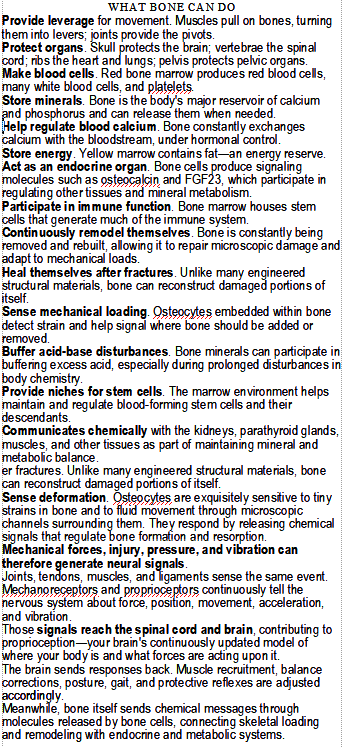
Once again, something in a living body that seemed to be just a simple, single-purpose mechanism, turned out not to be a a complex, multi-purpose function. Bones are not just supports. Blood is not just a carrier of oxygen. Skin is not just a covering. Muscle is not just a motor. Fat is not just stored energy.
Structures, substances, movements, chemical reactions, temperature changes, pressure changes, and even what we call waste products frequently perform multiple functions. Life does an astonishing amount with comparatively little.
The Battery Problem
Human engineering traditionally approaches problems differently.
Suppose you wished to are design an electric bicycle. It needs stored electrical energy. So, you add a battery. The battery has a job: provide electricity.
Then you need someplace to put it, a structure to support it, wiring to connect it, a system to protect it, perhaps a cooling mechanism, sensors to monitor it, and electronics to control it.
If nature made your battery, you might expect to discover that the battery casing also strengthened the bicycle frame; its mass improved balance; its heat performed some useful function; its electrical system communicated information; its structure absorbed impacts; its sensors monitored other parts of the bicycle; and perhaps some substance produced by one of its operations became an input required somewhere else.
This suggests a different engineering question. Instead of asking, “How can we make a better battery?” you ask, “What else can the battery do?” Or an even harder question: “How else could an energy source be configured so that it performs additional useful functions?”
And then the almost impossibly difficult question: “How would every one of those configurations affect every other component and every other function of the bicycle?”
Thus, the problem explodes. An energy source can have countless shapes, sizes, locations, chemistries, voltages, structural properties and operating temperatures. Every variation can interact differently with the frame, wheels, rider, motor, brakes, electronics and environment.
Even a bicycle creates a combinatorial problem that rapidly outruns unaided human imagination. Now try designing a rocket, or an amoeba, and ask that same question, where the number of possible configurations approaches infinity.
The Engineering Opportunity for Artificial Intelligence
This may be one of the great opportunities for artificial intelligence. Human builders manage complexity largely by dividing it. One group designs the engine. Another designs the structure. Others design the electrical system, the communications, the cooling.
This is extraordinarily effective, but partly it reflects the limitations of the human brain. We cannot hold millions of interacting variables and possibilities in mind simultaneously. AI potentially can explore vastly larger spaces of configurations.
Instead of telling an AI, “Optimize this battery,” we might eventually tell it, “Consider the entire machine and everything it needs to accomplish. Find arrangements in which every component performs as many useful functions as possible. Then determine how every proposed change affects the performance of everything else.”
That is much closer to nature’s method. Not because nature thinks. It doesn’t. Nature has no intention. It just is.
Everything Communicates
The comparison becomes even more striking when we consider communication. Computers communicate primarily through deliberately constructed electrical and optical pathways. We build processors, memory, wires, buses, networks and communication protocols.
A living organism makes that look primitive. The human body communicates electrically, but electricity is only one channel. We internally communicate through blood, hormones, interstitial fluid, neurotransmitters, ions, protein shapes, molecular concentrations, and temperature.
Oh, and did I mention pressure., acidity, mechanical stretching, chemical gradients, timing, frequency, repetition, spatial location, light, sound, touch, odor, and taste?
The body doesn’t consist simply of components attached to a communications network. The interactions among the components are themselves communication networks. And communication need not be direct.
A cell in the toe need not send a private message to a particular cell in the liver. It can alter something that alters something else that changes a circulating substance that affects another system that eventually alters the conditions experienced by that liver cell. The effects propagate. In that sense, an organism is an almost incomprehensibly interconnected system.
Everything Has Its Own “Subroutines”
“Subroutine” is an analogy. An electron does not contain a little computer program telling it what to do. A more precise term might be “constraints” or “characteristics.”
Throw a ball against a wall and a great number of things happen. The ball deforms. The wall moves, however slightly. The air moves. Sound is generated. Heat is generated. Forces propagate through the materials. Atoms and molecules change positions. Electromagnetic interactions occur.
No central computer calculates all this and issues instructions:. Instead, every component simply responds according to what it is and the conditions affecting it. Fields, atoms, molecules, and each does their thing, and the macroscopic event we call “the ball bounced” emerges from all of them.
Nature doesn’t calculate the bounce. There is no calculation. The result is the accumulation of Stimuli —>Responses, trillions of times every second.
The Ten-Body Problem
We cannot write a general closed-form solution to even the three-body gravitational problem. Nature has no such difficulty. Put ten or a thousand gravitating bodies together and each will move in response to the gravitational situation created by all the others.
It would be misleading to say they consciously “coordinate.” There is no coordination center. Each simply does its own thing while simultaneously affecting the conditions under which the other nine do their things. Now replace ten bodies with trillions of interacting components.
Nature still does not require a central calculator. This may suggest an important principle for future engineering. Perhaps the ultimate solution to overwhelming complexity is not to construct a sufficiently enormous central computer capable of calculating everything.
Perhaps it is to design components with appropriate local rules and interactions so that useful global behavior emerges. Biology does this constantly. Cells self-organize. Immune systems respond without a central commander. Embryos develop structures without a central architect specifying the coordinates of every cell. Ant colonies exhibit complex collective behavior without a chief executive ant.
The whole emerges from interactions among parts.
But How Did Nature Find Any of This?
Here we encounter what may be the most interesting problem of all. The weighting problem. The number of theoretically imaginable arrangements of matter is staggering.
The familiar analogy of monkeys randomly typing Shakespeare illustrates the difficulty. If every possible sequence of characters were equally probable and every failed attempt had to be discarded completely before beginning again, producing Hamlet by chance would require an absurd amount of time.
Yet Hamlet exists. So does an amoeba. How?
The answer cannot simply be that nature tried every conceivable possibility independently. Even nature doesn’t employ infinite time.
The Dice Were Loaded From the Beginning
Nature begins with constraints. Atoms cannot do absolutely anything. Their structures permit some interactions and prohibit others. Charges attract and repel. Atoms form some bonds readily and others reluctantly or not at all. Molecular shapes permit certain interactions. Water favors some structures and destabilizes others. Temperature changes which reactions are likely. Pressure matters.
Catalysts make some pathways enormously more probable than others.
Long before Darwinian selection begins, physics and chemistry already have eliminated or enormously reduced huge regions of possibility. Permit and prohibit are the sieve through which possibility is strained. Physics, chemistry, environment, weights, structure all weight the dice.
Then, once replication appears, Darwinian selection adds another extraordinarily powerful weighting mechanism: Persistence. A stable arrangement remains available for subsequent interactions. An unstable arrangement disappears. What persists becomes part of the conditions under which the next events occur.
Then Replication changes the game. A structure that makes copies of itself does more than persist physically. It multiplies its presence in the future possibility space. Variation creates alternatives. Selection changes their relative prevalence.
Successful structures become starting points for further experiments. Nature does not return to zero after every failure. It keeps what persists.
Inherited Solutions
This may be one of the principal ways nature escapes combinatorial impossibility. Each level inherits enormous amounts of already-solved machinery from below. Chemistry does not have to reinvent the proton. Molecules inherit the properties of atoms. Proteins inherit molecular chemistry. Cells inherit proteins and membranes. Multicellular organisms inherit cellular machinery. Nervous systems inherit cells. Brains inherit nervous systems. Language inherits brains.
Shakespeare inherited language.
Nature does not repeatedly search from fundamental particles. It builds upon what already persists. Solutions become components of subsequent possibilities. Yesterday’s result becomes part of today’s starting conditions.
It’s as though every engineer knew of every success and failure in history, and so, began creating with many dead ends already avoided.
Shakespeare Wasn’t a Random Monkey
This also explains why Shakespeare could accomplish what random monkeys effectively could not. Shakespeare wasn’t selecting randomly from every possible sequence of characters. His possibility space already had been constrained and weighted by English grammar and vocabulary. He further was constrained by human psychology, Elizabethan culture, theater, his previous reading and writing, and his memories.
The sentence he had just written constrained what could plausibly come next.
After writing, “To be, or not to be…” not every possible subsequent sequence of letters remained equally probable. Hia history had weighted his next response. And that brings us to a much broader principle.
History
Everything begins with possibilities. Possibilities encounter limits, which create constraints, which weight what can happen next. Then something happens. Some consequences persist, which changes the conditions under which the next event occurs.
So we might describe the process:
Possibility—>Constraint —>Weighting—> Interaction/Stimulus—>Response—>Persistence—>History—>New Possibilities
Then repeat.
The River
History, in this sense, is not merely a record kept somewhere, but the physical result of what previously happened. The eroded riverbank is the river’s history. And that history affects where tomorrow’s water flows.
A river provides a useful analogy. The water constantly changes, yet we call it the same river, because the river has location persistence. It has banks, a channel, tributaries, gradients, sediment and an accumulated physical structure produced partly by its own previous flow. Today’s river is constrained by yesterday’s river.
But today’s flow also erodes one bank, deposits sediment elsewhere and changes the channel.
Therefore: Existing structure—>Incoming water—>Flow—>Changed structure—>Different future flow
The river’s history influences its response to stimuli, which changes its history. The water changes continuously while the pattern persists. This begins to sound remarkably like a “Self” or “Consciousness.”
From Nature to Consciousness
The same principles apply to a living organism. A stimulus arrives and organism responds according to its existing physical structure. That response changes the organism, however slightly. The changed organism now confronts the next stimulus differently. This can be expressed as: I Am = My History, and My History = My Physical Structure × (Stimulus —> Response) —>My New Physical Structure—> My New History
This is not intended as a mathematical equation. It is a conceptual description. My History is not merely a diary of what happened to me, but what has physically made me. Memories, habits, learning, and skills must be physically instantiated.
The tendency to respond in one way rather than another must exist somehow in the organism’s present physical state, or it could not affect the next response. Thus: History + Stimulus —>Responses —> New History may describe not merely learning, but something fundamental about that thing we call “Self.”
The Illusions of Perception
Consider vision. We casually say that we “see” an apple, but the brain never receives an apple. Electromagnetic radiation interacts with the eye. Neural activity results. The brain constructs the experience we call seeing an apple. We do not experience electromagnetic wavelengths. We experience red.
Likewise, we don’t experience oscillating air pressure. We experience sound. We don’t experience molecular binding to receptors. We experience taste and smell. Everything we sense is a translation or construction.
This becomes obvious when the external source disappears. Close your eyes and you still may see colors and shapes. Tinnitus produces an experience of sound without corresponding sound waves entering the ear from the environment. Dreams can generate entire experienced worlds.
During a dream, the dream may feel completely real. Only upon waking does the brain reclassify it: That was a dream. Occasionally even that classification fails. A remembered event may leave us genuinely uncertain: “Did that happen, or did I dream it?”
The experience was real. What may have been false was its apparent source. So perhaps the distinction is not real perception versus constructed perception. All perception is constructed. The difference is how strongly the construction is constrained by events outside the nervous system.
Reality As Weighting
What we experience as reality itself may involve weighting. Vision and touch say “X.” Hearing is consistent with “X,” and memory predicts “X.” Other sources confirm “X.” The mutually reinforcing signals give enormous weight to the belief that “X” is externally real.
With tinnitus, the auditory system says “Sound.” Other systems fail to corroborate. Your history says, “I have experienced tinnitus before.” Your conclusion becomes “The sound experience is real, but, an external sound probably isn’t.”
During a dream, internally generated systems may agree sufficiently with one another that the brain temporarily concludes that “This is real.” Then we wake and a flood of differently constrained information arrives and the weighting changes.
It was a dream.
And Then, Self
Among all the brain’s constructions, perhaps none is more powerful than: “I am.” I feel that I am the same person who woke yesterday. I feel related to the person I was ten years ago and I even feel partly like the person I was seventy years ago.”
Obviously, I have changed enormously, yet something persists. At my fiftieth high-school reunion, faces had changed enough to become difficult for me to recognize. Then an old classmate spoke, and suddenly recognition occured. The voice itself surely had changed too, but something about the manner, cadence, timing, pronunciation, emphasis or pattern persisted.
I recognized not identical matter but persistent patterns.
Is There a Fundamental Self?
It is tempting to imagine a fundamental Self surrounded by more changeable layers. Some characteristics seem extraordinarily persistent, while others change rapidly. I can be tired, angry, frightened, hungry or delighted without ceasing to be myself.
My beliefs can change. My knowledge, relationships, and my body changes, yet the feeling of continuity remains remarkably powerful.
A brain injury could present an important challenge. Damage to relatively small amounts of physical brain tissue can sometimes alter personality, memory, inhibition, preferences, emotional responses or the sense of identity far more profoundly than losing a much larger amount of tissue elsewhere in the body.
Physical magnitude and historical importance are not the same thing. A lost leg may represent kilograms of physical change. A microscopic neural alteration may profoundly change future responses.
Again, the factor is weighting.
Where Is the Self?
If Self is an illusion or a construction, the physical processes producing it nevertheless must occur somewhere., but “somewhere” need not mean one location. There may be no little chamber in the brain marked “SELF,” just as there is no cubic meter of water containing the essential Mississippi River.
The river has a distributed physical existence. So may Self.
Different physical systems may contribute differently. Brain systems involved in memory, body awareness, emotion, perception, prediction and social understanding all may participate. The endocrine system, the immune system and the gut all communicate chemically and neurally.
Sensory organs continually modify the state from which responses emerge.
“Self” therefore may have a physical location without having a point location. It may resemble a topographical map where some regions and systems carry enormous weight while others carry less. Some characteristics are extraordinarily resistant to change because they have been reinforced throughout a lifetime, while others can change in minutes.
I Am = My History
This leads to the proposition: I Am= My History, but “history” is not merely what happened. Rather, it is the present physical structure produced by what happened. At any instant: I Am = My Present Physical History.
Then: Present Physical Structure × Stimulus—>Response—>Changed Physical Structure—>New History
The next stimulus encounters that new history. Usually, the change produced by one ordinary event is tiny compared with the accumulated structure produced by decades of previous events. That may explain the extraordinary persistence of Self.
Yesterday changed me but yesterday was weighted against more than ninety years of accumulated history. A sufficiently powerful event, however, can alter the weighting dramatically. Trauma, learning, disease or brain injury can do it.
Every event modifies the river. While most barely move its banks, some change its course.
The Larger Principle: Universal Solutions.
We began this post with fascia and we ended with “Self.” But perhaps we have been discussing the same process all along. The universe does not begin each moment from scratch. It inherits, existing structure, which constrains possibilities which create weighting. Stimuli and interactions produce responses.
Some consequences persist, which becomes history, which becomes structure, and structure constrains and weights the next response. And complexity accumulates.
There is no central calculator. Everything has its own “subroutines”—its characteristic responses arising from what it is, where it is, what surrounds it and what has happened before. Higher levels inherit the machinery of lower levels.
Atoms inherit the results of physics. Molecules inherit atoms. Cells inherit molecules. Organisms inherit cells. Brains inherit organisms. Thought inherits brains. Culture inherits thought. Shakespeare inherited language.
And tomorrow inherits the results and rules of today. Perhaps that is how nature accomplishes the apparently impossible. It doesn’t examine every conceivable possibility. Every present state already contains the weighting created by the history that produced it. That weighting determines which possibilities are available, which are probable, which disappear immediately, and which persist long enough to become part of the next round.
The future of human invention may depend upon learning to imitate this—not merely by making better individual components, but by creating systems in which components perform multiple functions, communicate through multiple channels, respond locally, alter one another, and allow useful global behavior to emerge.
Artificial intelligence may finally give us the ability to explore some of that complexity beyond the limits of unaided human thought. We have designed rockets, but we are not yet able to design an amoeba from scratch. Perhaps the difference is not merely that the amoeba is complicated.
Perhaps it is that we still think like engineers designing separate parts, while nature operates through inherited constraints, weighting, interaction, persistence and history of the whole, with the whole including all surrounding stimuli.
Perhaps this is the largest lesson nature can teach human engineering. We tend to solve problems discretely. We identify a problem, isolate it, design a solution, and then attach that solution to the larger machine. Need electricity? Add a battery. Need cooling? Add a cooling system. Need communication? Add a communications system.
Nature could not work that way. The human toe was never designed separately from the foot, the foot separately from the leg, or the leg separately from the rest of the body. Every change occurred within an already existing network of interactions. A change in the toe altered forces transmitted through the foot, ankle, leg, pelvis and spine. Those changes affected muscles, circulation, nerves, balance, energy requirements and behavior. Their consequences could propagate throughout the organism—even, ultimately, to conditions affecting the hair on the head.
Nature did not calculate all those consequences. The interactions themselves performed the calculation.
Every variation encountered the whole system. Its consequences propagated wherever they could. Some consequences disappeared. Some persisted. What persisted altered the conditions confronting the next variation.
Thus, nature did not solve millions of independent problems. It produced universal solutions—solutions tested, not against one isolated requirement, but against the interacting consequences of the whole.
That may be precisely what human beings cannot do. Our intelligence succeeds partly by simplifying. We divide overwhelming problems into manageable pieces. We create specialties, departments, components and disciplines. That has made extraordinary technological achievement possible.
But the method has an unavoidable weakness: the world does not remain divided merely because our minds require us to divide it. Change the battery and you may change weight, balance, temperature, structural loads, aerodynamics, manufacturing cost, maintenance, safety, recycling, control systems and a thousand other things. Change any one of those and still more consequences propagate outward.
The number of possible configurations and interactions quickly exceeds anything a human mind—or even a collection of human minds—can simultaneously consider and weight. And that may be one of the fundamental reasons we need artificial intelligence.
Not merely because AI can calculate faster or remember more. The greater possibility is that sufficiently sophisticated AI may allow us to begin solving problems universally: to explore enormous numbers of interacting possibilities, follow their consequences throughout an entire system, weight those consequences against one another, and discover configurations in which one solution simultaneously becomes part of many other solutions.
In other words, AI may allow human engineering to move a little closer to the method that produced the living world. Perhaps the next great step in human invention will come when we stop asking, “How do we solve this problem?” and begin asking, “What solution does the whole system want?”
Rodger Malcolm Mitchell

