More scare nonsense from the CRFB.

The nation’s leading supplier of federal debt lies, the Committee for a Responsible Federal Budget, has released its latest salvo of utter nonsense:

Here are a few of their baseless claims:

1. The Deficit Could Hit $1 Trillion This Year and $2 Trillion Within a Decade
Although deficits decreased from Fiscal Year (FY) 2011 to FY 2015, they’ve been rising ever since.

We now expect deficits to return to nearly $1 trillion this fiscal year (2019) and stay above that level indefinitely.

In fact, if lawmakers extend the costly tax cuts and spending increases indefinitely, deficits will be more than $2 trillion by 2028.

Although the above claims themselves are not baseless, the implication that somehow increases in the federal deficit are bad — that is baseless.

An increasing deficit merely means that the federal government pumps more dollars into the economy that it removes. That is a good thing. It is what grows the economy.

In fact, the opposite of deficits — i.e. surpluses — have been the cause of every depression in U.S. history.

1804-1812: U. S. Federal Debt reduced 48%. Depression began 1807.
1817-1821: U. S. Federal Debt reduced 29%. Depression began 1819.
1823-1836: U. S. Federal Debt reduced 99%. Depression began 1837.
1852-1857: U. S. Federal Debt reduced 59%. Depression began 1857.
1867-1873: U. S. Federal Debt reduced 27%. Depression began 1873.
1880-1893: U. S. Federal Debt reduced 57%. Depression began 1893.
1920-1930: U. S. Federal Debt reduced 36%. Depression began 1929.
1997-2001: U. S. Federal Debt reduced 15%. Recession began 2001.

A growing economy requires a growing supply of money. Austerity (i.e. reduced deficit spending) invariably leads to recessions and depressions.

2. The Long-Term Debt Outlook is Terrifying
This fall, CRFB released its own 75-year budget outlook, which projected an unsustainable fiscal outlook.

Under current law, debt will rise from 78 percent of Gross Domestic Product (GDP) in 2018 to 160 percent by 2050 and nearly 360 percent by 2093. Under the Alternative Fiscal Scenario, debt will exceed 600 percent of GDP by 2093.

Why is the high debt/GDP ratio “unsustainable”? It isn’t. 

There is no relationship between federal debt and GDP. The debt is not serviced by GDP, nor is it serviced with taxes, exports, or any other form of income.

The federal government is Monetarily Sovereign. It has the unlimited ability to service any amount of debt. It never can run short of dollars.

Japan, for example, carries a debt/GDP ratio exceeding 250%, and no one claims this debt is “unsustainable.” See graph, below.
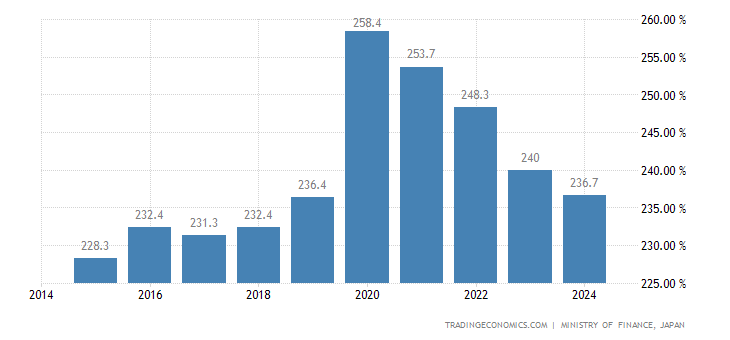
Japan General Government Gross Debt to GDP

3. “Debt-Financed Laws” Offered a Temporary Stimulus
While the economy has grown by about 3 percent over the past year, our analysis Can America Sustain the Recent Economic Boost? showed that the growth rate would likely return to 2 percent per year.

As we illustrated, near-term growth was largely driven by one-time stimulus and other effects from the Tax Cuts and Jobs Act (TCJA), the 2018 Bipartisan Budget Act, and other deficit-financed legislation.

Unfortunately, the economic boost from these laws will be temporary – but the debt will be permanent.

The CRFB admits that economic growth is driven by deficit stimuli. 

They also admit that continuing economic growth requires continuing deficit stimuli, which our Monetarily Sovereign government has the infinite ability to provide.

The U.S. government never unintentionally can run short of U.S. dollars. Never. Even if the federal government collected zero taxes, it could continue spending, forever.

So, exactly what is the problem? The CRFB never says.

4. Rapid Economic Growth is Unlikely to Last
In the analysis of America’s recent economic boost, we showed that nearly all forecasters agree that current rapid rates of economic growth are unlikely to last.

For example, the Congressional Budget Office (CBO) projects that the economy will grow by 3 percent in 2018 and 2.8 percent in 2019, but then grow by between 1.6 and 1.9 percent per year for the remainder of the decade.

A primary factor in predicting economic growth is federal debt growth. Debt growth creates the dollars that stimulate economic growth.
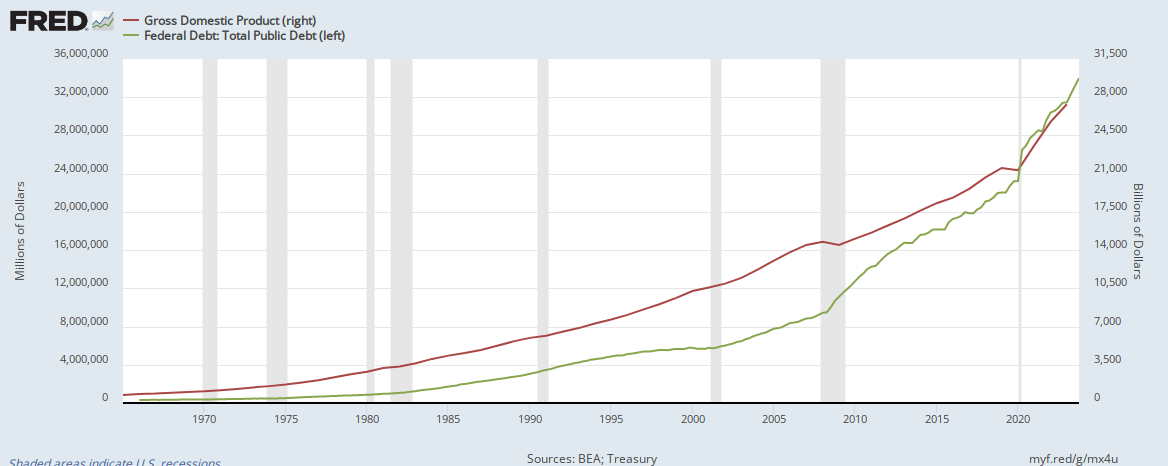
Economic growth (red) parallels federal debt growth (green).

5. Deficits Shouldn’t Rise When the Economy is This Strong
Typically, a strong economy is paired with low deficits (or even surpluses) – both because strong economic performance produces more revenue and because it creates the economic space for deficit reduction.

Yet despite the economy performing at or even above its potential, deficits are widening.

In a recent analysis of deficits and the economy, we showed that the deficit has never been this high when the economy was this strong. 2018 and 2019 are extremely abnormal in that we are running high and rising deficits despite low unemployment, no significant output gap, no recession, and strong economic growth.

The above is a lie of Trumpian proportions. Rising deficits make the economy strong by adding dollars to the economy.

Reduced deficit growth leads to recessions, which are cured by increased deficit growth:

Reduced federal deficit growth leads to recessions (vertical bars) which are cured by increased deficit growth.

And as you have seen, federal surpluses do not create strong economies. Quite the opposite. Federal surpluses create depressions.

It is true that economic growth brings in higher taxes, but that does not create “economic space for deficit reduction.”

The term “economic space for deficit reduction” is gobbledegook. As long as there are deficits, they always can be reduced, so long as one wishes to experience recessions and depressions.

6. Policymakers are Responsible for More than Half of This Year’s Deficit
This year, the deficit will approach $1 trillion – and policymakers have no one to blame but themselves.

We estimate that 55 percent of this year’s projected deficit is the result of deficit-financed legislation enacted since 2015.

Recent spending hikes and tax cuts will cost $540 billion this year. Had these laws been offset or not enacted, the deficit would be $440 billion rather than $981 billion, as CBO projects.

Said more accurately, “Policymakers are Responsible for More than Half of This Year’s Economic Growth, simply because deficits create the dollars necessary for economic growth.”

7. Recent Tax and Spending Bills Both Cost Trillions, If Extended
The Tax Cuts and Jobs Act of 2017 and the Bipartisan Budget Act of 2018 both added tremendously to the national debt.

And while the tax cuts will cost significantly more ($1.9 trillion versus $435 billion) over ten years, that is largely an artifact of the most of the tax cuts enacted for eight years, while the spending boost was a two-year deal.

We found that if lawmakers extend both laws indefinitely, the tax cuts will cost about $2.7 trillion over a decade while the spending bill will cost $2.4 trillion. That’s $5 trillion of additional debt that this country simply cannot afford.

The CRFT prays that you not understand Monetary Sovereignty, otherwise you would know that:

8. Revenue Has Dropped, Not Risen
While some have claimed that revenue grew over the past year  . . . we estimated that actual revenue fell by 3.6 percent between tax year 2017 and tax year 2018. Revenue fell by 5.4 percent after inflation, and by 8.1 percent relative to GDP.

Said more accurately,  . . . “we estimated that 3.6 fewer dollars were taken from the economy between tax year 2017 and tax year 2018.”

Taking fewer dollars out of the economy helps the economy grow, and the government has no need for those dollars.

And now we come to the real reason why the CRFB exists, why it devotes all its resources to promulgating the “Big Lie”: The Committee for a Responsible Federal Budget is paid by the rich to convince you that your federal benefits should be reduced.

The single, biggest economic problem facing the U.S. and the world is widening Gaps between the richer and the poorer.

9. Entitlements and Interest Explain Long-Term Debt Growth
While near-term deficits are largely self-imposed, medium- and long-term debt growth are driven primarily by growing costs of Social Security, federal health spending, and interest on the debt. Indeed, these three categories of spending are responsible for over four-fifths of all nominal spending growth over the next decade alone.

Yes, nothing irritates the rich more than you receiving money. This irritation is “Gap Psychology,”   the human desire to widen the Gap below you on any economic or social measure, and to narrow the Gap above you.

Gap Psychology drives the appeal of expensive jewelry, cars, homes, and designer clothing. Gap Psychology drives the resentment some have for anti-poverty aids like food stamps and college preferences, as well as immigration.

10. Social Security is Hurdling Toward Insolvency
Social Security costs continue to grow faster than dedicated revenue, and its trust fund is running out.

CBO projected that just 13 years from now – when today’s 54-year-olds reach the normal retirement age and today’s youngest retirees turn 75 – the Social Security trust fund will be depleted.

The Trustees project insolvency in 16 years, when today’s 51-year-olds reach the normal retirement age and today’s youngest retirees turn 78. At that point, the law calls for a deep automatic across-the-board cut in benefits.

It is a perfect example of the “Big Lie.”

The federal government cannot run short of dollars, and because the federal government cannot run short of dollars, no agency of the federal government can run short of dollars unless that is what the federal government wants.

The rich run the federal government. The rich want you to believe Medicare and Social Security and Medicaid and every other government program that benefits the not-rich must cut spending. 

Image result for bernanke and greenspan
It’s our little secret. Don’t tell the people we don’t use their tax dollars.

Ben Bernanke: “The U.S. government has a technology, called a printing press (or, today, its electronic equivalent), that allows it to produce as many U.S. dollars as it wishes at essentially no cost.”

Alan Greenspan: “Central banks can issue currency, a non-interest-bearing claim on the government, effectively without limit. A government cannot become insolvent with respect to obligations in its own currency.”

St. Louis Federal Reserve: “As the sole manufacturer of dollars, whose debt is denominated in dollars, the U.S. government can never become insolvent, i.e.,unable to pay its bills. In this sense, the government is not dependent on credit markets to remain operational.

There is no “Social Security trust fund.” It is a bookkeeping fiction. The federal government could, if the rich wished, supply unlimited funds to support Social Security and Medicare for every man, woman, and child, of all ages, forever.

11. Rising Health Costs Are Driving Up the Debt
Health care spending is rising even faster than Social Security spending – both as a result of population aging and rising per-person health care costs.

In our analysis of health spending and the federal budget, we found that If health spending were held constant at today’s level, debt would stabilize around 90 percent of GDP; if it had been held constant in 2010, debt would peak in about a decade and return to today’s level by 2040.

Said more accurately, “If only you people would spend more out of your own pockets on health care, and take less from the government, the federal debt would be lower, the economy would decline and the Gap between you and the rich would widen.”

12. Tax Expenditures Remain Costly
While Social Security, Medicare, and Medicaid are the fastest growing federal programs, tax breaks remain costly.

According to the Joint Committee on Taxation, income tax expenditures will cost about $1.5 trillion per year in lost revenue.

While one goal of tax reform was to dramatically shrink the size and number of these tax breaks, the Tax Cuts and Jobs Act actually only eliminated one significant tax expenditure, and it did little to reduce the overall cost of tax preferences.

In the misleading world of the Committee for a Responsible Federal Budget, the words “Tax Expenditures” are not expenditures at all. They are economic savings.

Those are the dollars not taken from your pockets. Those are the growth dollars that remain in the economy.

Then after telling us that Social Security, Medicare, Medicaid and other benefits to you should be cut, the CRFB suddenly expresses false concern for your future generations:

13. Policymakers are Prioritizing the Past Over the Future
Instead of leaving future generations better off, we’re leaving them with a stack of large bills.

Interest payments on the debt are expected to exceed federal spending on children by 2020 and all federal support for children (including tax expenditures and spending) by 2021.

That means we’ll soon be spending more financing the consumption of past generations than investing in our future.

All lies. Future generations will not pay for future federal deficit and debt, any more than current generations pay for current deficits and debt.

Who pays? The government pays for its deficits by creating dollars from thin air, just as it has done ever since it created the very first dollar, way back in the 1780s.

Federal taxes do not fund federal spending. All tax dollars are destroyed upon receipt, and brand-new dollars are created, ad hoc, each time the government pays a creditor.

If interest payments exceed federal support for children, the government could solve that “problem” simply by spending more on children.

Meanwhile, federal interest payments add growth dollars to the economy.

And finally, we come to the biggest whopper of them all:

14. Reducing Debt Would Increase the Size of the Economy
One consequence of a rising national debt is that it crowds out productive investment, which in turn slows income growth.

The corollary is that lower debt can actually boost income growth.

CBO estimates that if debt were reduced to its historic average of about 41 percent of GDP by 2048, per-capita GNP (a rough parallel for average income) would be about $6,000 (6.5 percent) higher than under current law.

Simply holding debt at current levels would boost income per person by $4,000 per year in 2048.

This is so laughably wrong, that one wonders how anyone with an IQ above 50 could possibly believe it.

Federal debt, by law and not by necessity, results from federal deficits. Federal deficits are economic surpluses. When the government runs a deficit, the economy runs a surplus — more money enters the economy than leaves it.

It takes a peculiar sort of illogic to claim that adding dollars to the economy “crowds out productive investment, which slows income growth.”

In short, the CRFB and its rich patrons want you to believe that cutting your federal benefits and/or increasing your federal taxes actually increases your income. 

If the people who wrote this nonsense actually believe it, they are woefully ignorant of basic economics, and if they don’t believe it, they are shameless liars.

Take your pick.

Rodger Malcolm Mitchell
Monetary Sovereignty
Twitter: @rodgermitchell; Search #monetarysovereignty
Facebook: Rodger Malcolm Mitchell

…………………………………………………………………………………………………………………………………………………………………………………………………………………………………………………………………………………………..

The single most important problems in economics involve the excessive income/wealth/power Gaps between the have-mores and the have-less.

Wide Gaps negatively affect poverty, health and longevity, education, housing, law and crime, war, leadership, ownership, bigotry, supply and demand, taxation, GDP, international relations, scientific advancement, the environment, human motivation and well-being, and virtually every other issue in economics.

Implementation of The Ten Steps To Prosperity can narrow the Gaps:

Ten Steps To Prosperity:
1. Eliminate FICA

2. Federally funded medicare — parts a, b & d, plus long-term care — for everyone

3. Provide a monthly economic bonus to every man, woman and child in America (similar to social security for all)

4. Free education (including post-grad) for everyone

5. Salary for attending school

6. Eliminate federal taxes on business

7. Increase the standard income tax deduction, annually. 

8. Tax the very rich (the “.1%) more, with higher progressive tax rates on all forms of income.

9. Federal ownership of all banks

10. Increase federal spending on the myriad initiatives that benefit America’s 99.9% 

The Ten Steps will grow the economy, and narrow the income/wealth/power Gap between the rich and you.

MONETARY SOVEREIGNTY


Why the Democrats need new leadership

It takes only two things to keep people in chains:

The Democrats have sold their progressive soul to the devil.


The ignorance of the oppressed
And the treachery of their leaders

==========================================================================
The Dems truly are hopeless. They will manage to blow the next election, though they have everything going for them:

*An incompetent, criminal President plus an incompetent, criminal cabinet.
*An anti-middle-income, anti-low-income, pro-rich party.
*Tax increases on imports.
*A new Trump/GOP scandal daily.
*White House lies daily.
*Broken promises daily.
*The vast majority of media opposed to the Trump agenda.
*Making enemies of our allies
*Pro-bigotry
*Immoral treatment of immigrants, especially immigrant children.
*Progressivism is more popular than conservatism

Yet the boobs running the Democratic party — the Pelosi/ Durbin/ Schumer bunch — are doing everything in their power to become conservatives, even to the point of denouncing anything or anyone progressive (See Bernie Sanders).

Consider this: Want to win the working-class vote? Try progressive economic policies, Democrats

Dem leaders embrace pay-go
By Mike Lillis – 06/06/18 

House Minority Leader Nancy Pelosi (Calif.) and other top Democrats are vowing to abide by fiscally hawkish pay-as-you-go rules if they seize the majority next year, rejecting calls from liberals who feel they’d be an impediment to big legislative gains.

Pelosi, who adopted “pay-go” rules when she held the Speaker’s gavel more than a decade ago, says she’ll push to do it again if the Democrats win the House in November’s midterm elections.

“Democrats are committed to pay-as-you-go,” Pelosi spokesman Drew Hammill said Tuesday, affirming the policy would be a 2019 priority. 

“Pay-go” is the other name for a balanced budget, the process by which the federal government does not create any new dollars.

This forces the money supply to remain the same, which precludes economic growth, and absolutely, positively guarantees a depression.

Deficit reduction is harmful and unnecessary: Alan Greenspan said it. Ben Bernanke said it. The St. Louis Fed said it. Even Thomas Edison said it.

Rep. Steny Hoyer (D-Md.), the minority whip, is also endorsing the notion that a Democratic majority should adopt the budget-neutral rules next year.

“The pay-go rule is a good rule and we ought to reinstitute it,” Hoyer told The Hill last week.

No, it is not a good rule. It is not even a bad rule. It is the most stupid, disaster of a rule that our worst enemies would wish on us.

Yet the idea is already prompting howls from some liberals in the caucus, who want to pursue an ambitious legislative agenda next year — including costly, big-ticket items such as expanding health-care access, subsidizing education opportunities and boosting infrastructure projects — and fear pay-go might be too confining.

Rep. Raúl Grijalva (D-Ariz.), who heads the Congressional Progressive Caucus (CPC), said the Democrats would be foolish to adopt the fiscal restraints, especially in light of the Republicans’ newly adopted tax-reform law, which is estimated to add almost $2 trillion to the debt over the next decade.

“The pay-go thing is an absurd idea now given the times and given what’s already been done to curry favor with corporate America,” Grijalva said.

What? There actually is an intelligent Democrat in Congress? Hard to believe.

Even the Trump Republicans were smart enough to understand that a Monetarily Sovereign government (a government with the unlimited power to create its sovereign currency) must run deficits (create money) in order to grow.

What happens when our government restricts deficit spending?

The vertical gray lines signify recessions. What happens leading up to recessions? Right. Deficit growth is reduced. Seven consecutive recessions preceded by reductions in deficit growth.

And how did we cure recessions? Right. By increasing deficit growth. Worked every time.

Attention Democrats: Any lessons to be learned?

Politically, Republicans will surely bash the Democrats if they pursue expensive government programs without offsets.

But the GOP under President Trump has lost the fiscal high ground, having busted budgets themselves, particularly with the enactment of their tax-reform law. The Congressional Budget Office predicts the annual deficit will top $1 trillion by 2020.

Even the author of this article, Mike Lillis, calls deficit reduction (i.e. starving the economy of dollars) “fiscal high ground.” Does it get more ignorant than that?

Grijalva noted that the revenue losses created by the tax law are already squeezing federal programs favored by Democrats. Adopting pay-go rules on top of that, he argued, would only pinch them further.

“It would be, I think, irresponsible to try to tie up Congress’s ability to respond to economic downturns or, in the current discussion, to slash programs,” he said. “We’re going down a path that I think helped cause the Great Recession.

Is Grijalva the only intelligent, informed person in Congress? Seems like.

Anyway, this is why Pelosi et al should leave, now:

The liberal position could create a headache for Pelosi and other party leaders, who have hammered the Republicans for being reckless with the budget and want to portray themselves as the more fiscally responsible party.

“We all have responsibility for reducing the debt for our children,” Pelosi said last month at a forum hosted by the Peter G. Peterson Foundation, which advocates for reducing the national debt.

“Democrats believe that you must pay as you go. Whatever you want to invest in, you must offset.”

Pelosi has zero — make that ZERO — understanding of Monetary Sovereignty and the differences between federal financing vs. state/local government financing.

Pelosi claims there is some magic by which the economy can grow without the money supply growing.

The Republican critics of the strategy argue that pay-go, by the Democrats’ design, is too weak to be effective, since it hasn’t applied to some of the biggest federal cost drivers, including Social Security.

Yes, there is nothing the GOP, the party of the rich, would like better than to cut social programs like Social Security, Medicare, Medicaid, Obamacare, etc.

After all, these programs just benefit the poor and the middle, and do little to benefit the rich. 

See if you can discern any difference between the Pelosi position and the ravings of the ultra-right-wing CRFB (Committee for a Responsible Federal Budget):

The following is a statement from Maya MacGuineas, president of the Committee for a Responsible Federal Budget:

“The Committee for a Responsible Federal Budget strongly supports calls from House Democratic Leadership to restore PAYGO rules and also urges policymakers to strengthen and closely abide by PAYGO.

“The idea that new spending or tax cuts should be offset is basic to budgeting. If Congress had followed PAYGO principles over the past year rather than debt-financing tax cuts and spending hikes, deficits wouldn’t be approaching the trillion-dollar mark next year.

“Ultimately, lawmakers are going to have to enact significant spending reductions and revenue increases to fix the debt. In the meantime, we should all agree to at least stop the digging and not make the situation worse.”

Let me rephrase her comments for clarity and honesty. She means:

“If the government had followed PAYGO, the money supply would not have increased, the economy would not have grown, and we could have cut spending for Social Security, Medicare, Medicaid, Obamacare, the military, infrastructure repairs and improvements, medical research and development, aids to education, poverty aids, and every other federal initiative that has built America.

“In this way, we can increase tax cuts to the rich, who after all, are the people who give us those nice, juicy campaign contributions.

“We know that federal debt is nothing like personal debt, in that unlike you, the federal government is Monetarily Sovereign, so it creates its sovereign currency at will.

“We also know that every time we cut deficit spending, we have a recession or a depression, like this:

1804-1812: U. S. Federal Debt reduced 48%. Depression began 1807.
1817-1821: U. S. Federal Debt reduced 29%. Depression began 1819.
1823-1836: U. S. Federal Debt reduced 99%. Depression began 1837.
1852-1857: U. S. Federal Debt reduced 59%. Depression began 1857.
1867-1873: U. S. Federal Debt reduced 27%. Depression began 1873.
1880-1893: U. S. Federal Debt reduced 57%. Depression began 1893.
1920-1930: U. S. Federal Debt reduced 36%. Depression began 1929.
1997-2001: U. S. Federal Debt reduced 15%. Recession began 2001.

“We know it, but we don’t want you to know it, because we are paid by the rich to lie to you.”

There, that’s the truth, finally.

And yet:

US primary elections in eight states confirm rightward shift by Democratic Party (By Patrick Martin)

No one knows what the Democrats stand for. Both parties take money from the rich.

The Democrats need new leadership, because the current leadership has sold its progressive soul to the devil.

Rodger Malcolm Mitchell
Monetary Sovereignty
Twitter: @rodgermitchell; Search #monetarysovereignty
Facebook: Rodger Malcolm Mitchell

………………………………………………………………………………………………………………………………………………………………………………………………………………………………………………………………………………………………………………………………………..

The single most important problems in economics involve the excessive income/wealth/power Gaps between the have-mores and the have-less.

Wide Gaps negatively affect poverty, health and longevity, education, housing, law and crime, war, leadership, ownership, bigotry, supply and demand, taxation, GDP, international relations, scientific advancement, the environment, human motivation and well-being, and virtually every other issue in economics.

Implementation of The Ten Steps To Prosperity can narrow the Gaps:

Ten Steps To Prosperity:
1. ELIMINATE FICA (Ten Reasons to Eliminate FICA )
Although the article lists 10 reasons to eliminate FICA, there are two fundamental reasons:
*FICA is the most regressive tax in American history, widening the Gap by punishing the low and middle-income groups, while leaving the rich untouched, and
*The federal government, being Monetarily Sovereign, neither needs nor uses FICA to support Social Security and Medicare.
2. FEDERALLY FUNDED MEDICARE — PARTS A, B & D, PLUS LONG TERM CARE — FOR EVERYONE (H.R. 676, Medicare for All )
This article addresses the questions:
*Does the economy benefit when the rich can afford better health care than can the rest of Americans?
*Aside from improved health care, what are the other economic effects of “Medicare for everyone?”
*How much would it cost taxpayers?
*Who opposes it?”
3. PROVIDE A MONTHLY ECONOMIC BONUS TO EVERY MAN, WOMAN AND CHILD IN AMERICA (similar to Social Security for All) (The JG (Jobs Guarantee) vs the GI (Guaranteed Income) vs the EB (Guaranteed Income)) Or institute a reverse income tax.
This article is the fifth in a series about direct financial assistance to Americans:

Why Modern Monetary Theory’s Employer of Last Resort is a bad idea. Sunday, Jan 1 2012
MMT’s Job Guarantee (JG) — “Another crazy, rightwing, Austrian nutjob?” Thursday, Jan 12 2012
Why Modern Monetary Theory’s Jobs Guarantee is like the EU’s euro: A beloved solution to the wrong problem. Tuesday, May 29 2012
“You can’t fire me. I’m on JG” Saturday, Jun 2 2012

Economic growth should include the “bottom” 99.9%, not just the .1%, the only question being, how best to accomplish that. Modern Monetary Theory (MMT) favors giving everyone a job. Monetary Sovereignty (MS) favors giving everyone money. The five articles describe the pros and cons of each approach.
4. FREE EDUCATION (INCLUDING POST-GRAD) FOR EVERYONE Five reasons why we should eliminate school loans
Monetarily non-sovereign State and local governments, despite their limited finances, support grades K-12. That level of education may have been sufficient for a largely agrarian economy, but not for our currently more technical economy that demands greater numbers of highly educated workers.
Because state and local funding is so limited, grades K-12 receive short shrift, especially those schools whose populations come from the lowest economic groups. And college is too costly for most families.
An educated populace benefits a nation, and benefitting the nation is the purpose of the federal government, which has the unlimited ability to pay for K-16 and beyond.
5. SALARY FOR ATTENDING SCHOOL
Even were schooling to be completely free, many young people cannot attend, because they and their families cannot afford to support non-workers. In a foundering boat, everyone needs to bail, and no one can take time off for study.
If a young person’s “job” is to learn and be productive, he/she should be paid to do that job, especially since that job is one of America’s most important.
6. ELIMINATE FEDERAL TAXES ON BUSINESS
Businesses are dollar-transferring machines. They transfer dollars from customers to employees, suppliers, shareholders and the federal government (the later having no use for those dollars). Any tax on businesses reduces the amount going to employees, suppliers and shareholders, which diminishes the economy. Ultimately, all business taxes reduce your personal income.
7. INCREASE THE STANDARD INCOME TAX DEDUCTION, ANNUALLY. (Refer to this.) Federal taxes punish taxpayers and harm the economy. The federal government has no need for those punishing and harmful tax dollars. There are several ways to reduce taxes, and we should evaluate and choose the most progressive approaches.
Cutting FICA and business taxes would be a good early step, as both dramatically affect the 99%. Annual increases in the standard income tax deduction, and a reverse income tax also would provide benefits from the bottom up. Both would narrow the Gap.
8. TAX THE VERY RICH (THE “.1%) MORE, WITH HIGHER PROGRESSIVE TAX RATES ON ALL FORMS OF INCOME. (TROPHIC CASCADE)
There was a time when I argued against increasing anyone’s federal taxes. After all, the federal government has no need for tax dollars, and all taxes reduce Gross Domestic Product, thereby negatively affecting the entire economy, including the 99.9%.
But I have come to realize that narrowing the Gap requires trimming the top. It simply would not be possible to provide the 99.9% with enough benefits to narrow the Gap in any meaningful way. Bill Gates reportedly owns $70 billion. To get to that level, he must have been earning $10 billion a year. Pick any acceptable Gap (1000 to 1?), and the lowest paid American would have to receive $10 million a year. Unreasonable.
9. FEDERAL OWNERSHIP OF ALL BANKS (Click The end of private banking and How should America decide “who-gets-money”?)
Banks have created all the dollars that exist. Even dollars created at the direction of the federal government, actually come into being when banks increase the numbers in checking accounts. This gives the banks enormous financial power, and as we all know, power corrupts — especially when multiplied by a profit motive.
Although the federal government also is powerful and corrupted, it does not suffer from a profit motive, the world’s most corrupting influence.
10. INCREASE FEDERAL SPENDING ON THE MYRIAD INITIATIVES THAT BENEFIT AMERICA’S 99.9% (Federal agencies)Browse the agencies. See how many agencies benefit the lower- and middle-income/wealth/ power groups, by adding dollars to the economy and/or by actions more beneficial to the 99.9% than to the .1%.
Save this reference as your primer to current economics. Sadly, much of the material is not being taught in American schools, which is all the more reason for you to use it.

The Ten Steps will grow the economy, and narrow the income/wealth/power Gap between the rich and you.

MONETARY SOVEREIGNTY

The CRFB myth machine keeps on rolling

It takes only two things to keep people in chains:Image result for fortune teller
The ignorance of the oppressed
And the treachery of their leaders

…………………………………………………………………………………………………………………………………………….
Quotes: Alan Greenspan: “A government cannot become insolvent with respect to obligations in its own currency.”

Ben Bernanke, “The U.S. government has a technology, called a printing press (or, today, its electronic equivalent), that allows it to produce as many U.S. dollars as it wishes at essentially no cost.”

St. Louis Federal Reserve: “As the sole manufacturer of dollars, whose debt is denominated in dollars, the U.S. government can never become insolvent, i.e., unable to pay its bills. In this sense, the government is not dependent on credit markets to remain operational. Moreover, there will always be a market for U.S. government debt at home because the U.S. government has the only means of creating risk-free dollar-denominated assets.”

Alan Greenspan (Re. Social Security solvency): “There’s nothing to prevent the federal government from creating as much money as it wants and paying it to somebody.”

…………………………………………………………………………………………………………………………………………….

The CRFB (Committee for a Responsible Federal Budget) was formed in 1983. For the past 38 years, they have been telling the same old story, namely that the federal deficit and debt are too high —  really, really, really too high.

But while that myth . . . uh, story, remains the same-old, same-old, year after year, there is another story they conveniently have omitted: What does it mean for the deficit and debt to be high — really, really high? Why should we care?

  1. Does it mean the federal government is running short of dollars?
  2. Does it mean the federal government will be unable to pay its debts?
  3. Does it mean your taxes need to rise?
  4. Does it mean the economy will suffer because of the federal debt?
  5. Does it mean the federal debt will cause hyperinflation?
  6. Does it mean no one will want to buy Treasury securities?

You might think that after 38 years, the CRFB would be ready, willing, and able to provide data to answer such questions. But amazingly, during those 38 painfully wrong years, the CRFB never even attempts to answer.

They just keep repeating the myth that the deficit and debt are too high. The CRFB seems to believe that if they repeat a lie often enough, they can get people to believe it.

Here are excerpts from the sorry and ongoing saga of CRFB, the paid mouthpiece for the rich:

Welcome to the woeful world of free-lunch economics
By Maya MacGuineas. Opinion Contributor — 04/13/18

Congress and the president have been on quite the borrowing binge over the past few months — from multiple rounds of tax cuts to smashing through the budget caps. Meanwhile, talk of paying for these budget-busting policies has just about disappeared.

Immediately, MacGuineas jumps into the phony “paying for” theme. Why is it phony? Because the federal government, unlike state and local governments, uniquely is Monetarily Sovereign.

Being Monetarily Sovereign, the federal government created the very first dollars out of thin air, by creating laws out of thin air. And ever since that time, 240 years ago, the federal government has continued to create dollars out of thin air.

U.S. dollars are not physical things. They are balance sheet notations, and the federal government owns the balance sheets.

Monetarily non-sovereign, state and local government can’t do this. Nor can businesses. Nor can the euro nations. Nor can you and I. The public’s confusion between Monetary Sovereignty and monetary non-sovereignty, is what helps the CRFB promulgate its myth.

But, in fact, as both former Fed Chairmen Alan Greenspan and Ben Bernanke admit, the federal government, uniquely cannot run short of its own sovereign currency, the dollar (which answers questions #1, and #2, above).

Given that the federal government has the unlimited ability to create its own sovereign currency, it neither needs nor uses tax dollars to pay its bills.

In fact, even if all federal tax collections fell to $0, the federal government could continue to spend dollars, forever, simply by creating more dollars (which answers question #3, above).

So, why does the federal government levy taxes? Federal taxation mostly is a relic of our gold and silver standards — those years when the federal government voluntarily surrendered its unlimited ability to create dollars.

Taxation also is an economic control device to reduce certain activities — for instance sin taxes on cigarettes, gasoline, and liquor. Unlike state & local taxation, federal taxation does not fund its spending. 

Finally, the rich, who own the federal politicians, do not want you to know that federal spending is not limited by debt or dollar supply.

Continuing the CRFB article: Instead of the sensible conversation that starts with: “If something is worth doing it is worth paying for,” we have been hearing from our leaders: “Don’t worry, this will pay for itself,” and, “This is too important to have to pay for.”
Welcome to the world of free-lunch economics.

By “pay for itself,” many of our leaders try to make you believe something like: “Increased deficits will cause increased income, which will cause increased tax collections, which in turn, will reduce deficits, leading to lower tax collections.”

The CRFB is right. The whole notion that increased deficits can cause reduced deficits is nutty. The idea leads to a ridiculous endless circle, in which high deficits would beget low deficits, which presumably would again beget high deficits.

Thus, it logically and mathematically is impossible for deficit spending ever to “pay for itself” — impossible and wholly unnecessary for a Monetarily Sovereign government.

More to the point, however, the CRFB never acknowledges that increased deficits actually result in economic growth.

Deficit spending grows the economy by putting dollars into consumers’ pockets, which is why when deficit growth decreases we have recessions, and when we have recessions, deficit growth cures them.

The CRFB never mentions this fact, though that answers question #4, above. The economy does not suffer because of federal debt; it thrives.

Recessions (vertical bars) tend to begin after deficit growth has been low, and are cured by increased deficit growth.

Continuing the CRFB article: Just this week, we learned that budget deficits are now projected to be $12.4 trillion over the next 10 years — an increase of $2.3 trillion since 10 months ago.

The milestones of trillion-dollar deficits about to return and become permanent, the debt reaching the size of the economy in just over a decade, and annual interest payments increasing by $600 billion over the decade are signs this new school of economics is not putting us on a smart path.

Why are “trillion-dollar deficits” a problem? The CRFB never tells you, principally because they aren’t a problem — not for the federal government and not for taxpayers. No, your grandchildren never will pay the U.S. federal debt, just as you have not paid the debt accumulated for the past seventy years.

(Deficits are a problem for monetarily non-sovereign state and local governments, and for you and me, but the CRFB doesn’t want you to understand the difference.)

And as for question #5 above, do not believe the scaremongers, who tell you deficit spending will cause a Zimbabwe, Weimar Germany hyperinflation (which the U.S. never has had in all its 240-year history).

This graph shows the huge increase in federal debt compared to our modest increase in inflation.

Federal debt (red line); inflation (blue line)

(Aside: Hyperinflations historically have not been caused by deficit spending. They are caused by shortages. Zimbabwe’s was a shortage of food. Germany’s was a shortage of gold. Deficit spending often has been a government’s bad response to hyperinflation, not a cause.)

Continuing the CRFB article: In just a little over a decade, our debt could be the highest it has even been compared to the overall economy. The current record was set just after World War II. The difference here, though is there is no world war. No recession. No depression. Unemployment is low. Growth is strong.

There is no need for stimulus and no rationale to rack up such a huge tab during stable times and already historic levels of debt.

Apparently, Ms. MacGuineas doesn’t realize that she has just admitted the truth:

The highest debt it has even been” and “historic levels of debt” have brought us “no recession, no depression, low unemployment and strong growth.”

So Ms. MacGuineas, please remind us again why you wish to reduce the debt.

Continuing the CRFB article: Instead, at this point in the business cycle, we should be running surpluses (remember that quaint concept?) to be prepared for the next emergency. But there is zero talk of changing course.

Not only are federal surpluses a “quaint concept,” but they are an economically suicidal concept. U.S. depressions tend to come on the heels of federal surpluses.

1804-1812: U. S. Federal Debt reduced 48%. Depression began 1807.
1817-1821: U. S. Federal Debt reduced 29%. Depression began 1819.
1823-1836: U. S. Federal Debt reduced 99%. Depression began 1837.
1852-1857: U. S. Federal Debt reduced 59%. Depression began 1857.
1867-1873: U. S. Federal Debt reduced 27%. Depression began 1873.
1880-1893: U. S. Federal Debt reduced 57%. Depression began 1893.
1920-1930: U. S. Federal Debt reduced 36%. Depression began 1929.
1997-2001: U. S. Federal Debt reduced 15%. Recession began 2001.

Why have federal surpluses repeatedly led to economic failures?  Because federal surpluses require either higher taxes and/or lower federal spending. In short,  federal surpluses take dollars out of consumers’ pockets, which depresses the economy. 

It’s really a simple and straightforward concept, which the CRFB wishes to obfuscate. Don’t fall for it.

Continuing the CRFB article: Sure, there is the empty idea of voting on a balanced budget amendment. If people were serious, this would be a reasonable idea for discussion.

Many details would need to be worked out, like escape hatches for recessions and emergencies, and balancing restraints on spending and revenue.

If a balanced budget was a “reasonable idea,” why would it need “escape hatches for recessions and emergencies?”

Hers is a tacit admission that a balanced budget cannot grow the economy, and whenever a balanced budget causes economic stagnation (which it always has), we need to “escape” from the balanced budget.

Escape how? By running federal deficits — by pumping dollars into the economy — and the bigger the deficits, the faster the recovery.

Continuing the CRFB article: Our fiscal hole is now so large that balance is a long, long way off, and it is better to focus on more credible goals. But come on, in this context, the balanced budget amendment is a total joke.

Here, we agree with MacGuineas. The balanced budget amendment is a total joke, because it would cause the greatest depression in American history, with no way out, no “escape hatch.”

Continuing the CRFB article: Voting to require balancing the budget without putting out a budget that does indeed balance is still looking for that free lunch.

MacGuineas never explains “free lunch,” but we’ll try to help her. A “free lunch” is what the rich receive whenever deficit reduction plans are put forth. The rich always make sure to escape the pain, while the poor and middle-income groups suffer.

Continuing the CRFB article: Our debt is projected to increase by almost 20 percentage points over the next 10 years. Spending on health, retirement and interest alone will double in dollars, and entitlement reform is long overdue.

During the next 13 years, our nation’s major trust funds for highways, Medicare hospital insurance and Social Security will run out of full funding. If Congress had addressed this problem 10 years ago, revenue and benefit changes would have been much smaller.

And here, the CRFB reveals its true motive: On behalf of the rich, the CRFB wants to cut Medicare, Social Security, and all other social programs (aka “entitlement reform”). 

Using the lie of unaffordability, the rich want to widen the income/wealth/power Gap between the rich and the rest.

(The Gap is what makes the rich, rich. Without the Gap, no one would be rich; we all would be the same. The wider the Gap, the richer they are.)

Continuing the CRFB article: Even today, changes can be phased in. But if we wait a few more years, the choices are much more difficult. Instead, this fiscal situation has been made dramatically worse by the large, irresponsible, unpaid-for tax cuts.

Taxes are “paid for” by taxpayers. But, who pays for tax cuts? Answer: The federal government which, being Monetarily Sovereign, neither needs nor uses tax dollars.

Continuing the CRFB article: Free-lunch economics appears poised to do major damage to our economy, slowing growth, increasing the chances of some type of crisis and starving the nation of the resources and flexibility to meet new challenges — from the threat of recession to grappling with artificial intelligence and the future of work.

Let’s examine the above nonsense paragraph. MacGuineas claims deficit spending “slows economic growth.” But how does pumping more dollars into the economy — the thing the government does to cure recessions — slow economic growth? It doesn’t.

And how does adding dollars to the economy “starve the nation of resources and flexibility to meet new challenges”? It’s all ridiculous.

Finally, if one wishes to “grapple with artificial intelligence (AI),” we must provide a source of income for people who have lost income to AI. Federal deficit spending, not tax increases, are needed.

Continuing the CRFB article: Policymakers have dug themselves into quite the hole. Our historic and unsustainable debt cannot be fixed with more tweaks and gimmicks.

What is “unsustainable” about the debt? It consists of deposits plus interest. The deposits are paid off with dollars already in the accounts, and the interest is paid by a government that has the unlimited ability to create dollars.

So, “unsustainable,” a word the CRFB often uses to describe the deficit and debt, is a lie, a Big Lie.

And then finally MacGuineas repeats the real purpose of the CRFB:

Continuing the CRFB article: It will take a big deal including new discretionary spending caps, a real plan to fix our entitlement programs and changes to bring in more revenues. Fairy dust, wishful thinking and free-lunch economics won’t get us there.

The real purpose of the CRFB is to facilitate cutting “entitlement” programs — Medicare, Social Security, Medicaid, aids to the poor, aids to education.

The CRFB wants to cut the programs that help narrow the Gap between the rich and the rest. That is the fundamental purpose of the CRFB.

Let’s end with a mention of question #6: Does it (a large debt) mean no one will want to buy Treasury securities?

As we already have discussed, the federal government does not need to sell T-securities — at least not to fund spending.  And even if the federal government did need to sell T-securities, and in the remote possibility that no one wanted to buy them, the Federal Reserve has the power to buy them — in fact, it already has, many times.

An excerpt from a December 22, 2010, Wall Street Journal article by Jon Hilsenrath, gives you one example:

“Back in March 2009, Mr. Ben Bernanke told CBS News’s Scott Pelley that the Fed was printing money to fund an earlier bond-buying program.

“It’s not tax money. The banks have accounts with the Fed, much the same way that you have an account in a commercial bank.

“So, to lend to a bank, we simply use the computer to mark up the size of the account that they have with the Fed.

“It’s much more akin to printing money than it is to borrowing.”

The Federal Reserve, an agency of the federal government, the bank where other federal agencies maintain accounts, has the unlimited ability to “use the computer to mark up the size of the account that they have with the Fed.”

That is how the federal government creates dollars. It uses the computer to mark up accounts. It can do this endlessly if it chooses.

So think about it. If you could use your computer to create unlimited dollars simply by marking up your bank account, at any time, and in any amount you chose, would you worry about debt? Would you need to borrow? Would you need to ask anyone for dollars?

Of course not. And that is why the CRFB is a fountain of lies — lies that hurt America, just to widen the Gap between the rich and the rest.

To summarize:

  1. The federal government is not running short of dollars.
  2. The federal government always will be able to pay its debts.
  3. Your taxes do not need to rise.
  4. The economy will not suffer. because of the debt.
  5. The debt will not cause hyperinflation.
  6. It does not mean no one will want to buy Treasury securities.

Continuing the CRFB article: Maya MacGuineas is the president of the Committee for a Responsible Federal Budget and head of the Campaign to Fix the Debt.

MacGuineas should be ashamed of damaging America by telling such monstrous lies, but apparently, a nice salary can be convincing.

Rodger Malcolm Mitchell
Monetary Sovereignty
Twitter: @rodgermitchell; Search #monetarysovereignty
Facebook: Rodger Malcolm Mitchell

…………………………………………………………………………………………………………………………………………………………..

The most important problems in economics involve the excessive income/wealth/power Gaps between the have-mores and the have-lesses.

Wide Gaps negatively affect poverty, health and longevity, education, housing, law and crime, war, leadership, ownership, bigotry, supply and demand, taxation, GDP, international relations, scientific advancement, the environment, human motivation and well-being, and virtually every other issue in economics.

Implementation of The Ten Steps To Prosperity can narrow the Gaps:

Ten Steps To Prosperity:
1. ELIMINATE FICA (Ten Reasons to Eliminate FICA )
Although the article lists 10 reasons to eliminate FICA, there are two fundamental reasons:
*FICA is the most regressive tax in American history, widening the Gap by punishing the low and middle-income groups, while leaving the rich untouched, and
*The federal government, being Monetarily Sovereign, neither needs nor uses FICA to support Social Security and Medicare.
2. FEDERALLY FUNDED MEDICARE — PARTS A, B & D, PLUS LONG TERM CARE — FOR EVERYONE (H.R. 676, Medicare for All )
This article addresses the questions:
*Does the economy benefit when the rich can afford better health care than can the rest of Americans?
*Aside from improved health care, what are the other economic effects of “Medicare for everyone?”
*How much would it cost taxpayers?
*Who opposes it?”
3. PROVIDE A MONTHLY ECONOMIC BONUS TO EVERY MAN, WOMAN AND CHILD IN AMERICA (similar to Social Security for All) (The JG (Jobs Guarantee) vs the GI (Guaranteed Income) vs the EB (Economic Bonus)) Or institute a reverse income tax.
This article is the fifth in a series about direct financial assistance to Americans:

Why Modern Monetary Theory’s Employer of Last Resort is a bad idea. Sunday, Jan 1 2012
MMT’s Job Guarantee (JG) — “Another crazy, rightwing, Austrian nutjob?” Thursday, Jan 12 2012
Why Modern Monetary Theory’s Jobs Guarantee is like the EU’s euro: A beloved solution to the wrong problem. Tuesday, May 29 2012
“You can’t fire me. I’m on JG” Saturday, Jun 2 2012

Economic growth should include the “bottom” 99.9%, not just the .1%, the only question being, how best to accomplish that. Modern Monetary Theory (MMT) favors giving everyone a job. Monetary Sovereignty (MS) favors giving everyone money. The five articles describe the pros and cons of each approach.
4. FREE EDUCATION (INCLUDING POST-GRAD) FOR EVERYONE Five reasons why we should eliminate school loans
Monetarily non-sovereign State and local governments, despite their limited finances, support grades K-12. That level of education may have been sufficient for a largely agrarian economy, but not for our currently more technical economy that demands greater numbers of highly educated workers.
Because state and local funding is so limited, grades K-12 receive short shrift, especially those schools whose populations come from the lowest economic groups. And college is too costly for most families.
An educated populace benefits a nation, and benefitting the nation is the purpose of the federal government, which has the unlimited ability to pay for K-16 and beyond.
5. SALARY FOR ATTENDING SCHOOL
Even were schooling to be completely free, many young people cannot attend, because they and their families cannot afford to support non-workers. In a foundering boat, everyone needs to bail, and no one can take time off for study.
If a young person’s “job” is to learn and be productive, he/she should be paid to do that job, especially since that job is one of America’s most important.
6. ELIMINATE FEDERAL TAXES ON BUSINESS
Businesses are dollar-transferring machines. They transfer dollars from customers to employees, suppliers, shareholders and the federal government (the later having no use for those dollars). Any tax on businesses reduces the amount going to employees, suppliers and shareholders, which diminishes the economy. Ultimately, all business taxes reduce your personal income.
7. INCREASE THE STANDARD INCOME TAX DEDUCTION, ANNUALLY. (Refer to this.) Federal taxes punish taxpayers and harm the economy. The federal government has no need for those punishing and harmful tax dollars. There are several ways to reduce taxes, and we should evaluate and choose the most progressive approaches.
Cutting FICA and business taxes would be a good early step, as both dramatically affect the 99%. Annual increases in the standard income tax deduction, and a reverse income tax also would provide benefits from the bottom up. Both would narrow the Gap.
8. TAX THE VERY RICH (THE “.1%) MORE, WITH HIGHER PROGRESSIVE TAX RATES ON ALL FORMS OF INCOME. (TROPHIC CASCADE)
There was a time when I argued against increasing anyone’s federal taxes. After all, the federal government has no need for tax dollars, and all taxes reduce Gross Domestic Product, thereby negatively affecting the entire economy, including the 99.9%.
But I have come to realize that narrowing the Gap requires trimming the top. It simply would not be possible to provide the 99.9% with enough benefits to narrow the Gap in any meaningful way. Bill Gates reportedly owns $70 billion. To get to that level, he must have been earning $10 billion a year. Pick any acceptable Gap (1000 to 1?), and the lowest paid American would have to receive $10 million a year. Unreasonable.
9. FEDERAL OWNERSHIP OF ALL BANKS (Click The end of private banking and How should America decide “who-gets-money”?)
Banks have created all the dollars that exist. Even dollars created at the direction of the federal government, actually come into being when banks increase the numbers in checking accounts. This gives the banks enormous financial power, and as we all know, power corrupts — especially when multiplied by a profit motive.
Although the federal government also is powerful and corrupted, it does not suffer from a profit motive, the world’s most corrupting influence.
10. INCREASE FEDERAL SPENDING ON THE MYRIAD INITIATIVES THAT BENEFIT AMERICA’S 99.9% (Federal agencies)Browse the agencies. See how many agencies benefit the lower- and middle-income/wealth/ power groups, by adding dollars to the economy and/or by actions more beneficial to the 99.9% than to the .1%.
Save this reference as your primer to current economics. Sadly, much of the material is not being taught in American schools, which is all the more reason for you to use it.

The Ten Steps will grow the economy, and narrow the income/wealth/power Gap between the rich and you.

———————————————————————————————————————


MONETARY SOVEREIGNTY

Even Maya MacGuineas admits (sort of) debt ceiling is a hoax

Maya MacGuineas is President of the Committee for a Responsible Federal Budget (CRFB). This is the right-wing organization that pretends federal taxes grow the economy because the economy has too much money.

Yes, that is what they really believe. They want taxes increased and/or federal spending decreased, both of which remove dollars from the economy.

It’s nuts, I know, but the CRFB has a big following among the politicians and other mentally and morally challenged.

MacGuineas is forever being invited to speak to such people, and her articles are widely published, apparently because people love Stephen King, Edgar Allen Poe, and other writers of horror fiction.

Unlike them, she is not a particularly good writer. For instance, consider the opening paragraph of her September 10, 2017, Washington Post article, titled “Don’t Get Rid of the Debt Ceiling. Reform It.”

As has happened more than 100 times before, Congress just raised the debt ceiling, the legal amount our government can borrow.

In the past, this act has occurred smoothly, and on many occasions, it has been used productively to spur fiscal efforts from budget deals to process reforms to the creation of a fiscal commission.

The first paragraph tacitly admits that the debt ceiling is useless.

It is based on “total debt,” of which about 25% is money the federal government owes to itself, i.e. one federal agency owes another federal agency.

More importantly, it does not do what it purports to do, i.e. limit federal spending. Congress and the President not only determine federal spending, but they set the debt ceiling.

It’s a process identical with you buying a $20,000 car and then, after the papers have been signed and you have driven off, you decide how much you will pay.  That is the nonsensical debt ceiling.

And then there is the second paragraph, replete with five prepositional clauses and two infinities, all of which mean . . . what? What is Maya trying to say with that garbled mess?

Does she mean the purpose of the debt ceiling is to create a “fiscal commission,” whatever that may be? Or is the purpose to create “budget deals,” which Congress does without debt ceilings, every day it is in session?

If she means that in the past the debt ceiling was good and now it’s bad, she is wrong. It never was good.

But in recent years, the debt-ceiling-as-leverage strategy has been taken too far with absurd and damaging threats to actually allow a default.

Yes, these threats are “absurd and damaging,” but they are the inevitable result of a ridiculous rule that tells Congress to limit what can be paid for what Congress already has purchased.

Debt remains a huge problem and is itself a threat to the economy, slowing growth and creating new risks.

Image result for pants on fireThat is a perfect, succinct statement of “The Big Lie,” the lie that somehow the U.S. government can be unable to pay its bills.

The “huge problem” never has happened, never will not happen, and never can happen, but that fact does not deter MacGuineas from setting her pants on fire.

Federal deficit spending, by federal law, creates the so-called “debt.” And federal deficit spending adds dollars to the economy.  So Maya effectively claims that adding dollars to the economy is a “threat to the economy and slows growth.”

But if adding dollars to the economy “slows growth,” how would MacGuineas explain the fundamental formula for Gross Domestic Product?

GDP = Federal Spending + Nonfederal Spending + Net Exports

If she understands simple algebra, she can see that Federal Spending, Nonfederal Spending, and Net Exports each adds dollars to the economy.  This demonstrates why adding dollars to the economy increases GDP.

Similarly, taxes, which take dollars out of the economy reduce GDP. So the entire notion that debt and/or deficits harm the economy is rank nonsense.

But amazingly, her article gets even worse:

Given that the debt ceiling is the only real check on borrowing, tossing it out without any plan for restraint would continue the fiscal free fall we are already in.

So instead of repealing the debt ceiling, we should reform it.

First, the debt ceiling is not “the only real check on borrowing.”

  1. It doesn’t prevent borrowing. It prevents paying for what already is owed.
  2. Because deficit spending adds dollars to the economy, the resultant “borrowing” grows the economy.
  3. So-called “borrowing” actually is the sale of T-securities, which are very much like deposits in bank savings accounts. They are no burden on the federal government or on taxpayers.  They are paid off by transferring existing dollars from the T-security accounts back to the holders’ checking accounts.
  4. The only “real check on borrowing” (in the unlikely event we will need a check on federal deficit spending) is the Congressional budgeting process. The less deficit spending Congress creates, the less “borrowing.”

And what is the “fiscal free fall” MacGuineas claims we are in? The economy and the “debt” have grown every year since the 2008 recession. “Fiscal free fall”?

No, Maya, the sky is not falling.

Then, temporarily, Maya seems to come to her senses:

One main problem with the debt ceiling is that it gets raised long after the tax and spending decisions that add to the debt are made, allowing policymakers to support adding to the debt while opposing the debt increase itself.

You don’t rein in your family budget by going on a spending spree and then refusing to pay the bill. The restraint has to come earlier in the process.

Well, yes. That isn’t “one main” problem; that is the problem.

And now for her solution, an obfuscating, convoluted plan to save a useless — no, harmful — program:

To address this, Congress could tie the debt ceiling to budget resolutions or any major legislation that adds to the debt.

Thus, Congress would have to vote in favor of lifting the debt ceiling when supporting the policy that necessitates it, which might give legislators more pause before adding to the debt.

Get it? Instead of Congress simply voting on a budget, MacGuineas would have Congress vote on a budget and a corresponding debt ceiling. Two votes.

So, for instance, if Congress voted for a billion dollar budget, it simultaneously would vote for a billion dollar debt ceiling, and thereafter, every time it raised the budget, it would raise the debt ceiling — again, two votes instead of one, and both votes for the same amount.

If that makes financial sense to you, kindly post your bank account numbers and your Social Security number on line for all to see. That would make equal sense.

A second problem is that the height of the debt ceiling is quite arbitrary.

Some level of debt is perfectly fine and, in fact, desirable for a country to have. And the amount of debt we can support depends on the size of the economy.

“Quite arbitrary” means Congress arbitrarily decides on it, which is exactly what the Constitution says Congress does for everything, including budgets.  Perhaps Maya wishes to tell Congress what to do, rather than having them do it “arbitrarily.”

And “‘some‘ level (what level?) is . . . desirable” (why?) But she thinks the “amount of debt we can support depends on the size of the economy.” Complete nonsense.

You and I “support” our debts, but the United States government does not “support” the thing that is misnamed, “debt.” It merely accepts deposits in T-security accounts. It can accept any amount it wishes, and pay back any amount it wishes.

And this has nothing whatsoever to do with the size of the economy. GDP is not the collateral for the federal debt, nor does GDP pay the federal debt. Whether the federal debt was 10% of GDP, or GDP was 10% of the federal debt, would make no difference in the U.S. ability to “support” the debt.

Accordingly, it would make sense to shift measuring the debt ceiling from a specific dollar figure, as we currently measure it, to a share of the economy.

More utter nonsense.

Consider this scenario: We enter a depression, and GDP falls. Curing the depression requires an increase in federal deficit spending, but because the government is limited to a share of a declining GDP, it must cut, rather than increase, deficits.

This leads to further declines in GDP in a never-ending downward economic helix. That is what MacGuineas suggests.

Policymakers could set a glide path to reduce the debt-to-gross-domestic-product ratio from today’s postwar-era high; the debt ceiling would only apply when our debt load breaches a set percentage of the economy.

Such a reform would give Congress an incentive to enact fiscally responsible policies to avoid a politically difficult vote to increase the debt ceiling.

To give you a feeling about the idiocy of her comments, here are a few of 2016 Debt/GDP ratios from around the world (Source: tradingeconomics.com).

  1. Japan: 250%
  2. Greece: 179%
  3. U.S.: 106%
  4. France: 96%
  5. United Kingdom: 89%
  6. Germany: 68%
  7. Israel: 61%
  8. Mexico: 48%
  9. Australia: 41%
  10. Russia: 17%

Based on the above ratios, which nations are most, and least, “fiscally responsible“?

Right. There is no relationship between Debt/GDP and “fiscal responsibility.”

Yet another problem with the debt ceiling is that the hammer, in this case, is just too dangerous. Given our past flirtations with the nuclear option of default, it needs to come with an escape valve.

That could take the form of allowing the president to lift the debt ceiling while automatic tax and spending adjustments went into effect until Congress put together its own plan. Or it could take the form of a softer trigger in which the president and Congress submit plans to make improvements to the debt.

The “hammer is too dangerous,” because telling the U.S. not to pay its bills when they are due, is the height of recklessness.

And a final recommendation for Congress and the president: Stop adding more to the debt.

Increases in the debt ceiling are always accompanied by rhetoric decrying the growing level of debt, even though politicians keep voting for more deficit-increasing policies.

The rhetoric comes from but two sources: Those who are ignorant about federal financing or those who are lying about federal financing.

If we ever stop adding to the debt, we will have a depression that makes the Great Depression of 1929 look like a garden party. Want some evidence?

U.S. depressions tend to come on the heels of federal surpluses:
1804-1812: U. S. Federal Debt reduced 48%. Depression began 1807.
1817-1821: U. S. Federal Debt reduced 29%. Depression began 1819.
1823-1836: U. S. Federal Debt reduced 99%. Depression began 1837.
1852-1857: U. S. Federal Debt reduced 59%. Depression began 1857.
1867-1873: U. S. Federal Debt reduced 27%. Depression began 1873.
1880-1893: U. S. Federal Debt reduced 57%. Depression began 1893.
1920-1930: U. S. Federal Debt reduced 36%. Depression began 1929.
1997-2001: U. S. Federal Debt reduced 15%. Recession began 2001.

U.S. recessions tend to come on the heels of debt growth reductions, and are cured by debt growth increases:

Debt held by the public, % change from previous year

With our national debt so high, we need a multitrillion-dollar debt-reduction plan that phases in savings from revenue and entitlement reforms.

Wrong. Debt growth (actually, deficit growth) is required for economic growth.

However, in today’s hyperpartisan environment, where politicians assume our fiscal policies come with free lunches, a serious debt deal seems pretty far off.

In fact, federal finances are a perfect example of a “free lunch.” (See:  I just thought you should know, lunch really can be free.)  Clearly, MacGuineas is ignorant or lying about how dollars are created.

Clearly, MacGuineas is one of those who is ignorant or lying about how dollars are created.

In the meantime, we can and should at the very least agree not to adopt new policies that add to the debt. It will require the old-fashioned notion of paying for things.

The federal government has been “paying for things” since its beginnings and never has defaulted. We have grown to 330 million people and $14 Trillion in debt, and we still are “paying for things.”

Maya wants you to believe federal financing is like personal financing, but the two could not be more different. You and I can run short of dollars. The federal government cannot.

Tax reform should be deficit-neutral. Spending plans should be fully paid for. And yes, even emergency spending, which should be passed swiftly, should be paired with plans to cover the costs.

And there, sneaked into the end of her article, MacGuineas reveals what this is all about. “Paired with plans to cover the costs” really means “Cut social spending.” 

Macguineas’s salary is paid by rich people, the .1%, who want nothing more than to widen the Gap between the rich and the rest, by cutting benefits to the 99%.

When claiming federal spending should be reduced, the bribed-by-the-rich pols try to do one of the things: Cut social benefits for the 99%,  or ask for tax increases on the 99%.

Politicians need to stop claiming that their policies are too important to pay for or that they will magically pay for themselves; instead, our lawmakers should start identifying real solutions to offset new costs.

News flash for Maya and her co-conspirators: The federal government always has paid for its policies — never has bounced a check. For 240 years it has been creating dollars, ad hoc, to pay for its spending. 

It’s not broken. Don’t “fix” it.

We shouldn’t depend on a debt ceiling in any form to replace politicians doing their jobs. They need to determine what spending is worthwhile — and then figure out how to pay for it.

Right. Get rid of the debt ceiling. Congress already knows how to pay for its spending.

Rodger Malcolm Mitchell
Monetary Sovereignty

…………………………………………………………………………………………………………………………………………………………………………………………………………………………………………………………………………………………………………………, …………………….
P.S.: As we said earlier, the only people who agree with MacGuineas fall into two groups: The people who are ignorant about federal financing or the people who are lying on behalf of the rich.

Here is a list of CRFB Board Members. You will recognize some of these names as people who absolutely are not ignorant about federal financing, which will put them in the “other” category:
Mitch Daniels, Leon Panetta, Timothy Penny, Barry Anderson, Erskine Bowles, Charles Bowsher, Kent Conrad, Dan Crippen, Vic Fazio, Bill Gradison, Jr., William Hoagland, James Jones, Lou Kerr, Jim Kolbe, Dave McCurdy, James T. McIntyre, Jr., David Minge, June O’Neill, Paul O’Neill, Marne Obernauer, Jr., Robert Packwood, Rudolph Penner, Peter G. Peterson, Robert Reischauer, Alice Rivlin, Charles Robb, Alan K. Simpson, John Spratt, Charlie Stenholm, Eugene Steuerle, David Stockman, John Tanner, Tom Tauke, Paul Volcker, Carol Cox Wait, Joseph R. Wright, Jr., Maya MacGuineas

Thirty-seven directors, four of whom are women, all of whom are white and all of whom hobnob with the rich and powerful.

…………………………………………………………………………………………………………………………………………………

The single most important problems in economics involve the excessive income/wealth/power Gaps between the have-mores and the have-less.

Wide Gaps negatively affect poverty, health and longevity, education, housing, law and crime, war, leadership, ownership, bigotry, supply and demand, taxation, GDP, international relations, scientific advancement, the environment, human motivation and well-being, and virtually every other issue in economics.

Implementation of The Ten Steps To Prosperity can narrow the Gaps:

Ten Steps To Prosperity:
1. ELIMINATE FICA (Ten Reasons to Eliminate FICA )
Although the article lists 10 reasons to eliminate FICA, there are two fundamental reasons:
*FICA is the most regressive tax in American history, widening the Gap by punishing the low and middle-income groups, while leaving the rich untouched, and
*The federal government, being Monetarily Sovereign, neither needs nor uses FICA to support Social Security and Medicare.
2. FEDERALLY FUNDED MEDICARE — PARTS A, B & D, PLUS LONG TERM CARE — FOR EVERYONE (H.R. 676, Medicare for All )
This article addresses the questions:
*Does the economy benefit when the rich can afford better health care than can the rest of Americans?
*Aside from improved health care, what are the other economic effects of “Medicare for everyone?”
*How much would it cost taxpayers?
*Who opposes it?”
3. PROVIDE A MONTHLY ECONOMIC BONUS TO EVERY MAN, WOMAN AND CHILD IN AMERICA (similar to Social Security for All) (The JG (Jobs Guarantee) vs the GI (Guaranteed Income) vs the EB (Economic Bonus)) Or institute a reverse income tax.
This article is the fifth in a series about direct financial assistance to Americans:

Why Modern Monetary Theory’s Employer of Last Resort is a bad idea. Sunday, Jan 1 2012
MMT’s Job Guarantee (JG) — “Another crazy, rightwing, Austrian nutjob?” Thursday, Jan 12 2012
Why Modern Monetary Theory’s Jobs Guarantee is like the EU’s euro: A beloved solution to the wrong problem. Tuesday, May 29 2012
“You can’t fire me. I’m on JG” Saturday, Jun 2 2012

Economic growth should include the “bottom” 99.9%, not just the .1%, the only question being, how best to accomplish that. Modern Monetary Theory (MMT) favors giving everyone a job. Monetary Sovereignty (MS) favors giving everyone money. The five articles describe the pros and cons of each approach.
4. FREE EDUCATION (INCLUDING POST-GRAD) FOR EVERYONE Five reasons why we should eliminate school loans
Monetarily non-sovereign State and local governments, despite their limited finances, support grades K-12. That level of education may have been sufficient for a largely agrarian economy, but not for our currently more technical economy that demands greater numbers of highly educated workers.
Because state and local funding is so limited, grades K-12 receive short shrift, especially those schools whose populations come from the lowest economic groups. And college is too costly for most families.
An educated populace benefits a nation, and benefitting the nation is the purpose of the federal government, which has the unlimited ability to pay for K-16 and beyond.
5. SALARY FOR ATTENDING SCHOOL
Even were schooling to be completely free, many young people cannot attend, because they and their families cannot afford to support non-workers. In a foundering boat, everyone needs to bail, and no one can take time off for study.
If a young person’s “job” is to learn and be productive, he/she should be paid to do that job, especially since that job is one of America’s most important.
6. ELIMINATE FEDERAL TAXES ON BUSINESS
Businesses are dollar-transferring machines. They transfer dollars from customers to employees, suppliers, shareholders and the federal government (the later having no use for those dollars). Any tax on businesses reduces the amount going to employees, suppliers and shareholders, which diminishes the economy. Ultimately, all business taxes reduce your personal income.
7. INCREASE THE STANDARD INCOME TAX DEDUCTION, ANNUALLY. (Refer to this.) Federal taxes punish taxpayers and harm the economy. The federal government has no need for those punishing and harmful tax dollars. There are several ways to reduce taxes, and we should evaluate and choose the most progressive approaches.
Cutting FICA and business taxes would be a good early step, as both dramatically affect the 99%. Annual increases in the standard income tax deduction, and a reverse income tax also would provide benefits from the bottom up. Both would narrow the Gap.
8. TAX THE VERY RICH (THE “.1%) MORE, WITH HIGHER PROGRESSIVE TAX RATES ON ALL FORMS OF INCOME. (TROPHIC CASCADE)
There was a time when I argued against increasing anyone’s federal taxes. After all, the federal government has no need for tax dollars, and all taxes reduce Gross Domestic Product, thereby negatively affecting the entire economy, including the 99.9%.
But I have come to realize that narrowing the Gap requires trimming the top. It simply would not be possible to provide the 99.9% with enough benefits to narrow the Gap in any meaningful way. Bill Gates reportedly owns $70 billion. To get to that level, he must have been earning $10 billion a year. Pick any acceptable Gap (1000 to 1?), and the lowest paid American would have to receive $10 million a year. Unreasonable.
9. FEDERAL OWNERSHIP OF ALL BANKS (Click The end of private banking and How should America decide “who-gets-money”?)
Banks have created all the dollars that exist. Even dollars created at the direction of the federal government, actually come into being when banks increase the numbers in checking accounts. This gives the banks enormous financial power, and as we all know, power corrupts — especially when multiplied by a profit motive.
Although the federal government also is powerful and corrupted, it does not suffer from a profit motive, the world’s most corrupting influence.
10. INCREASE FEDERAL SPENDING ON THE MYRIAD INITIATIVES THAT BENEFIT AMERICA’S 99.9% (Federal agencies)Browse the agencies. See how many agencies benefit the lower- and middle-income/wealth/ power groups, by adding dollars to the economy and/or by actions more beneficial to the 99.9% than to the .1%.
Save this reference as your primer to current economics. Sadly, much of the material is not being taught in American schools, which is all the more reason for you to use it.

The Ten Steps will grow the economy, and narrow the income/wealth/power Gap between the rich and you.

MONETARY SOVEREIGNTY