Trading nothing for nothing. Revealed: The not-so-secret about money and value.

You may know this, although the vast majority of Americans — including the media writers, politicians and economists — don’t: Money does not exist in any material form.

Money is nothing more than an electronic notation in an electronic balance sheet. You cannot see, touch, taste, smell, or hear money.

That dollar bill in your wallet is a title to a dollar, telling the world that you own a dollar. Just as a car title is not a car, and a house title is not a house, a dollar bill is not a dollar.

The fact that a dollar has no physical existence is what makes Monetary Sovereignty possible.

Because the U.S. dollar has no physical existence, the U.S. government has the unlimited ability to create infinite dollars at the touch of a computer key.

Within the past twelve months, the government has demonstrated this infinite ability by creating, from thin air, something like SIX TRILLION stimulus dollars, without collecting a single extra dollar in taxes.

The fact that dollars are mere balance sheet numbers makes the following article seem somewhat less shocking than it otherwise would.

Why Would Anyone Buy Crypto Art – Let Alone Spend Millions on What’s Essentially a Link to a JPEG File?
Posted on March 16, 2021 by Yves Smith
By Aaron Hertzmann, Affiliate Faculty of Computer Science, University of Washington. Originally published at The Conversation

On March 11, Beeple, a computer science graduate whose real name is Mike Winkelmann, auctioned a piece of crypto art at Christie’s for US$69 million.

The winning bidder is now named in a digital record that confers ownership. This record, called a nonfungible token, or NFT, is stored in a shared global database.

This database is decentralized using blockchain, so that no single individual or company controls the database.

But “ownership” of crypto art confers no actual rights, other than being able to say that you own the work. You don’t own the copyright, you don’t get a physical print, and anyone can look at the image on the web.

There is merely a record in a public database saying that you own the work – really, it says you own the work at a specific URL.

So why would anyone buy crypto art – let alone spend millions on what’s essentially a link to a JPEG file?

It’s a difficult question, only for those who believe money is a physical thing.

But because money has no physical existence, might just as well ask, “Why would anyone give someone a beautiful, physical automobile, containing 10,000 physical parts, in exchange for numbers in a balance sheet?

Before we try to answer both questions, let’s look a bit further at the article:

Some people buy art for their homes, hoping to incorporate it into their living spaces for pleasure and inspiration.

But art also plays many important social roles. The art in your home communicates your interests and tastes. Artworks can spark conversation, whether they’re in museums or homes.

People form communities around their passion for the arts, whether it’s through museums and galleries, or magazines and websites. Buying work supports the artists and the arts.
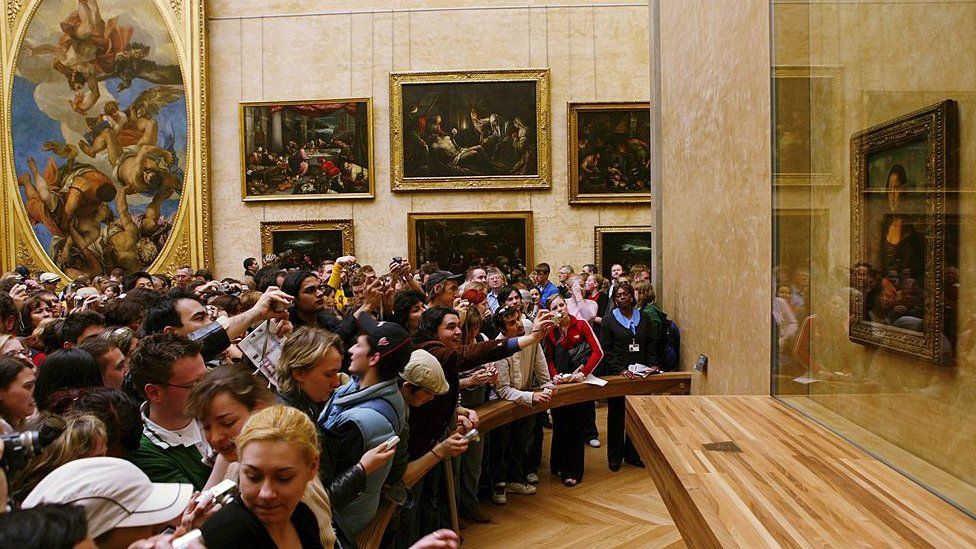
Mona Lisa is moving - what does it take to keep her safe? - BBC News
“Seeing” the Mona Lisa

Let me tell you three short stories about money, value, and art.

Story #1. Have you been to the Louvre and seen the famous Mona Lisa?

It’s a surprisingly small portrait, and your view is limited by the fact that a rail protects it from a close approach.

Further, most of the time, it is surrounded by a dense crowd of viewers, each of whom is able to spend only a few seconds to look at what arguably is the most famous painting in the world.Mona Lisa - Wikipedia

In the unlikely event this painting ever were sold, the cost would be in the trillions of euros.

Yet, you could purchase a very good lithographed copy for a few dollars, and you could hang it in your home, and enjoy it for hours on end.
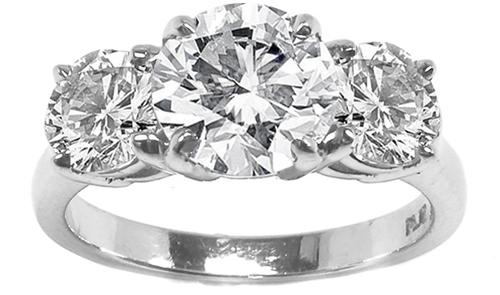
Center diamond: 3 carats. Each side diamond: 2 carats

So why would anyone spend millions, billions, or trillions of dollars to own something they could have for next to nothing?

Story #2. Years ago, I bought for my wife (now deceased) a ring, from a cousin (also now deceased) who was a wholesale diamond merchant. He sold to retailers, who sold to the public, so his own buying price was quite low.

The ring had a magnificent center diamond weighing 3 carats, with a diamond on both sides, each weighing 2 carats.

As I recall, the “family” price to me was about $7,000. I since have sold that ring for many times that amount.

But, I could have purchased an essentially identical piece of jewelry, made from cubic zirconia, for about $750, give or take.

Without a jeweler’s loop, no one (but my wife) would have been the wiser.

So why would a fool (me) spend so much on essentially nothing?

Perhaps the most visible form of art collecting today, and the one that drives so much public discussion about art, is the art purchased for millions of dollars – the pieces by Picasso and Damien Hirst traded by the ultrawealthy. 

Why were those pieces of are exchanged for so much money?

Finally, I think many people buy art strictly as an investment, hoping that it will appreciate in value.

If you look at the reasons people buy art, only one of them – buying art for your home – has to do with the physical work.

Every other reason for buying art that I listed could apply to crypto art.

You can build your own virtual gallery online and share it with other people online. You can convey your tastes and interests through your virtual gallery and support artists by buying their work.

You can participate in a community: Some crypto artists, who have felt excluded by the mainstream art world, say they have found more support in the crypto community and can now earn a living making art.

While Beeple’s big sale made headlines, most crypto art sales are much more affordable, in the tens or hundreds of dollars. This supports a much larger community than just a select few artists. And some resale values have gone up.

Aside from the visual pleasure of physical objects, nearly all the value art offers is, in some way, a social construct. This does not mean that art is interchangeable, or that the historical significance and technical skill of a Rembrandt is imaginary.

It means that the value we place on these attributes is a choice.

Story #3. It’s not really a story, but a common observation: Millionaires and billionaires love to see their names on things: Hospitals, schools, libraries, sports’ centers, etc. So they give away millions or billions of dollars, just to see what they could have seen for a few dollars or nothing: Their names.

What do they get for their money? Nothing physical.

They could have contributed without insisting that their name be engraved somewhere. They received the same benefit as did the person who bought the crypto art, and the same benefit I received for buying three transparent stones my wife could wear.

And that is the not-so-secret of the balance sheet notation we call “money.” Those arbitrary, non-physical, made-from-thin air dollars have enough value to be traded for  . . . traded for what? A couple of transparent stones? A picture?

They all are valuable because we social animals choose to deem them valuable.

You might respond that scarcity is what makes them valuable. But plenty of things are scarce and not valuable. I paint, but my paintings are not valuable, though they are just as scarce as the Mona Lisa.

You might say beauty or artistic talent makes them valuable. But before artists become famous, their paintings are just as beautiful and require just as much talent, but are valued much less.

When someone pays $90 million for a metal balloon animal made by Jeff Koons, it’s hard to believe that the work has that much “intrinsic” value.

Even if the materials and craftsmanship are quite good, surely some of those millions are simply buying the right to say “I bought a Koons. And I spent a lot of money on it.” If you just want an artfully made metal balloon animal, there are cheaper ways to get one.

Conversely, the conceptual art tradition has long separated the object itself from the value of the work. Maurizio Cattelan sold a banana taped to a wall for six figures, twice; the value of the work was not in the banana or in the duct tape, nor in the way that the two were attached, but in the story and drama around the work.

Again, the buyers weren’t really buying a banana, they were buying the right to say they “owned” this artwork.

Depending on your point of view, crypto art could be the ultimate manifestation of conceptual art’s separation of the work of art from any physical object. It is pure conceptual abstraction, applied to ownership.

On the other hand, crypto art could be seen as reducing art to the purest form of buying and selling for conspicuous consumption.

In Victor Pelevin’s satirical novel “Homo Zapiens,” the main character visits an art exhibition where only the names and sale prices of the works are shown. When he says he doesn’t understand – where are the paintings themselves? – it becomes clear that this isn’t the point. Buying and selling is more important than the art.

This story was satire. But crypto art takes this one step further. If the point of ownership is to be able to say you own the work, why bother with anything but a receipt?

The reason art, or anything else — cars, houses, jewelry, etc. — has value is not just its intrinsic value. For most of us, there are cheaper forms of transportation, cheaper forms of shelter, and cheaper stones than what we paid. A scratched and dented car has the same transportation value as does a shiny, untainted car.

We are social animals. These things have value because other people think they have value, and they are willing to exchange other things they think have value to get them.

And that is why money has value.

Money has value because the world thinks it has value. Remember, money has no physical existence. It is just a bookkeeping notation. And that same notation might appear in several places.

It might appear on your bank’s computer, on your computer, or on dozens of other computers. No matter how many computers it appears in, it still is the same money. It still has the same value.

It still seems hard to get used to the idea of spending money for nothing tangible.

Would anyone pay money for NFTs that say they “own” the Brooklyn Bridge or the whole of the Earth or the concept of love? People can create all the NFTs they want about anything, over and over again. I could make my own NFT claiming that I own the Mona Lisa, and record it to the blockchain, and no one could stop me.

But I think this misses the point.

In crypto art, there is an implicit contract that what you’re buying is unique. The artist makes only one of these tokens, and the one right you get when you buy crypto art is to say that you own that work.

Actually, the more important right is to say that you can afford to own the work.

As an investment, crypto-art just seems inconceivable to me that the higher prices reflect true value, in the sense of these works having higher resale value in the long term. As in the traditional art world, there are a lot more works being sold than could ever possibly be considered significant in a generation’s time.

And, in the crypto world, we’re seeing highly volatile prices, a sudden frenzy of interest, and huge sums being paid for things that seem, on the surface, not to have the slightest bit of value at all, such as the $2.5 million bid to “own” Jack Dorsey’s first tweetor even the $1,000 bid on a photo of a cease-and-desist letter about NFTs.

Much of this energy seems to be driven by price speculation. It’s also worth noting that the winner of the Beeple auction seems to be heavily invested in the success of crypto art. The cryptocurrencies that drive crypto art are often considered highly speculative.

Yes, there could be a tulip-bulb bubble at work here. And, where there is no intrinsic value, the possibility of a bubble increases.

But money itself has no intrinsic value. The value of the U.S. dollar is backed by the full faith and credit of the U.S. government. (See: Understanding Federal Debt. Full Faith and Credit.)

But what backs the full faith and credit of the U.S. government. No, not the “amber waves of grain,” or the “purple mountain majesties,” or the “enameled plain.” No creditor can acquire those.

The value of the Mona Lisa, the diamond ring, a mansion, a Rolls Royce car, the full faith and credit of the U.S. government, and the value of the U.S. dollar itself, all are backed by the same thing: Society’s belief that they have value.

Do you believe the dollar, that whispy, non-physical number in a bookkeeping record has value? If so, you are part of the billions of people who also think it has value.

Your dog doesn’t value a dollar. A fish doesn’t value a dollar. Tribes in the Amazon jungle don’t value the dollar.

But billions of people do, simply because other billions of people do. That is how value is determined.

When people claim that the federal government or some agency of the federal government (Social Security, Medicare et al) is in danger of running short of dollars, the ignorance is manifest. How can a government run short of something it creates by waving a magic wand (in the form of a computer key)?

Soon, President Biden will tell us he has to raise taxes in order to “pay for” the trillions being spent for COVID relief. It is utter nonsense. It is terrible, horrible, damaging Big Lie.

It is a lie that punishes America every day, by preventing us from having Medicare for All, Good Education for All, Good Housing for All, Good Food for All, Good Clothing for All, Good Transportation for All, and every other easily affordable (by the federal government) benefit.

The U.S. government not only has the unlimited ability to create dollars from thin air, but it can give those dollars any value it chooses (i.e. prevent or cure inflation.) The government neither borrows nor levies taxes to obtain dollars. It just waves that magic wand.

What is a dollar worth? Whatever its creator and society says it’s worth.

Hey, 69 million of them are worth the ability to claim you own a link to a JPEG file.

And it cost the federal government absolutely nothing to create those 69 million dollars.

In that same vein, if you send me a thousand dollars, I will send you (electronically, of course) a receipt saying you sent me $1,000. You can print it and hang it proudly in your home.

Giving you that receipt will cost me as much as providing free Medicare for All would cost the U.S. government. 

Exactly as much.

Rodger Malcolm Mitchell

Monetary Sovereignty Twitter: @rodgermitchell Search #monetarysovereignty Facebook: Rodger Malcolm Mitchell …………………………………………………………………………………………………………………………………………………………………………………………………………………………………………………………………………………………..

THE SOLE PURPOSE OF GOVERNMENT IS TO IMPROVE AND PROTECT THE LIVES OF THE PEOPLE.

The most important problems in economics involve:

  1. Monetary Sovereignty describes money creation and destruction.
  2. Gap Psychology describes the common desire to distance oneself from those “below” in any socio-economic ranking, and to come nearer those “above.” The socio-economic distance is referred to as “The Gap.”

Wide Gaps negatively affect poverty, health and longevity, education, housing, law and crime, war, leadership, ownership, bigotry, supply and demand, taxation, GDP, international relations, scientific advancement, the environment, human motivation and well-being, and virtually every other issue in economics. Implementation of Monetary Sovereignty and The Ten Steps To Prosperity can grow the economy and narrow the Gaps:

Ten Steps To Prosperity:

  1. Eliminate FICA
  2. Federally funded Medicare — parts A, B & D, plus long-term care — for everyone
  3. Social Security for all
  4. Free education (including post-grad) for everyone
  5. Salary for attending school
  6. Eliminate federal taxes on business
  7. Increase the standard income tax deduction, annually. 
  8. Tax the very rich (the “.1%”) more, with higher progressive tax rates on all forms of income.
  9. Federal ownership of all banks
  10. Increase federal spending on the myriad initiatives that benefit America’s 99.9% 

The Ten Steps will grow the economy and narrow the income/wealth/power Gap between the rich and the rest.

MONETARY SOVEREIGNTY

Should the United States be zero-sum or mutually beneficial?

Should the United States be zero-sum or mutually beneficial?

Most games are zero-sum. Baseball, football, basketball, gin rummy, etc. If you win, I lose, so I must do everything possible not only to win, but also to make sure you lose.

Is that the type of United States of which you would be proud and in which you wish to live?

Or would you prefer a mutually beneficial United States?

Would you prefer a nation in which my winning supports your winning?

Most families are mutually beneficial. The traditional TV family of father works, mother cooks, children help out and learn to become good people, is an example of mutual benefit.

Two companies competing for the same business are zero sum.

But what about a company and its employees? The best ones are mutually beneficial. When the companies prosper, the employees prosper.

The worst companies are zero-sum, with the employees trying to get the most and the companies trying to give the least.

I remember being a Chicago Bulls basketball fan during the era of perhaps the greatest player of all time, Michael Jordan. Externally, they were zero-sum. When they won, the other team lost.

But internally, the team and Jordan were smart enough to realize that great as he was, Jordon couldn’t do it alone. So he took a lower salary than he otherwise could command, so there would be enough money to pay Scottie Pippin, Dennis Rodman, et al.

Together they won six championships.

The team owners set a salary ceiling, so that the richest owner wouldn’t acquire all the best players. But as greedy as the owners were, they realized that they had to leave enough to motivate enough great players, so fans would be attracted.

As a result, the owners became rich, and so did the players.

The very concept of the United States came with the realization that to acquire the benefits of mutual protection, each state had to give up some of its sovereignty to a central government. The Constitution itself is a result of compromise, and our glorious, democratic world comes from mutual benefit.

The short-sighted are selfish, and they refuse to compromise. The far-sighted understand the power of compromise, and realize that over the long run, giving a little to get a little becomes what these days is known as a “win-win.”

Today, that compromise, win-win, mutually beneficial idea has been lost, especially by the Republican party.

This is a party, led by a psychopathic, short-sighted philosophy. It has become embedded with the notion that anything the Democrats wish to do must be fought, lest the Democrats receive credit, regardless of the benefits to the United States as a whole.

This is a party whose politicians 100% voted against the $1.9 million dollar stimulus package despite the fact that it contains many things Republican constituents want and need.

The problem: It was a package put forth by Democrats, and heaven forbid that “enemy” party receive voter goodwill, despite the fact that the majority of Republican voters support the bill.

This is a party that puts loyalty to Donald Trump above loyalty to America, to its middle-class, or to its poor.

The idea that a politician should represent his/her constituents is largely gone. The idea that a politician should follow his/her conscience and do the right thing is totally gone.

One must admire the morality of the Democrats who seriously consider the impeachment of a governor from their own party, because he may have been too flirtatious with young women, and because he lied about COVID in nursing homes.

Can you imagine the Republicans wanting to impeach a politician who has admitted to grabbing women “by their p*ssies, and whose ongoing lies helped kill 500,000+ Americans?

Today, there are only two questions in American politics:

  1. Will it help our side win?
  2. Will it help the other side lose?

Lying is fine. Exaggeration, misleading, and defrauding are expected. If one group of voters leans toward the other side, try to cheat them out of their vote.

And of course, the “I-didn’t-lose;-I-was-cheated divisiveness is an admired “win-at-all-costs” ploy.

As for “What’s-best-for-America,” even the electorate believes that’s a loser’s game. The voters have become accustomed to the narrow-minded, massively unpatriotic notion of “Me first; to-hell-with-everyone-else.”

Patriotism has devolved to waving a flag, chanting “USA, USA” and vilifying half of Americans.

And as for that 100% who voted against the stimulus packages, and still denounce it because some of the money goes to something they don’t like, really? Really 100%?

Are you so willing to sink the opposition and see the entire country sink into poverty, that you cannot find it within your hearts and minds to allot some dollars to the “blue” states you despise?

Do you really hate the blacks and Mexicans so much that you feel they should be disenfranchised during the next election, just to make sure they have no voice in the future?

Do you really enjoy the ranting misstatements of an anti-unity, alienating little twerp like Tucker Carlson, who would slam Mother Theresa and your mother, if he thought they were Democrats?

If so, then I thank God you were not among the ones who created the United States and our Constitution, else we would be a balkanized little bunch of fiefdoms, powerless and laughed at by the world.

Today, the self-proclaimed “patriots” of some states, wish to leave the union so they can wave the Confederate flag above their own miserable tribes, perhaps to re-install slavery and erect statues to traitors.

It was not always thus. There have been times, even within the past few decades, when politicians of opposing political parties, negotiated “what-is-best-for-America.”

Even recently, President Biden invited ten Republicans to the White House to discuss the stimulus package.

Well, that was a bloody waste of time. The Republicans wanted the infinitely rich federal government to spend less so the poor and middle-classes could receive less.

Even after the Dems compromised (fruitlessly, as it turns out) by cutting back on payments, still 100% of Republicans could find nothing to compromise about.

And horrors, the monetarily non-sovereign, on-the-edge-of-insolvency “blue” states will receive money to help support their poor urban areas that already send more dollars to the federal government than they receive.

I have news for you politicians and voters: The “winner-take-all, I-win, you-lose” attitude has not “made America great again.” Instead, it greatly has weakened the United States and turned us into the Divided States of America.

Once we were respected and admired. Today, we are scorned.

To paraphrase the Margueritaville song:

You Republicans claim
The Dems are to blame,
But you know,
It’s your own damn fault.

Rodger Malcolm Mitchell

Monetary Sovereignty Twitter: @rodgermitchell Search #monetarysovereignty Facebook: Rodger Malcolm Mitchell …………………………………………………………………………………………………………………………………………………………………………………………………………………………………………………………………………………………..

THE SOLE PURPOSE OF GOVERNMENT IS TO IMPROVE AND PROTECT THE LIVES OF THE PEOPLE.

The most important problems in economics involve:

  1. Monetary Sovereignty describes money creation and destruction.
  2. Gap Psychology describes the common desire to distance oneself from those “below” in any socio-economic ranking, and to come nearer those “above.” The socio-economic distance is referred to as “The Gap.”

Wide Gaps negatively affect poverty, health and longevity, education, housing, law and crime, war, leadership, ownership, bigotry, supply and demand, taxation, GDP, international relations, scientific advancement, the environment, human motivation and well-being, and virtually every other issue in economics. Implementation of Monetary Sovereignty and The Ten Steps To Prosperity can grow the economy and narrow the Gaps:

Ten Steps To Prosperity:

  1. Eliminate FICA
  2. Federally funded Medicare — parts A, B & D, plus long-term care — for everyone
  3. Social Security for all or a reverse income tax
  4. Free education (including post-grad) for everyone
  5. Salary for attending school
  6. Eliminate federal taxes on business
  7. Increase the standard income tax deduction, annually. 
  8. Tax the very rich (the “.1%”) more, with higher progressive tax rates on all forms of income.
  9. Federal ownership of all banks
  10. Increase federal spending on the myriad initiatives that benefit America’s 99.9% 

The Ten Steps will grow the economy and narrow the income/wealth/power Gap between the rich and the rest.

MONETARY SOVEREIGNTY

Fear and hatred, the evil twins of human emotion

Fear begets hatred.

These two emotions are twins, with fear being the firstborn and hatred eventually becoming the larger, evil twin.

It is impossible for you to hate what you do not already fear. 

Fear is the shrinking emotion, manifested in cowering and retreat. Hatred is the aggressive emotion, manifested in anger and aggression. Evolution has given us these twin emotions — the most powerful emotions we own — as survival responses to danger.

Bigotry is hatred, and like all hatred, bigotry is caused by fear. If you hate blacks, browns, yellows, or reds, it is because you fear them. It is your fear that enables your bigotry.

When you hate, you wish to harm the thing you fear. You stomp on a spider, but not on a butterfly. You fear the spider; you don’t fear the butterfly.

Often, you yourself cannot stomp on that spider, so you enlist a proxy to do your stomping. The Ku Klux Klan was formed to provide harm to the feared and hated blacks. For millions of bigots, the KKK provided the proxy, doing the harm the bigots could not or would not do themselves.

Hitler promoted the “danger” of Jews and Gypsies being traitors who polluted the Arian gene pool. Germans were taught fear, which progressed to hatred, against which no amount of logic, reason, or facts could prevail.

The result was mindless hatred. No amount of “stomping,” even a horrifying death camp for innocent men, women, and children, could erase the fear. Only total eradication — the “final solution” — could ease the distress of the haters.

Hitler was the proxy, who claimed he was the “only” one who could save the fearful Germans.

Woman shot inside U.S. Capitol during pro-Trump mob riot has died – The Denver Post
HATRED IS COWARDICE

Bullying is another symptom of fear. The bully is afraid the world will see his/her shortcomings, so he seeks to express dominance. The bully tries to distance himself from those who are weaker, thinking that will make him look strong.

Bullying is encouraged by mobs of people doing what they don’t have the courage to do alone.

All those with a dictatorial bent — including the Donald Trumps of the world — are aware of the relationship between fear and hatred and the public’s wish to have a proxy do harm to those who are feared.

Trump told you Mexicans are dangerous criminals and rapists. He told you Muslims are terrorists. He told you Democrats would endanger you by taking away your guns and allowing vicious aliens to run wild.

And he told you he was the “only” one who could save you.

Trump manipulated your emotions first by making you afraid, then by stoking your hatred, then by offering himself as your proxy for harming those he has trained you to fear and hate.

Fear and hatred are such powerful emotions, they override logic and reason. Trump’s followers know he is a liar, a bully, a thief, and an incompetent. They know intellectually, he is one of the worst human beings ever to fall into the Presidency.

Those who are educated in psychology know Trump is a psychopath.

But his followers forgave him for everything because he promised them protection from what they fear and punishment to those they hate.

That fear-to-hatred path is what drives cults. Leaders of cults warn their followers about the dangers of the “outside” world, then claim that only they, the leaders, can protect the followers from those dangers, thereby generating absolute allegiance and obedience to the cult.

Breaking the hatred and unholy bond to the leader requires allaying the fear.  Simple facts won’t do it; they are dismissed as “lies” by outsiders, and often serve as reinforcement of the leader’s warnings.

The hater not only must be made to feel comfortable with the object of his fears, but also be comfortable with rejecting the notion of fear, itself.

In short, it is a two-path journey.

On one path, the hater must be taught to look inward and to say to himself, “I am better than this. I am stronger than this. I safely can give these people my compassion.”

On the other path, the hater must be taught to look outward, at the object(s) of his hatred and say, “I do not fear them. They are people, just like me, and like me, they have hopes and loves and fears. They want the same kinds of things I want, and if I can get to know them better, we will find common ground.”

The most common fear-modulating device is called “exposure therapy,” which means what it sounds like. Graduated increases in exposure to the objects of your fear will reduce the fear which will reduce the hatred.

Example: Afraid of spiders? First, get a toy spider to play with. Then observe a real spider in a bottle. Then observe the spider on a table but trapped in a mesh cage.

Then reach into the cage with a pencil and touch the spider. Then reach in with your finger to touch the spider. Finally, reach in with your hand and allow the spider to walk in your palm.

Exposure therapy is difficult with humans. Even if you put a dozen black-fearing whites into a room together with a dozen white-fearing blacks, the two groups will tend to separate into”us” vs. “them.” Quite possibly, their fear and hatred will grow.

You see that effect in high schools and in prison populations.

Government encouraging inter-racial marriage probably long-term would reduce inter-racial fear and hatred. Presumably, there is some far away tipping point at which there are enough biracial children to create a quasi “herd-immunity” to racial fear and hatred. We won’t live long enough to see it.

There isn’t one basic cause of hatred-inducing fear. Every group is feared for something(s) different. For instance, blacks probably are feared most for crime. So, perhaps, the best cure for anti-black bigotry is to eliminate the anti-black fear by eliminating poverty.

Poverty is the single best predictor of crime, and crime begets fear, so eliminating black poverty would reduce anti-black bigotry.

Ironically, one way to reduce fear is to follow the lead of the cult leaders and induce another fear, a more acceptable fear.

During crises, people have been known to come together for mutual protection. Wars, for instance, tend to unite citizens of a nation under the banner of patriotism. The entire nation becomes the “we,” with the enemy becoming the “they.”

Ultimately, there may be no better way to eliminate hatred than to recognize it for what it is: An admission of weakness.

Haters like to pose as strong and forceful, when in fact they mask vulnerability and impotence. It was the cowards who comprised the lynch mobs and wore the KKK robes. It was the cowards who invaded Congress, doing in a mob what they would not have the courage to do alone.

Expressions of hatred are admissions of fear and weakness.

Teach that until it becomes common knowledge, and hatred may become less socially acceptable.

And maybe, just maybe, our democracy can avoid falling under the thumb of a brutal (and cowardly) dictator.

Rodger Malcolm Mitchell

Monetary Sovereignty Twitter: @rodgermitchell Search #monetarysovereignty Facebook: Rodger Malcolm Mitchell …………………………………………………………………………………………………………………………………………………………………………………………………………………………………………………………………………………………..

THE SOLE PURPOSE OF GOVERNMENT IS TO IMPROVE AND PROTECT THE LIVES OF THE PEOPLE.

The most important problems in economics involve:

  1. Monetary Sovereignty describes money creation and destruction.
  2. Gap Psychology describes the common desire to distance oneself from those “below” in any socio-economic ranking, and to come nearer those “above.” The socio-economic distance is referred to as “The Gap.”

Wide Gaps negatively affect poverty, health and longevity, education, housing, law and crime, war, leadership, ownership, bigotry, supply and demand, taxation, GDP, international relations, scientific advancement, the environment, human motivation and well-being, and virtually every other issue in economics. Implementation of Monetary Sovereignty and The Ten Steps To Prosperity can grow the economy and narrow the Gaps:

Ten Steps To Prosperity:

  1. Eliminate FICA
  2. Federally funded Medicare — parts A, B & D, plus long-term care — for everyone
  3. Social Security for all or a reverse income tax
  4. Free education (including post-grad) for everyone
  5. Salary for attending school
  6. Eliminate federal taxes on business
  7. Increase the standard income tax deduction, annually. 
  8. Tax the very rich (the “.1%”) more, with higher progressive tax rates on all forms of income.
  9. Federal ownership of all banks
  10. Increase federal spending on the myriad initiatives that benefit America’s 99.9% 

The Ten Steps will grow the economy and narrow the income/wealth/power Gap between the rich and the rest.

MONETARY SOVEREIGNTY

Is poverty harmful, harmless, or a benefit?

Liberals think the purpose of government is to protect the poor and powerless from the rich and powerful. Conservatives think the purpose of government is to protect the rich and powerful from the poor and powerless.
================================================================================================================================================

Evolution requires that for any physical feature to last a long time it either must be harmless or a benefit. Over the eons, harmful features tend to disappear.

Consider toenails. Once we came down from the trees, toenails were of no imaginable use, but they require so little energy to grow, they have not been an evolutionary inhibition. So we still have them.

Poverty too, has been with our species for thousands of years. But one is reluctant to say it is harmless. So that leaves the possibility that poverty is a benefit.

Or, because it is a social feature, rather than a physical feature, rather than a physical benefit, might it only be a perceived benefit?

Regarding perception, the Democrats are about to pass what can be one of the most meaningful bills in many years — meaningful because that one bill can change common economics perceptions.

Child tax credit expansion sets up showdown with GOP
By ALEXANDRA JAFFE and JOSH BOAK
March 8, 2021

WASHINGTON (AP) — The massive ($1.9 trillion) coronavirus relief plan making its way to President Joe Biden’s desk includes a plan to temporarily raise the child tax credit that could end up permanently changing the way the country deals with child poverty.

The American Rescue Plan, expected to receive final approval this week, temporarily raises the child tax credit, now at a maximum of $2,000, to as much as $3,600 per child annually.

The plan also expands the credit so it’s fully available to the poorest families, instead of restricting it based on the parents’ tax liability. And it will be paid out in monthly installments, to offer families struggling during the pandemic a more consistent lifeline.

If the Democrats are smart (big “if”), they will resist the calls to raise taxes to “pay for” the bill. The Democrats simply should allow the federal debt to rise significantly. Let debt fear-mongers wring their hands, and offer up dire predictions, none of which will occur.

The legislation gives families up to $3,600 annually for each child under age 6 and as much as $3,000 for those up to 17. 

The benefit is aimed at providing support to millions of families affected by the coronavirus pandemic. Democrats have embraced an analysis that found the proposal would cut child poverty 45%.

Republicans charge the move amounts to an expansion of the welfare state that will disincentivize parents from seeking work.

But Democrats hold out the proposal as a fundamental rethinking of the way the country approaches child poverty and an opportunity to address the income inequality that’s been exacerbated by the pandemic.

The old “disincentivize” myth simply means: “Give poor people some money, and they won’t work.” 

Thus poverty is wrongly portrayed as a benefit to the economy in that it supposedly stimulates labor. That false belief provides a ready excuse to widen the Gap between the rich and the rest.

It’s utter nonsense of course, as demonstrated by all the middle, upper-middle, and even rich people who have plenty of money yet still work. It’s the common “laziness” slur on the poor, most of whom actually labor much harder than do most of the rich.,

Connecticut Rep. Rosa DeLauro, a Democrat who has been advocating for an expansion of the credit since 2003, said in a statement that “this legislation forever changes the way that our nation supports both middle-class families and children in poverty.”

DeLauro and other Democrats on Capitol Hill see the current legislation as laying the groundwork for a permanent expansion of the credit.

Indeed, Biden himself told House Democrats during a private call last week that he supports legislation that would permanently increase the child tax credit to $3,000 per child.

While Republicans broadly support the idea of expanding benefits for children, some have opposed the Biden plan for its price tag, and others have criticized it for divorcing the benefit from any work requirement.

“Price tag” is an argument that takes several forms, among which are the false notions that:

1. Federal taxes fund federal spending. FALSE

The Federal government uniquely is Monetarily Sovereign. It never can run short of its own sovereign currency. Even if it collected $0 taxes, it could continue spending, forever.

Rather than using tax dollars, the federal government creates new dollars, ad hoc, each time it pays a creditor.

While state and local governments (which are monetarily non-sovereign) do use state and local taxes to fund spending, the federal government actually destroys federal taxes upon receipt.

That is why no one can answer the question, “How much money does the federal government have?” The best answer is, “Infinite.”

Tax dollars never become part of any money measure (i.e. M1, M2, M3, et al). They simply are destroyed

2. Federal deficit spending causes inflation. FALSE

All inflations are caused by scarcity, usually a shortage of food and/or energy.

Federal deficit spending actually can cure inflation, if the spending is directed toward reducing the scarcity (for instance, by buying overseas and distributing the scarce goods, or by supporting the manufacture of the scarce goods).

3. Federal deficit spending slows the economy. FALSE

The most common measure of the economy is Gross Domestic Product (GDP), the formula for which is:

GDP = Federal Spending + Non-federal Spending + Net Exports

Increases in federal deficit spending increase all three terms in the GDP formula.

4. Federal borrowing competes with private borrowing. FALSE

Though state and local governments do borrow, the U.S. federal government does not borrow. Federal financing is nothing like state and local government financing.

Banks and credit card companies, which do the vast majority of lending in America, do not lend to the federal government.

5. Future taxpayers will have to pay for the federal debt. FALSE

Because the federal government has the unlimited ability to create dollars, it does not borrow. Instead, it allows for deposits into T-security (T-bill, T-note, T-bond) accounts.

When you buy a T-security, you are not lending money to the federal government. You are making a deposit into your own T-security account, held at the Federal Reserve Bank. There your dollars remain, collecting interest until maturity, at which time the government returns your dollars.

The federal government does not use those dollars to pay its creditors or for any other purpose.

No borrowing or taxpayer money ever is involved in T-security transactions. All taxpayer dollars are destroyed upon receipt.

6. Federal interest payments crowd out other federal spending. FALSE

The federal government has the unlimited power to create dollars. It can pay an infinite amount of interest.

Scott Winship, director of poverty studies at the conservative American Enterprise Institute, said his concern is that a permanent child allowance might make parents less likely to work and reduce the number of two-parent households, since there would be a stream of income from the government.

He wants to reduce child poverty but is concerned that doing so this way might worsen factors such as unemployment and single-parenthood that contribute to policy.

“The feeling is we win the battle against child poverty but we lose the war in the long run because we’ve created incentives that make it tougher to reduce poverty,” Winship said.

The conservatives want you to believe that giving the impoverished money increases poverty. Remember that bit of nonsense, every time to make a contribution to charity. According to the conservatives, when you drop a dollar into the bell-ringer-Santa’s pail, you are worsening poverty!

“If pulling families out of poverty were as simple as handing moms and dads a check, we would have solved poverty a long time ago,” Sen. Marco Rubio wrote.

Pulling families out of poverty is as simple as handing moms and dads checks, but ignorant and/or dishonest politicians won’t admit it.

But the expanded benefits included in the coronavirus relief plan set up a precedent that could put Republicans on defense on the issue. Because the benefit currently expires after a year, the Biden plan essentially creates a potential fiscal cliff for child poverty.

This could set up a political showdown during an election year on whether voters believe it’s acceptable for millions of children to lose the added aid and become impoverished once again.

“When it’s up for renewal, Republicans will be in the awkward position of opposing payments to families delivered through a credit that they pioneered, and championed as recently as 2017,” said Samuel Hammond, director of poverty and welfare policy at the Niskanen Center. 

“No Republican wants to run on taking money away from families of any income,” Hammond said.

The Republicans never have expressed sympathy for the less-than-rich families. They tend to blame the impoverished for their own poverty, rather than to admit that good or bad fortune are the primary determinants of wealth.

Looking toward the midterm elections, the attack ads aimed at Republicans would simply highlight the party’s votes for tax cuts during the Trump administration in contrast with their votes against the Biden plan.

“It’s as simple as, when it was a vote on tax cuts for billionaires, Republicans voted yes, and when it was a check for you, they voted no,” he said.

If the Democrats avoid the pressure from the economics-ignorant, unnecessarily to raise taxes, the results might at long last demonstrate the facts of Monetary Sovereignty, and maybe, just maybe, we wouldn’t be subjected to the following Big Lies from such as the Committee For A Responsible Federal Budget (CFRB):

How High Are Federal Interest Payments?
Mar 10, 2021

This year, the federal government will spend $300 billion on interest payments on the national debt. This is the equivalent of nearly 9 percent of all federal revenue collection and over $2,400 per household.

Households don’t pay for federal interest payments.

The federal government spends more on interest than on transportation, education, and research and development combined.

The above statement is irrelevant. It only demonstrates that the government could spend more on transportation, education, and research and development.

The household share of federal interest is larger than average household spending on many typical expenditures, including gas, clothing, education, or personal care.

Again, irrelevant. Households do not pay for federal interest.

Growing debt levels add to the cost and risk associated with them.

The federal government has the unlimited ability to fund interest payments, which actually stimulate economic growth. There is no risk associated with federal spending.

Even with exceptionally low interest rates, the federal government is projected to spend just over $300 billion on net interest payments in fiscal year 2021. This amount is more than it will spend on food stamps and Social Security Disability Insurance combined.

It is nearly twice what the federal government will spend on transportation infrastructure, over four times as much as it will spend on K-12 education, almost four times what it will spend on housing, and over eight times what it will spend on research and development.

All the above demonstrates is the that government could, and should, spend more on food stamps, Social Security, infrastructure, education, housing, and research and development.

Interest payments effectively consume more than half of the worker-side payroll tax paid by households and are almost twice as large as total payments received through federal excise taxes and customs duties.

Interest payments do not “consume” any taxes. Federal taxes do not fund federal spending.

If interest rates were one percent higher than projected for all of 2021, interest costs would total $530 billion — more than the cost of Medicaid.

If rates were two percent higher, interest costs would total $750 billion, which is more than the federal governments spends on defense or Medicare. And at three percent higher, interest costs would total $975 billion — almost as much as is spent on Social Security benefits.

On a per-household basis, a one percent increase in the interest rate would increase costs by $1,805, to $4,210.

The CRFB keeps repeating the same lie, that federal taxes fund federal spending. They learned from Hitler that if you repeat a lie often enough, people will begin to believe it.

Trump used the same strategy with his repeat of the lie that the election was stolen. Millions of people believe that lie, too.

The higher the federal debt, the more exposed the federal government is to interest rate risk. 

There is no risk to the federal government or to taxpayers. The government has the unlimited ability to pay its bills. There also is no risk of inflation, which is not caused by government deficit spending, but rather by shortages, usually of food and/or energy.

And now, here is the CRFB’s Big Lie in all its glory:

Once the U.S. recovers from the COVID-19 pandemic, policymakers should work to adopt a combination of entitlement reforms, smart spending reductions, and revenue increases that will ultimately put debt and deficits on a more sustainable path.

“Entitlement reforms” and “spending reductions” mean “cut Social Security, cut Medicare, cut all social benefits for the poor and middle-income.”

“Revenue increases” means “increase FICA and other taxes on the poor and middle-income.”

“Sustainable” is the CRFB’s favorite word, that actually has no meaning at all, but it sounds oh, so prudent, doesn’t it?

SUMMARY

The Big Lie in economics is: The Monetarily Sovereign U.S. government uses tax dollars to pay its bills. This lie prevents the government from supplying benefits to those who are not rich.

A corollary to the Big Lie is the notion that spending for social benefits discourages people from working.

The Big Lie and its corollary are disseminated by the media, the politicians, and the economists who are bribed by the rich so as to widen the Gap between the rich and the rest.

Rodger Malcolm Mitchell

Monetary Sovereignty Twitter: @rodgermitchell Search #monetarysovereignty Facebook: Rodger Malcolm Mitchell …………………………………………………………………………………………………………………………………………………………………………………………………………………………………………………………………………………………..

THE SOLE PURPOSE OF GOVERNMENT IS TO IMPROVE AND PROTECT THE LIVES OF THE PEOPLE.

The most important problems in economics involve:

  1. Monetary Sovereignty describes money creation and destruction.
  2. Gap Psychology describes the common desire to distance oneself from those “below” in any socio-economic ranking, and to come nearer those “above.” The socio-economic distance is referred to as “The Gap.”

Wide Gaps negatively affect poverty, health and longevity, education, housing, law and crime, war, leadership, ownership, bigotry, supply and demand, taxation, GDP, international relations, scientific advancement, the environment, human motivation and well-being, and virtually every other issue in economics. Implementation of Monetary Sovereignty and The Ten Steps To Prosperity can grow the economy and narrow the Gaps:

Ten Steps To Prosperity:

  1. Eliminate FICA
  2. Federally funded Medicare — parts A, B & D, plus long-term care — for everyone
  3. Social Security for all or a reverse income tax
  4. Free education (including post-grad) for everyone
  5. Salary for attending school
  6. Eliminate federal taxes on business
  7. Increase the standard income tax deduction, annually. 
  8. Tax the very rich (the “.1%”) more, with higher progressive tax rates on all forms of income.
  9. Federal ownership of all banks
  10. Increase federal spending on the myriad initiatives that benefit America’s 99.9% 

The Ten Steps will grow the economy and narrow the income/wealth/power Gap between the rich and the rest.

MONETARY SOVEREIGNTY