Recession? Depression? The federal government has absolute control over what happens next.

You may believe that the U.S. government is doing everything in its power to prevent recessions and depressions.

If you believe it, you would be wrong.

While COVID-19 can cause businesses to fail, massive unemployment, poverty, and a recession or a depression, the U.S. government has the unlimited power to prevent businesses from failing, unemployment, poverty, and a recession or depression.

Consider that you own a small restaurant employing 20 people. Along comes the virus. No one can eat in your restaurant because you don’t have enough room for social distancing, and you don’t have an outdoor space.

So you have to close your doors, and let your employees go. In your little world, that means instant depression.

Now multiply your little business by millions, and you have millions of businesses in America suffering, and that would be a national depression.

Uncle Sam wants to give you $8000!
There is no reason for you to be poor.

But wait.

Your rich Uncle Sam comes to you and says, “I will give you all the money you need to keep paying your employees (including tips) and yourself the same amount you would have received had you been able to stay open.”

Now suddenly, your little world has no depression at all.

And if your rich Uncle Sam does the same for every business and person in America, suddenly the economy is thriving.

Recessions and depressions are caused by the lack of money; they are cured by infusions of money.

Companies do not close because they lack sales. Companies close because they lack income.

People do not stop spending because they lack jobs. People stop spending because they lack income.

The U.S. federal government has the absolute and unlimited power to provide income to every business and every person in America.

So why doesn’t the government do that, especially now, when so many businesses and people are suffering?

The government already has allocated (though not yet spent all) 3 trillion dollars to stimulate the economy, but that $3 trillion is much too little and far too late.

Since the government has not indicated it will raise taxes, clearly Congress and the President understand the basic truth of federal (Monetarily Sovereign) financing:

The U.S. government never can run short of dollars. It can spend endlessly, even without taxing.

So why do we see Democrats begging for money and Republicans resisting, especially when the coming election will greatly be affected by the health of the economy?

One would think President Trump, especially, would want to stimulate the economy before November, and it would be the Democrats resisting.

So, why do we repeatedly see articles like these:

Democrats seek to increase supplemental funding bill to $450 billion
By Alexander Bolton – 03/22/20
Senate Democrats are calling for a $450 billion emergency spending package to be added to the stimulus bill, nearly twice the amount Republicans have appropriated and nearly ten times what the White House has requested.

Senate Democrats propose $2,000 monthly coronavirus stimulus payments
Three Senate Democrats behind the proposal say the one-time, $1,200 stimulus checks were not nearly enough to help Americans through the COVID-19 crisis.
Author: TEGNA, Published: May 8, 2020

House passes Democrats’ $3T coronavirus ‘HEROES’ aid: Stimulus checks, money for states, rent assistance
President Donald Trump called it “DOA,” and Sen. Mitch McConnell said the bill was little more than an unrealistic wish list.
WASHINGTON — The House on Friday narrowly passed a $3 trillion coronavirus relief package crafted by Democrats that would include another round of stimulus payments of up to $1,200 per person.
President Donald Trump this week declared the Democrats’ proposal “DOA.” May 15, 2020, By Rebecca Shabad

Republicans And Democrats Are Trillions Apart On The Next Stimulus Bill
July 10, 2020
House Speaker Nancy Pelosi said the next bill ― which would be Congress’ fifth coronavirus response measure ― needed $1 trillion for state and local funding, $1 trillion for expanded unemployment benefits and direct payments, and “something like that, probably not as much” for COVID-19 testing, contact tracing, and treatment.
A senior GOP aide said Senate Republicans are pushing for $1 trillion overall.

The Republicans, who would benefit in November from any economic stimulus, amazingly reject stimulus bills. What is going on, here?

We easily could write this off as abject stupidity by Trump and his clownish group of sycophants. But it’s even more than that.

The GOP as a party, and Trump as President, are so anti-poor and pro-rich they have a knee-jerk, negative reaction to anything that helps the poor and middle classes. They incorrectly call aid to the non-rich, “socialism.” (Aid to the rich is fine, however.)

The Democrats want funding for state and local governments, and for expanded unemployment, nearly all of which aid the poor and middle classes.

McConnell’s “unrealistic wish list” comment was a reflection of the GOP’s anti-poor/middle proclivities.

Despite GOP foot-dragging, the $3 trillion stimulus, though much too little, has had some beneficial effect.

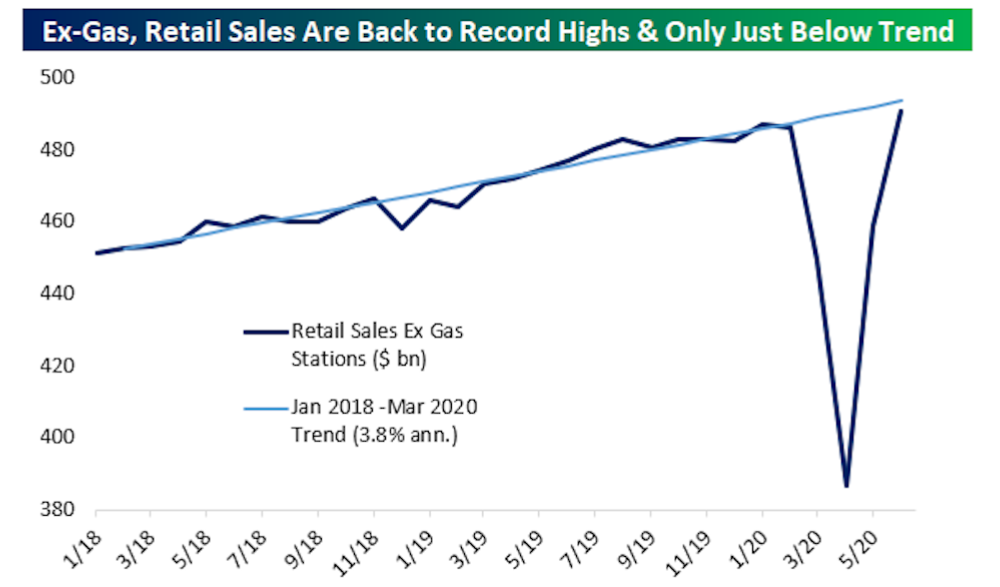
The uptick in retail sales demonstrates that a continued recovery is in Congress’s hands.

By Myles Udland, reporter and co-anchor of The Final Round. Follow him at @MylesUdland, Friday, Jul 17
Retail sales are all the way back.

Image

Sales in June jumped 7.5% over the prior month and 1.1% over the prior year, topping expectations for a 5% rise.

And as the chart from Bespoke Investment Group shows, excluding gas retail sales have come all the way back to pre-pandemic trendline growth.

And this report serves as more evidence that stimulus through the CARES Act sent to consumers has been enough to keep spending afloat and keep the gears economic growth turning.
More importantly, it serves as evidence that:

  1. Deficit spending by our Monetarily Sovereign government is not constrained by tax receipts or by any other form of receipts. The federal government needs no income.
  2. The spending by our Monetarily Sovereign is not constrained by inflation. Inflation is caused by scarcities, usually scarcities of food and/or energy, not by federal spending.
  3. Recessions and depressions and depressions can be prevented and cured by federal deficit spending.
  4. There are zero financial reasons to limit federal deficit spending.

The economic implications are enormous.

Since there are zero reasons to limit federal deficit spending, all the financial excuses for not eliminating payroll taxes (Step #1 of the Ten Steps to Prosperity, below), not providing health care for all (Step#2), not providing Social Security for All (Step #3), and not providing the rest of the Ten Steps — all those financial excuses disappear.

We are left with two false excuses:

False excuse #1: Federal spending is socialism, and socialism doesn’t work.

The reason “socialism” doesn’t work is because it involves public ownership and control of all means of production.

Despite what you repeatedly are told, mere government spending is not socialism.

False excuse #2: The poor and middle-income groups are fundamentally lazy, and if everything is given to them they won’t work.

First, the poor and middle-income groups are not fundamentally lazy. In fact, on average they work harder than do the rich

Second, the Ten Steps do not propose that “everything” be given to the poor and middle-income people. There are many levels of benefit and luxury above what the Ten Steps provide.

Third, the total of human desires is infinite. Pay for a person’s education, healthcare, housing, and food, and that person still will work to improve his life, further.

This is the lesson of Gap Psychology, the human desire to distance oneself from those below on any socioeconomic measure and to join those above. 

For example, people already owning a home and a car, will work to have an even better home and two cars. It is in the nature of people.

The GOP’s, and to a much lesser extent, the Democrat’s reluctance to spend enough to prevent and cure the coming recessions, not only is unnecessary, but cruel and insulting to those who are less wealthy.

‌”Several indicators suggest that May and June were the easy months, and that the resurgence of COVID-19 cases is leading to slower activity gains in July.” JPMorgan estimates that real consumer spending was 7.2% below January’s level in June.

‌As we’ve written in recent weeks, the pending expiration of these benefits is a looming fiscal cliff that could short circuit the still-fragile economic recovery.

Benefits for businesses and consumers should not end nor should they be inhibited. They should be increased, massively, to prevent the human suffering recessions cause.

The sole purpose of a government is to improve and protect the lives of the people, not to force them to dance on the edge of a precipice.

It is imperative that lawmakers continue offering support to consumers facing a historically weak labor market while small businesses continue to buckle under the pressure of the recessionary environment.

‌Including pandemic unemployment assistance claims, 2.4 million workers filed for unemployment last week.

‌Nancy Vanden Houten, lead economist at Oxford Economics, said Thursday that this data “[underscores] that layoffs remain widespread. And the risk may be for additional layoffs going forward as some states reimpose more restrictive measures to combat surging Covid-19 cases.”

‌In a separate note on Thursday, Oxford’s chief U.S. economist Greg Daco noted that the firm’s real-time activity tracker has flattened out in recent weeks, calling this a sign that we’re witnessing a “premature plateauing of the recovery.”

“Policymakers across the country have an active role to play in containing the virus and ensuring the nation avoids looming fiscal cliffs from the expiry of unemployment benefits, PPP funds running low, and state and local budgets being cut to the bone.”

Stock Video Footage - 4K and HD Video Clips | Shutterstock
This is how the federal government creates dollars.

The money exists. It is available at the touch of a computer key. It is free to the government. It costs no one, anything.

When people are drowning, you don’t throw them a ping-pong ball and yell, “Use that as your floatation device,” especially when you are standing next to a huge pile of life preservers.

There is no penalty for spending “too much,” but a huge penalty for spending too little.

‌And so while it may be an inelegant and imperfect short-term solution for the economy, there is more than enough evidence to support a continuation of enhanced unemployment benefits and another round of stimulus checks for households making less than $100,000.

Deficit spending neither is an “inelegant” nor an “imperfect” solution. It is the solution, the elegant and perfect solution to, and prevention of, recessions.

It is the elegant and perfect solution to homelessness, hunger, business failure, and the terror of impending poverty.

Don’t tell the drowning man to swim harder. And don’t limit federal aid to any household income level. That $100,000 is a trap, for it requires making such questionable determinations as:

–Should a household consisting of one person receive the same support as a household of ten people?
–Should a household averaging 80 years old receive the same as a household averaging 15 years old?
–Should a household earning $99,000 be supported, while a household earning $101,000 receives nothing?
–Should people living in an expensive big city receive the same as people living in an inexpensive rural area?

Money going to people should be on a per-capita basis, with the same amount going to rich old men and to poor infants.

Money going to states also should be on a per-capita basis, with the states distributing some of the receipts to counties and cities, also on a per-capita basis.

Money going to businesses should be based on the previous year’s gross sales, with special rules for new businesses.

‌Consumer spending accounts for just about 70% of GDP growth.

And with such a clear path forward for Congress to help support an economy likely to suffer its largest drop in growth since World War II, there is little to no justification for letting these benefits lapse.

There is no justification, financial or moral, for not implementing the Ten Steps, and for not dramatically increasing federal deficit spending to prevent a recession, grow the economy, and narrow the Gaps between the richer and the poorer.

Rodger Malcolm Mitchell

Monetary Sovereignty Twitter: @rodgermitchell Search #monetarysovereignty Facebook: Rodger Malcolm Mitchell …………………………………………………………………………………………………………………………………………………………………………………………………………………………………………………………………………………………..

THE SOLE PURPOSE OF GOVERNMENT IS TO IMPROVE AND PROTECT THE LIVES OF THE PEOPLE.

The most important problems in economics involve:

  1. Monetary Sovereignty describes money creation and destruction.
  2. Gap Psychology describes the common desire to distance oneself from those “below” in any socio-economic ranking, and to come nearer those “above.” The socio-economic distance is referred to as “The Gap.”

Wide Gaps negatively affect poverty, health and longevity, education, housing, law and crime, war, leadership, ownership, bigotry, supply and demand, taxation, GDP, international relations, scientific advancement, the environment, human motivation and well-being, and virtually every other issue in economics. Implementation of Monetary Sovereignty and The Ten Steps To Prosperity can grow the economy and narrow the Gaps:

Ten Steps To Prosperity:

1. Eliminate FICA

2. Federally funded Medicare — parts A, B & D, plus long-term care — for everyone

3. Social Security for all or a reverse income tax

4. Free education (including post-grad) for everyone

5. Salary for attending school

6. Eliminate federal taxes on business

7. Increase the standard income tax deduction, annually. 

8. Tax the very rich (the “.1%”) more, with higher progressive tax rates on all forms of income.

9. Federal ownership of all banks

10.Increase federal spending on the myriad initiatives that benefit America’s 99.9% 

The Ten Steps will grow the economy and narrow the income/wealth/power Gap between the rich and the rest.

MONETARY SOVEREIGNTY

It’s a freedom of speech issue. Very simple.

Pentagon bans Confederate flag in way to avoid Trump’s wrath
By LOLITA C. BALDOR Associated Press, July 17, 2020

After weeks of wrangling, the Pentagon is banning displays of the Confederate flag on military installations, in a carefully worded policy that doesn’t mention the word ban or that specific flag.

The policy, laid out in a memo released Friday, was described by officials as a creative way to bar the flag’s display without openly contradicting or angering President Donald Trump, who has defended people’s rights to display it.

Trump has flatly rejected any notion of changing base names and has defended the flying of the Confederate flag, saying it’s a freedom of speech issue.

Trump: “All I say is freedom of speech, it’s very simple. My attitude is freedom of speech. Very strong views on the Confederate flag. With me, it’s freedom of speech. Very simple. Like it, don’t like it, it’s freedom of speech.”

Flags freedom of speech.png
 “Very strong views on the Confederate flag. With me, it’s freedom of speech. Very simple. Like it, don’t like it, it’s freedom of speech.”

It’s freedom of speech — except when anyone writes a tell-all book about him.

How Trump tries to destroy the U.S. Postal Service

Let us begin with the reminder that:

  1. The U.S. Postal Service is an agency of the U.S. government
  2. The U.S. government, being Monetarily Sovereign, never can run short of its own sovereign currency, the U.S. dollar.
  3. Therefore, no agency of the U.S. government can run short of dollars, unless that is what Congress and the President want.

So when you hear that the U.S. Postal Service is running short of money, the reason is: Congress and the President want it to run short of money. There is no other reason.

Donald Trump is destroying the Post Office
Ryan Cooper, July 16, 2020. THE WEEK

The United States Postal Service has long been the most popular government agency. The last Gallup poll on the question found 74 percent of Americans rated it as excellent or good — as compared to 60 percent for NASA or 50 percent for the IRS.

Despite years of cash trouble (mainly the fault of Congress), most people like their good old mail carrier.

No federal agency can have “cash trouble” unless the federal government wishes it to have cash trouble.

Hot mail? Fire consumes postal delivery truck | The Lovell ...
Aged trucks catch fire

Despite what you have been told by your elected liars in Washington, neither the Postal Service, nor Medicare, nor Social Security, nor the Supreme Court, nor the Congress, nor the White House, nor NASA, nor the CIA, nor the FBI, nor any other federal agency can run short of money unless that is what Congress and the President wants.

All federal agencies have available to them, the infinite money creation powers of the U.S. federal government.

Indeed, as I have written, this country could not function without the USPS. So it should come as no surprise that President Trump is taking the agency apart.

Jacob Bogage reports at The Washington Post that the USPS is facing huge problems under Louis DeJoy, a big Trump donor who was recently appointed postmaster general.

DeJoy supposedly wants it to run more like a business, and has implemented structural changes that have fouled up deliveries.

It’s yet another example of how Trump’s authoritarian rot is dissolving the American state — and raising the possibility of interference with the 2020 election.

It also is another example of how Trump invariably associates with bootlickers and other incompetents, and hires some of them to run America’s federal agencies.

(A few of Trump’s incompetent and/or criminal pals: Health and Human Services Secretary Tom Price, EPA Administrator Scott Pruitt, HUD Secretary Ben Carson, Campaign manager Paul Manafort, Deputy campaign manager Rick Gates, National security adviser Michael Flynn, Personal lawyer Michael Cohen, Commerce Secretary Wilbur Ross, Rep. Chris Collins, Rep. Duncan Hunter, mobster Salvatore Testa, mobster Fat Tony Salerno, Roger Stone, Felix Sater, Jeffrey Epstein, Secretary of Labor Alexander Acosta, Trump Campaign Foreign Policy Adviser George Papadopoulos.)

Valiant' Postal Carrier Burns Hand Saving Somers Mail – Postal ...There is zero reason for the Postal Service, or any other federal agency, to run like a business.

The foundation of a business is income and profits. Businesses cannot operate without them.

But federal agencies have no use of, or reason for, income or profits. The Postal Service, for instance, could deliver all the mail in America, without charging you a penny.

It even could deliver twice a day, including Sundays, and have everything arrive overnight, and not just mail, but packages, too, and still you wouldn’t have to pay for postage — if Congress and the President wanted you to have that service.

If you want to know why you have to pay for postage and other federal services, visit What is Gap Psychology? A brief explanation.

Let me start with some background.

As noted, the USPS has struggled since 2006, when Congress and President Bush imposed absurd pension requirements in the Postal Accountability and Enhancement Act.

As my colleague Jeff Spross writes, this required the agency to pre-fund its pension obligations over the next 75 years, and immediately knocked its budget into the red.

There used to jokes about Bush’s low intelligence until Trump came along. Suddenly, Bush looks like a genius,  but only by comparison with Trump. He still did some really foolish things.

The pension requirement is absurd for three reasons.

  1. No other federal agencies has, or needs to have, this requirement
  2. A federal agency, having the U.S. federal government behind it, should not be burdened with any such requirement; it cannot run short of dollars unless Congress votes to make it run short of dollars.
  3. The federal government can pay any amount of pension at any time, which the government proved just this year by pumping $3 trillion into the economy.

Bush’s sole purpose was to make the Postal Service so sick that he could privatize it. Privatization is one of the GOP’s and Trump’s many attempted ploys to reward the rich at the expense of the public.

As a result, the collapse in ordinary mail volume thanks to the coronavirus pandemic landed on an agency that was already struggling to keep its head above water.

More than half of its mail trucks are outdated Grumman Long Life Vehicle models, kept in service long past their planned retirement dates, and have an alarming habit of catching on fire.

They also have no air conditioning — as a result, hundreds of mail carriers have suffered heat exhaustion over the last few years, and some have even died of heatstroke.

If there is one thing Donald Trump has demonstrated he cares nothing about, it’s human life. 

His treatment of children and families at our southern border, his numerous attempts to take health care from the poor, and his demand that states, counties, cities, and schools “open up,” despite the massive illness and death tolls from the highly contagious virus, is ample proof of his callous heartlessness.

Now, as the Post reports, the USPS has also seen a huge spike in demand for package delivery as people shop more online under quarantine, which has cushioned the blow somewhat.

But the agency is still reeling, and now the Trump administration is making the problems worse.

Congress authorized USPS to borrow $10 billion as part of a coronavirus relief package, but Treasury Secretary Steven Mnuchin is refusing to hand over the money until it turns over much of its operations to him. (This was not remotely stipulated in the law and is probably illegal.)

First, there is no reason for the Postal Service to borrow money, when Congress just as easily could have voted to give them money.

Second, Mnuchin, another of Trump’s incompetent suckups, has no reason for not handing over the money Congress authorized, except he has the power to do it, and Trump wants to punish the Postal Service for delivering Amazon mail.

Trump doesn’t care, so why not?

Meanwhile, DeJoy is pushing a lot of business consultant mumbo-jumbo on the agency.

He has limited overtime, instructed mail carriers to leave mail behind that will slow down their delivery routes, and required that they park no more than four times along their delivery routes.

Trump, meanwhile, has demanded the USPS quadruple its rates on packages.

As Trump proves every day, when an incompetent is assigned a job, the incompetent will do it poorly, if he does it at all.

He wants you to pay four times what you now pay for package delivery. There is no financial reason for this. It’s just another dopey Trump idea.

This betrays an alarming lack of understanding about what makes the USPS work.

Its primary advantage is daily, inexpensive service to almost every house and business in the country.

People will not turn to it if their mail is randomly delayed or lost, which is liable to happen if it is left behind, much less if it costs four times what it currently does.

Indeed, several cities are reporting severe problems with mail service of late. And limiting parking along the delivery route is simply bizarre — it could easily make the route take longer by forcing mail carriers to walk longer distances.

(It sounds very much like the plutocrat knee-jerk belief that the way to improve efficiency is to abuse one’s employees.)

Part of it is surely the Republican hatred of public services of any kind.

GOP dogma holds that government is bad by definition, and if there is a popular and successful agency, by God they will ruin it.

This, by the way, also is the belief of the Tea Party, which effectively has destroyed any competence or morality the GOP once may have had.

Add a dash of Libertarianism, and you have the perfect oligarchy cum anarchy that runs things in Washington, today — actually I meant “ruins,” not runs. The only thing that runs in Washington is Trump continually running for office.

Part of it is just the general malicious incompetence that saturates every part of the Trump administration.

Part of it probably has to do with Trump’s feud with Jeff Bezos — he seems to think that by punishing the USPS he can hurt Amazon.

Everything is personal with Trump. Everything is about him. If he can hurt an “enemy” like Bezos, he will do it despite what happens to America.

Trump is a solid believer in punishment. He punishes all who disagree with him. He punishes the poor for being poor. He punishes immigrants, Mexicans, Muslims, blacks, women, and America. He punishes states with Democratic governors and cities with Democratic mayors.

As for rewards, there are few, and they go only to himself, to sycophants, and to Vladimir Putin.

But it’s also impossible not to notice that Trump has been screeching paranoid lies about voting by mail for the last few months, falsely portraying it as some kind of Democratic conspiracy to commit voter fraud.

The pandemic will surely still be raging come November, and people will therefore want to vote by mail if they can.

Indeed, the USPS is already warning people to submit their ballots early.

Trump or his toadies may be calculating that Democrats are more likely to vote by mail, therefore ruining mail delivery might mean enough ballots are lost or unable to be delivered in time to tip the election to Trump.

Long lines at polling places is a voting rights violation: It's ...Trump, and the rest of the GOP, show us daily they will do anything to prevent the poor and people of color from voting.

When you see long lines standing in front of a voting location, you can be sure the line consists of poor black or brown people, seldom older white people, and definitely not rich people.

Trump’s lies about mail voting (which are to prepare us for claims of voter fraud when he loses) have become so inane that at one point he said mail-in ballots are ‘dishonest’ but in the same breath, said absentee ballots are ‘fine’ though they are exactly the same thing — and the entire Trump family votes via mail-in ballot. 

However, it might actually boomerang on Trump and other Republican candidates, which have historically relied on mail-in ballots to drive turnout among their elderly voters.

Trump’s own campaign has a large absentee ballot operation, but Trump’s howling has apparently made his crackpot base leery of mail-in voting themselves — missing the intended message that mail-in voting is fraud only when Democrats do it.

And if the pandemic is bad enough, many older Republicans may not vote at all for fear of catching COVID-19.

Whatever the reason, it’s just one more potential accelerating catastrophe to add to the pile caused by Trump’s disastrous misrule.

The U.S. could not possibly have become a rich country without the connective social tissue of efficient mail service.

But it seems the president is determined to cause as much destruction on his way down as he can.


Cook steak in postal vehicle.png

If Trump does nothing more and says nothing more, he already has proved he is the least competent, least intelligent, least honest, least effective President in American history.

His slogan, “make America great, again,” is so laughably ironic, it forever will be remembered as meaning, “make America corrupt, again.”

He is supported by Trumpers who care only about preventing poor women from having abortions (rich women always can get abortions), rewarding the rich, punishing the poor, and heaping hatred on all but aged, white, domestically-born, poorly educated Christians.

But sadly, Trump won’t do and say nothing more.

He will continue to broadcast idiotic lies, and make mean-spirited decisions, to be lapped up by his few, remaining toadies. Being a psychopath, he can’t help himself.

Just three and a half more months to go. Can the U.S. Postal Service survive him? Can America survive him?

Sadly, in that brief time, the virus will take hundreds of thousands of us. So the real question is, can we the people survive him?

Rodger Malcolm Mitchell

Monetary Sovereignty Twitter: @rodgermitchell Search #monetarysovereignty Facebook: Rodger Malcolm Mitchell …………………………………………………………………………………………………………………………………………………………………………………………………………………………………………………………………………………………..

THE SOLE PURPOSE OF GOVERNMENT IS TO IMPROVE AND PROTECT THE LIVES OF THE PEOPLE.

The most important problems in economics involve:

  1. Monetary Sovereignty describes money creation and destruction.
  2. Gap Psychology describes the common desire to distance oneself from those “below” in any socio-economic ranking, and to come nearer those “above.” The socio-economic distance is referred to as “The Gap.”

Wide Gaps negatively affect poverty, health and longevity, education, housing, law and crime, war, leadership, ownership, bigotry, supply and demand, taxation, GDP, international relations, scientific advancement, the environment, human motivation and well-being, and virtually every other issue in economics. Implementation of Monetary Sovereignty and The Ten Steps To Prosperity can grow the economy and narrow the Gaps:

Ten Steps To Prosperity:

1. Eliminate FICA

2. Federally funded Medicare — parts A, B & D, plus long-term care — for everyone

3. Social Security for all or a reverse income tax

4. Free education (including post-grad) for everyone

5. Salary for attending school

6. Eliminate federal taxes on business

7. Increase the standard income tax deduction, annually. 

8. Tax the very rich (the “.1%”) more, with higher progressive tax rates on all forms of income.

9. Federal ownership of all banks

10.Increase federal spending on the myriad initiatives that benefit America’s 99.9% 

The Ten Steps will grow the economy and narrow the income/wealth/power Gap between the rich and the rest.

MONETARY SOVEREIGNTY

How pandemic insurance can strengthen America and the world.

Recently I read, We can protect the economy from pandemics. Why didn’t we?”, an article by Evan Ratliff, in the June 16, 2020 edition of Wired Magazine.

The essence of the article concerns insurance, or rather the lack of it, to protect businesses and individuals from the disastrous effects of pandemics.

Most of us pay for all sorts of insurance: Life, fire, auto, liability, flood, windstorm, theft, healthcare, the list is long. But there is no private pandemic insurance.Businesses Warned There Will Be No “Back to Normal” Following ...

In fact, pandemic coverages specifically are omitted from most insurance policies.

The foundation of any insurance coverage is statistics — the probability that a covered event will occur and how soon, and the cost to the insurer of that event.

Life insurance, for instance, is based on time. The death event is 100% certain to happen, and the amount of coverage is known.

But the variable, time until death, tells the insurance company how much it needs to earn on premiums, before paying the death benefit.

Fire insurance is based not only on time but on the likelihood of the event ever occurring. The ultimate cost limit is specified by the policy.

Pandemic insurance has not existed because:

  1. The payout could be so enormous as to bankrupt carriers
  2. Premiums would have to be enormous, thus discouraging purchase
  3. The event itself is so rare it would discourage purchasers, further.

A few excerpts from the Wired article:

Gunther Kraut, a mathematician by training, was working at Munich Re, one of the world’s largest reinsurers.

Reinsurance is the business of insuring insurers. The local and national insurance companies that you and I buy life or auto coverage from—the Geicos and Allstates of the world—need their own protection against rare but catastrophic events that might create enough claims to bankrupt them.

Reinsurance companies provide that backstop on insurance for everything from homes and infrastructure projects to business losses and individual lives. 

Munich Re had a risk problem of its own: namely, the possibility of a global pandemic. I

“Let’s take the example of car insurance,” Kraut told me. “That’s a very, very stable business.” A local company might insure tens of thousands of cars, each with a certain probability of having a small accident.

“You can predict very well how much money you will have to pay on the claim settlements, and hence how much premium you will need to collect,” he said.

But let’s say that one year there is a freakishly large hailstorm in Bavaria, damaging half the cars in the portfolio. The resulting claims could be an extinction-level event for an insurance company.

Such storms may occur statistically only once every three decades—a one-in-30-year event, in risk parlance—but every car insurance company would have to keep enough cash on hand to pay out on claims on half its cars, just in case. “That’s a lot of money you need to put aside for something that happens very rarely,” Kraut said.

The more car insurers that Munich Re adds to its portfolio, in more geographical regions, the more it can convert a rare and expensive risk into a predictable and cheaper one for itself.

Kraut said. “That’s why reinsurance companies are global companies.”

“Insurance is sold, not bought,” the industry saying goes, and pandemic insurance would be both novel and quite expensive—potentially millions of dollars on top of what the company was paying for insurance.

No CFO was eager to be the first among their competitors to take on a significant new cost.

Potential insurance clients will say, ‘OK, we understand why this could potentially be such an impact. But we haven’t seen an event like this in 100 years. Why do we need to care about it now?’”

The statistics of insurance all merge on payout cost and premium income. A policy must be predicted statistically to payout less than premiums, in order to provide a profit to the insurance carrier.

Yet here is the COVID-19 virus, costing many trillions of dollars. How many insurance companies — or even group of companies — would be willing and able to absorb that risk? And, how many potential insureds would pay premiums that exceed that risk?

The answer to both questions probably is “zero.”

But what if there were an insurance company with the financial ability to absorb infinite financial risk?

And what if the premiums were $0.

Could such a combination make for viable insurance coverage?

As impossible as it may sound, such a combination does exist. The potential insurance company is the U.S. government.

Being Monetarily Sovereign, it has the infinite ability to create dollars and it needs no premiums. It could, at the touch of a computer key, pay out $1 trillion, $10 trillion, $100 trillion, any amount instantly.

And because these dollars would replace lost dollars, any discussions about inflation would be moot.

The U.S. government has the unlimited ability to cover the entire world’s losses, and using this ability would confer several benefits on the U.S.

  1. It would prevent worldwide recessions and depressions that otherwise result from pandemics. (See: How America Can Save The Entire World.“)
  2. It would help solidify the U.S. dollar as the world’s currency.
  3. It would strengthen U.S. financial influence, worldwide.

The problem is not the inability to foretell the next pandemic. The problem is not an inability to fund payment.

The real problem is to determine exactly to whom and how much payment should be made. Look at any fire insurance policy and you will see paragraph after paragraph detailing all the various eventualities.

Insurance underwriting experts devote their business lives to describing circumstances under which loss payments will be made. 

That is the kind of information the U.S. Congress could use in writing the laws describing pandemic insurance coverage for the people and businesses in America.

While private insurance policies are based on income and outgo, i.e profits, a U.S. government program would be simpler in that it needs not consider income.

It needs only to consider outgo, the money paid to businesses and individuals for specific losses.

In one sense, the U.S. government could use “helicopter money,” just drop dollars anywhere under the assumption that eventually it will flow throughout the economy. And, in fact, the federal government’s efforts so far, have been quite similar to “helicopter money.”

The problem is that “helicopter money” tends to accumulate in the hands of the rich and powerful, rather than going to the people who need it most.

By enlisting the services of insurance underwriting experts, Congress and the President would receive guidance (if they would take it), about where the new dollars would more accurately replace lost dollars.

Replacing every lost dollar with a new dollar would help prevent a recession or a depression.

Additionally, we would need to do more than replace the old. We would need to implement the new: New methods of agriculture, manufacture, education, transportation, and entertainment that would not shut down because of a future pandemic or other similar events.

Here, specialized organizations such as the MacArthur Foundation and Future Science Group could be enlisted to help identify areas of investment.

In Summary
The world has faced, and always will face, various catastrophes.  Whether a huge,  meteor, or a coronal mass ejection, global warming, global flooding, super-volcano eruption, or of course, a pandemic.

Any of these events can kill millions of people and destroy the world’s economies.

If governments, particularly the U.S. government, remain intact, the financial losses can be “insured,” and human disaster ameliorated.

The U.S. government has the unlimited ability to replace lost money with U.S. dollars, and by using those dollars, fund reconstruction.

Congress should make use of insurance underwiters, experts in determining circumstances under which benefits will be paid, to create appropriate underwriting laws for global catastrophes.

These laws could involve not only U.S. territory, but other participating nations.

Rodger Malcolm Mitchell

Monetary Sovereignty Twitter: @rodgermitchell Search #monetarysovereignty Facebook: Rodger Malcolm Mitchell …………………………………………………………………………………………………………………………………………………………………………………………………………………………………………………………………………………………..

THE SOLE PURPOSE OF GOVERNMENT IS TO IMPROVE AND PROTECT THE LIVES OF THE PEOPLE.

The most important problems in economics involve:

  1. Monetary Sovereignty describes money creation and destruction.
  2. Gap Psychology describes the common desire to distance oneself from those “below” in any socio-economic ranking, and to come nearer those “above.” The socio-economic distance is referred to as “The Gap.”

Wide Gaps negatively affect poverty, health and longevity, education, housing, law and crime, war, leadership, ownership, bigotry, supply and demand, taxation, GDP, international relations, scientific advancement, the environment, human motivation and well-being, and virtually every other issue in economics. Implementation of Monetary Sovereignty and The Ten Steps To Prosperity can grow the economy and narrow the Gaps:

Ten Steps To Prosperity:

1. Eliminate FICA

2. Federally funded Medicare — parts A, B & D, plus long-term care — for everyone

3. Social Security for all or a reverse income tax

4. Free education (including post-grad) for everyone

5. Salary for attending school

6. Eliminate federal taxes on business

7. Increase the standard income tax deduction, annually. 

8. Tax the very rich (the “.1%”) more, with higher progressive tax rates on all forms of income.

9. Federal ownership of all banks

10.Increase federal spending on the myriad initiatives that benefit America’s 99.9% 

The Ten Steps will grow the economy and narrow the income/wealth/power Gap between the rich and the rest.

MONETARY SOVEREIGNTY