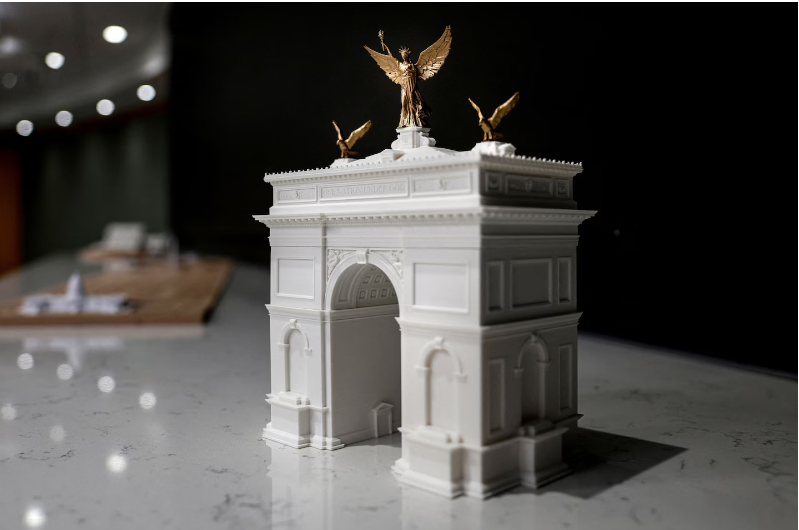
A model of Trump’s proposed 250-foot-tall triumphal arch. (Evelyn Hockstein/Reuters)
Federal officials are laying more groundwork to begin construction on President Donald Trump’s planned 250-foot-tall triumphal arch, sharing additional documents that detail the project’s scope and an aggressive timetable for potentially completing work before Trump’s term ends.
According to National Park Service documents posted this month, the administration envisions 20 hours per day of construction on the arch, year-round, in hopes of completing the project within two to three years. Construction experts said that timeline — which would involve two 10-hour daily shifts — is aggressive for a nonemergency project.
In related news, Republicans voted to reduce Medicaid and Social Security benefits and to increase FICA taxes, because these programs are running short of money.
Hitler’s triumphal arch was a massive, unbuilt monument intended to dwarf Paris’s Arc de Triomphe and serve as a centerpiece of Nazi Berlin.
Historical Context
The arch was part of Adolf Hitler and Albert Speer’s grand plan to transform Berlin into Welthauptstadt Germania, Envisioned as the capital of a global German empire. Planning began in the late 1930s, with the goal of creating monumental architecture that symbolized Nazi power, racial ideology, and the permanence of Hitler’s regime. The arch was intended to honor German soldiers who died in World War I and to impress both Germans and foreign visitors with the scale of the T
Design and Scale
The triumphal arch was designed to be three times the size of the Arc de Triomphe in Paris, large enough that the Parisian monument could fit entirely within its opening. It would have been part of a grand boulevard stretching from the Brandenburg Gate through the Tiergarten to Charlottenburg, forming an east-west axis lined with monumental buildings and public spaces. The arch’s massive pillars required extensive engineering studies due to Berlin’s marshy, sandy soil.
Engineering Test: Schwerbelastungskörper
To test the feasibility of building such a colossal structure, the Schwerbelastungskörper, a 12,650-ton concrete cylinder, was constructed between 1941 and 1942 in Tempelhof, Berlin. This cylinder measured 14 meters high and 21 meters in diameter, with a foundation extending 18.2 meters into the ground. It contained instruments to measure ground subsidence, simulating the load of one pillar of the planned arch Today, the Schwerbelastungskörper remains one of the few physical remnants of Hitler’s unrealized architectural ambitions.

