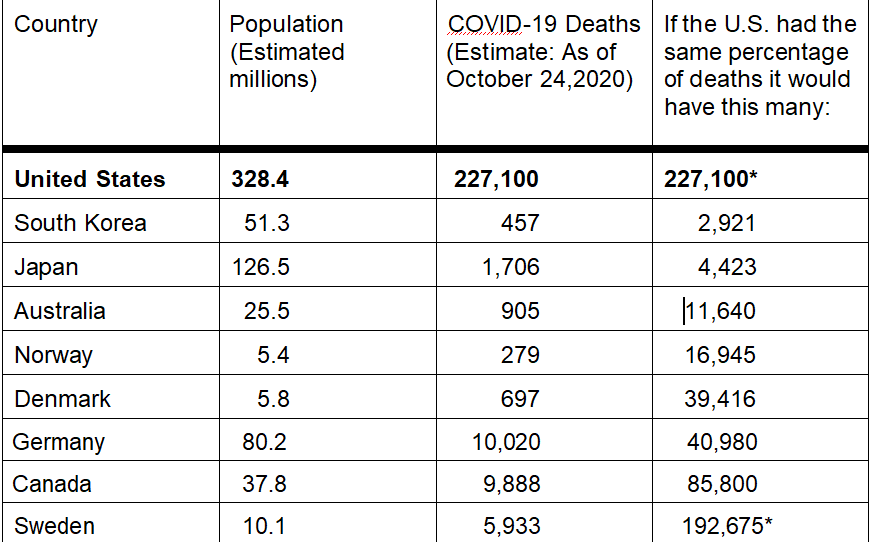
President Trump claims that if not for him, millions of Americans would have died from COVID-19. Has he really done a good job on COVID? Here’s the data. You decide.
Example: If the U.S. had done what South Korea did, we would have only 2,921 deaths by now.
*The findings of a study published Oct. 12 in the Journal of the American Medical Association pointed out that, of the countries the researchers investigated, Sweden and the U.S. essentially make up a category of two: they are the only countries with high overall mortality rates that failed to rapidly reduce those numbers as the pandemic progressed.
The numbers speak for themselves. Despite Trump’s claims, the U.S. has done almost the worst, if not the worst, job of any nation on earth, in controlling COVID-19 mortality.
His refusal to use the pandemic plans left for him by the Obama administration, his refusal to wear a mask, his mocking of people who do wear masks, his denial of COVID’s seriousness, his sabotaging of the CDC, his use of incompetent, anti-science personnel who follow his lethal lead, and his daily lying about all phases of the pandemic, have led to hundreds of thousands of unnecessary American deaths.
As such, Donald Trump is the single worst mass-murderer in American history, far outdoing Osama bin-Laden and the 9-11 terrorist act which killed “only” 2996people (including terrorists).
Trump also has far exceeded the December 7, 1941 Pearl Harbor attack, which killed 2,403, the Vietnam war which killed 47,424 Americans, and the Korean War which killed 33,686 Americans. Even World War I killed “only” 53,402 Americans.
Even now, as the rate of deaths continues to rise, Trump falsely claims we have “rounded the corner,” and fails to aggressively fight the killer.
Instead, he holds maskless ego-building rallies, from which more people will die, while he withholds money from those whose financial lives have been shattered by the disease.
No traitor or murderer in American history has been responsible for as many American deaths as has Donald J. Trump, in collusion with the Republican party.
The health of a President of the United States always is an issue. In fact, Donald Trump continually makes it an issue with repeated references to Joe Biden’s age. Biden is three years older than Trump.
Recently, Trump was interviewed by Lesley Stahl. It was a typical interview. Trump bragged, lied, repeatedly changed the subject, attacked Barack Obama, Hillary Clinton and Biden, blamed the media, and quoted unfounded conspiracy theories.
All normal.
But, something else seemed rather strange: the odd, two-handed way he drank water, as though he didn’t trust his hands not to shake.
Here are shots from the interview:
I don’t pretend to be a doctor, so I looked it up at:
What causes hand tremors?
In some cases, the cause is unknown, but tremors often result from neurological conditions, movement disorders, or other health problems.
Neurological conditions
Some neurological conditions that can cause shaky hands include:
Multiple sclerosis (MS): Many people with MS experience some degree of tremor. This often develops when the disease damages areas in the pathways of the central nervous system that control movement. Stroke: An ischemic stroke occurs when a blood clot blocks an artery, preventing blood from reaching the brain. This can cause lasting damage to neurological pathways and lead to tremors. Traumatic brain injury: Physical injury to the brain can also damage nerves that play a role in coordinating movement. Hand tremors may occur when an injury affects certain nerves. Parkinson’s disease: More than 25 percent of people with Parkinson’s disease have a related action tremor, as well as a more common resting tremor in one or both hands. Tremors usually begin on one side of the body, and they may spread to the other side. Shaking may become more pronounced during periods of stress or strong emotion.
Movement disorders
Anxiety and depression may cause movement disorders.
The following are examples of movement disorders that can cause hand tremors:
Essential tremor: This is among the most common movement disorders, and the cause is unknown. The tremor usually affects both sides of the body, but it may be more noticeable in the dominant hand. It tends to occur when the person is moving as well as when standing still. Genetics may be responsible for around half of the cases of essential tremor. Dystonic tremor: In a person with dystonia, the brain sends incorrect messages, resulting in overactive muscles, abnormal postures, and sustained undesired movements. Young adults and those in middle age are most likely to develop dystonic tremors, which can occur in any muscle.
The following health issues can also cause shaky hands:
psychiatric conditions, such as depression or post-traumatic stress disorder
inherited degenerative disorders, such as hereditary ataxia or fragile X syndrome
alcohol abuse or withdrawal mercury poisoning hyperthyroidism, or an overactive thyroid liver or kidney failure anxiety or panic
Certain drugs can also cause hand tremors, such as:
some asthma medicines
amphetamines
caffeine corticosteroids
medicines used to treat certain psychiatric and neurological disorders
Again, not to play doctor, but Trump has been taking powerful drugs for COVID-19. For example, He took hydroxychloroquine sulfate. Among the side effects are:
Mood changes, and feeling nervous or irritable.
He also took VEKLURY® (remdesivir).
“Coadministration of VEKLURY and chloroquine phosphate or hydroxychloroquine sulfateis not recommended based on in vitro data demonstrating an antagonistic effect of chloroquine on the intracellular metabolic activation and antiviral activity of VEKLURY.
Metabolic activation is the chemical conversion of a relatively benign substance into a more hazardous one by normal biochemical processes in cells and tissues.
Older adults and people who have severe underlying medical conditions are at higher risk for developing more serious complications from COVID-19 illness.
The virus can affect the whole nervous system — the brain, spinal cord, nerves, and muscles.
The reaction of the immune system to the infection can cause inflammation that can damage the brain and nerves, Koralnik added.
I still don’t pretend to be a doctor, but anyone who takes COVID-19 lightly and diminishes its risk, as Trump continually does, is asking for trouble, not only for himself but for everyone who believes him.
And that trouble can be exacerbated by powerful drugs combined with advanced age.
One only can hope Trump is receiving advice and treatment from experienced doctors like Dr. Fauci, and not from Dr. Atlas, the COVID-19 minimizer.
“I’m not a bigot. My best friend is a [Enter race, religion, nationality, political party here].”
That is an almost humorously trite response from supposed bigots — people who, by definition, are obstinately or unreasonably attached to a belief, opinion, or faction, especially one who is prejudiced against or antagonistic toward a person or people on the basis of their membership of a particular group.
Bigotry is the negative face of generalization, by definition, a proposition asserting something to be true of all members of a class or of an indefinite part of that class — in short, stereotyping
Thus, to some, Jews are greedy, blacks are stupid, the French are effete, Italians are womanizers, Muslims are terrorists, the English are pompous, Chinese are sneaky, Spanish are fiery, Japanese are inflexible, Mexicans are lazy, Germans are harsh, Canadians are bland, Americans are boisterous, women are bad drivers, men don’t ask for directions — the list is endless.
To some degree, you are a bigot, as am I, as is every human on earth. Bigotry, rationalization, and stereotyping are hardwired into brains as survival functions.
The common phrase, “Once bitten, twice shy,” is a description of experiential learning that is found among virtually all living creatures.
Slap a dog, and that dog likely will cower or growl at the next person it meets. That slap will have induced bigotry against people — even kind, friendly people, in that dog’s mind.
Angry? Laughing? Calling? How does one know?
I don’t need to evaluate the specific temperament of a lion, bear, a snake, or a spider to be wary of them, and that wariness could save my life if I wandered through a jungle or forest.
I am bigoted against all lions, bears, snakes, and spiders, no matter how friendly one may be.
Humans, being social animals, rely on more than experiential learning. Our beliefs are influenced by interactions with other human beings.
We learn to read cues, sometimes quite subtle, from facial and body “language.
The look of a face, the sound of a voice, certain seemingly bland words, all can provide cues about a person’s emotions, intelligence, attitudes, intentions, and preferences.
These cues can be so powerful that we may believe them more than direct statements.
“Why are you angry?
“I’m not angry.”
“Well, you look, angry.”
“Really, I’m not angry.”
(Aside: “I know he’s angry. He just won’t admit it.”)
The sum of these cues is known as “personality,” the interpretation of which can be the ultimate decider in your attitude about the person.
President John Kennedy exuded these cues, the total of which were referred to as “charisma.”
Kennedy followers loved him, not so much for what he accomplished (which was relatively minimal), nor even for what he said, but rather for how he said it and how he looked. Those were his cues.
By contrast, President Lyndon Johnson, who accomplished miles more than Kennedy, was followed but not loved. He had less charisma.
Since charisma, like beauty, is in the eyes and ears of the beholder, it provides for massive disagreement among viewers and listeners.
The Macho Appeal of Donald Trump
Though a majority of Latino voters favor Democrats, Hispanic men are a small but enduring part of Trump’s base.
Those supporters see him as forceful, unapologetic, and a symbol of economic success.
By Jennifer Medina, New York Times, Published Oct. 14, 2020
What has alienated so many older, female and suburban voters is a key part of Mr. Trump’s appeal to these men.
To them, the macho allure of Mr. Trump is undeniable. He is forceful, wealthy and, most important, unapologetic.
In a world where at any moment someone might be attacked for saying the wrong thing, he says the wrong thing all the time and does not bother with self-flagellation.
To these people, lies and bluster are not the signs of criminality or weakness, but of power. The reality of Trump being a cowardly draft dodger and bully is invisible to them.
For these men, who presumably lack what they feel the President offers, the shouting, incessant interrupting, and overall ignorant boorishness during the “debate” with Joe Biden, were signs of strength.
“I feel so powerful,” the president declared at a rally in Florida on Monday, standing in front of Air Force One. Lest anyone miss the message, the rally ended with “Macho Man” by the Village People blasting on the speakers.
Paul Ollarsaba Jr., a 41-year-old Marine veteran, voted for a Republican for the first time in 2016, won over by what he saw as Mr. Trump’s commitment to the military.
More irony: A marine veteran is won over by a draft-dodger who called marine war casualties and heroes, “losers” and “suckers.” It’s almost would be laughable, if it weren’t so bitter, but the power of personality cannot be overstated.
“I’ve been the biggest fan of him,” said Mr. Paul Cejudo, 33, recalling watching “The Apprentice” in a high school class. “We need a businessman, we need somebody like this to run our country.”
Even more irony: Not only is Trump a failed businessman, who squandered millions on losing casinos (Who loses money on casinos??), and who had to be bailed out of six bankruptcies by his daddy, but he has been President for nearly four years, and his “businessman” background has yet to yield positive results.
They said they saw his defiance of widely accepted medical guidance in the face of his own illness not as a sign of poor leadership, but one of a man who does his own research to reach his own conclusion.
Trump doing research? He is an obviously learning-disabled man who famously cannot read even one page of notes, and whose favorite communication is Twitter, with a 280 character limit. Trump learns not from research, but from Hannity, Carlson, Limbaugh, et al.
Edwin Gonzales said that for him, and many other Trump supporters, the president represented the best of capitalism, adding, “He’s a boss and they wanted to be him, they idolize him.”
Psychologists will tell you that Trump’s bragging, bluster, bullying, lawbreaking, and contempt for women are signs of weakness and of psychopathic insecurity.
But for Trump’s male (and presumably some female) followers, they are signs of strength, to be admired, much like the macho appeal of street gangs and drug cartel leaders.
The only thing that could reduce Trump’s appeal among those followers is for him to admit error, or to apologize for pain given, or to show compassion. Those human qualities are seen as weak among the “macho men.”
Though the New York Times article refers specifically to Latino men, the notion must be quite common, especially among blue-collar male workers, that bosses are supposed to be crude, rude, bullying, bellicose tyrants. This is considered “toughness.”
Visualize stereotypical dock foremen, football coaches, Southern sheriffs. Many men admire and aspire to those “boss” positions, and even may be experienced in obeying what those kinds of martinets demand.
Forget about morals. Forget about fairness. Forget about intelligence and honesty and truth. Forget about healthcare, Social Security, and unemployment compensation. From an evolutionary standpoint, obeying a “boss” leads to survival and success.
And that is why no facts or evidence can sway those Trump followers from their cult leader. Blind to reality, they always will be with him.
China’s economy expanded by 4.9% in the third quarter compared to the previous year, showing the rest of the world what’s possible when Covid-19 is brought under control.
China’s economy has now recovered from its historically bad first quarter, when the coronavirus forced the country to shut down. GDP grew a cumulative 0.7% through the first nine months of 2020, the data show.
The International Monetary Fund expects China’s economy to expand by 1.9% in 2020. That compares to contractions of 5.8% in the United States.
The way Beijing handled the initial outbreak of coronavirus late last year has been criticized by some Western politicians.
But China’s stringent lockdown and population tracking policies helped bring the virus under control within its borders. The country also set aside hundreds of billions of dollars for major infrastructure projects to fuel economic growth.
Europe and the United States are now facing another surge of coronavirus cases. The US is averaging more than 55,000 new cases a day — up more than 60% since a mid-September dip.
The United States’s economy will remain hamstrung until there’s a dramatic reduction in the number of coronavirus cases.
China, meanwhile, will continue to power ahead.
Economic data for the month of September indicated the country’s recovery is gaining even more strength. Industrial production and retail sales figures were particularly robust.
U.S. GDP: Blue line. China GDP: Red line
The International Monetary Fund predicts that China’s economy will grow by 8.2% in 2021, a much faster pace than the United States.
Most recent figures show China’s GDP at about $14 Trillion, while the U.S. GDP is about $20 Trillion, and since 2008, the gap has been closing.
In the United States our leadership began, and continues to this day, with denial of facts, based only on reelection efforts and not on reality.
The bluster of “Make America Great, Again” was not backed by actual lawmaking.
A leader does not make a nation great by:
Widening the income/wealth/power Gap between the rich and the rest.
Giving the rich huge tax breaks, while doing little for the rest.
Demeaning, threatening, and diminish the influence of, a free press.
Hiring criminals and incompetents to dismantle consumer-protection agencies.
Pardoning criminals who are friends of the government leader.
Reduce healthcare and healthcare insurance for the poor and middle-income.
Establishing nepotism as an approved government function.
Demanding that the President’s personal businesses be rewarded by the government
Continually disseminating and encouraging false information
Gutting laws that protect consumers from criminal banks and business owners.
Denying climate change and discouraging efforts to fight it.
Arbitrarily ending treaties with allies and enemies, fomenting distrust of Ameria.
Denying the dangers of COVID and discouraging the use of masks and other COVID-fighting efforts.
Encouraging the use of polluting and global-warming carbon-based fuels.
Discouraging anti-pollution efforts.
Discouraging efforts to expand renewable energy availability.
Discouraging the immigration of consumers and workers who would help grow the economy.
Failing to encourage or acknowledge science, technological advancement, and education.
Failing to encourage the arts.
Failing to encourage small business.
Failing to rebuild the crumbling infrastructure.
Encouraging bigotry and such bigoted movements as QAnon, white supremacists, and Nazis.
Idolizing ruthless dictators, while condemning leaders of free nations and former allies.
Never taking responsibility for problems while always taking unwarranted credit for good news.
Repeatedly committing acts of personal immorality.
Punishing whistleblowers who reveal the truth about illegal acts.
Punishing those who do not exhibit greater loyalty to the leader than to the nation.
The fact is, our once-great country is a mess. Our once-respected and admired nation, now is condemned, mocked, and denounced worldwide, even by former allies.
We have no national policy for anything other than what is best personally for the President. We have drifted inexorably toward fascism. One political party, the Republicans, has lost all sense of its history, its identity or its direction:
Stuart Stevens: “In a long-forgotten era — say, four years ago — such a question would have elicited a very different answer. Though there was disagreement over specific issues, most Republicans would have said the party stood for some basic principles: fiscal sanity, free trade, strong on Russia, and that character and personal responsibility count.
Today it’s not that the Republican Party has forgotten these issues and values; instead, it actively opposes all of them.”
“Republicans are now officially the character doesn’t count party, the personal responsibility just proves you have failed to blame the other guy party, the deficit doesn’t matter party, the Russia is our ally party, and the I’m-right-and-you-are-human-scum party.
Yes, it’s President Trump’s party now, but it stands only for what he has just tweeted.”
You, who always have been Republicans, no longer have a political party. The party you love has gone.
You are like baseball fans, still pledging allegiance to the Brooklyn Dodgers. Neither your Dodgers nor your Republican party still exists. You can stop yearning for your lovely, childhood sweetheart. She married another man, moved somewhere far away, and looks and acts like the Wicked Witch of the West.
Meanwhile, China, despite its despicable, dictatorial leadership, at least has leadership. Its focus is not solely on what will enrich the leader. Despite many horrifying failings regarding personal freedoms, China’s focus is on (ironically) making China great again.
Unless America takes a dramatic reversal of the twenty-nine points listed above, China will become the world’s dominant nation, democracy will be a lost experiment, and it will happen within your lifetime.



 #Monetary Sovereignty - Mitchell