The perfect expression of the Big Lie

Twitter: @rodgermitchell; Search #monetarysovereignty
Facebook: Rodger Malcolm Mitchell

……………………………………………………………………………………………………………………………………………..

This blog frequently refers to the “Big Lie,” the lie that says our Monetarily Sovereign federal government uses taxes to pay its bills.

Based on the Big Lie, politicians and others tell you the federal deficit and debt are “unsustainable,” “dangerous,” and a “ticking time bomb”  — all lies.

And these lies lead to the lies that FICA must be increased, while Medicare, Social Security, and other social benefits must be decreased. The politicians say it because the rich want them to say it, and the rich want it, because those lies widen the Gap between the rich and the rest.

In various posts, we have addressed the specifics of many lies emanating from the Big Lie, but seldom have we seen them expressed in such concise fashion as in the following:

Trump’s Economic Plan is a Betrayal of the People Who Voted for Him

“President-elect Donald Trump’s race to enact the biggest tax cuts since the 1980s went under a caution flag Monday as Senate Majority Leader Mitch McConnell warned he considers current levels of U.S. debt “dangerous” and said he wants any tax overhaul to avoid adding to the deficit.

“‘I think this level of national debt is dangerous and unacceptable,’ McConnell said, adding he hopes Congress doesn’t lose sight of that when it acts next year. ‘My preference on tax reform is that it be revenue neutral,’ he said…

“The Committee for a Responsible Federal Budget, a nonpartisan think tank, has projected that Trump’s plans would increase the debt by $5.3 trillion over a decade, with deficits already over $600 billion a year and rising on autopilot…

“‘What I hope we will clearly avoid, and I’m confident we will, is a trillion-dollar stimulus,’ he said. ‘Take you back to 2009. We borrowed $1 trillion and nobody could find that it did much of anything. So we need to do this carefully and correctly and the issue of how to pay for it needs to be dealt with responsibly.'”

Let’s analyze this abominable series of lies:

Lie #1. “Current levels of U.S. debt (are) dangerous.”

Why? What is dangerous about the U.S. debt? Will the federal government run short of dollars to pay its debts? No. The U.S. cannot run short of its own sovereign currency.

Has the massive “debt” increase caused the much-feared, overblown threat of hyperinflation? No. Inflation has been running below the Fed’s target rate. In fact, the U.S. never has had hyperinflation.

Lie #2. Tax reform(should) be revenue neutral

No it shouldn’t. This is a restatement of the notorious “Balanced Budget Amendment” argument, in which somehow the U.S. economy is expected to grow without a growing supply of dollars. There is no known economic mechanism for that to happen.

Every depression and most recessions have come on the heels of reduced deficit growth.

Lie #3. The Committee for a Responsible Federal Budget, (is a) a nonpartisan think tank

While the CRFB does not self-identify as Republican, it strongly leans to the right, and it is highly partisan for one goal: Widening the Gap between the rich and the rest.

The CRFB invariably favors cuts to social programs along with increases in FICA.

Lie #4. Trump’s plans would increase the debt by $5.3 trillion over a decade

Whether or not the figures turn out to be correct, this is a lie by inference. The CRFB loves to quote large numbers, implying that somehow these numbers are bad. However, if you go to the CRFB website you will not find a single analysis telling you why the numbers are bad.

Because there are no reasons, the CFRB hopes you simply will believe the lie without substantiation.

Lies #5 and #6. We borrowed $1 trillion and nobody could find that it did much of anything.

These are the most outrageous lies of all.
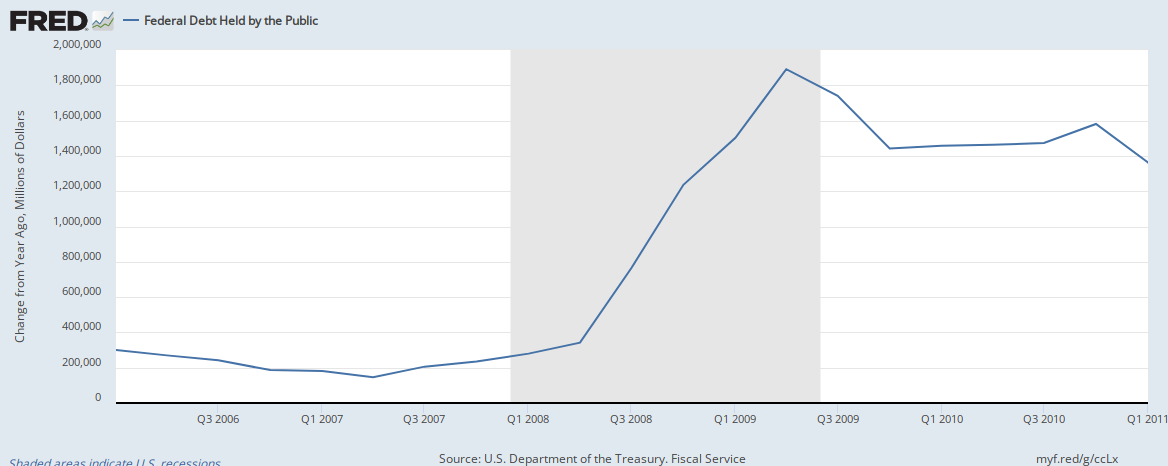
The U.S. doesn’t “borrow.” The Federal Reserve Bank accepts deposits in T-security accounts. The intentionally misleading word “debt,” when applied to T-securities, should be changed to “deposits.”

“Nobody could find that it did much of anything” except the deficit spending is what brought us out of the worst recession since the Great Depression of the 1930s.

Mitch McConnell and his fellow liars have learned that if one repeats a lie often enough, and if many other people repeat the same lie, the populace will believe it, no matter how obvious the lie is.

Most people are aware the federal government cannot run short of its own sovereign currency. And most people also are aware that despite massive deficit spending, the Fed’s primary concern has been the lack of inflation.

Finally, most people are aware of what the above graph tells them: The sharp increase in stimulus spending (i.e. deficits) brought us out of the recession and into almost a decade of economic growth and reduced unemployment.

The rich have bribed McConnell and his fellow politicians to lie. But they haven’t bribed you to believe their lies.

So why would you?

Rodger Malcolm Mitchell
Monetary Sovereignty

………………………………………………………………………………………………………………………………………………………………………………………………………………………………………………………………………………………………………………………………………..

The single most important problems in economics involve the excessive income/wealth/power Gaps between the rich and the rest.

Wide Gaps negatively affect poverty, health and longevity, education, housing, law and crime, war, leadership, ownership, bigotry, supply and demand, taxation, GDP, international relations, scientific advancement, the environment, human motivation and well-being, and virtually every other issue in economics.

Implementation of The Ten Steps To Prosperity can narrow the Gaps:

Ten Steps To Prosperity:
1. ELIMINATE FICA (Ten Reasons to Eliminate FICA )
Although the article lists 10 reasons to eliminate FICA, there are two fundamental reasons:
*FICA is the most regressive tax in American history, widening the Gap by punishing the low and middle-income groups, while leaving the rich untouched, and
*The federal government, being Monetarily Sovereign, neither needs nor uses FICA to support Social Security and Medicare.
2. FEDERALLY FUNDED MEDICARE — PARTS A, B & D, PLUS LONG TERM CARE — FOR EVERYONE (H.R. 676, Medicare for All )
This article addresses the questions:
*Does the economy benefit when the rich can afford better health care than can the rest of Americans?
*Aside from improved health care, what are the other economic effects of “Medicare for everyone?”
*How much would it cost taxpayers?
*Who opposes it?”
3. PROVIDE AN ANNUAL ECONOMIC BONUS TO EVERY MAN, WOMAN AND CHILD IN AMERICA, AND/OR EVERY STATE, A PER CAPITA ECONOMIC BONUS (The JG (Jobs Guarantee) vs the GI (Guaranteed Income) vs the EB) Or institute a reverse income tax.
This article is the fifth in a series about direct financial assistance to Americans:

Why Modern Monetary Theory’s Employer of Last Resort is a bad idea. Sunday, Jan 1 2012
MMT’s Job Guarantee (JG) — “Another crazy, rightwing, Austrian nutjob?” Thursday, Jan 12 2012
Why Modern Monetary Theory’s Jobs Guarantee is like the EU’s euro: A beloved solution to the wrong problem. Tuesday, May 29 2012
“You can’t fire me. I’m on JG” Saturday, Jun 2 2012

Economic growth should include the “bottom” 99.9%, not just the .1%, the only question being, how best to accomplish that. Modern Monetary Theory (MMT) favors giving everyone a job. Monetary Sovereignty (MS) favors giving everyone money. The five articles describe the pros and cons of each approach.
4. FREE EDUCATION (INCLUDING POST-GRAD) FOR EVERYONEFive reasons why we should eliminate school loans
Monetarily non-sovereign State and local governments, despite their limited finances, support grades K-12. That level of education may have been sufficient for a largely agrarian economy, but not for our currently more technical economy that demands greater numbers of highly educated workers.
Because state and local funding is so limited, grades K-12 receive short shrift, especially those schools whose populations come from the lowest economic groups. And college is too costly for most families.
An educated populace benefits a nation, and benefitting the nation is the purpose of the federal government, which has the unlimited ability to pay for K-16 and beyond.
5. SALARY FOR ATTENDING SCHOOL
Even were schooling to be completely free, many young people cannot attend, because they and their families cannot afford to support non-workers. In a foundering boat, everyone needs to bail, and no one can take time off for study.
If a young person’s “job” is to learn and be productive, he/she should be paid to do that job, especially since that job is one of America’s most important.
6. ELIMINATE CORPORATE TAXES
Corporations themselves exist only as legalities. They don’t pay taxes or pay for anything else. They are dollar-transferring machines. They transfer dollars from customers to employees, suppliers, shareholders and the government (the later having no use for those dollars).
Any tax on corporations reduces the amount going to employees, suppliers and shareholders, which diminishes the economy. Ultimately, all corporate taxes come around and reappear as deductions from your personal income.
7. INCREASE THE STANDARD INCOME TAX DEDUCTION, ANNUALLY. (Refer to this.) Federal taxes punish taxpayers and harm the economy. The federal government has no need for those punishing and harmful tax dollars. There are several ways to reduce taxes, and we should evaluate and choose the most progressive approaches.
Cutting FICA and corporate taxes would be a good early step, as both dramatically affect the 99%. Annual increases in the standard income tax deduction, and a reverse income tax also would provide benefits from the bottom up. Both would narrow the Gap.
8. TAX THE VERY RICH (THE “.1%) MORE, WITH HIGHER PROGRESSIVE TAX RATES ON ALL FORMS OF INCOME. (TROPHIC CASCADE)
There was a time when I argued against increasing anyone’s federal taxes. After all, the federal government has no need for tax dollars, and all taxes reduce Gross Domestic Product, thereby negatively affecting the entire economy, including the 99.9%.
But I have come to realize that narrowing the Gap requires trimming the top. It simply would not be possible to provide the 99.9% with enough benefits to narrow the Gap in any meaningful way. Bill Gates reportedly owns $70 billion. To get to that level, he must have been earning $10 billion a year. Pick any acceptable Gap (1000 to 1?), and the lowest paid American would have to receive $10 million a year. Unreasonable.
9. FEDERAL OWNERSHIP OF ALL BANKS (Click The end of private banking and How should America decide “who-gets-money”?)
Banks have created all the dollars that exist. Even dollars created at the direction of the federal government, actually come into being when banks increase the numbers in checking accounts. This gives the banks enormous financial power, and as we all know, power corrupts — especially when multiplied by a profit motive.
Although the federal government also is powerful and corrupted, it does not suffer from a profit motive, the world’s most corrupting influence.
10. INCREASE FEDERAL SPENDING ON THE MYRIAD INITIATIVES THAT BENEFIT AMERICA’S 99.9% (Federal agencies)Browse the agencies. See how many agencies benefit the lower- and middle-income/wealth/ power groups, by adding dollars to the economy and/or by actions more beneficial to the 99.9% than to the .1%.
Save this reference as your primer to current economics. Sadly, much of the material is not being taught in American schools, which is all the more reason for you to use it.

The Ten Steps will grow the economy, and narrow the income/wealth/power Gap between the rich and you.

MONETARY SOVEREIGNTY


President Slime and his little Slimes

STwitter: @rodgermitchell; Search #monetarysovereignty
Facebook: Rodger Malcolm Mitchell

………………………………………………………………………………………………………………………………………………

Remember the outrage when Hillary Clinton was accused of selling access in exchange for charitable contributions? Lest you have any doubts about the criminality that soon will invade the White House, read this:

For a price, you too can buy access to Team Trump

Ivanka Trump reportedly will have a White House office, which she’ll be able to use to advocate for policies – a step she’s already taken with preliminary calls to Republican members of Congress.

This follows a series of meetings Ivanka Trump has joined with her father, foreign leaders, domestic business leaders, and prospective cabinet members.

Remember, Ivanka has not been elected to anything or cleared for anything. But, seemingly she plans to use the White House to run her businesses. Is that even legal?

Who cares? Right?

When Ivanka auctioned a lunch with her for tens of thousands of dollars, it raised eyebrows. Though the charitable auction was eventually scrapped, it appeared Donald Trump’s daughter was putting a high price on access to an influential member of the incoming president’s orbit.

This week, it’s apparently Ivanka’s brothers’ turn. Time magazine, among others, reported:

A new Texas nonprofit led by Donald Trump’s grown sons is offering access to the freshly-minted president during inauguration weekend – all in exchange for million-dollar donations to unnamed “conservation” charities, according to interviews and documents reviewed by the Center for Public Integrity.

Trump’s “charities” have a history of benefitting Trump financially. He even has been fined for that offense for which he falsely and ironically accused Hillary Clinton.

The notion of Trump, the global warming denier and friend of big oil, having “conservation charities” is ludicrous.

And the donors’ identities may never be known.

Prospective million-dollar donors to the “Opening Day 2017” event – slated for Jan. 21, the day after inauguration, at Washington, D.C.’s Walter E. Washington Convention Center – receive a “private reception and photo opportunity for 16 guests with President Donald J Trump,” a “multi-day hunting and/or fishing excursion for 4 guests with Donald Trump, Jr. and/or Eric Trump, and team,” as well as tickets to other events and “autographed guitars by an Opening Day 2017 performer.”

The prices aren’t cheap. For $250,000, donors can receive a “private reception and photo opportunity” with Donald Trump himself. To hunt with Trump’s adult sons, donors should expect to write a check for $500,000.

There would be no legal requirement to disclose the donors’ names to the public.

Here we are, watching leading members of Team Trump put a generous price on access to themselves, and engaging in the exact behavior the president-elect condemned as a candidate in the very recent past.

You can just hear the water being drained from the swamp.

Oops. Like all other Trump promises, the swamp-draining now is cancelled.

Based on history, there is no reason to doubt that the Trump public-private partnerships will net billions for Trump and his family.

This is the same Donald Trump who promised to do as all other Presidential candidates have done:

  1. Release his tax returns
  2. Divest himself of any assets that could result in his self-dealing as a President

Not only has he refused to do either, but in the case of those self-enriching assets, he has indicated there isn’t a damn thing you can do about it.  His words: “The law’s totally on my side, meaning, the president can’t have a conflict of interest.”

“Ain’t no use to sit and wonder why, babe.” The “why” is that Trump plans to use the White House as his personal piggy bank, to enrich himself.  

Period.

Trump’s followers essentially have told him, “We don’t care how crooked and slimy you are. You can do anything you want and we still will back you.”

And it’s not just his followers. The entire Republican party is in on the scam:

REPORT: Republican lawmakers are AFRAID of Trump

Politico is reporting that some Republicans who would normally never go for an Obama-like stimulus plan are now entertaining the idea of a Trump infrastructure plan. Why, because they are hypocrites? No, according to Politico they are afraid of Trump:

POLITICO – To understand the spell Trump has cast on the Republican Party, just listen to the members of the House Republican Conference these days:

The same gang that made slashing spending their singular cause in Congress are now entertaining — and in many cases embracing — the president-elect’s pitch to pump billions into the economy in the form of a massive infrastructure package.

The irony, expressed privately by lawmakers and leadership aides, is glaring. Privately, House Republicans complain that Trump’s infrastructure plan reeks of Obama’s stimulus package.

They say his tariff proposal is ridiculous and using the White House to force companies to stay in the U.S. is inappropriate.

Many are afraid to publicly oppose Trump because of his fondness for retribution and use of Twitter to publicly shame his critics. So now, they’re left crossing their fingers that his rhetoric doesn’t translate into actual policy proposals next year.

“Sometimes it’s the pioneers that end up with arrows in their backs,” said Rep. Mark Sanford (R-S.C.). “Sometimes, for preservation sake in a political sense, people don’t want to pioneer in teeing off on a newly elected, and at this point popular, presidential nominee.”

This is indeed irony. What we wanted was for a Republican Congress to rein Trump in and keep him on the straight and narrow when it comes to spending and trade (and other things he decides to go liberal on). But now we’re hearing that they are considering Trump’s liberalism because they are afraid of him?

The next four years are not going to go well if Congress doesn’t get some balls.

Congress get balls?  Who can forget what Ted Cruz, Ben Carson, Mitt Romney, and Chris Christie had said about Trump and what he had said about them, then seeing them genuflecting before Trump, hoping to get some political assignment?

If that isn’t vomit inducing, nothing is. Well maybe Senate Majority Leader Mitch McConnell and House Speaker Paul D. Ryan are:

Mitch McConnell Speaks Out in Strong Support of Trump
Breaking a pattern of staying on the sidelines, the Senate’s GOP leader issues a call for a ‘powerful’ President Trump.

Ryan: Last night and again this morning, I spoke with president-elect Donald Trump and I congratulated him on his great victory. And now, Donald Trump will lead a unified Republican government.

So McConnell always stays on the sidelines, but this time he issued a call for a powerful President Trump. And Ryan called repeatedly to congratulate Trump and to assure him the party is unified behind him. (“Mr. Trump sir, we all love you, sir.”)

I can hear the kissing and sucking sounds, all the way here in Chicago.

If you give a proven liar and cheat an open invitation to steal, what do you think that proven liar and cheat will do?

Welcome to the slimy world of our President and his family and his Party — the Party that supposedly will rein Trump in.

Will someone please count the silverware in the White House. The Trumps are coming.

Rodger Malcolm Mitchell
Monetary Sovereignty

……………………………………………………………………………………………………………………………………………………

The single most important problems in economics involve the excessive income/wealth/power Gaps between the rich and the rest.

Wide Gaps negatively affect poverty, health and longevity, education, housing, law and crime, war, leadership, ownership, bigotry, supply and demand, taxation, GDP, international relations, scientific advancement, the environment, human motivation and well-being, and virtually every other issue in economics.

Implementation of The Ten Steps To Prosperity can narrow the Gaps:

Ten Steps To Prosperity:
1. ELIMINATE FICA (Ten Reasons to Eliminate FICA )
Although the article lists 10 reasons to eliminate FICA, there are two fundamental reasons:
*FICA is the most regressive tax in American history, widening the Gap by punishing the low and middle-income groups, while leaving the rich untouched, and
*The federal government, being Monetarily Sovereign, neither needs nor uses FICA to support Social Security and Medicare.
2. FEDERALLY FUNDED MEDICARE — PARTS A, B & D, PLUS LONG TERM CARE — FOR EVERYONE (H.R. 676, Medicare for All )
This article addresses the questions:
*Does the economy benefit when the rich can afford better health care than can the rest of Americans?
*Aside from improved health care, what are the other economic effects of “Medicare for everyone?”
*How much would it cost taxpayers?
*Who opposes it?”
3. PROVIDE AN ANNUAL ECONOMIC BONUS TO EVERY MAN, WOMAN AND CHILD IN AMERICA, AND/OR EVERY STATE, A PER CAPITA ECONOMIC BONUS (The JG (Jobs Guarantee) vs the GI (Guaranteed Income) vs the EB) Or institute a reverse income tax.
This article is the fifth in a series about direct financial assistance to Americans:

Why Modern Monetary Theory’s Employer of Last Resort is a bad idea. Sunday, Jan 1 2012
MMT’s Job Guarantee (JG) — “Another crazy, rightwing, Austrian nutjob?” Thursday, Jan 12 2012
Why Modern Monetary Theory’s Jobs Guarantee is like the EU’s euro: A beloved solution to the wrong problem. Tuesday, May 29 2012
“You can’t fire me. I’m on JG” Saturday, Jun 2 2012

Economic growth should include the “bottom” 99.9%, not just the .1%, the only question being, how best to accomplish that. Modern Monetary Theory (MMT) favors giving everyone a job. Monetary Sovereignty (MS) favors giving everyone money. The five articles describe the pros and cons of each approach.
4. FREE EDUCATION (INCLUDING POST-GRAD) FOR EVERYONEFive reasons why we should eliminate school loans
Monetarily non-sovereign State and local governments, despite their limited finances, support grades K-12. That level of education may have been sufficient for a largely agrarian economy, but not for our currently more technical economy that demands greater numbers of highly educated workers.
Because state and local funding is so limited, grades K-12 receive short shrift, especially those schools whose populations come from the lowest economic groups. And college is too costly for most families.
An educated populace benefits a nation, and benefitting the nation is the purpose of the federal government, which has the unlimited ability to pay for K-16 and beyond.
5. SALARY FOR ATTENDING SCHOOL
Even were schooling to be completely free, many young people cannot attend, because they and their families cannot afford to support non-workers. In a foundering boat, everyone needs to bail, and no one can take time off for study.
If a young person’s “job” is to learn and be productive, he/she should be paid to do that job, especially since that job is one of America’s most important.
6. ELIMINATE CORPORATE TAXES
Corporations themselves exist only as legalities. They don’t pay taxes or pay for anything else. They are dollar-transferring machines. They transfer dollars from customers to employees, suppliers, shareholders and the government (the later having no use for those dollars).
Any tax on corporations reduces the amount going to employees, suppliers and shareholders, which diminishes the economy. Ultimately, all corporate taxes come around and reappear as deductions from your personal income.
7. INCREASE THE STANDARD INCOME TAX DEDUCTION, ANNUALLY. (Refer to this.) Federal taxes punish taxpayers and harm the economy. The federal government has no need for those punishing and harmful tax dollars. There are several ways to reduce taxes, and we should evaluate and choose the most progressive approaches.
Cutting FICA and corporate taxes would be a good early step, as both dramatically affect the 99%. Annual increases in the standard income tax deduction, and a reverse income tax also would provide benefits from the bottom up. Both would narrow the Gap.
8. TAX THE VERY RICH (THE “.1%) MORE, WITH HIGHER PROGRESSIVE TAX RATES ON ALL FORMS OF INCOME. (TROPHIC CASCADE)
There was a time when I argued against increasing anyone’s federal taxes. After all, the federal government has no need for tax dollars, and all taxes reduce Gross Domestic Product, thereby negatively affecting the entire economy, including the 99.9%.
But I have come to realize that narrowing the Gap requires trimming the top. It simply would not be possible to provide the 99.9% with enough benefits to narrow the Gap in any meaningful way. Bill Gates reportedly owns $70 billion. To get to that level, he must have been earning $10 billion a year. Pick any acceptable Gap (1000 to 1?), and the lowest paid American would have to receive $10 million a year. Unreasonable.
9. FEDERAL OWNERSHIP OF ALL BANKS (Click The end of private banking and How should America decide “who-gets-money”?)
Banks have created all the dollars that exist. Even dollars created at the direction of the federal government, actually come into being when banks increase the numbers in checking accounts. This gives the banks enormous financial power, and as we all know, power corrupts — especially when multiplied by a profit motive.
Although the federal government also is powerful and corrupted, it does not suffer from a profit motive, the world’s most corrupting influence.
10. INCREASE FEDERAL SPENDING ON THE MYRIAD INITIATIVES THAT BENEFIT AMERICA’S 99.9% (Federal agencies)Browse the agencies. See how many agencies benefit the lower- and middle-income/wealth/ power groups, by adding dollars to the economy and/or by actions more beneficial to the 99.9% than to the .1%.
Save this reference as your primer to current economics. Sadly, much of the material is not being taught in American schools, which is all the more reason for you to use it.

The Ten Steps will grow the economy, and narrow the income/wealth/power Gap between the rich and you.

MONETARY SOVEREIGNTY

I smell the meat a’cookin’. The new privatization scam.

wTwitter: @rodgermitchell; Search #monetarysovereignty
Facebook: Rodger Malcolm Mitchell

……………………………………………………………………………………………………………………………………………………

We’ve posted before about infamous Illinois politician, Paul Powell who when salivating over another crooked political deal said, “I smell the meat a’cookin’”. 

Ah, Illinois, the land of the incarcerated pol, where the tried-and-true political route is: First, get elected; then, steal money; then, go to jail.

The smart ones, like the recent Mayor Daley, don’t go to jail, but rather are rewarded by an insider law firm with a do-nothing, “thank you” job.

Otherwise, from the top — governors — to the bottom — Chicago aldermen — it is a well-travelled path of Illinois political chicanery.

We frequently have posted about another well-travelled path of political chicanery: Privatization.

Examples are:

1. TSA and the great privatization scam: Part II;

2. Why Privatization? Here’s why;

3. PRIVATIZATION: The Road to Perdition in the United States of Koch;

4. Presenting!! The Great Privatization Scam!

And, there are others.

“Privatization” actually can have two, significantly different meanings. One can refer to government contracting out for goods and services. When the federal government builds planes, tanks, bullets, roads, and dams, typically it pays private contractors to do the work.

The federal government acts as a customer, not as a partner.

That is not true “privatization,” which is when the government sells or gives to private industry its toll-roads, its jails, its mail delivery, its policing — functions typically handled by government employees.  That is the kind of privatization where stealing is most rife.

The key question is this: Who owns and runs the business?

The key question is this: Who owns and runs the business? In one sense, it is not possible for there to be a real partnership between the federal government and a private party, because they have different motives and goals.

Ostensibly, the federal government wants some task accomplished in the most efficient, most expeditious manner. That is its primary goal.

The federal government has no need for, nor should it take, profits. If the federal government were to accept profits, those dollars would be taken from the economy and have the same recessive effect as a tax.

By contrast, the primary goal of a private investor is profits. Unless the program is set up for charitable purposes, the accomplishment of a task only is the medium by which profits may be obtained.

The difference between profit-maximization and output maximization is decisive in how the business is run.

If the federal government owns and runs the business, what would motivate an investor to put his money into it? And what would motivate a Monetarily Sovereign federal government to solicit the investor’s money?

If the investor owns and runs the business, the result is not a partnership. Rather, the federal government plays the role of a customer, which it already does for millions of products and services.

So exactly which format is Trump proposing? As with so much Trump, his proposals are vague wishes, with specifics “to follow later.”

The classic example is his border wall. Trump’s “plan” is: “I will build a wall and Mexico will pay for it. You figure out how.” 

There are two facts — excuses really —  repeatedly given for government privatization:

1. The government needs private money. This may be true for state and local government privatization but never, ever is true for our Monetarily Sovereign federal government.

2. The private sector is smarter than the government, so will do a better job.  This is true or not depending on specifics. There are smart and non-smart individuals in the private sector and in government.

Neither sector has a monopoly on brains. Remember, it was federal employees who created atomic energy and the man on the moon, two of the most complex initiatives in human history,

There is a 3rd fact about privatization:

3. Private sector leaders are motivated by personal profits, while government leaders are motivated by votes and bribes.

When the sole motivation is profits, you reliably will see excessive pricing and under-servicing in privatized businesses, which often are given monopoly status by the government.

Privatized jails, privatized toll roads, privatized parking meters, privatized electric service, privatized TSA — all offer examples of excessive pricing and under-servicing by privatized, monopoly businesses.

As is the custom for privatization, governments sell or give public property or exclusives at a discount to rich insiders, while claiming #1 and #2 above, and hiding #3.

Trump’s Plan for Infrastructure, by Michael Likosky

To remain a land of opportunity, all citizens—and many businesses—must have access to state-of-the-art affordable infrastructure.

It includes transportation,  water, communications, schools, public hospitals, community colleges, and public universities. Today, most of us simply do not have this access. Moreover, we cannot attract and retain global businesses with the resources we have.

We are in this situation in part due to dysfunctional politics. The Beltway cannot agree on the basics: how to pay for the needed infrastructure, how to prioritize our needs, and the most efficient way to design and build projects.

In reality, the issue is “how to pay,” and for the federal government, it is no issue at all.  It is a pretend issue. Our Monetarily Sovereign government can pay for anything.

As for “prioritize,” this is something the federal government has to do, whether or not it privatizes.

The same is true for “efficient way to design and build.”  The government sets the standards. It will employ architects and engineers to provide the plans and contractors to organize the work. No “privatization” needed.

However, more significantly, we find ourselves in such sorry shape because for decades we have suffered from a mindset that refuses to recognize that a rising tide, in this case investment in Infrastructure, raises all boats.

At times the wealthy do not want to pay for the infrastructure of the poor, metropolitan areas the rural, the coasts for the Rust Belt, and so on.

Some wealthy may be ignorant of Monetary Sovereignty, so they truly believe they must pay (via taxes).  The majority of wealthy understand their taxes not pay, but they want the poor to believe reasons for not improving infrastructure.  They want to widen the Gap between the rich and the rest.

But, infrastructure projects benefit the 99.9% more than the .1%. The benefits come from added jobs and from improved services. Thus, these projects could narrow the Gap — which the rich don’t want — unless the rich receive inordinate compensation.

President-elect Donald Trump is coming to office with a mandate to fix all this.

These days, losing by more than 2 million votes is considered a “mandate.” Imagine what they would call it if he actually won the popular vote.

The elements of the plan are clear. However, how it all fits together is not self-evident.

It’s neither “clear” nor “self-evident,” because there is no plan.  It’s just a vague wish list.

Before getting into even the elements though, let’s get the sticker shock out of the way. The plan aims to bring $1 trillion of public and private dollars to the table into infrastructure over the next decade.

As for “sticker shock,” all the dollars contributed by the federal government constitute a stimulus to the economy. Why would anyone be “shocked” by that?

His (Trump’s) elements read like a who’s-who of the most innovative ideas in Washington.

They include public-private partnerships, a special bond program, the repatriation of corporate profits sitting overseas, the streamlining of environmental and regulatory review processes, among others.

“A who’s who of the most innovative ideas in Washington”?  How strange, considering the “innovative ideas” either are fuzzy, non-existent, or are conservative-usual: More money in the pockets of the rich.

“Public-private partnerships” generally mean a few, rich insiders receive the exclusive right to overcharge for shoddy services.

“Special bond program” is unnecessary in a Monetarily Sovereign nation, and probably will turn out to be a feeding trough for rich, criminal banksters.

“Repatriation of profits” has no value to America. Corporations do what is best for business, and unless repatriation stimulates American business it is meaningless. Corporations will spend here only if such spending is good for business.

And here is the best one: “Streamlining of environmental and regulatory review processes.”  That, very simply means, don’t regulate business.

It means: “Let the criminal bankers, the overcharging pharmaceutical companies, the dishonest food processors, the cheating car manufacturers, et al do whatever they please without the intrusion of inconvenient rules against deceiving their customers and exploiting their employees.”

The idea is: “Let ’em pollute, overcharge, and steal.  It’s big business first, big business last, and big business always, and the public be damned.”

That is why billionaire, proven cheater Trump has filled his cabinet with fellow billionaires. And amazingly, the public believes these billionaires represent beneficial change or concern about the “little people.”

Remember, we’re talking about the same Donald Trump who has a history of cheating his employees out of their wages. (Does the phrase, “from the frying pan into the fire” come to mind?)

News flash! Trump and his cabal didn’t get to be billionaires by caring about your family’s finances.

The bond proposal is based upon the Build America Bonds which were, according to Alan Kruger, the former Chief Economist of President Barack Obama’s U.S. Treasury Department, the “unsung hero of the recovery”.

In fact, Steven Mnuchin, the president-elect’s choice for U.S. Treasury Secretary, even mentioned recently that the incoming administration was looking at a National Infrastructure Bank, the holy grail of bipartisan politics.

“Bonds are the unsung hero of the recovery”? The only thing that took us out of the recession was federal deficit spending. Period.

Bonds added a few dollars of interest, and benefitted the kind of people who invest in bonds. But that’s about it.

There have been dozens of different proposals for a “National Infrastructure Bank,” so many that today, no one knows what it is.  Supposedly the bank would borrow from the federal government and lend to private developers to build infrastructure — or something.

Aside from not being a plan with specifics, and aside from the fact that the Monetarily Sovereign federal government never needs to lend  (It only should give), and aside from the Bank having no function that Congress already doesn’t have, it’s wonderfully “bipartisan” (i.e. both parties “smell the meat a’cookin’.”)

So that bipartisanship makes it an “innovative idea” (an idea that has been tossed around for the past ten years.)  It’s the “holy grail of bipartisan politics” because the .1% loves it.

Public-private partnerships are the cornerstone of his plan. Rather than use public outlay of money to pay the entire cost of infrastructure build-out, these partnerships use public money as honey to attract global investor money from pensions, insurers, sovereigns, endowments, and other sources.

Except that the federal government doesn’t need “global investor money,” especially when these global investors are the same billionaires who will be making decisions in Trump’s cabinet.

“Conflict of interest?? Who me?”

Additional partnerships are formed with global design, engineering, and construction firms with astounding capabilities to build the projects themselves.

“Astounding capabilities“?? The author has no idea who these firms are, but he is sure they have “astounding capabilities”?  Who really wrote this article?  Does it sound like anyone you know?

My view is that Mr. Trump’s plan, boiled down, is about three things: moving money to market very quickly; raising money from investors who do not expect to be repaid in the near term; and designing and building projects with engineering prowess.

Oh, puh-leeze! “Not expect to be repaid near term”? Who says? And “engineering prowess“?  Gimme a break.

The government can move money to market even more quickly by eliminating FICA than with a convoluted, mysterious “National Infrastructure Bank.”

The plan is a good one, including the spirit of prudent innovation behind it. The question will be whether Mr. Trump can inspire us to pull together as a single community one project at a time.

The “plan” (which doesn’t exist) includes “prudent innovation” (whatever the heck that means), but we should “pull together” (i.e. let Trump and his billionaires steal the house without us objecting.)

The author of the article, Michael Likowsky works for “32 Advisors.” This is what they say about themselves:

“We assist governments and companies in developing, structuring, and financing public-private partnerships and traditional infrastructure opportunities.”

That may explain the hard-sell for Trump’s non-existent programs. If what pays your salary is public-private partnerships, then you will shill for public-private partnerships.  Self-interest is the most powerful motivator.

You will hear much more about phony “public-private partnerships,” those. devices for widening the Gap between the billionaires and the rest of us. The concept is too delicious for the greedy rich and the crooked politicians to forget.

Just, let your politicians know you know what they are doing and you aren’t fooled by this scam.

Sunlight is the enemy of political criminality.

Rodger Malcolm Mitchell
Monetary Sovereignty

………………………………………………………………………………………………………………………………………………………………………………………………………………………………………………………………………………………………………………………………………..

The single most important problems in economics involve the excessive income/wealth/power Gaps between the rich and the rest.

Wide Gaps negatively affect poverty, health and longevity, education, housing, law and crime, war, leadership, ownership, bigotry, supply and demand, taxation, GDP, international relations, scientific advancement, the environment, human motivation and well-being, and virtually every other issue in economics.

Implementation of The Ten Steps To Prosperity can narrow the Gaps:

Ten Steps To Prosperity:
1. ELIMINATE FICA (Ten Reasons to Eliminate FICA )
Although the article lists 10 reasons to eliminate FICA, there are two fundamental reasons:
*FICA is the most regressive tax in American history, widening the Gap by punishing the low and middle-income groups, while leaving the rich untouched, and
*The federal government, being Monetarily Sovereign, neither needs nor uses FICA to support Social Security and Medicare.
2. FEDERALLY FUNDED MEDICARE — PARTS A, B & D, PLUS LONG TERM CARE — FOR EVERYONE (H.R. 676, Medicare for All )
This article addresses the questions:
*Does the economy benefit when the rich can afford better health care than can the rest of Americans?
*Aside from improved health care, what are the other economic effects of “Medicare for everyone?”
*How much would it cost taxpayers?
*Who opposes it?”
3. PROVIDE AN ANNUAL ECONOMIC BONUS TO EVERY MAN, WOMAN AND CHILD IN AMERICA, AND/OR EVERY STATE, A PER CAPITA ECONOMIC BONUS (The JG (Jobs Guarantee) vs the GI (Guaranteed Income) vs the EB) Or institute a reverse income tax.
This article is the fifth in a series about direct financial assistance to Americans:

Why Modern Monetary Theory’s Employer of Last Resort is a bad idea. Sunday, Jan 1 2012
MMT’s Job Guarantee (JG) — “Another crazy, rightwing, Austrian nutjob?” Thursday, Jan 12 2012
Why Modern Monetary Theory’s Jobs Guarantee is like the EU’s euro: A beloved solution to the wrong problem. Tuesday, May 29 2012
“You can’t fire me. I’m on JG” Saturday, Jun 2 2012

Economic growth should include the “bottom” 99.9%, not just the .1%, the only question being, how best to accomplish that. Modern Monetary Theory (MMT) favors giving everyone a job. Monetary Sovereignty (MS) favors giving everyone money. The five articles describe the pros and cons of each approach.
4. FREE EDUCATION (INCLUDING POST-GRAD) FOR EVERYONEFive reasons why we should eliminate school loans
Monetarily non-sovereign State and local governments, despite their limited finances, support grades K-12. That level of education may have been sufficient for a largely agrarian economy, but not for our currently more technical economy that demands greater numbers of highly educated workers.
Because state and local funding is so limited, grades K-12 receive short shrift, especially those schools whose populations come from the lowest economic groups. And college is too costly for most families.
An educated populace benefits a nation, and benefitting the nation is the purpose of the federal government, which has the unlimited ability to pay for K-16 and beyond.
5. SALARY FOR ATTENDING SCHOOL
Even were schooling to be completely free, many young people cannot attend, because they and their families cannot afford to support non-workers. In a foundering boat, everyone needs to bail, and no one can take time off for study.
If a young person’s “job” is to learn and be productive, he/she should be paid to do that job, especially since that job is one of America’s most important.
6. ELIMINATE CORPORATE TAXES
Corporations themselves exist only as legalities. They don’t pay taxes or pay for anything else. They are dollar-transferring machines. They transfer dollars from customers to employees, suppliers, shareholders and the government (the later having no use for those dollars).
Any tax on corporations reduces the amount going to employees, suppliers and shareholders, which diminishes the economy. Ultimately, all corporate taxes come around and reappear as deductions from your personal income.
7. INCREASE THE STANDARD INCOME TAX DEDUCTION, ANNUALLY. (Refer to this.) Federal taxes punish taxpayers and harm the economy. The federal government has no need for those punishing and harmful tax dollars. There are several ways to reduce taxes, and we should evaluate and choose the most progressive approaches.
Cutting FICA and corporate taxes would be a good early step, as both dramatically affect the 99%. Annual increases in the standard income tax deduction, and a reverse income tax also would provide benefits from the bottom up. Both would narrow the Gap.
8. TAX THE VERY RICH (THE “.1%) MORE, WITH HIGHER PROGRESSIVE TAX RATES ON ALL FORMS OF INCOME. (TROPHIC CASCADE)
There was a time when I argued against increasing anyone’s federal taxes. After all, the federal government has no need for tax dollars, and all taxes reduce Gross Domestic Product, thereby negatively affecting the entire economy, including the 99.9%.
But I have come to realize that narrowing the Gap requires trimming the top. It simply would not be possible to provide the 99.9% with enough benefits to narrow the Gap in any meaningful way. Bill Gates reportedly owns $70 billion. To get to that level, he must have been earning $10 billion a year. Pick any acceptable Gap (1000 to 1?), and the lowest paid American would have to receive $10 million a year. Unreasonable.
9. FEDERAL OWNERSHIP OF ALL BANKS (Click The end of private banking and How should America decide “who-gets-money”?)
Banks have created all the dollars that exist. Even dollars created at the direction of the federal government, actually come into being when banks increase the numbers in checking accounts. This gives the banks enormous financial power, and as we all know, power corrupts — especially when multiplied by a profit motive.
Although the federal government also is powerful and corrupted, it does not suffer from a profit motive, the world’s most corrupting influence.
10. INCREASE FEDERAL SPENDING ON THE MYRIAD INITIATIVES THAT BENEFIT AMERICA’S 99.9% (Federal agencies)Browse the agencies. See how many agencies benefit the lower- and middle-income/wealth/ power groups, by adding dollars to the economy and/or by actions more beneficial to the 99.9% than to the .1%.
Save this reference as your primer to current economics. Sadly, much of the material is not being taught in American schools, which is all the more reason for you to use it.

The Ten Steps will grow the economy, and narrow the income/wealth/power Gap between the rich and you.

MONETARY SOVEREIGNTY

Goodbye, Brazil

Twitter: @rodgermitchell; Search #monetarysovereignty
Facebook: Rodger Malcolm Mitchell

………………………………………………………………………………………………………………………………………………

Reader “Elizabeth” called our attention to the tragedy in Brazil.

Background: June of the year 2005, was the first time I spoke of the euro. I said:

Because of the Euro, no euro nation can control its own money supply. The Euro is the worst economic idea since the recession-era, Smoot-Hawley Tariff. The economies of European nations are doomed by the euro.

The euro nations voluntarily surrendered the single, most valuable asset any nation can have: Their Monetary Sovereignty.  Having surrendered the ability to create and control their own sovereign currencies, the euro nations were reduced to using an “alien” currency, a currency over which they have no control: The euro.

The euro is a product of the European Union (EU), an Oligarchy, “a government in which all power is vested in a few persons or in a dominant class or clique; government by the few.”

The euro nations, now having chosen monetary non-sovereignty, are forced by the few unelected officials of the EU to adopt austerity, as the EU itself drains away the member nation’s resources.

All monetarily non-sovereign entities must adopt some form of austerity unless they have significant income coming from outside their borders.  This is true of cities, counties, states, businesses, you and me, as all are monetarily non-sovereign.

When a nation adopts monetary non-sovereignty, the rich prosper, while the populace is punished. Unless exports exceed imports by a significant amount (to bring money into the economy), wages decline, living standards decline, savings decline; the prosperity and grandeur, even of formerly great nations like Germany, Greece, Italy, France et al, becomes a distant memory.

As the Gap between the rich and the rest widens, the rich gain greater and greater power, which of course, is the whole idea.

All of the above brings us to the Brazilian tragedy, for the Brazilian government, which is Monetarily Sovereign, has chosen monetary non-sovereignty. It blithely has surrendered its single greatest asset:

Trading Economics: The rapid deterioration of (Brazil’s) finances has significantly raised the country’s debt burden leading to a gross debt of 66.2 percent of GDP, sharply higher than 57.2 percent in 2014.

The Gross Domestic Product (GDP) in Brazil was worth 1774.72 billion US dollars in 2015. GDP in Brazil reached an all time high of 2614.57 USD Billion in 2011.

Brazil Summary: Debt/GDP = 66.2%.  GDP has been going down since 2011.

By comparison with the U.S.:

The United States recorded a Government Debt to GDP of 104.17 percent of the country’s Gross Domestic Product in 2015.

The Gross Domestic Product (GDP) in the United States  was worth 17947 billion US dollars in 2015 reaching an all time high in 2015.

U.S. Summary: Debt/GDP=104%. GDP has been going up.

What are we to make of the Debt/GDP comparison between Brazil and the U.S.?  Brazil=66%; U.S.=104%

The U.S. economy being healthier and growing, while Brazil’s is shrinking, shall we conclude that contrary to the opinions of the pundits, higher Debt/GDP is better?

In fact, the Debt/GDP is a meaningless measure for a Monetarily Sovereign government. As its sovereign currency, Brazil uses the “Real,” a widely accepted money, which Brazil can create endlessly.

So long as the Real is accepted for payment of Brazil’s financial obligations, and/or in exchange for the U.S. dollar and other major world currencies, Monetarily Sovereign Brazil does not need to borrow, does not need to tax, and does not need to cut spending.

The so-called “Debt” is the misleading name for the total of investments in Brazilian government securities — securities the Brazilian government has the unlimited ability to create and service.

Thus, the Debt/GDP ratio measures the ratio of all outstanding investments in Brazilian government securities vs. this year’s Gross Domestic Product — a measure that indicates absolutely nothing about the Brazilian economy.

What is worrisome is Brazil’s decline in GDP. Since money is the lifeblood of any economy, and GDP itself is a money measure, one might think Brazil would want to increase dramatically its money supply — specifically its deficit spending  — to help stimulate GDP growth.

After all, if you put more Reals into the hands of the people, and the people spend those reals, that is a major part of GDP growth. This is exactly what the U.S. did to recover from the Great Depression of 2008.

And if, as is the case with Brazil, inflation is too high, the solution is not to reduce the Supply of Reals, but rather to increase the Demand for Reals.

Demand = Reward/Risk, and a large part of the “Reward” for owning money is interest.

Raising interest rates to increase the Demand for money is the program the U.S. Fed successfully has used over the years, and is using right now, as even the slightest whiff of inflation has led to a small rate increase.

Yet:

The Central Bank of Brazil lowered its benchmark Selic rate to 13.75 percent on November 30th, its lowest in over a year. Policymakers aim to bring inflation back to target amid a deep economic recession.

“Bring inflation back to target” by lowering interest rates?? The U.S. Fed raises rates to control inflation.  Why the difference?

Protests erupt in Brazil over controversial 20-year austerity plan
By Emiko Jozuka, Shasta Darlington, and Deborah Bloom, CNN, Updated 6:50 AM ET, Wed December 14, 2016

Brazil is Latin America’s largest economy and has a well-developed agricultural, manufacturing, and service sector. But the country has suffered its deepest recession in decades.

Since the beginning of 2015, the unemployment rate has doubled to more than 11% and as many as 12 million Brazilians are currently unemployed.

Known as PEC 55, the constitutional amendment imposes a cap on public spending that will limit federal investment in social programs for the next 20 years.

Plans to slash public spending are incompatible with Brazil’s human rights obligations and place the country in a “socially retrogressive category of its own,” according to Philip Alston, the United Nations Special Rapporteur on extreme poverty and human rights.

“It is completely inappropriate to freeze only social expenditure and to tie the hands of all future governments for another two decades,” said Alston, in a statement.

“It will hit the poorest and most vulnerable Brazilians the hardest, will increase inequality levels in an already very unequal society, and definitively signals that social rights are a very low priority for Brazil for the next 20 years,” Alston added.

Alston positions the government’s actions as a moral problem, which it is.  But more than that, it is an economics problem.

Brazil cuts interest rates to “Bring inflation back to target” and freezes public spending on social programs to fight recession?? These are the exact opposite of the steps that should be taken.  So what is going on, here?

Clearly, GDP growth and the welfare of the populace are not the goals of the rich who lead Brazil. Their true plan: To solidify a permanent underclass of desperate Brazilians willing to work in poor conditions for a pittance — the perfect slave labor force for the rich industrialists.

Widening the distance — the Gap — between the rich and the rest always has been a primary goal of the rich in all countries, not just in Brazil.

The ridiculous emphasis on sovereign “debt” in Monetarily Sovereign nations that never can run short of their own sovereign currencies demonstrates the goals of the rich. Even naming these investments “debt,” rather than the more correct “deposits,” is indicative.

It’s an ancient scheme:

  1. Create hardship
  2. Convince the populace to accept a counter-productive “cure” for the hardship, that worsens the situation. and widens the Gap between the rich and the rest.
  3. Repeat.

Brazil now has voted for 20 years of abject misery — except for the rich, who will prosper on the sweat of the people. Misery is the penalty for ignorance.

Goodbye, Brazil

Rodger Malcolm Mitchell
Monetary Sovereignty

……………………………………………………………………………………………………………………………………..

THE LAWS

•Those, who do not understand the differences between Monetary Sovereignty and monetary non-sovereignty, do not understand economics.

•Any monetarily NON-sovereign government — be it city, county, state or nation — that runs an ongoing trade deficit, eventually will run out of money.

•The more federal budgets are cut and taxes increased, the weaker an economy becomes..

•No nation can tax itself into prosperity, nor grow without money growth.

•Cutting federal deficits to grow the economy is like applying leeches to cure anemia.

•A growing economy requires a growing supply of money (GDP = Federal Spending + Non-federal Spending + Net Exports)

•Deficit spending grows the supply of money

•The limit to federal deficit spending is an inflation that cannot be cured with interest rate control. The limit to non-federal deficit spending is the ability to borrow.

•Until the 99% understand the need for federal deficits, the upper 1% will rule.

•Progressives think the purpose of government is to protect the poor and powerless from the rich and powerful. Conservatives think the purpose of government is to protect the rich and powerful from the poor and powerless.

•The single most important problem in economics is the Gap between the rich and the rest.

•Austerity is the government’s method for widening the Gap between the rich and the rest.

•Until the 99% understand the need for federal deficits, the upper 1% will rule.

•Everything in economics devolves to motive, and the motive is the Gap between the rich and the rest..

MONETARY SOVEREIGNTY