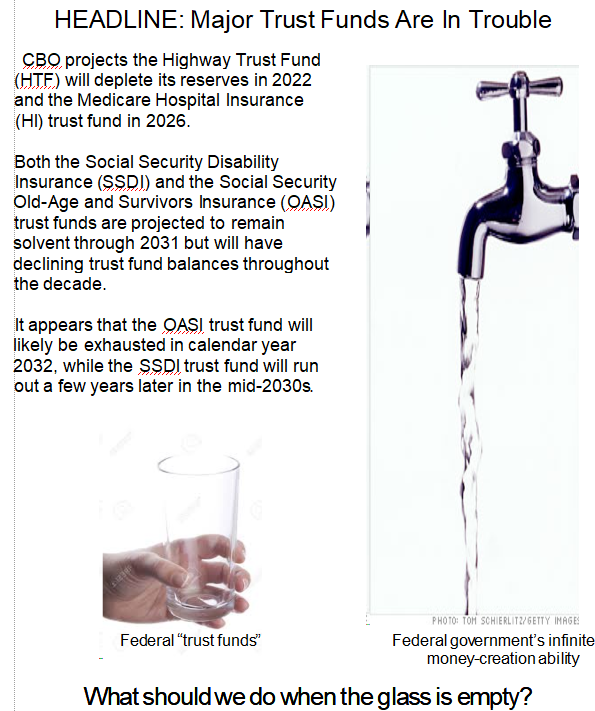
Congress is doing its usual disingenuous dance about the minimum wage.

It may surprise readers to learn that on balance, I am opposed to raising the minimum wage. In fact, I oppose the entire concept of a “minimum wage.”
Before I get into the pros and cons, here are some excerpts from an article in the Chicago Tribune.
The downsides of a higher minimum wage
Steve ChapmanFor most Americans, being asked if they favor a higher minimum wage is like asking if they like sunshine and ice cream. What’s not to like about increasing the rewards for low-paid workers — especially for anyone who has ever been a low-paid worker?
This is one of those ideas that you might think would generate disagreement along partisan lines. President Joe Biden wants to increase the national minimum wage to $15 an hour, up from $7.25. It’s no surprise that 87% of Democrats support the idea. The surprise is that 62% of Republicans agree.
Empathy for essential workers during the pandemic has only made the idea more appealing.
But just because an idea is popular doesn’t mean it’s wise. What economics teaches is that no government intervention in the economy comes without costs, some of which greatly outweigh benefits. This one has major flaws.
The most obvious drawback is that raising the price of anything causes people to pay for less of it. Double the price of a gallon of gas or a pound of ground beef and consumers will cut back on their consumption. When businesses have to pay their employees more, they will search for ways to reduce staffing.
“It’s not the Amazons of the world that will be hurt,” Nada Eissa, an economist at Georgetown University points out. “It’s mostly small businesses.” Those are many of the same employers that have suffered disproportionately from the pandemic.
A recent report from the Congressional Budget Office (CBO) concluded that a $15 minimum wage would lift 900,000 people out of poverty — while destroying 1.4 million jobs. Is that a sensible trade-off?
Let’s pause for a moment to digest what Chapman says. All of us, with the exception of Trump Republicans, many of whom are among the lower-paid workers, have empathy for lowest-paid workers.
(The seeming disconnect of lower-paid workers having no empathy for lowest-paid workers is a common consequence of Gap Psychology combined with a dash of envy.)
Lower-paid workers, especially those making minimum wage not only wish to distance themselves from those making below minimum wage (Gap Psychology), but also suffer from the “If-I-didn’t, Why-should-he” envy disease.
It’s the same disease that infects those who paid for college, and now do not want the government to forgive student loan debt.
That said, the majority of Americans would like to see poverty eliminated, or near-eliminated, in America.
As for the CBO, their main function is to act as a seemingly bipartisan — but not really bipartisan — front for the right-wing. We discussed them in “Overshoot” or “undershoot”? Making decisions by using wrong assumptions based on mythical numbers”.
The day the CBO makes even an attempt to understand the realities of Monetary Sovereignty, will be a great day for economics. I suspect that blessed day is a long way off, however.
Different places have different circumstances. A $15 minimum would be a minor matter in places like California, which already has a state floor of $14, Massachusetts ($13.50) and New York ($12.50). Illinois ($11) is already on track to go to $15 in 2025. The increase would be a huge change, though, in the many states that don’t set a minimum above the federal level.
The current $7.25 looks far skimpier in Hawaii or California, which have the highest living costs in the country, than in Mississippi or Oklahoma, which have the lowest. The average monthly rent is $689 in Mississippi but $1,657 in California.
That’s a logical argument if one believes there is an “overshoot or undershoot” conundrum. It’s less logical if we merely agree to overshoot, by providing sufficient income to everyone so that no one earns at a poverty level, no matter where in America they live.
That’s an argument for federalism: letting states set their own levels to reflect their economic conditions, living costs, educational levels and prevailing ideology.
A state with a lower minimum wage may attract businesses, creating jobs that otherwise would have gone elsewhere. A state with a higher one may lure workers looking to boost their income. There is no answer that suits every state.
Except that workers and businesses aren’t as mobile as the economists want you to believe, else every worker would have moved to California and Massachusetts, and every business would have relocated to Mississippi or Oklahoma.
Further, the “red” states seem to have retained their appreciation for the business advantages of slavery, and are less inclined to understand the benefits of a well-paid citizenry and workforce.
The right-wing’s efforts to repeal and (not) replace Obamacare provide ample evidence of this bias.
If we want to raise the incomes of low-wage workers, there’s a superior option: expanding the federal Earned Income Tax Credit (EITC), a sort of wage bonus.
It provides up to $3,584 per year for workers in households with one child and a maximum of $6,660 for those with three or more kids. But childless workers can get no more than $538, and only those from the age of 25 to 64 qualify.
More generous credits, particularly for workers without kids, would raise incomes at the bottom of the wage scale. Like a minimum wage increase, the change would encourage work by boosting earnings. But unlike a minimum wage increase, it doesn’t raise the cost of labor to employers. Result: more people working and earning more for their work.
If it were, in fact, a “bonus” it would be worth considering. But it is not a bonus; it is a tax credit, which requires that one pay income taxes.
Under today’s tax laws, the lowest paid, neediest among us, are not overly burdened with federal taxes. They are burdened far more by state and local taxes, FICA, and sales taxes.
And notice those two little words, “encourage work.” This is part of the upper- and middle-class belief that the poor are poor because they are lazy, and if given any financial support, they will opt not to work.
This is multiplied by the belief that labor is a moral issue, so everyone but the rich and the aged morally is obligated to work. Giving these impoverished “freeloaders” money becomes morally objectionable.
And then, the “lazy” belief and the “moral” belief are further multiplied by the “what-if-everyone” belief, which assumes there is a possibility everyone would stop working if given money, and the economy would come to a halt.
So, we are faced with three false beliefs, which then are compounded by a fourth:
A virtue of the EITC is it spreads the cost of helping low-wage workers to all taxpayers, not just those who have the misfortune of owning small businesses.
Democratic politicians are entranced by the visible benefits of boosting the minimum wage. The harm it promises to do, luckily for them, will go mostly unseen.
Steve Chapman, a member of the Tribune Editorial Board, blogs at http://www.chicagotribune.com/chapman .
schapman@chicagotribune.com
Twitter @SteveChapman13
The above puts forth the false belief that federal taxes fund federal spending. It is a belief that demonstrates an ignorance of the differences between Monetary Sovereignty and monetary non-sovereignty.
(Just as a reminder, the federal government has the unlimited ability to pay its bills, not with tax dollars, but by creating new dollars, ad hoc. It never can run short of dollars. Even if all federal tax collections were $0, the federal government could continue spending forever.
Moving on now to another article in the same edition of the Chicago Tribune;
===========================================
$1.9 trillion for a relief package should be the minimum — not the max
By Marie Newman, a Democrat, is the U.S. representative for Illinois’ 3rd Congressional District.This week marks the 12-year anniversary of President Barack Obama’s American Recovery and Reinvestment Act, the historic stimulus package passed in 2009 to lift the nation out of the Great Recession and put millions of Americans back to work.
In appeasing Republican concerns of spending too much money on a single relief package, Obama’s final $800 billion package was only two-thirds of the $1.2 trillion stimulus proposal originally recommended by the administration economists. Even after cuts were made, Republicans decried it as too much. In reality, it was not enough.
Absolutely true.
The Republicans never spend enough, ostensibly because they believe in “small government,’ but in reality because they want to appear to be helping, while actually keeping the underclasses down.
While the bold legislation certainly cushioned the financial downturn and fueled longer-term economic competitiveness, the price of aiming too small on relief resulted in a sluggish jobless recession that cost millions of low-income families — mostly people of color — their homes, livelihoods and savings.
In fact, the unemployment rate during the month of the 2010 midterm election was 9.8%, nearly the same it had been a full year before.
As President Joe Biden’s $1.9 trillion stimulus package inches closer to passing Congress, Democrats cannot afford to make the same mistakes we made over a decade ago. And we are in a much worse situation than in 2009.
The gravest danger currently facing America is that Biden is a less charismatic, older version of Obama. He seems to lack a strong ideology, being more interested in compromising to get something done than if fighting for the beliefs he lacks.
Last Wednesday, Federal Reserve Chairman Jerome Powell said the real unemployment rate today is close to 10%. “The pandemic has led to the largest 12-month decline in labor force participation since at least 1948,” stated the Republican-appointed chairman.
And yet, like they did a decade ago, Republicans in Congress today are preaching from their faux gospel of fiscal conservatism.
Earlier this month, a group of 10 Republican lawmakers presented a $618 billion counterproposal. Sen. Susan Collins of Maine called it “premature” for Congress to consider a relief package in the trillions.
The Republicans do not want a Democrat to solve the nation’s problems, as that would make the 2022 election year more difficult for them. They prefer being able to point with horror at failure.
It’s difficult to imagine any other motive for someone claiming adequate relief is “premature” at this stage of the pandemic. If not now, when?
Just last week, the Chicago Tribune’s Editorial Board called on Congress to hold “money until it has a clearer picture of the actual impact of the pandemic” and proclaimed that it was “not clear that Americans need another round of stimulus payments in the amount of $1,400 per person.”
“A clearer picture”? Ten percent unemployment and small businesses drowning is not “clear” enough. The Tribune’s editorial board consists of journalists — not an economist among them — and if you go to their page they universally boast about their humble beginnings.
And this is supposed to justify their ability to write about economics??
Two million women have left the labor force entirely, 29 million Americans face food insecurity, and an estimated 14 million are behind on payments.
Additionally, states and cities across America — run by elected officials from both political parties — face historic budget shortfalls.
The last COVID-19 relief package excluded state and local aid, and the Republicans’ counterproposal would continue to ignore this looming crisis that will have catastrophic consequences.
Economists predict 5.3 million workers likely will lose their jobs by the end of 2021. Simply put, the fate of our state and cities is a kitchen table economics issue.
The Republicans will tell you that state and local governments simply suffer from bad management, so why give them money? This is absolutely false.
The federal government’s ability to spend is not due to its good management. Far from it. Monetary Sovereignty is the reason.
Seven states actually send more money to the federal government (which destroys it) than they receive in return.
Visualize sending your last dollars to Bill Gates, who then complains about your poor money management.

Even our leading national economic experts agree that helping more working families far outweighs fears of spending too much. In fact, their estimated costs of relief to revitalize our economy is no less than $3 trillion , dwarfing President Biden’s $1.9 trillion relief package.
Back on April 17, we wrote, “The economy needs at least $7 Trillion net added from the federal government.” That was before Trump let the economy deteriorate to its current condition.
Forbes Magazine says that so far, the federal government has added about $3.5 trillion extra as a stimulus, (Stimulus Spending: $2.6 trillion, Stimulus Tax Relief: $900 billion) plus next Stimulus Proposal: $1.8 to $2.2 trillion, would bring the total to $5.3 – $5.7, so considering the current state of the economy, an additional $3 trillion should be about right.
If a $1.9 trillion tax cut for the ultrawealthy was justifiable four years ago, surely a $1.9 trillion rescue plan during a pandemic is appropriate today.
Fiscal responsibility must mean meeting the economic needs of today, not hypocritical concerns about the national debt.
Americans need and want a robust relief package that meets the scale of the public health and economic crises. The cost of President Biden’s American Rescue Plan must be the floor, not the ceiling.
Marie Newman
IN SUMMARY:
Clearly, the wealthiest nation on earth should do whatever it can to lift the less financially fortunate.
Being Monetarily Sovereign, the U.S. government has the unlimited ability to support the lower- and middle-income groups.
One suggested method for doing this is to raise the minimum wage. The problems with that approach are:
- It only helps salaried workers. It does nothing for those who receive income in ways other than salary, or who don’t have any income at all.
- While it helps narrow the Gap between the richer and the poorer, it does nothing for the overall economy. It merely shifts dollars from businesses to individuals.
- By adding a cost to businesses, it decreases the profits that businesses use to grow and innovate.
- It puts American businesses at a competitive disadvantage relative to foreign businesses.
- It discourages hiring.
Rather than forcing monetarily non-sovereign businesses to supply the populace with more money, the Monetarily Sovereign U.S. government can do the same thing by simply giving people money.
- It would help all less affluent people, not just salaried workers
- It not only would narrow the Gap, but it would stimulate the economy by adding dollars to the economy.
- It increases business profits by adding dollars to consumers pockets while costing businesses nothing.
- It helps American businesses remain competetive.
- It does not discourage hiring.
The federal government should not rely on the private sector to feed itself. The federal government has been given the unlimited power to grow the private sector. It should use that power. Feeding the economy is the job of the federal government.
I recommend the federal government supplement current pay scales by instituting Step #3 from the Ten Steps to Prosperity (below): Social Security for all or a reverse income tax
Rodger Malcolm Mitchell
Monetary Sovereignty Twitter: @rodgermitchell Search #monetarysovereignty Facebook: Rodger Malcolm Mitchell …………………………………………………………………………………………………………………………………………………………………………………………………………………………………………………………………………………………..
THE SOLE PURPOSE OF GOVERNMENT IS TO IMPROVE AND PROTECT THE LIVES OF THE PEOPLE.
The most important problems in economics involve:
- Monetary Sovereignty describes money creation and destruction.
- Gap Psychology describes the common desire to distance oneself from those “below” in any socio-economic ranking, and to come nearer those “above.” The socio-economic distance is referred to as “The Gap.”
Wide Gaps negatively affect poverty, health and longevity, education, housing, law and crime, war, leadership, ownership, bigotry, supply and demand, taxation, GDP, international relations, scientific advancement, the environment, human motivation and well-being, and virtually every other issue in economics. Implementation of Monetary Sovereignty and The Ten Steps To Prosperity can grow the economy and narrow the Gaps:
Ten Steps To Prosperity:
- Eliminate FICA
- Federally funded Medicare — parts A, B & D, plus long-term care — for everyone
- Social Security for all or a reverse income tax
- Free education (including post-grad) for everyone
- Salary for attending school
- Eliminate federal taxes on business
- Increase the standard income tax deduction, annually.
- Tax the very rich (the “.1%”) more, with higher progressive tax rates on all forms of income.
- Federal ownership of all banks
- Increase federal spending on the myriad initiatives that benefit America’s 99.9%
The Ten Steps will grow the economy and narrow the income/wealth/power Gap between the rich and the rest.
MONETARY SOVEREIGNTY