Obeying the rich: Telling the Big Lie and cutting benefits to the middle and poor.

“The federal ‘debt’ is too high.”

Debt ceiling: Biden says debt deal 'very close'
The Big Lie as expressed in a sign. The federal government doesn’t owe the so-called “debt,” and your family doesn’t owe any of it either.

That false belief — the Big Lie in economics — is so deeply implanted into the public’s brain that one seldom sees any discussion about its falsity.

The simple assumption is that debt is a burden, and more debt is a greater burden, and the federal government is deeply in debt, so the government should spend less and tax more to get rid of the debt burden.

And it’s all a gigantic, horrible, damaging lie, a Big Lie that locks the middle and bottom incomes in place while enriching the top.

That is the whole plan.

The very rich, who run America, send the Big Lie at us from all sides: The media, the politicians, and the economists, either via bribery or ignorance.

The rich bribe the media with advertising dollars or outright ownership. The rich bribe politicians with campaign contributions or promises of lucrative employment—the rich bribe economists with contributions to schools or employment at think tanks.

And those not bribed are influenced by constant repetition of the Big Lie, which addles their brains, reducing their ability to recognize obvious flaws in the Big Lie. Here are but three examples.

I. Why proposed GOP spending cuts hardly dent national debt, David Lightman

We assume David Lightman means federal, not national, debt. His reference is not to the nation’s debt but to the federal government’s.

But what he and virtually all others call “debt,” those Treasury bills, notes, and bonds aren’t debt. And contrary to popular wisdom, they aren’t “borrowing.”

We of the private sector (including state and local governments) borrow dollars to help us pay for things.

We don’t have the unlimited ability to create dollars, so we can run short. We are what is known as monetarily NON-sovereign.

You, I, and the local governments need a sovereign currency we can create instantly. We use the dollar.

By contrast, the U.S. federal government is Monetarily Sovereign. It created the first dollar and still creates the U.S. dollar from thin air merely by tapping computer keys.

The federal government cannot unintentionally run short of dollars. Even if the U.S. government stopped collecting taxes, it could continue creating and spending dollars forever.

Why does the government collect taxes if it doesn’t use them for spending?

  1. To control the economy by taxing what it wishes to discourage and giving tax breaks to those it rewards and encourages.
  2. To provide a certain demand for the dollar by requiring taxes to be paid in dollars.
  3. To fool the public into believing that certain benefits are unaffordable, thus widening the income/wealth/power Gaps between the rich and the rest. This is how the rich become richer.

Why does the government issue Treasury bills, notes, and bonds if this isn’t borrowing and the government doesn’t need the money? The purposes of T-securities are:

  1. To provide a safe, interest-paying place for the world to store unused dollars. This helps stabilize and secure the value of the dollar.
  2. To help the Federal Reserve control interest rates.
  3. To fool the public into believing the government must borrow dollars to pay for benefits given to the middle- and lower-income groups. This stifles the public’s objections to benefit cuts for the middle and lower-income groups and enriches the rich.

Why isn’t this borrowing? When you invest in a T-security, you open your account and deposit your dollars into it.

Think of this account as being like your bank safe deposit box. You, not the bank, own the contents of the box.

Similarly, you, not the federal government, own the contents of your T-security account.

The federal government neither uses nor even touches those dollars. That is why it’s not borrowing.

When your deposit reaches maturity, the government merely transfers the contents of your account to you. This is no more a burden on the federal government than is your bank allowing you to retrieve the contents of your safe deposit box.

That is why the contents of your safe deposit box are not your bank’s debt, and the contents of your T-security account are not the federal government’s debt.

Then why do so many people erroneously call T-securities “borrowing” and “debt”?

The Big Lie survives because of confusion and ignorance. The public needs to learn the differences between Monetary Sovereignty and monetary non-sovereignty. The people must also learn the differences between federal T-bills, T-notes, and T-bonds vs. private sector bills, notes, and bonds.

The words look the same, but they are homonyms. They describe vastly different things, like the word “band” (a ring vs a musical group.) 

A private sector bond transfers dollars from a lender’s account to a borrower’s account. The lender surrenders ownership of the dollars in exchange for the borrower’s bond.

The borrower then controls those dollars and uses them for his purposes. This is true even for state and local government bonds. The dollars go to the state and local government checking accounts at private-sector banks.

A T-bond transfers dollars from the bond owner’s checking account to the bond owner’s bond account. The bond owner never loses ownership of the dollars, and the government never touches the dollars.

The dollars are returned to the bond owner’s checking account upon maturity.

Private sector bonds denote borrowing and resultant debt. Treasury bonds indicate deposits, not debt. This confusion and ignorance help the rich to foster the Big Lie.

The relentless conservative drive to dramatically cut federal spending — a campaign that nearly caused a government shutdown and helped topple House Speaker Kevin McCarthy — wouldn’t do much to reduce the national debt anytime soon significantly.

There is zero reason to cut federal spending and a huge reason not to: When federal spending is cut or even increased too little, we have recessions and depressions.
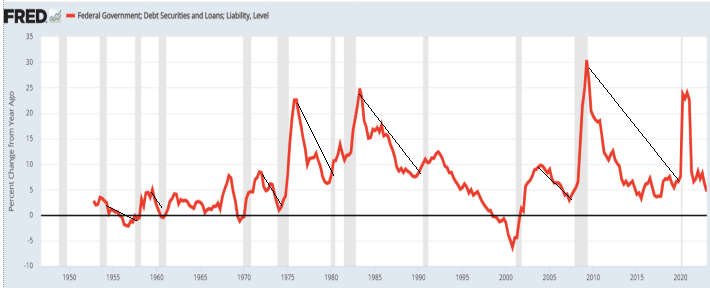
Vertical gray bars denote recessions. The red line indicates changes in federal deficit spending. Recessions begin with reductions in deficits.

The above graph dramatically shows how reduced federal deficits lead to recessions cured by increased obligations.

The Federal Reserve calls the red line “Federal Government Debt Securities and Loans, Liability, Level” when it is more like “Deposits into T-Security Accounts.” Even the Fed gets it wrong.

Going back in time, here is what happens when the federal government runs a surplus (taxes exceed spending).

U.S. depressions tend to come on the heels of federal surpluses.

1804-1812: U. S. Federal Debt reduced 48%. Depression began in 1807.
1817-1821: U. S. Federal Debt reduced 29%. Depression began in 1819.
1823-1836: U. S. Federal Debt reduced 99%. Depression began in 1837.
1852-1857: U. S. Federal Debt reduced 59%. Depression began in 1857.
1867-1873: U. S. Federal Debt reduced 27%. The depression began in 1873.
1880-1893: U. S. Federal Debt reduced 57%. Depression began in 1893.
1920-1930: U. S. Federal Debt reduced 36%. Depression began in 1929.
1997-2001: U. S. Federal Debt reduced 15%. The recession began 2001.

Why do the rich want the government to run surpluses?

  1. A surplus requires a tax increase and/or a spending decrease. Congress has provided tax loopholes so the rich seldom are affected by the tax increases paid for by the rest of us. Concerns about deficit rarely translate into a reduction of loopholes for the rich. A federal surplus effectively widens the income/wealth/power Gap between the rich and the rest
  2. The spending decreases invariably come from benefits important to those who are not rich — Medicare, Medicaid, Social Security, and other poverty aids — further widening the Gap.
  3. Surpluses cause depressions and recessions, forcing unemployment and providing rich business owners with a ready supply of desperate workers who will labor at starvation wages.

During recessions and depressions, the rich can maintain their lavish lifestyles while the rest of the populace suffers.

The push for drastic reductions in federal spending is expected to come up again once House Republicans pick a new speaker.

Whoever takes the gavel is expected to keep pushing for deep cuts. The Democratic-run Senate is unlikely to go along, but the GOP effort matters as a message to constituents about what Republicans are seeking.

The Republicans are the party of the rich. They are more likely to do the rich’s bidding than the Democrats, as evidenced by the divergent stances on federal spending.

The GOP initiative is also a reminder of why Congress is so stuck on adopting a budget.

When McCarthy, R-Bakersfield, agreed last month to a bipartisan plan to continue current spending for 45 days, angry conservatives plotted his successful removal.

The GOP is so in thrall of the rich it even demoted its House Speaker when he failed to end the government’s ability to spend.

The GOP budget plans range: For instance, aid that 702,000 Californians receive to buy healthy produce (through the Women’s, Infant and Children’s program WIC) would be dramatically cut.

So would the federal tax credit for electric vehicle charge equipment.

While such reductions collectively would save billions, nonpartisan budget analysts maintain that the cuts barely address the broader question of how to reduce the nation’s $33 trillion debt significantly.

Why is reducing the government’s “debt” (that isn’t a debt) an important question? Because it’s what the rich want, and their money talks.

Republican budget-cutters claim that their changes are a vital first step toward making the federal government more efficient and starting on a useful path to reducing the debt.

Reduced spending does not make government “more efficient.” Growing the economy is the government’s job, so reducing federal spending makes the government less efficient at its job.

Gross Domestic Product (GDP) is a common measure of the economy.

GDP = Federal Spending + Non-federal Spending Net Exports.

When Federal Spending increases, Non-federal spending also increases. When two terms of the equation increase, GDP increases.

Mathematically, there is no way for the government to do its job — growing the economy — by cutting spending.

“Stop bleeding money, stop racking up debt, defend the United States, stop social engineering, and just do your damn job as Congress.

I think that ought to be a pretty simple goal and a bipartisan goal,” said Rep. Chip Roy, R-Texas.

The key words are “stop social engineering.” This is right-wing speak for “cut Social Security, Medicare, Medicaid, and cut all benefits received by those who aren’t rich but don’t touch the loopholes that allow people like Donald Trump to pay $500 per year in federal taxes.”

Struggling with debt, The federal budget had annual surpluses from fiscal 1998 to 2001, as a booming economy, a 1995 budget deal, and a 1993 tax increase helped revenue pour into the Treasury. 

As you can see in the above graph, the recession of 2001 resulted from the federal surplus that began in 1998 and ended in 2002, when we emerged from the recession.

Since then, there have been nothing but annual deficits—$1.35 trillion in fiscal 2022—and the national debt has grown to $33 trillion.

David Lightman conveniently forgets that in the same period, Gross Domestic Product more than tripled, due to federal spending.

The deficit began climbing as Washington responded to the Sept. 11, 2001, terrorist attacks, pumping an estimated $2 trillion into wars in Iraq and Afghanistan. It spent to combat the Great Recession in 2009, delivered significant tax cuts in 2017, and passed huge COVID aid packages in 2020 to 2022.

Here is where the logic gets wacky. The government always spends to combat recessions. Federal spending is the one thing that cures recessions.

Why, then is it so hard for the debt nuts to understand that federal spending prevents recessions and grows the economy?

In fiscal 2022, the 12-month period that ended last September, the federal government spent $6.2 trillion. About two-thirds is called “mandatory spending,” meaning Congress does not have to vote on it. This includes Social Security benefits and Medicare payments.

That leaves only about one-third that Congress can control annually.

Wrong. Congress and the President have 100% control. They can, and should, expand Social Security and Medicare to include everyone in America, from birth to death, and for heaven’s sake, stop taxing Social Security benefits. That makes no sense from any standpoint.

Roughly half is defense, and the other half is domestic programs like education, transportation, energy, and others.

Most independent budget analysts agree that meaningful debt reduction involves costly entitlement spending. Social Security is estimated to be 11 years from insolvency. Medicare also faces financial problems in a few years.

You never will read a better expression of the Big Lie than the preceding paragraph. The phrase “meaningful debt reduction” should be changed to “harmful debt reduction.”

Neither Social Security nor Medicare can be “insolvent” or face “financial problems” unless that is what Congress and the President want.

The prevention and cure for those problems: A few touches of computer keys to provide money to these two vital programs — programs that benefit the “not-rich” far more than the rich.”

Those programs’ benefits are automatically funded and adjusted annually for inflation. Social Security benefits this year are up 8.7%, and next year are expected to climb about 3%.

The House’s GOP-run budget committee released a budget blueprint this summer that, while it proposes deep spending cuts, would not change Social Security. It does propose billions in Medicare savings through reforms.

Isn’t it clear why the budget cutters always use the word “reforms” when the honest word would be “cuts.”

Every conceivable “reform” for Medicare involves the Monetarily Sovereign federal government sending fewer dollars to the monetarily non-sovereign private sector.

As we repeatedly have experienced, reducing federal spending is recessionary or depressionary.

“Our budget protects and strengthens Medicare through policies that drive down out-of-pocket costs for seniors, stop overpayments, and enhance our healthcare workforce,” the budget says.

The budget does no such thing, neither protecting nor strengthening Medicare. To protect and strengthen:

  1. Eliminate FICA, which pays for nothing. Instead pay for Medicare the same way the government pays for Congress, POTUS, SCOTUS and nearly every other federal program: Create new dolllars, ad hoc.
  2. Eliminate Medicare deductibles. 
  3. Cover all the things that aren’t covered (dental, drugs, many procedures, etc.)
  4. Cover every man, woman. and child in America, from birth.
  5. Stop referring to the non-existent, fictional, phony Medicare Trust Fund.

It also urges the creation of a bipartisan commission to tackle the programs’ future. The commission would devise ways to get the programs on a sustainable financial path and help modernize the systems.

We don’t need another fake “bipartisan commission” that is ignorant (or feigns ignorance) of Monetary Sovereignty. Point #1 would get Medicare on a 100% sustainable path.

This sort of commission was arguably successful in the 1980s, when Social Security faced financial uncertainty.

It proposed what at the time were politically shaky reforms, including tax increases to fund the program and an increase in the age of eligibility.

The commission may have been “arguably” successful, but it wasn’t actually successful. It was a disaster.

The so-called “reforms” did nothing but shift the financial burden from the Monetarily Sovereign federal government (which never can run short of dollars) to the monetarily non-sovereign private sector (for which dollars always are scarce).

That could be called “successful” only in the eyes of the very rich. The Gap below widened, which is how the rich become richer.

Cuts and more cuts. The political focus is on spending cuts and taking incremental steps that are unlikely to get final approval. Once the House gets down to business again, those cuts will be the main topic of debate for some time.

Spending cuts always are harmful. By mathematical definition, they reduce GDP.

The House Budget Committee said in its blueprint that its plan can deliver a surplus by fiscal 2033. In addition to cuts, it assumes 3% economic growth per year, above what the nonpartisan Congressional Budget Office forecasts. More growth usually means more revenue and less spending.

The same surplus that repeatedly caused depressions in the past 200 years? Or Clinton’s surplus that “only” caused a recession?

Do these people not understand simple algebra? GDP=Federal Spending + Nonfederal Spending + Net Exports. How will federal spending cuts increase GDP?

The budget also reverses some of the plans Democrats recently approved. Outlays for green energy and technology “should have been targeted towards traditional roads and bridges, not wasteful initiatives,” the committee said, listing several programs it found excessive.

The committee claims that green energy and technology to save our planet are “excessive” and “wasteful initiatives”? What planet do these people live on?

Among them: $7.5 billion for electric vehicle charging stations, $5 billion for electric and low emissions buses and ferries and $10 million for career skills training to install energy efficient building technologies.

The Republicans prefer CO2-emitting, pollution-causing, gas-guzzling cars, busses, and ferries. And of course, they don’t want “energy efficient building technologies”.

Rep. Marjorie Taylor Greene, R-Georgia, proposed the reduction in Pentagon Secretary Austin’s salary, arguing “he is destroying our military.” She cited the chaotic American withdrawal from Afghanistan, saying Austin “failed America.”

If Marjorie Taylor Greene speaks for the GOP, need I say more?

Some analysts warn that such cuts have the potential to harm the people who need help the most.

Not “potential” harm; real harm to real people.

Cutting Women, Infants and Children program funds to buy healthy produce would leave recipients with roughly $11 to $15 monthly to spend, the left-learning Center on Budget and Policy Priorities estimates.

It said the cuts would affect an estimated 702,000 toddlers, preschoolers, and pregnant, postpartum, and breastfeeding California participants in the program.

This is exactly what happens when politicians value the federal government’s finances (which are infinite) more than personal finances (which are limited).

Republicans have argued that strengthening work requirements in assistance programs will help motivate people to work, reducing the programs’ cost and helping the economy as people pay more taxes and increase their spending.

“Motivate people to work” follows the right-wing claim that the poor are lazy takers who would rather wallow in their poverty than work, while the rich are industrious givers who labor so hard on their yachts, private planes, gated communities, and chauffeur-driven limos.

===================================

Then there was this example of economics ignorance from Chartr, the web site that provides graphs for many different subjects:

II. Like most developed nations, the US spends more than it takes in taxes — essentially “living beyond its means”. For years, that wasn’t an issue, with Uncle Sam able to borrow at close to record-low rates for a decade.

Again, Uncle Sam never borrows its own sovereign currency, the U.S. dollar. It creates all the dollars it needs

However, higher borrowing costs have changed the game. Indeed, forecasts from the Congressional Budget Office project that the majority of future government deficits will not be down to net new spending, but rather paying the interest on what’s already owed (some $33 trillion), with deficits expected to rise as a share of GDP for the coming decades.

“Living beyond its means” is another version of the Big Lie, this one popularized by economically dense Democrat Barach Obama. The federal government has infinite means, so cannot live beyond it.

The deficit/GDP fraction is a popular, but meaningless number. It demonstrates nothing about the federal government’s financial health or its ability to pay its debts (which is infinite) and predicts nothing about the future.

You can visit a related website, “Debt to GDP Ranking by Country” and decide for yourself what the fraction tells you about anything at all.

Would the author of this article prefer to be owed money by Zambia (with a 119% score) rather than by the United States (with an “inferior” 128% score).

==========================================

And finally, to demonstrate how the Big Lie is everywhere, we come to the New York Times:

Higher rates stoke growing chorus of deficit concerns NYSE on June 13. The interest rate on 10-year Treasury bonds has spiked since July. By Jeanna Smialek, Jim Tankersley and Joe Rennison The New York Times

The U.S. government’s persistent budget deficit and growing debts were low on Wall Street’s list of worries when interest rates were at rock bottom for years.

But borrowing costs have risen so sharply that it is causing many investors and economists to fret that the United States’ big debt pile could prove less sustainable.

In 1940, The Gross Federal Debt Held by the Public totaled $41 Billion and was called a “ticking time bomb.” Now, it’s somewhere near $31 TRILLION.

Yet the bomb still ticks, and we still sustain, though the NY Times continues to clutch its pearls. Must be a slow tick.

The exact cause of the latest run-up in Treasury rates is hard to pinpoint. Many economists say a combination of drivers is probably helping to drive it — including strong growth, fewer foreign buyers of America’s debt, and concerns about debt sustainability in and of itself.

Gee, does the Times think “the run-up in Treasury rates” might be related to the Fed’s repeated rate increases?

That old worry about “foreign buyers” not buying America’s “debt” should be retired. It’s complete nonsense.

The federal government is not in debt and does not rely on foreigners to provide it with its own sovereign currency, the U.S. dollar. It creates all the dollars it needs by touching computer keys. No limit.

What’s clear is that if rates remain elevated, the federal government will need to pay investors more interest in order to fund its borrowing.

“Paying investors more” is a good thing. It adds to GDP. But, since the U.S. federal government never borrows dollars, investors can’t “fund borrowing.”

The nation’s gross national debt stands just above $33 trillion, more than the total annual output of the U.S. economy. The debt is projected to keep growing both in dollar figures and as a share of the economy.

The fact that the non-existent “debt” (i.e., deposits in Treasury security accounts) is greater than GDP reveals zero about the economy. The oft cited Debt/GDP fraction is meaningless. 

It’s like saying the Chicago Cubs had more runs than the Bears had field goals. Same “meaningful” comparison.

While the climbing cost of holding so much debt is stoking conversations among economists and investors about the appropriate size of the government’s annual borrowing, there is no consensus in Washington for deficit reduction in the form of either higher taxes or big spending cuts.

There’s no consensus because both higher taxes and spending cuts would injure the economy. Both take dollars from the economy and give them to the federal government, which promptly destroys them.

Should you cure anemia by applying leeches or by cutting wrists? No consensus there, either.

Still, the renewed concern is a stark reversal after years in which mainstream economists increasingly thought that the United States might have been too timid when it came to its debt: Years of low interest rates had convinced many that the government could borrow cheap money to pay for relief in times of economic trouble and investments in the future.

Our Monetarily Sovereign federal government has the infinite ability to “pay for relief in times of economic trouble,” no matter what interest rates have been. It does not borrow, cheap money or otherwise.

As always, the media confuse Monetary Sovereignty with monetary non-sovereignty. The former cannot run short of money; the latter can and often do.

“How big a problem deficits are depends — and it depends very critically on interest rates,” said Jason Furman, an economist at Harvard and former economic official under the Obama administration. 

Oops, another Obama economist. That tells us all we need to know. What is it with Harvard that their economists believe the federal government borrows and needs to worry about the interest it pays?

We’ll finish with a lovely compilation of economic ignorance, widely promulgated, widely believed, and widely wrong.

Furman had previously estimated that the growing cost of interest on federal debt would remain sustainable for some time, after factoring in inflation and economic growth. But now that rates have climbed so much, the calculus has shifted, he said.

The deficit has been sustainable since — uh, since the federal government had the power to create laws, and laws had the power to create dollars.

The deficit will continue to be sustainable forever. The U.S. government cannot unwillingly run short of dollars. Not now. Not tomorrow. Not ever.

Higher interest rates are a leading cause, along with surprisingly weak tax collections, of what the Congressional Budget Office projects will be a doubling of the federal budget deficit over the last year. 

The deficit, when properly measured, grew from $1 trillion in the 2022 fiscal year to an estimated $2 trillion in the 2023 fiscal year, which ended last month.

This means the federal government will pump about two trillion growth dollars into the economy. And this is a bad thing??

If borrowing costs climb further — or simply remain where they are for an extended period — the government will accumulate debt at a much faster rate than officials expected even a few months ago.

The federal government does not owe the misnamed “debt,” and even if it did, it could pay it all instantly.

The Big Lie in economics is that the federal government can run short of its sovereign currency. The Lie is repeated endlessly by nearly every information source — media, politicians, and economists.

The facts as explained by Monetary Sovereignty, are overwhelmed by the sheer volume of lies being promulgated from everywhere.

At long last, is there any one out there who has world standing plus even a modicum of knowledge about economics and Monetary Sovereignty? Is so, would that person please debunk the false notions that federal finances resemble personal finances and that federal benefits are “unsustainable”?

Hello?

Anyone?

Rodger Malcolm Mitchell
Monetary Sovereignty

Twitter: @rodgermitchell Search #monetarysovereignty
Facebook: Rodger Malcolm Mitchell

……………………………………………………………………..

The Sole Purpose of Government Is to Improve and Protect the Lives of the People.


MONETARY SOVEREIGNTY

The lawsuit you never heard of could upend your life

The U.S. Supreme Court has a sordid history, with only brief flashes of morality and honesty.
Following a sad tradition of supporting extremism, bigotry, and personal greed.
It has legalized slavery, counted blacks and women as less than human, denied the words “well-regulated militia” exist, approved civil asset forfeiture without due process, and approved forced sterilization of the mentally feeble. SCOTUS legalized the internment of Japanese Americans, uninhibited use of eminent domain taking, approved Jim Crow laws, and recently, denied women control over their bodies. SCOTUS ruled that money is speech, so those with the most money were given the constitutional right to the most speech. And then, there was Bush v. Gore, a flat-out contradiction of the Constitution. So yes, far too many crooked, immoral, greedy, and even stupid justices have populated many terrible Supreme Courts. The current one follows that sad tradition. My reading of the current Supreme Court is that it will continue to fail the morality/honesty test and will invent ever more twisted reasons to justify decisions reflecting the following concepts:
  1. If something benefits the rich, the Court’s right-wing likes it.
  2. If something benefits the rich at the expense of the poor, they love it.
  3. If something benefits the rich, punishes the poor, and personally benefits certain members of the Court, they positively adore it.
Call me a pessimist if you will, but Moore vs. the United States will test the Court’s morality and honesty yet again, and I predict the Court will find a way to fail the test. Excerpts:

Moore vs. the United States. The Roosevelt Institute and the ITEP report warned that the Supreme Court’s ruling could even affect social programs and the federal deficit.

The decision can affect social programs only if one wrongly believes federal taxes fund federal spending. While state/local taxes fund spending by these monetarily non-sovereign entities, federal taxes do not fund spending by the Monetarily Sovereign U.S. government. Even if all federal tax collections, including FICA, fell to $0, the federal government could continue its deficit spending forever.

“In Moore, the Roberts Court could decide with the stroke of a pen to simultaneously forgive big business decades of tax dues, increase the federal deficit over the long run, jeopardize future public revenue and essential social programs, escalate these multinational companies’ already sizable after-tax profits, and further enrich their shareholders,” the report authors wrote.

Contrary to popular wisdom, Social Security and Medicare are not funded by federal taxes. They are financed by dollars created ad hoc with the press of computer keys. As for the federal deficit, it is necessary for economic growth. When the deficit fails to grow, we have recessions and depressions. The federal deficit is the private sector’s income. Concerns about the federal deficit are based on ignorance of federal finance. Corporate profits create economic growth, and enriching shareholders is fine if the government also will spend to enrich the poor (via Social Security for All and Medicare for All).

The Supreme Court will hear the upcoming case, scheduled for December. It could potentially have far-reaching implications on the United States tax structure.

 The case deals with whether the U.S. Constitution’s 16th Amendment authorizes Congress to tax unrealized sums without apportionment among the states.

Charles and Kathleen Moore are minority shareholders in an Indian farming firm, and they have disputed a provision in the Tax Cuts and Jobs Act passed by Congress in 2017 after the IRS presented them with a $15,000 bill for their investment.

The Moores argue the reparation tax is not on income and violates the 16th Amendment that requires direct federal taxes to be apportioned among the states. After losing a suit in the District Court in Washington state in 2022, the Moores’ dispute will be heard by the Supreme Court.

The Roosevelt Institute and the ITEP explained that before the Tax Cuts and Jobs Act, American individuals and corporations “owning stock in a foreign corporation were allowed to defer payment of U.S. tax on profits generated by the offshore company until those profits were ‘repatriated.'”

Because this is a tax benefit taken mainly by wealthy investors, one might expect the right-wing Supreme Court to rule in favor of the Moores.

If the high court sides with the plaintiffs, almost 400 multinational corporations could collectively receive $271 billion in tax relief.

The U.S. federal government, being Monetarily Sovereign, neither needs nor uses any form of income, including tax income. When this income originates with U.S. taxpayers, it represents a dollar reduction from the private sector and, therefore, is recessive. On the other side of the coin is that most taxpayers will be among the rich, so the tax would help narrow the Gap between the rich and the rest. So, we have a conundrum. Is stimulating economic growth or narrowing the Gap more economically beneficial?

The report noted Chief Justice John Roberts and Associate Justice Samuel Alito are said to own stock in 19 companies that could receive a combined $30 billion if the court strikes down the repatriation tax.

Aha. That would seem to be the closing argument. In the unlikely event that the SCOTUS justices have any remaining morality, Roberts and Alito would recuse. I suspect Roberts still has a modicum of ethics. I doubt Alito has any. If they decide to recuse, it probably will be because Roberts embarrassed Alito into gritting his teeth and going along. If they don’t recuse, Alito and the rest of the right-wing gang will have won the cage match race to the bottom.

The report also argues that depending on the scope of the decision, the Supreme Court could “supplant Congress as a major American tax policymaker, putting at legal jeopardy much of the architecture of laws that prevent corporations and individuals from avoiding taxes, and introducing great uncertainty about our democracy’s ability to tax large corporations and the most affluent.”

Laws that allow the rich to avoid taxes are like roast beef for starving SCOTUS justices. Who will take them on those free junkets if the rich get angry with them? The federal government is not funded with tax dollars. It creates its own funding by pressing computer keys. Taxes control the economy by taxing what the government wishes to encourage and giving tax breaks to what the government wishes to reward. Taxes also create demand for the dollar by requiring tax payments to be in dollars. The actual function of federal taxes is to enrich the rich by widening the Gap between the rich and the rest. “Rich” is just a comparative, not an absolute term. The wider the Gap, the richer are the rich. The rich pay a much smaller percentage of their income and wealth than the poor, so today’s tax law widens the Gap and makes the rich richer. While taxing businesses is anti-growth, taxing the rich (i.e., eliminating tax dodges) would narrow the Gap.

Common Dreams wrote about the report on Moore v. United States and said that while justices could take a narrower view on specific parts of the Moore case, a broader ruling could protect individuals from a wealth tax.

There are many problems with a wealth tax — what constitutes “wealth,” how is it measured, how would a home, a bank account, or company stock be measured for tax purposes. The biggest problem is that, as with current tax laws, the rich would influence (i.e., bribe) Congress to answer those questions in their favor.

The Manhattan Institute, one of eight conservative advocacy groups that filed amicus briefs urging the Supreme Court to hear the Moores’ case, argued in a filing that “the case presents the court with an ideal opportunity to clarify that taxes on unrealized gains, such as wealth taxes, are direct taxes that are unconstitutional if not apportioned among the states.”

On balance — and there are two strong sides to this — I will agree with the conservatives if they rule in favor of the Moores. While state and local taxes are necessary to fund state and local government spending, federal taxes don’t support anything. In my view, the best federal tax is no tax. SUMMARY Remember the three points at the start of this post: If something benefits the rich, the Court’s right-wing likes it. If something benefits the rich at the expense of the poor, the right wing loves it. If something benefits the rich, punishes the poor, and secretly benefits certain members of the Court, they positively adore it. See whether any justice recuses. Then, see the decision and who votes for what. That will demonstrate much about this SCOTUS. My guesses: The right wing will back Moore and the rich. Their obligations to the rich and powerful are too strong to break. Roberts and Alito won’t recuse, though, for appearances, they might dump their stock shares (and repurchase them later.) Those posh vacations on yachts and private planes may be too much fun to give up. And hey, they have lifetime jobs, so let the peons complain. I’d like to be proven wrong on this. The only solution is term limits and a morals clause similar to what every other judge in America must follow. Rodger Malcolm Mitchell Monetary Sovereignty Twitter: @rodgermitchell Search #monetarysovereignty Facebook: Rodger Malcolm Mitchell

……………………………………………………………………..

The Sole Purpose of Government Is to Improve and Protect the Lives of the People.

MONETARY SOVEREIGNTY

Is the problem cruelty, ignorance, or greed? You decide

We’ll begin with our usual reminders:

1. The U.S. federal government is not like state/local governments. It is uniquely Monetarily Sovereign, meaning it cannot unintentionally run short of its sovereign currency, the U.S. dollar.

Unlike state/local governments, the federal government never spends “taxpayer money.” It creates new dollars ad hoc when it pays any bills. Even if the government collected $0 in taxes, it could continue spending forever.

Because federal taxes do not fund federal spending, what is their purpose? The first purpose of federal taxes is to control the economy by taxing what the government wishes to discourage and giving tax breaks to what the government wishes to reward.

The second purpose is to assure demand for the dollar by requiring taxes to be paid in dollars.

2. Federal deficit spending does not, has not, and will not cause inflation. All inflations in history have been caused by scarcities of key goods and services, most notably oil and food, but more recently, transportation, computer chips, metals, lumber, labor, and other goods.

Today’s inflation was COVID-induced by all of the above scarcities. The scarcities and inflation could be cured by more federal spending to acquire and distribute the scarce goods and services.

Recently, I read an article in THE WEEK Magazine that reflects Congress’s cruelty, ignorance, and or greed, primarily those of the right. Here are excerpts and comments:Child Poverty in Western Cities: learning from global approaches – Child in  the City

The child poverty rate in the United States more than doubled between 2021 and 2022, according to new data on poverty, income, and health insurance from the U.S. Census Bureau on Sept. 12.

A year after the rate hit a historic low of 5.2 percent, the percentage of impoverished children jumped to 12.4 percent.

The bureau pointed to the end of the pandemic-era expansion of child tax credits in late 2021 as a critical factor in the dramatic increases.

“This represents a return to child poverty levels before the pandemic,” Liana Fox, assistant division chief at the Census Bureau, said during a news conference, per the Associated Press. “We did see the child tax credit substantially decreased child poverty.”

Why was the program discontinued if the child tax credit was proven to work and no taxpayer dollars were involved? We’ll discuss that later in this post.

The increase was “part of a wider rise in poverty recorded by the Census,” Time noted, “some of which can be attributed to inflation.” However, child advocates said, “the leap was particularly stark for kids — and was avoidable,” the outlet added.

The federal government can cure inflation by using its infinite money-creation power to acquire scarce items and/or reduce business expenses.

How did the rate go from a record low to more than doubling in one year? During the pandemic, Congress expanded the child tax credit as a part of the American Rescue Plan, which helped families stay afloat alongside stimulus checks.

Families received up to $3,600 for kids under 6 and $3,000 for children aged 6 to seventeen.

Officials also made the tax credit refundable, meaning families who did not make enough money to owe income tax could still be eligible for the monthly payments. This allowed millions of low-income families to be qualified and helped drive the child poverty rate to its lowest level in years.

That progress was reversed when the pandemic relief lapsed, and Congress did not vote to extend the expanded child tax credit at the end of 2021. With the program ending, millions of families lost eligibility for the credit.

The child tax credit can sometimes be considered “an upside-down policy,” Sharon Parrott, president of the Center on Budget and Policy Priorities, told NPR. “That’s because the children who need it the most get the least, while higher income children get more.”

That means when the pandemic relief ended, many families no longer reached the income requirement to qualify for the credit.

In contrast, families making six-figure incomes still get the full tax credit, Parrott explained. The child credit is income-based, so the more money you make, the more you earn per child.

Why did Congress favor giving more to the rich and less to the poor? Logically, it should be the other way around. But the rich make bigger campaign contributions. It’s that simple.

The data highlights “that poverty in our country isn’t a personal failing, but rather a policy choice,” said Melissa Boteach, vice president of income security at the National Women’s Law Center, per Time.

Legislators could “lift millions of women and children out of poverty” if they “prioritize families over their wealthy donors,” Boteach added.

The rich have convinced the voting public that the poor are lazy takers whose poverty results from their sloth. “If only they worked harder like I do,” goes the mantra, “they wouldn’t be poor.” It’s all a convenient lie to excuse cruelty and lack of compassion. If anything, the poor work harder than the rich. They are tasked with the most menial, least pleasant, most demeaning, least rewarding, back-breaking jobs our society offers. More than any other fact, luck separates the poor from the rich. “There, but for the grace of God, go I.”

If the expanded tax credit was working, why wasn’t it extended? President Biden blamed congressional Republicans for not extending the expanded child tax credit, arguing that the rise reported by the Census was “no accident.”

But the push to expand the child tax credit reached a stalemate in Congress, with opposition from Democrats and Republicans. “One flash point was an insistence by some lawmakers that it should go only to families with working parents,” wrote The Washington Post editorial board.

That’s the WSJ expression of the “lazy takers” poverty theory. If someone doesn’t have a job, that “proves” they don’t deserve help. It’s a disgusting lie promulgated to support cruelty and indifference. “I am a good person, but I don’t give to charity because (fill in the blank).

Others objected because they felt the money would discourage people from working and fuel inflation, which was already at a record high.

Think about it. Some 0f the financially fortunate in Congress felt that people receiving $3,600 to support a child for a year would not look for work. Only the clueless would believe such nonsense. Others falsely claimed that increasing the federal deficit would exacerbate inflation. (They had no objections to the gigantic tax loopholes enjoyed by the rich, which further increased the deficit.) When Donald Trump paid only $500 in total annual taxes for income that otherwise would have resulted in many millions of tax dollars, he alone increased the deficit by more than several thousand poor people receiving child tax credits.

Sen. Joe Manchin (D-W.Va.) reportedly suggested that parents would use the extra money on drugs, per Intelligencer, and he later opposed his party’s Build Back Better budget proposal, which included an extension to the child tax credit program.

Manchin’s disturbing suggestions were:. If you give anything to the poor, they’ll blow it on booze, cigarettes, and drugs rather than feeding their children. If you’re one of the (mostly) right-wingers who like to make that claim, I genuinely feel sorry for the terrible job your parents did on you. They made you into a small, mean-spirited excuse for a person.

On a smaller scale, it’s “encouraging that 13 states have a version of the tax credit in place,” the Post editorial board reported. Most are blue states, but “there are also programs in conservative states such as Idaho and Oklahoma, where lawmakers understand how effectively it works,” the board noted.

The irony is that when states spend money, their taxpayers fund the dollars, unlike federal taxpayers, who fund nothing. And here’s a cute switch by the increasingly right-wing extremist Wall Street Journal:

The temporary infusion of cash provided by the child tax credits and other pandemic stimulus programs contributed to “an inflation surge that gutted real incomes.”

Manchin was right to oppose a program that would have cost $1.2 trillion over the next decade.

The U.S. doesn’t need more inflationary spending that disproportionately “punishes lower-income Americans.”

Get it? The Wall Street Journal tells its gullible readers that helping the poor is bad for the economy and even bad for the poor!  (As though that right-wing paper gives a fig about the well-being of the poor.) In the lying words of the hate-mongers, giving to the poor encourages unemployment, drugs, inflation, and amazingly, even makes the poor and their children poorer. (Never mind that the child poverty rate more than doubled when the child tax credit ended.) Perhaps the death of the WSJ’s owner, Rupert Murdoch, will help this paper come to some semblance of accuracy, though it has not yet improved the equally extremist Fox News. SUMMARY Giving money to the poor makes them less poor, doesn’t cause inflation, doesn’t increase illegal drug use, doesn’t increase unemployment, doesn’t threaten America’s solvency, and doesn’t cost taxpayers a thing. In answer to the title question, “Is the problem cruelty, ignorance, or greed”? The answer, of course, is: All three. And it applies to Washington and the voting public. Rodger Malcolm Mitchell Monetary Sovereignty Twitter: @rodgermitchell Search #monetarysovereignty Facebook: Rodger Malcolm Mitchell

……………………………………………………………………..

The Sole Purpose of Government Is to Improve and Protect the Lives of the People.

MONETARY SOVEREIGNTY

Fairy tales about money.

We have three main political groups in America:
  1. The Republicans who support rich, white, Christian, NRA men born in America, but claim too much money is given to everyone else.
  2. The semi-Republicans (aka “Libertarians) who also claim the government spends too much helping the poor and middle-income people but support tax breaks for the rich.
  3. The Dems who claim to love ordinary people but still yield to fairy tales about excessive federal deficits and debt.
  4. There’s a fourth category: All those groups that claim to support a specific issue but, in reality, are designed to take votes from one of the major parties.
Veronique de Rugy | Washington Examiner
Veronique de Rugy
Here are some excerpts from an article that demonstrates the fairy tales they all promulgate. It was written by a semi-Republican (Libertarian).

‘Bidenomics’ Is Failing Everyday Americans The big spending has fueled higher inflation, resulted in larger-than-projected deficits, and contributed to a record level of debt.

By Veronique de Rugy, 9/21/2023

We’ve shown you data (here, here, here, here, and elsewhere) that demonstrate why even massive federal spending does not cause inflation. All inflations are caused by shortages of critical goods and services. When anything is in short supply, its price rises. When critical goods like oil and food are in short supply, prices generally increase.  This general increase is called inflation. These shortages can be cured by federal spending to obtain and disseminate the scarce goods and services. The U.S. government spent massively for many years, and we experienced meager inflation. Only when COVID, the Russian/Ukraine war, immigration restrictions, and Saudi greed caused shortages of oil, food, computer chips, lumber, metals, labor, and other Gross Domestic Product necessities did we have the general increase in prices known as “inflation.” GRAPH I.
There is no historical relationship between highs and lows of federal spending (green) and inflation (red).
GRAPH II.
Also, there is no historical relationship between highs and lows of federal DEFICIT spending (blue) and inflation (red).
GRAPH III.
There is a strong correlation between the highs and lows of oil supplies (gray) and inflation (red).

Ordinary Americans aren’t feeling the so-called success of “Bidenomics.”

Superficially, the economy looks solid. Real gross domestic product (GDP) increased at an annual rate of 2.1 percent in the second quarter of 2023.

While August’s unemployment rate rose to 3.8 percent, that’s still considered full employment by economists.

Wages are rising, and we are often told we’re in a manufacturing boom.

But these numbers need perspective. Employment growth was inevitable because we lost millions of jobs during the pandemic.

De Rugy forgets she admitted we’re at full employment. This has nothing to do with employment growth. “Full” means “full.” She makes the strange claim that because we lost jobs during COVID, today’s full employment was a natural result. Sorry, but that right-wing naysaying won’t fly. Federal spending helped create those jobs. We have a labor shortage, partly because right-wingers falsely claim that undocumented immigrants bring crime and drugs to America.

Comparing Crime Rates Between Undocumented Immigrants, Legal Immigrants, and Native-born US Citizens in Texas

This study used uniquely comprehensive arrest data from the Texas Department of Public Safety to compare the criminality of undocumented immigrants to legal immigrants and native-born U.S. citizens between 2012 and 2018.

The study found that undocumented immigrants had substantially lower crime rates than native-born citizens and legal immigrants across a range of felony offenses. Relative to undocumented immigrants, U.S.-born citizens are over 2 times more likely to be arrested for violent crimes, 2.5 times more likely to be arrested for drug crimes, and over 4 times more likely to be arrested for property crimes.
Drugs come in via legal entry ports, not via immigrant families desperate to escape gangs and poverty.)

Cocaine seizures on U.S. borders, for instance, regularly measure in tons, making it impractical to have individual migrants ferry it across. Instead, dealers prefer to smuggle drugs into the country via legal ports of entry, which allow them to bring in high-value substances that are more easily hidden.

“The majority of the illegal drugs that enter the United States through the U.S.-Mexico border cross through formal Points of Entry,” said Joel Martinez, a Mexico research associate for the Center for American Progress

“The drugs that cross in between are very minimal and non-expensive products like marijuana. All the cocaine, fentanyl and methamphetamine — they cross through formal ports because they’re easier to hide […in] freight comp and assorted vehicles.”

So, right-wing bigotry against foreigners, especially those of color, make it almost impossible for those people to gain citizenship.

Unemployment is low, but only because the economy is drunk on spending, simultaneously closing many people out of the labor force.

De Rugy, desperate to minimize Biden’s success, unknowingly admits that federal spending reduces unemployment. Then, strangely, she declares that in some unknown way, federal spending “closes people out of the labor force.” It is not unusual for people to take both sides of an issue when they have no facts.

Moreover, inflation-adjusted median household income has declined—from $76,330 in 2021 to $74,580 in 2022. Labor tensions and strikes are also intensifying.

This problem is not caused by federal spending but rather by the greed of the rich. Plenty of profits reward shareholders via stock price growth and stock by-backs. Companies have plenty of money to reward executives with excessive pay increases, many multiples higher than average workers’. Now, we see the inevitable result: Strikes.

With all this in mind, is the average American becoming better off?

No, the average worker is not making more inflation-measured dollars, which is why Biden (but not the Libertarians and the GOP) favors the strikers. They are striking to narrow the income/wealth/power Gap between the rich and the rest. This is anathema to the Republicans and the faux Republicans (Libertarians), who always favor cutting benefits to the not-rich (while cutting taxes on the rich.)

These troubles are partly caused by inflation, which continues to take its toll. Per the Consumer Price Index (CPI), year-over-year inflation rose to 3.7 percent in August, nudging back up after peaking at 9.1 percent not long ago.

“Core” CPI (excluding food and energy) is down slightly to 4.3 percent. Although these numbers are an improvement after we experienced their highest levels since 1982, they remain disturbingly high.

Excluding food and energy from the measure of inflation and calling the balance “core inflation” makes no sense. It’s like excluding all home runs, triples, and doubles from a baseball player’s statistics and calling singles his “core” batting average. Scarities of energy and/or food are the most common and most important reasons for inflation. The Fed is so focused on money it has lost sight of reality. The reason: The Fed is tasked with curing inflation, and its only tool is interest rates. So, the Fed ignores the scarcity of energy and food and proclaims these products are not “core,” when that is precisely what they are. (“Move on, folks. Nothing to see here.”)

This is bad news for Americans whose standard of living has fallen since early 2021.

The Bureau of Labor Statistics (BLS) reported real average hourly earnings declining in 2021 and 2022, meaning Americans can afford less with their hard-earned dollars.

More than three-quarters of people’s income is devoted to living expenses like housing, transportation, and food—all of which have become more expensive.

The federal government can make all of the above less expensive to Americans. Consumers could receive federal benefits for housing, transportation, and food. FICA could be eliminated; being a federal tax, it pays for nothing. (The federal government pays for everything by creating new dollars ad hoc. Federal tax dollars are destroyed upon receipt.) The right-wing opposes all these solutions to the fallen standard of living.

Food prices, for instance, rose by 19.3 percent. Shelter rose by 16.5 percent since 2021. Gasoline prices are up, too.

Inflation is a tax on every American’s standard of living. It’s also a regressive tax. Low-income workers tend to experience higher-than-average levels of household inflation.

Inflation would not take its toll on Americans if the federal government increased spending to:
  1. Provide free healthcare insurance to every man, woman, and child in America, regardless of wealth and income.
  2. Provide Social Security benefits to every man, woman, and child in America, regardless of wealth and income.
  3. Reduce energy prices by supporting renewable energy and oil drilling/refining.
De Rugy cries crocodile tears for the “Average American’s troubles” but refuses to consider any cure for those troubles. Instead, she worries about the non-existent “troubles” of the federal government, the one entity in America with limitless funds, and never needs to worry about bankruptcy.

Making matters worse, high-interest rates resulting from the Federal Reserve’s fight against inflation also hit lower-income Americans the hardest.

These tend to consume a higher proportion of such incomes and take money from the pockets of people who hold assets in cash or low-yielding bank deposits.

In other words, inflation creates the opposite of an equitable economy.

Both inflation and high-interest rates take money from the pockets of average Americans. But both inflation and high-interest rates are unnecessary and totally within the control of the government. High rates do not “result” from anything. They are the Fed’s primary inflation-fighting tool. Inflation can be cured by federal spending to cure the shortages that cause inflation. And interest rates are determined by the Fed. Raising interest rates not only does nothing to cure inflation but also exacerbates inflation by increasing the price of nearly everything: Real estate, cars and trucks, food, clothing, all imported goods, construction materials. The Fed feeds the patient salt tables to cure high blood pressure. Why does the Fed do it? Because the Fed focuses on money, raising interest rates increases the demand for the dollar. The Fed ignores the obvious fact that adding interest payments to the price of everything increases the purchase price of everything.

Simple example: You buy a $50,000 car and finance the purchase with a 5-year, 3% loan. The total of your 60 monthly payments is $53,852.13.

Alternatively, say you finance that $50,000 car with a 5-year 6% loan. Now, the total of your monthly payments is $57,776.95

That $50,000 car cost you an additional $3,924.82, courtesy of the Federal Reserve. That is the very definition of inflation.

By now, it’s well-known that Bidenomics’ big spending has fueled higher inflation, resulted in larger-than-projected deficits, and contributed to a record level of government debt.

It may be “well-known” that federal spending causes inflation, but what’s “well-known” often contradicts the facts. It once was “well-known” that the earth was the center of the universe, emotional stress was the primary cause of stomach ulcers, and drinking water during exercise causes cramps (Yes, really. When I was young, that was common knowledge.) As GRAPH I and GRAPH II (above) demonstrate, there is no relationship between federal spending and inflation. Nor is there a relationship between federal deficit spending and inflation. There is, however, a robust relationship between oil price increases (which are strongly related to oil scarcity) and inflation. As for de Rugy’s concern about federal debt and deficits, she displays widespread ignorance about Monetarily Sovereign governments. The U.S. federal government’s finances are nothing like those of monetarily non-sovereign governments such as state, county, city, and the euro governments. Monetarily, Sovereign government cannot run short of their own sovereign currency.

Alan Greenspan: “A government cannot become insolvent with respect to obligations in its own currency.”

“Federal debt” is not a debt of the federal government. It is deposited into T-security accounts that are owned not by the government but by the depositor. The government never touches those deposits other than to add interest money, and upon maturity, the money in those accounts is returned to the depository. The two purposes of T-accounts (T-bills, T-notes, T-bonds) are to:
  1. Provide the public with a safe storage place for unused dollars.
  2. To assist the Fed in setting interest rates.
T-securities do not provide the federal government with spending money. To pay its bills, the federal government creates new dollars ad hoc. Federal deficits are not a burden on the federal government or on taxpayers. The government has the infinite ability to pay any obligations. Unlike state and local governments, the federal government does not need or use tax dollars to pay its bills. It always uses newly created dollars for that purpose. Ms. de Rugy’s concerns about federal “debt” and deficits are unwarranted. Federal deficits add dollars to the economy. When federal deficits are too small, the economy ceases to grow (“recessions”) or shrinks (“depressions). Graph II shows this effect. As deficit spending shrinks, the economy goes into a recession, cured by increased deficit spending. Deficit spending grows the economy and does not cause inflation or require taxes. Even if no federal taxes were collected, the federal government could continue spending forever.

The most recent estimate of the full-year deficit for 2023 is $1.5 trillion, up from $946 billion last year. Total federal debt is more than $33 trillion, an increase from $28.5 trillion in 2021. Budget tensions led the credit agency Fitch Ratings to downgrade Treasury debt based on prospects of further fiscal deterioration.

Fitch Ratings did not downgrade Treasury debt because of the size of the debt or deficits. It downgraded the debt because of the uncertainty regarding one of the most ignorance-based laws in American history: The debt ceiling. This harmful law is based on the false premise that federal debt and deficits burden the government and taxpayers. The law threatens to force the federal government to renege on its promise to return the money in T-security accounts to depositors or to fail to pay past obligations to creditors.

This is not great; federal borrowing is projected to be $120 trillion in the next 30 years.

The federal government never borrows dollars. It creates all the dollars it needs and uses ad hoc.

Statement from the St. Louis Fed: “As the sole manufacturer of dollars, whose debt is denominated in dollars, the U.S. government can never become insolvent, i.e., unable to pay its bills. In this sense, the government is not dependent on credit markets to remain operational.”

The prospect of gigantic, never-ending deficits during good times makes investors nervous.

Knowledgeable investors are aware that the size of federal deficits does not, in any way, affect the federal government’s ability to pay its bills.

Borrowing costs like mortgage and car loan rates are rising, as are yields on benchmark 10-year treasury notes. They’re above 4.3 percent, their highest level since 2007—weighty burdens on lower-income Americans.

Here, Ms. de Rugy mixes two errors.
  1. Mortgage rates are whatever the Fed wishes them to be. Sadly, the Fed believes raising rates is the way to fight inflation, while it causes more inflation.

Finally, while America may be experiencing a hike in real construction spending, that’s a far cry from a manufacturing boom.

According to the Institute for Supply Management Report on Business, economic activity in the manufacturing sector in August contracted for the tenth consecutive month following 28 months of growth.

Moreover, manufacturing only accounts for 11 percent of GDP. Even if this sector grew, the benefits wouldn’t be widely shared.

After the COVID recession, GDP grew faster than at any time since WWII.
Manufacturing will continue to contract as we transition to a computer-based society. One day, we all will have 3-D printers that allow us to create what we want without buying manufactured goods. Ms. de Rugy is stretching to find fault with economic growth. She is a member of the “semi-GOP” Libertarians whose sole contribution to the economic discussion is to criticize Democrats.

Nor will Bidenomics’ manufacturing subsidies help workers with college degrees. These handouts, often extensive and rich, benefit companies for projects they would have likely taken on anyway.

It’s not clear why Ms. de Rugy believes manufacturing subsidies won’t help workers with college degrees. And as for projects that “likely” would be taken on without benefits, one wonders where she came up with that bit of fakery.

Take the Inflation Reduction Act, for example. About half of all projects included in the Act were announced before it was passed.

Meaning that half were announced after it was passed. That’s an excellent result.

The private green market was booming even before the subsidies. The remainder of those subsidies overwhelmingly benefit affluent consumers of electric cars and other Biden-favored products.

Ms. de Rugy’s complaint seems ever more desperate. The private green market may or may not have been “booming,” but is that a reason not to invest in green? She objects to government aid for anti-global warming electric vehicles because rich people own them (though average workers build them).

Taken together, these facts can help explain the president’s low approval ratings and the American people’s overall pessimism about the economy’s direction.

With so many working people feeling pinched, who can blame them?

The president’s low approval rates are not related to reality but more to the relentless naysaying from extreme right-wingers like Ms. de Rugy. When you keep pounding people with the message that things are awful, they tend to believe it.

JUST SOME OF BIDEN’S ACCOMPLISHMENTS DESPITE THE EFFORTS OF THE GOP

1) $1.2 trillion infrastructure package 2) $1.9 trillion COVID relief deal 3) Highest appointment of federal judges since Reagan 4) Halt on federal executions 5) Rejoined the international Paris Climate Accord 6) Mandated converting the federal fleet to zero-emission vehicles. 7) Support for transgender service members. 8) Reduced unemployment. 9) Strengthened QUAD alliance with the U.S., India, Australia, and Japan. 10) Student loan debt relief 11) Used the Russia/Ukraine war to strengthen NATO, which Trump tried to weaken. 12) Imposed crippling sanctions on Russia 13) Fought Saudi’s oil price increases by releasing 180 million barrels of oil from the country’s Strategic Oil Reserves. 14) Pardoned people convicted of a federal marijuana charge 15) Respect for Marriage Act 16) Prevented the rail strike and gave workers a significant raise. 17) Passed Government Funding Bill 18) Got us out of Afghanistan, ending years of American deaths. 19) Expanded healthcare. 20) Defended Obamacare 21) Negotiated lifting the debt limit to prevent an economic disaster 22) Rejoined UNESCO 23) Lowest unemployment in years 24) Massive job creation 25) COVID-caused inflation dropping

Considering that unemployment is at historic lows and GDP is at historic highs, consumers’ biggest problem is the COVID-caused shortages causing in inflation. Without the obstinacy of the right-wing, Biden could have passed even more consumer benefit programs to “unpinch” working people. And yes, that would have increased federal spending, a good thing. It would have grown GDP further.

Federal Spending + Nonfederal Spending + Net Exports = GDP

Dick Durbin calls for Clarence Thomas to recuse in key case over executive overreach - Washington Times
Sen. Dick Durbin
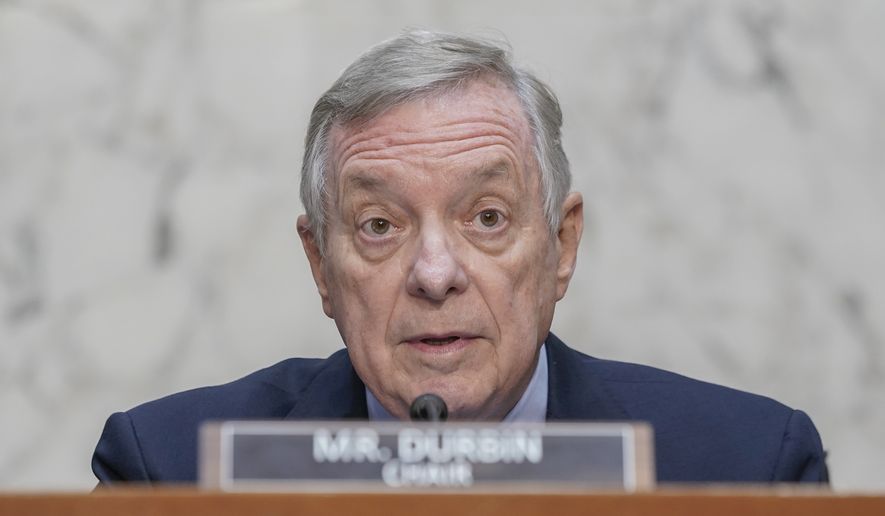
Unfortunately, Republicans and faux Republicans are not the only parties guilty of misstating federal finances. Here are excerpts from a Senator Dick Dubin (D-IL) letter I recently received:

September 22, 2023,  Dear Mr. Mitchell,

Thank you for contacting me about the Fiscal Responsibility Act (P.L. 118-5).  I appreciate hearing from you.

          The debt limit is a statutory limit on the amount of debt the federal government may incur.  When government expenditures outpace revenues, the Treasury may issue debt to cover the shortfall. 
Those T-securities don’t cover anything. The government never touches the dollars that purchase T-bills, T-notes, and T-bonds. Though Sen. Durbin has been in Congress for over 26 years, he still does not comprehend the difference between federal and personal finance.

Government spending and revenues vary by month, and even if the government has a surplus for the year, it may need to borrow money to cover a shortfall at some point during the year.  

Why would an entity having the infinite ability to create dollars ever “need to borrow money?” It doesn’t.

On May 26, 2023, Treasury Secretary Janet Yellen projected that without action from Congress, the federal government would be unable to meet its obligations and subsequently default on  June 5, 2023.  

Default would have crashed the economy and impeded the government’s ability to make payments to Social Security and Medicare recipients, military personnel, veterans, federal employees, defense contractors, state governments, and our bondholders. 

The federal government never needs to default. Only foolish actions by Congress and the President can force the government to default.

On May 27, 2023, President Biden and  Speaker Kevin McCarthy reached an agreement.  The Fiscal Responsibility Act avoids default by raising the debt limit through January 1, 2025. 

Notice that Congress can raise the meaningless debt limit merely by deciding to do so.

Alan Greenspan: “There is nothing to prevent the federal government from creating as much money as it wants and paying it to somebody.”

This agreement was a good-faith compromise between President Biden and Speaker McCarthy, and it included some provisions that alter several important federal programs, which includes clawing back unspent pandemic relief funding and expanding work requirements for some beneficiaries of the Supplemental Nutrition Assistance Program (SNAP).  On June 5, 2023, President Biden signed the Bipartisan Budget Agreement into law. 

There is no reason for the U.S. government to “claw back” anything or to expand work requirements. The government has infinite money. There is no reason, but there is a purpose: To make the rich richer by widening the income/wealth/power Gap between the rich and the rich. The wider the Gap, the richer and more powerful are the rich.

This agreement did not include everything I wanted.  I am incredibly disappointed in any reallocation of funding to medical research or the National Institutes of Health.   However, this agreement is what was required to avoid default. 

And, of course, there was no economic reason for the reallocation.

I also have joined Representative Brendan Boyle of Pennsylvania to introduce the Debt Ceiling Reform Act (S. 1882), which would take the threat of default off of the table in the future.  This bill would permanently end the weaponization of the debt ceiling by giving the Treasury Department the authority to continue paying the nation’s bills unless Congress submits a resolution of disapproval, which would need to be signed by the president. 

The full faith and credit of the United States is not a bargaining chip, and it should not be used to enact any party’s extreme agenda.  The Debt Ceiling Reform Act has been referred to the Senate Committee on Finance. 

The whole thing is an exercise in stupidity. If, for some strange reason, Congress and the President wished to reduce spending (a reduction that mathematically would force a recession or depression), Congress and the President merely could stop spending. Period.

Now that we have avoided the default crisis, we must look to passing our twelve regular spending bills through regular order.  I will be sure to keep your views in mind as we develop these spending priorities, and I will continue working to protect and enhance the federal programs on which American families rely. 

If he wants to “protect and enhance federal programs, he should learn Monetary Sovereignty. After 26 years, it’s about time he learned at least this fundamental truth: The federal government cannot unintentionally run short of U.S. dollars. It has infinite dollars.

     Thank you again for contacting me.  Please feel free to stay in touch. 

That didn’t work for Stephanie Kelton; I wonder whether it would work for me. Rodger Malcolm Mitchell Monetary Sovereignty Twitter: @rodgermitchell Search #monetarysovereignty Facebook: Rodger Malcolm Mitchell

……………………………………………………………………..

The Sole Purpose of Government Is to Improve and Protect the Lives of the People.

MONETARY SOVEREIGNTY