GOP does the right thing for the wrong reasons. The Dems do the wrong thing for the right reasons.

Readers of this site know that federal tax dollars, unlike state/local tax dollars, do not fund anything. (See “Motley Fool spreads the bullshit about Social Security”)

Liars, Cheaters, and Thieves Continue to Increase the Federal Debt | The TNM
Your federal tax dollars are taken from the economy and are destroyed upon receipt.

Unlike state/local tax dollars, federal tax dollars are destroyed the second they are received by the government.

State/local governments, being monetarily non-sovereign, need tax dollars to support spending. The Monetarily Sovereign federal government does not.

Federal tax collections do nothing but take dollars from the U.S. economy and therefore are recessive. (State/local tax dollars remain in the economy.)

Thus, steps to reduce federal tax collections are economically stimulative because those steps keep money in the economy.

An article from the Wall Street Journal discusses the latest Republican steps to reduce federal tax collections — the right move for the wrong reasons.

GOP House Takes First Swipe at IRS Money
A bill expected to be first legislation from the new Republican majority would rescind billions in funding for tax agency

WASHINGTON—The new Republican-controlled House is poised to vote as soon as Monday to repeal tens of billions of dollars in Internal Revenue Service funding, taking up a bill that is unlikely to become law but that previews coming battles with Democrats over the tax agency’s expansion.

Initially, this repeal would be recessive. It would prevent the federal government from adding tens of billions of growth dollars to the economy.

However, if those dollars were to be used to increase the collection of taxes, repealing the added federal spending could be stimulative. 

The bill—expected to be the first legislation advanced by the Republican majority that took over the House last week—aims to erase a key policy priority of the Democrats, who used their control of the government to enact it last year.

Democrats, who still hold the Senate and White House, could block the legislation. But Republicans’ emphasis on clawing back IRS funding marks it as a top concern and demand for the House majority, one that could re-emerge when lawmakers turn to raising the debt ceiling or passing annual spending bills later this year.

The bill, sponsored by Rep. Adrian Smith (R., Neb.), would rescind almost all of the $80 billion in IRS funding that Congress approved in August in the climate, health, and tax law known as the Inflation Reduction Act.

In short, whether the Smith bill would be stimulative or recessive depends on whether the $80 billion would result in more or fewer federal tax dollars being collected.

If rescinding the $80 billion investment would prevent the collection of more than $80 billion tax dollars, the Republican bill would be stimulative. Until that point, however, rescinding the $80 billion investment would be recessive.

That’s just arithmetic.

The other consideration is why the Republicans wish to rescind this expenditure.

House Speaker Kevin McCarthy (R., Calif.) promised, “Our very first bill will repeal the funding for 87,000 new IRS agents. We believe government should be to help you, not go after you.”

The IRS would keep $3.2 billion for taxpayer services, which it started using to hire thousands of customer-service representatives to answer phone calls during the coming tax-filing season. In fiscal year 2022, the agency’s level of service—a measurement of how often phones are answered—was 17.4%, below its 30% target for that year, its 75.9% level from 2018, and the 85% target for this year.

The Republicans, the party of law and order — the party that is pro-police — tells America that added IRS “police” would “go after” the public. The Dems deny it.

The fact that the IRS would keep $3.2 billion is stimulative from the standpoint of dollars added to the economy. Using that money to improve customer service is stimulative in that it increases the efficient use of time. Increased efficiency is stimulative.

The IRS would also keep $4.8 billion for systems modernization, which the agency plans to use to update aging technology.

If updating aging technology would increase federal tax collections by more than $4.8 billion, the systems modernization would be recessive.

But tens of billions designated for enforcement, operations, the inspector general’s office, the U.S. Tax Court and the Treasury Department would be rescinded.

Democrats championed the $80 billion IRS expansion to bolster the agency, which had generally flat or declining budgets for much of the past decade. The IRS has shed staff and conducts audits less frequently than it did in the past.

Conducting audits less frequently is stimulative because it leaves more dollars in the private sector (i.e., the economy).

The biggest piece of the money went to enforcement, and administration officials say they want to focus on high-income taxpayers and large corporations. The Congressional Budget Office estimated that the $80 billion in spending would generate $180.4 billion in additional revenue.

If the Congressional Budget Office is correct, the Democrat’s bill would be $100 billion recessive. 

But then we come to the huge unknown, the key phrase, “. . . focus on high-income tax-payers and large corporations.”

To the degree that the $80 billion would focus on high-income taxpayers, the program would help narrow the income/wealth/power Gap between the rich and the rest. That Gap is currently too broad, and it is widening. Narrowing the Gap would help the economy.

But the effect of large corporations on the economy is primarily positive. On balance, large corporations can better provide efficient services than small businesses. 

While the economy needs small businesses’ creativity and employment power, using tax laws to punish large companies seems counter-productive.

The administration has said audit rates for taxpayers with incomes below $400,000 would stay around recent or historical levels. But the IRS hasn’t specified what those audit rates would be, and audit rates have fluctuated over time.

Democrats argued that removing the funding would offer comfort to tax cheats, making it harder for the IRS to find and penalize tax dodging.

Federal taxes are a significant drag on the economy, and tax laws exacerbate the Gap between the rich and the rest of us. So again, we have a split decision.

Tax dodging helps the economy by leaving more dollars in the private sector, but the rich are more able to do it, hurting the economy.

Perhaps, a vital issue is motive.

The Democrats wish to collect more taxes from the rich, using the false premise that those additional tax dollars would pay for more benefits given to the poor.

The GOP wishes to collect less tax from the rich because it, more than the Democrats, is ruled by the rich. As perhaps an overly broad generalization, the Republicans are the party of the rich, while the Democrats are the party of the rest — at least from a purely financial standpoint.

Race, religion, and country of origin affect that metric.

IN SUMMARY

Federal taxes are an unnecessary drag on the economy. They pay for nothing and are destroyed on receipt. Anything that reduces federal tax collections benefits the private sector (aka, “the economy”).

The sole function of federal taxes is to control the economy by punishing what the government wishes to discourage and by giving tax breaks to what the government wishes to encourage.

The economic drag could be eliminated if the government gave financial rewards to what it wishes to encourage, and simply didn’t reward what it wishes to discourage.

Federal taxes can and should be eliminated.

The Democrats wish to increase federal tax collections while promulgating the false notion that federal deficits are too high and federal taxes are necessary to minimize deficits while paying for benefits.

The Democrats correctly, wish to narrow the income/wealth/power Gap between the rich and the rest, but increasing federal taxes is a poor strategy for that purpose.

The Republicans wish to widen the Gap and enrich the rich by cutting tax collections from the rich. They promulgate the lie that the middle classes and the poor should pay more taxes to fund such benefits as Medicare, Medicaid, and Social Security, though federal taxes do not fund those benefits.

The GOP’s stated concern that additional IRS agents would attack the low-paid is camouflage for their genuine concern that additional agents would focus on the rich.

Rodger Malcolm Mitchell
Monetary Sovereignty

Twitter: @rodgermitchell Search #monetarysovereignty
Facebook: Rodger Malcolm Mitchell

……………………………………………………………………..

The Sole Purpose of Government Is to Improve and Protect the Lives of the People.

MONETARY SOVEREIGNTY

Is it possible for one human being to get so much wrong about our economy?

If someone sets a world record, perhaps they could expect applause. In that vein, let’s give a massive round of applause to Veronique de Rugy, who has set a world record for economic myth dissemination. Her bio reads:

Veronique de Rugy is the George Gibbs Chair in Political Economy and Senior Research Fellow at the Mercatus Center at George Mason University and a nationally syndicated columnist.

Her primary research interests include the US economy, the federal budget, taxation, tax competition, and cronyism.

Her popular weekly columns address economic issues ranging from lessons on creating sustainable economic growth to the implications of government tax and fiscal policies.

She has testified numerous times in front of Congress on the effects of fiscal stimulus, debt and deficits, and regulation on the economy.

Presumably, she believes in using research results to come to her conclusions. Or at least, that is her claim. But what research supports the following nonsense?
WATCH: See How Leeches Can Be A Surgeon's Sidekick | WAMU
The Fed applies leeches to cure anemia. Ms. de Rugy agrees.

Congress and the Federal Reserve Could Be Setting Us Up for Economic Disaster If lawmakers keep spending like are, and if the Fed backs down from taming inflation, then the government may create a perfect storm. VERONIQUE DE RUGY | 12.29.2022 12:20 PM

In the final week of 2022, we Americans can foresee two significant economic risks in 2023. The first one is a probability that the Federal Reserve will get weak-kneed and stop raising interest rates before inflation is truly under control.

The second risk is that Congress will continue to spend and borrow money irresponsibly.

The likely mix of these two hazards would all but ensure that our economic misery lasts much longer than necessary.

At this point in the article, we don’t yet know which “misery” she means, especially since she considers not raising interest rates or increased spending “hazards.” And by the way, the federal government never borrows dollars. It has the infinite ability to create its own sovereign currency, the U.S. dollar. So why would it ever borrow what it has the endless ability to create? If ever it did borrow, it quickly could pay the dollars back simply by creating dollars.

Let’s start with the first risk.

In theory, to tame inflation, the Fed will need to push real interest rates not only high—as it has already done—but higher than the highest rate that the Fed is now targeting, and in fact much higher than most investors can remember.

Substitute the word “myth” for the word “theory,” and you have a correct statement. In the history of the universe, inflation has never been caused by interest rates that were too low. Anyone so devoted to research as Ms. de Rugy claims to be, should know this. I challenge her, or anyone else, to provide an example of inflation caused by low-interest rates or cured by high interest rates. There have been thousands of inflations worldwide, regular inflations and hyperinflations, and eventually, almost all have been cured — but never by raising interest rates. All inflations in history have been caused by shortages of critical goods and services, and those cured were cured only when the shortages were cured. It even is possible for high rates to cause shortages, i.e., cause inflations, by interfering with production. The primary effect of raising interest rates is to reduce demand and supply. These reductions make the de Rugys of the world think that is the way to cure inflation. The reasoning is if demand drops, then people won’t pay higher prices. (If supply decreases, prices will rise, but de Rugy doesn’t consider that.) What de Rugy et al. don’t understand is that recession is another word for reduced supply and demand. GDP = Federal Spending + Non-federal Spending – Net Imports. Thus, reduced spending = recession. In short, de Rugy wants to cure inflation by causing a recession. Not only is that nuts, but it can also lead to stagflation, the worst of all worlds.

Such high rates will have two main effects: popping the stock market and real estate market, along with any other asset bubbles that we’ve witnessed in recent years.

The economic downturn that would follow would increase unemployment rates significantly.

Here she admits she wants to “pop the stock market and real estate market,” aka cause a recession (“economic downturn”, maybe a depression. She also admits she wants to “increase unemployment rates significantly.” Presumably, her employment is secure, so she feels comfortable increasing other people’s unemployment.

On the other hand, if the Fed stops tightening too early, we will continue to suffer high inflation and slower growth.

When is “too early” to begin curing inflation? She never says. And why does tightening (raising interest rates) “too early” lead to more inflation? And why does “too early” cause slower growth when “the right time” doesn’t slow growth? She never explains. Her whole concept is a confusing mess.

The rise in unemployment might be pushed back for a while, but because no inflationary policy can continue forever, it will inevitably arrive.

And the longer we delay its arrival, the worse it will be. Unfortunately, facing such challenges, I worry that Fed Chair Jerome Powell will not make the better (and more complex) choice and hold the line on inflation.

Does anyone understand what the hell she is saying? “Too soon,” “too late,” “hold the line.” What exactly is she suggesting Powell do? It doesn’t matter because her suggestions are so deviant from reality that trying to understand them would be useless.

First, the pressure that he already faces from, for example, Sens. Bernie Sanders (I–Vt.) and Elizabeth Warren (D–Mass.) to stop raising rates will only intensify as the economy slows down and the unemployment rate increases.

Yes, Sanders and Warren are likely to say, “Stop raising rates” when we start sliding into recession, and people lose jobs. To de Rugy, Sanders and Warren are wrong. She apparently wants full foot on the brakes so we can go into complete depression.

Second, as interest rates increase, the amount of interest payments on the government’s debt will grow.

With no money to pay those interest obligations, the Treasury will increase borrowing—a move that will further raise the budget deficit.

This is beyond ignorant. She believes there will come a time when the government runs out of money. This person supposedly specializes in “the US economy, the federal budget, taxation, tax competition, and cronyism.” Incredible. She also believes that the Monetarily Sovereign U.S. government, which has the infinite ability to create U.S. dollars, resorts to borrowing U.S. dollars. What do real experts think?
Alan Greenspan: “A government cannot become insolvent with respect to obligations in its own currency.” Ben Bernanke: “The U.S. government has a technology, called a printing press (or, today, its electronic equivalent), that allows it to produce as many U.S. dollars as it wishes at essentially no cost.” Statement from the St. Louis Fed: “As the sole manufacturer of dollars, whose debt is denominated in dollars, the U.S. government can never become insolvent, i.e., unable to pay its bills. In this sense, the government is not dependent on credit markets to remain operational.”
Get it, Ms. de Rugy? The government cannot become insolvent. It does not borrow dollars (i.e. it does not depend on credit markets). It ca,n produce as many dollars as it wishes. So there never can be a time when, as you said, the government “will have no money to pay those interest obligations.” It always has money, and you should know that.

When complaints about rising deficits become loud, it won’t be long before President Joe Biden’s administration, and others in Congress demand an end to the interest rate hikes.

This practice is called fiscal dominance and it creates a real risk of further fueling inflation.

Never in history has an end to interest rate hikes caused inflation.

Finally, there is the risk that market actors will also pressure the Fed to protect them against losing the inflated wealth they’ve reaped as a result of two decades’ worth of irresponsible monetary policy.

“Irresponsible monetary policy is Ms. de Rugy’s term for a growing economy. By formula, adding dollars to the economy causes an increase in Gross Domestic Product, not inflation.

In fact, as of now Wall Street investors are showing signs that they believe the Fed may soon abandon its policy of high-interest rates to avoid a recession.

It’s hard to blame them because that’s precisely what the Fed has done in the past.

That’s right. In the past, high-interest rates have led to recessions, which is precisely what Ms. de Rugy recommends.

So, will the Fed blink? Politicians aren’t known for doing the right thing when times get hard, and it would be naïve to assume that Fed chairs are immune from this.

Powell, too, is a politician, as he demonstrated with his unwillingness to acknowledge the surging inflation problem—created by the government’s own spending and stimulus—until it was too late. He could surprise us, of course, by courageously enforcing much-needed monetary discipline.

No, no, no. The inflation was NOT created by the government’s spending. The inflation was created by COVID-related shortages of oil, food, transportation, computer chips, lumber, housing, etc. The spending and stimulus prevented a depression.

The second threat comes from politicians in Washington, right and left, doing their best to make the mess caused by the Fed just that much worse.

Indeed, just as the Fed is pushing interest rates sharply higher, irresponsible “leaders” are launching a new “spend and borrow” spree to the tune of $1.7 trillion all wrapped in a reckless end-of-the-year omnibus bill.

The Fed is pushing interest rates higher, which will do nothing to cure the shortages that cause inflation. However, the $1.7 trillion spending bill may defeat inflation if it is directed toward obtaining and distributing the scarce goods and services.

This 4,155-page bill is guaranteed to be inflationary.

No such thing. The bill will not cause inflation. It will grow GDP by $1.7 trillion.

It will make Powell’s job harder and the rate hikes needed to control inflation larger. That will only increase the chance that the Fed will cave to pressure to extend the crisis further into the year 2023.

The Fed may cave to pressure — by raising interest rates and thereby creating more inflation together with a recession.

But that’s assuming the Fed won’t cave to the administration and monetize all that new borrowing, adding more fuel to the inflation fire.

There is no “borrowing” to monetize. The U.S. government does not borrow U.S. dollars. PERIOD.  Contrary to popular misunderstanding, T-bills, T-notes, and T-bonds do not represent federal borrowing. They represent deposits into privately owned accounts. The deposited dollars never are touched by the federal government. They are owned by depositors. The government creates its own dollars each time it pays a bill.

The bottom line is this, people: Grab your antacids because if our leaders don’t start thinking differently, 2023 is likely to be painful.

The above statement is the only correct line in Ms. de Rugy’s entire article. SUMMARY Federal spending increases GDP. The U.S. federal government cannot run short of dollars, so it never borrows dollars. Inflations always are caused by shortages of goods and services and never by federal spending. Government spending does not lead to shortages. Government spending can cure shortages by aiding the production and obtaining of scarce goods and services. Ms. de Rugy simply does not understand economics. She advocates causing a recession to cure inflation, like applying leeches to cure anemia. You are correct if you believe I am angry at Ms. de Rugy. If she does research, she should know that raising interest rates does not cure the shortages that cause inflation. Ms. de Rugy is in a position to promulgate the truth, yet she spreads a lie that harms America. And yes, that makes me angry. It should make you angry, too. Rodger Malcolm Mitchell Monetary Sovereignty Twitter: @rodgermitchell Search #monetarysovereignty Facebook: Rodger Malcolm Mitchell

……………………………………………………………………..

The Sole Purpose of Government Is to Improve and Protect the People’s Lives.

MONETARY SOVEREIGNTY

“Free minds, free markets,” and free lies.

Reason.com, a mouthpiece for the Libertarian Party, bills itself as “free minds, free markets.” More accurately, it should be called “closed minds, closed markets, and free lies.”

Here is the latest post from Eric Boehm, Reason.com’s economic policy reporter. As expected with Libertarian economic “thought,” it is loaded with wrong inferences, misunderstandings, and/or outright lies. 

Printing more money
Printing more money (Photo 17929028 © Svyatoslav Lypynskyy | Dreamstime.com)

November’s $249 Billion Federal Budget Deficit Set a Record. Now, Congress Is Preparing To Spend Even More.
The government spent $501 billion in November but collected just $252 billion in revenue, meaning that about 50 cents of every dollar spent were borrowed.
ERIC BOEHM | 12.16.2022 1:00 PM

The article comes with the photo and caption shown above.

Boehm doesn’t realize that his photo undermines his claim that “about 50 cents of every dollar spent were borrowed.”

The photo shows someone (presumably representing the government) creating dollars from thin air using a copy machine. This immediately demonstrates the senselessness of the Libertarian economic claims because it illustrates why the federal government has no need to borrow dollars. 

In fact, the government does create dollars from thin air simply by pressing computer keys, so it never borrows dollars.

Boehm claims that T-bills, T-notes, and T-bonds represent borrowed money. Completely false. They represent dollars deposited into privately held accounts, similar to safe deposit boxes. The government never touches the contents of those accounts.

The dollars are the property of the depositors, not of the government, and remain inviolate until the accounts mature when the contents are returned to the owners. The dollars never are borrowed or used by the government or by anyone else.

Though those dollars often incorrectly are termed federal “debt,” the government does not owe the money any more than a bank owes the contents of a safe deposit box.

As the St. Louis Federal Reserve Bank has said:

“The U.S. government can never become insolvent, i.e., unable to pay its bills . . . the government is not dependent on credit markets to remain operational.

“Not dependent on credit markets” is government-speak for, “does not borrow.”

Further, even if the T-securities were debt, the federal government pays all its debt by creating new dollars ad hoc. It does this by the simple expedient of passing laws and pressing computer keys, both of which it has the infinite ability to do.

Debt never is a burden on the U.S. government or on taxpayers.

As for those taxes you are forced to pay, they are destroyed upon receipt by the Treasury. You take dollars from your checking account — dollars that are part of the M2 money supply measure — and when they reach the Treasury, they cease to be part of any money supply measure.

There is no measure of the Treasury’s money holdings because the Treasury has infinite money. Thus, your tax dollars disappear, effectively destroyed.

So much for all that talk about falling deficits.

The federal government ran a $249 billion deficit during the month of November—that’s the largest total ever posted for that month, and a staggering $56 billion increase over the deficit from November 2021.

The economy is measured by Gross Domestic Product (GDP). The formula for GDP is:

GDP = Federal Spending + Non-federal spending + Net Exports

Thus, by simple algebra, federal spending always grows the economy. Boehm may not realize that he is complaining about economic growth.

Nearly 50 cents of every dollar spent were borrowed and added to the national debt. That’s utterly unsustainable.

“Unsustainable” is the favorite word of deficit liars, who never explain why any size deficit cannot be sustained.

In what year did the federal “debt” become “unsustainable”?


The gross federal “debt” (deposits) totaled $51 billion in 1940. It now totals about $30 trillion, nearly a 600-fold increase, and here we are, sustaining.

For over 80 years, the debt whiners have claimed the debt is “unsustainable.” Year after year after year, they have been proven wrong, and still, they learn nothing. Truly pitiful.

And now Congress is gearing up to spend even more.

Though the final details of a lame-duck session omnibus bill won’t be known until next week (likely not until just before lawmakers are asked to vote on it), it’s a near certainty that the final agreement will add to this year’s budget deficit and the ballooning national debt.

Translation: The final agreement will add to the budget deficit which will grow GDP.

Congress passed a short-term spending deal on Thursday night to avert a government shutdown and give lawmakers another week to hammer out a more comprehensive deal to fund the government through the end of the current fiscal year.

Where did the dollars to fund the government come from? The government merely created them from thin air by creating laws and pressing computer keys, something they can do forever.

That larger omnibus bill could include billions of dollars in additional military and humanitarian aid for Ukraine, as well as emergency funds for hurricane relief, The Washington Post reports.

The final price tag is likely to be about $1.7 trillion, according to Politico.

That will be $1.7 trillion added to Gross Domestic Product.

Depending on what else ends up in the final version of the end-of-year omnibus, the package will add between $240 billion and $585 billion to this year’s budget deficit, according to an analysis by the Committee for a Responsible Federal Budget (CRFB), a nonprofit that advocates for balancing the books.

It says much about your lack of economics knowledge when you resort to the CRFB for your ideas. Here is what happens when the government balances the books:

1804-1812: U. S. Federal Debt reduced 48%. Depression began 1807.
1817-1821: U. S. Federal Debt reduced 29%. Depression began 1819.
1823-1836: U. S. Federal Debt reduced 99%. Depression began 1837.
1852-1857: U. S. Federal Debt reduced 59%. Depression began 1857.
1867-1873: U. S. Federal Debt reduced 27%. Depression began 1873.
1880-1893: U. S. Federal Debt reduced 57%. Depression began 1893.
1920-1930: U. S. Federal Debt reduced 36%. Depression began 1929.
1997-2001: U. S. Federal Debt reduced 15%. Recession began 2001.

Balancing the books is a good idea for monetarily non-sovereign entities like cities, counties, states, euro nations, businesses, and individuals. They do not have the unlimited ability to create their own sovereign currencies.

In fact, they have no sovereign currencies.

But the U.S. government is Monetarily Sovereign. It can create infinite dollars and the legal ability to make those dollars worth anything it chooses. 

Over the 10-year budget window used by the Congressional Budget Office and other number crunchers to assess the federal budget, the damage could exceed $5 trillion.

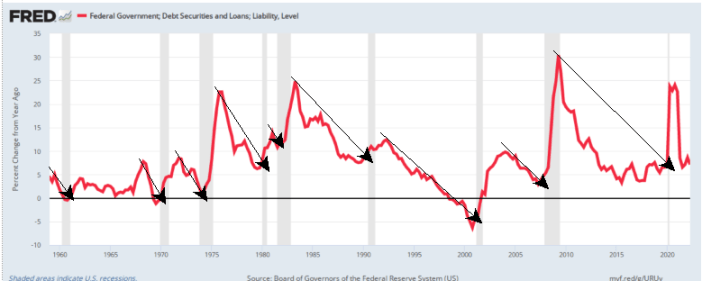
Recessions (vertical gray bars) follow reductions in federal deficit growth.

Translation: Exchange the words “economic growth for the term “damage” and you will see the truth.

“Not only would these policies increase deficits, but they would also worsen inflation,” the CRFB warns in its analysis.

“With inflation surging and debt approaching record levels, policymakers should avoid passing costly end-of-year policy changes.”

As always, the CRFB spouts nonsense. Inflation is not caused by or “worsened” by federal deficits. All inflations through history have been caused by shortages of important goods and services.

Changes in federal debt, i,e, deficits (red), do not correspond with changes in inflation (blue).

If federal deficits “worsened inflation,” one would expect the peaks and valleys of the above graph to correspond. They do not. 

Inflations are not caused by federal spending. Today’s inflation was caused by COVID-related shortages of oil, food, shipping, lumber, computer chips, labor et al.

For much of the past year, the Biden administration has been touting falling deficit figures as evidence that the economy was picking up and, implicitly, as a signal that government spending could increase without adding to the nation’s tenuous fiscal situation.

If true, that would be incredibly uninformed by the Biden administration.

Mathematically, it is not possible for falling deficit figures to be evidence of growing Gross Domestic Product. That would be like falling food supplies being evidence of growing nutrition.

That was always misleading, as the falling deficit was entirely the result of one-time, emergency COVID-19 spending coming off the books.

The underlying figures showed all along that the deficit situation was continuing to worsen, and that President Joe Biden’s policies were adding trillions of dollars to the deficit over the long term.

Wait, Mr. Boehm. You say emergency COVID-19 spending came off the books, yet now we have inflation. What happened to your claim that increased federal spending causes inflation?

November’s spending and revenue figures should put an end to these silly games. We’re only two months into the fiscal year, but the federal government is now on pace to run a deficit of about $1.9 trillion, which would be the largest nonpandemic budget deficit ever and a huge increase from the $1.38 trillion deficit in the fiscal year that ended on September 30.

That spending has helped reduce the likelihood of a recession, which by the way, is defined as two consecutive quarters of reduced GDP — a reduction which is exactly what you want to do.

A major driver of November’s rapidly expanding deficit was something else that fiscal hawks have been warning about for a while: higher borrowing costs created by higher interest rates.

The Wall Street Journal notes that the federal government spent 53 percent more on borrowing costs last month than it did in November 2021.

The higher borrowing costs were foolishly and arbitrarily created by the Fed. They do nothing to prevent/cure inflation. They do nothing to cure the shortages that cause inflation.

In fact, higher interest rates exacerbate the shortages and thus, exacerbate inflation. In essence, the Fed is applying leeches to cure anemia.

Higher borrowing costs are not the result of federal deficits. They are the result of Fed ignorance.

The best time to stop borrowing heavily was yesterday (or several years ago), but the second-best time would be today. Instead, Congress is likely to make this problem even worse—again—by continuing to spend like there’s no tomorrow.

SUMMARY

The entire Boehm article is based on commonly held myths. The facts are:

  1. Federal deficits are necessary for economic growth. (That is simple mathematics.)
  2. The U.S. federal government never borrows dollars. (Why would it, given its infinite ability to create dollars).
  3. Reduced federal spending causes recessions and depressions. (Again, this is simple mathematics.)
  4. Inflations are caused by shortages of key goods and services, not by federal spending. (As demonstrated by history).
  5. Inflations are cured by federal spending to acquire and distribute the scarce goods and services. (Again, as demonstrated by history.)
  6. Increasing interest rates does not help prevent or cure inflations.
  7. Increasing interest rates exacerbates the shortages that cause inflations. (That is why raising interest rates is recessionary.) 

Oh, and applying leeches does not cure anemia.

Rodger Malcolm Mitchell
Monetary Sovereignty

Twitter: @rodgermitchell Search #monetarysovereignty
Facebook: Rodger Malcolm Mitchell

……………………………………………………………………..

The Sole Purpose of Government Is to Improve and Protect the Lives of the People.

MONETARY SOVEREIGNTY

Good news, if true. CBO: Deficits are falling now, are set to soar later

Assuming the following headline is correct, it’s short-term bad news for the economy, but great long-term news:

“CBO: Deficits are falling now, are set to soar later” Courtenay Brown. Neil Irwin, Axios

The federal government’s budget deficit is expected to shrink this year before skyrocketing in the years ahead, the Congressional Budget Office (CBO) said Wednesday.

Why is it short-term bad news but great long-term news? Because this is:

    1. Federal deficit spending goes into the economy as an economic growth stimulus.
    2. The federal government has infinite dollars; it never can run short of dollars.
    3. The economy does not have infinite dollars. To grow, it needs a growing input of dollars from the federal government.
    4. Federal spending is funded not by federal taxes but by *federal money creation. Federal tax dollars are destroyed upon receipt by the Treasury.
    5. Federal spending does not cause inflation; shortages of critical goods and services cause inflation. Inflations can be cured by additional federal spending to obtain and distribute scarce goods and services.

*Here is how the federal government creates dollars:

  • To pay a bill, the federal government sends instructions (not dollars) to the creditor’s bank, instructing the bank to increase the balance in the creditor’s checking account (“Pay to the order of”)
  • When the bank does as instructed, new dollars are created and added to the M1 money supply.

  • This transaction is then cleared by the Federal Reserve

Similarly, dollars are destroyed when you pay taxes:

  • To pay taxes, you take dollars from your checking account. Those dollars were part of the M1 money supply.
  • When your dollars reach the Treasury, they disappear from the M1 money supply. They cease to exist in any money supply measure.

Because the Treasury has access to infinite dollars, there can be no money supply measure for Treasury dollars. Your tax dollars are destroyed.

The federal government collects tax dollars, not to fund spending, but to:

  1. Control the economy by taxing what the government wishes to discourage and giving tax breaks for what it wishes to encourage.
  2. To create demand for dollars, which must be used for tax payments. This helps stabilize the dollar.
  3. To create the impression that federal taxes are necessary to fund federal spending. This discourages the public from asking for federal benefits. 

Restricting federal benefit spending on benefits helps widen the Gap between the rich (who run America) and the rest of us. Widening the Gap makes the rich richer.

Why it matters: America’s reprieve from climbing deficits is only temporary as coronavirus-related government spending wanes and tax revenues increase.

The use of the word “reprieve” is misleading. Climbing deficits are essential for economic growth.

By the numbers: The CBO projects the budget deficit will shrink to $1 trillion this year, down from $2.8 trillion in 2021.

Shrinking budget deficits reduce the amount of money coming into the economy and thereby lead to recessions.

Recessions (vertical gray bars) result from reduced federal deficit growth and are cured by increased federal deficit growth.

It’s expected to rise to more than $2 trillion in 2032, reaching 6.1% of GDP, up from a projected 4.2% this year.

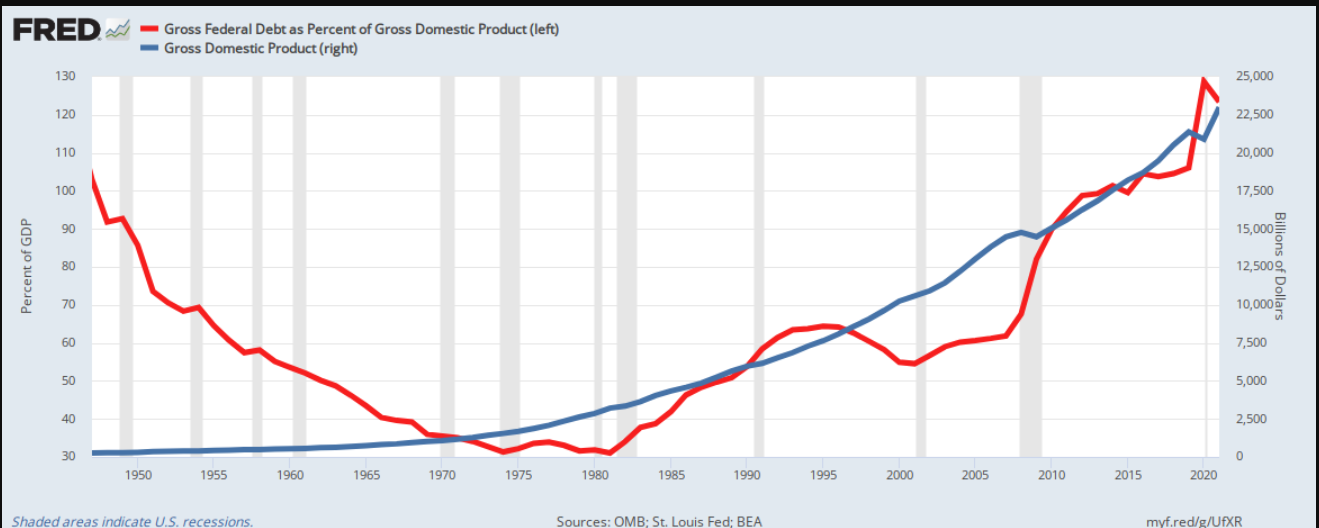
The deficit as a percentage of GDP is a meaningless number. It has no predictive significance.

GDP (blue) rose during periods of falling Debt/GDP and during periods of rising Debt/GDP. The ratio, Debt/GDP, has no predictive value.

Federal debt held by the public is estimated to dip from 100% of GDP at the end of this year to 96% in 2023, reflecting rapid inflation that is causing GDP to expand more rapidly. It’s expected to reach 110% of GDP — the highest ever recorded — by the end of the decade.

A meaningless fact. Whether an economy has a high or a low Debt/GDP ratio tells nothing about the health of that economy. For example:

Top Countries with the Lowest Debt-to-GDP Ratios (%)

    1. Brunei — 3.2%
    2. Afghanistan — 7.8%
    3. Kuwait — 11.5%
    4. Congo (Dem. Rep.) — 15.2%
    5. Eswatini — 15.5%
    6. Burundi — 15.9%
    7. Palestine — 16.4%
    8. Russia — 17.8%
    9. Botswana — 18.2%
    10. Estonia — 18.2%

Top Countries with the Highest Debt-to-GDP Ratios (%)

    1. Venezuela — 350%
    2. Japan — 266%
    3. Sudan — 259%
    4. Greece — 206%
    5. Lebanon — 172%
    6. Cabo Verde — 157%
    7. Italy — 156%
    8. Libya — 155%
    9. Portugal — 134%
    10. Singapore — 131%
    11. Bahrain — 128%
    12. United States — 128%

The Debt/GDP ratios tell you nothing about the economic health of the nations. The data come from an article by WorldPopulationReview.com, which falsely states:

“Nations with a low debt-to-GDP ratio are more likely to be able to repay their debts with relative ease. Nations whose economies struggle to produce income or which have an oversized debt tend to have a high debt-to-GDP ratio.

This is a perfect example of belief overcoming obvious facts.

The U.S. is Monetarily Sovereign. A Monetarily Sovereign nation has the infinite ability to pay debts denominated in that nation’s own sovereign currency. Such countries have the unlimited ability to create sovereign currency. They never can run short.

By contrast, a monetarily non-sovereign — for instance, a euro nation like Greece, Italy, or Portugal — can have difficulty paying its debts.

The belief that a high Debt/GDP ratio mitigates debt repayment ability All the concerns about the U.S. federal deficit or debt being too high are based on ignorance about government financing.

Clearly, the WorldPopulationReview.com authors of the above article know little-to-nothing about Monetary Sovereignty. 

Details: The CBO is now expecting higher interest rates over the coming years than it did in the last forecast, as the Federal Reserve acts to try to contain inflation. Higher interest rates would strain the nation’s fiscal position further.

America’s fiscal position is clear. It always can pay any debt denominated in dollars. Even if the U.S. federal government didn’t collect a penny in taxes, it could pay off any financial obligation.

Further, the so-called federal “debt” is not the federal government’s debt. It is the total of deposits into privately-owned Treasury Security accounts. 

To purchase a T-security (T-bill, T-note, T-bond), you deposit dollars into your T-security account. The government never touches those dollars. Periodically the government adds to the balance, but it never uses the dollars for anything.

The dollars remain in your account until maturity when they are returned to you. This functions similarly to a bank safe deposit box, the contents of which are not a debt of the bank.

Last July, for example, the CBO projected that the 10-year Treasury yield would average 2% in 2023; now that projection is 2.9%.

In the CBO projections, interest costs alone will pass $1 trillion in 2030.

Translation: Federal interest payments will add 1 trillion growth dollars to the economy by 2030. The federal government, being Monetarily Sovereign, easily can make these payments without collecting taxes.

As this post was being written, another relevant article appeared. It is an excellent example of the economic ignorance that mischaracterizes the federal “debt.”

Biden’s Student Loan Debt Forgiveness Plan Now Estimated To Cost $400 Billion
According to a new report for the Congressional Budget Office, student loan debt forgiveness will likely completely wipe out gains made by the Inflation Reduction Act—and then some.
Emma Camp | 9.27.2022

The “gains” are deficit reductions that the author wrongly believes will benefit the economy and mitigate inflation. They will not, though they will mitigate economic growth and probably cause stagflation.

U.S. depressions tend to come on the heels of federal surpluses.

1804-1812: U. S. Federal Debt reduced 48%. Depression began 1807.
1817-1821: U. S. Federal Debt reduced 29%. Depression began 1819.
1823-1836: U. S. Federal Debt reduced 99%. Depression began 1837.
1852-1857: U. S. Federal Debt reduced 59%. Depression began 1857.
1867-1873: U. S. Federal Debt reduced 27%. Depression began 1873.
1880-1893: U. S. Federal Debt reduced 57%. Depression began 1893.
1920-1930: U. S. Federal Debt reduced 36%. Depression began 1929.
1997-2001: U. S. Federal Debt reduced 15%. Recession began 2001.

The sweeping student loan forgiveness plan will wipe all the budget savings created by the Inflation Reduction Act—and then some.

Translation: “The sweeping student loan forgiveness plan will add federal dollars to the economy, thereby stimulating economic growth.”

In a letter published on Monday, the Congressional Budget Office (CBO), a nonpartisan federal agency, estimated that Biden’s student loan debt forgiveness plan will increase the cost of student loans by $400 billion.

Translation: ” . . . will decrease students’ loan cost by $400 billion. It will stimulate economic growth by keeping more money in the economy and by encouraging more young people to attend and finish college..”

That’s more than the White House originally projected, and it means that the fiscally imprudent debt relief effort will end up swamping the modest budgetary savings achieved by last month’s passage of the Inflation Reduction Act by more than $150 billion.

Translation: ” . . . it means that the fiscally prudent debt relief effort will end up overcoming the economy’s budgetary losses caused by last month’s passage of the Inflation Reduction Act by more than $150 billion.

. . . the plan is likely to massively increase the national deficit by over $150 billion.

Translation: “. . . the plan is likely to massively increase the economy’s money supply by over $150 billion.”

Student loan forgiveness stands to be a massively expensive project—one that not only erases recent gains in spending reduction but manages to make the problem significantly worse than the status quo.

Translation: “Student loan forgiveness stands to be a massively beneficial project—one that not only erases recent economic losses in income reduction but manages to make the economy significantly better than the status quo.”

The so-called “problem” is the increased federal deficit, which is not a problem at all. It is necessary for a growing economy.

Only one thing could make “the problem worse than the status quo”: Running a federal surplus, which invariably leads to recessions or depressions.

SUMMARY

Federal finances differ from personal, business, and state/local government finances.

Those who bemoan a growing federal deficit and debt do not understand that a Monetarily Sovereign entity can pay any size debt instantly. It does so by creating its own sovereign currency.

Gross Domestic Product (GDP), a measure of the economy, is a measure of spending. A growing economy requires a growing supply of money. By deficit spending, the federal government creates new dollars and adds them to the economy. 

Thus, by increasing the money supply, federal deficits help boost GDP. That is why falling federal deficit growth results in recessions, which are cured by increased deficit growth.

For the above reason, the oft-quoted federal Debt/GDP ratio does not indicate anything about the economic health of a Monetarily Sovereign nation. 

Further, the misnamed federal “debt” is not the federal government’s debt. It is the total of privately owned deposits into Treasury Security accounts.

The next time you read or hear negative comments about the federal deficit or debt, know this: The author of those comments doesn’t understand how U.S. federal finances work — or doesn’t want you to understand.

Rodger Malcolm Mitchell
Monetary Sovereignty

Twitter: @rodgermitchell Search #monetarysovereignty
Facebook: Rodger Malcolm Mitchell

……………………………………………………………………..

THE SOLE PURPOSE OF GOVERNMENT IS TO IMPROVE AND PROTECT THE LIVES OF THE PEOPLE.

MONETARY SOVEREIGNTY