No, it isn’t “the economy, stupid.” It’s another issue, and you know what it is

Image result for freedom

It takes only two things to keep people in chains:
The ignorance of the oppressed and the treachery of their leaders.

——————————————————————————————————————————————————————————————————

Bill Clinton famously said, “It’s the economy, stupid,” meaning that ultimately, Americans will vote their wallets, with all other issues being secondary.

He was wrong.  There is another, more important, though less logical, issue, and if you think about it, you know what it is.

Toward the end of the 1800’s, the Democrats came to control the Southern states, and it wasn’t pretty.

White Democrats began to use strategies you’ll find eerily familiar today. They made the entire voting process much more difficult for poor blacks, including the passage of poll taxes. Though poor whites fell into the same trap, the poll tax was aimed at the blacks.

Poll taxes were “necessary,” because someone had to pay for the cost of elections, right?

And then there were the literacy tests, which were “necessary,” because if you can’t read and write, how can you cast an intelligent vote, right?

And strict, complex residency tests were “necessary,” because if you weren’t a long-time resident, you shouldn’t be telling residents what to do, right? Today, those residency tests have morphed into citizenship tests, the primary purpose of which is as before: To deny anyone of color, the right to vote.

Blacks even were denied the right to be jurors, because they weren’t “qualified,” so every facet of Southern law was tilted against them.

As blacks were denied the vote, they also were denied representation, so all the national Southern votes went to the then dominant party, the Democrats. In the South, there virtually were no Republican Senators, Representatives, Governors, Mayors, Sheriffs, Judges — it was all Democrats all the time. It was known as the “solid South.”

Because Democrats seldom lost Southern elections, the incumbents controlled the gerrymandering that solidified their positions. This gave them seniority, not only in local and state politics, but in the national arena, where Chairmanships of important Congressional committees were held largely by Southerners.

And all of this enormous political power had its beginnings, and its ongoing expansion, with wall-to-wall racial bigotry.

Then, in the late 1940’s, the Democrats began to adopt some measure of morality, and morality would prove to be their undoing in the South.

President Truman desegregated the Army and the Dixiecrat party was formed, the sole purpose of which was to retain segregation and Jim Crow laws. The Dixiecrats nominated Strom Thurman for president, and he won in South Carolina, Alabama,  Louisiana, and Mississippi.

After Democrat Lyndon Johnson passed many civil rights laws, Thurman became a Republican.

And then came Richard Nixon and the “Southern Strategy,” as cynical a political strategy as ever has been devised. Here is the summary of the strategy, in the words of the man who popularized the term, political advisor, Kevin Phillips:

“From now on, the Republicans are never going to get more than 10 to 20 percent of the Negro vote and they don’t need any more than that…but Republicans would be shortsighted if they weakened enforcement of the Voting Rights Act.

“The more Negroes who register as Democrats in the South, the sooner the Negrophobe whites will quit the Democrats and become Republicans.”

“That’s where the votes are. Without that prodding from the blacks, the whites will backslide into their old comfortable arrangement with the local Democrats.”

To appeal to Southern whites, Nixon pushed two philosophies, “law and order” and “states rights,” which remain popular excuses, today.

“Law and order” were the code words that brought into existence the notorious Southern Sheriffs, in the Joe Arpaio mold. The sole purpose had nothing to do with “law” or with “order,” but rather was to keep the blacks frightened and powerless.

“States rights” were the code words used by the Southern states to tell the federal government, “Don’t interfere with our version of bigoted “law and order.”

After Nixon, no Northerner has won the Presidency . . . until our first 1/2 black President, Barack Obama.

And that is the 2nd part of our story.

ElectoralCollege2012.svg
2012 Presidential Election of Obama

In his first Presidential election, Obama won 68% of the electoral votes. In his second election, Obama won 62% of the electoral votes.

Both were resounding victories, yet in neither case did he win in any Southern state, except Florida.

Remember the description of the Southern Strategy:

“The more Negroes who register as Democrats in the South, the sooner the Negrophobe whites will quit the Democrats and become Republicans. That’s where the votes are. Without that prodding from the blacks, the whites will backslide into their old comfortable arrangement with the local Democrats.”

Obama proved to be the ultimate “prodding from the blacks.” His black face created terror in the minds of whites who already were predisposed to hate or fear blacks.

Though Obama won his second election (by a much smaller margin than the first), he was a special case of a charismatic, only 1/2 black, great speaker with a terrific election committee, and uncharismatic opponents.

And he was unable to extend his election success to the rest of the Democratic party.

The Democratic Party suffered huge losses at every level during Obama’s West Wing tenure. The grand total: a net loss of 1,042 state and federal Democratic posts, including congressional and state legislative seats. Democratic governorships also became a rarity during this eight-year period, slipping from 28 to 16.

Then came Hillary Clinton and Donald Trump: This essentially was a fact-free election, based solely on emotions.

She, an uncharismatic female, a poor speaker and a with a seemingly clueless election committee. He, a charismatic, male TV star and an excellent speaker who used mass meetings as his “election committee.”

Clinton campaigned on intellectual ideas and on herself: HER experience and HER being able to make history as the first female President and HER inheriting the Obama legacy.

But while the man, Obama, was much loved, at least in most quarters, his legacy was minimal. Ask people today what he accomplished and they might say, “Obamacare,” (to which, in truth, he contributed little. The Democratic Congress did all the work).

Others might include the recovery from the “Great Recession,” and the “worst” ones (from the standpoint of the “Southern Strategy) were the rights he gave to gays and immigrants. These latter, along with his skin color, energized the unfortunately-large bigot community of America. 

Trump campaigned on viscerals and you: YOUR fears and YOUR hatreds.

Trump said, “I’m going to protect YOU from blacks, browns, gays, foreigners, Muslims and people who will take away the guns YOU need for your protection.”

Today, the Republicans continue to rely on the “Southern Strategy,” nationally. And it works on a public made frightened.

There was a time when the phrase, “It’s the economy, stupid,” was considered the holy script to election success. But no more.  Now, “It’s beware of THEM, and kill THEM,” with “them” including all those who are not white, straight, and citizens.

He is a compulsive liar who has changed his positions on dozens of issues.

Once, being a “flip-flopper” was the formula for public ridicule and political defeat.  By that history, Trump should have zero followers.  He is a compulsive liar, and there were at least 141 Stances Trump Took During His White House Bid) :

–19 contradictory positions on immigration and his wall,
–4 contradictory positions on undocumented children of immigrants,
–16 positions on banning Muslims,
–5 different positions on H1-B visas (for highly skilled workers),
–4 different positions on border control,
–9 different positions on how to defeat ISIS,
–7 separate positions on gun-free zones,
–2 opposing positions on nuclear first-strike,
–8 different positions on minimum wage,
–7 contradictory positions on tax reduction,
–4 opposing positions on climate change,
–8 different opinions about what to do with the national debt,
–4 opposing opinions about abortion,
–9 different comments about Obama’s citizenship,
–2 opposing comments about voting for the Iraqi war,
–5 different opinions about the Libya intervention,
–2 opposing positions on whether Japan should have nukes
–3 opposing positions about accepting political donations
–3 different opinions about military torture
–3 different comments about his relationship with David Duke
–2 opposing positions regarding the Iran nuclear deal
–5 opposing positions regarding Obamacare (also his vow to sign any R&R law)
–8 different positions about whether the election was “rigged”
–3 different promises about accepting the results of the election

And then there’s this:

Over the course of just one day, President Trump declared different positions than he took during the campaign on four issues.

In an interview with The Wall Street Journal and at a press conference on Wednesday, President Trump declared that China is not a currency manipulator, entertained the possibility of re-appointing Janet Yellen as chair of the Federal Reserve, asserted that NATO is a relevant alliance and expressed a favorable view of the Export-Import Bank.

None of it matters.

The GOP spent seven years and 50+ votes trying to “Repeal & Replace” ACA, without even having a replacement plan, and then in the 8th year, they proposed several replacement plans that would have disenfranchised millions. In years past, this alone would logically have destroyed them as a party. It did not.

In years past, this incompetence alone would have destroyed them as a party. It did not.

Now, the GOP is proposing tax “reform,” that despite denials, undoubtedly will benefit the rich far more than it helps the rest of us. In all likelihood, this disparity will not cost them any seats in Congress.

To the electorate, it’s not the most important issue.

Having no consistent position, and especially no position that benefits 99% of the electorate, logically would prevent the people from aligning themselves with Trump and/or the GOP.

But the electorate is not moved by logic. The GOP politics of fear and hatred, and the adoption of bigotry and a prime directive, has remained consistent. And that is the real GOP power.

For much of the rest of the country, race is a top-three importance issue. For the South, it is the only issue.

Fear and hatred, our hottest emotions, defeat cold truth and logic. Every dictator in history has known this.

No, President Clinton, it isn’t “the economy, stupid.”

It’s fear hatred, stupid.

Rodger Malcolm Mitchell
Monetary Sovereignty
Twitter: @rodgermitchell; Search #monetarysovereignty
Facebook: Rodger Malcolm Mitchell

………………………………………………………………………………………………………………………………………………………………………………………………………………………………………………………………………………………………………………………………………..

The single most important problems in economics involve the excessive income/wealth/power Gaps between the have-mores and the have-less.

Wide Gaps negatively affect poverty, health and longevity, education, housing, law and crime, war, leadership, ownership, bigotry, supply and demand, taxation, GDP, international relations, scientific advancement, the environment, human motivation and well-being, and virtually every other issue in economics.

Implementation of The Ten Steps To Prosperity can narrow the Gaps:

Ten Steps To Prosperity:
1. ELIMINATE FICA (Ten Reasons to Eliminate FICA )
Although the article lists 10 reasons to eliminate FICA, there are two fundamental reasons:
*FICA is the most regressive tax in American history, widening the Gap by punishing the low and middle-income groups, while leaving the rich untouched, and
*The federal government, being Monetarily Sovereign, neither needs nor uses FICA to support Social Security and Medicare.
2. FEDERALLY FUNDED MEDICARE — PARTS A, B & D, PLUS LONG TERM CARE — FOR EVERYONE (H.R. 676, Medicare for All )
This article addresses the questions:
*Does the economy benefit when the rich can afford better health care than can the rest of Americans?
*Aside from improved health care, what are the other economic effects of “Medicare for everyone?”
*How much would it cost taxpayers?
*Who opposes it?”
3. PROVIDE A MONTHLY ECONOMIC BONUS TO EVERY MAN, WOMAN AND CHILD IN AMERICA (similar to Social Security for All) (The JG (Jobs Guarantee) vs the GI (Guaranteed Income) vs the EB (Economic Bonus)) Or institute a reverse income tax.
This article is the fifth in a series about direct financial assistance to Americans:

Why Modern Monetary Theory’s Employer of Last Resort is a bad idea. Sunday, Jan 1 2012
MMT’s Job Guarantee (JG) — “Another crazy, rightwing, Austrian nutjob?” Thursday, Jan 12 2012
Why Modern Monetary Theory’s Jobs Guarantee is like the EU’s euro: A beloved solution to the wrong problem. Tuesday, May 29 2012
“You can’t fire me. I’m on JG” Saturday, Jun 2 2012

Economic growth should include the “bottom” 99.9%, not just the .1%, the only question being, how best to accomplish that. Modern Monetary Theory (MMT) favors giving everyone a job. Monetary Sovereignty (MS) favors giving everyone money. The five articles describe the pros and cons of each approach.
4. FREE EDUCATION (INCLUDING POST-GRAD) FOR EVERYONE Five reasons why we should eliminate school loans
Monetarily non-sovereign State and local governments, despite their limited finances, support grades K-12. That level of education may have been sufficient for a largely agrarian economy, but not for our currently more technical economy that demands greater numbers of highly educated workers.
Because state and local funding is so limited, grades K-12 receive short shrift, especially those schools whose populations come from the lowest economic groups. And college is too costly for most families.
An educated populace benefits a nation, and benefitting the nation is the purpose of the federal government, which has the unlimited ability to pay for K-16 and beyond.
5. SALARY FOR ATTENDING SCHOOL
Even were schooling to be completely free, many young people cannot attend, because they and their families cannot afford to support non-workers. In a foundering boat, everyone needs to bail, and no one can take time off for study.
If a young person’s “job” is to learn and be productive, he/she should be paid to do that job, especially since that job is one of America’s most important.
6. ELIMINATE FEDERAL TAXES ON BUSINESS
Businesses are dollar-transferring machines. They transfer dollars from customers to employees, suppliers, shareholders and the federal government (the later having no use for those dollars). Any tax on businesses reduces the amount going to employees, suppliers and shareholders, which diminishes the economy. Ultimately, all business taxes reduce your personal income.
7. INCREASE THE STANDARD INCOME TAX DEDUCTION, ANNUALLY. (Refer to this.) Federal taxes punish taxpayers and harm the economy. The federal government has no need for those punishing and harmful tax dollars. There are several ways to reduce taxes, and we should evaluate and choose the most progressive approaches.
Cutting FICA and business taxes would be a good early step, as both dramatically affect the 99%. Annual increases in the standard income tax deduction, and a reverse income tax also would provide benefits from the bottom up. Both would narrow the Gap.
8. TAX THE VERY RICH (THE “.1%) MORE, WITH HIGHER PROGRESSIVE TAX RATES ON ALL FORMS OF INCOME. (TROPHIC CASCADE)
There was a time when I argued against increasing anyone’s federal taxes. After all, the federal government has no need for tax dollars, and all taxes reduce Gross Domestic Product, thereby negatively affecting the entire economy, including the 99.9%.
But I have come to realize that narrowing the Gap requires trimming the top. It simply would not be possible to provide the 99.9% with enough benefits to narrow the Gap in any meaningful way. Bill Gates reportedly owns $70 billion. To get to that level, he must have been earning $10 billion a year. Pick any acceptable Gap (1000 to 1?), and the lowest paid American would have to receive $10 million a year. Unreasonable.
9. FEDERAL OWNERSHIP OF ALL BANKS (Click The end of private banking and How should America decide “who-gets-money”?)
Banks have created all the dollars that exist. Even dollars created at the direction of the federal government, actually come into being when banks increase the numbers in checking accounts. This gives the banks enormous financial power, and as we all know, power corrupts — especially when multiplied by a profit motive.
Although the federal government also is powerful and corrupted, it does not suffer from a profit motive, the world’s most corrupting influence.
10. INCREASE FEDERAL SPENDING ON THE MYRIAD INITIATIVES THAT BENEFIT AMERICA’S 99.9% (Federal agencies)Browse the agencies. See how many agencies benefit the lower- and middle-income/wealth/ power groups, by adding dollars to the economy and/or by actions more beneficial to the 99.9% than to the .1%.
Save this reference as your primer to current economics. Sadly, much of the material is not being taught in American schools, which is all the more reason for you to use it.

The Ten Steps will grow the economy, and narrow the income/wealth/power Gap between the rich and you.

MONETARY SOVEREIGNTY

How applying leeches cures anemia and other Libertarian myths.

Image result for breaking chains

It takes only two things to keep people in chains:
The ignorance of the oppressed and the treachery of their leaders.

…………………………………………………………………………………………………………………………………………….

We divert your attention from Donald Trump’s angry focus on kneeling vs. standing, while less important things like Puerto Rico’s suffering, the ridiculous GOP “no-health-care” bill, and threats of war with North Korea are left unattended.

Recently I saw an article in Reason.com that had me shaking my head:

Why We Need To Shrink the National Debt, And Fast!
Too much debt slows economic growth and reduces living standards.
Nick Gillespie & Mark McDaniel | September 25, 2017

It was big news when our national debt recently passed the $20 trillion mark. What’s less understood is exactly why having such a massive debt is a bad thing. The short answer is that too much debt slows economic growth, reducing living standards.

The sheer size of the existing debt is deeply worrying to economists on both the left and the right, who agree that when debt reaches 90 percent of GDP for five years in a row it means painfully slow growth, creating what’s called a “debt overhang.” 

A group of progressive economists affiliated with the University of Massachusetts predicted in 2013 that a debt burden at that level would result in an annual growth rate of just 2.2 percent, which means economic stagnation and anemic job growth.

(Earlier this year, one of those researchers co-authored a paper walking back that claim).

Pause for a moment to consider what you just have read: Three paragraphs telling you how “deeply worrying” the federal debt is, and the “painfully slow growth” it will cause, followed by one little parenthetical sentence taking it all back.  Huh?

The paper that took it all back said this:

“We provide a comprehensive assessment of the relationship between public debt and GDP growth in the postwar advanced economies.

“We use the timing of changes in public debt and growth to account for endogeneity, and find little evidence of a negative relationship.

“Semi-parametric estimates do not indicate any threshold effects. Finally, we reconcile our results with four recent, influential papers that found a substantial negative relationship, especially when public debt exceeds 90 percent of GDP.

“These earlier results appear to derive mostly from peculiar parametric specifications of nonlinearities, or use of small samples which amplify the influence of outliers.

Said in English, the paper from which Nick Gillespie & Mark McDaniel took their information was wrong; the author later admitted it was wrong, and Gillespie and McDaniel knew it was wrong, and still, they published their article referencing the wrong information.

Why did they do it? Because in their hearts they believe that something called “debt” must be bad; it simply must. After all, it’s debt, isn’t it, and debt always is bad, right?

That is what passes for economics these days.

Messrs. Gillespie & McDaniel compounded the crime by quoting none other than Carmen Reinhart and Kenneth Rogoff, whose infamous 2010 research paper “Growth in a Time of Debt” was found to contain an embarrassing mathematical error negating their silly conclusion that austerity aids economic growth.

Well duh, you mean taking money out of an economy doesn’t grow the economy? Who’da thunk?

Oh, but it gets worse:

Countries like New Zealand, Canada, and Germany have demonstrated that when governments reduce debt good things happen.

Uh, I hate to remind Messrs. Gillespie & McDaniel, but as the graph (below) shows, none of the three have reduced debt over the past decade.

Also, Germany should not be mentioned together with Canada and New Zealand; their finances are completely different.

Canada and New Zealand are Monetarily Sovereign, while Germany is monetarily NON-sovereign. The former is not burdened by national debt, while the latter is.

People who don’t understand the differences between Monetary Sovereignty and monetary non-sovereignty should not write articles about economics.

Barack Obama, and George W. Bush were leaders who lacked the integrity to do what’s best for the country by keeping spending and debt in line. President Donald Trump also shows no interest in explaining to the public how runaway debt chokes off the future.

That’s a failure which we’ll all be paying for for a very long time to come.

Under Obama, the “runaway debt” has “choked off the future” by giving us a powerful, nine-year expansion. If that is choking off the future, please give us more of it.

Bottom line: Reason.com is a Libertarian website wanting you to believe that federal tax increases and spending decreases somehow grow an economy.

Since both tax increases and spending decreases take dollars out of the economy, the Libertarians hope you will believe the incredibly foolish argument that the fewer dollars in the economy, the more the economy will grow.

The formula for economic growth is:

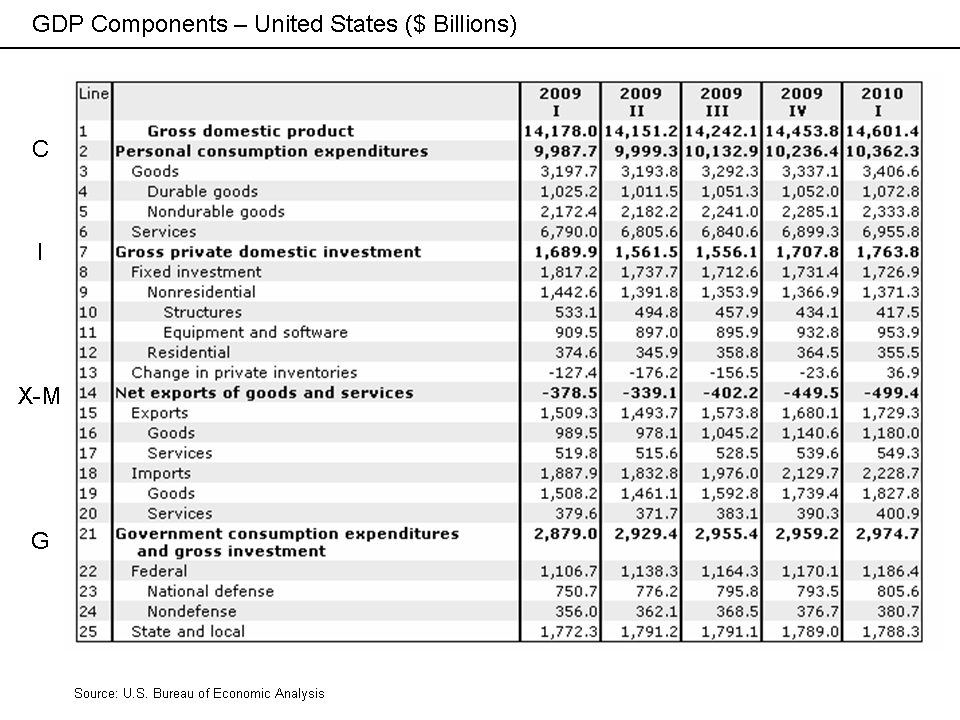
GDP = Federal Spending + Non-federal Spending + Net Exports

So, by what magic of mathematics can GDP grow with less money in the economy?

The example we like to give is applying leeches to cure anemia. It simply cannot work.

Addendum: Reason.com, just today, had the gall to re-publish the following article from 2012:

To Revive the Economy, Cut Federal Spending
Obama and Boehner are both big spenders. That’s the problem.
Nick Gillespie & Veronique de Rugy

In a paper released this year, economists Carmen M. Reinhart, Vincent R. Reinhart, and Kenneth Rogoff said that periods of “debt overhang” – when accumulated gross debt exceeds 90 percent of a country’s total economic activity for five or more consecutive years – reduce annual economic growth by more than one percentage point for decades.

Can you believe it? Back in 2012 they wanted spending cuts to “revive” an economy that had been growing for four years.

Now, it’s 2017. Spending has continued to grow; the economy also has continued to grow — for nine years — and Reason.com publishes the same article that was wrong in 2012 and remains wrong in 2017.

Whew, talk about not learning from your errors!

Anyway, what’s the use? Economic reality means nothing to Libertarians. “We believe what we believe and please don’t confuse us with facts.”

It is ever thus.

Rodger Malcolm Mitchell
Monetary Sovereignty
Twitter: @rodgermitchell; Search #monetarysovereignty
Facebook: Rodger Malcolm Mitchell

THOUGHTS

•All we have are partial solutions; the best we can do is try.

•Those, who do not understand the differences between Monetary Sovereignty and monetary non-sovereignty, do not understand economics.

•Any monetarily NON-sovereign government — be it city, county, state or nation — that runs an ongoing trade deficit, eventually will run out of money no matter how much it taxes its citizens.

•The more federal budgets are cut and taxes increased, the weaker an economy becomes..

•No nation can tax itself into prosperity, nor grow without money growth.

•Cutting federal deficits to grow the economy is like applying leeches to cure anemia.

•A growing economy requires a growing supply of money (GDP = Federal Spending + Non-federal Spending + Net Exports)

•Deficit spending grows the supply of money

•The limit to federal deficit spending is an inflation that cannot be cured with interest rate control. The limit to non-federal deficit spending is the ability to borrow.

•Until the 99% understand the need for federal deficits, the upper 1% will rule.

•Progressives think the purpose of government is to protect the poor and powerless from the rich and powerful. Conservatives think the purpose of government is to protect the rich and powerful from the poor and powerless.

•The single most important problem in economics is the Gap between the rich and the rest.

•Austerity is the government’s method for widening the Gap between the rich and the rest.

•Everything in economics devolves to motive, and the motive is the Gap between the rich and the rest..

MONETARY SOVEREIGNTY

Have you heard of the New Democracy Party?

Image result for breaking chains

It takes only two things to keep people in chains:

The ignorance of the oppressed and the treachery of their leaders.

—————————————————————————————————————————————————————

Reader “ejhr2015” brought my attention to the New Democracy Party (NDP) in Australia. It is based on the beliefs of Modern Monetary Theory (MMT), a close relative of Monetary Sovereignty (MS).

In reader ejhr2015’s words:

There are, world wide, several NDP’s; Your namesake, Bill Mitchell, is a dead set opponent of a UBI, hence the bias you see. Me, there’s room for both, IMO. https://newdemocracyparty.org.au/home/democracy.php

On the Australian New Democracy Party’s website you can learn that: They understand the fundamental truth of Monetary Sovereignty: A Monetarily Sovereign Government’s spending is not funded by government income. 

Image result for gap between the rich and poorThe fundamental economic problem facing Australia, America, and the world is the Gap between the rich and the rest.

In America, the federal government is Monetarily Sovereign, while the state and local governments, businesses, and individual people are not Monetarily Sovereign.

So while the aforementioned state and local governments, et al, need various forms of income in order to spend, the federal government needs no income at all.

The U.S. federal government literally could eliminate all taxes and every other form of income, and still continue to spend, forever. There are reasons why it chooses not to forego income, but the power exists.

The Australian government has the same power. Keep that in mind as we explore some of the New Democracy Party’s recommendations, together with my comments:

Economy (https://newdemocracyparty.org.au/policy/economy/)
No targets will be set for the government’s fiscal balance – focus is on full employment, price stability, sustainability, and well-being, i.e. as low as practicable spending gap. The resulting fiscal balance is what it is

https://newdemocracyparty.org.au/policy/employment/ A job guarantee scheme in which any person willing and able to work will be offered a meaningful job by the government at a socially acceptable minimum wage along with training, support and mechanisms for transitioning participants to the private sector if he/she wishes

This focus on full employment and price stability is the classic MMT dogma. At the University of Missouri, Kansas City, the focus of MMT thinking, there even is a Center for Full Employment and Price Stability.

We often have discussed the MMT “jobs guarantee” (JG), and have found it to be naive, impractical and counter-productive.  Although the plan has changed through the years, it has these features:Image result for gap between the rich and poor

  1. “Junk jobs”: Look in the newspapers and online. There is no shortage of jobs. There are millions of jobs, but they are the wrong jobs.
    .
    The vast majority are jobs you wouldn’t take, even if you were unemployed.  They are minimum wage jobs, in the wrong location, or have physical or experiential requirements you don’t wish to fulfill, or are unpleasant for any number of other reasons.
    .
    Those are the jobs the government bureaucrats of JG will provide.
  2. JG bureaucrats would compete with private employment agency professional personnel or would have to create “make-work jobs” from thin air.
  3. JG is based on the Puritanical assumption that work, even in “make-work jobs,” is the only moral way for the poor to receive money — “work ’til you drop,” digging a hole and filling it up. The rich, however, are not subject to that moral imperative.
  4. Because JG must be minimum wage (so as not to compete with the private sector), it doesn’t provide the real financial needs of the unemployed: Enough money to lead a decent life. (“Minimum wage” is a legal term that differs according to locality.  It is not a “sufficient” wage, which also differs according to locality.)
  5. And then there is the question of benefits, hours, and perks. How will those compare with “regular” jobs?
  6. What happens if a person is fired for cause? Is he entitled to another job, where he again can be fired for cause? Or for no cause?
  7. There are many, many other reasons why JG is a truly terrible idea; you can read about them here.

A national savings fund guaranteed by the government will be set up as an alternative to superannuation funds.

Offer accounts for superannuation funds that provide stable interest returns as an alternative to current superannuation arrangements

Somewhat confused: “. . . alternative to superannuation funds . . .” and “Offer accounts of superannuation funds . . . ” Which is it?

Anyway, I believe the above is like America’s Social Security, though no details about age or payment amounts are given.

No government debt securities will be issued

I’m not sure about the purpose of the above, but in America, T-securities assist in interest rate (i.e. inflation) control. At one point on the NDP website, there is an explanation of why the government should issue debt (!)

The assets owned by the sovereign fund (Future Fund) will be sold down in a controlled fashion unless government ownership or partial ownership is required for public benefit.

Because the Australian government is Monetarily Sovereign, and has no need for any sort of income, it also has no need to sell anything. It should give what it doesn’t want. Selling assets (“privatization”) is one way governments enrich the already rich.

Speculative behaviour in the financial markets that provides no real benefits to the population will be eliminated.

Who will determine what has “real benefits” and what does not? Most financial speculation exists as insurance for commodity pricing, or for market liquidity.

The ability of banks to sell loans on to others will be eliminated.

This is a dangerous policy, for it would tie a bank’s financial hands, increase the likelihood of bank insolvency, and reduce lending ability. I suspect this has not been well thought out.

Provide loans for business and farming investments that benefit the community when commercial loans are not available.

Provide seed capital for start up incubators that demonstrate a real potential for a benefit to the community.

Provide zero interest home loans to break intergenerational poverty

The national government never should lend. It does not need the return of capital, and lending can impoverish borrowers. America’s student-loan debacle is an example.

The national government should provide no-obligation financial support to benefit the community. In short, the government should give, not lend.

Tax: https://newdemocracyparty.org.au/policy/tax/

Create fiscal “space” for the government to enact its social agenda

One might think “fiscal space” means the government has enough money to do what it wishes. But at another place on the website, “fiscal space” is defined as allowing the government to spend without creating inflation.

This follows the MMT claim that the federal government uses taxes to prevent inflation. But, the government does no such thing. In the first place, when the government is considering taxes, it does not include inflation.

It may include rates against various income groups or rates for the purpose of trade agreements, or for “sin” taxes, but it does not include inflation. Why? Because tax changes are slow to implement, slow to take effect and almost impossible to use as an inflation cure or preventative.

Inflation comes quickly, and in unexpected amounts. No one ever is able to determine how much, and what kind of tax will prevent or cure any amount of inflation.

Instead, the U.S. Fed controls inflation via interest rates which control the demand for dollars, which in turn, controls the value of dollars. Despite MMT’s repeated claims, the government does not, and cannot, set taxes or tax rates to control inflation.

Education: https://newdemocracyparty.org.au/policy/education/

High quality public education (early childhood, primary, secondary, vocational, tertiary and post-graduate) will be free to all citizens. Existing student loans will be forgiven.

The above are good ideas, except they should not be limited to citizens. There are strong reasons why everyone in Australia should be educated so they can contribute to Australia’s economic and scientific progress.

The choice of courses to be offered in universities will be at the discretion of the respective academic board and an evidence-based clear public benefit. Public funding of private primary and secondary education institutions will be reviewed to clearly determine their public benefit.

Allowing the national government to determine whether a course offers a “clear public benefit” is dangerous. Will government bureaucrats consider courses in poetry, music, art, history, and sports as offering a clear, public benefit?

Will this also open up each course to an examination of content? For example, even if a music course is considered to have a “clear public benefit,” what if part of the course contains “gangsta rap.” Will a government bureaucrat allow it?

Health care: https://newdemocracyparty.org.au/policy/health/

Health care will be free for all permanent residents and citizens including dental, mental, psychological and emotional health care

What is the benefit to Australia, if a government that can afford anything, denies health care to those who are not permanent residents or citizens?

Welfare: https://newdemocracyparty.org.au/policy/welfare/

All citizens and permanent residents will be provided with housing and adequate food if they are unable to afford and secure these for themselves

All citizens and permanent residents will be entitled to a dignified weekly income and free public transport if they are unable to work for whatever reason

Same question as previous. What is the benefit to Australia if a government that can afford anything, denies housing and adequate food to those who are not citizens and permanent residents.

Climate: https://newdemocracyparty.org.au/policy/climate/

Investment in renewable energy research, development and implementation will be encouraged and made directly by the government to convert Australia’s economy to carbon neutrality by 2030

Excellent. There is zero reason not to do this.

The New Democracy Party has some good ideas, but sometimes it seems to forget that the Australian government is Monetarily Sovereign. The Jobs Guarantee is a terrible idea for many reasons, which we have detailed in other posts:

Why Modern Monetary Theory’s Employer of Last Resort is a bad idea. Sunday, Jan 1 2012
MMT’s Job Guarantee (JG) — “Another crazy, rightwing, Austrian nutjob?” Thursday, Jan 12 2012
Why Modern Monetary Theory’s Jobs Guarantee is like the EU’s euro: A beloved solution to the wrong problem. Tuesday, May 29 2012
“You can’t fire me. I’m on JG” Saturday, Jun 2 2012
More proof Jobs Guarantee (JG) can’t work  Saturday, Jan 4, 2017

Finally, although part of the MMT mantra is “price stability,” we don’t see anything in their recommendations that deal with the price stability issue.

We believe the fundamental economic problem facing America’s and Australia’s people is: The wide Gap between the rich and the rest. This Gap can and should be narrowed by government spending that benefits the “not-rich.”

While some of the NDP’s recommendations address this issue, some do not. Surely, minimum wage, “junk jobs,” which are closely akin to slavery, are more likely to widen the Gap than to narrow it. All such jobs do is perpetuate the starvation of the slave class.

The New Democracy Party is an attempt to help the poor, by taking advantage of Australia’s Monetary Sovereignty. But it is so dominated by MMT’s mantra (full employment and price stability) it has forgotten that its stated goal is to: “Wage a war against poverty,” and often forgets the government is Monetarily Sovereign.

It mentions, but does not correctly answer such questions as:

  1. “Will increased government spending drive up inflation?”
  2. “Will increased government spending result in the Australian dollar collapsing on the foreign exchange markets?”
  3. Then it gives complex non-informative answer to: “Will higher budget deficits increase interest rates? If the government doesn’t need to borrow to fund the deficits, why does it issue debt?”
  4. Finally, there is the misleading answer to the question: “What’s to stop the government from going crazy with its spending?” Here is what they say:

The answer to the question is around the concept of the economy’s capacity utilization, also be thought of as an output gap or a spending gap, which is the difference between what the economy could be producing (in terms of goods and services) if it was operating at full capacity and what it is actually producing.

The answer is misleading, partly because no one knows what “full capacity” is. Consider the full capacity of a farm that picks by hand vs. the full capacity of a highly advanced, robot-computer operated farm. If government investment in farm automation increases capacity, what then is “full capacity”?

The question about the government “going crazy” with spending is a good one, but it is a question the government already has answered. “What currently prevents the government from “going crazy” with its spending?”

Neither the total of deficits nor of debt have prevented Congress from spending, as both have risen significantly almost every year since the Great Depression. Rather than worrying about inflation (which the Fed controls), our greatest worry should be the Gap between the rich and the rest. That is the real problem facing America.

The New Democracy Party has taken a step toward educating the public about Monetary Sovereignty (though NDP doesn’t call it that.) Though their explanations are lacking, and some of their proposals are poor, one only can hope they are a step forward rather than a step in the wrong direction.

On balance, to address the fundamental problem of inequality, we should consider the Ten Steps to Prosperity (below).

Rodger Malcolm Mitchell
Monetary Sovereignty
Twitter: @rodgermitchell; Search #monetarysovereignty
Facebook: Rodger Malcolm Mitchell

………………………………………………………………………………………………………………………………………………………………………………………………………………………………………………………………………………………………………………………………………..

The single most important problems in economics involve the excessive income/wealth/power Gaps between the have-mores and the have-less.

Wide Gaps negatively affect poverty, health and longevity, education, housing, law and crime, war, leadership, ownership, bigotry, supply and demand, taxation, GDP, international relations, scientific advancement, the environment, human motivation and well-being, and virtually every other issue in economics.

Implementation of The Ten Steps To Prosperity can narrow the Gaps:

Ten Steps To Prosperity:
1. ELIMINATE FICA (Ten Reasons to Eliminate FICA )
Although the article lists 10 reasons to eliminate FICA, there are two fundamental reasons:
*FICA is the most regressive tax in American history, widening the Gap by punishing the low and middle-income groups, while leaving the rich untouched, and
*The federal government, being Monetarily Sovereign, neither needs nor uses FICA to support Social Security and Medicare.
2. FEDERALLY FUNDED MEDICARE — PARTS A, B & D, PLUS LONG TERM CARE — FOR EVERYONE (H.R. 676, Medicare for All )
This article addresses the questions:
*Does the economy benefit when the rich can afford better health care than can the rest of Americans?
*Aside from improved health care, what are the other economic effects of “Medicare for everyone?”
*How much would it cost taxpayers?
*Who opposes it?”
3. PROVIDE A MONTHLY ECONOMIC BONUS TO EVERY MAN, WOMAN AND CHILD IN AMERICA (similar to Social Security for All) (The JG (Jobs Guarantee) vs the GI (Guaranteed Income) vs the EB (Economic Bonus)) Or institute a reverse income tax.
This article is the fifth in a series about direct financial assistance to Americans:

Why Modern Monetary Theory’s Employer of Last Resort is a bad idea. Sunday, Jan 1 2012
MMT’s Job Guarantee (JG) — “Another crazy, rightwing, Austrian nutjob?” Thursday, Jan 12 2012
Why Modern Monetary Theory’s Jobs Guarantee is like the EU’s euro: A beloved solution to the wrong problem. Tuesday, May 29 2012
“You can’t fire me. I’m on JG” Saturday, Jun 2 2012

Economic growth should include the “bottom” 99.9%, not just the .1%, the only question being, how best to accomplish that. Modern Monetary Theory (MMT) favors giving everyone a job. Monetary Sovereignty (MS) favors giving everyone money. The five articles describe the pros and cons of each approach.
4. FREE EDUCATION (INCLUDING POST-GRAD) FOR EVERYONE Five reasons why we should eliminate school loans
Monetarily non-sovereign State and local governments, despite their limited finances, support grades K-12. That level of education may have been sufficient for a largely agrarian economy, but not for our currently more technical economy that demands greater numbers of highly educated workers.
Because state and local funding is so limited, grades K-12 receive short shrift, especially those schools whose populations come from the lowest economic groups. And college is too costly for most families.
An educated populace benefits a nation, and benefitting the nation is the purpose of the federal government, which has the unlimited ability to pay for K-16 and beyond.
5. SALARY FOR ATTENDING SCHOOL
Even were schooling to be completely free, many young people cannot attend, because they and their families cannot afford to support non-workers. In a foundering boat, everyone needs to bail, and no one can take time off for study.
If a young person’s “job” is to learn and be productive, he/she should be paid to do that job, especially since that job is one of America’s most important.
6. ELIMINATE FEDERAL TAXES ON BUSINESS
Businesses are dollar-transferring machines. They transfer dollars from customers to employees, suppliers, shareholders and the federal government (the later having no use for those dollars). Any tax on businesses reduces the amount going to employees, suppliers and shareholders, which diminishes the economy. Ultimately, all business taxes reduce your personal income.
7. INCREASE THE STANDARD INCOME TAX DEDUCTION, ANNUALLY. (Refer to this.) Federal taxes punish taxpayers and harm the economy. The federal government has no need for those punishing and harmful tax dollars. There are several ways to reduce taxes, and we should evaluate and choose the most progressive approaches.
Cutting FICA and business taxes would be a good early step, as both dramatically affect the 99%. Annual increases in the standard income tax deduction, and a reverse income tax also would provide benefits from the bottom up. Both would narrow the Gap.
8. TAX THE VERY RICH (THE “.1%) MORE, WITH HIGHER PROGRESSIVE TAX RATES ON ALL FORMS OF INCOME. (TROPHIC CASCADE)
There was a time when I argued against increasing anyone’s federal taxes. After all, the federal government has no need for tax dollars, and all taxes reduce Gross Domestic Product, thereby negatively affecting the entire economy, including the 99.9%.
But I have come to realize that narrowing the Gap requires trimming the top. It simply would not be possible to provide the 99.9% with enough benefits to narrow the Gap in any meaningful way. Bill Gates reportedly owns $70 billion. To get to that level, he must have been earning $10 billion a year. Pick any acceptable Gap (1000 to 1?), and the lowest paid American would have to receive $10 million a year. Unreasonable.
9. FEDERAL OWNERSHIP OF ALL BANKS (Click The end of private banking and How should America decide “who-gets-money”?)
Banks have created all the dollars that exist. Even dollars created at the direction of the federal government, actually come into being when banks increase the numbers in checking accounts. This gives the banks enormous financial power, and as we all know, power corrupts — especially when multiplied by a profit motive.
Although the federal government also is powerful and corrupted, it does not suffer from a profit motive, the world’s most corrupting influence.
10. INCREASE FEDERAL SPENDING ON THE MYRIAD INITIATIVES THAT BENEFIT AMERICA’S 99.9% (Federal agencies)Browse the agencies. See how many agencies benefit the lower- and middle-income/wealth/ power groups, by adding dollars to the economy and/or by actions more beneficial to the 99.9% than to the .1%.
Save this reference as your primer to current economics. Sadly, much of the material is not being taught in American schools, which is all the more reason for you to use it.

The Ten Steps will grow the economy, and narrow the income/wealth/power Gap between the rich and you.

MONETARY SOVEREIGNTY

GOP: Cut spending? Add spending? Cut deficits? Add deficits? Increase debt? Cut debt? All of the above. None of the above.

Image result for the truth will set you free
It takes only two things to keep people in chains:
The ignorance of the oppressed and the treachery of their leaders.

——————————————————————————————————————————————————————

Which of the following do you believe the federal government should do? Think carefully before you answer.Image result for many choices

  1. Reduce federal spending?
  2. Increase federal spending?
  3. Reduce federal deficits?
  4. Increase federal deficits?
  5. Increase the federal debt?
  6. Reduce the federal debt?
  7. All of the above?
  8. None of the above?

Members of the GOP seem to believe very strongly in all of these options. Many individuals actually believe in two or more opposing directions.

No kidding:

Tax cuts quiet once-deafening GOP call for fiscal discipline
ANDREW TAYLOR, Associated Press, September 16, 2017

When Democrat Barack Obama was president, conservatives demanded financial discipline and deep spending cuts in the face of the country’s fast-growing debt.

With Republican President Donald Trump pressing for politically popular tax cuts and billions more for the military, few in the GOP are complaining about the nation’s soaring debt.

Tax cuts in the works could add hundreds of billions of dollars to the debt while bipartisan pressure for more money for defense, infrastructure and domestic agencies could mean almost $100 billion in additional spending next year alone.

The bottom line: The $20 trillion national debt promises to spiral ever higher with Republicans controlling both Congress and the White House.

In short, the GOP has become fiscally (though not socially) more progressive than was Barack Obama.  And that is a good thing for America. Here is why:

Gross Domestic Product = Federal Spending + Non-federal Spending + Net Exports.

All three terms, Federal Spending, Non-federal Spending, and Net Exports show that a growing GDP, i.e. a growing economy, requires a growing supply of money.

    • Federal Spending grows the money supply because the federal government creates dollars, ad hoc, every time it pays a bill.
    • Tax cuts, which allow more dollars to remain in the economy, increase Non-federal Spending.
    • Finally, Net Exports increase the money supply by bring dollars into the U.S. economy.

“Republicans gave up on caring about deficits long ago,” bemoaned Republican Sen. Rand Paul of Kentucky, who was elected in the 2010 tea party class.

One might say the Republicans finally have recognized the fact that a growing economy requires a growing money supply.

By formula, it mathematically is impossible for GDP to grow, unless Federal Spending, and/or Non-federal Spending, and/or Net Exports grow.

And since Federal Deficit Spending stimulates Non-federal Spending, by adding net dollars to consumers’ pockets, the fundamental stimulus for economic growth is federal deficit spending, i.e spending increases and tax decreases.

But if “Republicans gave up on caring about deficits long ago,” as Rand Paul claims, why all the discussion of the debt ceiling?

It’s a far cry from the Newt Gingrich-led GOP revolution that stormed Washington two decades ago with a mandate to balance the budget and cut taxes at the same time.

To balance the budget and cut taxes requires cutting the military (which the GOP always opposes) and/or cutting social benefits (which the Democrats and the American voters oppose).

Further, because the U.S. federal government (unlike state and local governments) is Monetarily Sovereign, it never can run short of its own sovereign currency. It can pay any bill of any size, instantly, simply by creating dollars.

The federal government’s method for creating new dollars is to spend dollars. In that sense, the federal government always spends dollars it doesn’t have. If you did that, you would be reckless, but the federal government’s finances are different from yours.

Even if federal taxes were $0 and spending tripled, the federal government could pay its bills, endlessly. So there is no purpose to a “balanced” federal budget.

Or even from Republicans of 2001, who enthusiastically cut taxes under President George W. Bush, but only at a moment when the government was flush with money.

The federal government never is short of dollars, nor is it ever “flush with money.”  The federal government has the unlimited power to create brand new dollars from thin air, every time it pays a creditor.

Now, Medicare and Social Security are drawing closer to insolvency.

Fiscal hawks and watchdogs like the Congressional Budget Office warn that the debt is eventually going to drag the economy down.

Neither the U.S. federal government, nor any of the thousand agencies of the federal government, ever can be insolvent. Such federal agencies as Congress, the White House, the Supreme Court, the CIA, the FBI, the NSA, Social Security, and Medicare, etc., etc, cannot go insolvent unless the Congress and the President want them to be insolvent.

Have you ever heard of the Navy being “insolvent”?  The Army? Name a single federal agency that ever has been insolvent.

The notion that Medicare or Social Security can become “insolvent,” ironically is based on a special tax, FICA, being collected supposedly to support them.

But FICA supports nothing and no, there is no “Social Security Trust Fund.” It is an accounting fiction designed to make you believe your Medicare and Social Security benefits must be limited.  It’s all a great big fat lie.

And as far as federal debt “eventually dragging the economy down,” this too is a lie, promulgated for the same purpose — to make you believe the federal government is unable to help you.

The so-called debt actually is the total of deposits in T-security accounts.

If the federal government wished, it easily could pay off the entire “debt” today, simply by transferring existing dollars from those T-security accounts, back to the checking accounts of T-security holders. No new dollars needed.

There is no mechanism by which deposits in T-security accounts (aka “savings”) can drag down the U.S. economy.  Anyone who says otherwise is a great, big, fat liar.

But like Obama and Bush before him, Trump isn’t talking about deficits. Neither much are voters.

“Voters, frankly, after these huge deficits, are saying, ‘Well, how much do deficits really matter?’” said former Sen. Rick Santorum, R-Pa., a two-time presidential candidate. “We’re not Greece yet, right?”

Deficits do matter, but not in the way most people think.

Deficit growth reductions have led to recessions, and deficit growth increases have cured recessions.

Far from being a problem, federal deficits are absolutely necessary for economic growth.

And as for the U.S. ever being “Greece,” that unfortunate nation surrendered its most valuable asset, its Monetary Sovereignty, when it gave up the drachma and adopted the euro.

Chicago, Florida, General Motors, you, and me and Greece do not have a sovereign currency. None of the aforementioned has the unlimited ability to pay bills. All can become insolvent.

By contrast, the U.S. government has the unlimited ability to pay any bill, of any size, at any time, simply by creating dollars. There is no economic reason to cut deficits or debt.

Top Capitol Hill Republicans such as House Speaker Paul Ryan of Wisconsin and Senate Majority Leader Mitch McConnell of Kentucky had promised for months that a tax overhaul would not add to the deficit, with rate cuts financed by closing loopholes and other steps.

Instead, Republicans are talking about tax cuts whose costs to the debt — still under negotiation — would be justified by assumptions of greater economic growth.

Yes, tax cuts are justified by greater economic growth, but not in the way the GOP once has claimed.

Under President Reagan’s bogus “trickle-down” economic plan, tax rate reductions for the rich were supposed to “pay for themselves” by expanding the economy so much, tax collections actually would rise.

Not only didn’t this happen, but it wasn’t necessary. Tax cuts do stimulate the economy — especially tax cuts for consumers, i.e. the 99% (not tax cuts for the rich), because federal taxes (unlike state and local taxes) destroy dollars. And the federal government neither needs nor uses tax dollars.

Federal taxes no longer are part of any money supply measure, i.e. they effectively are destroyed upon receipt.

“We want pro-growth tax reform that will get the economy going, that will get people back to work, that will give middle-income taxpayers a tax cut and that will put American businesses in a better competitive playing field so that we keep American businesses in America,” Ryan said in an AP Newsmakers interview this past week. “That’s more important than anything else.”

He backed off months of promises that the Republicans’ tax plan won’t add to the nation’s ballooning deficit.

Ryan, the “new liberal Democrat,” is absolutely correct in what he says. Tax cuts for the middle- and lower-income groups, and for businesses, will grow the economy.

What the GOP does may be a different story, as their leaning always has been tax cuts for the rich and for “broadening the tax base” (tax increases for the poor).

Among the few deficit hawk holdouts is Sen. Bob Corker, R-Tenn., a key vote on the Senate Budget Committee, who says he doesn’t want to “let this just be party time that just takes us no place but massive deficits down the road.”

The real danger to America is that Corker, who has so much power on the Senate Budget Committee, completely misstates federal financial reality.

Image result for time bomb
Since 1940, the “time bomb” of federal debt has been ticking. Still ticking.

This deficit hawk cannot explain the simple fact that the federal debt in 1940 was $40 billion, and deficit hawks then were calling it a “ticking time bomb.

Today, after 77 years, the debt $14 Trillion debt has risen 35,000%  (yes, that’s 35 thousand percent), and here we are:

The federal government is not insolvent; no federal agency is insolvent; the “time bomb has not exploded, the sky has not fallen; and we are discussing tax reductions.

Trump’s election has GOP military hawks pressing to shovel enormous amounts of money into the Pentagon — about $90 billion over the stringent spending limits set by the hard-won 2011 deficit control effort.

Don’t call it “hard won.” Call it the “foolish, counter-productive, based-on-the-Big-Lie, deficit control effort. Call it “hard lost,” as it reduced GDP growth to its lowest level in many years.

Deficit growth cured every recession, but the “hard-won” deficit control effort of 2011, resulted in the lowest GDP growth we’ve had in many years. 

The unpopular leftover from the 2011 agreement are those spending limits, which if violated would be enforced by across-the-board spending cuts. Republicans want to scrap them, at least for military money.

“There’s so much pressure on our side for additional defense spending,” said Rep. Tom Cole, R-Okla. “Believe me there’s more defense hawks than budget hawks in the Republican conference right now.”

Republicans believe in spending reductions unless there’s something on which they want to spend. Then suddenly, spending reductions aren’t important any more.

Conservatives demanding that spending cuts accompany any extension of the government’s borrowing ability were undercut by Trump, who agreed last week to add temporary borrowing approval to a must-pass Harvey relief bill.

See, it’s like this. Spending cuts help the economy except when spending increases help the Texas economy, which then helps the U.S. economy.  Got it?

Anger over Trump’s debt bargain, though, has conservatives vowing that issues of spending and deficits won’t be kicked to the curb for long.

“It’s not going to be shoved aside much longer because this (debt limit) deal last week … has got people all riled up, and justifiably so,” said longtime GOP Rep. Joe Barton of Texas. “We’ll be ready next time.”

Translation:

“O.K., we’ll agree to increase the debt this time, because Texas needs the money, and I’m a Texan, and the government can afford anything. But next time, if it’s just the poor or the middle classes who need the money, we won’t give it to them, because the government can’t afford it.

“What? Oh, you say that Florida and Puerto also were hit by a hurricane, and they too need the money.  O.K., I guess we have to give it to them, but we’ll be ready to screw America NEXT time, because as you know, the government is running short of dollars it creates every day, from thin air.

Huh? There is another hurricane, this time threatening the northeastern states, a couple of which are ‘red’ states, so FEMA will have to help them, too? Well, so long as they’re red states, we’ll give them money, even though the federal government is totally destitute, although in the entire history of this nation, the government never has run out of dollars.

“Huh? The military also needs more money. Well, of course we can’t be without a military, and we might want to bomb North Korea, so give the military more money, too, even though the federal government doesn’t have any money at all. Not a penny, even though the government creates dollars by spending dollars.

“Oh, the President needs more money to build a wall that will protect us against drugs, even though drug dealers know how to avoid walls and don’t bring drugs across areas where we don’t have a wall. But if the President wants more money, we have to give more money, even though the government is so broke the sky is falling and Congress must live in poverty, which it never has.

But aside from that, the debt has been a ticking time bomb for 75 years, and even though we’ve had all kinds of wars, recessions, inflations, terrorism, and natural disasters, that time bomb hasn’t exploded. But it could. Soon. Any second now. The end is nigh. Here it comes. Hang on. Almost here. 

“And yes, there is zero evidence that the debt is “unsustainable” and that cutting the debt will grow GDP, but hey we’ve been telling the same lie for so many years, we can’t go back how, or we’ll look really stupid.

Right?”

Right. Really stupid.

Rodger Malcolm Mitchell
Monetary Sovereignty
Twitter: @rodgermitchell; Search #monetarysovereignty
Facebook: Rodger Malcolm Mitchell

………………………………………………………………………………………………………………………………………………………………………………………………………………………………………………………………………………………………………………………………………..

The single most important problems in economics involve the excessive income/wealth/power Gaps between the have-mores and the have-less.

Wide Gaps negatively affect poverty, health and longevity, education, housing, law and crime, war, leadership, ownership, bigotry, supply and demand, taxation, GDP, international relations, scientific advancement, the environment, human motivation and well-being, and virtually every other issue in economics.

Implementation of The Ten Steps To Prosperity can narrow the Gaps:

Ten Steps To Prosperity:
1. ELIMINATE FICA (Ten Reasons to Eliminate FICA )
Although the article lists 10 reasons to eliminate FICA, there are two fundamental reasons:
*FICA is the most regressive tax in American history, widening the Gap by punishing the low and middle-income groups, while leaving the rich untouched, and
*The federal government, being Monetarily Sovereign, neither needs nor uses FICA to support Social Security and Medicare.
2. FEDERALLY FUNDED MEDICARE — PARTS A, B & D, PLUS LONG TERM CARE — FOR EVERYONE (H.R. 676, Medicare for All )
This article addresses the questions:
*Does the economy benefit when the rich can afford better health care than can the rest of Americans?
*Aside from improved health care, what are the other economic effects of “Medicare for everyone?”
*How much would it cost taxpayers?
*Who opposes it?”
3. PROVIDE A MONTHLY ECONOMIC BONUS TO EVERY MAN, WOMAN AND CHILD IN AMERICA (similar to Social Security for All) (The JG (Jobs Guarantee) vs the GI (Guaranteed Income) vs the EB (Economic Bonus)) Or institute a reverse income tax.
This article is the fifth in a series about direct financial assistance to Americans:

Why Modern Monetary Theory’s Employer of Last Resort is a bad idea. Sunday, Jan 1 2012
MMT’s Job Guarantee (JG) — “Another crazy, rightwing, Austrian nutjob?” Thursday, Jan 12 2012
Why Modern Monetary Theory’s Jobs Guarantee is like the EU’s euro: A beloved solution to the wrong problem. Tuesday, May 29 2012
“You can’t fire me. I’m on JG” Saturday, Jun 2 2012

Economic growth should include the “bottom” 99.9%, not just the .1%, the only question being, how best to accomplish that. Modern Monetary Theory (MMT) favors giving everyone a job. Monetary Sovereignty (MS) favors giving everyone money. The five articles describe the pros and cons of each approach.
4. FREE EDUCATION (INCLUDING POST-GRAD) FOR EVERYONE Five reasons why we should eliminate school loans
Monetarily non-sovereign State and local governments, despite their limited finances, support grades K-12. That level of education may have been sufficient for a largely agrarian economy, but not for our currently more technical economy that demands greater numbers of highly educated workers.
Because state and local funding is so limited, grades K-12 receive short shrift, especially those schools whose populations come from the lowest economic groups. And college is too costly for most families.
An educated populace benefits a nation, and benefitting the nation is the purpose of the federal government, which has the unlimited ability to pay for K-16 and beyond.
5. SALARY FOR ATTENDING SCHOOL
Even were schooling to be completely free, many young people cannot attend, because they and their families cannot afford to support non-workers. In a foundering boat, everyone needs to bail, and no one can take time off for study.
If a young person’s “job” is to learn and be productive, he/she should be paid to do that job, especially since that job is one of America’s most important.
6. ELIMINATE FEDERAL TAXES ON BUSINESS
Businesses are dollar-transferring machines. They transfer dollars from customers to employees, suppliers, shareholders and the federal government (the later having no use for those dollars). Any tax on businesses reduces the amount going to employees, suppliers and shareholders, which diminishes the economy. Ultimately, all business taxes reduce your personal income.
7. INCREASE THE STANDARD INCOME TAX DEDUCTION, ANNUALLY. (Refer to this.) Federal taxes punish taxpayers and harm the economy. The federal government has no need for those punishing and harmful tax dollars. There are several ways to reduce taxes, and we should evaluate and choose the most progressive approaches.
Cutting FICA and business taxes would be a good early step, as both dramatically affect the 99%. Annual increases in the standard income tax deduction, and a reverse income tax also would provide benefits from the bottom up. Both would narrow the Gap.
8. TAX THE VERY RICH (THE “.1%) MORE, WITH HIGHER PROGRESSIVE TAX RATES ON ALL FORMS OF INCOME. (TROPHIC CASCADE)
There was a time when I argued against increasing anyone’s federal taxes. After all, the federal government has no need for tax dollars, and all taxes reduce Gross Domestic Product, thereby negatively affecting the entire economy, including the 99.9%.
But I have come to realize that narrowing the Gap requires trimming the top. It simply would not be possible to provide the 99.9% with enough benefits to narrow the Gap in any meaningful way. Bill Gates reportedly owns $70 billion. To get to that level, he must have been earning $10 billion a year. Pick any acceptable Gap (1000 to 1?), and the lowest paid American would have to receive $10 million a year. Unreasonable.
9. FEDERAL OWNERSHIP OF ALL BANKS (Click The end of private banking and How should America decide “who-gets-money”?)
Banks have created all the dollars that exist. Even dollars created at the direction of the federal government, actually come into being when banks increase the numbers in checking accounts. This gives the banks enormous financial power, and as we all know, power corrupts — especially when multiplied by a profit motive.
Although the federal government also is powerful and corrupted, it does not suffer from a profit motive, the world’s most corrupting influence.
10. INCREASE FEDERAL SPENDING ON THE MYRIAD INITIATIVES THAT BENEFIT AMERICA’S 99.9% (Federal agencies)Browse the agencies. See how many agencies benefit the lower- and middle-income/wealth/ power groups, by adding dollars to the economy and/or by actions more beneficial to the 99.9% than to the .1%.
Save this reference as your primer to current economics. Sadly, much of the material is not being taught in American schools, which is all the more reason for you to use it.

The Ten Steps will grow the economy, and narrow the income/wealth/power Gap between the rich and you.

MONETARY SOVEREIGNTY