Donald Trump has been begging for a Nobel Peace Prize, laughable at all levels. If, however, there were a Nobel Prize for Stupidity, he would be a favorite.
Trump has opted for “beautiful clean coal”, which is neither beautiful nor clean. While beauty is subjective, cleanliness is measurable. Coal combustion produces carbon dioxide, sulfur dioxide, nitrogen oxides, particulates, and potentially toxic residues. Not only is coal dirty, but it is a more expensive way to produce electricity than solar power.
Solar’s competitive advantage no longer depends entirely on environmental arguments or subsidies. Technological improvements and manufacturing scale have fundamentally changed electricity generation costs.
The September 2026 Scientific American magazine contains an independent economic analysis that supports solar’s economics. Solar panels have improved in efficiency, manufacturing costs have plummeted, and the fuel—sunlight—is free. The articles also report that, in May 2026, solar generated more U.S. electricity than coal for the first time in a single month.
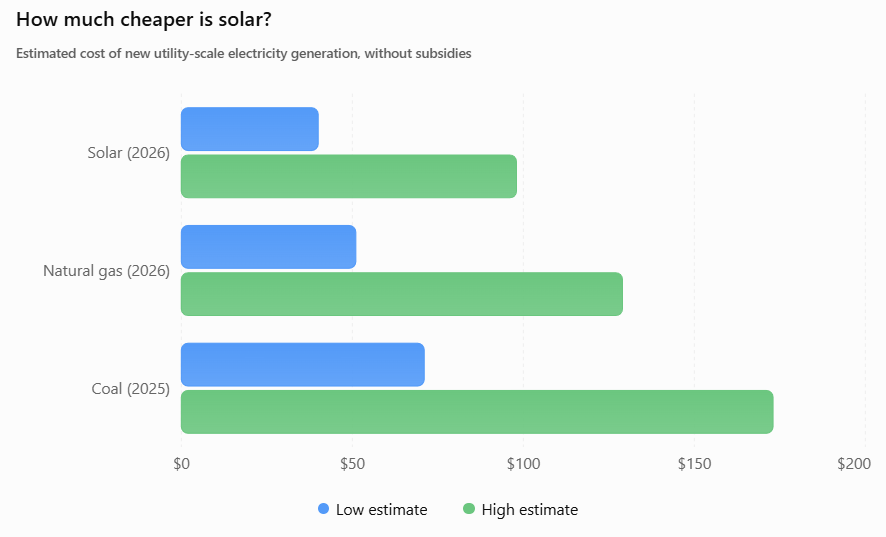
The International Renewable Energy Agency provides an even broader perspective. Its July 2026 report found that the worldwide average cost of newly commissioned utility-scale solar was approximately $44 per megawatt-hour, or 4.4 cents per kilowatt-hour. Onshore wind averaged just 3.3 cents.
|
Energy source |
Cost per megawatt-hour |
Cents per kilowatt-hour |
|---|---|---|
|
Onshore wind (global average) |
$33 |
3.3¢ |
|
Solar (global average) |
$44 |
4.4¢ |
|
Natural gas, combined-cycle (U.S. range) |
$51–$129 |
5.1–12.9¢ |
|
Coal (U.S. range, 2025) |
$71–$173 |
7.1–17.3¢ |
More than 90% of new renewable projects were cheaper than the least expensive new fossil-fuel alternative in their respective markets. Why has solar become so inexpensive? Three developments explain much of the transformation.
Manufacturing scale. China and other countries developed enormous solar manufacturing capacity, reducing the cost per panel.
Better technology. Modern cells convert more sunlight into electricity, requiring less land, wiring, and supporting equipment for the same output.
No fuel expense. Once installed, a solar farm doesn’t need daily deliveries of coal or natural gas. Solar’s greatest weakness remains its intermittency. Electricity production declines with clouds and stops at night. Batteries, transmission lines, flexible demand, and other generators help maintain reliable service.
What about Trump’s coal policy? Coal has genuine advantages: It is storable on-site, and a coal plant can generate electricity at night or during prolonged cloudy weather. But calling it clean ignores its emissions and environmental consequences.
The economics also have shifted against constructing new coal plants. Lazard’s July 2026 report concluded that renewable energy remains the most cost-competitive category of new electricity generation in the United States, even without subsidies.
Tariffs, financing costs, and supply-chain problems have recently increased renewable construction costs.
So, the argument for preserving some existing coal capacity during a transition can be defensible. But, the argument for building a new generation of coal plants because coal is inherently cheaper than solar is much harder to sustain.
There’s a direct connection to the argument that inflation is fundamentally a problem of shortages.
Electricity is an essential input into virtually every part of the economy. Increasing its supply at lower cost potentially reduces production costs across many industries.
And because solar has no fuel expense, greater solar generation also can reduce exposure to volatile fossil-fuel prices.
Government investment in electricity generation, transmission, and storage can increase productive capacity rather than merely increase monetary demand. That does not guarantee that every such investment reduces inflation; timing, construction bottlenecks, and financing matter. But it is a concrete example of how expanding supply can relieve price pressure.
The irony is that a president who emphasizes cheap American energy is promoting coal while treating one of the cheapest sources of new electricity as an adversary.
And sunlight has one additional advantage over coal: Nobody has figured out how to impose a fuel surcharge on the sun.
The U.S. has fallen way behind China in solar production and solar-related patents.


The magnitude of China’s lead is frightening.
China doesn’t merely lead the United States in solar manufacturing; it dominates the global industry. It also leads in the number of solar-related patent applications.
China’s advantage extends beyond finished panels. The International Energy Agency’s 2026 analysis estimates that China controls approximately 85% of solar supply-chain production capacity and 95% of photovoltaic wafer capacity.
And the patents? They show that China accounted for roughly 5.7 times the American share of published solar patent applications. Patent quantity isn’t the same as patent quality, but the disparity is substantial.
WIPO The IEA’s 2026 innovation report also identifies China as the global leader in patenting perovskite solar cells, an important emerging technology.
The strategic irony is that America pioneered much of the science underlying modern photovoltaics. Bell Labs demonstrated the first practical silicon solar cell in 1954. But China subsequently made solar manufacturing a strategic industrial priority, combining research, investment, manufacturing scale, and supply-chain integration.
The United States still has important solar research capabilities and a growing domestic manufacturing sector. But China’s enormous lead can’t be reversed simply by imposing tariffs.
And the market is hardly standing still. In 2025, China installed approximately 415 gigawatts of new solar capacity, compared with 43 gigawatts in the United States—almost ten times as much.
America now must buy Chinese solar panels. Worse, America has surrendered the research, manufacturing expertise, and industrial infrastructure associated with a major energy technology. That is a huge economic and strategic loss.
And we must not forget, there are serious environmental consequences as we poison the air our children breathe and the water they drink.
While China builds the next generation of solar technology, America debates whether coal is beautiful.
Falling far behind China in renewable electricity is just one example of how the Republican Party has been making America “great” again — by cancelling research and development support for renewable energy and supporting dirty, expensive coal fossil fuels.
Perhaps they could burn more “woke” books to keep us warm. And as foreign powers exert ever more control over oil supplies, be sure to fuel your car with Republican coal.
Rodger Malcolm Mitchell


Dear Sir, I am sorry to say, but this article contains a great deal of erroneous information. Firstly, the true cost of renewable energy is significantly higher when all relevant factors are taken into account—such as storage solutions, recycling, and losses caused by adverse weather conditions, among others. Secondly, China is ramping up the production of such equipment because, in doing so, it effectively exports insecurity and control to other nations. In fact, a new coal-fired power plant is being built in China every two weeks. Thirdly, it is simply not true that coal-fired power plants still emit particulate matter, sulfur, or carbon monoxide; such claims could only be made by someone who has never worked in a coal-fired power plant. Fourthly, humanity is still a long way from reaching the CO2 concentrations seen in the pre-deluge era—a time when the entire planet was green and herbivores thrived even near the Arctic Circle. Carbon dioxide is a gas essential to life; without it, life could not exist, nor would it be possible to sustain a growing population. It is regrettable that you are disseminating such false information. You can find genuine scientific data here: https://clintel.org/world-climate-declaration/ Respectfully.
LikeLike
Rodion, than you for your comments. I see you have given a great deal of thought to this problem.
Rather than get into some of your speculative or political claims, which contain no data, I’ll discuss the website that seems to be the scientific basis of your thoughts: the World Climate Declaration published by CLINTEL (Climate Intelligence).
My assessment: It combines several legitimate scientific concerns with misleading claims and conclusions that the evidence does not support.
I agree with its demand that climate policies should be evaluated scientifically and economically. But I don’t agree with its central claim that there is no climate emergency, particularly when it uses that phrase to dismiss substantial evidence of climate-related risks.
The declaration is a good example of something worth watching for in scientific arguments: a statement that begins with an indisputable fact and ends with a conclusion that doesn’t follow.
Examining its principal claims
CLINTEL’s claim: Climate has always changed naturally.
My assessment: True, but misleading. Past natural changes don’t establish that current warming is natural.
Claim: Warming has been much slower than predicted.
Assessment: Largely false. Observed long-term warming broadly agrees with climate-model projections. In any event, “slower” would not equate with “harmless.”
Claim: Climate models are inadequate.
Assessment: Partly true. Models have limitations, particularly for regional predictions. But their limitations don’t invalidate their demonstrated successes.
Claim: CO benefits plants and agriculture.
Assessment: Partly true. CO fertilization is real, but higher temperatures, water shortages, and other stresses can offset or reverse benefits. Further, experiments indicate the too much CO2 can overload plants and have a negative effect. Tests show that increased CO2 levels can cause wheat, rice, and other crops to contain less protein, iron, and zinc.
Claim: Global warming hasn’t increased natural disasters.
Assessment: Misleading. Not every type of disaster has increased, but evidence links warming to more intense heat extremes, heat deaths, fires, heavy precipitation, floods, and, conversely, droughts and other weather extremes.
Claim: Net-zero policies are costly and potentially harmful.
Assessment: A legitimate policy question. Costs, benefits, reliability, and alternatives deserve rigorous comparison. It would be interesting to see your data regarding, for instance, the cost of extinction events.
What about the 2,000 scientists who signed? CLINTEL’s current page reports more than 2,000 scientists and professionals supporting its declaration. That sounds impressive, and some signatories have substantial scientific credentials.
But the number is not equivalent to 2,000 climate researchers reaching the same conclusion through published research.
The signatories included engineers, physicians, geologists, mathematicians, and people without scientific backgrounds. Only a small number identified themselves specifically as climate scientists.
One prominent supporter, Nobel laureate John Clauser, received his Nobel Prize for experimental quantum physics—not climate research. His achievement deserves respect, but expertise in one branch of physics doesn’t automatically establish expertise in another.
And CLINTEL itself says something I agree with: The quality of arguments matters more than the number of experts.
The evidence I find most persuasive: The case for human-caused warming doesn’t rest solely on computer models. It rests on several independent observations: rising greenhouse gas concentrations, measured changes in atmospheric temperatures, ocean heat accumulation, the energy balance of Earth, and the physical properties of greenhouse gases.
The Intergovernmental Panel on Climate Change concluded that human activity unequivocally caused modern global warming. Its 2023 synthesis report estimated warming of approximately 1.1°C for 2011–2020 relative to 1850–1900.
And CLINTEL’s assertion about failed models has a particularly straightforward empirical test. Researchers examined 17 historical climate-model projections published between 1970 and 2007. Fourteen performed well when compared with subsequent observations, especially after accounting for differences between assumed and actual greenhouse gas forcing.
That’s not proof that every future projection will be correct. It is evidence against the sweeping claim that climate models are fundamentally unreliable.
My principal objection: The declaration conflates three separate questions:
The first has an exceptionally strong scientific answer: Yes.
The second involves measurable risks and genuine uncertainties, especially about timing, regional consequences, and future human responses.
The third is a political and economic judgment informed by science—not dictated by it.
It’s perfectly reasonable to question whether a particular net-zero deadline is feasible, whether nuclear energy should play a larger role, or whether adaptation deserves more investment.
But those arguments don’t require rejecting the evidence for human-caused warming.
My conclusion: CLINTEL is making a political and economic argument dressed partly as a scientific declaration. Its policy questions deserve discussion. Its scientific assertions, as written, do not deserve equal weight with the much larger body of observational research.
As for CLINTEL: I see three reasons to approach its scientific claims cautiously:
1. Its central conclusion was adopted at its founding and remains its defining message. In short, its beliefs are baked into its existence, making it difficult to accept other evidence. This is not science.
2. It frequently emphasizes uncertainties in climate research without giving comparable weight to the extensive evidence for human-caused warming, and other example of belief straining objectivitiy.
3. Its impressive signatory count can create a misleading impression of specialized scientific support.
The strongest criticism is not that CLINTEL disagrees with the scientific majority. Scientific majorities sometimes are wrong.
The problem is that CLINTEL has not demonstrated that its alternative interpretation explains the full body of climate observations better than established climate science does.
LikeLike
Dear Sir, I have read your response carefully. It is true that all the statements on that page are merely claims. However, they are claims based on actual scientific studies and historical, material evidence regarding the history of the planet. My suggestion was to perform a sort of “reverse engineering”—that is, to take each statement and examine the real science behind it. What you refer to as “established science” is, in fact, propaganda funded by the planet’s masters, who seek to reduce the population and revert humanity to a primitive state—both to ensure their own comfort and, more importantly, to impose their own religion. The issue of climate change—along with other so-called “established science”—is, at its core, a religious matter, and the subject is highly complex. To draw a parallel to another deception—one even more dangerous to humanity than the narrative of human-caused climate change—I would point to the ruse surrounding viruses and communicable diseases. Of course, this would expand the scope of the discussion significantly. I am not sure how best to provide you with further references, as there are simply too many. However, since many people have begun to perceive the reality of the situation but lack the time for extensive research, I would direct you to a website that addresses these matters quite effectively, in a way that is accessible to everyone and covers the full spectrum of these issues. You can find several texts that might interest you at this link: https://crestinortodox.org/. Examples include “Read and you can save yourself,” among many others. Furthermore, you neglected to address my point regarding coal-fired power plants—a point that remains valid. They actually cause less pollution than the renewable energy equipment industry. Hoping that this has been helpful to both you and your readers, I offer my respectful regards and suggest that you look into the matter further. There are other issues far more important than saving the planet from global warming.
LikeLike
“The issue of climate change—along with other so-called “established science”—is, at its core, a religious matter, and the subject is highly complex.”
Thank you for your comments. I’m sorry, but I do not know how to debate religion. I deal only in science and data. Perhaps you should discuss this further with your religious leaders.
LikeLike
Dear friend, here’s the thing: I didn’t visit your page because I hate you, or because I want to compete with you over who’s cooler or better informed. I was just getting my weekly dose of information and happened to come across your article. Honestly, at first glance, I thought you were just another poor, innocent soul taken in by official propaganda. But looking at your sophistry-filled replies, I realize you’re actually a trained propaganda agent. And now, you come out with this claim—how can you say you don’t know anything about religion? All those hypotheses—climate change, evolution, modern medicine regarding viruses and infectious diseases, and so on—are nothing more than religions. Heretical, satanic religions! You have to believe in them to accept them as truth. If you were genuinely interested in real science, you would employ scientific methods. You would ask the right questions and seek answers from every perspective—for, against, and everything in between. I’d also like to point out that people like you follow a personal religion: “Mammonism”—that is, worship of the god of money. As long as you’re getting paid, you’ll do anything. In fact, this is the core problem facing humanity today: there are far too many “Mammonists”—people who would even sell their own mothers to organ traffickers, provided the price is right! And please, don’t try to tell me you wrote this article for the good of humanity. Because in your initial article, you already introduced two blatant lies—the one about coal-fired power plants and the one about the Chinese. You need to understand the fundamental principle of doing good: to do good, you must have a religion that defines what good and evil are. “Good” and “evil” are strictly theological concepts and can only be defined based on a religion. But you know what? Let’s not argue. I hold no resentment toward you. I know what it’s like to feel lost and to be lied to from every direction. Perhaps you are also young, and when we are young, it is easier to fall into the traps set by malicious people. But it is time to come to your senses. You have very little time left to live! It seems you live in America, which means your chances of being killed in the next three years are around 30%. If, by any chance, you made the mistake of believing in the “science” of vaccines and got the COVID-19 shot, your chances of dying within about three or four years increase exponentially. It would be better to write to me at my email address: rodionzamfir@proton.me. Together, and with patience, I can help you deprogram yourself from all the garbage with which your brain has been washed. And if you have been vaccinated, I can help you take steps to increase your chances of survival—giving you time to rebuild your life—so that death doesn’t catch you in your current state, for that would be a disaster in the hereafter. I’ll stop here; please feel free to reach out for my disinterested help, and you will see that life begins to take on meaning. With sincere friendship, Rodion.
LikeLike