Why I agree (gasp!) with Trump and the GOP — almost.


It takes only two things to keep people in chains:
The ignorance of the oppressed
and the treachery of their leaders.

——————————————————————————————————————————————————————————————————————————————————————————–

Here is why I agree with Trump and the GOP — almost — even though he and they don’t understand exactly what they are lying about:

Deficit worries complicate path for Republican tax cuts
Reuters, By David Morgan

WASHINGTON (Reuters) – Unease among Republicans about a massive increase in the federal deficit could complicate passage of two tax-cut bills working their way through the U.S. Congress, endangering President Donald Trump’s top legislative priority.

The Committee for a Responsible Federal Budget (CRFB), a nonpartisan budget watchdog in Washington, on Friday called a Senate Republican tax plan a “fatally flawed budget buster,” likening it to Republican legislation in the House of Representatives that the House tax committee has approved.

Both measures would add $1.5 trillion over 10 years to the annual budget deficit and the $20 trillion national debt, according to congressional tax analysts.

O.K., immediately you know Trump and the GOP are wrong — for two reasons:

  1. They are worried about the increase in the economy’s money supply (aka the misnamed “deficit”), the increase that stimulates economic growth
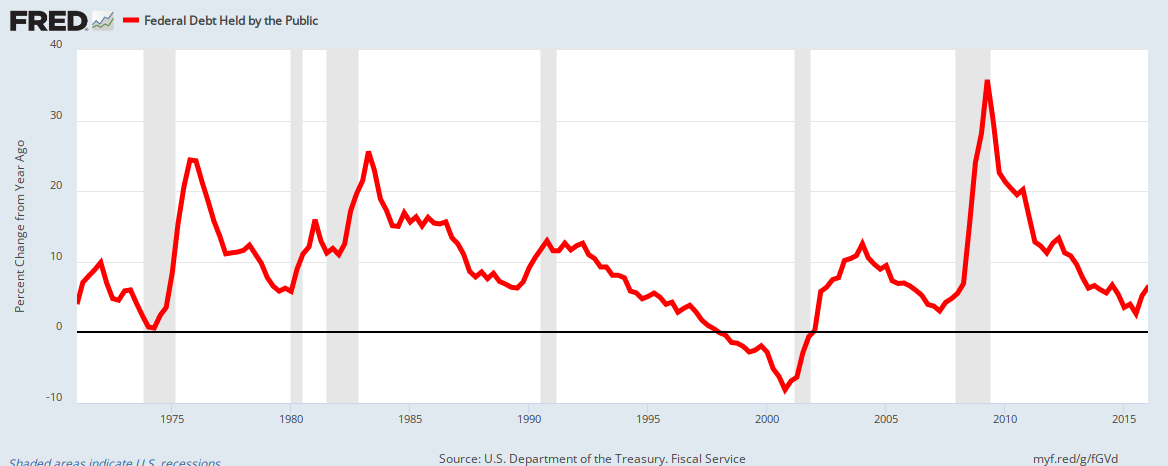
  2. They are taking advice from the notorious “debt Henny Pennys, the CRFB, who have issued the same old warning about the debt “ticking time bomb,” year after year, for more than 35 years. During that period, the federal “debt” has risen an astounding $13 Trillion, from under $1 Trillion to $14 Trillion — and still, we wait for that “time bomb” to explode.

The so-called federal “debt” is the total of deposits in T-security accounts, which are similar to interest-paying savings accounts. 

Image result for savings account passbook
A T-security account is like a bank savings account.

When you deposit your dollars in your bank savings account, they become a debt of your bank.

Your bank owes you the dollars, but does not spend or lend your dollars.

To lend, your bank creates brand new dollars.

Your dollars stay in your account, accumulating interest until you withdraw them. Their only function is to provide legal reserves.

Similarly, when you “lend” to the federal government, you actually make a deposit in your T-security account. The government does not spend or lend your dollars. Your dollars remain in your T-security account, accumulating interest until the government pays it back.

As with a bank savings account, the government does not spend your T-security account dollars.  To pay off the “debt,” the government does not use tax dollars. It merely gives you back the dollars that currently exist in your T-security account.

The primary difference between a T-security account and a bank savings account is semantic. We call the former, “debt,” and the latter, “deposits.”

Ironically, we worry about the size of federal “debt” but not the size of bank “deposits,” though the federal government cannot go bankrupt, and banks can.

I know. I know. It makes no sense.

Nearly 10 months into his presidency, with his party in control of the House and the Senate, Trump is still without a major legislative victory.

There are two reasons Trump hasn’t had a victory:

  1. He can’t comprehend anything much longer than a paragraph. He had no idea what was in the multitude of awful “repeal & replace” Obamacare plans, so he couldn’t give Congress any guidance. Similarly, he has no idea what is in the various tax plans. He only wants to sign something, anything, no matter how terrible, so he can say he did something.
  2. The voters may be ignorant of the facts, but they are not stupid, and they can see that everything the GOP puts in front of them will take from the 99% and reward the richest 1%.

The Tax Foundation, another nonpartisan group, said the Senate plan would add $1.78 trillion to the deficit over a decade.

Translation: It would add $1.78 million more to the economy over a decade.

It estimated that over the same time frame lower taxes would expand the U.S. economy by 3.7 percent, add 925,000 full-time jobs, raise wages by 2.9 percent and generate enough new tax revenue to erase all but $516 billion of the deficit effect.

Now think very closely about the above two paragraphs. Together they tell you (rightly) that because tax cuts (i.e. deficit increases) will add dollars to the economy, they will grow the economy, add jobs and raise wages.

Those are good things, right? So if deficit spending will accomplish those good things, why is anyone opposed to deficit spending?

Here’s why:

For decades, Republicans positioned themselves as deficit hawks, refusing to raise the debt limit, opposing Democratic spending programs and warning of crushing federal debts being passed on to future generations of Americans.

The deficit Henny Pennys are afraid to admit they have been lying to you and the rest of the voters about the “dangers” of what really benefits you: Federal deficit spending.

Today, they are hung on their own lies, and will try to double-talk you into believing “federal deficits aren’t so bad after all, but anyway, there won’t be deficits” — or something.

In short, they think you’re stupid.

The tax plans now being debated represent a stark reversal, with congressional Republican leadership and tax law writers urging passage of deficit-expanding tax changes. Only a handful of Republican senators already have publicly voiced misgivings.

This is one more demonstration of the Republican Party’s utter bankruptcy. Most of them hate Trump, but are frightened to say it. And most of them know that deficits grow the economy, but are afraid to tell you the truth.

This is disgusting, even for politicians, because their lies directly harm you and the economy.

After the Senate plan was released on Thursday, Republican Senator Jeff Flake said in a statement, “I remain concerned over how the current tax reform proposals will grow the already staggering national debt by opting for short-term fixes, while ignoring long-term problems for taxpayers and the economy.”

Flake repeats the Big Lie that taxpayers will have to pay off the federal “debt” (deposits). They won’t.

Questions:

  1. Do you consider your bank’s savings account deposits to be “staggering.”
  2. Do you even know or care what those deposits are?
  3. Do you think you and your children will have to pay off those deposits?

If your answers rightfully are “No,” “No, and “No,” you similarly should not care about the federal government’s so-called “debt.”

Senator James Lankford said in a statement, “As we work on tax relief, we must also not lose sight of our responsibilities to protect the nation, provide basic government services and confront our federal debt.”

Senator Bob Corker, another Republican and a critic of Trump, did not comment after the Senate bill’s release but signaled fiscal concerns after the House issued its plan, saying he did not want tax cut legislation that added to the deficit.

And then there’s the CRFB, with its usual misstatement:

“The current tax reform debate shows Congress just can’t seem to shake its addiction to debt,” said Maya MacGuineas, president of the Committee for a Responsible Federal Budget.

“If tax cuts paid for by debt are signed into law, Congress will have sent a massive, budget-busting tax bill to our children to pay, and it will result only in a short-term sugar high with little to no economic improvement over the long term,” she said.

May MacGuineas, would you please shut up.  Just shut up.

You should be ashamed of yourself. Either you don’t know what you are talking about or, more likely, you have been paid to spread the Big Lie for all these years.

Either way, you will do America a great service if you simply shut up.

I agree with Trump’s and the GOP’s desire to cut taxes, and I agree with the resultant, increased deficit, simply because that would do exactly what The Tax Foundation predicted: Grow the economy, add jobs and raise wages.

What I don’t agree with is the nature of the GOP’s deficits, because as always, they favor the rich, and widen the Gap between the rich and the rest.

Instead, we should increase deficits by instituting The 10 Steps to Prosperity (below).

If Congress and the President merely took Step #1 — eliminate the FICA tax — that alone would go a long way toward growing the economy, adding jobs and raising wages, while narrowing the Gap.

So, enough! Enough with calling deposits in T-security accounts “debt.” Enough with plans that favor the rich and punish the 99%. Enough with widening the Gap between the rich and the rest.

Enough with the Big Lie.

At long last, Congress and the President, forget the political BS and do what you’re paid to do. Do what’s right for the people.

Is that too much to ask?

Rodger Malcolm Mitchell
Monetary Sovereignty
Twitter: @rodgermitchell; Search #monetarysovereignty
Facebook: Rodger Malcolm Mitchell

………………………………………………………………………………………………………………………………………………………………………………………………………………………………………………………………………………………………………………………………………..

The most important problems in economics involve the excessive income/wealth/power Gaps between the have-mores and the have-less.

Wide Gaps negatively affect poverty, health and longevity, education, housing, law and crime, war, leadership, ownership, bigotry, supply and demand, taxation, GDP, international relations, scientific advancement, the environment, human motivation and well-being, and virtually every other issue in economics.

Implementation of The Ten Steps To Prosperity can narrow the Gaps:

Ten Steps To Prosperity:
1. ELIMINATE FICA (Ten Reasons to Eliminate FICA )
Although the article lists 10 reasons to eliminate FICA, there are two fundamental reasons:
*FICA is the most regressive tax in American history, widening the Gap by punishing the low and middle-income groups, while leaving the rich untouched, and
*The federal government, being Monetarily Sovereign, neither needs nor uses FICA to support Social Security and Medicare.
2. FEDERALLY FUNDED MEDICARE — PARTS A, B & D, PLUS LONG TERM CARE — FOR EVERYONE (H.R. 676, Medicare for All )
This article addresses the questions:
*Does the economy benefit when the rich can afford better health care than can the rest of Americans?
*Aside from improved health care, what are the other economic effects of “Medicare for everyone?”
*How much would it cost taxpayers?
*Who opposes it?”
3. PROVIDE A MONTHLY ECONOMIC BONUS TO EVERY MAN, WOMAN AND CHILD IN AMERICA (similar to Social Security for All) (The JG (Jobs Guarantee) vs the GI (Guaranteed Income) vs the EB (Economic Bonus)) Or institute a reverse income tax.
This article is the fifth in a series about direct financial assistance to Americans:

Why Modern Monetary Theory’s Employer of Last Resort is a bad idea. Sunday, Jan 1 2012
MMT’s Job Guarantee (JG) — “Another crazy, rightwing, Austrian nutjob?” Thursday, Jan 12 2012
Why Modern Monetary Theory’s Jobs Guarantee is like the EU’s euro: A beloved solution to the wrong problem. Tuesday, May 29 2012
“You can’t fire me. I’m on JG” Saturday, Jun 2 2012

Economic growth should include the “bottom” 99.9%, not just the .1%, the only question being, how best to accomplish that. Modern Monetary Theory (MMT) favors giving everyone a job. Monetary Sovereignty (MS) favors giving everyone money. The five articles describe the pros and cons of each approach.
4. FREE EDUCATION (INCLUDING POST-GRAD) FOR EVERYONE Five reasons why we should eliminate school loans
Monetarily non-sovereign State and local governments, despite their limited finances, support grades K-12. That level of education may have been sufficient for a largely agrarian economy, but not for our currently more technical economy that demands greater numbers of highly educated workers.
Because state and local funding is so limited, grades K-12 receive short shrift, especially those schools whose populations come from the lowest economic groups. And college is too costly for most families.
An educated populace benefits a nation, and benefitting the nation is the purpose of the federal government, which has the unlimited ability to pay for K-16 and beyond.
5. SALARY FOR ATTENDING SCHOOL
Even were schooling to be completely free, many young people cannot attend, because they and their families cannot afford to support non-workers. In a foundering boat, everyone needs to bail, and no one can take time off for study.
If a young person’s “job” is to learn and be productive, he/she should be paid to do that job, especially since that job is one of America’s most important.
6. ELIMINATE FEDERAL TAXES ON BUSINESS
Businesses are dollar-transferring machines. They transfer dollars from customers to employees, suppliers, shareholders and the federal government (the later having no use for those dollars). Any tax on businesses reduces the amount going to employees, suppliers and shareholders, which diminishes the economy. Ultimately, all business taxes reduce your personal income.
7. INCREASE THE STANDARD INCOME TAX DEDUCTION, ANNUALLY. (Refer to this.) Federal taxes punish taxpayers and harm the economy. The federal government has no need for those punishing and harmful tax dollars. There are several ways to reduce taxes, and we should evaluate and choose the most progressive approaches.
Cutting FICA and business taxes would be a good early step, as both dramatically affect the 99%. Annual increases in the standard income tax deduction, and a reverse income tax also would provide benefits from the bottom up. Both would narrow the Gap.
8. TAX THE VERY RICH (THE “.1%) MORE, WITH HIGHER PROGRESSIVE TAX RATES ON ALL FORMS OF INCOME. (TROPHIC CASCADE)
There was a time when I argued against increasing anyone’s federal taxes. After all, the federal government has no need for tax dollars, and all taxes reduce Gross Domestic Product, thereby negatively affecting the entire economy, including the 99.9%.
But I have come to realize that narrowing the Gap requires trimming the top. It simply would not be possible to provide the 99.9% with enough benefits to narrow the Gap in any meaningful way. Bill Gates reportedly owns $70 billion. To get to that level, he must have been earning $10 billion a year. Pick any acceptable Gap (1000 to 1?), and the lowest paid American would have to receive $10 million a year. Unreasonable.
9. FEDERAL OWNERSHIP OF ALL BANKS (Click The end of private banking and How should America decide “who-gets-money”?)
Banks have created all the dollars that exist. Even dollars created at the direction of the federal government, actually come into being when banks increase the numbers in checking accounts. This gives the banks enormous financial power, and as we all know, power corrupts — especially when multiplied by a profit motive.
Although the federal government also is powerful and corrupted, it does not suffer from a profit motive, the world’s most corrupting influence.
10. INCREASE FEDERAL SPENDING ON THE MYRIAD INITIATIVES THAT BENEFIT AMERICA’S 99.9% (Federal agencies)Browse the agencies. See how many agencies benefit the lower- and middle-income/wealth/ power groups, by adding dollars to the economy and/or by actions more beneficial to the 99.9% than to the .1%.
Save this reference as your primer to current economics. Sadly, much of the material is not being taught in American schools, which is all the more reason for you to use it.

The Ten Steps will grow the economy, and narrow the income/wealth/power Gap between the rich and you.

MONETARY SOVEREIGNTY

Why Does the Euro Area Have Such Low Growth and High Unemployment?

These people believe taking money out of the economy will grow the economy and benefit them.

.


It takes only two things to keep people in chains:
The ignorance of the oppressed
and the treachery of their leaders.

——————————————————————————————————————————————————————————————————————————————————————————–

In a May, 2010 talk at the University of Missouri, Kansas City, I said, “Because of the Euro, no euro nation can control its own money supply. The Euro is the worst economic idea since the recession-era, Smoot-Hawley Tariff. The economies of European nations are doomed by the euro.”

My reason was something that should have been obvious to anyone with even a smattering of knowledge about economics. Every euro nation was forced to surrender the single most valuable asset any nation can have: It’s Monetary Sovereignty.

A Monetarily Sovereign (MS) government has complete control over its own sovereign money. An MS government can control the supply and the value of its money.  It can pay any debt denominated in its sovereign currency. It can create its sovereign currency at will, simply by paying bills.

An MS government never can run short of its sovereign currency, never can be “burdened” by debt, never can find debt “unsustainable,” and never needs to ask anyone (taxpayers or lenders) for infusions of its sovereign currency.

The U.S. government, for instance, has absolute power over the dollar, which gives lie to all the debt “Henny Penny’s” who for at least 77 years, have claimed the federal deficit and debt are in some vague way a threat to the government or to American taxpayers.

So it was with guilty but pleasurable feelings of “I told you so,” that once again I publish excerpts from an article that appeared in the “Naked Capitalism blog:

Why Does the Euro Area Have Such Low Growth and High Unemployment?
Posted on November 11, 2017 by Yves Smith
By Philip Arestis, Professor of Economics at the University of the Basque Country, Spain and Malcolm Sawyer, Professor of Economics, University of Leeds. Originally published at Triple Crisis

Since the euro was adopted as a virtual currency in 1999 (and the exchange rates between the currencies of the then 11 countries fixed en route to adopting the euro), growth among the euro-area countries has been lacklustre.

The euro-area annual growth rate was just under 2% in 2002 to 2007, followed by 0.3% in 2008, -4.5% in 2009, then 2% in 2010, and an average of 0.8% 2011 to 2016. Over the period 1999 to 2016, the average was 1.1%.

Unemployment declined through to 2007 down to 7.5%, then rose in the aftermath of the financial crises and the effects of fiscal austerity programmes to 12% in 2013, and has gently declined since to 10% in 2016 and likely to come close to 9% at the end of October 2017.

There are notable disparities between different countries’ experiences, with Italy’s growth 1998 to 2016 being an annual average rate of 0.2%, and unemployment in Greece over 23% and Spain close to 20% in 2016.

We pause to examine the term, “fiscal austerity,” which I bolded for your convenience. It is a term that describes a government’s efforts to limit or reduce its deficits and debt.

Fiscal austerity is inevitable, even mandatory, for all monetary non-sovereign nations.

In America, city, county, and state governments, all being monetarily non-sovereign, continually must practice fiscal austerity, lest they eventually be unable to pay their bills.

No monetarily non-sovereign government can survive long-term on taxes alone. All monetarily non-sovereign governments require money coming in from outside their borders.

U.S. cities survive by borrowing, by trade surpluses, and by receiving dollars from county and state governments. County and state governments survive the same way, and additionally by receiving dollars from the federal government, which the federal government provides by running deficits vs. the states.

The Monetarily Sovereign federal government can survive forever, even while running deficits, and even while collecting $0 in taxes.

The euro nations are much like U.S. cities, counties, and states, all of which require euros coming in from outside their borders, just to survive, let alone to grow economically.

But from where will these additional euros come? They can come from borrowing (which is limited by the need to repay), net exports (though not all nations can be net exporters), or from the European Union (which requires that the EU itself run deficits).

Gross Domestic Product = Government Spending + Non-government Spending + Net Exports

Increasing any of the three factors — government spending, non-government spending, or net exports — requires an increased supply of money. This formula tells you a growing economy requires a growing supply of money.

Mathematically, it is impossible for an economy to grow while its money supply shrinks.

This all boils down to one absolute truth: The long-term survival of monetarily non-sovereign governments requires input from one or more Monetarily Sovereign governments, which in turn, requires the MS governments to run deficits.

The launch of the single currency had a whole range of political forces behind it, but was viewed as enhancing economic integration and giving some boost to trade between member countries.

“Boosting trade” always was the public excuse to the euro. But trade does not grow the overall money supply; it only transfers money from one nation to another.

Because a growing money supply is necessary for a growing economy, intra-EU trade does not grow the overall EU economy.

Many of the “structural reforms” have detrimental effects on inequality and productivity. “Reforms” attacking the level of minimum wages and undermining the position of trade unions exacerbate inequality.

“Reforms” attacking employment protection and security of employment do not help to foster training and innovation. Indeed, “structural reforms” were promoted to reduce “structural unemployment” and yet it is notable that the rate of “structural unemployment” in 2016 was 8.9%, compared with an average of 9.0% in the period 1992-2001, and 9.1% over 2002=2011.

Those favoring austerity always title their actions “Reforms.” Thus today, in America, we have “tax reform,” the ostensible purpose of which is to reduce (beneficial) deficits and debt, but which really is designed to increase the Gap between the rich and the rest.

The operations of the euro area (and the Economic and Monetary Union) are hampered by restrictive fiscal policies which strive for balanced budgets.

The attempt at a uniformity of fiscal policy (with the common aim of a “balanced structural budget”) cannot take into account the differing needs of countries for infrastructure investments nor does it take into account the differing economic circumstances of countries.

Balanced budgets also do not take into account the fact that government deficits add money to the private sector. When any government entity, whether Monetarily Sovereign or monetarily non-sovereign, runs a surplus, the private sector it serves runs a deficit — which is recessive.

In America,for instance, economic growth has required not just deficits, but deficit growth. Reductions in deficit growth have led to recessions, while increased deficit growth has cured recessions.

The adoption of the euro took place without any thought to the current-account imbalances between the member countries, and without any perspective on the sustainability of those imbalances.

Translation: Some euro nations had net exports of goods and services (i.e. imports of euros) and so, prospered. The others had net imports of goods and services (exports of euros), so suffered.

The current-account imbalances grew in the first decade of the euro, with associated capital flows between countries. In the second decade of the euro, current-account deficits were drastically reduced as internal deflation brought imports down.

But the underlying pattern of imbalances has not been resolved, and countries with high unemployment seeking a return to prosperity will face severe constraints from their current-account position.

Translation: The net-import, monetarily non-sovereign nations have no way to stimulate their economies by growing their money supply.

The austerity policy agenda (from the Stability and Growth Pact, the “fiscal compact,” etc., with the drives for balanced budgets), the pursuit of “structural reforms,” and the failures to address the current account constraints on euro-area member countries have all contributed to the lacklustre economic performance.

In Summary:

Austerity (i.e. the reduction of deficits and debt), reduces the growth of a nation’s money supply, which in turn, reduces economic growth, and even leads to recessions and depressions.

Image result for austerity

1804-1812: U. S. Federal Debt reduced 48%. Depression began 1807.
1817-1821: U. S. Federal Debt reduced 29%. Depression began 1819.
1823-1836: U. S. Federal Debt reduced 99%. Depression began 1837.
1852-1857: U. S. Federal Debt reduced 59%. Depression began 1857.
1867-1873: U. S. Federal Debt reduced 27%. Depression began 1873.
1880-1893: U. S. Federal Debt reduced 57%. Depression began 1893.
1920-1930: U. S. Federal Debt reduced 36%. Depression began 1929.
1997-2001: U. S. Federal Debt reduced 15%. Recession began 2001.

Monetarily non-sovereign governments are forced into austerity by their inability to create the money they use.

Monetarily Sovereign nations have the unlimited ability to create their own sovereign currency, but may intentionally be taken into austerity by government malfeasance on behalf of the rich.

Keep this in mind as Congress and the President debate tax “reform,” health care “reform,” and other so-called fiscal “reforms,” that are designed to widen the Gap between the very rich and you.

Deficit reduction guarantees economic death.

Rodger Malcolm Mitchell
Monetary Sovereignty
Twitter: @rodgermitchell; Search #monetarysovereignty
Facebook: Rodger Malcolm Mitchell

………………………………………………………………………………………………………………………………………………………………………………………………………………………………………………………………………………………………………………………………………..

THE WAY THINGS ARE:

•All we have are partial solutions; the best we can do is try.

•Those, who do not understand the differences between Monetary Sovereignty and monetary non-sovereignty, do not understand economics.

•Any monetarily NON-sovereign government — be it city, county, state or nation — that runs an ongoing trade deficit, eventually will run out of money no matter how much it taxes its citizens.

•The more federal budgets are cut and taxes increased, the weaker an economy becomes..

•No nation can tax itself into prosperity, nor grow without money growth.

•Cutting federal deficits to grow the economy is like applying leeches to cure anemia.

•A growing economy requires a growing supply of money (GDP = Federal Spending + Non-federal Spending + Net Exports)

•Deficit spending grows the supply of money

•The limit to federal deficit spending is an inflation that cannot be cured with interest rate control. The limit to non-federal deficit spending is the ability to borrow.

•Until the 99% understand the need for federal deficits, the upper 1% will rule.

•Progressives think the purpose of government is to protect the poor and powerless from the rich and powerful. Conservatives think the purpose of government is to protect the rich and powerful from the poor and powerless.

•The single most important problem in economics is the Gap between the rich and the rest.

•Austerity is the government’s method for widening the Gap between the rich and the rest.

•Everything in economics devolves to motive, and the motive is the Gap between the rich and the rest..

MONETARY SOVEREIGNTY

Why do you pay to visit a national park?


It takes only two things to keep people in chains:
The ignorance of the oppressed
and the treachery of their leaders.

————————————————————————————————————————————————————-

BACKGROUND: The federal government is Monetarily Sovereign. It issues its sovereign currency, the dollar. It never can run short of its sovereign currency.

Even if the federal government were to collect $0 taxes, it could continue paying dollars for goods and services, forever. Paying dollars for things is the method by which the federal government creates new dollars.

You, your local and state governments, and all businesses, are monetarily NON-sovereign. The dollar is not your sovereign currency. In fact, you do not have a sovereign currency.

So you, your local and state government, and all businesses can, and sometimes do, run short of dollars.

Keep the above in mind as you read about yet another, in a long list of cases, where ignorance of Monetary Sovereignty, causes the public blissfully to accept unnecessary reductions in government benefits.

I live part-time, in the Chicago area, close to many public parks. The city alone has 570 parks, occupying many thousands of acres. The suburbs offer additional thousands of park acres.

Virtually all of these parks are free to visitors.

The question of the day: If local governments, all of which have limited funds, provide free parks, why does the national government, which has unlimited funds, charge for visiting national parks?

Charging More for National Parks is Not a Bad Idea
by Steve Chapman, Chicago Tribune

If you assume that anything the Trump administration does is bad, you will be right more often than not. But there is the occasional surprising exception. The administration’s proposal to raise entrance fees at 17 popular national parks is proof that even the worst presidents can’t always be wrong.

The idea has sparked predictable objections. A group of Democratic senators led by Maria Cantwell and Patty Murray of Washington accused Interior Secretary Ryan Zinke of plotting “to exclude many Americans from enjoying their national parks.”

Ninety House Democrats signed a letter saying, “Public lands belong to all Americans, not just wealthy families who can absorb the steep fee increases.”

They may forget that this approach didn’t start with Donald Trump. Democratic President Jimmy Carter liked the idea. It also found champions in President Bill Clinton, another Democrat, and his interior secretary, Bruce Babbitt, who had been president of the League of Conservation Voters.

In short, bad ideas are not exclusive to one party or one President. The ignorance of federal financing (Monetary Sovereignty) is promulgated by all sides.

It would be nice if visits cost nothing. Under this plan, critics should be glad to know, 299 of 417 national park sites would remain free.

Not only that, but the higher fees at the 17 parks would apply only during the busiest five-month stretch of the year. Anyone unwilling or unable to pay could visit the Grand Canyon in October or Acadia in May. There are also a number of free days each year.

Nor would the change be a huge obstacle to locals who make frequent use of nearby national parks. An $80 annual pass provides unlimited access to every national park site in the country.

Yes, indeed it would be nice if visits cost nothing. And it also is nice that 299 national parks are free to visitors. And it is nice that at 17 parks, fees don’t apply during the seven, least popular months.

If all these things are “nice,” why do 118 national parks charge any fees at all?

Writing recently in The New York Times, Timothy Egan took the contrary view that “all national parks should be free.” But free for whom?

Someone has to furnish the money required to run and maintain these vast sites, which last year endured the wear and tear of 330 million visitors.

Most of the National Park Service budget, which exceeds $3 billion a year, comes from taxpayers. The new charges would raise a mere $70 million a year.

And there, folks, you have a statement of the “Big Lie,” that federal taxes fund federal spending. It is an insidiously believable lie because it sounds so familiar.Image result for national park fee

After all, your city and state do need to receive dollars in order to spend dollars. And businesses do need an income of dollars so they can spend dollars. And you need a source of dollars for spending.

So “obviously” the federal government also needs an income of dollars.

Except it doesn’t. Being uniquely Monetarily Sovereign, the creator and issuer of dollars does not need to take dollars from anyone. 

The federal government doesn’t need to tax. It doesn’t need to borrow. It doesn’t need to charge fees.

It’s entirely fair to expect all taxpayers to contribute to preserving these priceless treasures, which belong to everyone. But it’s also fair to ask those who actually venture into them to kick in a bit more.

No, it isn’t “fair” at all. Not only is it misguided, but it’s an unnecessary burden on the poorest among us, who suffer for every penny they spend.

The money goes to a good cause — those roads, trails, bridges, campgrounds, water systems and visitors centers that make the parks accessible and enjoyable.

Federal law directs 80 percent of the revenue from entrance fees to the park where they were collected.

Right now, the maintenance backlog on park infrastructure totals nearly $12 billion. The extra income at the gate could only help.

Outrageous lies. The money goes nowhere. Not to a good cause, or a bad cause, or any other cause.

State and local tax dollars first are deposited in private banks, and then are spent. During that time they remain as part of the nation’s money supply.

Federal taxes cease to be a part of any money supply, the instant they are received by the government. In short, they are destroyed. They no longer exist.

If you ask economists, “How much money does the federal government have?” they will be unable to tell you.

The question is nonsensical, because the government has the infinite ability to create its sovereign dollars from thin air, simply by paying bills.

It’s like asking, “How many thoughts do you have?” or, “How many numbers are there?”  Nonsensical.

One objection to the fees is that they would discourage people from coming. But fees were raised in 2015, and the number of visits last year was 11 percent higher than in 2014.

The misleading statement is that unnecessarily taxing people is O.K. because more people are willing to pay the tax.  No, it’s never O.K. to take dollars from the economy.

Entrance fees at the national park are the rare tax that people will travel thousands of miles to pay.

A truly misleading statement. People don’t travel thousands of miles in order to pay a tax. It’s another unwelcome cost — an unnecessary cost, in this case — of a vacation.

The Trump administration has many bad ideas when it comes to preserving the environment and protecting national treasures. This isn’t one of them.

Steve Chapman, a member of the Tribune Editorial Board, blogs at http://www.chicagotribune.com/chapman, schapman@chicagotribune.com, Twitter @ SteveChapman13

In summary, you are told the Monetarily Sovereign federal government is just like monetarily non-sovereign state and local governments. But there is a diametric difference between Monetary Sovereignty and monetary non-sovereignty.

Only the U.S. government has the unlimited ability to create its sovereign currency, the dollar. All other entities are limited in their ability to create dollars.

Taxes are a burden on the public and on the economy. They remove dollars from the economy, and therefore are recessive. They punish the poorer among us more than the richer. They widen the Gap between the rich and the rest.

Even small taxes contribute to the “death of a thousand cuts” created by federal tax laws.

People like Steve Chapman help disseminate the Big Lie that damages you and your country.

If you look up the word, “tax,” you’ll find such synonyms as “deadweight,” “excess baggage,” “hardship,” “hindrance,” “millstone,” “misfortune,” “obstruction,” and “punishment.” They are especially appropriate for federal taxes.

The next time you plop down your $30 (per car) to enter Yellowstone National Park, know this. The $30 did is much to support Yellowstone as would the same $30 tossed into Old Faithful — in short, nothing.

Not only is it a waste of your money, but it takes $30 out of the economy.

Did you buy your car, or build it? America’s tolerance for ignorance.


It takes only two things to keep people in chains:
The ignorance of the oppressed
and the treachery of their leaders.

——————————————————————————————————————————————————————————————————————————————————————————–

This post describes four strangely related subjects: International Trade, Political Leadership, America’s Tolerance for Ignorance, and National Greatness.

1. INTERNATIONAL TRADE:

THE WEEK MAGAZINE

Trump tells Japan it’s time to reduce U.S. trade deficit

President Trump called for reducing America’s trade deficit with its ally, urged Japanese Prime Minister Shinzo Abe on Monday to buy “massive amounts of military equipment” from the U.S.

“It’s a lot of jobs for us and a lot of safety for Japan,”

Trump said. Earlier, Trump told business leaders that Japan had an unfair advantage in trade with the U.S.

Did you buy your car, or did you build it yourself? Chances are you bought your car because it is easier for you to obtain dollars than it would be to build a car.

Now, what if you were like the Monetarily Sovereign U.S. government, that has the unlimited ability to create its sovereign currency, the dollar, at the touch of a computer key? Would you rather expend time and effort building things, or would it be much easier and more efficient simply to buy them with dollars?

A trade deficit occurs when the U.S. ships dollars to a foreign country, and in return receives goods and services (which the foreign country must expend effort and precious natural resources to create).

I short, we give them dollars that cost us nothing to create, and they send us valuable stuff they work hard to create.  And this fabulous deal for America is what Trump wants to end.

If Trump thinks U.S. industry is not manufacturing enough guns, bombs, bullets, fighter planes, napalm, and other killing materials, all he needs do is have the U.S. government buy more of these things, using the U.S. government’s unlimited ability to create dollars from thin air.

We have sold weapons to many nations, and we received dollars in return. Sadly, many of those weapons have come back to kill our own soldiers and civilians, while the dollars we received easily could have been created by the U.S. government.

So which is more precious to us: The lives of our soldiers, or the dollars our government can create at the touch of a computer key?

No need to tell Japan to arm themselves to the teeth, so they can become independent of us, and maybe — just maybe — attack us, once again. Only a fool cannot learn from history.

But, some say, Trump wants to create jobs. How about instead of demanding that Japan buy napalm from us, he creates a better life for Americans.  See: The Ten Steps to Prosperity (below).

Trump tells Japanese automakers to ‘try’ to build their cars in the U.S.

President Trump asked Japanese automakers on Monday to do something they are already quite familiar with: Manufacture cars and parts in the United States.

Try building your cars in the United States instead of shipping them over,” he said during a meeting in Tokyo with business executives. “That’s not rude?”

The Japan Automobile Manufacturers Association said in its 2017-18 report that in 2016, nearly 4 million vehicles and 4.7 million engines were built by its members in the U.S., and as of 2016, their manufacturing plants have cumulatively invested $45.6 billion in the U.S. economy.

In 2015, JAMA said that 75 percent of Japanese cars sold in the U.S. that year were built in North America, up from 12 percent in 1985.

Trump made his curious demands during the first stop on his 12-day trek through Asia.

O.K., Trump is, as usual, unaware of the facts, so in typical form, he bloviates, inventing a reality known only to him, Breitbart,  FOX news, and his followers.

Trump doesn’t get it. Japan builds cars in America, not because that is good for America, but because it is good for Japan.

This “great businessman” (whose father bailed him out of multiple bankruptcies) is too oblivious to understand that the profits from Japanese car manufacture in America go to Japan, not to America. 

2. LEADERSHIP

Trump also promised to counter North Korea’s “dangerous aggressions, saying that “the era of strategic patience is over.”

Oh, really? Strategic patience is over.

The alternative to “strategic patience” is an all-out war.

And what could make more sense than being led by a cowardly draft-dodger (heel spur, you know) who is drooling to send many thousands of brave American children into a foreign land to die?

Trump’s “America first” policy, not only is based on ignorance of facts, but it doesn’t make America a leader.

A leader cares about his followers. He helps them up. He doesn’t ask them to carry him up.

Image result for leadership

Think of Trump and “America first.” Is Trump the kind of leader who shows concerns for the middle and lower income groups, or does he seem to care more about himself and his rich cronies?

And does “America first” demonstrate leadership, or is it just a statement of “me first, me only” selfishness that is guaranteed to make no country willing to follow our “lead”?

If you are a citizen of any other country than the U.S., do you view America as a nation you would like to follow? Would you follow Donald Trump?

3. AMERICA’S TOLERANCE FOR IGNORANCE

“Tolerance” in biological terms means that organisms adjust over time, and “learn” to live or even thrive in the presence of previously harmful factors.

Bacteria, for instance, have learned to live in the presence of antibiotics that once had killed them. You too, evolve to tolerate; that is the basis for your immune system.

You tolerate heat by evolving to sweat. People who live on mountains learn to tolerate low pressure.

Once we would have been outraged by a politician who lies in the face of obvious facts, admits to repeated womanizing, endangers our children by fostering air and water pollution, denies science, threatens war daily, cheats creditors, boasts, and bullies.

Tolerance is caused by repetition. Keep giving bacteria the same antibiotic, again and again, and eventually they learn to tolerate it.

Today, Trump’s repetitive outrages and massive ignorances have taught us to tolerate a POTUS who is an ass.

Some are not concerned that the President of the United States is a danger to them, to all of America and to the world. It’s as though “Anyone can be President so long as he makes the promises I like, even though he doesn’t keep them, and he hates the same people I hate.”

Trump repeatedly parrots concepts about which he has no understanding:

From The Week Magazine

Trump blames church massacre on mental health problems

When asked whether tighter gun-control laws could help prevent such shootings, Trump said, “Mental health is your problem here.” He said the initial investigation indicates the killer was a “very deranged individual.”

Trump accepts the NRA’s, “Guns don’t kill people; only crazy people with guns kill people.”

So don’t even think about gun-control. Think about crazy-control. And since crazy cannot be controlled, and in fact, we demand that crazy people be allowed to own guns, there can be no solution.

Gotcha!

You can expect another mass shooting soon, then another and another and another . . . a continual round of mass shootings, none of which supposedly have anything to do with guns.

And there is not a damn thing you can do about it.

It never will end, for two reasons: Trump, the GOP, and the NRA have blocked all possible solutions, and too many gun owners are blind. They can’t see that they have been conned by the gun manufacturers, who have convinced them they need guns, many guns, many, many guns.

Trump and the GOP have taught you not to be outraged by mass shootings. Instead, you are to be outraged by football players kneeling. Kneeling, not mass gun murders, is the crime Trump and the GOP want you to hate most.

4. NATIONAL GREATNESS

We American voters have received what we, in our ignorance, have voted for: World hatred and scorn, an economy that increasingly favors the rich, and mass killings.

We may like to strut and boast that we are “the greatest county in the world,” and by military power, we still may be — maybe.

But by any other measure — concern about our most vulnerable citizens, concern about our neighbors, crime, health care, political honesty, poverty, hunger, education, the Gap between the rich and the rest — by any measure you use in determining “greatest,” America is well down the list.

Are we America “first”? No, we are despised America. We are “Trump and the American rich first, last and only.”

But we deserve our plight. We vote for it.

It’s just another demonstration of ignorance.

Rodger Malcolm Mitchell
Monetary Sovereignty
Twitter: @rodgermitchell; Search #monetarysovereignty
Facebook: Rodger Malcolm Mitchell

………………………………………………………………………………………………………………………………………………………………………………………………………………………………………………………………………………………………………………………………………..

The most important problems in economics involve the excessive income/wealth/power Gaps between the have-mores and the have-less.

Wide Gaps negatively affect poverty, health and longevity, education, housing, law and crime, war, leadership, ownership, bigotry, supply and demand, taxation, GDP, international relations, scientific advancement, the environment, human motivation and well-being, and virtually every other issue in economics.

Implementation of The Ten Steps To Prosperity can narrow the Gaps:

Ten Steps To Prosperity:
1. ELIMINATE FICA (Ten Reasons to Eliminate FICA )
Although the article lists 10 reasons to eliminate FICA, there are two fundamental reasons:
*FICA is the most regressive tax in American history, widening the Gap by punishing the low and middle-income groups, while leaving the rich untouched, and
*The federal government, being Monetarily Sovereign, neither needs nor uses FICA to support Social Security and Medicare.
2. FEDERALLY FUNDED MEDICARE — PARTS A, B & D, PLUS LONG TERM CARE — FOR EVERYONE (H.R. 676, Medicare for All )
This article addresses the questions:
*Does the economy benefit when the rich can afford better health care than can the rest of Americans?
*Aside from improved health care, what are the other economic effects of “Medicare for everyone?”
*How much would it cost taxpayers?
*Who opposes it?”
3. PROVIDE A MONTHLY ECONOMIC BONUS TO EVERY MAN, WOMAN AND CHILD IN AMERICA (similar to Social Security for All) (The JG (Jobs Guarantee) vs the GI (Guaranteed Income) vs the EB (Economic Bonus)) Or institute a reverse income tax.
This article is the fifth in a series about direct financial assistance to Americans:

Why Modern Monetary Theory’s Employer of Last Resort is a bad idea. Sunday, Jan 1 2012
MMT’s Job Guarantee (JG) — “Another crazy, rightwing, Austrian nutjob?” Thursday, Jan 12 2012
Why Modern Monetary Theory’s Jobs Guarantee is like the EU’s euro: A beloved solution to the wrong problem. Tuesday, May 29 2012
“You can’t fire me. I’m on JG” Saturday, Jun 2 2012

Economic growth should include the “bottom” 99.9%, not just the .1%, the only question being, how best to accomplish that. Modern Monetary Theory (MMT) favors giving everyone a job. Monetary Sovereignty (MS) favors giving everyone money. The five articles describe the pros and cons of each approach.
4. FREE EDUCATION (INCLUDING POST-GRAD) FOR EVERYONE Five reasons why we should eliminate school loans
Monetarily non-sovereign State and local governments, despite their limited finances, support grades K-12. That level of education may have been sufficient for a largely agrarian economy, but not for our currently more technical economy that demands greater numbers of highly educated workers.
Because state and local funding is so limited, grades K-12 receive short shrift, especially those schools whose populations come from the lowest economic groups. And college is too costly for most families.
An educated populace benefits a nation, and benefitting the nation is the purpose of the federal government, which has the unlimited ability to pay for K-16 and beyond.
5. SALARY FOR ATTENDING SCHOOL
Even were schooling to be completely free, many young people cannot attend, because they and their families cannot afford to support non-workers. In a foundering boat, everyone needs to bail, and no one can take time off for study.
If a young person’s “job” is to learn and be productive, he/she should be paid to do that job, especially since that job is one of America’s most important.
6. ELIMINATE FEDERAL TAXES ON BUSINESS
Businesses are dollar-transferring machines. They transfer dollars from customers to employees, suppliers, shareholders and the federal government (the later having no use for those dollars). Any tax on businesses reduces the amount going to employees, suppliers and shareholders, which diminishes the economy. Ultimately, all business taxes reduce your personal income.
7. INCREASE THE STANDARD INCOME TAX DEDUCTION, ANNUALLY. (Refer to this.) Federal taxes punish taxpayers and harm the economy. The federal government has no need for those punishing and harmful tax dollars. There are several ways to reduce taxes, and we should evaluate and choose the most progressive approaches.
Cutting FICA and business taxes would be a good early step, as both dramatically affect the 99%. Annual increases in the standard income tax deduction, and a reverse income tax also would provide benefits from the bottom up. Both would narrow the Gap.
8. TAX THE VERY RICH (THE “.1%) MORE, WITH HIGHER PROGRESSIVE TAX RATES ON ALL FORMS OF INCOME. (TROPHIC CASCADE)
There was a time when I argued against increasing anyone’s federal taxes. After all, the federal government has no need for tax dollars, and all taxes reduce Gross Domestic Product, thereby negatively affecting the entire economy, including the 99.9%.
But I have come to realize that narrowing the Gap requires trimming the top. It simply would not be possible to provide the 99.9% with enough benefits to narrow the Gap in any meaningful way. Bill Gates reportedly owns $70 billion. To get to that level, he must have been earning $10 billion a year. Pick any acceptable Gap (1000 to 1?), and the lowest paid American would have to receive $10 million a year. Unreasonable.
9. FEDERAL OWNERSHIP OF ALL BANKS (Click The end of private banking and How should America decide “who-gets-money”?)
Banks have created all the dollars that exist. Even dollars created at the direction of the federal government, actually come into being when banks increase the numbers in checking accounts. This gives the banks enormous financial power, and as we all know, power corrupts — especially when multiplied by a profit motive.
Although the federal government also is powerful and corrupted, it does not suffer from a profit motive, the world’s most corrupting influence.
10. INCREASE FEDERAL SPENDING ON THE MYRIAD INITIATIVES THAT BENEFIT AMERICA’S 99.9% (Federal agencies)Browse the agencies. See how many agencies benefit the lower- and middle-income/wealth/ power groups, by adding dollars to the economy and/or by actions more beneficial to the 99.9% than to the .1%.
Save this reference as your primer to current economics. Sadly, much of the material is not being taught in American schools, which is all the more reason for you to use it.

The Ten Steps will grow the economy, and narrow the income/wealth/power Gap between the rich and you.

MONETARY SOVEREIGNTY