Eleanor Pringle and Fortune display dismal understanding of economics.

You might think, OK, hope, that Fortune Magazine economics writers would understand. . .  well . . .  economics.
Eleanor Pringle
Eleanor Pringle

Alas, Eleanor Pringle may have shattered any such hope.

“Eleanor Pringle is an award-winning senior reporter at Fortune covering news, the economy, and personal finance. Eleanor previously worked as a business correspondent and news editor in regional news in the U.K. She completed her journalism training with the Press Association after earning a degree from the University of East Anglia.”

Immediately, we sense a potential problem. Those words, “the economy and personal finance — do they hint that she doesn’t understand the difference between the federal government’s finance and personal finance?

Keep that question in mind as you read the following excerpts from her article in Foutune.

Two months into the new fiscal year, the US government is already spending more than $10 billion a week servicing the national debt.

Uh, oh. What does Ms. Pringle mean by “servicing“? Is she talking about returning the principal or paying the interest? There is a difference.

To grasp the difference, she first must understand the fundamentals of Monetary Sovereignty, which she clearly does not.

If you are a regular reader, you know that federal  (Monetarily Sovereign) finances are very different from the monetarily non-sovereign finances of state and local governments, businesses and individuals.

I won’t go into the details here, because you readers know them, but for a refresher, read “Common Myths in Economics . . .”

Briefly:

  1. The federal government has the unlimited power to create dollars merely by passing laws and pressing computer keys. It never can run short of dollars to pay interest or bills.
  2. Given that power, the government never borrows dollars. It just makes new ones. Those T-bills, T-notes, and T-bonds do not represent borrowing. They are deposit accounts whose purpose is not to supply the government with spending money.
  3. Instead, the purposes are to help the Fed control interest rates and to provide a safe place to store unused dollars.
  4. The T-securities represent deposits into savings accounts, and paying off the misnamed “debt” (deposits) merely requires returning the dollars that are in those accounts. Returning dollars that already exist in accounts is not a burden on the government.
  5. Finally, the “debt” (which is not debt) also is not a burden on taxpayers, because federal taxes do not pay for anything. Even if all federal tax collections totaled $0, the federal government could continue spending and paying forever.

If you buy a Treasury Bill, you will deposit your Federal Reserve Notes (aka, dollar bills) into your Treasury Bill account, and you will receive a Treasury Bill. It’s a simple dollar exchange — your Federal Reserve notes for Treasury bills, all of which are U.S. dollars.

To pay this off, the government simply reverses the process. It exchanges Federal Reserve Notes for Treasury Bills. No tax dollars are involved.

Your deposited dollars remain in your account until maturity, when they are returned. As for the interest, the federal government presses a few computer keys, and the interest dollars are added to your account and then, upon maturity, they are returned to you with the principal.

Unlike real debt, which burdens borrowers, this federal Treasury round-trip process imposes no burden on the federal government or taxpayers.

Ms. Pringle’s article continues:

The calendar year may have a few weeks left to tick off, but as far as the government’s budget is concerned, we’re in fiscal 2026. And in a matter of weeks, the Treasury has already paid out a 12-figure sum to service the nation’s debt.

Unlike the tax and calendar year, the government’s financial calendar runs to the end of September. According to Treasury data, in the nine weeks since, it has spent $104 billion in interest on its $38 trillion borrowing burden.

That’s more than $11 billion a week, and already represents 15% of federal spending in the current fiscal year.

Economists may be hopeful that the Treasury would make some New (fiscal) Year’s resolutions: Perhaps either scaling back its borrowing, and the additional interest rates on that debt as a result, or drumming up some meaningful revenue to offset the costs.

The federal government does not borrow, and the additional interest adds to Gross Domestic Product (GDP).

GDP = Federal Spending + Nonfederal Spending + Net Exports

President Trump and his cabinet have been discussing debt more meaningfully in this administration. While economists say some of their methods are “peculiar,” the Oval Office has nevertheless devised some money-making schemes, like tariffs, estimated to offset $3 trillion through fiscal year 2035.

This is, unfortunately, $1 trillion lower than previous estimates from the Congressional Budget Office (CBO) earlier this year.

A “money-making scheme” like tariffs simply is a money-transfer scheme that moves dollars from the private sector (aka “the economy“) to the federal government, which neither needs nor uses those dollars. The federal government creates new dollars, ad hoc, for every dollar it spends.

There’s also the issue of how much money will be left over to offset the debt from tariff revenue.

Tariffs do not “offset” T-securities. Unlike T-securities, tariffs are taxes taken from the economy. While T-securities are merely a savings device, tariffs impoverish the economy, drawing us toward recession.

Current estimations suggest that duties will bring in between $300 billion and $400 billion a year, which would help to pay a fraction of the yearly interest payments totaling more than $1 trillion in gross spending in 2025.

Those “$300 billion and $400 billion a year” are tax dollars, subtracted from the economy along with all other tax dollars.

However, President Trump has pledged to share proceeds from the tariff project with individuals, sharing a “dividend” of $2,000 per person. This, according to the Committee for a Responsible Federal Budget (CRFB), would cost $600 billion annually.

The “$2,000 per person is far less than the ongoing, year-after-year cost of the tariffs — a net loss for the economy. And it comes with a caveat: The reduction of federal support for healthcare.

While money is coming in to help rebalance the books (unless it has already been spent, and more, on tariff rebate cheques), government borrowing doesn’t appear to be slowing.

No books are being “rebalanced.” Tariffs drain the economy of dollars.

The ostensible purpose of tariffs is to protect American businesses and American jobs. This could be accomplished by additional government spending to support businesses and jobs, thereby growing the economy rather than punishing it, as tariffs do.

Last week, the Peterson Foundation, which lobbies for responsible fiscal action, published an analysis of the Treasury’s Quarterly Refunding process, which shares government borrowing expectations.

The foundation wrote that the government’s borrowing will increase, issuing $158 billion more in debt in the first half of this fiscal year than in the same period a year earlier.

The sentence should read, “Deposits into T-securities accounts will increase by $158 billion more in the first half of this fiscal year than in the same period a year earlier.” This is not a financial burden on the federal government or on taxpayers.

This demonstrates that the world is more reliant on the U.S. dollar than it was last year. It does NOT demonstrate that the federal government is indebted to anyone, or living beyond its means, or that future grandchildren will owe the “debt.”

And now for the focus on the fake, “sky is falling” scenario:

Debt is a key risk for 2026

Deutsche Bank is generally bullish. It expects global growth of 3.2% in 2026, with the U.S. economy projected to expand by 2.4%. Trade uncertainty is fading, which will boost growth, the bank added, with households also benefiting from tax cuts from Trump’s “One Big, Beautiful Bill” Act.

One small caveat. The line should read, “. . .  Rich households also benefiting from tax cuts from Trump’s ‘One Big, Beautiful Bill’ Act.” As for the poor and middle, who cares about them? Not Trump.

But deficits cast a shadow, on a global scale, over that rosy outlook. The institution wrote: “Many countries face high deficits with limited fiscal and monetary ability. The expected structural shift towards fiscal impulse in 2026 will further widen deficits and heighten concerns around ongoing debt sustainability issues.”

Add two words to the sentence, and it would be correct: “Many monetarily non-sovereign countries face high deficits with limited fiscal and monetary ability.” If monetarily non-sovereign countries like Germany, Italy, France, Portugal, et al face high deficits, they indeed have “limited fiscal and monetary ability.”

But if Monetarily Sovereign countries like the UK, Japan, China, and the U.S. face high deficits, their fiscal and monetary ability remains infinite.

I’d love to explain this to Ms. Pringle, but I suspect she would reject the notion that personal finances are diametrically opposed to federal finances.

In the U.S., in particular, fiscal risks are on the rise, the bank added: “We expect the 2026 deficit to reach 6.7%, with further widening if we see lower tariff revenues or more targeted fiscal stimulus that renews market concerns. Congress is also up against the clock to negotiate on healthcare subsidies and appropriations bills before the stopgap funding again expires on January 30.”

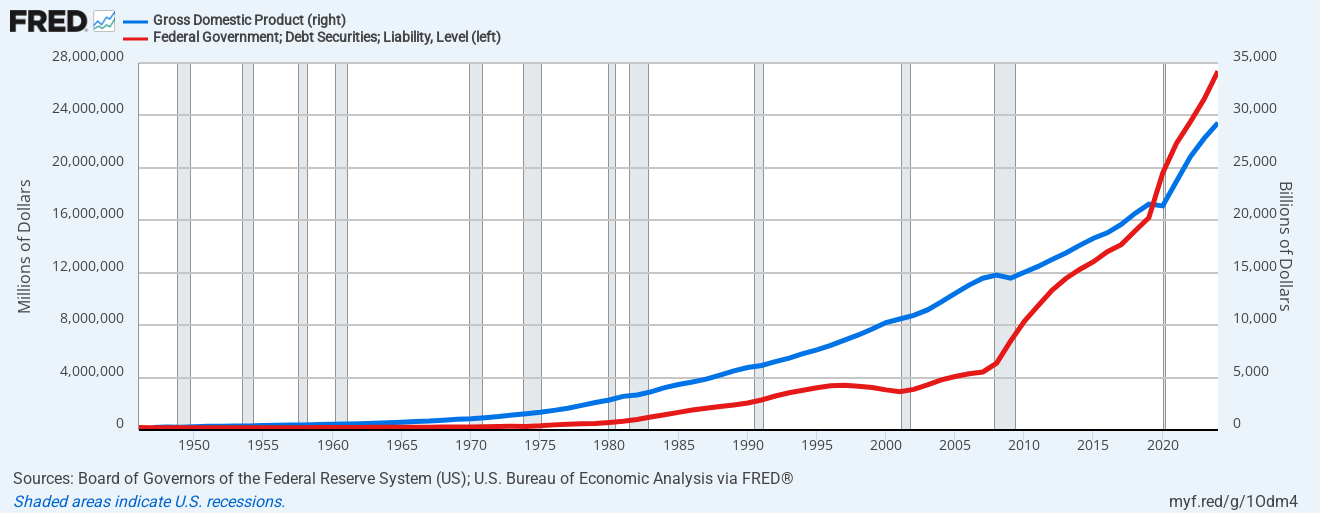
The net total of federal deficits is called the “federal debt” (red line), which parallels economic growth (blue dashed line). GDP=Federal Spending + nonfederal spending + Net Exports.

The government may also be banking on a shift of wealth over the next few decades, which could be leveraged to balance its bottom line.

The Great Wealth Transfer is expected to see $80 trillion change hands over the next 20 years, according to UBS. Some studies put that figure even higher, saying as much as $124 trillion will be passed down from older generations to their younger counterparts.

Wealth consistently transfers from older individuals to younger ones, as older individuals pass away and new ones are born. Viewing this as a problem seems ignorant at best and misleading at worst.

And this new flow of wealth represents an opportunity for tax revenue, UBS’s chief economist Paul Donovan believes. “Governments have long mobilized private wealth to support public finances,” he told a media briefing last month.

“There are several approaches. One is to influence market behavior—encouraging individuals to buy government bonds through incentives like tax-free premium bonds, which channel savings directly into state financing.

Suddenly, without warning, Ms. Pringle stops talking about federal debt and begins talking about state/local government debt.

The line, “Governments have long mobilized private wealth to support public finances,” refers only to monetarily non-sovereign state/local governments. The federal government does not use “private wealth to support public finances.”

Apparently, Ms. Pringle wishes to replace federal bonds with municipal bonds. She wants the federal government to raise taxes so that more (rich) people will buy federal tax-free state/local municipal bonds. This is a strange view. Increasing federal taxes will take more dollars out of the economy, while buying more municipal bonds helps add to state/local government (monetary non-sovereign) indebtedness.

Prudential regulation can also steer pension funds toward domestic government debt, as seen in the UK after 1945, when a debt-to-GDP ratio of 240% was successfully reduced over decades.”

The Debt-to-GDP ratio is the most useless calculation in all of economics. It shows nothing. See Myth #8 of “Common Debt Myths . . .” The ratio reveals nothing about a nation’s ability to service its debts, its financial strength, or anything else.

Anyone who uses the Debt/GDP ratio to demonstrate anything reveals a profound ignorance of national finances.

He added: “More contentious options exist, such as taxing wealth through capital gains or inheritance levies. In practice, the initial focus tends to be on financial repression—using tax incentives or regulation to direct money into government bonds—before moving toward wealth taxation.”

Any federal tax increase — ANY — is financial repression because dollars are taken from the economy and given to the federal government, where they cease to exist.

(Taxes are paid with dollars from the M2 money supply measure. When they reach the Treasury, they cease to exist in any money supply measure.)

The federal government does not spend tax dollars. Instead, it creates new dollars ad hoc.

State/local taxes stay in the economy, but they tend to be regressive, hitting the poor and middle much harder than the rich. For example, sales taxes are massively regressive, as are FICA and most real estate taxes.

The question is, “What is the real problem?”

High federal deficits and debt? These are not problems. They are additions to Gross Domestic Product.

Paying for federal projects? This is not a problem. The federal government can do this endlessly simply by voting to fund projects, and then creating the necessary dollars, ad hoc.

There are two problems that should be addressed:

  1. How to support economic growth without negatively impacting the world.
  2. How to reduce poverty, while narrowing the income/wealth/power Gap between the rich and the rest.

Rather than tilt at the windmill of phony federal “debt,” we should:

1 Eliminate FICA. It is a regressive tax that unfairly targets the lower- and middle-income workers, and contrary to popular myth, it doesn’t fund Medicare or Social Security. Like all federal taxes, it funds nothing.

The primary intent of FICA, as stated by President Franklin D. Roosevelt, was to deceive the public into believing they had funded their benefits. The idea was to deter politicians from cutting them. That has not worked.

The fact is that FICA limits benefits by creating a misleading ceiling through a fictitious “trust fund.

Additionally, because FICA is a business expense, like all business expenses, it is passed on to consumers and thus is inflationary. Further, it discourages hiring by making employees more expensive and lowering net wages.

2. Tax-free Social Security for All, regardless of age, income, or wealth. Providing everyone with the same financial benefits would grow the economy, reduce poverty, and narrow the income/wealth/power Gap.

Receiving a $10,000 stipend, for instance, would improve the lives of the poor more than the middle class, and improve the middle class more than the rich.

3. Comprehensive, no-deductible Medicare for everyone, regardless of age, income, wealth, or health history.

4. Federal support for college attendance.

5. Federal, per-capita support for the monetarily non-sovereign states, allowing them to reduce their regressive taxes.

6. Targeted federal support for economically important businesses. Rather than levying tariffs, which are paid by American consumers, the federal government should support the same businesses financially, either through tax benefits or direct payments.

This would grow the economy and benefit consumers, and using taxes this way is part of one real purpose of federal taxation: controlling the economy.

In summary, understanding Monetary Sovereignty is the first step in understanding economics. Without that understanding, all commentary about the economy is useless.

Rodger Malcolm Mitchell

Monetary Sovereignty

Twitter: @rodgermitchell

Search #monetarysovereignty

Facebook: Rodger Malcolm Mitchell;

MUCK RACK: https://muckrack.com/rodger-malcolm-mitchell;

https://www.academia.edu/

……………………………………………………………………..

A Government’s Sole Purpose is to Improve and Protect The People’s Lives.

MONETARY SOVEREIGNTY

Common debt myths in economics and why they exist

Economics is filled with myths that might make one think it is taught at Hogwarts School of Witchcraft and Wizardry. A discipline that loves to use statistics often seems to disregard them in favor of intuition and confused semantics.

The majority of economics revolves around two key concepts: Monetary Sovereignty and Gap Psychology.

Monetary Sovereignty is the historical truth that the federal government created the first dollars from thin air through legislation. The government retains the unlimited authority to continue passing laws and those laws can produce as many dollars as the government desires for any purpose it chooses.

Gap Psychology suggests that the terms “rich” and “poor” are relative. To become richer, one must widen the gap in income, wealth, and power below, while narrowing the gap above. This can be achieved either by increasing one’s own earnings or by reducing others’ earnings.

Currently, the federal government creates dollars by this process:

  1. Congress votes to fund something.
  2. The President approves
  3. Computer keys are pressed
  4. The money is credited to the appropriate accounts.

This means the federal government, being Monetarily Sovereign:

  1. Cannot run short of dollars.
  2. Cannot become insolvent or go bankrupt
  3. Does not need to, and indeed does not, borrow dollars.
  4. Neither needs nor uses tax dollars to pay its obligations

Due to the monetary non-sovereignty of state and city governments, businesses, and individuals, there are many misunderstandings and myths about federal finances.

Federal “debt.” It isn’t what most people know as “debt.” The federal government is not “in debt.” It does not borrow. It does not owe. It merely accepts deposits into U.S. Treasury savings accounts.

Those deposits are owned by the depositor, not by the government. To pay off the “debt,” the government returns the deposits plus interest. Federal taxes and taxpayers are not involved in any way.

The purpose of those accounts is not to provide the government with funds for spending. Instead, those accounts:

  • Assist the Federal Reserve in managing interest rates by establishing a “base” rate.
  • Provide a secure location for unused dollars to stabilize and enhance their value.

Here are the most common myths about T-securities deposits (aka “debt”).

1. “The debt is a burden on future generations.” Future generations are not responsible for repaying past federal debt. When Treasury securities are bought, the purchaser deposits dollars into their T-security account. Upon maturity of those securities, the buyer is paid with the dollars in that account. Future tax dollars are not involved in this process.

Future generations will benefit from the government’s interest payments.

2. “The federal government could become insolvent.” Many people believe federal finances resemble a family budget. This comparison is intuitively appealing and for some, politically advantageous.

A monetarily sovereign government creates all the currency it owes. It cannot run out of dollars any more than a scorekeeper runs out of points. It can generate the dollars required to fulfill any obligation.

3. “China ‘owns’ us and can demand repayment.” China holds U.S. Treasuries because it seeks a secure way to save in dollars. It does not have the power to make demands regarding these securities. Repayment occurs only at maturity and involves an electronic transfer from China’s T-security account at the Federal Reserve to other Chinese accounts at the same

4. “Interest will crowd out federal programs.” Paying interest simply credits bank accounts. It doesn’t deplete federal funds; the government creates the funds it pays out. Additionally, paying interest generates dollars for economic growth. Even if the government paid trillions of dollars in interest, it would not affect the government’s ability to fund its programs — not by one penny.

5. “High debt causes inflation.” Federal debt differs from personal debt. It is created when dollars are accepted into Treasury accounts, which are settled at maturity simply by returning those dollars. Inflation is related to resource shortages, not to federal debt.

There is no relationship between federal debt (red) and inflation (green). The peaks and valleys of the two lines differ substantially.

6. “High debt raises interest rates.” The Federal Reserve sets interest rates arbitrarily. Since the federal government does not have a financial need to accept T-security deposits, the demand for these investments does not influence interest rates.

The peaks and valleys of interest rate changes (gold) do not match those of federal debt, indicating that interest rate changes are not associated with changes in federal debt. One even could argue that increases in federal debt lead to lower interest rates.

7. “Our grandchildren will be saddled with the debt.” Every dollar of debt corresponds to a dollar of someone’s savings. Future generations will own both the Treasuries and the interest dollars used to service them. There is no intergenerational burden. The “debt” is not a taxpayer liability.

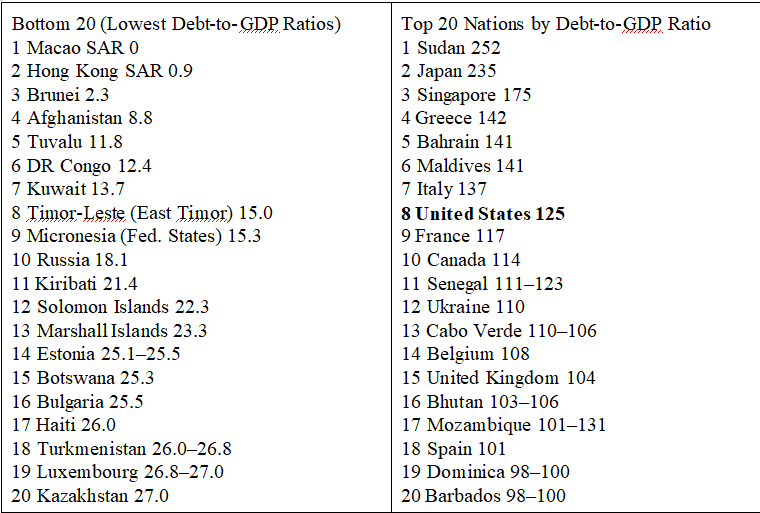
8. “The level of debt is too high compared to the GDP.” Japan is at 260% and has had almost no inflation and near-zero interest rates for decades. The Debt/GDP ratio tells nothing about the government’s credit or ability to pay its obligations. It is an often quoted, but useless ratio.

Here are the lowest and highest ratios. By analyzing these ratios, could you determine which nations you would prefer to lend to? Which nations are strongest financially? Which nations are least likely to default?

You can’t, because the Debt/GDP ratio is meaningless.

There is no relationship between the Debt/GDP ratio and financial strength.

9. “Large debt hurts economic growth.” Higher government debt correlates with stronger GDP growth because federal deficits and interest payments add growth dollars to the economy.

The following graph illustrates the parallel paths of Gross Domestic Product and Federal Debt. This parallelism is not coincidental. The most crucial equation in economics is GDP = Federal Spending + Nonfederal Spending + Net Exports. Federal spending adds dollars to the private sector and is necessary for economic growth.

Federal expenditures and GDP move essentially in parallel.

10. “We must reduce debt so interest payments don’t explode.” Interest payments act as a fiscal stimulus by adding growth funds to the private sector. When interest payments increase, private income also rises.

Our government, as a monetarily sovereign entity, easily manages any level of interest payments.

Interest rates (yellow, dashed line) and GDP (blue) rise and fall together.

11. “It’s irresponsible to let debt grow forever.” The federal debt is the difference between federal spending and revenue. Thus, debt adds growth capital to the economy, allowing for continuous economic growth, which is beneficial.

The federal debt has grown for 85 years, belying the repeated false claims that it is a “ticking time bomb.” 

12. “Eventually, no one will buy our debt.” The Federal Reserve and primary dealers are obligated to purchase Treasury securities; however, the federal government has no financial need for anyone to buy its debt.

The purpose of federal debt is not to provide spending funds to the government. T-securities provide dollar users with a safe place to store unused dollars. The dollar-using world wants the insurance that T-securities provide.

13. “High deficits mean higher taxes later.” Federal taxes do not pay for the federal debt. Instead, the Treasury creates new dollars to cover the interest, and each debt account is settled at maturity by returning the dollars in that account.

Tax rates: The Highest bracket (green dashed line) and the lowest bracket (blue dashed line) are compared with annual changes in federal deficit spending (red). Tax rates have fallen as deficit spending has increased.

14. “We should have a balanced budget.” This means the federal government would not provide additional funds to the economy, which would result in a depression.

Even President Barack Obama, who should have known better, said in 2011, “We have to reduce our deficit, and we have to get back on a path that will allow us to pay down our debt.” 

Paying down the debt requires running surpluses, which historically have led to depressions. Throughout U.S. history, every depression has been preceded by federal surpluses.

1804-1812: U. S. Federal Debt reduced 48%. Depression began in 1807.
1817-1821: U. S. Federal Debt reduced 29%. Depression began in 1819.
1823-1836: U. S. Federal Debt reduced 99%. Depression began in 1837.
1852-1857: U. S. Federal Debt reduced 59%. Depression began in 1857.
1867-1873: U. S. Federal Debt reduced 27%. Depression began in 1873.
1880-1893: U. S. Federal Debt reduced 57%. Depression began in 1893.
1920-1930: U. S. Federal Debt reduced 36%. Depression began in 1929.
1997-2001: U. S. Federal Debt reduced 15%. The recession began in 2001.

When federal deficit spending decreases, recessions tend to occur, which are resolved by increasing federal deficit spending. See the following graph:

Every recession (vertical gray bars) followed a decline in federal deficit spending, and all were cured by an increase in deficit spending.

15. “The federal debt is not sustainable.” This is a non-specific false claim encompassing all of the other false claims about federal debt. The term “sustainable” frequently is used by individuals opposed to debt and leaning toward Libertarian views.

However, they seldom clarify why a Monetarily Sovereign nation cannot “sustain” any level of debt, especially when the situation in question isn’t even a debt. (It’s deposits.)

And all the false claims boil down to the one underlying false claim:

16. The government and taxpayers cannot afford Medicare for All, Social Security for all, housing assistance, food assistance, or any other benefits for the middle class and the poor. The federal government, being Monetarily Sovereign, can afford anything without needing taxpayer funds.

Despite the fact that tax loopholes for the wealthy cost the government money, Congress and the President rarely oppose them. The reason: wealthy people are major campaign contributors.

Given this situation, why is Washington hesitant to provide those benefits? Why do we have “debt ceilings” and government shutdown battles over spending?

The answer: Gap Psychology.

The very wealthy still want to become wealthier. It is human nature. To become wealthier, one must widen the income/wealth/power Gap below and narrow it above.

To do that, one must increase one’s own income or decrease the income of others. The rich do both by bribing the most important information sources:

  1. They bribe politicians via campaign contributions and lucrative jobs in “think tanks.”
  2. They bribe economists via university endowments and promises of lucrative jobs and assignments
  3. They bribe the media via advertising dollars and outright ownership

All are expected to promulgate the myths about federal debt so as to reduce or eliminate entirely spending for social services.

That is why it is said that the Social Security and Medicare trust funds are running out of money, when in reality, there are no actual trust funds, and the necessary funds would be available if Congress simply voted for them.

It is why Congress forces the states to fund social programs, knowing that the states are monetarily non-sovereign and often unable to fund programs properly.

SUMMARY

The federal “debt” is not real debt in the traditional sense. It refers to deposits that are essentially repaid by returning them. This process does not impact taxpayers.

The federal government, as a monetarily sovereign entity, does not borrow dollars. Instead, the purpose of this so-called debt (or deposits) is to help the Federal Reserve manage interest rates and provide a safe option for unused dollars, thereby protecting dollar users.

In summary, the federal debt does not threaten the federal government’s solvency nor hinder economic growth. In fact, it serves the opposite purpose.


Rodger Malcolm Mitchell

Monetary Sovereignty

Twitter: @rodgermitchell

Search #monetarysovereignty

Facebook: Rodger Malcolm Mitchell;

MUCK RACK: https://muckrack.com/rodger-malcolm-mitchell;

https://www.academia.edu/

……………………………………………………………………..

A Government’s Sole Purpose is to Improve and Protect The People’s Lives.

MONETARY SOVEREIGNTY

How to screw the public by making the simple and affordable, complex and unaffordable.

The problem: Healthcare costs are high. Many Americans can’t afford even basic healthcare.

The simple, affordable solution: Recognize that the U.S. government is Monetarily Sovereign, meaning it never can run out of dollars to cover its expenses.

Also recognize that federal spending creates economic growth and costs taxpayers nothing.

With this understanding, we should implement comprehensive, no-deductible Medicare for all Americans, regardless of age, income, or pre-existing health conditions.

We already know how to navigate the difficult task called “Medicare.” Expanding coverage to the entire nation is a straightforward step that requires money — of which the federal government has an endless supply.

It’s simple and affordable.

The government’s complex, unaffordable non-solution is described in the following article:

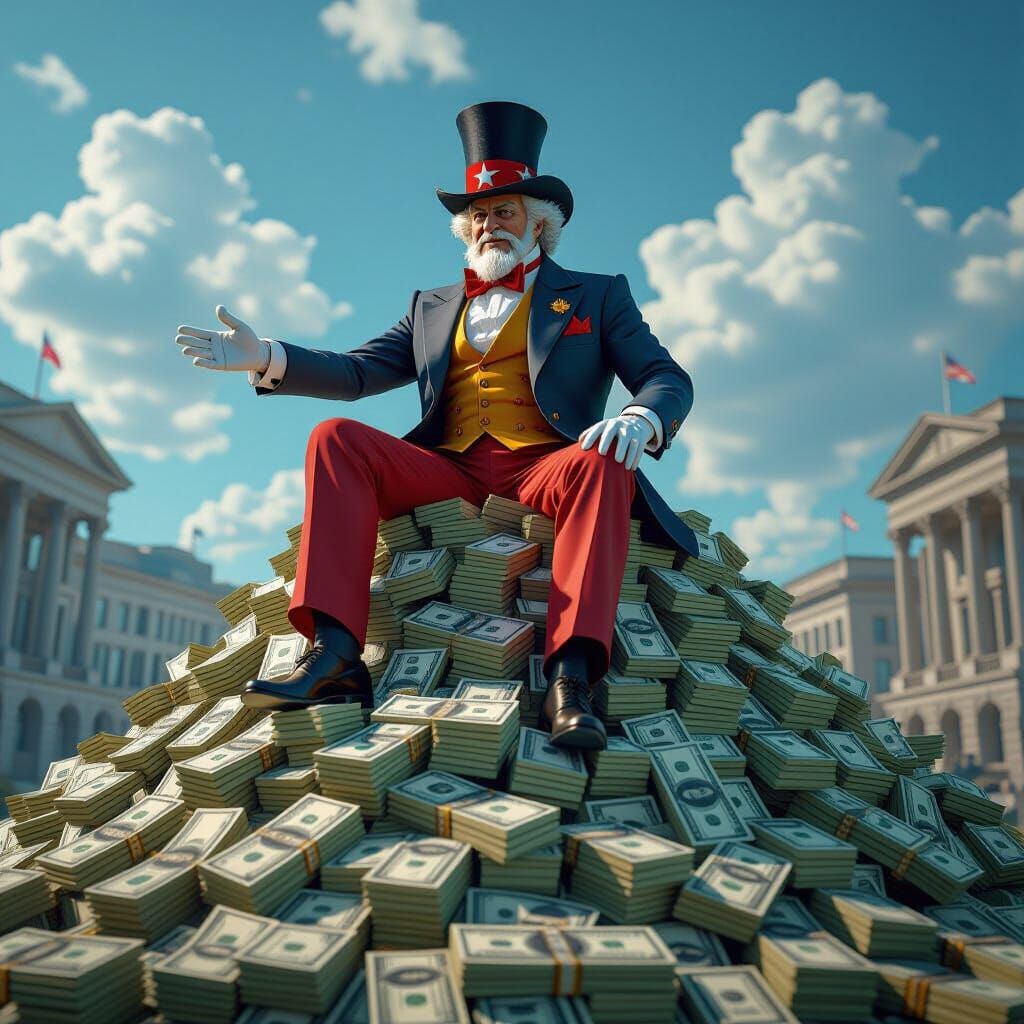
Uncle Sam sitting on a huge pile of cash
It cost me nothing to print this. But I don’t want to help the poor and middle classes, so I’ll just claim that I’m spending taxpayers’ money. The dummies will believe it.

Premium Reports from Epoch Times Spiraling Costs and a Broken Insurance Market—What Went Wrong With Obamacare   By Lawrence Wilson, November 23, 2025

The government shutdown might be over, but the political and financial problems that dog Obamacare haven’t gone away.

Congress is now debating a second extension of the temporary tax credits that have shielded Obamacare users from rising costs for five years.

Without the subsidies, Democrats say millions of Americans will be priced out of the health insurance market at the stroke of midnight on New Year’s Eve.

President Donald Trump and other Republicans don’t want an extension; they want a transformational change that eliminates what they say are the unworkable policies and perverse incentives that have plagued the program from the beginning.

The policies are unworkable because the Republicans and the Democrats don’t really want a solution. The Republicans don’t want to help the poor. The Democrats want to help the poor, but are afraid to spend what’s required to help all the people.

The Republicans will not come up with a “transformational change” unless it transforms something that is worse for the poor and better for the rich.

(As an aside, Stephanie Kelton once was an advisor to the Democratic Party, and probably told them the government could afford to spend the money, though even she had unfounded worries about inflation.)

It isn’t just Republicans who say Obamacare went awry. Many experts and even some Democrats recognize that while the program did make health coverage more affordable for 24 million Americans at one point, it has essentially backfired.

It could and should be free to all Americans.

Here’s how they think Obamacare went off course, how it might be overhauled, and how it upended the wider health insurance market.

Failed Aims The Affordable Care Act aimed to make health insurance affordable for everyone and lower health care costs across the board.

“The reality of the [Affordable Care Act] could not be more different,” Douglas Holtz-Eakin, president of the think tank American Action Forum, said in written comments to a Senate committee on Nov. 19.

Republicans have said the system was poorly designed from its beginning in 2014. Now, some Democrats agree it has not been successful.

Keep in mind that the Republicans have been saying this from the beginning, yet in all that time, they never have come up with a “well-designed” program. It comes down to one truth: The party of the rich does not want to help the poor. Period.

Sen. Peter Welch (D-Vt.) said as much in a Nov. 6 speech imploring colleagues to extend the temporary tax credits, which expire in December.

“I owe you an answer on why it is I am standing here today asking to extend something that was temporary,” Welch said. “Here is the reason: We did fail to bring down the cost of health care.”

Sen. Bill Cassidy (R-La.) said on Nov. 19: “I think there’s remarkable agreement between Democrats and Republicans. Obamacare failed to give access to all Americans to health care, and Obamacare failed to control health care costs.”

The Republican “solution” is to give access to as few as possible.

When Obamacare was proposed, the Congressional Budget Office projected that enrollment would reach 29 million by 2019 and that the percentage of uninsured adults would drop from 17 percent to 6 percent.

That didn’t happen. By 2019, enrollment had plateaued at around 11.4 million, and about 11 percent of adults remained uninsured.

The reason: It cost too much. Healthcare for all Americans should be free. (Unless the politicians are satisfied with the poor using the hospital emergency room as their free, all-purpose, healthcare facility.)

A year later, Congress altered the program in 2020 to help Americans cope with the economic downturn caused by the COVID-19 state of emergency.

The key change was the addition of “enhanced” tax credits that made middle-income households eligible for subsidized health care and allowed some low-income households to get coverage with a zero-dollar premium.

This should have been done for all Americans, not only because of COVID, but because the federal government’s purpose is to protect and improve the lives of all the people, not just the wealthy.

The enhanced credits were offered for two years, beginning in 2021, then extended through 2025.

Enrollment skyrocketed, doubling in five years. But the cost was climbing rapidly, too.

Even before the enhanced tax credits came online, premiums had more than doubled since 2013, the year before Obamacare began. By 2025, the increase reached nearly 133 percent, about four times the rate of inflation.

Health care costs generally rose dramatically in that decade, partly because of rising wages, consolidation within the industry, an aging population, and the popularity of new and expensive medications, according to the Committee for a Responsible Federal Budget.

Meanwhile, some analysts say Obamacare is the key driver of higher premiums.

The premiums should be, and easily could be, $0.00.

Market Disruption With traditional health insurance (and other forms of insurance), the price to the customer is based on the risk to the

Obamacare is different, however. insurer and the type of coverage they choose.

A key selling point of Obamacare was that it largely ended the practice of excluding people from health coverage due to preexisting conditions. No one would be denied coverage due to illness, and all plans were required to offer the same set of minimum benefits.

That is an excellent program.

As this one-size-fits-all system treats high- and low-risk customers the same, many younger, healthier people left the market, leading to higher premiums.

Healthier people would not leave the market if premiums were free.

And because preexisting conditions are not a barrier to coverage, those consumers enter the market only when they become ill, raising costs even higher, Sen. Ron Johnson (R-Wis.) told The Epoch Times.

Again, this would not happen if premiums were free.

Those increases spread across the industry because the Affordable Care Act requires insurers to offer Obamacare compliant policies to individuals and small groups in the commercial market.

The solution, Johnson said, is to cover those with existing illnesses in high-risk pools, which allow groups of people within Obamacare to be priced and subsidized separately.

The Johnson so-called “solution” is high-risk pools, which will change unaffordable premiums — a perfect right-wing approach.

“You have to reestablish those,” Johnson said. “You have to start by covering people with preexisting conditions.

“You bring as much free market back into health care as possible, so people are actually competing for customers with price, customer service, and quality.”

Johnson doesn’t say how high-risk pools would make insurance companies compete for customers without raising prices sky high.

A Spiral Masked by Subsidies Gross federal subsidies of Obamacare now stand at an estimated $138 billion per year, according to the Committee for a Responsible Federal Budget.

Those subsidies have masked the rise in premiums, allowing them to rise virtually unchecked, according to Brian Blase, founder of think tank Paragon Health Institute.

The subsidies have not “masked” anything. They have paid premiums that otherwise would be unaffordable.

“When enrollees pay only a small slice of the premium or no premium at all, insurers face almost no price discipline,” Blase told Senators on Nov. 19.

Blaise’s “price discipline” does not exist. The consumer simply does without, sickens, and dies.

By 2024, 80 percent of Obamacare customers qualified for plans costing them no more than $10 per month, according to the Treasury Department.

A better rate would be $0.00 a month, a rate the government could absorb without collecting a penny in taxes

That created a spiral that kept pushing the cost up, Blase said. “Higher premiums created pressure for still more subsidies. More subsidies lock in a high-cost system and permit large insurers and hospital systems to remain inefficient.”

Someone please ask Johnson and Blaise why their theories don’t seem to apply to Medicare, where preexisting illnesses are covered and there is little evidence of a cost spiral.

That rising premiums also drove out general market consumers who did not qualify for a subsidy, causing even further increases, said Dr. Mehmet Oz, administrator of the Centers for Medicare and Medicaid Services.

That wouldn’t happen if the federal government paid all the premiums as it now does with Medicare.

The Obamacare market was designed for a 50/50 mix of private-sector customers, and those who need financial help, Oz said in a Nov. 16 interview with CNN.

“We have priced the systems now so heavily with government subsidies that it crowds out the private shopper,” Oz said.

So instead, Oz wants to crowd out the poor, leaving them no alternative but the emergency room, thus shifting the price burden from the government (which can afford anything) to hospitals, which must raise prices to the private-sector customers. See the irony?

Perverse Incentives in the Workplace Large employers, those with more than 50 employees, face a $2,900 fine for each full-time worker who receives an Obamacare subsidy. That’s to encourage companies to offer employer-sponsored health insurance.

Who pays when the companies offer employer-sponsored health insurance? Only two groups: Consumers and employees. In short, the private sector pays for health care rather than the federal government, which has limitless dollars.

In reality, it may have the opposite effect for employees earning below a certain level, according to Holtz-Eakin.

“You could do the math and figure out that … it made a lot of sense for employers to just stop being in the insurance business, put their workers in the exchanges, and both the worker and the employer could come out ahead,” Holtz-Eakin said.

And this supposedly is a bad thing — for workers and employers to come out ahead. Isn’t that exactly what Obamacare was designed to do?

That appears to have happened in many smaller companies, which have no threat of a fine to induce them to buy insurance for employees.

The year before Obamacare began, 85 percent of companies with 25 to 49 workers offered health insurance for their employees. By 2025, that had fallen to 64 percent.

Ripe for Fraud When the enhanced tax credits were introduced in 2021, 42 percent of the uninsured population qualified for a policy with a zero-dollar premium. To boost and maintain enrollment during the health emergency, eligibility checks were relaxed, and reenrollment was automated.

Also, insurance brokers receive a commission for each person they enroll.

Those factors made the program ripe for fraud and abuse, Blase said.

Offering free health care insurance would eliminate eligibiity check and brokers commissions, two unnecessary expenses.

“Many enrollees were signed up without their knowledge or consent,” Blase said. He noted that some unscrupulous vendors promised enrollees cash benefits, and others were moved from one plan to another without their consent.

Approximately 2.8 million people were dually enrolled in Medicaid or the Children’s Health Insurance Program in multiple states in 2024, or simultaneously enrolled in one of those programs and an Obamacare plan, according to federal data.

Also, 40 percent of those enrolled in a zero-premium plan in 2024, more than 4 million people, filed no medical claims.

All those problems would disappear with a Medicare-for-All, single-payer plan.

The national average for zero-claim health insurance customers is 15 percent, according to Paragon Health Institute, which estimates that taxpayers spent $35 billion in 2024 to insure people who were unaware they had coverage.

Isn’t that exactly how insurance is supposed to work? That’s why it’s called “insurance,” not salary.

While Democrats acknowledge that rising health care costs are a problem, they say it’s not related to Obamacare. Proposed solutions generally involve increasing corporate taxes and cracking down on corporate abuses.

Or better yet, single payer health care that covers everyone.

“Insurance premiums are skyrocketing,” Rep. Jonathan Jackson (D-Ill.) told The Epoch Times on Nov. 20. He named government negotiations on drug prices and higher corporate taxes as partial solutions.

Both of those “solutions” take growth dollars out of the economy and give them to the federal government, which has no use for them.

Sen. Ron Wyden (D-Ore.) said on Nov. 19 that reducing health care costs “means reining in insurance company abuses across the health care system.”

Ever since the politicians learned the word “abuse,” they have described anything that benefits the economy, especially what benefits the poor, as abuse. You seldom hear them call tax loopholes for the rich, “abuse.”

Republicans generally favor market-based reforms that give consumers more control over their health care spending.

“More control” is a right-wing synonym for: “The poor pay.”

“The free market guarantees three things,” Johnson said. “The lowest possible price and cost, the best possible quality, and the best level of customer service.”

The free market guarantees that the wealthy will pay less and the poor will pay more. Isn’t that why we have anti-trust laws?

Trump has proposed a direct cash payment to low- and middle-income Americans to be used for health care expenses. Cassidy and Sen. Rick Scott (R-Fla.) have proposed similar ideas.

Yes, Republicans Trump, Cassidy, and Scott want to give people $2,000 a year. How generous. Here is what ChatGPT’s massive information sources say about healthcare insurance costs:

Average Annual Health Insurance Cost in the U.S.

  1. Employer-Sponsored Insurance (2024)
    • Average annual premium for single coverage: $8,951
    • Average annual premium for family coverage: $25,572
    • On average, workers contribute: $6,296/year toward family coverage.
  2. Affordable Care Act (ACA) / Marketplace Plans
    • According to Insurify, the average annual premium for a single person on a mid-level (marketplace) plan is $5,964.
    • Forbes Advisor estimates that for ACA marketplace plans (before accounting for subsidies), the average premium is about $590/month~$7,080/year.
    • According to Fidelity, a 40-year-old on a typical Silver ACA plan would pay around $497/month~$5,964/year.
  3. Other Data
    • MoneyGeek reports that, on average, health insurance costs $599/month for an adult on a marketplace plan → ~$7,188/year.
Oh, those Republicans are so clever. They’ll give you $2,000 and cost you $6,000 to $26,000 or more. Be sure to give them your vote.

Rep. Chip Roy (R-Texas) named direct primary care, health sharing ministries, and expanded Health Savings Accounts as ways to empower patients to make their own health decisions.

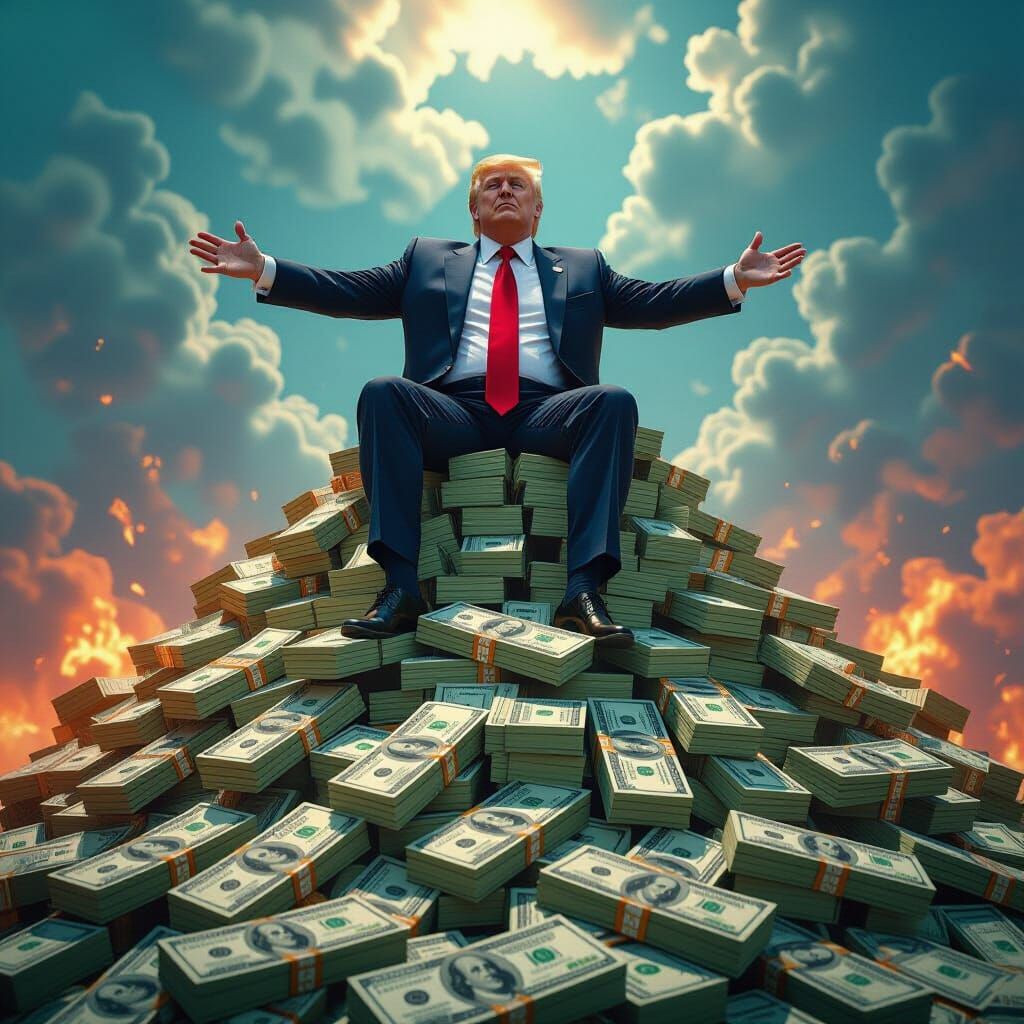
Trump sitting on a huge pile of dollars
No problem. My friends and I are OK. Crypto, anyone?
“Empower” is another current right-wing synonym for “charge.”

“I want to free up individuals to have better options,” Roy told The Epoch Times. “If you’re starting there, then you’re going to be transformative, and that will drive prices down,” Roy said.

Yes, more right-wing synonyms. “Free up” means “cost.” “Better options” means “unaffordable options.”

Congress is expected to vote in mid-December on an extension of enhanced subsidies and possibly other health care reforms.

No matter what happens, so long as the current right wing has voting power, the middle- and lower-income will be screwed, and the rich will do just fine, thank you.    

Rodger Malcolm Mitchell

Monetary Sovereignty

Twitter: @rodgermitchell

Search #monetarysovereignty

Facebook: Rodger Malcolm Mitchell;

MUCK RACK: https://muckrack.com/rodger-malcolm-mitchell;

https://www.academia.edu/

……………………………………………………………………..

A Government’s Sole Purpose is to Improve and Protect The People’s Lives.

MONETARY SOVEREIGNTY

Something too many economists don’t understand: Economics

One would hope that historians, and especially economists, would understand the differences between federal financing (Monetary Sovereignty) and personal financing (monetary non-sovereignty).

Sadly, any such hopes seem dashed by this MSN article.

‘We are guilty of spending our rainy-day fund in sunny weather’: Top economists, historians unite to urge action on $38 trillion national debt.

By Nick Lichtenberg

The national debt has grown to $38 trillion. The United States’ national debt, currently standing at $38 trillion and exceeding 120% of annual economic output, demands action, experts warn.

What about that $38 trillion national debt? To understand what it means, you might wish to review: Historical bullshit about federal “debt.” From September 26, 1940, to August 12, 2025

The article lists and describes the panic-stricken statements from “experts” about the federal debt from 1940 through today. In 1940, it was $43 billion— roughly 44% of GDP at the time.

As debt and the debt-to-GDP ratio rose, the economy grew and prospered. Yet, the panic has continued, and the screams have become ever more strident. Now, the so-called “debt” (that isn’t really debt; it’s deposits) has grown nearly a thousand-fold, the sky has not fallen, and we continue to be pummelled with articles like Nick Lichtenberg’s.

Having learned absolutely nothing in the past eighty-five (!) years, the experts continue to panic and scream, hoping you, too, will panic and scream. For your amusement, and perhaps sorrow, here’s the latest.

The nonpartisan Peter G. Peterson Foundation gathered a series of distinguished national economists and historians from outside the foundation in a collection of essays published Thursday.

They analyzed risks to U.S. economic strength, dollar dominance, and global leadership.

Ah, yes, distinguished national economists and historians — distinguished by their misunderstanding of the difference between federal government financing vs. state/local government financing. The former is Monetarily Sovereign; the latter is monetarily nonsovereign — two different animals.

The experts also explored the national debt’s impact on interest rates, inflation, and financial markets, with some characterizing this moment in history as a crisis.

A crisis of ignorance.

Collectively, they argue that the nation is operating under a dangerous fiscal gamble.

Assessing the mounting liabilities  delivered a stark judgment: “In simpler terms, we are guilty of spending our rainy-day fund in sunny weather.” Meaning, the government has little “dry powder” left to fund a major military effort or stimulate the economy during a crisis.

And what exactly is our “rainy-day fund”? How much is it? Where is it stored? And that “dry powder,” how much is it and where is it stored?

Feel free to ask Council on Foreign Relations President Emeritus Richard Haass and NYU professor Carolyn Kissane. However, they won’t know, because the fund and powder do not exist, not in real or even metaphorical terms.

Well, in one sense, they do exist in the Monetary Sovereignty of the U.S. government, which has the infinite ability to create dollars (and dry powder) merely by pressing computer keys.

Who says so? A few real experts, not the self-proclaimed, self-aggrandized, overly anointed kind:

Former Fed Chairman Alan Greenspan: “A government cannot become insolvent with respect to obligations in its own currency. There is nothing to prevent the federal government from creating as much money as it wants and paying it to somebody. The United States can pay any debt it has because we can always print the money to do that.”

Former Fed Chairman Ben Bernanke: “The U.S. government has a technology, called a printing press (or, today, its electronic equivalent), that allows it to produce as many U.S. dollars as it wishes at essentially no cost. It’s not tax money… We simply use the computer to mark up the size of the account.”

Fed Chairman Jerome Powell: “As a central bank, we can create money digitally.”

Statement from the St. Louis Fed: “As the sole manufacturer of dollars, whose debt is denominated in dollars, the U.S. government can never become insolvent, i.e., unable to pay its bills. In this sense, the government is not dependent on credit markets to remain operational.”

Former Secretary of the Treasury Paul O’Neill: “I come to you as a managing trustee of Social Security. Today, we have no assets in the trust fund. We have promises of the good faith and credit of the United States government that benefits will flow.”

Nobel Prize–winning economist Paul Krugman: “The U.S. government is not like a household. It literally prints money, and it can’t run out.” — Numerous op-eds/blog posts.

Economist Hyman Minsky: “The government can always finance its spending by creating money.”

Economist Eric Tymoigne: “A sovereign government does not need to collect taxes or issue bonds to finance spending. It finances directly through money creation.”

Now, back to the fun:

The debt crisis has reached a critical threshold. The U.S. now spends approximately $1 trillion annually servicing its debt—a figure that surpasses its defense spending.

And why is spending more on interest than on defence significant? It isn’t. Spending is spending. All federal spending adds to GDP. The phrase was just a desperate attempt to shock you. It shouldn’t.

The federal government can pay infinite interest, and the more it pays, the healthier the economy is. Here’s the evidence:

Gross Domestic Product = Federal Spending + Nonfederal Spending + Net Exports

Get it? The more the federal government spends, and the less it taxes (i.e., the greater the deficit), the more Gross Domestic Product grows.

What would be truly shocking is if the federal debt declined. History shows us examples of that decline:

Every Depression in U.S. History Came On the Heels of a Reduced Federal Debt

1804-1812: U. S. Federal Debt reduced 48%. Depression began in 1807.

1817-1821: U. S. Federal Debt reduced 29%. Depression began in 1819.

1823-1836: U. S. Federal Debt reduced 99%. Depression began in 1837.

1852-1857: U. S. Federal Debt reduced 59%. Depression began in 1857.

1867-1873: U. S. Federal Debt reduced 27%. Depression began in 1873.

1880-1893: U. S. Federal Debt reduced 57%. Depression began in 1893.

1920-1930: U. S. Federal Debt reduced 36%. Depression began in 1929.

1997-2001: U. S. Federal Debt reduced 15%. The recession began in 2001.

Economist Heather Long wrote that the 2020s are “fast becoming the era of big permanent deficits” with annual budget gaps projected to remain high (around 6% of GDP) even though unemployment is low, a startling departure from U.S. historical norms.

Let us pray for an “era of big permanent deficits.”  The alternative is small deficits or surpluses (which lead to recessions or depressions).

When deficit growth decreases, we have recessions (vertical gray bars), which are cured by increases in deficit growth.
Economists warn that solutions that worked in the past—such as the post-World War II debt reduction or the 1990s surpluses—are unavailable today. Economist Barry Eichengreen explained that the debt’s steep decline after World War II was supported by a highly favorable interest-rate-growth-rate differential (low real interest rates and fast GDP growth). Likewise, the 1990s reduction was fueled by the “peace dividend,” enabling deep cuts in defense spending. “None of these facilitating conditions is present today.”

The only necessary “facilitating conditions” for economic growth are increased federal deficit spending — exactly the thing that creates economic growth.

The Threat to National Security and the Dollar

Eichengreen, for his part, noted that current security threats from Russia, Iran, and the South China Sea create pressure for defense spending increases, not cuts.

Defense spending increases, if they occur, will grow the economy.
Compounding the problem is political polarization, which is cited as the most robust determinant of unsuccessful fiscal consolidation.

“Successful fiscal consolidation” is economics-speak for reduced deficit spending, which causes recessions and depressions.

With major entitlement programs politically protected, this fiscal gridlock leaves raising additional revenue as the most viable path, given that the United States is a low tax-revenue economy compared to its peers.

As the real economists — Greenspan, Bernanke, and Powell — stated above, the federal government neither needs (nor even uses) revenue. It creates all its spending money in three easy steps:

  1. Congress votes.
  2. The President signs
  3. Federal employees press computer keys

And voila, all the millions and billions of dollars the federal government spends are magically created. No tax dollars are involved. It’s all bookkeeping notations.

The debt is framed not just as a financial strain but as a direct threat to security. Haass and Kissane emphasized that money spent on borrowing is “money not available for more productive purposes, from discretionary domestic spending to defense,” a classic case of crowding out.

The above statement is ridiculous on its face, for two, what-should-be-obvious reasons:

  1. The federal government has the infinite ability to create dollars and,
  2. The dollars the government spends go into the economy, where the private sector can use them for productive purposes.

There never has been “crowding out,” and never will be. The government can’t run short, and every dollar spent is added to the economy, boosting spending.

Other underfunded programs—including cybersecurity and public health—hollow out internal capacities that protect the homeland.

It is unclear how an entity with the unlimited ability to create dollars can be “hollowed out,” nor is it explained how an economy that receives more dollars is being “hollowed out.”

I imagine there is no explanation simply because it cannot be explained. It is utter nonsense.

The crisis was characterized by Haass and Kissane as moving in “slow motion,” the most challenging type for democratic governments to address effectively. Avoiding a sudden “cliff scenario” in which bond markets crash, experts argue, is not avoiding the crisis itself; they added: “The day will come when the boiling water finally kills the frog.”
Ah, yes, “slow motion” because it isn’t happening yet, even though we’ve been predicting it for 85 years. And that darn old frog simply doesn’t understand that it’s supposed to have died by now.
The institutional integrity undergirding the U.S. dollar is also at risk. Historian Harold James wrote that he sees the situation as “the middle of a very dangerous experiment with the U.S. dollar, and with the international monetary system, whose fundamental driver is a fiscal gamble.” Erosion of the rule of law, accountability, and transparency raises the “specter of political risk in U.S. sovereign bond markets,” making it harder to maintain dollar dominance. Disturbingly, the potential for political interference in institutions, such as the Federal Reserve or the tampering with national statistics—as seen in Argentina’s cautionary tale—further erodes confidence.

Historian Harold James probably doesn’t realize it, but he’s not talking about the federal debt. Instead, he’s talking about dictator wannabe Donald Trump, and a cowardly do-nothing Congress, plus the morally compromised right wing of the Supreme Court.

They are the ones — not the essential debt growth –who are creating and countenancing the fall of the American economy, .

James’ colleague, Princeton politics professor Layna Mosley, cited the famous comment from the French statesman Valéry Giscard d’Estaing, who described the “exorbitant privilege” the U.S. enjoyed on the back of the dollar. She noted that, by virtue of the global role of the U.S. dollar and the U.S. leadership of the international financial system, the U.S. government has been able to borrow significant amounts on generous terms. But now, government actions and policy generate uncertainty and instability and “undermine the rules-based liberal international order from which the U.S. benefited greatly.”

Sounds frightening, except for one small detail. The U.S. federal government does not borrow.

As the representative of the St. Louis Fed correctly stated (above), the government is not dependent on credit markets to remain operational.”

The federal government creates all the dollars it spends just by pressing computer keys. The government neither needs nor uses any income, whether from borrowing or taxes.

Rather than providing spending money, the purposes of federal taxes are to:

  1. Control the economy by taxing what the government wishes to discourage and by giving tax breaks to what it wishes to reward.
  2. Assure demand for the U.S. dollar by requiring taxes to be paid in dollars.
The purposes of Treasury securities (T-bills, T-notes, T-bonds) are to:
  1. To help the Fed control interest rates by providing a “floor” rate.
  2. To provide dollar holders with a safe, interest-paying place to store unused dollars, which supports the value of dollars.
This loss of credibility empowers bond markets, and their displeasure can lead to sudden, painful economic consequences for everyday Americans through surging mortgage and loan interest rates. Haass and Kissane turned to another metaphor, saying the situation is akin to “forgoing fire or automobile insurance just because the odds are you will not suffer from a fire at home or an accident on the road.”

The above metaphor is a backward attempt to explain why all those “doomsday” predictions have been wrong. The better advice would be: “Don’t bet your life savings on misinformation from the media, the politicians and many economists, because for 85 years, you’d have lost.”

Learn from experience. The only loss of credibility will be endured by the noted historians and economists who, once again, as they have for the past eighty-five years, will be forced to come up with excuses for why the economy does not obey their dire predictions.

Rodger Malcolm Mitchell

Monetary Sovereignty

Twitter: @rodgermitchell

Search #monetarysovereignty

Facebook: Rodger Malcolm Mitchell;

MUCK RACK: https://muckrack.com/rodger-malcolm-mitchell;

https://www.academia.edu/

……………………………………………………………………..

A Government’s Sole Purpose is to Improve and Protect The People’s Lives.

MONETARY SOVEREIGNTY