The most important invention since the Internet

Twitter: @rodgermitchell; Search #monetarysovereignty
Facebook: Rodger Malcolm Mitchell

Mitchell’s laws:
•Those, who do not understand the differences between Monetary Sovereignty and monetary non-sovereignty, do not understand economics.
•Any monetarily NON-sovereign government — be it city, county, state or nation — that runs an ongoing trade deficit, eventually will run out of money.
•The more federal budgets are cut and taxes increased, the weaker an economy becomes..

•Liberals think the purpose of government is to protect the poor and powerless from the rich and powerful. Conservatives think the purpose of government is to protect the rich and powerful from the poor and powerless.

•The single most important problem in economics is the Gap between rich and the rest..
•Austerity is the government’s method for widening
the Gap between rich and poor.
•Until the 99% understand the need for federal deficits, the upper 1% will rule.
•Everything in economics devolves to motive, and the motive is the Gap between the rich and the rest..

============================================================================================================================================================================================================================================================

There have been select technological advances in human history that have “changed everything” — the use of fire, the lever, the wheel, the knife, the use of electricity, the computer, the Internet, to name a few, and now . . .

You live at a time of the most important invention since the Internet and you may not yet have heard of it.

It was invented by two women, Jennifer Doudna (UC Berkeley) and Emmanuelle Charpentier (Max Planck Institute).

The invention: CRISPR-Cas9 (pronounced: crisper).

Sound familiar? No? It soon will be all you’ll think about.

Everything You Need to Know About CRISPR, the New Tool that Edits DNA

CRISPR allows scientists to edit genomes with unprecedented precision, efficiency, and flexibility.

The past few years have seen a flurry of “firsts” with CRISPR, from creating monkeys with targeted mutations to preventing HIV infection in human cells.

Earlier this month, Chinese scientists announced they applied the technique to nonviable human embryos, hinting at CRISPR’s potential to cure any genetic disease. And yes, it might even lead to designer babies.

“Designer babies” is the pejorative used to describe human babies that have been “improved” genetically to be faster, taller, smarter, better-looking, stronger, disease-free or in some other ways, to have been changed far more quickly than what breeding by nature accomplishes slowly.

This power is threatening as all power is.

There is an irony to the fact that, for instance, assuring your baby is free of horrible genetic and communicable diseases is an anathema. A distant relation of mine is in a family containing the dreaded Huntington gene. I’m sure they and their afflicted children, would have welcomed a bit of “designing.”

But power corrupts, and CRISPR truly is powerful, so expect the corrupt to use it for corrupt purposes.

CRISPR is actually a naturally-occurring, ancient defense mechanism found in a wide range of bacteria.

CRISPR is one part of bacterias’ immune system, which keeps bits of dangerous viruses around so it can recognize and defend against those viruses next time they attack.

The second part of the defense mechanism is a set of enzymes called Cas (CRISPR-associated proteins), which can precisely snip DNA and slice the hell out of invading viruses.

There are a number Cas enzymes, but the best known is called Cas9. It comes from Streptococcus pyogenes, better known as the bacteria that causes strep throat.

In short, the whole thing is as natural as eating corn on the cob (a human-modified grain). Natural, yes. But that is not where its power lies.

All biologists have to do is feed Cas9 the right sequence, called a guide RNA, and boom, you can cut and paste bits of DNA sequence into the genome wherever you want.

All you have to do is design a target sequence using an online tool and order the guide RNA to match. It takes no longer than few days for the guide sequence to arrive by mail.

You can even repair a faulty gene by cutting out it with CRISPR/Cas9 and injecting a normal copy of it into a cell.

Fast, cheap and powerful, CRISPR will change the world. The question: Will it be a better world?

There already is work being done to apply CRISPR to genetic diseases of the blood, like sickle-cell anemia, where we can repair the mutation that causes it.

CRISPR could, for example, be used to introduce genes that slowly kill off the mosquitos spreading malaria (or the genes for harboring malaria).

Or put the brakes on invasive species like weeds. It could be the next great leap in conserving or enhancing our environment.

CRISPR has been getting a lot of coverage as a future medical treatment. But focusing on medicine alone is narrow-minded.

Precise genome engineering has the potential to alter not just us, but the entire world and all its ecosystems.

Of course, the above-mentioned use of fire, the lever, the wheel, the knife, the use of electricity, the computer, the Internet, etc. all have altered the entire world and its ecosystems. Should we have done without them?

Of course not, but power needs control, and so far, there has been little control over CRISPR.

Easy DNA Editing Will Remake the World. Buckle Up.

Using (CRISPR), researchers have already reversed mutations that cause blindness, stopped cancer cells from multiplying, and made cells impervious to the virus that causes AIDS.

Agronomists have rendered wheat invulnerable to killer fungi like powdery mildew, hinting at engineered staple crops that can feed a population of 9 billion on an ever-warmer planet.

Bioengineers have used Crispr to alter the DNA of yeast so that it consumes plant matter and excretes ethanol, promising an end to reliance on petrochemicals.

With CRISPR, we theoretically could rid the world of every single mosquito, quickly, cheaply and easily (but then, what of the bats and fish that eat mosquitoes and their larvae?)

Over time, we could rid the world of all human diseases. We could extend human life. We could grow more and better foods. We could eliminate any species.

And, of course, this being an economics blog, we should mention money, and as we spoke earlier, corruption:

Just before Doudna’s team published its discovery in Science, Feng Zhang, a molecular biologist at the Broad Institute of MIT and Harvard, applied for a federal grant to study Crispr-Cas9 as a tool for genome editing.

Doudna’s publication shifted him into hyperspeed. He knew it would prompt others to test Crispr on genomes. And Zhang wanted to be first.

Zhang had asked the Broad Institute and MIT, where he holds a joint appointment, to file for a patent on his behalf.

Doudna had filed her patent application—which was public information—seven months earlier. But the attorney filing for Zhang checked a box on the application marked “accelerate” and paid a fee, usually somewhere between $2,000 and $4,000.

A series of emails followed between agents at the US Patent and Trademark Office and the Broad’s patent attorneys, who argued that their claim was distinct.

A little more than a year after those human-cell papers came out, Doudna (learned) that Zhang, the Broad Institute, and MIT had indeed been awarded the patent on Crispr-Cas9 as a method to edit genomes. “I was quite surprised,” she says, “because we had filed our paperwork several months before he had.”

The Broad win started a firefight. The University of California amended Doudna’s original claim to overlap Zhang’s and sent the patent office an 114-page application for an interference proceeding—a hearing to determine who owns Crispr—this past April.

In Europe, several parties are contesting Zhang’s patent on the grounds that it lacks novelty. Zhang points to his grant application as proof that he independently came across the idea.

The stakes here are high. Any company that wants to work with anything other than microbes will have to license Zhang’s patent; royalties could be worth billions of dollars, and the resulting products could be worth billions more.

When the stakes are high, the corrupt move in. And as yet, we don’t even know what “corrupt” means with regard to the use of CRISPR.

This post already has grown too long, but I urge you to use the links referenced above and learn the many biological and ethical implications of CRISPR.

You should make it your mission to learn about the most important invention since the Internet.

Rodger Malcolm Mitchell
Monetary Sovereignty

===================================================================================
Ten Steps to Prosperity:
1. Eliminate FICA (Click here)
2. Federally funded Medicare — parts A, B & D plus long term nursing care — for everyone (Click here)
3. Provide an Economic Bonus to every man, woman and child in America, and/or every state a per capita Economic Bonus. (Click here) Or institute a reverse income tax.
4. Free education (including post-grad) for everyone. Click here
5. Salary for attending school (Click here)
6. Eliminate corporate taxes (Click here)
7. Increase the standard income tax deduction annually Click here
8. Tax the very rich (.1%) more, with higher, progressive tax rates on all forms of income. (Click here)
9. Federal ownership of all banks (Click here and here)

10. Increase federal spending on the myriad initiatives that benefit America’s 99% (Click here)

The Ten Steps will add dollars to the economy, stimulate the economy, and narrow the income/wealth/power Gap between the rich and the rest.
——————————————————————————————————————————————

10 Steps to Economic Misery: (Click here:)
1. Maintain or increase the FICA tax..
2. Spread the myth Social Security, Medicare and the U.S. government are insolvent.
3. Cut federal employment in the military, post office, other federal agencies.
4. Broaden the income tax base so more lower income people will pay.
5. Cut financial assistance to the states.
6. Spread the myth federal taxes pay for federal spending.
7. Allow banks to trade for their own accounts; save them when their investments go sour.
8. Never prosecute any banker for criminal activity.
9. Nominate arch conservatives to the Supreme Court.
10. Reduce the federal deficit and debt

No nation can tax itself into prosperity, nor grow without money growth. Monetary Sovereignty: Cutting federal deficits to grow the economy is like applying leeches to cure anemia.
1. A growing economy requires a growing supply of dollars (GDP=Federal Spending + Non-federal Spending + Net Exports)
2. All deficit spending grows the supply of dollars
3. The limit to federal deficit spending is an inflation that cannot be cured with interest rate control.
4. The limit to non-federal deficit spending is the ability to borrow.

THE RECESSION CLOCK

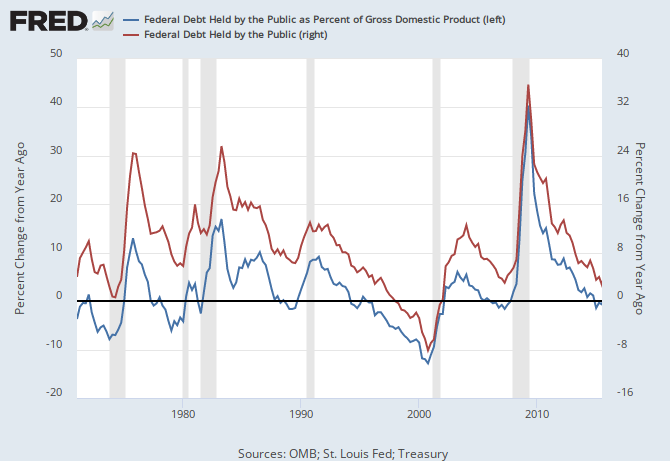
Recessions begin an average of 2 years after the blue line first dips below zero. There was a dip in 2015.
Monetary Sovereignty

Vertical gray bars mark recessions.

As the federal deficit growth lines drop, we approach recession, which will be cured only when the growth lines rise. Increasing federal deficit growth (aka “stimulus”) is necessary for long-term economic growth.

#MONETARYSOVEREIGNTY

When will the next recession arrive?

Twitter: @rodgermitchell; Search #monetarysovereignty
Facebook: Rodger Malcolm Mitchell

Mitchell’s laws:
•Those, who do not understand the differences between Monetary Sovereignty and monetary non-sovereignty, do not understand economics.
•Any monetarily NON-sovereign government — be it city, county, state or nation — that runs an ongoing trade deficit, eventually will run out of money.
•The more federal budgets are cut and taxes increased, the weaker an economy becomes..

•Liberals think the purpose of government is to protect the poor and powerless from the rich and powerful. Conservatives think the purpose of government is to protect the rich and powerful from the poor and powerless.

•The single most important problem in economics is the Gap between rich and the rest..
•Austerity is the government’s method for widening
the Gap between rich and poor.
•Until the 99% understand the need for federal deficits, the upper 1% will rule.
•Everything in economics devolves to motive, and the motive is the Gap between the rich and the rest..

============================================================================================================================================================================================================================================================

If you believe the federal debt and deficit are too high, “unsustainable” and otherwise negative for the economy, here are a few graphs you may find interesting:

Monetary Sovereignty
After rebounding from a previous recession, the blue line drops below “0” in 1972. The next recession follows two years later.

monetary sovereignty
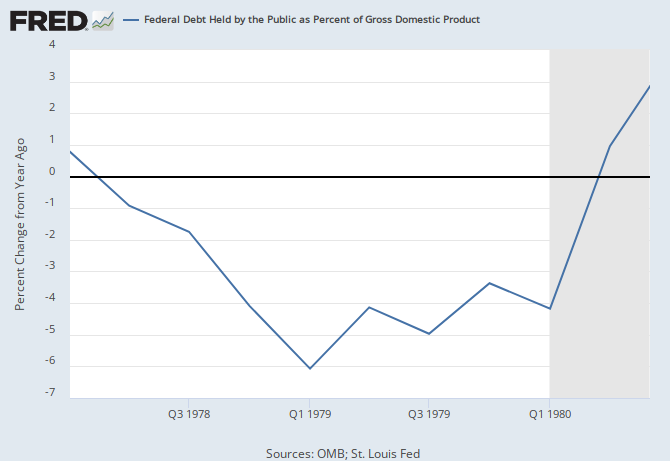
The blue line drops below “0” in 1978. The next recession follows two years later.

monetary sovereignty
The blue line drops below “0” in the 2nd quarter of 1981. The next recession follows one quarter later.

monetary sovereignty
After the blue line first drops below “0” in 1988, the next recession follows two years later.

monetary sovereignty
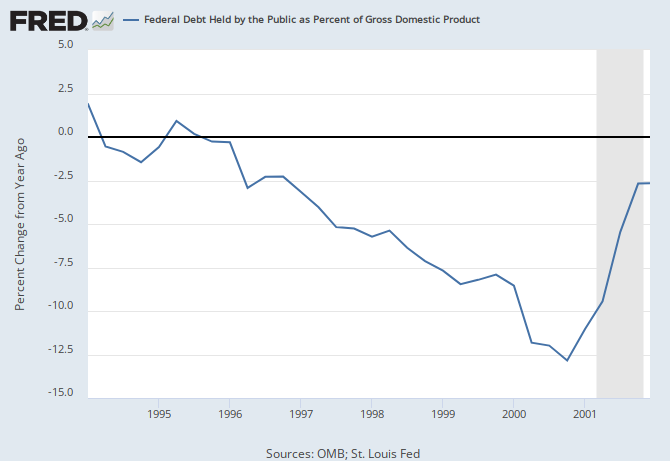
After the blue line first drops below “0” in 1994, the next recession follows six years later.

monetary sovereignty
After the blue line drops below “0” in 2006, the next recession follows two years later.

monetary sovereignty
The blue line fell below “0” in 2015.

——————————————————————————————————————————————————————————————————————————–
Summary: After the Federal Debt Held by the Public as Percent of Gross Domestic Product fell, year-to-year, recessions came:
— Two years later,
— Two years later,
— One quarter later,
— Two years later,
— Six years later, and
— Two years later.

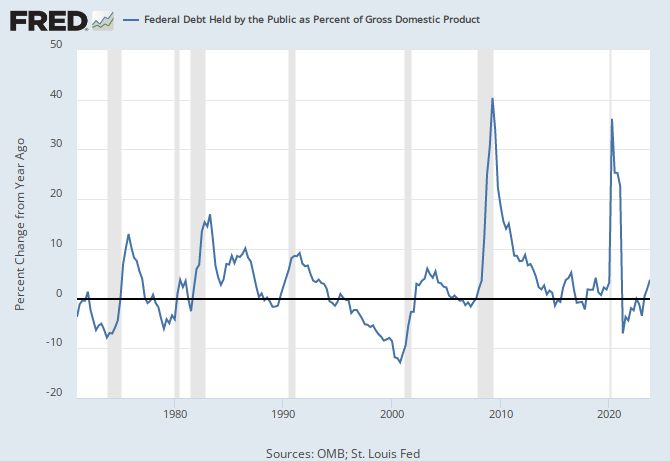
Here is a summary graph, from when the U.S. abandoned all gold standards and became Monetarily Sovereign:
monetary sovereignty
Since the U.S. became Monetarily Sovereign, every recession has been preceeded by a year-to-year reduction in the GDP/Debt ratio.

Cutting the GDP/Debt ratio has been a precursor to recessions. The average length of time between a reduction in the GDP/Debt ratio and a recession: Two years.

Anyone for Debt reduction, please raise your hand.

Then explain why you like recessions.

Rodger Malcolm Mitchell
Monetary Sovereignty

===================================================================================
Ten Steps to Prosperity:
1. Eliminate FICA (Click here)
2. Federally funded Medicare — parts A, B & D plus long term nursing care — for everyone (Click here)
3. Provide an Economic Bonus to every man, woman and child in America, and/or every state a per capita Economic Bonus. (Click here) Or institute a reverse income tax.
4. Free education (including post-grad) for everyone. Click here
5. Salary for attending school (Click here)
6. Eliminate corporate taxes (Click here)
7. Increase the standard income tax deduction annually Click here
8. Tax the very rich (.1%) more, with higher, progressive tax rates on all forms of income. (Click here)
9. Federal ownership of all banks (Click here and here)

10. Increase federal spending on the myriad initiatives that benefit America’s 99% (Click here)

The Ten Steps will add dollars to the economy, stimulate the economy, and narrow the income/wealth/power Gap between the rich and the rest.
——————————————————————————————————————————————

10 Steps to Economic Misery: (Click here:)
1. Maintain or increase the FICA tax..
2. Spread the myth Social Security, Medicare and the U.S. government are insolvent.
3. Cut federal employment in the military, post office, other federal agencies.
4. Broaden the income tax base so more lower income people will pay.
5. Cut financial assistance to the states.
6. Spread the myth federal taxes pay for federal spending.
7. Allow banks to trade for their own accounts; save them when their investments go sour.
8. Never prosecute any banker for criminal activity.
9. Nominate arch conservatives to the Supreme Court.
10. Reduce the federal deficit and debt

No nation can tax itself into prosperity, nor grow without money growth. Monetary Sovereignty: Cutting federal deficits to grow the economy is like applying leeches to cure anemia.
1. A growing economy requires a growing supply of dollars (GDP=Federal Spending + Non-federal Spending + Net Exports)
2. All deficit spending grows the supply of dollars
3. The limit to federal deficit spending is an inflation that cannot be cured with interest rate control.
4. The limit to non-federal deficit spending is the ability to borrow.

THE RECESSION CLOCK

Recessions begin an average of 2 years after the blue line first dips below zero. There was a dip in 2015. Recessions are cured by a rising red line.

Monetary Sovereignty

Vertical gray bars mark recessions.

As the federal deficit drops, we approach recession, which will be cured only when the growth rises. Increasing federal deficit growth (aka “stimulus”) is necessary for long-term economic growth.

#MONETARYSOVEREIGNTY
Are we the Interim Species?

Twitter: @rodgermitchell; Search #monetarysovereignty
Facebook: Rodger Malcolm Mitchell

Mitchell’s laws:
•Those, who do not understand the differences between Monetary Sovereignty and monetary non-sovereignty, do not understand economics.
•Any monetarily NON-sovereign government — be it city, county, state or nation — that runs an ongoing trade deficit, eventually will run out of money.
•The more federal budgets are cut and taxes increased, the weaker an economy becomes..

•Liberals think the purpose of government is to protect the poor and powerless from the rich and powerful. Conservatives think the purpose of government is to protect the rich and powerful from the poor and powerless.

•The single most important problem in economics is the Gap between rich and the rest..
•Austerity is the government’s method for widening
the Gap between rich and poor.
•Until the 99% understand the need for federal deficits, the upper 1% will rule.
•Everything in economics devolves to motive, and the motive is the Gap between the rich and the rest..

============================================================================================================================================================================================================================================================

The universe is not static. Every living species evolved from an earlier species. All species are “interim.” Either a species evolves or it dies. No species remains permanent.

To what are we humans interim? Are we those dinosaurs, whose fate was a dead end, or are we those dinosaurs, whose fate was to continue as birds?

Or both?

Despite Buck Rogers, despite Star Trek, despite Star Wars, homo sapiens may never fulfill our dream of colonizing the distant reaches of our solar system — Pluto or even the moons of Saturn — much less planets of other stars, and even much, much less, planets in other galaxies.

So when the earth is destroyed, either by our own hands, or by meteors or by a swelling sun, we will have found nowhere to hide — even if we still exist.

Our memories, our thoughts, our goals, our accomplishments — our footprints on the universe — all will disappear.

Or will they?

You may have read about the development of brain/computer interfaces (BCI)

By Antonio Regalado on January 14, 2015
Electronic brain interfaces may give paralyzed people control over their environments.

A few paralyzed patients could soon be using a wireless brain-computer interface able to stream their thought commands as quickly as a home Internet connection.

Researchers at Brown University and a Utah company, Blackrock Microsystems, have commercialized a wireless device that can be attached to a person’s skull and transmit via radio, thought commands collected from a brain implant.

Implants in the brains of paralyzed people show that electrical signals emitted by neurons inside the cortex could be recorded, then used to steer a wheelchair or direct a robotic arm.

The new interface is attached to the skull and wired to electrodes inside the brain. Inside the device are circuits to digitize the information, and a radio to beam it to a receiver. There, the information is available to move a cursor across a computer screen.

Although the implant can transmit the equivalent of about 200 DVDs’ worth of data a day, that’s not much information compared to what the brain generates in executing even the simplest movement.

Of the billions of neurons in the human cortex, scientists have never directly measured more than 200 or so simultaneously. “You and I are using our brains as petabyte machines,” says Nurmikko. “By that standard, 100 megabits per second is going to look very modest.”

The Brown scientists have plans to try it on paralyzed patients, but haven’t yet done so.

Eventually, scientists say, all the electronics will have to be implanted completely inside the body, with no wires reaching through the skin, since that can lead to infections.

Last year, the Brown researchers reported testing a prototype of a fully implanted interface, with the electronics housed inside a titanium can that can be sealed under the scalp.

That device is not yet commercialized.

Machines are stronger and faster than we are. And can do some “thinking” processes faster and more accurately than we can. So what should we do about that?

I. We could develop better brain/computer interfaces, allowing us to control machines with our minds, while experiencing what they experience.

The machines would handle the physicality — play games, explore, work — while we direct them.

Rather than sending rudimentary “rovers” to alien planets, or trying to send people on the dangerous and costly journeys to those planets, imagine that instead, we send robot surrogates. We not only control them with our minds, but we see, feel, hear, smell and taste what they do, all in the safety and comfort of our living rooms.

Would our brains and bodies naturally evolve, to better accommodate brain/computer interfaces? Would we intentionally evolve our brain and body genetics to do that?

Will, over time, our frail, illness and accident-prone bodies become unnecessary, even a liability, as the merger of our brains and machines evolves?

Consider that devices like today’s incredible “smart” phones and mind control over prostheses surely would have seemed unlikely science fiction a mere 100 years ago.

So, if you visualize our future being rows upon rows of glass jars, each containing a living human brain, tended by machines, as the evolutionary future of humankind — well, why not?

Or:

II. We can continue improving machines to mirror our thinking processes. Watson, the computer that answers questions posed in natural language and which beat human contestants in the show, “Jeopardy,” is a step in that direction.

Rather than evolving our brains and bodies to accommodate brain/computer interfaces, will we simply evolve machines to match and then exceed our brains?

Currently, we head in both directions — creating better brain/machine interfaces and creating better “thinking” machines — both of which have the potential to end the homo sapiens line, while continuing the memories, thoughts, goals and accomplishments that make us human.

Humanity would continue, but not as a species — only in surrogate form.

At what point does our morality become an important consideration?

Today, we strive to prevent the eradication of species, and we lament our failures. Many species disappear each year, and we mourn their passing. We speak of “endangered species” and try to save them.

We view the eradication of species (except for certain viruses and mosquitos) as not only being uneconomic, but immoral (according to the morality we ourselves have invented).

What right, we ask, do we have to play God by ending a species line?

Yet, we endanger our own species, not only with pollution, climate change and wars, but with scientific advances in computer and biological technology that will end the homo sapiens species.

If we are making our species obsolete, is this an immoral thing or a necessary and inevitable result of the brains we have been given?

What are the economic and moral considerations?

All species are interim, thus we are interim, thus our morality is interim. Are we, on this “pale, blue dot,” here by some greater design, to be one in a long line of Interim Species that eventually colonizes and unites the universe?

Is that our purpose?

Rodger Malcolm Mitchell
Monetary Sovereignty

===================================================================================
Ten Steps to Prosperity:
1. Eliminate FICA (Click here)
2. Federally funded Medicare — parts A, B & D plus long term nursing care — for everyone (Click here)
3. Provide an Economic Bonus to every man, woman and child in America, and/or every state a per capita Economic Bonus. (Click here) Or institute a reverse income tax.
4. Free education (including post-grad) for everyone. Click here
5. Salary for attending school (Click here)
6. Eliminate corporate taxes (Click here)
7. Increase the standard income tax deduction annually Click here
8. Tax the very rich (.1%) more, with higher, progressive tax rates on all forms of income. (Click here)
9. Federal ownership of all banks (Click here and here)

10. Increase federal spending on the myriad initiatives that benefit America’s 99% (Click here)

The Ten Steps will add dollars to the economy, stimulate the economy, and narrow the income/wealth/power Gap between the rich and the rest.
——————————————————————————————————————————————

10 Steps to Economic Misery: (Click here:)
1. Maintain or increase the FICA tax..
2. Spread the myth Social Security, Medicare and the U.S. government are insolvent.
3. Cut federal employment in the military, post office, other federal agencies.
4. Broaden the income tax base so more lower income people will pay.
5. Cut financial assistance to the states.
6. Spread the myth federal taxes pay for federal spending.
7. Allow banks to trade for their own accounts; save them when their investments go sour.
8. Never prosecute any banker for criminal activity.
9. Nominate arch conservatives to the Supreme Court.
10. Reduce the federal deficit and debt

No nation can tax itself into prosperity, nor grow without money growth. Monetary Sovereignty: Cutting federal deficits to grow the economy is like applying leeches to cure anemia.
1. A growing economy requires a growing supply of dollars (GDP=Federal Spending + Non-federal Spending + Net Exports)
2. All deficit spending grows the supply of dollars
3. The limit to federal deficit spending is an inflation that cannot be cured with interest rate control.
4. The limit to non-federal deficit spending is the ability to borrow.

THE RECESSION CLOCK

Recessions begin an average of 2 years after the blue line first dips below zero. There was a dip in 2015. 

Monetary Sovereignty

Vertical gray bars mark recessions.

As the federal deficit growth lines drop, we approach recession, which will be cured only when the growth lines rise. Increasing federal deficit growth (aka “stimulus”) is necessary for long-term economic growth.

#MONETARYSOVEREIGNTY

Are you “Gap dumb”?

Twitter: @rodgermitchell; Search #monetarysovereignty
Facebook: Rodger Malcolm Mitchell

Mitchell’s laws:
•Those, who do not understand the differences between Monetary Sovereignty and monetary non-sovereignty, do not understand economics.
•Any monetarily NON-sovereign government — be it city, county, state or nation — that runs an ongoing trade deficit, eventually will run out of money.
•The more federal budgets are cut and taxes increased, the weaker an economy becomes..

•Liberals think the purpose of government is to protect the poor and powerless from the rich and powerful. Conservatives think the purpose of government is to protect the rich and powerful from the poor and powerless.

•The single most important problem in economics is the Gap between rich and the rest..
•Austerity is the government’s method for widening
the Gap between rich and poor.
•Until the 99% understand the need for federal deficits, the upper 1% will rule.
•Everything in economics devolves to motive, and the motive is the Gap between the rich and the rest..

============================================================================================================================================================================================================================================================

Why would the middle classes agree to reduce such benefits as unemployment insurance, Social Security, Medicare, Medicaid, food stamps and other aids to the poor?

Many of those benefits aid the middle classes, yet they repeatedly vote to reduce them. They vote against their own interests, doing exactly what the rich want them to do. Why?

The Gap is the difference between the “haves” and the “have-nots,” the difference between the rich and the rest, the difference between the powerful and the powerless.

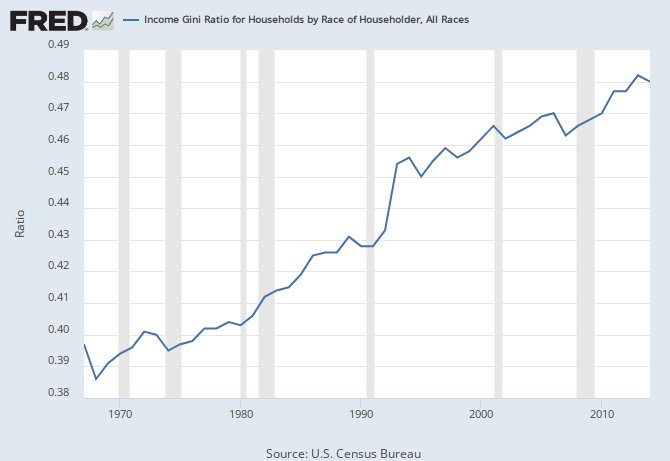
The income Gap has been growing for the past 45 years, partly because both political parties have convinced the voting public that benefit restriction is necessary:

monetary sovereignty
(The Gini ratio shows a Gap difference, with “0.000” meaning everyone has the same income and “1.000” meaning one person has all the income)

Although we speak of “the” Gap, there are, in fact, many Gaps. Not only is there a Wealth Gap, an Income Gap and a Power Gap, but there are Gaps between all levels.

For example, there is an Income Gap between the upper .1% income group and the 1% income group, and Gaps between every income group below.

There are Power Gaps between the President of the U.S. and any individual Congressperson, and the lay people below them.

There are salary Gaps, even among various employees in the same companies.

While every Gap has its own characteristics, a generalization can be made about all Gaps:

The occupants of each level wish to narrow the Gaps above themselves and to widen the Gaps below themselves.

The following article demonstrates this generality at play:

The $70,000 Minimum Wage Experiment Reveals A Dark Truth
Sam Becker, December 25, 2015

Earlier this year, a small Seattle-based payment processing company made headlines when its 31-year-old CEO made a rather jarring change to the company’s pay structure: Gravity Payments would pay all employees, at a bare minimum, $70,000 annually.

It was met with a variety of reactions, ranging from those who said CEO Dan Price was establishing himself as a working-class hero to those who thought he was actively destroying the fabric of society as we know it.

Price had read a study that said the optimal level of happiness can be achieved with an income at around $70,000, and decided that he was in a position to make a difference. So he acted on it — by cutting his own salary by 90%.

Now, with several months having passed, we’re beginning to see the fallout.

The company has lost a handful of clients, but it’s signed on even more — so many more that it’s had to go on a hiring spree.

The other unintended side effect of Price’s minimum wage policy has come from within the company.

According to reports, Gravity Payments lost two of their rock star employees, both who evidently thought it was unfair that other employees were getting big pay bumps, while not necessarily contributing as much to the company’s success.

Essentially, it rubbed them the wrong way that a receptionist was getting a huge raise, while not working harder than they were. They felt that the value of their skills had been diminished.

Said another way, the higher paid employees did not like the fact that the Income Gap between them and those below them had been narrowed. They looked upon the lower levels as being “inferior,” and did not want “inferior” people coming closer, physically, financially or in prestige.

This is comparable to the way the rich feel about the non-rich. “Keep your distance. If you come closer it diminishes our own status.”

We’re seeing similar sentiments pop up all over the country as calls for $15 minimum wages for fast food workers and others start to gain momentum. Basically, people don’t feel like someone who simply cooks fries, serves drinks, or parks cars should be paid that much.

The Gravity Payments employees who quit didn’t see their pay go down, or see a negative externality as a result of their coworkers’ wages going up. Yet, they were unhappy that their coworkers were better off.

It speaks to a certain psychological element that we see in many aspects of society — lots of people are only happy with success when it means that others around them are worse-off. It’s the view that the world is a zero-sum game, and that instead of everyone being better off, we need to have some losers.

The very rich — the .1% — make use of that psychology, by convincing the populace that those below them do not deserve help. Thus, the poor are portrayed by the rich as “lazy undeserving takers,” who if they receive welfare, would simply loll about and refuse to work.

Nevermind that the poor lead comparatively miserable lives, and few if any would prefer receiving welfare than receiving earned salaries. And nevermind that the working poor — the gardeners, car valets, house cleaners, waiters, fast food employees, factory workers, etc. — work harder and receive less for their efforts than do the rich.

The belief is widespread that the wealthy have earned their largess, while the poor have earned their misery. It is a belief disseminated by the rich and the people who have been bribed by the rich: The media, the politicians and the university economists.

Thus brainwashed, each level tends to vote against its own best interests, so long as those below are hurt more.

It also is a strange quirk of human psychology that the “good deed” of giving to charities benefitting those below seems satisfying, while allowing the government to do the same creates resentment.

NOTE to those who object to the government helping the poor and middle classes: Just know you are doing the dirty work of the rich at your own detriment.

That’s just “Gap dumb.”

Rodger Malcolm Mitchell
Monetary Sovereignty

===================================================================================
Ten Steps to Prosperity:
1. Eliminate FICA (Click here)
2. Federally funded Medicare — parts A, B & D plus long term nursing care — for everyone (Click here)
3. Provide an Economic Bonus to every man, woman and child in America, and/or every state a per capita Economic Bonus. (Click here) Or institute a reverse income tax.
4. Free education (including post-grad) for everyone. Click here
5. Salary for attending school (Click here)
6. Eliminate corporate taxes (Click here)
7. Increase the standard income tax deduction annually Click here
8. Tax the very rich (.1%) more, with higher, progressive tax rates on all forms of income. (Click here)
9. Federal ownership of all banks (Click here and here)

10. Increase federal spending on the myriad initiatives that benefit America’s 99% (Click here)

The Ten Steps will add dollars to the economy, stimulate the economy, and narrow the income/wealth/power Gap between the rich and the rest.
——————————————————————————————————————————————

10 Steps to Economic Misery: (Click here:)
1. Maintain or increase the FICA tax..
2. Spread the myth Social Security, Medicare and the U.S. government are insolvent.
3. Cut federal employment in the military, post office, other federal agencies.
4. Broaden the income tax base so more lower income people will pay.
5. Cut financial assistance to the states.
6. Spread the myth federal taxes pay for federal spending.
7. Allow banks to trade for their own accounts; save them when their investments go sour.
8. Never prosecute any banker for criminal activity.
9. Nominate arch conservatives to the Supreme Court.
10. Reduce the federal deficit and debt

No nation can tax itself into prosperity, nor grow without money growth. Monetary Sovereignty: Cutting federal deficits to grow the economy is like applying leeches to cure anemia.
1. A growing economy requires a growing supply of dollars (GDP=Federal Spending + Non-federal Spending + Net Exports)
2. All deficit spending grows the supply of dollars
3. The limit to federal deficit spending is an inflation that cannot be cured with interest rate control.
4. The limit to non-federal deficit spending is the ability to borrow.

THE RECESSION CLOCK

Recessions come only after the blue line drops below zero.

Monetary Sovereignty

Vertical gray bars mark recessions.

As the federal deficit growth lines drop, we approach recession, which will be cured only when the growth lines rise. Increasing federal deficit growth (aka “stimulus”) is necessary for long-term economic growth.

#MONETARYSOVEREIGNTY