Are you “Gap dumb”?

Twitter: @rodgermitchell; Search #monetarysovereignty
Facebook: Rodger Malcolm Mitchell

Mitchell’s laws:
•Those, who do not understand the differences between Monetary Sovereignty and monetary non-sovereignty, do not understand economics.
•Any monetarily NON-sovereign government — be it city, county, state or nation — that runs an ongoing trade deficit, eventually will run out of money.
•The more federal budgets are cut and taxes increased, the weaker an economy becomes..

Liberals think the purpose of government is to protect the poor and powerless from the rich and powerful. Conservatives think the purpose of government is to protect the rich and powerful from the poor and powerless.

•The single most important problem in economics is the Gap between rich and the rest..
•Austerity is the government’s method for widening
the Gap between rich and poor.
•Until the 99% understand the need for federal deficits, the upper 1% will rule.
•Everything in economics devolves to motive, and the motive is the Gap between the rich and the rest..

============================================================================================================================================================================================================================================================

Why would the middle classes agree to reduce such benefits as unemployment insurance, Social Security, Medicare, Medicaid, food stamps and other aids to the poor?

Many of those benefits aid the middle classes, yet they repeatedly vote to reduce them. They vote against their own interests, doing exactly what the rich want them to do. Why?

The Gap is the difference between the “haves” and the “have-nots,” the difference between the rich and the rest, the difference between the powerful and the powerless.

The income Gap has been growing for the past 45 years, partly because both political parties have convinced the voting public that benefit restriction is necessary:

monetary sovereignty
(The Gini ratio shows a Gap difference, with “0.000” meaning everyone has the same income and “1.000” meaning one person has all the income)

Although we speak of “the” Gap, there are, in fact, many Gaps. Not only is there a Wealth Gap, an Income Gap and a Power Gap, but there are Gaps between all levels.

For example, there is an Income Gap between the upper .1% income group and the 1% income group, and Gaps between every income group below.

There are Power Gaps between the President of the U.S. and any individual Congressperson, and the lay people below them.

There are salary Gaps, even among various employees in the same companies.

While every Gap has its own characteristics, a generalization can be made about all Gaps:

The occupants of each level wish to narrow the Gaps above themselves and to widen the Gaps below themselves.

The following article demonstrates this generality at play:

The $70,000 Minimum Wage Experiment Reveals A Dark Truth
Sam Becker, December 25, 2015

Earlier this year, a small Seattle-based payment processing company made headlines when its 31-year-old CEO made a rather jarring change to the company’s pay structure: Gravity Payments would pay all employees, at a bare minimum, $70,000 annually.

It was met with a variety of reactions, ranging from those who said CEO Dan Price was establishing himself as a working-class hero to those who thought he was actively destroying the fabric of society as we know it.

Price had read a study that said the optimal level of happiness can be achieved with an income at around $70,000, and decided that he was in a position to make a difference. So he acted on it — by cutting his own salary by 90%.

Now, with several months having passed, we’re beginning to see the fallout.

The company has lost a handful of clients, but it’s signed on even more — so many more that it’s had to go on a hiring spree.

The other unintended side effect of Price’s minimum wage policy has come from within the company.

According to reports, Gravity Payments lost two of their rock star employees, both who evidently thought it was unfair that other employees were getting big pay bumps, while not necessarily contributing as much to the company’s success.

Essentially, it rubbed them the wrong way that a receptionist was getting a huge raise, while not working harder than they were. They felt that the value of their skills had been diminished.

Said another way, the higher paid employees did not like the fact that the Income Gap between them and those below them had been narrowed. They looked upon the lower levels as being “inferior,” and did not want “inferior” people coming closer, physically, financially or in prestige.

This is comparable to the way the rich feel about the non-rich. “Keep your distance. If you come closer it diminishes our own status.”

We’re seeing similar sentiments pop up all over the country as calls for $15 minimum wages for fast food workers and others start to gain momentum. Basically, people don’t feel like someone who simply cooks fries, serves drinks, or parks cars should be paid that much.

The Gravity Payments employees who quit didn’t see their pay go down, or see a negative externality as a result of their coworkers’ wages going up. Yet, they were unhappy that their coworkers were better off.

It speaks to a certain psychological element that we see in many aspects of society — lots of people are only happy with success when it means that others around them are worse-off. It’s the view that the world is a zero-sum game, and that instead of everyone being better off, we need to have some losers.

The very rich — the .1% — make use of that psychology, by convincing the populace that those below them do not deserve help. Thus, the poor are portrayed by the rich as “lazy undeserving takers,” who if they receive welfare, would simply loll about and refuse to work.

Nevermind that the poor lead comparatively miserable lives, and few if any would prefer receiving welfare than receiving earned salaries. And nevermind that the working poor — the gardeners, car valets, house cleaners, waiters, fast food employees, factory workers, etc. — work harder and receive less for their efforts than do the rich.

The belief is widespread that the wealthy have earned their largess, while the poor have earned their misery. It is a belief disseminated by the rich and the people who have been bribed by the rich: The media, the politicians and the university economists.

Thus brainwashed, each level tends to vote against its own best interests, so long as those below are hurt more.

It also is a strange quirk of human psychology that the “good deed” of giving to charities benefitting those below seems satisfying, while allowing the government to do the same creates resentment.

NOTE to those who object to the government helping the poor and middle classes: Just know you are doing the dirty work of the rich at your own detriment.

That’s just “Gap dumb.”

Rodger Malcolm Mitchell
Monetary Sovereignty

===================================================================================
Ten Steps to Prosperity:
1. Eliminate FICA (Click here)
2. Federally funded Medicare — parts A, B & D plus long term nursing care — for everyone (Click here)
3. Provide an Economic Bonus to every man, woman and child in America, and/or every state a per capita Economic Bonus. (Click here) Or institute a reverse income tax.
4. Free education (including post-grad) for everyone. Click here
5. Salary for attending school (Click here)
6. Eliminate corporate taxes (Click here)
7. Increase the standard income tax deduction annually Click here
8. Tax the very rich (.1%) more, with higher, progressive tax rates on all forms of income. (Click here)
9. Federal ownership of all banks (Click here and here)

10. Increase federal spending on the myriad initiatives that benefit America’s 99% (Click here)

The Ten Steps will add dollars to the economy, stimulate the economy, and narrow the income/wealth/power Gap between the rich and the rest.
——————————————————————————————————————————————

10 Steps to Economic Misery: (Click here:)
1. Maintain or increase the FICA tax..
2. Spread the myth Social Security, Medicare and the U.S. government are insolvent.
3. Cut federal employment in the military, post office, other federal agencies.
4. Broaden the income tax base so more lower income people will pay.
5. Cut financial assistance to the states.
6. Spread the myth federal taxes pay for federal spending.
7. Allow banks to trade for their own accounts; save them when their investments go sour.
8. Never prosecute any banker for criminal activity.
9. Nominate arch conservatives to the Supreme Court.
10. Reduce the federal deficit and debt

No nation can tax itself into prosperity, nor grow without money growth. Monetary Sovereignty: Cutting federal deficits to grow the economy is like applying leeches to cure anemia.
1. A growing economy requires a growing supply of dollars (GDP=Federal Spending + Non-federal Spending + Net Exports)
2. All deficit spending grows the supply of dollars
3. The limit to federal deficit spending is an inflation that cannot be cured with interest rate control.
4. The limit to non-federal deficit spending is the ability to borrow.

THE RECESSION CLOCK

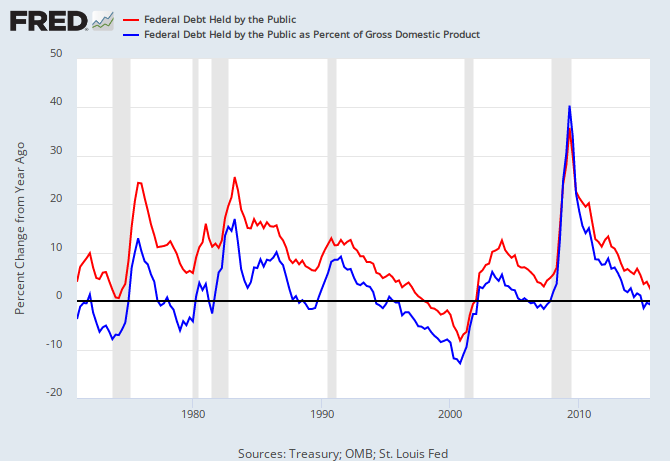
Recessions come only after the blue line drops below zero.

Monetary Sovereignty

Vertical gray bars mark recessions.

As the federal deficit growth lines drop, we approach recession, which will be cured only when the growth lines rise. Increasing federal deficit growth (aka “stimulus”) is necessary for long-term economic growth.

#MONETARYSOVEREIGNTY


Right wing perfection

Twitter: @rodgermitchell; Search #monetarysovereignty
Facebook: Rodger Malcolm Mitchell

Mitchell’s laws:
•Those, who do not understand the differences between Monetary Sovereignty and monetary non-sovereignty, do not understand economics.
•Any monetarily NON-sovereign government — be it city, county, state or nation — that runs an ongoing trade deficit, eventually will run out of money.
•The more federal budgets are cut and taxes increased, the weaker an economy becomes..

Liberals think the purpose of government is to protect the poor and powerless from the rich and powerful. Conservatives think the purpose of government is to protect the rich and powerful from the poor and powerless.

•The single most important problem in economics is the Gap between rich and the rest..
•Austerity is the government’s method for widening
the Gap between rich and poor.
•Until the 99% understand the need for federal deficits, the upper 1% will rule.
•Everything in economics devolves to motive, and the motive is the Gap between the rich and the rest..

============================================================================================================================================================================================================================================================

The following needs no embellishment. It is perfect, as is.

« December 18, 2015; Trump Lead Grows Nationally; 41% of His Voters Want to Bomb Country From Aladdin

Donald Trump holding his largest lead yet in the wake of Tuesday night’s debate.

He’s at 34% to 18% for Ted Cruz, 13% for Marco Rubio, 7% for Jeb Bush, 6% for Ben Carson, 5% for Chris Christie, 4% each for Carly Fiorina and Mike Huckabee.

Trump is the biggest gainer since our last national poll in mid-November, going from 26% to 34%. He’s also become more broadly popular with GOP voters, with his favorability rating going from 51/37 up to 58/34.

54% (of Republicans) support Trump’s proposed Muslim ban, to only 25% who oppose it.

To put some of these findings about real modern day issues and Trump voters in context, 41% of his voters think Japanese internment was a good thing, to 37% who don’t.

And 41% of his supporters would favor bombing Agrabah to only 9% who are opposed to doing that.

Overall 30% of Republican primary voters say they support bombing it to 13% who are opposed.

Agrabah does not exist. It is the fictional nation in a Disney movie titled, “Aladdin.”

But 41% of Trump supporters and 30% of Republicans want to bomb it.

Juan Cole, 41 Percent of Donald Trump Supporters Want to Bomb Aladdin and Jasmine

Only 19% of Democrats were knee-jerk bombers, and 36% were firmly opposed to reducing the cartoon land to smouldering cellulose. That 19% of Democrats wanted to bomb is pretty bad, obviously.

But it is interesting that the most belligerent constituencies besides Trump were supporters of Jeb Bush, Ted Cruz and Chris Christie.

I suppose Bush acolytes figure they know what a Bush would get up to. And after all, all those Neoconservatives who engineered the Iraq War are in his brain trust.

Christie, being a bully, likely attracts other bullies.

It is hard to know if the Cruz devotees are militarily aggressive or just addled like their leader.

All those Republicans, who were brainwashed and incited by the bombastic speeches of their leaders, now want to bomb “Agrabah” and kill its people, simply because it has an Arabian-sounding name.

They know nothing about Agrabah, but by God, they know they want to murder the men, women and children who live there.

What does that tell you about today’s Republican candidates? What does that tell you about today’s “religious” right-wing, gun-nut voters?

Perfect.

Rodger Malcolm Mitchell
Monetary Sovereignty

===================================================================================
Ten Steps to Prosperity:
1. Eliminate FICA (Click here)
2. Federally funded Medicare — parts A, B & D plus long term nursing care — for everyone (Click here)
3. Provide an Economic Bonus to every man, woman and child in America, and/or every state a per capita Economic Bonus. (Click here) Or institute a reverse income tax.
4. Free education (including post-grad) for everyone. Click here
5. Salary for attending school (Click here)
6. Eliminate corporate taxes (Click here)
7. Increase the standard income tax deduction annually Click here
8. Tax the very rich (.1%) more, with higher, progressive tax rates on all forms of income. (Click here)
9. Federal ownership of all banks (Click here and here)

10. Increase federal spending on the myriad initiatives that benefit America’s 99% (Click here)

The Ten Steps will add dollars to the economy, stimulate the economy, and narrow the income/wealth/power Gap between the rich and the rest.
——————————————————————————————————————————————

10 Steps to Economic Misery: (Click here:)
1. Maintain or increase the FICA tax..
2. Spread the myth Social Security, Medicare and the U.S. government are insolvent.
3. Cut federal employment in the military, post office, other federal agencies.
4. Broaden the income tax base so more lower income people will pay.
5. Cut financial assistance to the states.
6. Spread the myth federal taxes pay for federal spending.
7. Allow banks to trade for their own accounts; save them when their investments go sour.
8. Never prosecute any banker for criminal activity.
9. Nominate arch conservatives to the Supreme Court.
10. Reduce the federal deficit and debt

No nation can tax itself into prosperity, nor grow without money growth. Monetary Sovereignty: Cutting federal deficits to grow the economy is like applying leeches to cure anemia.
1. A growing economy requires a growing supply of dollars (GDP=Federal Spending + Non-federal Spending + Net Exports)
2. All deficit spending grows the supply of dollars
3. The limit to federal deficit spending is an inflation that cannot be cured with interest rate control.
4. The limit to non-federal deficit spending is the ability to borrow.

THE RECESSION CLOCK

Recessions come only after the blue line drops below zero.

Monetary Sovereignty

Vertical gray bars mark recessions.

As the federal deficit growth lines drop, we approach recession, which will be cured only when the growth lines rise. Increasing federal deficit growth (aka “stimulus”) is necessary for long-term economic growth.

#MONETARYSOVEREIGNTY

The most economically destructive question: “Who will pay for it?”

Twitter: @rodgermitchell; Search #monetarysovereignty
Facebook: Rodger Malcolm Mitchell

Mitchell’s laws:
•Those, who do not understand the differences between Monetary Sovereignty and monetary non-sovereignty, do not understand economics.
•Any monetarily NON-sovereign government — be it city, county, state or nation — that runs an ongoing trade deficit, eventually will run out of money.
•The more federal budgets are cut and taxes increased, the weaker an economy becomes..

Liberals think the purpose of government is to protect the poor and powerless from the rich and powerful. Conservatives think the purpose of government is to protect the rich and powerful from the poor and powerless.

•The single most important problem in economics is the Gap between rich and the rest..
•Austerity is the government’s method for widening
the Gap between rich and poor.
•Until the 99% understand the need for federal deficits, the upper 1% will rule.
•Everything in economics devolves to motive, and the motive is the Gap between the rich and the rest..

============================================================================================================================================================================================================================================================

Just because its title is “Fact Check,” doesn’t mean it actually is checking facts

AP FACT CHECK: Glossed-over realities in Democratic debate
By RICARDO ALONSO-ZALDIVAR and JOSH BOAK

A look at some of the statements Saturday night and how they compare with the facts:

CLINTON on rising premiums and out-of-pocket costs for the privately insured after enactment of Obama’s health care law: “I would certainly build on the successes of the Affordable Care Act and work to fix some of the glitches.”

THE FACTS: Obama’s law was mainly about expanding coverage for the uninsured, and even former officials of his administration say major work still has to be done on cost control. In other words, rising costs are more than “glitches.”

One of the health care law’s main brakes on costs — a tax on high-value workplace coverage — has been put on hold by the new federal budget deal. Clinton had called for complete repeal of that levy, known as the Cadillac tax. Many economists believe the tax would help keep costs in check by forcing people into leaner insurance plans.

The real facts: “Cost control,” as it currently is used, has little to do with efficiency, productivity, better service, better medical outcome or any other positive feature.

Rather, “cost control” is a euphemism for Make the public pay more and the federal government pay less.

The federal government has the unlimited ability to pay, and its payments enrich the economy — two facts never mentioned.

SANDERS on his proposed single-payer health care system: “The average middle-class family will be saving thousands of dollars a year.”

Sanders says his plan for a government-run health care system along the lines of Canada’s and Western Europe’s would save money for families and taxpayers.

But such a major transition would involve winners and losers, as well as new taxes in place of premiums.

When the nonpartisan Congressional Budget Office looked at the concept back in the early 1990s, it concluded that a single-payer system had the potential to save money but that wasn’t guaranteed.

Moreover, individuals would have less freedom to choose their insurance packages, a trade-off that not everyone would accept.

The real facts: A true single payer system need not involve any new taxes. Our Monetarily Sovereign government does not need to levy taxes to fund payment.

Federal taxes do not fund federal spending. That is the essence of Monetary Sovereignty.

The purpose of a single-payer system is not to save the government money; the purpose is to save the people money and to provide health care for all.

Trying to save the government money not only is negative for the economy, but leads to a complex, convoluted, Rube Goldbergian system like Obamacare.

Finally, with single payer, individuals do not need “freedom to choose their insurance packages.” The single payer pays for hospitals, doctors and procedures, so no so-called “freedom” is necessary.

SANDERS: “The cost of college education is escalating a lot faster than the cost of inflation. There are a lot of factors involved in that. And that is that we have some colleges and universities that are spending a huge amount of money on fancy dormitories and on giant football stadiums.”

CLINTON: “States have been disinvesting in higher education … So states over a period of decades have put their money elsewhere; into prisons, into highways, into things other than higher education.”

THE FACTS: Clinton comes closest to diagnosing the problem accurately. College expenses are unsustainably high, but luxurious dorms aren’t the big driver that Sanders portrays. Public universities are charging more because they receive less in state government support.

Demos, a left-leaning think tank, said in a May study that the decline in state funding accounted for 79 percent of tuition hikes between 2001 and 2011. Just 6 percent was due to construction costs.

True: College costs have become completely unaffordable for many families, and a life-style sacrifice for most families. And the states are struggling to pay their bills.

So, here is the problem:

Sanders would make up that lost government money by providing free tuition, paid for with a tax on financial transactions.

Clinton would offer federal dollars to encourage states to do more and keep students from having to borrow.

It’s unclear how either plan would control colleges’ costs, though.

In short, both candidates and indeed, both political parties, want to make college affordability an obligation of the private, monetarily non-sovereign sector (states and colleges), while saving dollars for the Monetarily Sovereign entity (the federal government), which has no need to save money.

In government speak, “saving” means increased taxes or cutting benefits to the economy, so long as the federal government spends less.

SANDERS: “Middle class in this country for the last 40 years has been disappearing.”

THE FACTS: It’s no secret that the middle class is struggling. The costs of college, health care and housing continue to rise, while wages have barely budged for two decades.

The Pew Research Center reported earlier this month that the majority of Americans are no longer “middle income.”

“The closer look at the shift out of the middle reveals that a deeper polarization is under way in the American economy,” Pew concluded.

Every new benefit to the economy is required to answer the question, “Who will pay for it?” meaning that all benefits to the people must be paid for by the people, i.e. there would be no federal benefits.

When the middle classes and the poor need help, then the middle classes and the poor will have to pay for that help. Don’t ask the federal government to do anything.

Convincing the public to save money for the federal government (which needs no financial protection), rather than to protect the private sector (which is desperate for financial help), has been the great triumph of the rich over the rest — the great triumph of senselessness over logic — the great triumph of fiction over fact:

The most economically destructive question: “Who will pay for it?”

Rodger Malcolm Mitchell
Monetary Sovereignty

===================================================================================
Ten Steps to Prosperity:
1. Eliminate FICA (Click here)
2. Federally funded Medicare — parts A, B & D plus long term nursing care — for everyone (Click here)
3. Provide an Economic Bonus to every man, woman and child in America, and/or every state a per capita Economic Bonus. (Click here) Or institute a reverse income tax.
4. Free education (including post-grad) for everyone. Click here
5. Salary for attending school (Click here)
6. Eliminate corporate taxes (Click here)
7. Increase the standard income tax deduction annually Click here
8. Tax the very rich (.1%) more, with higher, progressive tax rates on all forms of income. (Click here)
9. Federal ownership of all banks (Click here and here)

10. Increase federal spending on the myriad initiatives that benefit America’s 99% (Click here)

The Ten Steps will add dollars to the economy, stimulate the economy, and narrow the income/wealth/power Gap between the rich and the rest.
——————————————————————————————————————————————

10 Steps to Economic Misery: (Click here:)
1. Maintain or increase the FICA tax..
2. Spread the myth Social Security, Medicare and the U.S. government are insolvent.
3. Cut federal employment in the military, post office, other federal agencies.
4. Broaden the income tax base so more lower income people will pay.
5. Cut financial assistance to the states.
6. Spread the myth federal taxes pay for federal spending.
7. Allow banks to trade for their own accounts; save them when their investments go sour.
8. Never prosecute any banker for criminal activity.
9. Nominate arch conservatives to the Supreme Court.
10. Reduce the federal deficit and debt

No nation can tax itself into prosperity, nor grow without money growth. Monetary Sovereignty: Cutting federal deficits to grow the economy is like applying leeches to cure anemia.
1. A growing economy requires a growing supply of dollars (GDP=Federal Spending + Non-federal Spending + Net Exports)
2. All deficit spending grows the supply of dollars
3. The limit to federal deficit spending is an inflation that cannot be cured with interest rate control.
4. The limit to non-federal deficit spending is the ability to borrow.

THE RECESSION CLOCK

Recessions come only after the blue line drops below zero.

Monetary Sovereignty

Vertical gray bars mark recessions.

As the federal deficit growth lines drop, we approach recession, which will be cured only when the growth lines rise. Increasing federal deficit growth (aka “stimulus”) is necessary for long-term economic growth.

#MONETARYSOVEREIGNTY

Student loans and the unforgivable debt

Twitter: @rodgermitchell; Search #monetarysovereignty

Facebook: Rodger Malcolm Mitchell

Mitchell’s laws:

•Those, who do not understand the differences between Monetary Sovereignty and monetary non-sovereignty, do not understand economics.

•Any monetarily NON-sovereign government — be it city, county, state or nation — that runs an ongoing trade deficit, eventually will run out of money.

•The more federal budgets are cut and taxes increased, the weaker an economy becomes..

Liberals think the purpose of government is to protect the poor and powerless from the rich and powerful. Conservatives think the purpose of government is to protect the rich and powerful from the poor and powerless.

•The single most important problem in economics is the Gap between rich and the rest..

•Austerity is the government’s method for widening the Gap between rich and poor.

•Until the 99% understand the need for federal deficits, the upper 1% will rule.

•Everything in economics devolves to motive, and the motive is the Gap between the rich and the rest..

============================================================================================================================================================================================================================================================

I know of no undertaking more important to the growth, success and survival of America than the education of our people.

Our forefathers knew it:

Historical Timeline of Public Education in the US

1647: The General Court of the Massachusetts Bay Colony decrees that every town of fifty families should have an elementary school and that every town of 100 families should have a Latin school.

1790: Pennsylvania state constitution calls for free public education but only for poor children. It is expected that rich people will pay for their children’s schooling.

1817: A petition presented in the Boston Town Meeting calls for establishing of a system of free public primary schools. Main support comes from local merchants, businessmen and wealthier artisans. Many wage earners oppose it, because they don’t want to pay the taxes.

1820: First public high school in the U.S., Boston English, opens.

1827: Massachusetts passes a law making all grades of public school open to all pupils free of charge.

1851: State of Massachusetts passes first its compulsory education law.

Today, free education, grades K – 12, is available to virtually all Americans, and mostly mandatory for those 18 and under. This education is paid for by monetarily non-sovereign governments: State, county, city, village — i.e., it is paid for by taxpayers.

Through time, mechanization and technology have made America’s competitiveness and success dependent on education beyond grade 12.

1945: At the end of World War 2, the G.I. Bill of Rights gives thousands of working class men college scholarships for the first time in U.S. history.

The “Ten Steps to Prosperity” (below) contains two steps directly addressing education:

4. Free education (including post-grad) for everyone. Click here

5. Salary for attending school (Click here)

The November 30th issue of Time Magazine contains an article titled, “But can America afford this approach to solving the student debt,” by Haley Sweetland Edwards:

“I’m a correspondent at TIME. Previously, I was an editor at the Washington Monthly, where I wrote about policy and regulation. I studied philosophy and history at Yale and journalism and politics at Columbia.”

Some thoughts from Ms. Edwards’s article:

Tens of millions of Americans collectively owe $1.3 trillion in student debt.

In the past eight years, the federal government has quietly, almost imperceptibly, changed the rules of the loan game. It has made itself the primary bank for students and put in place an expansive new safety net.

Rather than owing for-profit lenders, students will owe dollars to the federal government, which being Monetarily Sovereign, has no need to collect dollars from students.

A key provision allows all federal borrowers to cap their monthly payments at 10% or 15% of their discretionary income and wipes any remaining balance off the books after 20 or 25 years.

The great “improvement” is that students will not be in debt for life; they will be in debt “only” for their first 20-25 years after college, the prime family-building times of their lives.

Paying this debt effectively will require their children to apply for school debt, and so the cycle will continue.

Bush and Rubio have advanced higher-education plans that would overhaul the accreditation process to clear the wary for new, online institutions offering cut-rate degrees.

The thought of online institutions offering cut-rate degrees to the masses, makes one shiver.

It is the perfect right-wing solution, guaranteed to widen the gap between the rich (who can afford the best brick-and-mortar universities), and the rest (who will be “educated” by cut-rate, online schools.)

Hillary Clinton offers a smorgasbord approach, including cutting loan-interest rates, expanding existing grant programs and offering rewards to colleges that keep their tuition low.

In short, she offers the typical left-wing, complex, convoluted Obamacare-esque sort of, not quite, pretend solution to two problems that need real solutions: Eliminating onerous student debt and educating our population.

And now, for the inevitable Big Lie:

But this new federal safety net contains serious flaws. The Brookings Institution estimated that it could cost taxpayers $250 billion over the next 10 years.

Wrong, of course. Taxpayers do not fund federal spending. That is the basis for Monetary Sovereignty, and is the fundamental difference between the Monetarily Sovereign federal government and the monetarily non-sovereign state and local governments.

And here, Ms. Edwards repeats the Big Lie:

It allows (students) to run up vast debts . . . and to leave future taxpayers holding the bag.

Oh, well, it is ever thus. Anyway, she gets down to the rest of the problem:

Perhaps most damning, while the program takes the pressure off students, it does nothing to control the actual price of tuition, which has risen like crazy for years.

It also arguably makes it more likely that tuition will rise even more quickly in the future, as students’ ability to pay becomes a moot point.

First, it won’t really be a “moot point,” because student still will pay. The rich ones will pay out of their own checkbooks, and the rest again will take out loans. The loan payments merely will be capped.

But let’s get beyond the details and explore the theory, which is: Federal support makes ability to pay moot, so prices will rise. Is this a justifiable concern and is it a real problem?

The closest parallel I can think of is Medicare. It pays most of the doctors’ bills. And if you ever review those bills to see what Medicare pays doctors, you will find that far from being out of control, they are so “in control,” that most doctors are underpaid.

With but few exceptions, doctors net less today than they did in the pre-Medicare days. Medicare actually has held down fees. So much for the effects of the “moot point.”

Though health care costs have risen, most of that rise can be attributed to more sophisticated and expensive tests with more sophisticated and expensive machines and better hospital facilities. (Are you old enough to remember when nearly all hospital rooms were “doubles,” “triples” or “wards”?)

But, let’s say, for argument sake, that university tuitions do rise dramatically, because of the “moot point” effect, and that the federal government pays a great deal more, and schools and teachers get rich. Here’s what would happen:

–The government would pump more dollars into the economy, which would grow the economy.

–The public schools would receive more dollars, requiring less state taxes to support them.

–Some private schools would expand and improve their facilities while others simply would get rich

–Teachers’ pay would increase, resulting in more people and better people wanting to be teachers.

–Students wouldn’t have to shop around for scholarships, some of which require free labor (Think: Athletic scholarships)

–Schools wouldn’t have to shop around for donors, many of whom come with “strings” (Think: Koch brothers dictating curriculums)

Frankly, I can’t imagine a single reason why rising, federally funded tuitions would be harmful, and if there are any, surely the benefits would outweigh them.

Ms. Edwards’s article includes many interesting points, and I advise you to read it in the Time Magazine issue. But all her points have to do with loan capping, scholarships and grants, and none really levels the playing field between the rich and the rest, and none eliminates the financial penalty for attending college.

So we are left with two questions:

1. Is it in America’s best interests for all those who want a college education to be able to afford it?

2. Should the federal government fund what is in the nation’s best interests?

At the end of World War II, our answer to both questions was, “Yes.” Sadly, we have drifted away from sense and into the Big Lie. We have made it more difficult to earn a college education, when we should be making it easier.

Bottom line: The entire student loan program is unforgivable, in every sense of that word.

Rodger Malcolm Mitchell

Monetary Sovereignty

===================================================================================

Ten Steps to Prosperity:

1. Eliminate FICA (Click here)

2. Federally funded Medicare — parts A, B & D plus long term nursing care — for everyone (Click here)

3. Provide an Economic Bonus to every man, woman and child in America, and/or every state a per capita Economic Bonus. (Click here) Or institute a reverse income tax.

4. Free education (including post-grad) for everyone. Click here

5. Salary for attending school (Click here)

6. Eliminate corporate taxes (Click here)

7. Increase the standard income tax deduction annually Click here

8. Tax the very rich (.1%) more, with higher, progressive tax rates on all forms of income. (Click here)

9. Federal ownership of all banks (Click here and here)

10. Increase federal spending on the myriad initiatives that benefit America’s 99% (Click here)

The Ten Steps will add dollars to the economy, stimulate the economy, and narrow the income/wealth/power Gap between the rich and the rest.

——————————————————————————————————————————————

10 Steps to Economic Misery: (Click here:)

1. Maintain or increase the FICA tax..

2. Spread the myth Social Security, Medicare and the U.S. government are insolvent.

3. Cut federal employment in the military, post office, other federal agencies.

4. Broaden the income tax base so more lower income people will pay.

5. Cut financial assistance to the states.

6. Spread the myth federal taxes pay for federal spending.

7. Allow banks to trade for their own accounts; save them when their investments go sour.

8. Never prosecute any banker for criminal activity.

9. Nominate arch conservatives to the Supreme Court.

10. Reduce the federal deficit and debt

No nation can tax itself into prosperity, nor grow without money growth. Monetary Sovereignty: Cutting federal deficits to grow the economy is like applying leeches to cure anemia.

1. A growing economy requires a growing supply of dollars (GDP=Federal Spending + Non-federal Spending + Net Exports)

2. All deficit spending grows the supply of dollars

3. The limit to federal deficit spending is an inflation that cannot be cured with interest rate control.

4. The limit to non-federal deficit spending is the ability to borrow.

THE RECESSION CLOCK

Recessions come only after the blue line drops below zero.

Monetary Sovereignty

Vertical gray bars mark recessions.

As the federal deficit growth lines drop, we approach recession, which will be cured only when the growth lines rise. Increasing federal deficit growth (aka “stimulus”) is necessary for long-term economic growth.

#MONETARYSOVEREIGNTY