Economists debate Bernie. Who cares? No one.

Twitter: @rodgermitchell; Search #monetarysovereignty
Facebook: Rodger Malcolm Mitchell

============================================================================================================================================================================================================================================================

Economists enjoy talking to themselves. They especially enjoy “speaking in tongues,” debating social issues in such abstruse terms, the public neither understands nor cares.

Lately, they have debated Bernie Sanders, who clearly and simply has offered the best proposals of any Presidential candidate. According to his web site, here are but a few of the things Bernie would like to do:

–Create a progressive estate tax on the top 0.3 percent of Americans who inherit more than $3.5 million.
–Increase the federal minimum wage from $7.25 to $15 an hour by 2020.
Invest $1 trillion over five years towards rebuilding our crumbling roads, bridges, railways, airports, public transit systems, ports, dams, wastewater plants, and other infrastructure needs.
–Make tuition free at public colleges and universities throughout America.
–Enact a Medicare for all single-payer healthcare system.
Break up huge financial institutions so that they are no longer too big to fail.
–Tax carbon pollution, repeal fossil fuel subsidies and invest in energy efficiency and clean, sustainable energy such as wind and solar power.
–Create a Clean-Energy Workforce of 10 million good-paying jobs by creating a 100% clean energy system.
–Fight to overturn Citizens United.
–Dismantle inhumane deportation programs and detention centers.
–Pave the way for a swift and fair legislative roadmap to citizenship for the eleven million undocumented immigrants.
–Federally fund and require body cameras for law enforcement officers.
–Ban prisons for profit.
–Fully fund and expand the VA

These are good ideas, adult ideas. Some are part of the Ten Steps to Prosperity (below).

Go to Bernie’s web site, and compare his ideas with those of the other candidates. You’ll find no ridiculous “build-a-wall-and-make-Mexico-pay.” No nonsensical “global-warming-is-a-myth.” No destructive “cut-Social-Security-and-Medicare-to-balance-the-budget.”

Bernie’s ideas, taken in total, clearly are the best of any candidate.

Unfortunately, economists, like the public at large, don’t really like to think in those terms. They, also like the public at large, prefer to fixate on one narrow issue, and critique an entire plan based on that one issue.

In the case of the public, the one issue might be abortion, or gay marriage, or education or gender. In the case of the economists, there are two issues — affordability and inflation — which are not real issue.

Consider this article:

CEA Chair’s Critique of Sanders Economics Is Well Wide of the Mark
Alan Harvey

On February 17, Christina Romer and three other former Council of Economic Advisers (CEA) chairs joined in a letter in panning economist Gerald Friedman’s analysis of Bernie Sanders’ economic plan.

They ridiculed his findings and by implication Sanders’ economics.

Where Friedman found substantial positive impacts from the substantial initiatives in the plan, the four former chief economists to the president found fairy tales and flying puppies. In less than twenty-four hours there was pushback, from James K. Galbraith, among others.

Galbraith’s letter criticized the CEA chairs for using high position rather than reasoned examination, and excoriating their lesser-known colleague without foundation. Indeed, detail was conspicuously absent. Galbraith described the model used by Friedman was not out of line with what the CBO and CEA themselves employ and the results were consistent with historical precedent.

The economists are debating something that exists only in the hopeful imaginations of economists: An economic model.

A model is a mathematical “If/then” prediction. “If A happens, then Z will happen.” This works quite well in physics, less well in quantum mechanics, and hardly at all in a social science, i.e. economics.

The problem with social sciences is that they describe people, and people are so darn unpredictable, both individually and in groups. So an economic model becomes, “If 2.76A times 3.43B divided by 5.63C . . . cubed by 8.46V . . . plus 6.47X all happen in exactly the right sequence, then Z probably will happen.

But that is what economists like to argue about.

A few days later, Romer and her economist husband David Romer provided detail.

We had a chance to review the Friedman report, the Romers’ paper, and Friedman’s rebuttal. We found that the Romers’ basic critique is weak, and Friedman is correct in saying it is based on a brittle understanding of how the economy works.

Friedman’s model imagines a dynamic economy, the Romers a very static economy. The view that government investment and spending can expand the economy is explicit in Friedman’s view. The Romers suggest that things may get better while the spending is going on, but will contract to the previous state, or even below, once it’s over.

A non-economist might ask, “If everyone agrees that things get better when federal spending is going on, why stop federal spending?”

But no, economists don’t think that way. They want to fight about the details of “the model,” specific effects that absolutely are not predictable.

It’s like fighting about the exact amount of rain in Chicago on a day five years in the future.

The Romers appeal to a higher law, a “standard economics” as if it were a universally accepted and validated norm that Friedman does not understand.

They define error as deviation from this standard economics.

While it may be that the static equilibrium view they hold is the flavor of the moment in Academia, it is far from being universally accepted, nor has it always been the norm.

Friedman points out in his rebuttal that his is closer to the economics of Keynes. (The “standard economics’ of the moment comes under the title “New Keynesian,” but much like the program of Neoliberalism is not liberal as most use the term, nor are Neoclassical economists very close to Classicals, New Keynesians owe more to John Hicks and Paul Samuelson and early 20th century economists than they do to John Maynard Keynes.)

The article goes on and on in this vein, and actually is well written considering the subject matter — except for one not-so-small detail.

Michal Kalecki, a major economist in the middle of the 20th century once characterized another “standard” economics when he once observed:

“A solid majority of economists is now of the opinion that, even in a capitalist system, full employment may be secured by a government spending programme

. . . If the government undertakes public investment (e.g., builds schools, hospitals and highways) or subsidizes mass consumption (by family allowances, reduction of indirect taxation, or subsidies to keep down the prices of necessities), and if this expenditure is financed by borrowing and not by taxation … . . . the effective demand for goods and services may be increased up to a point where full employment is achieved.)
[from “Political Aspects of Full Employment”]

Another, more appropriate term for the Romers’ “standard” economics would be “failed,” since economists of this school universally failed to see the Great Financial Crisis coming, to understand it when it happened, and to effectively mitigate many of its impacts.

It failed Christina Romer herself, as we noted in our previous piece, when as CEA chair during the Obama stimulus period she predicted an immediate turnaround in employment, as the stimulus accelerated the natural return to equilibrium.

When the effects failed to materialize as she predicted, the policy of government spending as a corrective was discredited, at least in political circles, and so it remains to this day.

Did you see that line, ” . . . if this expenditure is financed by borrowing and not by taxation . . . “?

Readers of this blog know that federal spending NEVER is financed by borrowing or by taxing. The federal government, uniquely being Monetarily Sovereign, creates its own sovereign currency ad hoc, whenever it pays a bill.

So the fake “affordability” issue is raised, quoted and left undenied.

Then we come to the other issue, inflation, which IS properly denied:

The Federal Reserve – itself in the grip of another major fallacy of standard economics – is almost sure to squelch recovery once it begins for fear of inflation.

The Romers say “interest rates will rise.” But in fact, as they admit elsewhere, rates will rise not for any natural or market-driven reason, but because the Fed will raise them.

Informing, if that is the word, the Fed’s raising rates is the doctrine of NAIRU. NAIRU, the Non-Accelerating Inflation Rate of Unemployment, is a fallacy that contends that at some indistinct and moving rate of unemployment the inflation genie will get out of the bottle and run amok.

NAIRU survived both the stagflation of the 1970s and the high employment/low inflation of the 1990s and the era previous to 1963, and became a favorite of Alan Greenspan.

It is highly likely the Fed will act from its belief in NAIRU in the belief it is preventing a runaway inflation, and likely will abort any expansion by raising interest rates and inciting a slowdown.

Here, we see the economists version of this scenario: “Federal spending increases employment and causes inflation, which causes the Fed to raise interest rates, which causes recession.

Yes, federal spending can increase employment. And yes, federal spending can increase inflation. And yes, the fed worries about inflation almost as much as it worries about deflation, so will likely raise interest rates at the mere hint of inflation.

BUT, raising interest rates does NOT slow the economy. In fact, if anything it can stimulate the economy by forcing the federal government to pay more interest into the economy.

I cannot do justice to Mr. Harvey’s excellent article or Bernie Sanders excellent proposals, so I recommend you visit both.

The sad bottom line to all of this is: Economists cannot see the forest because they are focused on a tree, and the public cannot see the tree because they are focused on a leaf, and virtually no one cares about facts.

Elections are decided on the “cut of his jib” basis, not on reality.

So Trump is “tough,” and Cruz is “mean,” and Kasich is “adult,” and Clinton is “untrustworthy” and Sanders is “crazy,” and that is how the people, in their profound and stubborn ignorance, will vote.

Meanwhile, the economists will babble incoherently about the number of angels who can dance on the head of a pin — or is it the point of a pin — while making wrong predictions based on wrong assumptions.

It was ever thus.

Rodger Malcolm Mitchell
Monetary Sovereignty


===================================================================================
Ten Steps to Prosperity:
1. Eliminate FICA (Click here)
2. Federally funded Medicare — parts A, B & D plus long term nursing care — for everyone (Click here)
3. Provide an Economic Bonus to every man, woman and child in America, and/or every state a per capita Economic Bonus. (Click here) Or institute a reverse income tax.
4. Free education (including post-grad) for everyone. Click here
5. Salary for attending school (Click here)
6. Eliminate corporate taxes (Click here)
7. Increase the standard income tax deduction annually Click here
8. Tax the very rich (.1%) more, with higher, progressive tax rates on all forms of income. (Click here)
9. Federal ownership of all banks (Click here and here)

10. Increase federal spending on the myriad initiatives that benefit America’s 99% (Click here)

The Ten Steps will grow the economy, and narrow the income/wealth/power Gap between the rich and you.
========================================================================================================================================================================================================================================================================================================

10 Steps to Economic Misery: (Click here:)
1. Maintain or increase the FICA tax..
2. Spread the myth Social Security, Medicare and the U.S. government are insolvent.
3. Cut federal employment in the military, post office, other federal agencies.
4. Broaden the income tax base so more lower income people will pay.
5. Cut financial assistance to the states.
6. Spread the myth federal taxes pay for federal spending.
7. Allow banks to trade for their own accounts; save them when their investments go sour.
8. Never prosecute any banker for criminal activity.
9. Nominate arch conservatives to the Supreme Court.
10. Reduce the federal deficit and debt

THE RECESSION CLOCK

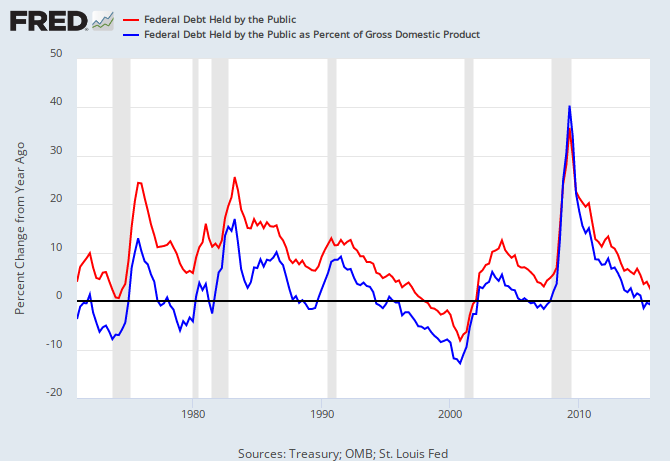
Recessions begin an average of 2 years after the blue line first dips below zero. A common phenomenon is for the line briefly to dip below zero, then rise above zero, before falling dramatically below zero. There was a brief dip below zero in 2015, followed by another dip – the familiar pre-recession pattern.
Recessions are cured by a rising red line.
Monetary Sovereignty

Vertical gray bars mark recessions.

As the federal deficit growth lines drop, we approach recession, which will be cured only when the growth lines rise. Increasing federal deficit growth (aka “stimulus”) is necessary for long-term economic growth.

————————————————————————————————————————————————————————————————————————————————————————————————-

Mitchell’s laws:
•Those, who do not understand the differences between Monetary Sovereignty and monetary non-sovereignty, do not understand economics.
•Any monetarily NON-sovereign government — be it city, county, state or nation — that runs an ongoing trade deficit, eventually will run out of money.
•The more federal budgets are cut and taxes increased, the weaker an economy becomes..

•No nation can tax itself into prosperity, nor grow without money growth.
•Cutting federal deficits to grow the economy is like applying leeches to cure anemia.
•A growing economy requires a growing supply of money (GDP = Federal Spending + Non-federal Spending + Net Exports)
•Deficit spending grows the supply of money
•The limit to federal deficit spending is an inflation that cannot be cured with interest rate control.
•The limit to non-federal deficit spending is the ability to borrow.

Liberals think the purpose of government is to protect the poor and powerless from the rich and powerful. Conservatives think the purpose of government is to protect the rich and powerful from the poor and powerless.

•The single most important problem in economics is the Gap between rich and the rest..
•Austerity is the government’s method for widening
the Gap between rich and poor.
•Until the 99% understand the need for federal deficits, the upper 1% will rule.
•Everything in economics devolves to motive, and the motive is the Gap between the rich and the rest..

MONETARY SOVEREIGNTY


Bernie Sanders’ litmus test for the Supreme Court

Twitter: @rodgermitchell; Search #monetarysovereignty
Facebook: Rodger Malcolm Mitchell

============================================================================================================================================================================================================================================================

Bernie Sanders has a litmus test for his Supreme Court nominations:

By Eric Bradner, CNN, Updated 10:58 AM ET, Sun May 10, 2015

Bernie Sanders says he’d have a litmus test for Supreme Court nominees if he’s elected president: They’d all support overturning the Citizens United decision.

The Vermont senator who’s seeking the Democratic presidential nomination said Sunday on CBS’s “Face the Nation” that he wants to “overturn this disastrous decision” that allowed unfettered spending on politics by unions and corporations, rolling back campaign finance contribution limits.

He said Sunday that mega-donors like the conservative brothers Charles and David Koch will play an outsized role in determining the party nominees in 2016.

“There is in my view massive dissatisfaction in this country today with corporate establishment and the greed of corporate America,” Sanders said.

The court decided Citizens United in 2010, but in the decision encouraged Congress to pass more robust campaign spending disclosure laws. Congress, however, has failed to do so.

In principle, I find such litmus tests abhorrent. The notion of a judge, saying in advance, how he or she will vote on any case, before even hearing the case, is a mockery of justice.

Oh, let’s get real. Every nominee for the Supreme Court has stated, either overtly or via his opinions, where he stands on a myriad of issues. I cannot imagine a President submitting a nominee, without have a very good fix on how that nominee will vote.

Oh, let’s get even more real. Supreme Court justices love to demonstrate their independence, and in doing so, a strange thing happens: They often become more progressive.

Perhaps the reason is that they begin to understand the massive human implications of their decisions. It is one thing to judge an individual case in a lower court, a case that has meaning primarily for a single claimant and a single defendant.

It is quite another thing to judge a case that has implications for every man, woman and child in America — a case that if judged wrongly, can shatter thousands, if not millions, of lives.

Thus, a judge may enter the Supreme Court viewing himself as a strict constructionist or even an originalist. Later, he may come to care more about history’s view of him, and realize those rigid legal, but inhumane, decisions will not long be admired.

Justice Scalia, for instance, despite his acknowledged brilliance, never seemed to understand. My belief is history will not remember him kindly — his passionate concurrences in such cases as Burwell v. Hobby Lobby Stores, Inc and Citizens United v. Federal Election Commission, and his statements that money is free speech.

I also believe Justice Roberts may have been trying to lift his own place in history, with his defense of the Affordable Care Act in National Federation of Independent Business v. Sebelius and again in King v. Burwell.

We never will know his motives, but while denying health care coverage to millions of poor citizens may not have troubled Republican consciences, Roberts may have taken the longer and more compassionate view.

Bottom line: The Supreme Court is a political organization, with decisions being made on the basis of personal ideology and only later justified via often twisted legal interpretations.

Scalia knew full well that money is not speech, but if he voted “wrong,” who would pay for his posh hunting vacations?

Compassion is not the conservatives’ long suit. Their religion is harsh and without love. Theirs is a mean and selfish God.

In the battle between the poor and powerless vs. the rich and powerful, I find myself leaning leftward. I believe our greatest SC justices have been compassionate.

I hope Bernie becomes President, and if he doesn’t, I hope Hillary Clinton does, and that she exhibits his compassion for the those in America and the world, who need it most.

I know for certain, Donald Trump and Ted Cruz won’t.

Rodger Malcolm Mitchell
Monetary Sovereignty


===================================================================================
Ten Steps to Prosperity:
1. Eliminate FICA (Click here)
2. Federally funded Medicare — parts A, B & D plus long term nursing care — for everyone (Click here)
3. Provide an Economic Bonus to every man, woman and child in America, and/or every state a per capita Economic Bonus. (Click here) Or institute a reverse income tax.
4. Free education (including post-grad) for everyone. Click here
5. Salary for attending school (Click here)
6. Eliminate corporate taxes (Click here)
7. Increase the standard income tax deduction annually Click here
8. Tax the very rich (.1%) more, with higher, progressive tax rates on all forms of income. (Click here)
9. Federal ownership of all banks (Click here and here)

10. Increase federal spending on the myriad initiatives that benefit America’s 99% (Click here)

The Ten Steps will grow the economy, and narrow the income/wealth/power Gap between the rich and you.
========================================================================================================================================================================================================================================================================================================

10 Steps to Economic Misery: (Click here:)
1. Maintain or increase the FICA tax..
2. Spread the myth Social Security, Medicare and the U.S. government are insolvent.
3. Cut federal employment in the military, post office, other federal agencies.
4. Broaden the income tax base so more lower income people will pay.
5. Cut financial assistance to the states.
6. Spread the myth federal taxes pay for federal spending.
7. Allow banks to trade for their own accounts; save them when their investments go sour.
8. Never prosecute any banker for criminal activity.
9. Nominate arch conservatives to the Supreme Court.
10. Reduce the federal deficit and debt

THE RECESSION CLOCK

Recessions begin an average of 2 years after the blue line first dips below zero. A common phenomenon is for the line briefly to dip below zero, then rise above zero, before falling dramatically below zero. There was a brief dip below zero in 2015, followed by another dip – the familiar pre-recession pattern.
Recessions are cured by a rising red line.

Monetary Sovereignty

Vertical gray bars mark recessions.

As the federal deficit growth lines drop, we approach recession, which will be cured only when the growth lines rise. Increasing federal deficit growth (aka “stimulus”) is necessary for long-term economic growth.

————————————————————————————————————————————————————————————————————————————————————————————————-

Mitchell’s laws:
•Those, who do not understand the differences between Monetary Sovereignty and monetary non-sovereignty, do not understand economics.
•Any monetarily NON-sovereign government — be it city, county, state or nation — that runs an ongoing trade deficit, eventually will run out of money.
•The more federal budgets are cut and taxes increased, the weaker an economy becomes..

•No nation can tax itself into prosperity, nor grow without money growth.
•Cutting federal deficits to grow the economy is like applying leeches to cure anemia.
•A growing economy requires a growing supply of money (GDP = Federal Spending + Non-federal Spending + Net Exports)
•Deficit spending grows the supply of money
•The limit to federal deficit spending is an inflation that cannot be cured with interest rate control.
•The limit to non-federal deficit spending is the ability to borrow.

Liberals think the purpose of government is to protect the poor and powerless from the rich and powerful. Conservatives think the purpose of government is to protect the rich and powerful from the poor and powerless.

•The single most important problem in economics is the Gap between rich and the rest..
•Austerity is the government’s method for widening
the Gap between rich and poor.
•Until the 99% understand the need for federal deficits, the upper 1% will rule.
•Everything in economics devolves to motive, and the motive is the Gap between the rich and the rest..

MONETARY SOVEREIGNTY


The dumb and dumber of negative interest rates

Twitter: @rodgermitchell; Search #monetarysovereignty
Facebook: Rodger Malcolm Mitchell

============================================================================================================================================================================================================================================================

On their face, negative interest rates seem dumb.  Are you really going to pay your bank interest for holding, and using, your money?

If so, I’d be glad to hold and use your money for free. I won’t charge you a penny. Just send it to me.

But negative interest rates actually are happening, and the reasons are explained in the following article — and they are the “dumber” part of this post’s title.

Negative Interest Rate Conundrum
Posted on March 17, 2016 by Yves Smith

Across the developed world the persistence of a phenomenon that was initially seen as a freak occurrence—negative interest rates—is now a cause for concern. One form the tendency takes is for central banks to set their policy rates, which signal their monetary stance, below zero.

The process was triggered by the European Central Bank (ECB). Under pressure to forestall deflation in the region, the ECB reduced its deposit rate to (minus) 0.1 per cent in June 2014.

Since then, according to the Bank for International Settlements (BIS), till January 2016 four national central banks, from Denmark, Sweden, Switzerland and Japan, have moved the interest ‘paid’ on part of their deposits with them to negative territory.

“Deflation,” i.e. a general reduction in prices — the opposite of inflation — might seem to be a welcome event. After all, doesn’t everyone like lower prices?

But the threat of deflation causes panic in financial quarters, and the philosophy is this: If consumers of any product know that tomorrow’s prices will be lower than today’s, these consumers will delay purchases, waiting for the lower prices.

And we’re not talking just about traditional “consumers,” people buying food, clothing and shelter. We’re talking about all consumers: Businesses buying raw and processed materials for subsequent process and sale.

So if everyone waits until tomorrow to buy things, and when tomorrow comes, they wait until the next tomorrow, and the next, what happens to Gross Domestic Product?

Right. GDP falls, and by definition, falling GDP is called “recession.”

What does that have to do with interest rates?

Inflation is the loss in value of money compared with the value of goods and services. In the U.S. that would mean more dollars are necessary to purchase any given amount of those goods and services.

The Fed, and other central banks, control inflation by raising interest rates. Higher rates increase the Demand for dollars, making dollars more valuable, aka “strengthen” the dollar.

Investors are more likely to invest in dollar-based investments: Bonds, notes, interest-paying bank accounts, and less likely to invest in goods and services (which brings down their price).

The formula is Value = Demand / Supply. When Demand goes up more than Supply, Value goes up.

There is a banking corollary to this:

The motivation for negative deposit rates is clearly to pressure or persuade banks to lend rather than hold on to reserves with the central bank.

For a bank, lending is a form of investing. Banks continually look for the “best” (safest and most remunerative) investments.

Banks earn money by lending, and by depositing reserves with the Federal Reserve Bank, and by purchasing T-securities. (The obscene, illegal, and so-far unpunished earnings that come from selling worthless mortgages to suckers, are not part of this discussion).

Even Fed Chairman Janet Yellen told a Congressional hearing that the US Fed would consider this (negative interest rates) option if it found it to be necessary.

Clearly, negative interest rates are an extreme, rarely considered, much less used, option — an option that only would be used when no other option is available. Right?

Well, maybe. Remember the formula Value = Demand / Supply?

The Value of a dollar is based not only on Demand but on Supply. Reduce the Demand, by lowering interest rates, and you reduce the Value, thereby fighting deflation.

But increasing the Supply of dollars would accomplish the same thing.

And how does the federal government increase the supply of dollars? By federal deficit spending.

And herein lies a gigantic absurdity.

Governments have succumbed to the pressure not to use debt-financed fiscal spending as a means of stimulating recovery.

America’s debt and deficit scare-mongers shriek that the federal debt and deficit are too high because they are “unsustainable” (the favorite debt scare-monger word.) The fiction goes like this:

Debt scare monger: “The debt is so high, America will not be able to pay it off, so we have to cut spending (on social benefits) or raise taxes (on the middle class). Like you and me, the federal government should live within its means (As spoken by President Barack Obama and numerous politicians, economists and the media).”

Voice of fact and reason: “But the federal government, being Monetarily Sovereign never can run short of dollars.”

Debt scare monger: “Oh sure, the government always can print money, but that would cause inflation. Remember the Weimar Republic and Zimbabwe.”

See the absurdity? Central banks say they must cut interest rates below zero to prevent and cure deflation, but nations cannot use deficit spending because that would cause inflation.

Never mind that national deficit spending primarily funds such social services as Social Security, Medicare, Medicaid, aids to education, and food and housing for the lower income groups. Helping the lower income groups is the last thing the rich bankers wish to do.

And that is not the only problem with negative interest rates:

The movement of rates to negative territory reflects the desperation that has overcome governments, as they find that deep rate cuts have not had the desired effects of stalling the downturn and ensuring recovery.

What a surprise. Those below-zero rate cuts don’t don’t even work. They don’t stimulate an economy.

Who could have guessed — other than any thinking person. Rate cuts reduce the amount of interest money a central bank pays into the economy.

The interest on T-securities (T-bills, T-bonds, T-notes) adds dollars to the economy. Dollars are the lifeblood of our economy. Adding dollars is stimulative; subtracting dollars is recessive.

So negative interest rates, in theory used for fighting deflation (which causes recessions), actually cause recessions, the very thing that deflation causes and the reason deflation is so feared.

Thus the title of this post, “Dumb and dumber”: Doing “A” to prevent “B” despite the fact that “A” causes “B.”

Increased deficit spending not only would:
1. Prevent deflation and
2. Grow the economy and
3. Pay for science, education, infrastructure and myriad other benefits, but also
4. Pay for benefits to the lower income groups, thereby narrowing the Gap between the rich and the rest.

So expect Janet Yellen to continue worrying about deflation and hinting at negative interest rates “if necessary,” while saying nary a word about increased deficit spending.

Like her predecessors, she’s a bought-and-paid-for politician, owned by the rich, who want the Gap widened.

And as for us, the public. We can’t seem to figure it out. So I guess that makes us dumb, dumber, and dumbest.

Rodger Malcolm Mitchell
Monetary Sovereignty

===================================================================================
Ten Steps to Prosperity:
1. Eliminate FICA (Click here)
2. Federally funded Medicare — parts A, B & D plus long term nursing care — for everyone (Click here)
3. Provide an Economic Bonus to every man, woman and child in America, and/or every state a per capita Economic Bonus. (Click here) Or institute a reverse income tax.
4. Free education (including post-grad) for everyone. Click here
5. Salary for attending school (Click here)
6. Eliminate corporate taxes (Click here)
7. Increase the standard income tax deduction annually Click here
8. Tax the very rich (.1%) more, with higher, progressive tax rates on all forms of income. (Click here)
9. Federal ownership of all banks (Click here and here)

10. Increase federal spending on the myriad initiatives that benefit America’s 99% (Click here)

The Ten Steps will grow the economy, and narrow the income/wealth/power Gap between the rich and you.
========================================================================================================================================================================================================================================================================================================

10 Steps to Economic Misery: (Click here:)
1. Maintain or increase the FICA tax..
2. Spread the myth Social Security, Medicare and the U.S. government are insolvent.
3. Cut federal employment in the military, post office, other federal agencies.
4. Broaden the income tax base so more lower income people will pay.
5. Cut financial assistance to the states.
6. Spread the myth federal taxes pay for federal spending.
7. Allow banks to trade for their own accounts; save them when their investments go sour.
8. Never prosecute any banker for criminal activity.
9. Nominate arch conservatives to the Supreme Court.
10. Reduce the federal deficit and debt

THE RECESSION CLOCK

Recessions begin an average of 2 years after the blue line first dips below zero. A common phenomenon is for the line briefly to dip below zero, then rise above zero, before falling dramatically below zero. There was a brief dip below zero in 2015, followed by another dip – the familiar pre-recession pattern.
Recessions are cured by a rising red line.

Monetary Sovereignty

Vertical gray bars mark recessions.

As the federal deficit growth lines drop, we approach recession, which will be cured only when the growth lines rise. Increasing federal deficit growth (aka “stimulus”) is necessary for long-term economic growth.

————————————————————————————————————————————————————————————————————————————————————————————————-

Mitchell’s laws:
•Those, who do not understand the differences between Monetary Sovereignty and monetary non-sovereignty, do not understand economics.
•Any monetarily NON-sovereign government — be it city, county, state or nation — that runs an ongoing trade deficit, eventually will run out of money.
•The more federal budgets are cut and taxes increased, the weaker an economy becomes..

•No nation can tax itself into prosperity, nor grow without money growth.
•Cutting federal deficits to grow the economy is like applying leeches to cure anemia.
•A growing economy requires a growing supply of money (GDP = Federal Spending + Non-federal Spending + Net Exports)
•Deficit spending grows the supply of money
•The limit to federal deficit spending is an inflation that cannot be cured with interest rate control.
•The limit to non-federal deficit spending is the ability to borrow.

Liberals think the purpose of government is to protect the poor and powerless from the rich and powerful. Conservatives think the purpose of government is to protect the rich and powerful from the poor and powerless.

•The single most important problem in economics is the Gap between rich and the rest..
•Austerity is the government’s method for widening
the Gap between rich and poor.
•Until the 99% understand the need for federal deficits, the upper 1% will rule.
•Everything in economics devolves to motive, and the motive is the Gap between the rich and the rest..

MONETARY SOVEREIGNTY

U.S. recession already here?

Twitter: @rodgermitchell; Search #monetarysovereignty
Facebook: Rodger Malcolm Mitchell

============================================================================================================================================================================================================================================================

Excerpts from the Daily Bell:

Key indicators show that US is already in recession
Simon Black – March 16, 2016

Much of the (Federal Reserve) data show that manufacturing is shrinking. Or to be even more clear, that the US is in a manufacturing recession.

Prosperity is quite simple. You have to produce more than you consume.

Strangely, though, the financial establishment cheers when consumption is up. And they totally ignore the data when production is down.

And no surprise, if you look at the long-term data you’ll see that a manufacturing downturn (i.e. less production) almost invariably precedes a recession.

There were large downturns in manufacturing and industrial production in 2008, 2001, 1990, 1980-81, 1974, 1970… and every other recession since the Great Depression.

Welcome to the world.

See the Recession Clock at the bottom of this page and the descriptive article at When Will the Next Recession Arrive?

There is a statistic that precedes recessions by an average of two years: Percentage Change from Previous Year of Federal Debt as a Percentage of GDP.

It may be a bit difficult to wrap your mind around — a percentage of a percentage — but fundamentally it tells you reductions in federal debt lead to recessions.

There is an average of a two-year lag between when the trend line falls below 0 and we have a recession. After the 2008 recession, the line again fell below 0 at the beginning of 2015.

On average, we would expect a recession the beginning of 2017.

Why would anyone be surprised? Federal debt currently results from federal deficits, and deficits add stimulus dollars to the economy.

Money is economic fuel. Reducing the money supply is like turning down the thermostat. The economy cools.

The major error in the article is this line: “Today government debt exceeds $19 trillion, well in excess of 100% of GDP. They don’t have the ability to bail anyone out, including themselves.

Two problems with that:

1. The federal government, being Monetarily Sovereign, never can run short of its own sovereign currency, the dollar.

2. Federal debt is nothing more than the total to T-security accounts at the Federal Reserve Bank. These accounts are paid off the way any bank pays off its accounts: By debiting the accounts and crediting the holder’s checking accounts — a simple money transfer.

No new dollars needed.

Even if federal debt were $100 trillion, the federal government could:

–Pay it all off in one day, simply by transferring existing dollars
and/or
–Continue spending, forever.

Congress, the media and the economists, all of whom bribed by the richest 1%, are sure to claim we are headed for a disaster — which is true.

But they also will tell us this disaster can be thwarted only with cuts in social spending (Social Security, Medicare, Medicaid, food benefits, housing benefits, education benefits, etc.) — things that help the poor and middle classes.

And that is the Big Lie, designed to widen the Gap between the rich and the rest.

The disaster will be caused by (relative to GDP) reductions in deficit spending, and later will be cured by increases in deficit spending — as always.

After the increased deficit spending cures the recession, we once again will hear claims that the deficit and debt are too high and “unsustainable.”

We have documented how this charade has continued since at least 1940, and undoubtedly much earlier.

The Fed doesn’t have any room either. On average, the Fed cuts interest rates by 3.5% in a recession. And the smallest interest rate cut in any recession during the last 60 years was 2%.

Today, interest rates are at 0.25%… next to nothing.

That means that even if the next (i.e. current) recession is extremely mild and the Fed cuts by only 2%, interest rates are practically guaranteed to go below zero.

Sadly (for the economy), and contrary to popular belief, low interest rates do not stimulate the economy. The primary stimulant for any economy is money supply, and low rates reduce money supply growth. When rates are low, the federal government pays fewer interest dollars into the economy.

Once again we will cut deficit spending relative to our economy.

And once again we will enter an unnecessary recession, which we do on average, every five years.

And once again we will cure the recession by doing what we should have been doing all along to prevent the recession: Increase deficit spending ala the Ten Steps to Prosperity (below).

And once again, the debt hawks will claim the federal debt and deficit are “unsustainable,” as they have been doing for 75 years.

And once again, the poor and middle income/wealth/power groups (the “99%”) will suffer and drift further behind the rich.

The Big Lie is alive and well and living in Congress, the media, and classrooms all over America. The rich grow richer; the poor grow poorer; and the American dream drifts further from reality.

Rodger Malcolm Mitchell
Monetary Sovereignty


===================================================================================
Ten Steps to Prosperity:
1. Eliminate FICA (Click here)
2. Federally funded Medicare — parts A, B & D plus long term nursing care — for everyone (Click here)
3. Provide an Economic Bonus to every man, woman and child in America, and/or every state a per capita Economic Bonus. (Click here) Or institute a reverse income tax.
4. Free education (including post-grad) for everyone. Click here
5. Salary for attending school (Click here)
6. Eliminate corporate taxes (Click here)
7. Increase the standard income tax deduction annually Click here
8. Tax the very rich (.1%) more, with higher, progressive tax rates on all forms of income. (Click here)
9. Federal ownership of all banks (Click here and here)

10. Increase federal spending on the myriad initiatives that benefit America’s 99% (Click here)

The Ten Steps will grow the economy, and narrow the income/wealth/power Gap between the rich and you.
========================================================================================================================================================================================================================================================================================================

10 Steps to Economic Misery: (Click here:)
1. Maintain or increase the FICA tax..
2. Spread the myth Social Security, Medicare and the U.S. government are insolvent.
3. Cut federal employment in the military, post office, other federal agencies.
4. Broaden the income tax base so more lower income people will pay.
5. Cut financial assistance to the states.
6. Spread the myth federal taxes pay for federal spending.
7. Allow banks to trade for their own accounts; save them when their investments go sour.
8. Never prosecute any banker for criminal activity.
9. Nominate arch conservatives to the Supreme Court.
10. Reduce the federal deficit and debt

THE RECESSION CLOCK

Recessions begin an average of 2 years after the blue line first dips below zero. A common phenomenon is for the line briefly to dip below zero, then rise above zero, before falling dramatically below zero. There was a brief dip below zero in 2015, followed by another dip – the familiar pre-recession pattern.
Recessions are cured by a rising red line.

Monetary Sovereignty

Vertical gray bars mark recessions.

As the federal deficit growth lines drop, we approach recession, which will be cured only when the growth lines rise. Increasing federal deficit growth (aka “stimulus”) is necessary for long-term economic growth.

————————————————————————————————————————————————————————————————————————————————————————————————-

Mitchell’s laws:
•Those, who do not understand the differences between Monetary Sovereignty and monetary non-sovereignty, do not understand economics.
•Any monetarily NON-sovereign government — be it city, county, state or nation — that runs an ongoing trade deficit, eventually will run out of money.
•The more federal budgets are cut and taxes increased, the weaker an economy becomes..

•No nation can tax itself into prosperity, nor grow without money growth.
•Cutting federal deficits to grow the economy is like applying leeches to cure anemia.
•A growing economy requires a growing supply of money (GDP = Federal Spending + Non-federal Spending + Net Exports)
•Deficit spending grows the supply of money
•The limit to federal deficit spending is an inflation that cannot be cured with interest rate control.
•The limit to non-federal deficit spending is the ability to borrow.

Liberals think the purpose of government is to protect the poor and powerless from the rich and powerful. Conservatives think the purpose of government is to protect the rich and powerful from the poor and powerless.

•The single most important problem in economics is the Gap between rich and the rest..
•Austerity is the government’s method for widening
the Gap between rich and poor.
•Until the 99% understand the need for federal deficits, the upper 1% will rule.
•Everything in economics devolves to motive, and the motive is the Gap between the rich and the rest..

MONETARY SOVEREIGNTY