The queen of bullsh*t

You may have thought that Donald Trump and Hillary Clinton were the royal monarchs of bullsh*t, but Maya MacGuineas has them beat by a light year.

Her queenship comes not just from her incessant lying, but from the respect she is given by the bribed politicians in Washington.  She repeatedly is asked to testify about the “unsustainable” federal deficit and debt, always confusing them with private deficits and debts.

(News flash: Federal financing is different from private financing.)

I know politicians are cowards — afraid to upset the public’s delusions — but are they all really so ignorant of economics they not only listen to MacGuineas, but actually invite her to speak?

I am set off on this latest rant about her efforts to promulgate The Big Lie, by an Email I received today:

Maya MacGuineas: We Can’t Borrow Our Way to Prosperity

Maya MacGuineas, president of the nonpartisan Committee for a Responsible Federal Budget and head of the Campaign to Fix the Debt, wrote an op-ed that appeared in RealClearPolicy. It is reposted here. 

With the general election now officially underway, it’s encouraging that presidential candidates Hillary Clinton and Donald Trump have begun a discussion about how best to grow the economy and ensure our long-term prosperity.

Both candidates laid out their economic agendas last week, and it’s reassuring that reforming our dysfunctional tax system and increasing public investment seem to top the list of ideas for accelerating long-term economic growth.

Yes, they both want to “re-form” (i.e. change, form again), our tax system, but is simple change a good thing?

How about change-for-the-worse, by benefitting the rich more and by providing fewer benefits to the middle-class (Trump’s plan), or simply moving dollars around while increasing total taxes (Clinton’s plan).

Are those the kind of “reforms” we need?

But calls to finance these initiatives by increasing the deficit — effectively tacking them onto the national credit card — are self-defeating. Without a plan to pay for new initiatives and address our long-term debt, the nation faces slower, not faster, economic growth.

Early on, MacGuineas confuses federal finances with personal finances. There is no “national credit card,” nor is there anything even remotely resembling a “national credit card.”

It’s a phrase she uses to paint a picture of a federal government hopelessly indebted and unable to extricate itself — just like a person with large credit card debts.  And it’s all a lie.

The national debt is currently three-fourths the size of the economy — more than at any time in our nation’s history (with the exception of the World War II era).

Perfectly revealing. When the national debt rose dramatically during WWII, so did GDP:

Huge increases in federal deficit spending massively grew the economy. Government buying of goods and services built business sales and profits and employment. Government deficit spending for WWII was the most powerful economic growth device in U.S. history.

And, according to the Congressional Budget Office (CBO), the government’s official score-keeping agency, debt is on track to double as a share of the economy by 2050.

Assuming our creditors continue to allow these levels of debt, the CBO estimates that within three decades this will reduce average income by $4,000 per person compared to what it would be if debt were on a declining path.

In actuality, the U.S. has no “creditors.”

The federal government, being Monetarily Sovereign, has the unlimited ability to create its own sovereign currency, the dollar. It never can run short of dollars. It never needs to ask anyone else for dollars.

Thus, the U.S. never needs to borrow dollars. The so-called “debt” is nothing more than deposits in T-security accounts at the Federal Reserve Bank. The “debt” is bank accounts.

If you own a T-bond, T-note, or T-bill, you have a T-security account at the FRB. It’s part of the so-called federal “debt.” To buy that T-security, you ordered dollars taken from your bank checking account and deposited in your T-security account at the FRB.

It was a simple transfer of dollars.

To pay off the debt to you, the FRB simply will transfer your dollars from your T-security account back to your checking account. No new dollars needed.

MacGuineas either doesn’t know, or pretends she doesn’t know the difference between federal financing (Monetary Sovereignty) and personal financing (monetary non-sovereignty). Either she’s ignorant of basic economics or she’s lying.

While you and I can run short of dollars and may need to borrow some, the federal government cannot run short of dollars, so never needs to borrow any.

Not needing to borrow, the federal government has no “creditors” as the word normally is used. The so-called creditors are depositors — you and all the other depositors in Federal Reserve Bank accounts. (When you put money in the bank, you are referred to as a “depositor,” not a “creditor.”)

Go back to Macguineas’s statement, “Assuming our creditors continue to allow these levels of debt . . .” and substitute the word “depositors”:

  • Assuming depositors in Federal Reserve Bank accounts continues to make these levels of deposits, the CBO estimates that within three decades this will reduce average income by $4,000 per person compared to what it would be if debt were on a declining path.

The CBO is trying to tell you that increases in federal spending (as during the WWII growth years), plus deposits in the Federal Reserve Bank, reduce average income. What utter nonsense.

There is no known mechanism in economics, by which increased federal purchases of goods and services can reduce average income.

Think about it: The government buys more goods and services, thereby increasing business income, so businesses hire more people and pay more salaries. Somehow, by a miracle of mathematics, this is supposed to cut average income???

And yet we’re hearing calls for more borrowing.

No, the government doesn’t borrow.  What we’re hearing are more calls for federal spending on infrastructure repairs, Social Security, Medicare, education, the military, Research & Development, and all the other necessary investments in America the government can and should make.

Earlier this summer, the Committee for a Responsible Federal Budget estimated that Mr. Trump’s policies would add $11.5 trillion to the debt over the next decade, largely as a result of his tax reform plan.

That would be $11.5 trillion added to the economy — $11.5 trillion in purchases of goods and services. And this is supposed to “reduce average income”? Ludicrous.

He has also called for further deficit spending as “priming the pump.”

Meanwhile, there have been calls on the left for Hillary Clinton to expand — and to deficit finance — her $275 billion infrastructure plan.

So, the government should not add 275 billion stimulus dollars to the economy and fix our crumbling infrastructure??? 

Some have pointed to today’s low-interest rates to buttress the argument that now’s the perfect time to invest in our future. And there is some truth to this.

Actually, low-interest rates are not a good argument for deficit spending. The government can pay any bill of any size.  Paying interest on T-securities is no problem, whatsoever.

Paying higher interest rates would be more beneficial, as more dollars would be added to the economy.

But the bottom line is that any plan to increase spending or cut taxes on pro-growth activities would be strengthened by including ways to pay for it over the medium-term, thereby reducing our nation’s long-term debt burden.

The above paragraph is classic MacGueneas obfuscation. She correctly talks about “pro-growth activities” as requiring spending increases and tax cuts.

But then demands spending decreases and tax increases (i.e. anti-growth activities) to pay down the mythical “debt.”

Just ask the CBO. They recently estimated the economic impact of increasing federal investment. According to their findings, $500 billion of new deficit-financed federal investments spread out over a decade would increase the size of the economy by about 0.007 percent over the first ten years, while $500 billion of investment fully paid for would double that level of economic growth.

Classic economic double-talk by MacGuineas and the CBO. The words “fully paid for,” mean no additional dollars added to the economy. Somehow, the federal government would be expected to make a $500 billion investment in economic growth, while spending no new dollars.

How? Where will the $500 billion come from if not from new dollars or new taxing (which would be recessive for the economy)? No one knows.

It’s all part of The Big Lie, the lie that like you and me, the federal government requires income in order to pay its bills. (The Big Lie is: “Federal taxes fund federal spending.)

Unlike state and local governments, and unlike you and me, the federal government requires no income. It creates dollars, ad hoc, each time it pays a bill. That is the method by which the federal government creates dollars.

By 2035, the CBO estimates the fully paid-for investment would increase the size of the economy by 0.06 percent, while the deficit-financed investment would shrink the economy by 0.04 percent.

See, it’s like this: You are asked to believe that adding dollars to the economy shrinks the economy, while taking dollars out of the economy, grows the economy. If you believe that, I have a bridge to sell you.

Or ask the Joint Committee on Taxation. They found that while comprehensive revenue-neutral tax reform could increase the size of the long-run economy by about 1.5 percent, revenue-positive tax reform — even with a smaller reduction in tax rates — would increase it by close to 2 percent.

“Revenue-neutral” means no dollars added to the economy. “Revenue-positive” means dollars taken out of the economy.  You can decide for yourself which is more likely to grow the economy, additional government spending on goods and services, or no additional government spending.

Folks, this is not advance math. It’s a simple concept, made confusing by phrases like “revenue-positive,” which literally means “revenue-negative for the economy.” 

If federal debt wasn’t already on a path to increase by $10 trillion over the next decade, there might be a case for new borrowing. But, as a nation, we’ve too often been cavalier about borrowing when rates are both high and low, making tens of trillions of dollars in promises with no plans for how to pay them back. Given our past fiscal irresponsibility, no honest assessment of our nation’s balance sheet could conclude that what we need now is more borrowing.

And all these years, “with no plans for how to pay them back,” the federal government continues to pay it bills. Through depressions, recessions, stagflations, and wars, not only has the federal government never failed to pay a single invoice, but the U.S. economy has grown.

How would this be possible under the MacGuineas theory of austerity?  She keeps telling you the federal “debt” is unsustainable, and yet here we are, still paying our debts with no problem, whatsoever — still sustaining.

At what point do we acknowledge that “the girl who cried wolf” is a phony?

The evidence is clear: Reducing our projected long-term debt will promote economic growth; increasing debt will slow that growth.

In other words, increased government purchase of goods and services actually reduces economic growth, while reduced government purchases increase economic growth. Is that insane, stupid, or The Big Lie?

Today’s low interest rates do provide an opportunity: They buy us time to implement gradually much needed deficit reduction plans. Meanwhile, we can boost the economy by leading with pro-growth tax and spending reforms and enabling the pay-fors to follow as rates rise and the economy grows.

But low interest rates don’t get us off the hook. We must still address our massive and growing debt burden, particularly over the long run. There’s no excuse for punting this burden — and the slow economic growth that will accompany it — to the next generation.

And there you have it, The Big Lie in all its glory. “Cut deficit spending to grow the economy,” is like: “Apply leeches to cure anemia.”

Does The Big Lie result from mere ignorance or is there a more sinister motive?  I submit that the real motive is the desire to widen the Gap between the rich and the rest.

Without the Gap, no one would be rich (We all would be the same), and the wider the Gap, the richer they are.

So the rich pay the politicians (via campaign contributions), and the media (via ownership), the economists (via salaries and university contributions), and Maya MacGuineas (via her salary) to promulgate The Big Lie and to impoverish you.

They are terrified that one day, you will demand the truth.

At that point, poverty in American will diminish to historic lows, the Gap between you and the rich will be narrowed, and America will fulfill its promise of true greatness.

Rodger Malcolm Mitchell
Monetary Sovereignty

===================================================================================
Ten Steps to Prosperity:
1. ELIMINATE FICA (Ten Reasons to Eliminate FICA )
Although the article lists 10 reasons to eliminate FICA, there are two fundamental reasons:
*FICA is the most regressive tax in American history, widening the Gap by punishing the low and middle-income groups, while leaving the rich untouched, and
*The federal government, being Monetarily Sovereign, neither needs nor uses FICA to support Social Security and Medicare.
2. FEDERALLY FUNDED MEDICARE — PARTS A, B & D, PLUS LONG TERM CARE — FOR EVERYONE (H.R. 676, Medicare for All )
This article addresses the questions:
*Does the economy benefit when the rich afford better health care than the rest of Americans?
*Aside from improved health care, what are the other economic effects of “Medicare for everyone?”
*How much would it cost taxpayers?
*Who opposes it?”
3. PROVIDE AN ECONOMIC BONUS TO EVERY MAN, WOMAN AND CHILD IN AMERICA, AND/OR EVERY STATE, A PER CAPITA ECONOMIC BONUS (The JG (Jobs Guarantee) vs the GI (Guaranteed Income) vs the EB) Or institute a reverse income tax.
This article is the fifth in a series about direct financial assistance to Americans:

Why Modern Monetary Theory’s Employer of Last Resort is a bad idea. Sunday, Jan 1 2012
MMT’s Job Guarantee (JG) — “Another crazy, rightwing, Austrian nutjob?” Thursday, Jan 12 2012
Why Modern Monetary Theory’s Jobs Guarantee is like the EU’s euro: A beloved solution to the wrong problem. Tuesday, May 29 2012
“You can’t fire me. I’m on JG” Saturday, Jun 2 2012

Economic growth should include the “bottom” 99.9%, not just the .1%, the only question being, how best to accomplish that. Modern Monetary Theory (MMT) favors giving everyone a job. Monetary Sovereignty (MS) favors giving everyone money. The five articles describe the pros and cons of each approach.
4. FREE EDUCATION (INCLUDING POST-GRAD) FOR EVERYONEFive reasons why we should eliminate school loans
Monetarily non-sovereign State and local governments, despite their limited finances, support grades K-12. That level of education may have been sufficient for a largely agrarian economy, but not for our currently more technical economy that demands greater numbers of highly educated workers.
Because state and local funding is so limited, grades K-12 receive short shrift, especially those schools whose populations come from the lowest economic groups. And college is too costly for most families.
An educated populace benefits a nation, and benefiting the nation is the purpose of the federal government, which has the unlimited ability to pay for K-16 and beyond.
5. SALARY FOR ATTENDING SCHOOL
Even were schooling to be completely free, many young people cannot attend, because they and their families cannot afford to support non-workers. In a foundering boat, everyone needs to bail, and no one can take time off for study.
If a young person’s “job” is to learn and be productive, he/she should be paid to do that job, especially since that job is one of America’s most important.
6. ELIMINATE CORPORATE TAXES
Corporations themselves exist only as legalities. They don’t pay taxes or pay for anything else. They are dollar-tranferring machines. They transfer dollars from customers to employees, suppliers, shareholders and the government (the later having no use for those dollars).
Any tax on corporations reduces the amount going to employees, suppliers and shareholders, which diminishes the economy. Ultimately, all corporate taxes come around and reappear as deductions from your personal income.
7. INCREASE THE STANDARD INCOME TAX DEDUCTION, ANNUALLY. (Refer to this.) Federal taxes punish taxpayers and harm the economy. The federal government has no need for those punishing and harmful tax dollars. There are several ways to reduce taxes, and we should evaluate and choose the most progressive approaches.
Cutting FICA and corporate taxes would be an good early step, as both dramatically affect the 99%. Annual increases in the standard income tax deduction, and a reverse income tax also would provide benefits from the bottom up. Both would narrow the Gap.
8. TAX THE VERY RICH (THE “.1%) MORE, WITH HIGHER PROGRESSIVE TAX RATES ON ALL FORMS OF INCOME. (TROPHIC CASCADE)
There was a time when I argued against increasing anyone’s federal taxes. After all, the federal government has no need for tax dollars, and all taxes reduce Gross Domestic Product, thereby negatively affecting the entire economy, including the 99.9%.
But I have come to realize that narrowing the Gap requires trimming the top. It simply would not be possible to provide the 99.9% with enough benefits to narrow the Gap in any meaningful way. Bill Gates reportedly owns $70 billion. To get to that level, he must have been earning $10 billion a year. Pick any acceptable Gap (1000 to 1?), and the lowest paid American would have to receive $10 million a year. Unreasonable.
9. FEDERAL OWNERSHIP OF ALL BANKS (Click The end of private banking and How should America decide “who-gets-money”?)
Banks have created all the dollars that exist. Even dollars created at the direction of the federal government, actually come into being when banks increase the numbers in checking accounts. This gives the banks enormous financial power, and as we all know, power corrupts — especially when multiplied by a profit motive.
Although the federal government also is powerful and corrupted, it does not suffer from a profit motive, the world’s most corrupting influence.
10. INCREASE FEDERAL SPENDING ON THE MYRIAD INITIATIVES THAT BENEFIT AMERICA’S 99.9% (Federal agencies)Browse the agencies. See how many agencies benefit the lower- and middle-income/wealth/ power groups, by adding dollars to the economy and/or by actions more beneficial to the 99.9% than to the .1%.
Save this reference as your primer to current economics. Sadly, much of the material is not being taught in American schools, which is all the more reason for you to use it.

The Ten Steps will grow the economy, and narrow the income/wealth/power Gap between the rich and you.

MONETARY SOVEREIGNTY
Today’s new politics explained

For those who cannot understand today’s Presidential campaign, we offer:

Today’s New Politics Explained

  1. I don’t mean what I say. I don’t say what I mean. I won’t do what I promise. Follow me.
  2. I never consult with anyone. I know more than everyone. I have a very good brain.
  3. My illogic is logical; you just aren’t smart enough to understand it.
  4. My immorality is strength. Your morality is weakness.
  5. My fictions are fact. Your facts are fiction.
  6. That’s not what I said. That’s not what I meant. That’s not what I did. Don’t you understand sarcasm?
  7. If I cheat, I am a winner and they are losers. If I lose, they cheated, but I still am a winner and they still are losers.
  8. If the media tell the truth about me, they are liars.
  9. I offer non-solutions to hard problems. Real solutions are too hard .
  10. Women are beautiful if they say nice things about me; they are bleeding pigs if they don’t.
  11. I am not a bigot. Mexican-American judges are bigots.
  12. If it’s bad, it’s your fault and I always knew it would be. If it’s good, I alone did it, and I always knew I would.
  13. Captured soldiers are not heroes; dodging the draft is real heroism.
  14. The handicapped, gay, poor, or non-white are losers.
  15. My hatred of “them” demonstrates my compassion for you.
  16. I love babies; Get that one out of here.
  17. My favorite book is the bible. I didn’t read it. My next favorite book is “Art of the Deal.” I didn’t write or read it.
  18. Only losers apologize.

Many people say I will be the greatest President in the history of the world.

I am huge.

Now do you understand?

Rodger Malcolm Mitchell
Monetary Sovereignty

===================================================================================
Ten Steps to Prosperity:
1. ELIMINATE FICA (Ten Reasons to Eliminate FICA )
Although the article lists 10 reasons to eliminate FICA, there are two fundamental reasons:
*FICA is the most regressive tax in American history, widening the Gap by punishing the low and middle-income groups, while leaving the rich untouched, and
*The federal government, being Monetarily Sovereign, neither needs nor uses FICA to support Social Security and Medicare.
2. FEDERALLY FUNDED MEDICARE — PARTS A, B & D, PLUS LONG TERM CARE — FOR EVERYONE (H.R. 676, Medicare for All )
This article addresses the questions:
*Does the economy benefit when the rich afford better health care than the rest of Americans?
*Aside from improved health care, what are the other economic effects of “Medicare for everyone?”
*How much would it cost taxpayers?
*Who opposes it?”
3. PROVIDE AN ECONOMIC BONUS TO EVERY MAN, WOMAN AND CHILD IN AMERICA, AND/OR EVERY STATE, A PER CAPITA ECONOMIC BONUS (The JG (Jobs Guarantee) vs the GI (Guaranteed Income) vs the EB) Or institute a reverse income tax.
This article is the fifth in a series about direct financial assistance to Americans:

Why Modern Monetary Theory’s Employer of Last Resort is a bad idea. Sunday, Jan 1 2012
MMT’s Job Guarantee (JG) — “Another crazy, rightwing, Austrian nutjob?” Thursday, Jan 12 2012
Why Modern Monetary Theory’s Jobs Guarantee is like the EU’s euro: A beloved solution to the wrong problem. Tuesday, May 29 2012
“You can’t fire me. I’m on JG” Saturday, Jun 2 2012

Economic growth should include the “bottom” 99.9%, not just the .1%, the only question being, how best to accomplish that. Modern Monetary Theory (MMT) favors giving everyone a job. Monetary Sovereignty (MS) favors giving everyone money. The five articles describe the pros and cons of each approach.
4. FREE EDUCATION (INCLUDING POST-GRAD) FOR EVERYONEFive reasons why we should eliminate school loans
Monetarily non-sovereign State and local governments, despite their limited finances, support grades K-12. That level of education may have been sufficient for a largely agrarian economy, but not for our currently more technical economy that demands greater numbers of highly educated workers.
Because state and local funding is so limited, grades K-12 receive short shrift, especially those schools whose populations come from the lowest economic groups. And college is too costly for most families.
An educated populace benefits a nation, and benefiting the nation is the purpose of the federal government, which has the unlimited ability to pay for K-16 and beyond.
5. SALARY FOR ATTENDING SCHOOL
Even were schooling to be completely free, many young people cannot attend, because they and their families cannot afford to support non-workers. In a foundering boat, everyone needs to bail, and no one can take time off for study.
If a young person’s “job” is to learn and be productive, he/she should be paid to do that job, especially since that job is one of America’s most important.
6. ELIMINATE CORPORATE TAXES
Corporations themselves exist only as legalities. They don’t pay taxes or pay for anything else. They are dollar-tranferring machines. They transfer dollars from customers to employees, suppliers, shareholders and the government (the later having no use for those dollars).
Any tax on corporations reduces the amount going to employees, suppliers and shareholders, which diminishes the economy. Ultimately, all corporate taxes come around and reappear as deductions from your personal income.
7. INCREASE THE STANDARD INCOME TAX DEDUCTION, ANNUALLY. (Refer to this.) Federal taxes punish taxpayers and harm the economy. The federal government has no need for those punishing and harmful tax dollars. There are several ways to reduce taxes, and we should evaluate and choose the most progressive approaches.
Cutting FICA and corporate taxes would be an good early step, as both dramatically affect the 99%. Annual increases in the standard income tax deduction, and a reverse income tax also would provide benefits from the bottom up. Both would narrow the Gap.
8. TAX THE VERY RICH (THE “.1%) MORE, WITH HIGHER PROGRESSIVE TAX RATES ON ALL FORMS OF INCOME. (TROPHIC CASCADE)
There was a time when I argued against increasing anyone’s federal taxes. After all, the federal government has no need for tax dollars, and all taxes reduce Gross Domestic Product, thereby negatively affecting the entire economy, including the 99.9%.
But I have come to realize that narrowing the Gap requires trimming the top. It simply would not be possible to provide the 99.9% with enough benefits to narrow the Gap in any meaningful way. Bill Gates reportedly owns $70 billion. To get to that level, he must have been earning $10 billion a year. Pick any acceptable Gap (1000 to 1?), and the lowest paid American would have to receive $10 million a year. Unreasonable.
9. FEDERAL OWNERSHIP OF ALL BANKS (Click The end of private banking and How should America decide “who-gets-money”?)
Banks have created all the dollars that exist. Even dollars created at the direction of the federal government, actually come into being when banks increase the numbers in checking accounts. This gives the banks enormous financial power, and as we all know, power corrupts — especially when multiplied by a profit motive.
Although the federal government also is powerful and corrupted, it does not suffer from a profit motive, the world’s most corrupting influence.
10. INCREASE FEDERAL SPENDING ON THE MYRIAD INITIATIVES THAT BENEFIT AMERICA’S 99.9% (Federal agencies)Browse the agencies. See how many agencies benefit the lower- and middle-income/wealth/ power groups, by adding dollars to the economy and/or by actions more beneficial to the 99.9% than to the .1%.
Save this reference as your primer to current economics. Sadly, much of the material is not being taught in American schools, which is all the more reason for you to use it.

The Ten Steps will grow the economy, and narrow the income/wealth/power Gap between the rich and you.

MONETARY SOVEREIGNTY
Bexit: The EU PR lie machine grinds away.

In June, we published, What will Brexit mean?

Later in June, we published, Brexit: How Obama “bailed then failed”

Then, this month, we published, How not to run a Brexit

The theme running through all three articles can be summarized as:

  1. The EU is a device invented by rich bankers, to control entire nations.
  2. The euro nations were foolish to surrender the single most valuable asset any nation can have: Their Monetary Sovereignty (as well as their territorial sovereignty), to bankers.
  3. Brexit is a great idea — it will allow the UK to control its own borders and finances — and easily will be accomplished, unless the leaders of the UK have been bought by the European bankers.
  4. Those rich bankers will try every trick they know, to preserve the goose laying those golden eggs, i.e to punish the UK, and dissuade any other nations from following suit.

And now, here comes the EU sycophants and the anti-exit Public Relations:

THE BREXIT HANGOVER JUST GOT WORSE, by Henry Porter
Those who supported a departure from Europe are only now coming to terms with the crippling economic realities—including the fact that many didn’t quite understand the rules and the whims of their neighbors.

Denmark’s former foreign minister Uffe Ellemann-Jensen,told Bloomberg, “Basically, the British need to take time to understand what an enormous task they took upon themselves. . . . Asking for a Brexit and expecting it to be clear-cut simply can’t happen.”

After all, the government minister in charge of Brexit only realized in the last few months that it would not be possible for the U.K. to forge individual trade deals with different E.U. member states.

British Conservative politicians hope that Britain can, like Norway, become a member of the European Free Trade Association, which allows a country to enjoy the benefits of the single market while not being a member of the European Union.

Not unreasonably, Norway is raising objections. “It’s not certain that it would be a good idea to let a big country into this organization,” said the country’s European-affairs minister, Elizabeth Vik Aspaker.“It would shift the balance, which is not necessarily in Norway’s interests.”

If Britain were to lose access to the single market, or British-based banks were stopped from trading freely in Europe through the “passporting” arrangements with the E.U., it would take very little to end the City of London’s reign as the de facto financial capital of Europe.

In fact, Britain could pretty soon be broke on account the enormous tax revenue the City produces.

Once new tariffs are brought in, as they surely will be to protect what little remains of British manufacturing industry, it will make things that much harder for British exporters of every kind to trade with our neighbors.

This is to say nothing of the effect on the cost of living in the U.K., as the pound sinks, or on the country’s finances.

In summary, The UK will be broke, and Brexit will make trade more difficult and cause inflation in the UK., all of which might be true for a monetarily NON-sovereign nation, but not for a Monetarily Sovereign nation that has 100% control over its money supply and its money value. 

First, the UK cannot “be broke.” It never can be unable to pay any bill denominated in pounds or in any other currency exchangeable for pounds.  NEVER. 

A large, Monetarily Sovereign government simply cannot run short of its own sovereign currency, and the author of the article should know it.

Now, let’s talk trade:

In fundamental effect, exports of goods and services really are imports of money. Because the UK is Monetarily Sovereign, it does not need to import pounds. It creates pounds at will, by paying bills. It never can run short of pounds.

If any of the UK manufacturing industries were to begin to suffer from lack of sales or exports (i.e. imports of pounds), the UK government simply could  support these industries in any number of ways (Reduced taxes; purchases of product; fund payrolls, etc)

In fundamental effect, imports really are exports of money together with acquisition of goods and services.

Because the UK has unlimited supplies of UK pounds, it can pay any amount to EU nations for their goods and services. Try to imagine EU nations refusing to accept British pounds, in exchange for goods and services.

Will the impoverished French refuse pounds in exchange for wine; will the impoverished Italians refuse pounds in exchange for pasta; will the impoverished Spanish refuse pounds in exchange for olive oil? (All impoverished by the euro.)

Oh, you think so? Then you don’t understand commerce.

But let’s say a miracle happens, and those struggling euro nations along with the bankers, and starve themselves of British money, just to make a point.

Will they also refuse U.S. dollars, which the UK easily can obtain in exchange for pounds? Will they refuse to sell to a U.S importer, who pays in dollars and immediately exports to the UK?

Not a chance.

The UK can import all the goods and services it wants, and doesn’t need to import money.

But what about inflation — the so-called “rising cost of living as the pound sinks.”

Being Monetarily Sovereign, the UK has total control over the value of the pound by its control over interest rates.  The formula is: Value = Demand/Supply

If the Demand for pounds rises faster than the supply, inflation is defeated. How is Demand increased? The formula is: Demand = Reward/Risk.

The Reward for owning any form of money is Interest. All the UK would need do is increase the rate of interest it is willing to pay on government bonds, and there would be a mad dash for the pounds necessary to buy those bonds.

The pounds would become more valuable and inflation would be defeated.

The U.S. Fed does this all the time, to control inflation.

Bottom line: There is absolutely nothing the EU can do to punish the UK, if the leaders of the UK don’t want to be punished (big “IF.”)

Britain is too big, too strong and too Monetarily Sovereign to be punished by the EU’s bankers.

The ONLY way Brexit can run into problems is if the UK’s leaders have been bribed by the EU’s bankers.

No need for the UK to struggle through trade negotiations. The euro nations need the British pounds that the UK creates by the touch of a computer key.

And the UK easily can obtain euro nations’ goods and services directly or indirectly, also by creating pounds.

And finally, the UK has total control over domestic inflation.

Watch, as the rich EU banksters and their bribed UK politicians make Brexit seem “oh-so-difficult,” which will require punishing the British people (via totally unnecessary increased taxes and shortages of goods and services).

The game has begun. If the referees are bribed, the British people have lost.

You’ll know who has been bribed simply by the statements they make

Rodger Malcolm Mitchell
Monetary Sovereignty

===================================================================================
Ten Steps to Prosperity:
1. ELIMINATE FICA (Ten Reasons to Eliminate FICA )
Although the article lists 10 reasons to eliminate FICA, there are two fundamental reasons:
*FICA is the most regressive tax in American history, widening the Gap by punishing the low and middle-income groups, while leaving the rich untouched, and
*The federal government, being Monetarily Sovereign, neither needs nor uses FICA to support Social Security and Medicare.
2. FEDERALLY FUNDED MEDICARE — PARTS A, B & D, PLUS LONG TERM CARE — FOR EVERYONE (H.R. 676, Medicare for All )
This article addresses the questions:
*Does the economy benefit when the rich afford better health care than the rest of Americans?
*Aside from improved health care, what are the other economic effects of “Medicare for everyone?”
*How much would it cost taxpayers?
*Who opposes it?”
3. PROVIDE AN ECONOMIC BONUS TO EVERY MAN, WOMAN AND CHILD IN AMERICA, AND/OR EVERY STATE, A PER CAPITA ECONOMIC BONUS (The JG (Jobs Guarantee) vs the GI (Guaranteed Income) vs the EB) Or institute a reverse income tax.
This article is the fifth in a series about direct financial assistance to Americans:

Why Modern Monetary Theory’s Employer of Last Resort is a bad idea. Sunday, Jan 1 2012
MMT’s Job Guarantee (JG) — “Another crazy, rightwing, Austrian nutjob?” Thursday, Jan 12 2012
Why Modern Monetary Theory’s Jobs Guarantee is like the EU’s euro: A beloved solution to the wrong problem. Tuesday, May 29 2012
“You can’t fire me. I’m on JG” Saturday, Jun 2 2012

Economic growth should include the “bottom” 99.9%, not just the .1%, the only question being, how best to accomplish that. Modern Monetary Theory (MMT) favors giving everyone a job. Monetary Sovereignty (MS) favors giving everyone money. The five articles describe the pros and cons of each approach.
4. FREE EDUCATION (INCLUDING POST-GRAD) FOR EVERYONEFive reasons why we should eliminate school loans
Monetarily non-sovereign State and local governments, despite their limited finances, support grades K-12. That level of education may have been sufficient for a largely agrarian economy, but not for our currently more technical economy that demands greater numbers of highly educated workers.
Because state and local funding is so limited, grades K-12 receive short shrift, especially those schools whose populations come from the lowest economic groups. And college is too costly for most families.
An educated populace benefits a nation, and benefiting the nation is the purpose of the federal government, which has the unlimited ability to pay for K-16 and beyond.
5. SALARY FOR ATTENDING SCHOOL
Even were schooling to be completely free, many young people cannot attend, because they and their families cannot afford to support non-workers. In a foundering boat, everyone needs to bail, and no one can take time off for study.
If a young person’s “job” is to learn and be productive, he/she should be paid to do that job, especially since that job is one of America’s most important.
6. ELIMINATE CORPORATE TAXES
Corporations themselves exist only as legalities. They don’t pay taxes or pay for anything else. They are dollar-tranferring machines. They transfer dollars from customers to employees, suppliers, shareholders and the government (the later having no use for those dollars).
Any tax on corporations reduces the amount going to employees, suppliers and shareholders, which diminishes the economy. Ultimately, all corporate taxes come around and reappear as deductions from your personal income.
7. INCREASE THE STANDARD INCOME TAX DEDUCTION, ANNUALLY. (Refer to this.) Federal taxes punish taxpayers and harm the economy. The federal government has no need for those punishing and harmful tax dollars. There are several ways to reduce taxes, and we should evaluate and choose the most progressive approaches.
Cutting FICA and corporate taxes would be an good early step, as both dramatically affect the 99%. Annual increases in the standard income tax deduction, and a reverse income tax also would provide benefits from the bottom up. Both would narrow the Gap.
8. TAX THE VERY RICH (THE “.1%) MORE, WITH HIGHER PROGRESSIVE TAX RATES ON ALL FORMS OF INCOME. (TROPHIC CASCADE)
There was a time when I argued against increasing anyone’s federal taxes. After all, the federal government has no need for tax dollars, and all taxes reduce Gross Domestic Product, thereby negatively affecting the entire economy, including the 99.9%.
But I have come to realize that narrowing the Gap requires trimming the top. It simply would not be possible to provide the 99.9% with enough benefits to narrow the Gap in any meaningful way. Bill Gates reportedly owns $70 billion. To get to that level, he must have been earning $10 billion a year. Pick any acceptable Gap (1000 to 1?), and the lowest paid American would have to receive $10 million a year. Unreasonable.
9. FEDERAL OWNERSHIP OF ALL BANKS (Click The end of private banking and How should America decide “who-gets-money”?)
Banks have created all the dollars that exist. Even dollars created at the direction of the federal government, actually come into being when banks increase the numbers in checking accounts. This gives the banks enormous financial power, and as we all know, power corrupts — especially when multiplied by a profit motive.
Although the federal government also is powerful and corrupted, it does not suffer from a profit motive, the world’s most corrupting influence.
10. INCREASE FEDERAL SPENDING ON THE MYRIAD INITIATIVES THAT BENEFIT AMERICA’S 99.9% (Federal agencies)Browse the agencies. See how many agencies benefit the lower- and middle-income/wealth/ power groups, by adding dollars to the economy and/or by actions more beneficial to the 99.9% than to the .1%.
Save this reference as your primer to current economics. Sadly, much of the material is not being taught in American schools, which is all the more reason for you to use it.

The Ten Steps will grow the economy, and narrow the income/wealth/power Gap between the rich and you.

MONETARY SOVEREIGNTY

A shameful graph

Education is important to America.

Of the many investments the federal government could make, few would have a greater positive impact on the American economy than education.

When you visualize the things that make America special compared to other large nations, like China and India, advanced education is one of the first things that comes to mind.

So it is sad that Americans believe making advanced education difficult to afford, somehow is normal or acceptable.

Steps #4 and #5 of the Ten Steps to Prosperity (below) tell why the federal government can and should fund college educations for all those who want them.

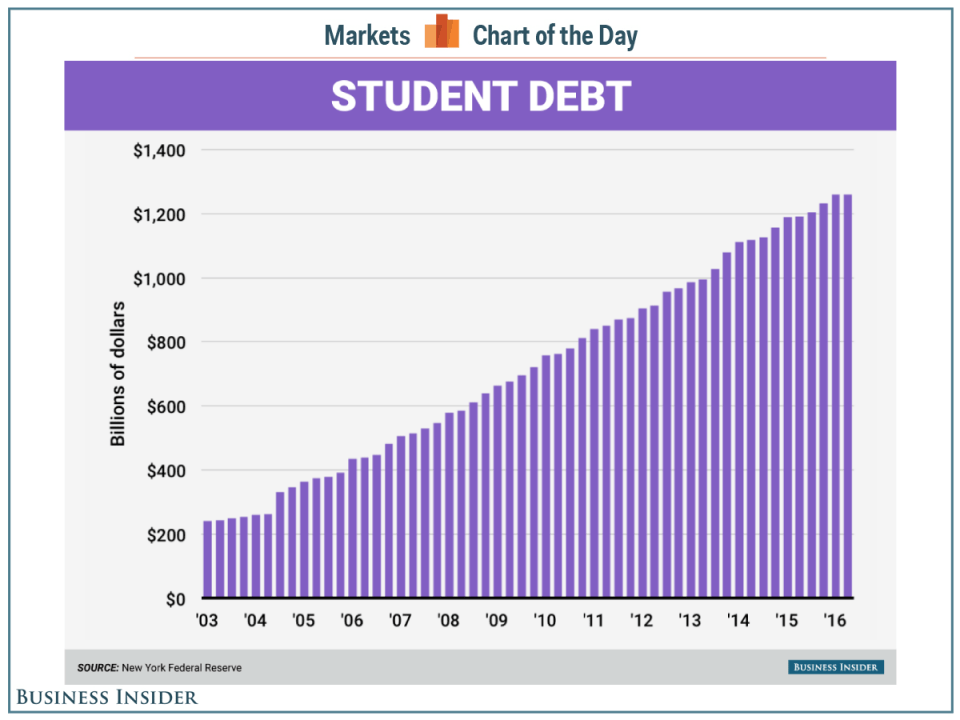
Instead, we have the following shameful graph.

STUDENT DEBT

In case you wonder why we intentionally put our students into debt, the answer is quite simple: Student loans widen the Gap between the rich and the rest.

Gap widening, rather than mere income, is the primary motivation of the rich. It is the Gap, not just their own incomes, that makes them rich (Without the Gap, no one would be rich; we all would be the same). The wider the Gap, the richer they are.

Thus, keeping the non-wealthy down is just as important to the rich as lifting their own incomes up. Either way, the Gap is widened.

Every wealth stratum wants the Gap between them and those lower, to be widened. That is why so many lower-to-middle-income people resent aid to the poor. Such aid narrows the Gap, bringing the poor uncomfortably closer to those in the middle.

When the federal government lends to students, interest payments remove stimulus dollars from the economy,  and all loan repayments punish borrowers, who primarily are middle-income (The rich don’t use student loans).

The federal government, being Monetarily Sovereign, neither needs nor uses any form of income. To pay its bills, the government creates dollars ad hoc. There is no economic purpose for student loan payments to a government that has no use for the money.

When the lender is a private bank, the bank is enriched by a loan that is difficult to discharge in bankruptcy.  It is a “forever” loan, passed down through the generations — perfect for Gap widening:

Business Insider: America’s crushing surge of student debt, now at $1.2 trillion, has bred a disturbing new phenomenon: School loans that span multiple generations within families.

Weighed down by their own loans, many parents lack the means to fund their children’s educations without sinking even deeper into debt.

  • School loans increasingly belong to Americans over 40. This group accounts for 35 percent of education debt, up from 25 percent in 2004
  • Student loan balances average $20,000 for Generation X adults — those from 35 to 50 years old.
  • Gen-X parents who carry student debt and have teenage children have struggled to save for their children’s educations. Many of their children will need to borrow heavily for college, thereby perpetuating a cycle of family debt.
  • Student debt is surpassing groceries as a primary expense, with the gap widening most for younger families.

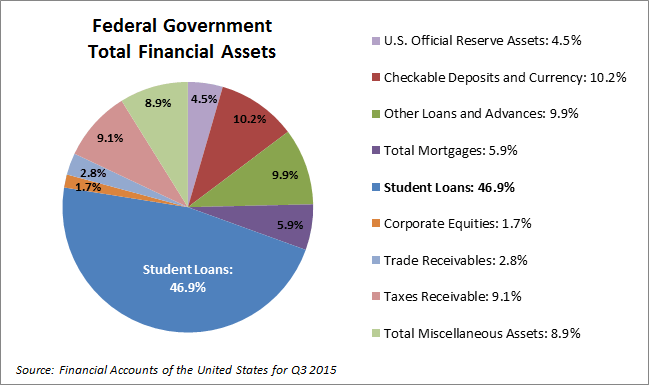
And if the above weren’t shameful enough, consider this graph, also supplied by Business Insider:

w704

Student loans are listed on the government’s books as its largest financial asset. Millions of American families are in debt to the federal government for educating children.

In reality, this is all just record-keeping. The federal government has no need for financial assets, because as mentioned earlier, it creates all the dollars it needs, ad hoc, when it pays its bills.

Thus, the government has discovered yet another, powerful Gap-widening device, designed to keep millions of families in financial bondage for many years, even for generations.

(Among such Gap-widening devices are federal sales taxes, FICA, and high-end income taxes on 401k mandatory distributions.) 

State and local governments are monetarily non-sovereign. They need income in order to pay for K-12 education.

The federal government is Monetarily Sovereign. It needs no taxes or loan repayments to fund a college education for every American who wanted one.

All those additional educated minds would greatly benefit America. No one knows how many potential Nobel winners America has lost lack for of the finances to attend college.

Even the time away from work is too expensive for many people. The federal government should pay for that, too.(Step #5)

But the rich don’t want federal funding for college; it would narrow the Gap. Despite what Presidential and Congressional campaigning may indicate, the rich, not the politicians, run America.

College debt is another destgructive result of The Big Lie, the lie that federal taxes fund federal spending.

Rodger Malcolm Mitchell
===================================================================================
Ten Steps to Prosperity:
1. ELIMINATE FICA (Ten Reasons to Eliminate FICA )
Although the article lists 10 reasons to eliminate FICA, there are two fundamental reasons:
*FICA is the most regressive tax in American history, widening the Gap by punishing the low and middle-income groups, while leaving the rich untouched, and
*The federal government, being Monetarily Sovereign, neither needs nor uses FICA to support Social Security and Medicare.
2. FEDERALLY FUNDED MEDICARE — PARTS A, B & D, PLUS LONG TERM CARE — FOR EVERYONE (H.R. 676, Medicare for All )
This article addresses the questions:
*Does the economy benefit when the rich afford better health care than the rest of Americans?
*Aside from improved health care, what are the other economic effects of “Medicare for everyone?”
*How much would it cost taxpayers?
*Who opposes it?”
3. PROVIDE AN ECONOMIC BONUS TO EVERY MAN, WOMAN AND CHILD IN AMERICA, AND/OR EVERY STATE, A PER CAPITA ECONOMIC BONUS (The JG (Jobs Guarantee) vs the GI (Guaranteed Income) vs the EB) Or institute a reverse income tax.
This article is the fifth in a series about direct financial assistance to Americans:

Why Modern Monetary Theory’s Employer of Last Resort is a bad idea. Sunday, Jan 1 2012
MMT’s Job Guarantee (JG) — “Another crazy, rightwing, Austrian nutjob?” Thursday, Jan 12 2012
Why Modern Monetary Theory’s Jobs Guarantee is like the EU’s euro: A beloved solution to the wrong problem. Tuesday, May 29 2012
“You can’t fire me. I’m on JG” Saturday, Jun 2 2012

Economic growth should include the “bottom” 99.9%, not just the .1%, the only question being, how best to accomplish that. Modern Monetary Theory (MMT) favors giving everyone a job. Monetary Sovereignty (MS) favors giving everyone money. The five articles describe the pros and cons of each approach.
4. FREE EDUCATION (INCLUDING POST-GRAD) FOR EVERYONEFive reasons why we should eliminate school loans
Monetarily non-sovereign State and local governments, despite their limited finances, support grades K-12. That level of education may have been sufficient for a largely agrarian economy, but not for our currently more technical economy that demands greater numbers of highly educated workers.
Because state and local funding is so limited, grades K-12 receive short shrift, especially those schools whose populations come from the lowest economic groups. And college is too costly for most families.
An educated populace benefits a nation, and benefiting the nation is the purpose of the federal government, which has the unlimited ability to pay for K-16 and beyond.
5. SALARY FOR ATTENDING SCHOOL
Even were schooling to be completely free, many young people cannot attend, because they and their families cannot afford to support non-workers. In a foundering boat, everyone needs to bail, and no one can take time off for study.
If a young person’s “job” is to learn and be productive, he/she should be paid to do that job, especially since that job is one of America’s most important.
6. ELIMINATE CORPORATE TAXES
Corporations themselves exist only as legalities. They don’t pay taxes or pay for anything else. They are dollar-tranferring machines. They transfer dollars from customers to employees, suppliers, shareholders and the government (the later having no use for those dollars).
Any tax on corporations reduces the amount going to employees, suppliers and shareholders, which diminishes the economy. Ultimately, all corporate taxes come around and reappear as deductions from your personal income.
7. INCREASE THE STANDARD INCOME TAX DEDUCTION, ANNUALLY. (Refer to this.) Federal taxes punish taxpayers and harm the economy. The federal government has no need for those punishing and harmful tax dollars. There are several ways to reduce taxes, and we should evaluate and choose the most progressive approaches.
Cutting FICA and corporate taxes would be an good early step, as both dramatically affect the 99%. Annual increases in the standard income tax deduction, and a reverse income tax also would provide benefits from the bottom up. Both would narrow the Gap.
8. TAX THE VERY RICH (THE “.1%) MORE, WITH HIGHER PROGRESSIVE TAX RATES ON ALL FORMS OF INCOME. (TROPHIC CASCADE)
There was a time when I argued against increasing anyone’s federal taxes. After all, the federal government has no need for tax dollars, and all taxes reduce Gross Domestic Product, thereby negatively affecting the entire economy, including the 99.9%.
But I have come to realize that narrowing the Gap requires trimming the top. It simply would not be possible to provide the 99.9% with enough benefits to narrow the Gap in any meaningful way. Bill Gates reportedly owns $70 billion. To get to that level, he must have been earning $10 billion a year. Pick any acceptable Gap (1000 to 1?), and the lowest paid American would have to receive $10 million a year. Unreasonable.
9. FEDERAL OWNERSHIP OF ALL BANKS (Click The end of private banking and How should America decide “who-gets-money”?)
Banks have created all the dollars that exist. Even dollars created at the direction of the federal government, actually come into being when banks increase the numbers in checking accounts. This gives the banks enormous financial power, and as we all know, power corrupts — especially when multiplied by a profit motive.
Although the federal government also is powerful and corrupted, it does not suffer from a profit motive, the world’s most corrupting influence.
10. INCREASE FEDERAL SPENDING ON THE MYRIAD INITIATIVES THAT BENEFIT AMERICA’S 99.9% (Federal agencies)Browse the agencies. See how many agencies benefit the lower- and middle-income/wealth/ power groups, by adding dollars to the economy and/or by actions more beneficial to the 99.9% than to the .1%.
Save this reference as your primer to current economics. Sadly, much of the material is not being taught in American schools, which is all the more reason for you to use it.

The Ten Steps will grow the economy, and narrow the income/wealth/power Gap between the rich and you.

MONETARY SOVEREIGNTY