It’s difficult to decide when and why Florida Governor Ron DeSantis first became a Nazi. Did his parents beat him for the slightest infraction? Did the school children tease him about having tiny genitals? Was he friendless — always the last kid chosen?
For whatever reasons, this hate-mongering bigot has turned to Hitler as his model.
Consider the eagerness with which he has embraced the ICE thugs as they roam and arrest unabated by conscience, compassion or legal restraint.
Consider his pride and joy, the vile “Alligator Alcatraz,” an unimaginably cruel concentration camp that’s missing only gas chambers and ovens to be complete. What kind of person could willingly throw desperate people—whose only “crime” was to follow in the footsteps of America’s early settlers in search of a better life—into such a nightmare?
And now, in his final months as governor, his latest insult to America: If you hope your children will be taught to be, hate-mongering, uneducated bigots, you might consider a Hitlerian college-qualification course DeSantis is foisting on Florida’s children.
Apparently, some Floridians are unaware—or prefer their children not to learn—that slavery existed in America and that it was brutally inhumane and morally reprehensible.
Perhaps there are Floridians who don’t know, and don’t want their children to learn, that slavery was largely supported by white bible-quoting, anti-Christ Christians, some of whose descendants still deny its existence while mourning its passing.
Some Floridians might deny that Black and brown people are equal to white people — they have families and children they love, along with hopes and dreams just like anyone else.
Some Floridians might reject the idea that Christianity is just one of many respected religions in America, and that people who accept Christ as their savior still can be bad, while some who don’t repeatedly praise Jesus still can be good—like those having no religion at all.
There even may be Floridians who deny that women have the same rights to health and happiness as men, and are just as intelligent and hardworking, often more so, but still remain the most brutalized segment of our population. Donald Trunp has paid millions of dollars denying that fact.
This nation was built by honest, hard-working immigrants in search of better lives, just like today’s newcomers, and without them, we lose part of what made America great.
I mention these facts because, while you may find them obvious, they appear to go against the teachings of Florida’s MAGA-Nazi leaders, especially Governor Ron, who seems to want Florida’s children to grow up as ignorant, hate-based bigots.
Does this sound familiar? Hitler and the Nazi Party systematically reshaped education to teach an ideological and distorted version of history. Schools in Nazi Germany were used as tools of propaganda.
History classes commonly taught that Germans were a superior “Aryan” race. The curriculum distorted or omitted facts that conflicted with Nazi ideology.
For example, Jewish contributions to German culture and science were minimized or erased; atrocities were reframed or hidden; racist pseudoscience was presented as legitimate biology and history; German history was rewritten as a heroic racial struggle.
Textbooks, teachers, youth organizations, films, and radio all reinforced the same narrative. In another age, Hitler would have used the pejorative term, “woke.”.
That does not mean every single thing taught was false. Propaganda is usually more effective when mixed with truths, selective omissions, emotional framing, and repetition.
People experience reality through interpretive frameworks built from prior information. Control the framework, and you strongly influence what people perceive as obvious, moral, or true.
Keep Hitler’s methods in mind as you read the following:
———————————///————————————-
State launches history course to rival AP Florida launches a US history course to rival AP. Experts have concerns Experts fear it would present sanitized view of nation’s story
Florida is launching its own college-level U.S. history course for high school students, trying to teach “the full scope” of America’s story, but some experts say the proposed lesson plans present sanitized views of topics such as slavery, and some college counselors say pupils should stay away.
The new course, which also places particular emphasis on Christian faithand American exceptionalism, will be offered in select school districts as a pilot program starting next school year. Florida high school students who pass the course’s standardized exam can get credit at Florida’s public colleges and universities.
The history course, part of Florida Advanced Courses and Tests, or FACT, is the latest attempt by Gov. Ron DeSantis’ administration to move Florida away from courses and exams offered by the College Board, the nonprofit that makes the Advanced Placement program and the SAT college admissions exam.
In recent years, the state’s Republican leader has argued that the College Board’s AP courses — long a popular way for Florida high school students to get a head start on their college course load — tilt to the political left.
That fight came to a head in 2023 when DeSantis created a national uproar by prohibiting Florida public high schools from offering the AP African American studies course because it included critical race theory and other topics, he found objectionable.
This week the state released a 214-page framework for the new course, outlining its goals and the topics to be covered. “The FACT U.S. History framework underscores our commitment to instruction grounded in the full scope of our nation’s history, while ensuring materials are free from ideological bias or indoctrination,” said Education Commissioner Anastasios Kamoutsas in a statement.
More importantly, free from facts that might embarrass hate-mongering bigots, who no longer wear sheets and pointy hates, but would like to.
Almost half a million students take AP U.S. history each year nationwide, including about 200,000 in Florida. The new history course aims to “teach our young people to become informed, self-aware, and dedicated citizens of the United States of America—of this particular nation,” the framework reads.
It differs in several ways from the long-established AP class, perhaps most notably that it leans heavily into Christian faith, using verses from the Bible as primary sources.
But apparently does not include the words spoken by Jesus regarding the treatment of others, including Jesus description of the final judgment: “I was a stranger and you welcomed me.” And “Whatever you did for one of the least of these brothers and sisters of mine, you did for me.”
It also does not include such passages as, “The stranger who resides with you shall be to you as the native among you, and you shall love him as yourself.” Or “You shall not oppress a stranger, for you know the heart of a stranger, since you were strangers in Egypt.”
FACT U.S. History also recommends only one textbook, “Land of Hope: An Invitation to the American Story,” authored by a historian from the conservative Christian Hillsdale College in Michigan.
Adam Rothman, a historian at Georgetown University and director of the school’s Center for the Study of Slavery and Its Legacies, said Florida is “0 for 3” on their promises for the FACT course.
The course does not look to offer “a full scope” of U.S. history, Rothman said, nor does it seem “free from ideological bias or indoctrination.” Rothman called the course “shoddy” and “not a college-level U.S. history class.”
DeSantis is not interested in college level instruction. He wants only bigoted (i.e., anti-black) propaganda that eliminates what he calls “woke” (i.e., morally and factually honest).
Rothman said the lack of discussion on the racism in early U.S. history, for example, was “striking.” The word “racism” never appears in the entire 214-page course framework, while the topic appears in the first unit of AP U.S. history and then in numerous parts of that course.
“You can’t really understand the contradiction between freedom and slavery at the founding of the United States in the late 18th century without some grasp of the emergence of racist views about black people,” he said.
The FACT course contains factual errors, Rothman added, such as saying “indentured servants” were brought to the Americas in 1619 instead of “slaves.”
(Defenders of the course say) “American history is a site of contestation, full of lively disagreements. Which is precisely why no one organization should be permitted to have a monopoly on advanced-placement testing. We will all be better off if we have a variety of choices,” McClay wrote.
When people deny the differences between right and wrong, and between moral vs. immoral, they use the “both sides” false argument. By giving children a “variety of choices,” some will choose hatred and bigotry, and some will not.
Is that what a parent should want — “Teach them the world is flat and let them choose”?
The FACT course framework outlines a 9-unit course with specific primary sources and key facts that students are expected to memorize for the exam. “It represents an important step toward restoring academic integrity in the classroom after years of uneven and, at times, ideologically driven instruction,” said Ryan Petty, chair of the State Board of Education, in a statement.
Opposing “ideologically driven instruction,” while twisting history to fit the extreme right-wing, Nazi ideology, is ironic,
In contrast, the AP U.S. History course framework is more than twice as long at 560 pages and emphasizes a less “content prescriptive” approach, according to the College Board, meaning teachers have leeway to use different historical examples in their lessons.
Kevin Kruse, a Princeton professor, posted a thread to the social media site Bluesky sharing and criticizing parts of the Florida course outline, from its use of Bible selections to its discussions of slavery, the New Deal and abortion. “If any historians want to suffer through the Florida Man Version of AP History, here’s the document,” he wrote.
One person who responded noted Florida’s course implies Sen. Joseph McCarthy, who pushed the “Red Scare” communist panic in the 1950s, was justified in his crusade. Florida’s social studies standards for teaching communism, approved last year, make a similar point, though McCarthy’s biography on the U.S. Senate website notes some of his accusations were deemed “a fraud and a hoax” and that he was censured by the Senate.
Kruse also highlighted that the Florida course criticized Roe v. Wade, the U.S. Supreme Court case that protected a woman’s right to an abortion, as a ruling that “removed a contentious topic from the democratic process.” And it seemed to praise the 2022 overturning of Roe as “returning the matter to regulation by the states via the democratic process.”
No one should wonder if colleges outside Florida will offer credits based on FACT, he added. “It’s not unknown. We won’t accept this,” he wrote.
The FACT course may not give students college creditat out of state schools, and it also may be viewed by some admissions departments as less rigorous than AP or International Baccalaureate courses, which also offer high school students a way to earn college credit.
But for students who plan to attend an in-state (Florida) college or university, is guaranteed to be accepted for credit.
Those Florida parents who do not want their children to be indoctrinated into MAGA-Nazism should beware. The hate-mongers are after your children.
Many people repeatedly encounter and believe several common fallacies:
that the federal government can run out of dollars,
that it pays its bills by collecting taxes,
that it borrows money when taxes aren’t enough,
that the national debt is too high and needs to be reduced, and
that excessive federal spending causes inflation, which can be fixed by cutting spending.
None of these is true, yet most Americans, including many economists, accept one or more of them. Do you?
Fallacy 1. The federal government can run out of dollars
The U.S. federal government is Monetarily Sovereign, which means exactly what it says. The government is sovereign over the U.S. dollar. It has the unlimited ability to do whatever it wishes with the dollar. It can create as many as it wants, simply by pressing computer keys.
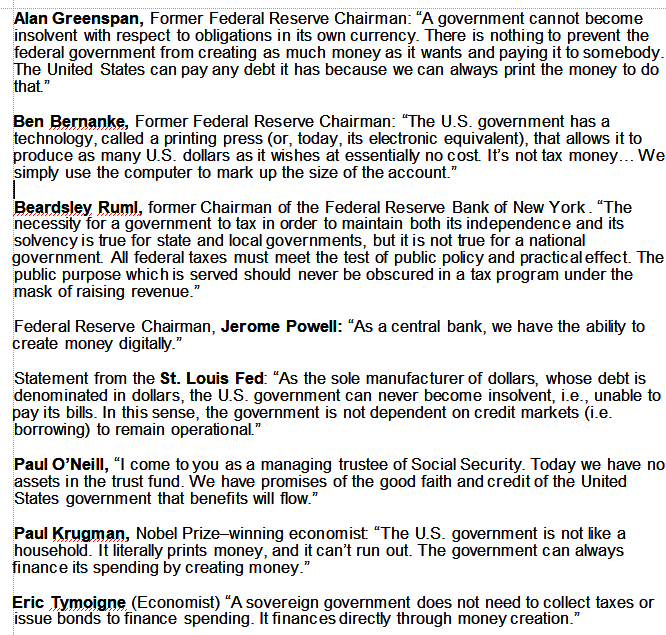
Who says so? Read what a few real experts say: “Monetary Sovereignty. Who Says So?” The abbreviated list includes current and former Federal Reserve chairmen, a Social Security Trusted, economists (including a Noble Prize winner) and a representative of the St. Louis Federal Reserve Bank.
The fact: It is functionally impossible for the federal government to run out of dollars unless it wants to. To quote one of the experts: ““The U.S. government is not like a household. It literally prints money, and it can’t run out. The government can always finance its spending by creating money.”
Fallacy 2. The federal government pays its bills by levying taxes
Not only is the federal government unlike a household, it also is unlike state and local governments, which are monetarily non-sovereign. Because they do not have the unlimited ability to create dollars, they need income to pay their bills. That income includes taxes and borrowing.
The federal government also levies taxes, but for different reasons:
To control the economy by taxing what the government wishes to discourage and by giving tax breaks to what the government wishes to reward. Examples are “sin” taxes on cigarettes and alcohol and tax deductions for charitable giving.
To assure demand for the U.S. dollar by requiring taxes be paid in dollars.
The federal government pays all its bills with newly created dollars. It has no financial need for tax dollars.
Fallacy 3. The federal government borrows money when taxes aren’t enough
Having the unlimited ability to create dollars, the federal government never borrows dollars. Much of the confusion about this is semantic, relating to the words bills, notes, and bonds.
In the private sector, bills, notes and bonds denote debt. When you or I pay a bill, we are paying a debt. When we sign a note, we are signing a debt. When we buy a corporate bond, we are buying a corporate debt.
To make matters a bit more confusing, dollar bills have the words, “Federal Reserve Note” printed on them.
A dollar bill is unlike an ordinary debt in several important ways:
It never has to be repaid in anything else.
It has no maturity date.
It pays no interest.
The government creates it at will.
The issuer cannot become unable to “pay” more dollars.
Thus, a dollar bill is identical to a Treasury billthat pays no interest and has no maturity date.
So, calling Treasury bills “debt” uses accounting language that resembles household or business debt but functions very differently.
Dollar bills are part of the federal “debt,” as are Treasury bills, Treasury notes and Treasury bonds, none of which resemble private sector debt.
Federal debt is paid off by exchanging it for other federal debt. Visualize you always being able to pay off your mortgage and credit card debts simply by signing up for more debt. You never would be unable to pay your debts; you endlessly could issue new debt to pay old debt.
That is exactly how the federal government works. It pays off all its debt by issuing more debt, i.e. dollar bills. It never can be unable to pay off old debt because it always can issue new debt.
While personal debts weigh heavily on individuals, the federal debt doesn’t burden the federal government. Worries about its size are largely misplaced, as the government could, if it wished, instantly cover a trillion or even a hundred trillion dollars in debt simply by issuing more debt in the form of dollar bills.
The federal government never borrows money (“Borrow” is another word that means something different for the federal government vs. the private sector). It simply exchanges old debt for new debt, which it can do, forever.
Fallacy 4. The national debt is too high and needs to be reduced.
We already have discussed the fact that government pays off the national debt by exchanging T-bills, notes, and bonds for more national debt, i.e., dollar bills. The only way to reduce the national debt is to reduce the amount of money in the economy. And that leads to recessions and depressions.
If dollar bills are part of the national debt, how is the national debt ever reduced?
The semantic confusion comes from lumping together very different things under the single label “national debt.” There are several major categories:
currency (dollar bills),
bank reserves,
Treasury securities (T-bills, notes, bonds).
The term “national debt” usually refers to outstanding Treasury securities, not the total amount of currency in circulation. When these securities mature, the government reduces the securities account and increases a checking-type account (bank reserves).
In other words, one type of government liability is simply swapped for another. A dollar bill is just as much a federal liability as a Treasury bill, note, or bond.
Would you like to reduce the real federal debt? Burn a dollar bill.
Fallacy 5. Excessive federal spending causes inflation, which can be fixed by cutting spending.
In one sense, this is a tautology. By calling it “excessive,” we already have made a claim: “When is federal spending excessive? When it causes inflation.”
And we even have a common slogan for this: “Too much money chasing too few goods and services.”
We have shown in previous posts, that it is shortages (i.e., too few goods and services) that are the cause of inflations. There can be no inflation unless there are shortages.
The real question becomes, “what caused the shortages?” Was it “too much federal spending” or some other factors? This is the key question, because federal spending is absolutely necessary for a growing economy.
Gross Domestic Product = Federal Spending + Non-federal Spending + Net Exports
Federal “debt” (red line) parallels GDP (blue line). Reductions in federal debt lead to recessions (vertical gray bars), which are cured by increased federal debt.
All U.S. depressions come come on the heels of federal surpluses.
1804-1812: U. S. Federal Debt reduced 48%. Depression began 1807. 1817-1821: U. S. Federal Debt reduced 29%. Depression began 1819. 1823-1836: U. S. Federal Debt reduced 99%. Depression began 1837. 1852-1857: U. S. Federal Debt reduced 59%. Depression began 1857. 1867-1873: U. S. Federal Debt reduced 27%. Depression began 1873. 1880-1893: U. S. Federal Debt reduced 57%. Depression began 1893. 1920-1930: U. S. Federal Debt reduced 36%. Depression began 1929. 1997-2001: U. S. Federal Debt reduced 15%. Recession began 2001.
What led to the shortages that that caused inflations?
Because of our belief in the Five Fallacies, we’ve ended up paying far too many taxes while missing out on easily affordable health care for every American, quality education, updated infrastructure, the end of poverty, and a fairer distribution of income, wealth, and power between the rich and everyone else.
All of these are within reach—if only we understood the facts.
Now, compare the above with these excerpts from an editorial in the Florida Sun-Sentinel:
As Social Security withers, Congress dithers By The Sun Sentinel Editorial Board, Opinion Editor Steve Bousquet, Deputy Opinion Editor Dan Sweeney, editorial writers Pat Beall and Martin Dyckman, and Executive Editor Gretchen Day-Bryant. April 8, 2026
Americans who might agree on little else share a common interest in preserving Social Security and Medicare. Nearly all of us are either enrolled in those universal programs or expect to be as we get older. Social Security is far and away the nation’s most important safety net.
So, it should alarm Republicans, Democrats and independents that Congress is doing nothing to prevent the enormous benefit reductions threatening both programs in just seven years. That is when the trust funds are on track to exhaust their reserves and reduce payoutsto no more than what existing earmarked taxes will collect.
There’s no reason for trust funds to cut back on anything—in fact, there’s no need for them at all. The federal government could fund Social Security the same way it funds the military, the White House, Congress, the Supreme Court, and most other federal programs: simply vote and create the dollars.
A lifeline for millions Across the board, everyone receiving old age or survivor assistance from Social Security would get 23% less. For the average recipient, who gets about $2,000 a month before taxes, that’s a $600 cut.
No need for cuts. The government has infinite money.
For every four of 10 retired Americans, Social Security provides at least half of their income. For one of every seven, it is more than 90%. Social Security keeps 20 million older people and a million children out of poverty. To let them down would be a catastrophic national disgrace.
Medicare would have to reduce spending by 11%, most of which would impact doctors and hospitals and result in diminished care. A reasonable tax increase would avert that. The longer Congress puts off reckoning with these problems, the more difficult the solutions will be.
Reductions would be the result of ignorance.
Earmarking tax revenue from Social Security to its trust fund is one fix proposed to prevent the 2033 shortfall.
Tax earmarking is not necessary.
“It’s not possible for us to take care of daycare, Medicaid, Medicare, all these individual things,” President Trump told an Easter Sunday luncheon at the White House. “We have to take care of one thing: military protection. We have to guard the country.”
The usual Trumpian lie. It is easily possible to “take care of daycare, Medicaid, all these individual things” while also taking care of the military. But the rich want you to believe that you must sacrifice.
Few members of Congress are in favor of impending cuts in Social Security and Medicare, but it would be just as daunting to find many to specify how they would prevent it.
Ignorance comes with consequences. Congress could, and should, vote to support Social Security and Medicare, and like all other federal funding, the necessary dollars would simply be created.
The Brookings Institution summarized them in a white paper that proposed making Social Security fully solvent for another 75 years. The plan would raise the ceiling on income subject to Social Security tax and increase the tax rate from 12.4%, paid jointly by workers and employers, to 12.6%; raise the retirement age, in stages, from 67 to 70 for people in the highest two fifths of income brackets; and earmark to the trust fund all taxes paid on Social Security benefits.
The Brookings plan is an unnecessary ode to ignorance. Not one of its benefit cutting, tax increasing suggestions is necessary.
It would fully tax Social Security benefits paid to individuals with adjusted gross incomes of $100,000 or $125,000 for couples. It would base payouts on the highest 40 years of earnings rather than the present basis of 35, and it would reduce some spousal and child benefits for retirees.
The Brookings program asks for something from everyone, but not too much from anyone.
Either the Brookings people are ignorant of the facts or being deliberately deceptive.
The urgent need for this is the falling birthrate and the declining ratio of taxpaying workers to retired beneficiaries. That is a real fiscal time bomb that could set off generational warfare in Washington.
The ratio of taxpaying workers to benefits is irrelevant. Federal taxes don’t fund anything; all federal spending is covered by the creation of federal money.
Congress is already a day late to the duty of saving it. It’s one of the most important issues that voters should demand every candidate address in this election year.
No, every candidate should be honest and not pretend that the federal government is financially constrained by taxes. Why do they keep up the pretense? The wealthy run America, and the tax code only widens the gap in income, wealth, and power between them and everyone else.
Seemingly, Mr. Josh Boak or the Trump White House believes that pharmaceutical companies are not part of the economy. How else can you explain the following headline?
WASHINGTON (AP) — White House economists estimate that President Donald Trump’s deals with pharmaceutical companies to drop some of their U.S. prescription drug pricesto what they charge in other countries could save $529 billion over the next 10 years.
If a U.S. pharmaceutical company drops its prices, how does that save “the economy” anything? Less money will come from American buyers and less will go to American businesses. Both are part of the economy.
It’s a net wash for the economy. It’s good news for drug users, but bad news for drug companies, their employees, and their suppliers.
The analysis obtained by The Associated Press includes the first economy-wide projections behind a policy at the core of Trump’s pitch to voters going into November’s midterm elections for control of the House and Senate. Democratic lawmakers have been doubtful about the savings claimed by Trump and these new numbers are likely to trigger additional questions about the data.
Now why would anyone question claims provided by Donald (“The war will end in a week”) (“It actually isn’t a war” “I hardly knew Epstein”) Trump?
Cost-of-living issues are at the forefront of voters’ concerns and higher energy prices tied to the Iran war have deepened the public’s anxiety. Trump has tried in part to address affordability concerns by focusing on his efforts to cut deals with companies so that the cost of prescription drugs in the U.S. would no longer be dramatically higher than in other affluent nations.
That’s good news for some sick people — or it would be good news if the Republicans were not doing everything possible to cut Medicare, Medicaid, Social Security, and almost every other federal benefit for the lower 99% income/wealth/power group.
(You’ll be pleased to know that tax benefits for the ultra-wealthy, like those that allowed billionaire Trump to pay less than $1,000 in taxes in some years, will remain in place.
“Now you have the lowest drug prices anywhere in the world,” Trump said at a Friday rally before a crowd of seniors in Florida. “And that alone should win us the midterms.”
Really? The lowest in the world? Uh, wait . . .
The analysis was done by administration officials for the White House Council of Economic Advisers. They also estimated that federal and state governmentscould save a combined $64.3 billion on Medicaid during the next decade because of what Trump calls his “most favored nation” policy on drug prices.
The words, “The analysis was done by administration officials,” are enough to make one doubtful. But combine them with the following, and you would have to be a MAGA to believe them.
Few of the details of the deals struck by the Trump administration and 17 leading pharmaceutical companies have been made public, making it hard to independently verify the projected savings.
The White House analysis sought to estimate the prospective savings as more medications come onto the market and fall under Trump’s framework — with one model in the report tallying the possible savings at $733 billion over a decade.
If the details were that impressive, Trump likely would have shared them by now.
I toss dollars from one hand to the other. The left hand loses money; the right hand saves money. It’s just another con.
Let’s look at what we do know. The phrase “federal and state governments could save” stands out. State savings would just circulate back into the economy, essentially breaking even—money shifting from one pocket to another.
Federal savings, however, could actually harm the economy. That’s money taken from pharmaceutical companies, their workers, suppliers, and shareholders, and handed to the federal government. Federal savings pull from the economy, while federal spending injects money back in.
Essentially, it’s like taxing pharmaceutical companies, and like all federal taxes, it’s regressive. (That’s why tariffs, which consumers pay to the federal government, also are recessive.)
Trump and his Department of Health and Human Services have touted his drug-pricing deals as transformative and urged Congress to codify their principles into law.
Democratic lawmakers have challenged the administration’s claims of savings. Senate Finance Committee Ranking Member Ron Wyden, D-Ore., and 17 Senate Democrats in April proposed a measure requiring the administration to disclose the terms of the agreements signed by pharmaceutical companies.
Wow! We actually need a law requiringTrump to disclose what he is bragging about!?
“If these deals are so great, why is the Trump administration afraid of showing them to the public?” Wyden said when announcing the measure. Health Secretary Robert F. Kennedy Jr. said his team would share details that didn’t include proprietary information or trade secrets.
The White House said it has not shared the text of the agreements because they include highly sensitive data that could move financial markets.
Since when has Trump been afraid to move markets, especially if the information would make markets go up? And Trump spews “sensitive data” like a public fountain.
The potential savings estimated by the Trump administration would be substantial as Americans spent $467 billion on prescription drugs in 2024, according to the most recent government data available. The analysis is premised on the idea that foreign countries would also pay more for their prescription drugs, which would diversify drugmakers’ sources of revenue and preserve their ability to innovate with new treatments.
So, in essence, Trump wants his incompetent appointees to fix overseas prices as well as domestic prices. And of course, the pharmaceutical companies won’t respond by manufacturing overseas, right?
Outside economists have caveated that any savings might not flow directly to patients, many of whom already pay discounted prices for their drugs through their insurance coverage.
Would you really expect the political party that’s attempting to destroy Medicare and Obamacare, to provide savings to consumers? Hmmm . . .
The Congressional Budget Office in October 2024 estimated that a plan similar to what Trump ended up adopting could reduce prescription drug prices by more than 5%, though the decrease “would probably diminish over time as manufacturers adjusted to the new policy by altering prices or distribution of drugs in other countries.”
So, some (not all) prescription drugs that now cost say, $100, temporarily would cost $95, and that is the big news? That is what Trump is crowing about?
The scope of the savings claimed by the Trump administration are likely to intensify the scrutiny by Democrats, who counter that any price reductions would be offset by higher costs for prescription drugs not covered by the “most favored nation” framework.
One of their main critiques is that pharmaceutical companies have increased their profit margins while working with the administration.
In April, staff working for Sen. Bernie Sanders, I-Vt., released an analysis that looked at 15 of the companies that have agreed to this drug-pricing plan and found that their combined profits jumped 66% over the past year to $177 billion. The report noted that the tax cuts Trump signed into law last year “exempted or delayed many of the most expensive drugs” from price negotiations with Medicare.
Because Trump won’t release the details (those “highly sensitive data”) we only can surmise that the bill exempts the most expensive drugs, just like the last one did.
The Trump administration has countered that they consider Sanders’ critique to be flawed, saying that it’s based on the list prices for pharmaceutical drugs instead of the actual price that patients pay.
But that means the so-called “savings” would be lessthan expected.
And what are the “actual prices patients pay”? It’s a secret. And what are the drugs covered? It’s a secret. And how will that benefit the economy. It’s a secret. And which consumers will benefit? It’s a secret.
And who is trying to make healthcare insurance more expensive for everyone except the very rich, by increasing FICA taxes and decreasing benefits? That is no secret. Trump and his rich buddies.
There is a solution, however — a solution that would add growth dollars to the economy, save consumers billions of dollars, fund research and development of new drugs, and provide more doctors, nurses, hospitals and medical equipment, all while costing taxpayers $0.
That solution is a comprehensive, no deductible Medicare for every man, woman, and child in America regardless of age, combined with tax breaks for medical education, medical R&D, and medical equipment development and sales. Our Monetarily Sovereign federal government has the ability to fund it all without collecting a penny in taxes.
But that would narrow the income/wealth/power Gapbetween the very rich and the rest of us — and who wants that? Apparently, not the 99% lower income sheep, because you don’t hear them demanding it.
This November’s elections will demonstrate the intelligence (or lack thereof) of the American voter. So far, they’ve demonstrated a greater desire to deport innocent, hard-working, tax-paying immigrants, than assuring themselves and their children of good health care.
Imagine you being the richest person in the world—the first trillionaire—when your adult daughter comes to you and says, “I have cancer, and my insurance won’t cover the treatments I need to survive. I can’t afford to pay the medical bills.”
” What would you do?
Would you say, “I’m trillionaire; I’ll pay for the cost of your treatment”?
Or would You say, “I don’t care whether you go broke or die. You’ll have to pay because, even though I’m a trillionaire, I don’t want to help you.”
The federal government, being Monetarily Sovereign. Has more money than even a trillionaire. It effectively has infinite money.
Who says so? These experts, listed at the right, and many others.
If four Federal Reserve Chairmen, and many others of similar note, say the government has the infinite ability to pay for anything, without collecting taxes or borrowing, why won’t the government simply pay for a comprehensive, no deductible Medicare for everyone, regardless of age or illness?
Hundreds of thousands of Americans have switched to health insurance that covers a lot less of their care this year. Republicans hope a lot more will follow them.
The shift since January was driven by GOP lawmakers’ decision at the end of December to reduce the help the government provides to people who don’t get insurance through work, but instead buy it in the Obamacare marketplace. The reduction in those subsidies sent Obamacare customers searching for plans that cost less.
There’s a catch: The cheaper plans don’t cover the first several thousand dollars in sick visits, drugs and surgeries a patient needs. Nearly 4 in 10 Obamacare enrollees are in these “high-deductible” plans now, compared to 3 in 10 a year ago.
In short, Republicans want to move the financial burden from the government, which can afford it, to lower-income people, who can’t.
The reason is that it widens the income, wealth, and power gap between the rich and everyone else. This gap is what makes the rich wealthy—the wider it gets, the richer they become.
Since Republicans are seen as the “party of the rich,” their goal often seems to be helping the rich get richer while the poor get poorer.
President Donald Trump and GOP senators want to encourage more to go that route by shifting remaining Obamacare subsidies, which are now used to reduce monthly premiums, into tax-advantaged savings accounts that come with the high-deductible plans.
That would be very good for some — affluent people in good health who use the savings accounts to accrue wealth — but not so much for others: sicker and poorer people who incur medical bills they can’t afford.
The “Overuse” False Excuse
For many Republicans, that’s a worthwhile trade-off, considering the plans also reduce overuse of the health care system and put downward pressure on prices.
“The president clearly has said we need to send money to patients rather than insurers in the system, and building out policies that are consistent with that is important,” said Brian Blase, president of the right-leaning Paragon Health Institute and an adviser to Trump in his first term.
Republicans believe that poor Americans tend to “overuse” the healthcare system, whether by visiting the doctor too frequently or undergoing unnecessary surgeries.
It’s likely that very few people see a doctor too often or undergo unnecessary surgeries. Regular checkups are encouraged as a cost-seaving and preventive measure, and while some cosmetic procedures might be unnecessary, most of us would rather eat spiders than have surgery we don’t need.
Many high-deductible customers are “chasing after that lower premium, but they actually do need to use care on an ongoing basis, and then they end up with a lot of debt or being terrified to use their insurance or seek care and ignoring symptoms,” said Katherine Hempstead, senior policy adviser at the Robert Wood Johnson Foundation, a progressive health care-focused philanthropy.
The president touted his “Great Health Care Plan” at a Turning Point USA event two weeks ago, promising “to get it done one way or the other.”
The “Save Money” False Excuse
Among Republicans on Capitol Hill, both Trump allies, like Sen. Rick Scott of Florida, and adversaries, such as Sen. Bill Cassidy of Louisiana, are trying to help.
Cassidy told POLITICO he thought most people would come out ahead given the lower premiums and tax savings. “Your total cost of being insured is less,” he said.
The phrase “being insured” feels like mealy-mouthed double talk. Sure, the overall cost might be lower, but having no insurance at all would be even cheaper. Is that the idea?
Cassidy ignores the fact that deductibles shift costs from the infinitely rich government onto poor sick individuals.
The “Greater Control” False Excuse
For Scott, it’s about giving patients greater control. The change would “radically re-empower the American people and let them dictate more of where their money goes,” he said.
It’s hard to see how deductibles give more “control,” especially when a relatively small federal payment is unlikely to cover the costs of serious illnesses.
One easily could ask, If the Republican proposal offers, better, cheaper insurance, would Senators be willing to use their own proposed plan?
A mass shift to high-deductible plans could leave millions of Americans who recently lost access to Obamacare subsidies vulnerable to unexpectedly high costs, health policy experts said.
“You’re going to have parallel-marketed plans — next to comprehensive ACA plans — that are loosely regulated, that may look attractive at first because they they appear to have lower premiums, but then you come to find out when you actually need to use the plan you’re stuck with much higher out-of-pocket costs and fewer consumer protections,” said Michelle Long, a senior policy manager for the Program on Patient and Consumer Protections at KFF, a health policy research organization.
The “Most People” Doubletalk
Sen. Bill Cassidy (R-La.) thinks most people would come out ahead under his plan to direct Obamacare subsidies into individuals’ HSA accounts when they enroll in low-premium, high-deductible plans.
In fact, most people would be better off financially if they didn’t buy any insurance at all. That’s what makes insurance companies profitable. If most people came out ahead by purchasing insurance, there wouldn’t be any private insurers.
You can be certain that Cassidy knows this.
Cassidy, the Health Committee chair, is leading a bill with the Finance chair, Mike Crapo (R-Idaho), that would direct federal funds used for Obamacare subsidies instead to individuals’ HSA accounts when they enroll in low-premium, high-deductible plans.
If the government were to put $2,000 into enrollees’ health savings accounts, Cassidy said, that would cover the annual medical expenses of the average American.
Scott said his proposal would do more to lower costs by allowing people to save in new Trump Health Freedom Accounts in any type of insurance plan. Currently, only people in high-deductible plans can open HSAs.
Scott’s plan would also let states waive certain ACA requirements, including coverage of essential health benefits, to lower premiums. That could leave enrollees who get sick on the hook for unexpected bills.
The plan is consistent with Trump’s efforts to offer more choices for Obamacare enrollees outside traditional ACA plans, including expanding short-term health plans, which Democrats have derided as “junk insurance.”
No matter how many twists, turns, and fake options the Republicans add to confuse the public, the goal remains the same: Have the government spend less and the people spend more.
The Trump administration has also proposed a marketplace rule that would crack down on fraudulent ACA enrollments and expand several alternative plan options, including catastrophic plans — lower-premium plans that cover Obamacare’s essential health benefits but come with a more than $10,000 deductible for an individual in 2026. Trump also proposes allowing the sale of so-called non-network plans on the ACA marketplace, which typically come with high deductibles but have no networks of doctors or providers, an option some employers currently offer.
If all these options leave you feeling confused, that’s exactly the point: toss in dozens of variations to make you believe you’re paying less, when the real goal is to have you pay more while thinking you’re getting a deal.
If insurers take a financial hit as a result of the policies, they might hike premiums across the market, raising costs for large swaths of Obamacare enrollees regardless of what plans they’re in. And the plans might not provide much protection for an unexpected medical event.
What politicians don’t mention is that while federal spending doesn’t cost taxpayers directly, it actually helps grow the economy. They complain about hospitals, doctors, and pharmaceutical companies charging “too much,” but overlook the fact that this money circulates through the economy and ends up in everyone’s pockets.
Insurers and providers argue the plans would leave consumers vulnerable to high out-of-pocket costs. vers just because they’re armed with pricing data.
“What you might see instead is somebody who gets duped into thinking it’d be better to have a lower-tier plan and $2,000. That could be a really terrible trade-off for them, because that $2,000 won’t last long if something really happens, and they’re just going to have a way more exposure to debt.”
THE REAL SOLUTION
The government exists to protect and enhance the well-being of its people, and in return, we provide it with money and grant it authority over certain aspects of our lives.
Since the U.S. federal government has unlimited funds, it can cover services that would be expensive for individuals, such as military defense, legal protections, and healthcare.
The federal government can afford to fund — without collecting a penny in taxes — a comprehensive, no-deductible Medicare plan for everyone in America, regardless of age or health.
This would not only include all services from doctors, nurses, and hospitals, but also educational programs to train more doctors and nurses, along with funding for pharmaceutical R&D and equipment manufacturers.
A holistic approach to funding America’s health could not only cost taxpayers nothing and boost healthy longevity but also generate billions in economic growth. Cost no longer would be an issue, because the dollars would circulate through the economy and benefit everyone, both economically and physically.
If we ever can educate America on the huge possible benefits of Monetary Sovereignty, we’ll finally become the great nation we’ve always aspired to be.