The Solution to Medicare and Social Security

My favorite radio station is public radio WLRN.  One show I enjoy most is On Point, hosted by the brilliant Meghan Chakrabarti.

Sadly, while she and her guests often lament the state of inequality and health care in America and the looming insolvency of Medicare, Medicaid, and  Social Security, they never seem to offer a solution other than cutting benefits and/or making Americans pay more.

We can do better;

———————–

The Real Limits on Federal Spending:
Healthcare, Poverty, and Inflation

Real resources are limited. Dollars are unlimited.

Two propositions should start any discussion of federal spending, healthcare, poverty, and inflation.

  1. No American should be unable to obtain needed healthcare because they lack money.
  2. No American should be forced to live in poverty merely because private income is inadequate.

These are not questions of whether the United States can “find” enough dollars. The federal government, as the issuer of the U.S. dollar, never can run short of dollars.

Alan Greenspan, Former Federal Reserve Chairman: “A government cannot become insolvent with respect to obligations in its own currency. Nothing prevents the federal government from creating as much money as it wants and paying it to somebody. The United States can pay any debt it has because we can always print the money to do that.”

The genuine economic question is whether the nation has enough real goods and services to satisfy the demand those dollars create.

That distinction changes almost everything. Federal finance commonly is discussed as though the federal government were a household, business, city, or state. Such users of the dollar must obtain dollars before they can spend them. The federal government creates the dollars it spends. Its meaningful limit therefore is not a shortage of dollars. The limit is inflation, and inflation ultimately is a problem of insufficient supply.

Inflation Is a Supply Problem

Prices rise when supply is insufficient relative to demand. When the shortage involves a product of limited importance, the result may be merely a higher price for that product. A shortage of a particular luxury handbag does not cause general inflation. But shortages of widely used necessities and inputs can spread price increases throughout the economy.

Energy is the obvious example. Oil and natural gas affect transportation, agriculture, manufacturing, chemicals, plastics, heating, electricity, and distribution. When energy becomes scarce, its higher cost is passed through to the prices of thousands of other goods and services.

Food shortages can have similarly broad effects. So can serious shortages of housing, labor, steel, shipping capacity, computer chips, or other resources that are used throughout the economy.

Wars, droughts, pandemics, crop failures, embargoes, OPEC restrictions, natural disasters, monopoly restrictions, labor shortages, housing shortages, and supply-chain failures all can create inflationary pressures without any need for “excessive” federal spending. The common element is not too many federal dollars. It is inadequate availability of important goods and services.

This is why the familiar phrase “government spending causes inflation” is misleading. It treats all federal spending as economically identical simply because it is all denominated in dollars. But the effect of spending depends on what it buys.

The Crucial Question: What Does the Spending Buy?

Suppose there is a serious oil shortage. Gasoline prices rise, transportation costs rise, and those costs work their way into food, manufactured goods, construction, and countless other prices. The federal government could respond by eliminating gasoline taxes or sending consumers checks.

Those actions would help people pay the higher prices, but they would not produce another barrel of oil. Indeed, by supporting demand for the same inadequate supply, they could let prices rise even further.

Now suppose the federal government spends the same number of dollars to attack the shortage itself: encouraging additional production where practical, expanding refining capacity, improving pipelines and distribution, developing substitute sources of energy, increasing efficiency, or removing some other bottleneck responsible for the shortage.

The number of federal dollars spent might be identical, yet the economic effect would be entirely different. The first form of spending finances competition for a shortage. The second increases the supply and therefore attacks the source of the inflation.

The important distinction, then, is not simply more federal spending versus less federal spending. It is spending that leaves shortages untouched versus spending that prevents or cures shortages. Federal spending can be inflationary, neutral, or anti-inflationary depending on its effect on the supply of the goods and services people need.

Healthcare: Financing Is Not Producing

Healthcare illustrates the distinction especially well. Millions of Americans cannot comfortably afford medical care, and public discussion treats this as though the nation lacks the dollars needed to pay doctors and hospitals. It does not.

The federal government can create all the dollars necessary to pay for healthcare. The real limitation is whether the country has enough doctors, nurses, technicians, hospitals, clinics, ambulances, laboratories, medicines, equipment, nursing facilities, home-health workers, and other medical resources.

Medicare for All therefore should have two inseparable parts. The first is financial: make necessary healthcare available regardless of the patient’s ability to pay. No one should avoid a physician, skip a prescription, postpone surgery, or face financial ruin because of illness.

The second part is productive: expand the healthcare supply enough to meet the demand created when financial barriers are removed. The federal government should finance medical education, nursing education, residency programs, training for technicians and other healthcare workers, and incentives to enter specialties and geographic areas suffering shortages. It should support construction and modernization of hospitals, clinics, laboratories, nursing facilities, and other medical infrastructure. It should finance medical research and the development and production of medicines, equipment, diagnostic systems, and treatments.

Simply giving people more ability to pay for a fixed quantity of healthcare could increase medical prices. But that is not an argument against Medicare for All. It is an argument against designing Medicare for All as nothing more than an insurance program. The answer to a healthcare shortage is to finance both access to healthcare and the production of healthcare.

The question “How can we afford Medicare for All?” therefore confuses dollars with resources. The federal government can afford the dollars. The nation must produce the healthcare.

Social Security and Poverty

The same principle applies to poverty, although the spending is less narrowly directed. No one in a wealthy nation should be forced to live in poverty because retirement, disability, unemployment, or low wages leave him or her without adequate income. A Social Security benefit sufficient to establish an income floor could eliminate much financial poverty immediately. Again, the federal government’s ability to create dollars is not the obstacle.

The inflation question is what recipients will buy and whether the economy can supply it. Additional income may increase demand for food, housing, medical care, transportation, home assistance, nursing care, recreation, and many other goods and services. Where supply can expand readily, additional demand can lead to additional production. Where supply is constrained, prices may rise.

That does not mean the government should preserve poverty in order to suppress demand. It means the government should identify the shortages and attack them. If affordable housing is scarce, increase the housing supply. If nursing-home beds are scarce, encourage construction and staffing of nursing facilities. If home-health workers are scarce, finance training and compensation sufficient to attract more workers. If transportation for the elderly is inadequate, expand it. If medical personnel are scarce, train more.

Reducing poverty by increasing income while simultaneously expanding the supply of the goods and services whose demand will rise is a far more humane anti-inflation policy than keeping people poor so they cannot bid for scarce resources.

The Wrong Cure for Inflation

Traditional anti-inflation policy often attempts to reduce demand. Higher interest rates, spending cuts, and tax increases can make borrowing and purchasing more difficult. If enough people are prevented from buying homes, cars, medical care, or other goods and services, price pressures may decline.

But this does not cure the underlying shortage. It can achieve balance by reducing the public’s ability to buy rather than by increasing the nation’s ability to produce.

If there are too few houses, one solution is to make mortgages so expensive that fewer families can buy houses. Another is to increase the housing supply. If energy is scarce, one solution is to suppress economic activity until energy demand falls. Another is to increase energy availability and efficiency. If medical services are scarce, one solution is to make medical care unaffordable for some people. Another is to produce more medical care.

The second approach grows the economy. The first just restrains it.

The Federal Budget Should Ask a Different Question

Federal programs commonly are judged by asking, “How much will this add to the deficit?” For a Monetarily Sovereign government, that question focuses attention on the wrong scarcity. Dollars are not the scarce resource. Every major federal spending proposal instead should be accompanied by a real-resource and inflation analysis.

The questions should be: What additional goods and services will this program cause people or government to demand? Are those goods and services available in sufficient quantity? Where are the likely shortages and bottlenecks? How rapidly can supply expand? What additional federal spending, incentives, research, training, construction, regulatory changes, or other measures would expand that supply?

Under such an approach,

  • Medicare for All would be paired with expansion of medical capacity. Social Security for All would be paired with attention to housing, elder care, healthcare, transportation, and other likely constraints.
  • Housing assistance would be paired with housing construction.
  • Infrastructure spending would include measures to ensure adequate supplies of skilled workers, machinery, steel, concrete, and other necessary resources.

The federal budget then would cease being primarily an exercise in pretending the government might run out of its own dollars. It would become an exercise in managing the nation’s real resources.

The Gap

This has another important consequence. The income/wealth/power Gap between the rich and the rest is not narrowed merely by telling people that desirable programs are “unaffordable.” For the federal government, affordability in dollars is not the issue. The real issue is whether increased purchasing power can be matched by increased production.

A government that understands its Monetary Sovereignty can use federal spending to provide healthcare, prevent poverty, improve education, build infrastructure, support scientific research, and expand productive capacity. Properly directed, such spending can narrow the Gap while reducing, rather than increasing, the shortages that cause inflation.

Two Principles

Much of America’s unnecessary economic suffering rests on confusion about two basic facts.

  1. First, the federal government never can run short of U.S. dollars. Taxes may serve important economic and social purposes, but the federal government does not need to collect dollars before it can create and spend dollars.
  2. Second, the true constraint on federal spending is not the number of dollars created. It is the availability of real resources. Inflation occurs when important supplies are inadequate for the demand placed upon them. Therefore, the intelligent response to inflation is to identify the shortages and cure them.

Those two principles lead to a very different conception of federal economic policy. We do not need to choose between adequate Social Security and stable prices, or between universal healthcare and stable prices. We need to finance what people require while simultaneously financing the productive capacity necessary to provide it.

The United States does not need to ration dollars. It needs to prevent shortages.

Rodger Malcolm Mitchell

When a belief is ingrained, no evidence is wanted

It is widely believed, especially among conservatives, that:
  1. Federal finances are like state/local government finances, business finances, and personal finances.
  2. It makes no difference whether a government is Monetarily Sovereign or monetarily non-sovereign.
  3. The “federal debt” is a debt of the federal government.
  4. The federal debt is owed by, and will be paid by, taxpayers.
  5. The federal debt and deficits are too large and are “unsustainable.”
  6. Federal spending should be reduced.
  7. The federal government should run a balanced budget or surplus. The federal government has borrowed and owes trillions of dollars via T-bills, T-notes, and T-bonds.
  8. The purpose of federal taxes is to fund federal spending.
    SIDE VIEW of a PLATTER WITH A MAP OF EARTH
    Once, people strongly believed the earth was flat. A few still do, despite the evidence.
  9. Medicare and Social Security will run short of funds unless taxes are increased and/or benefits are reduced.
  10. Many federal programs, for instance, poverty aid, foreign aid, global warming prevention, immigration, education, etc., are unaffordable and unsustainable.
  11. The rich don’t get richer by making you poorer.
  12. Undocumented immigrants bring crime and drugs into our country.
  13. Federal spending causes inflation.
How many of these beliefs do you have? Every one of them is wrong, proven wrong by readily available data (here, here, here, here, and elsewhere in this blog). Yet most people strongly defend one or more of these wrong beliefs, even without any evidence to support them. Here is an example of the widespread belief that immigrants harm our economy, and our way of life.

Immigration fuels US economic growth while politicians rage. Augusta Saraiva and Enda Curran, Bloomberg News While the rising number of immigrants in the U.S. has sowed division among politicians across the country — and stoked angst among a swath of voters — there’s one place where almost everyone seems on the same, upbeat page: Wall Street.

Last month, the nonpartisan Congressional Budget Office (CBO) calculated that immigration will generate a $7 trillion boost to gross domestic product over the next decade. The agency came to that conclusion after incorporating the recent surge in immigration.

The CBO release spurred a flurry of fresh number-crunching among investment bank economists to account for the boost those newcomers are giving to the labor force and consumer spending. Goldman Sachs Group Inc. revised up its near-term economic growth forecasts Sunday.

JPMorgan Chase & Co. and BNP Paribas SA were among banks that acknowledged the economic impact from surging immigration in recent weeks.

We’ll pause to remind you that Gross Domestic Product (the most common measure of our economy) = Federal Spending + Non-federal Spending + Net Exports.
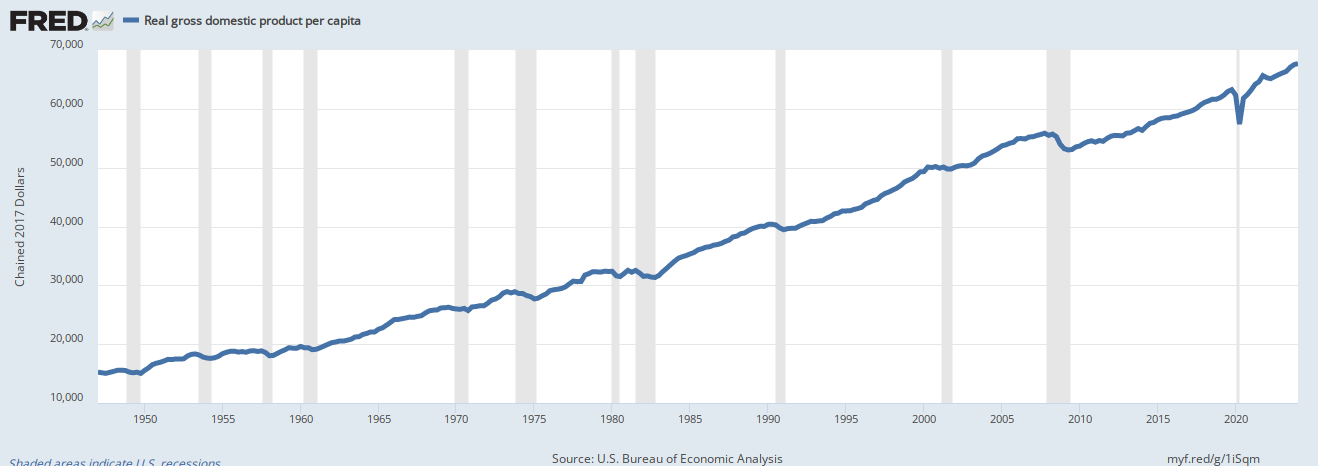
Inflation-Adjusted, Per Capita, Gross Domestic Product
Spending by immigrants increases per capita (including yours and mine) inflation-adjusted GDP. In short, immigrants make us all wealthier by working, paying local taxes, and creating and buying stuff. That is what immigrants have done for decades, and it is what has made America prosperous.

“Immigration is not just a highly charged social and political issue, it is also a big macroeconomic one,” Janet Henry, global chief economist at HSBC Holdings Plc, wrote in a note to clients Tuesday.

No advanced economy benefits from immigration quite like the U.S., and “the impact of migration has been an important part of the U.S. growth story over the past two years.”

“Two years”? More like two hundred years.

Morgan Stanley economists Sam Coffin and Ellen Zentner noted this month that faster population growth fueled by immigration leads to stronger employment and population estimates than initially thought, though they added that the full effect might not be captured by official data.

It’s hard to pin down the exact scale of the inflows of foreign-born people, thanks to many entering without visas or other documentation. But CBO statisticians incorporated data from U.S. Customs and Border Patrol to come up with their higher projected net immigration, according to Morgan Stanley analysis.

Goldman estimates that immigration was around 2.5 million in 2023, a figure that is far above the 1.6 million implied by the change in the foreign-born population in the official household survey from the Census Bureau.

The positive tone among economists contradicts that seen on the campaign trail, as a surge in the number of undocumented immigrants entering the U.S. through the southern border stokes political strife.

The share of Americans who see immigration as the most important problem facing the U.S. is now matching a record high in data going back four decades, according to a recent Gallup poll.

The recent boost from immigration is the result of both more legal immigrants as the U.S. goes through unprecedented visa backlogs and the surge in illegal border crossings.

The nation’s 32.5 million immigrant workers now account for roughly one in five U.S. workers, a record-high in government data going back almost two decades.

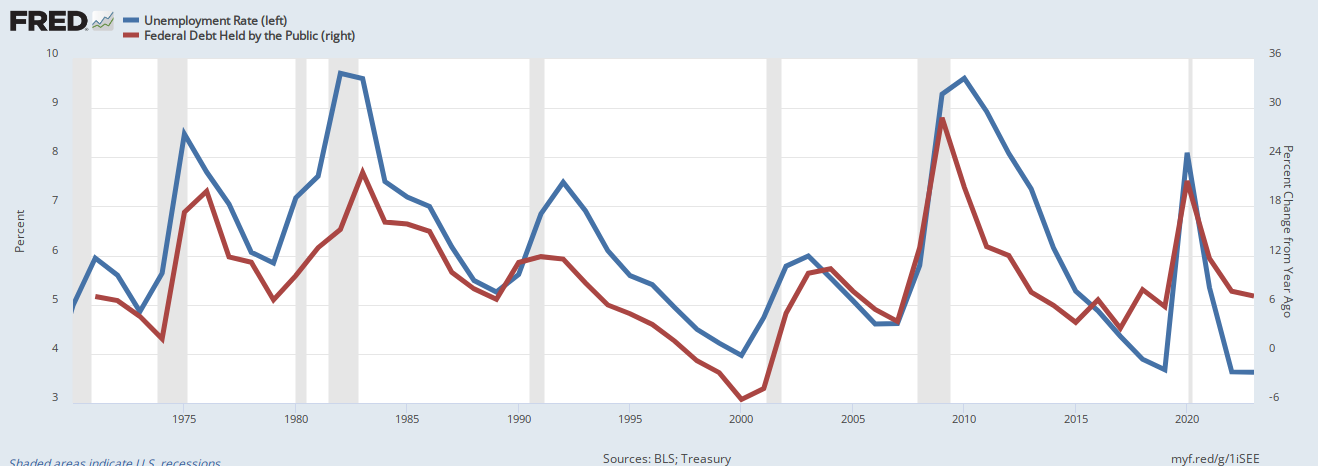
They not only are working, but their buying creates jobs. They aren’t stealing jobs as America’s xenophobes often claim. The proof: Unemployment is low “despite” (because of?) massive immigration:
Red line is federal deficits. Blue line is Unemployment. Vertical gray bars are recessions.
This interesting graph reveals several facts:
  1. When federal deficit spending declines, we have recessions.
  2. The recessions are cured by increases in federal deficit spending.
  3. The recessions cause unemployment.
  4. The unemployment, which is caused by decreases in federal deficit spending is cured by increased federal deficit spending.
Thus, unemployment is not caused by immigrants taking jobs. Quite the opposite. Unemployment and recessions have the same cause: Insufficient federal deficit spending, exactly what the conservatives want us to do.

To be sure, the connection between the higher influx of foreign workers and the rapid post-pandemic recovery has been noted by economists and policymakers alike for some time now.

The Trump GOP’s main election focus is to deport undocumented immigrants, the people who help grow America’s economy.

Federal Reserve Chair Jerome Powell has repeatedly cited immigration as one of the reasons behind strong economic growth.

In a reference to the role being played by higher labor supply, Powell pointed on Wednesday to “a strong pace” of immigration as helping on that front.

“The overall picture is a strong labor market — the extreme imbalances we saw in the early parts of the pandemic recovery have mostly been resolved, you’re seeing high job growth, you’re seeing big increases in supply,” Powell said in his press conference Wednesday.

Fed policymakers lifted their growth forecast for this year to 2.1% from 1.4%, their median estimate showed.

Businesses are ramping up calls for changes to bring in more workers through legal channels.

Almost 9 million positions are open across the economy, equal to 1.4 jobs for every job-seeker. Foreign-born workers made up a record 18.6% of the civilian workforce in 2023 and the U.S. approved a record number of work authorizations in the fiscal year through last September.

Immigration is “very policy sensitive,” Feroli cautioned, advising against extrapolating out bigger numbers beyond the end of this year. After all, policy could change after the November election, he noted.

Why does Trump and his GOP harp on immigration as America’s biggest “problem”? His success is as a fear-mongering hate-mongerer. When he preaches hatred toward Muslims, Mexicans, gays, blacks, people from “shithole” countries — when he lies that they bring crime, drugs to America, he is preaching to people he has frightened with his bigotry. He creates scapegoats, and then claims he will deal with them. Hitler did it. All dictators do it. The facts are:
  1. Immigrants are less likely to commit crimes than are citizens.
  2. Illegal drugs enter the U.S. through legal channels, not via undocumented immigration.
False beliefs, especially those repeated for months and years, are difficult to dislodge with facts. But ultimately, that is all you can do. Just as a lie gains strength the more it is repeated, so does the truth. Learn the truths and repeat them again and again. It’s the only way to defeat the Hitlers of the world. Rodger Malcolm Mitchell Monetary Sovereignty Twitter: @rodgermitchell Search #monetarysovereignty Facebook: Rodger Malcolm Mitchell

……………………………………………………………………..

The Sole Purpose of Government Is to Improve and Protect the Lives of the People.

MONETARY SOVEREIGNTY

–The failure of common sense in economics. How the President and Congress ignore economic facts and play Russian roulette with our lives.

Those, who do not understand the differences between Monetary Sovereignty and monetary non-sovereignty, do not understand economics.
=================================================================================================================================================================================================================

There is something of a rule in problem-solving that questions beginning with “How” are to be preceded by a thorough examination of questions beginning with “Should.” President Bush II failed to do that when he asked his advisors questions like, “How do we fight a war in Iraq and Afghanistan” and “How do we arrest Saddam Hussein.” The correct questions were “Should we fight a war in Iraq and Afghanistan” and “Should we arrest Saddam Hussein.”

A football coach does not begin with “How can we increase our passing yardage?” He begins with “Should we increase our passing yardage?” A company does not begin with, “How can we increase the number of our stores?” It begins with a thorough examination of “Should we increase the number of our stores?”

Sadly, President Obama, Congress, the media and the old-line economists work feverishly to answer the question, “How can we reduce the federal deficit?” They believe a thorough examination of “Should we reduce the federal deficit?” is unnecessary. They already “know” the answer, despite massive evidence to the contrary.

When you ask the wrong question, you find the wrong answer. Congress and the President can’t agree on an answer, because the question is wrong. It’s akin to asking, “How should we sail a ship without falling off the edge of the world?”

The correct question is, “Should we reduce the federal deficit?” Many people give perfunctory, knee-jerk answers, such as, “The deficit is not sustainable” or “Our children will pay for it.” But no answers have been based on the one, overriding, undeniable fact:

Federal deficits = net non-federal saving

Cut deficits and you cut saving. Cut saving and you cut economic growth. Cut economic growth and you enter recessions and depressions and the unemployment that accompanies them. The facts are that simple and undeniable. But, the President and members of Congress do not work from facts; they work from what each believes is common sense.

Common sense consists of beliefs most people consider obvious and sound, things “everyone knows.” Yet, your common sense may be different from my common sense, because it is affected by our different personal experiences, as well as by analogy, religion, social mores, history, logic, teaching, folklore, aphorisms, leaders and every form of information transfer, all of which vary from person to person.

The earth must be flat, not round, else the oceans would pour out. Nothing can be in two places at the same time – except in Quantum Mechanics. Running fast does not make your watch run slower – except in Relativity. If a roulette wheel lands on red five times in a row, it is more likely to land on black the next spin. Common sense.

Because common sense does not require research, it allows for fast decisions and is powerfully built into our genes. We have great difficulty departing from our common sense beliefs, because they are evolutionarily valuable. We experience and use common sense every day of our lives. We do not need research to tell us to avoid walking blindly into a street or reaching into a fire. Anyone who intentionally does these things is a “fool.”

So powerful is common sense, we angrily consider all those who depart from of our visions of common sense to be fools. Here are examples of common sense for most Americans:

1. Debt is a burden on the debtor; the more debt, the greater the burden. Debtors can be forced into bankruptcy by creditors.
2. A deficit is worse than a surplus. Outgo requires income. Taxes and borrowing pay for government spending.
3. Everything has a cost and a limit. Nothing can be created from nothing. Nothing goes on forever. There is no such thing as a free lunch. No pain; no gain. If it sounds too good, it is.
4. The greater the supply, the less the value. “Printing” money causes inflation. You can have too much of a good thing.
5. Dollars are real and scarce. They can be held, stored and moved.

Every one of these common sense beliefs either is always false or often false, when applied to the U.S. federal government, because:

1. Federal debt is not a burden. Unlike state and local governments, the federal government cannot be forced into bankruptcy (except by Congress). It can service any debt of any size, any time.
2. Federal deficits stimulate the economy while surpluses cause recessions and depressions. The federal government, being Monetarily Sovereign, neither needs nor uses taxes or borrowing to pay its bills.
3. The federal government creates money by marking up the bank accounts of creditors, in a cost-free, pain-free, limit-free process. To the federal government, money is a “free lunch.”
4. Increasing the supply does reduce value, unless demand increases more. Money demand is increased by interest rates. Since we went off the gold standard, there has been no relationship between federal deficit spending and inflation.
5. Dollars have no physical reality. They are nothing more than numbers in bank accounts. Even dollar bills are not dollars; they are receipts or titles for dollars. Dollars are not scarce to the federal government.

These truths are counter to intuition, counter to common sense and counter to the beliefs of most Americans, yet they are truths, nonetheless.

Very soon, Americans will face the cold reality of recession or depression, caused by Congress’s and the President’s following their “common sense,” rather than economic fact. Federal spending for Social Security, Medicare, Medicaid, and many other vital federal services will decline. We will suffer “invisible” pain from the loss of scientific and medical research, declining infrastructure, a weaker military, poorer schools, less food and drug inspection, and worse investment protections. Our standard of living will decline. Unemployment will worsen. Destitution will increase. Our children and our grandchildren will lead meaner lives. Their futures will be impoverished.

And most Americans will not realize what has been done to them.

Rodger Malcolm Mitchell
http://www.rodgermitchell.com


==========================================================================================================================================
No nation can tax itself into prosperity, nor grow without money growth. Monetary Sovereignty: Cutting federal deficits to grow the economy is like applying leeches to cure anemia.

MONETARY SOVEREIGNTY

–The single, most misunderstood fact in all of economics. It will blow your mind.

Those, who do not understand the differences between Monetary Sovereignty and monetary non-sovereignty, do not understand economics.
====================================================================================================================================================================================================
When you ask the wrong question, you get the wrong answer. Congress and the President are asking, “How should we reduce the federal deficit?” The correct question is, “Should we reduce the federal deficit?” And the answer is “No.”
=================================================================================================================================================================================================

Sometimes, something is so simple it can be hard to understand, as though “It just couldn’t be that easy.” This is one of those times.

The media don’t understand it. The columnists don’t understand it. The Tea Party, the Republicans, the Democrats and the debt hawks don’t understand it. For sure, President Obama doesn’t understand it. The old-line economics professors do understand it, but they’re afraid to admit it, because it makes them look like boobs for not telling you, all these years.

It is the single most important equation in economics. It’s so simple as to be laughable, yet it will amaze you (unless you are among the one-in-ten-thousand who already understands it). And once you understand it, you will look at the politicians in wonderment at their incredible ignorance.

Are you ready? Here it is:

Federal Deficits – Net Imports = Net Private Saving

This is not a hypothesis. It’s not a theory. It’s not my opinion or anyone else’s opinion. It is an accounting fact. In a closed economy (where money exports equal money imports), your annual savings, plus my annual savings, plus everyone else’s annual savings equals annual federal deficit spending, to the penny. In such an economy, Federal Deficits = Net Private Savings.

This means, if the federal deficit is reduced $1, our combined savings will be reduced by exactly $1 — not $.99; not $1.01 — exactly $1.00.

Today, the politicians in Washington are talking about a $4 trillion (!) deficit reduction. That means our savings will be reduced by $4 trillion. There are about 310 million people in America. A deficit reduction of $4 trillion will reduce the savings of each man, woman and child in America by an average of $12,900.

That’s $12,900 out of your pocket, another $12,900 out of the pockets of your spouse, each of your children and each of your grandchildren. A four-person family will lose $51,600 in savings. If both your parents are alive, they’ll lose another $25,800 in savings.

Why do the politicians want to reduce your savings? Sheer ignorance of Monetary Sovereignty. They think “deficit” is a bad word and want to eliminate it. But a federal deficit is money in your pocket. And a federal surplus? That’s money taken out of your pocket.

How can this be? Again, simple. When federal spending exceeds federal taxes, it’s called a “deficit.” When the federal government spends, its payments for goods and services enter the economy. When you pay taxes, the money leaves the economy. So federal deficits add money to the economy, and where does that money go? Into your pocket as savings. Similarly, federal taxes take money out of your pocket.

(If you want to see a longer, more erudite explanation, you might try Deficit = Savings, or Mosler letter to the President but I think you get the picture.)

Now tell me, how much would you like the federal deficit to be reduced? That is, how much of your savings would you like to lose? Tell your Congressperson.

Rodger Malcolm Mitchell
http://www.rodgermitchell.com


==========================================================================================================================================

Rodger Malcolm Mitchell
http://www.rodgermitchell.com


==========================================================================================================================================
No nation can tax itself into prosperity, nor grow without money growth. Monetary Sovereignty: Cutting federal deficits to grow the economy is like applying leeches to cure anemia.

MONETARY SOVEREIGNTY