Why we deport illegal immigrants

Here are the reasons provided by the Trump administration for deporting illegal immigrants.


I. Undocumented immigrants smuggle drugs into America

Immigration entry point. Huge lines of trucks and cars
How illegal drugs really enter America

First, we must acknowledge that deporting people who live here does little to prevent drug smuggling. To smuggle drugs, one must carry them across a border crossing, which someone already living here seldom would do.

Federal data (DEA, CBP) show that the overwhelming majority of fentanyl, heroin, cocaine, and methamphetamine is smuggled through official ports of entry, hidden in cars, trucks, or commercial shipments — not carried across the desert by migrants on foot.CBP reports consistently show that more than 90% of fentanyl seizures occur at legal crossings.

A 2025 DEA report confirms that cartels utilize ports of entry in California and Arizona for large-scale smuggling operations.

DEA CBP records show that in the 2024 fiscal year alone, they seized over 19,600 pounds of fentanyl, a record amount—signaling the scale of interdiction efforts at legal entry points. The cartels rely on volume shipping through legal infrastructure, not backpacking with migrants.

Now, with illegal crossings nearly eliminated, virtually all drug smuggling is forced through legal ports and means.

II. Undocumented immigrants commit crimes

Studies from the Cato Institute, the National Academy of Sciences, and state-level crime data (e.g., Texas DPS reports) show undocumented immigrants have lower conviction and arrest rates than native-born Americans.

The reasons: the risk of deportation is high, so undocumented people generally avoid criminal entanglements.

A Reuters fact-check debunked claims that undocumented immigrants are responsible for thousands of killings annually. In reality, homicide rates among undocumented immigrants (around 1.9 per 100,000) are far lower than among U.S.-born individuals (around 4.8 per 100,000).

They do commit immigration-related offenses (being in the country unlawfully, using false papers), but violent crime and property crime rates are lower than U.S. citizens.

III. Undocumented immigrants don’t pay taxes.

False. They pay sales taxes, property taxes (either directly as owners or indirectly through rent), and payroll taxes.

The Social Security Administration estimates that undocumented workers contribute billions annually in Social Security and Medicare payroll taxes (via false or borrowed SSNs), benefits they can’t collect.

According to the Institute on Taxation and Economic Policy, in 2022, undocumented immigrants paid an estimated $96.7 billion in total taxes: $59.4 billion in federal taxes $37.3 billion in state and local taxes.

Specifically, they contributed: $25.7 billion in Social Security taxes $6.4 billion in Medicare taxes $1.8 billion in unemployment insurance taxes.

Furthermore, the Penn Wharton Budget Model reports that undocumented immigrants paid around $24 billion into Social Security in 2024—even though they can’t receive benefits.

Thus, on balance, immigrants contribute to the official Social Security fund.

IV. Undocumented immigrants use services like schools and hospitals, crowding out citizens.

It is true they use these services, but they also pay for them.

Schools are funded by state/local sales, income, and property taxes, which undocumented immigrants also must pay.

Hospitals: Though undocumented immigrants pay FICA taxes, they cannot use Medicare or Social Security benefits. They are more likely to live in poverty and tend to utilize emergency rooms for their healthcare needs. This does impose local costs, though immigrants use fewer health services per capita than citizens.

“Crowding out citizens” is a misleading term. The central problem arises when local governments do not utilize immigrants’ taxes to enhance local systems.

V. Undocumented workers depress wages and compete with citizens

Comprehensive wage-impact reviews, such as those by the Economic Policy Institute, show that immigration—including undocumented—has a minimal effect on native-born workers’ wages, even for those with low education levels.

Immigrants, particularly the undocumented, often work in physically demanding, manual occupations that do not overlap heavily with those held by native low-skilled workers, suggesting a complementary rather than competitive dynamic.

THE COSTS

Huge pile of dollars
Deportation is massively expensive.

The Center for American Progress (CAP) estimates a cost of $315 billion for a one-time, comprehensive deportation effort, or $88 billion annually if implemented at a rate of 1 million deportations per year.

The Penn Wharton Budget Model calculates the average per-deportee cost to be between $70,000, encompassing arrests, detention/monitoring, legal processing, and transportation.

A major 2025 appropriations package allocated $75 billion over four years to ICE—this nearly triples its previous annual enforcement capabilities. Two-thirds of this funding ($45 billion) is slated for detention operations, with the remaining $30 billion for arrests, transport, and related enforcement.

In May 2025, the House passed a plan that adds over $150 billion over five years for immigration enforcement, with $59 billion earmarked specifically for detention and transportation, and $51 billion for border infrastructure.

ICE Air charters cost approximately $17,000/hour, with 5-hour flights translating to about $630 per deportee. Use of military aircraft like C-17s and C-130Es is far more expensive—some trips have been estimated at $852,000 for a single flight of up to 80 migrants.

A Guantanamo Bay detention of 40 migrants cost of $16 million, $400,000 per person, including transport, tents (at $3.1 million each), and security overhead.

The Joint Economic Committee estimates that deporting 8.3 million could shrink GDP by 7.4% by 2028, remove up to 1.5 million workers from the construction sector, and result in the loss of 44,000 native-born jobs for every 500,000 removals.

The costs of deporting 11 million people could total $1.1–$1.7 trillion in GDP loss, equivalent to a 4.2–6.8% decline in GDP.

The American Immigration Council found that undocumented immigrants contributed in 2022: $46.8 billion in federal taxes, $29.3 billion in state/local taxes, and had $256.8 billion in spending power, which would vanish if deported.

There appears to be sufficient funding for deportations, but insufficient funding for Social Security and Medicare. That, at least, is the claim of the current administration.

THE POLITICS

a stern dictator seated on a throne. He is talking with his advisors
First, we need a scapegoat to instill fear in the people and draw them to our side.

The Trump administration has portrayed undocumented immigrants as a threat for political gain. This is an age-old tactic used by dictatorships: they label a group as dangerous to the nation and then position the dictator as the sole protector of the citizens.

Hitler did it with the Jews.

Stalin claimed kulaks (better-off peasants) as “enemies of the people” and traitors, justifying mass deportations, executions, and forced collectivization.

Mao Zedong claimed “counterrevolutionaries” and intellectuals were existential threats to the revolution, which enabled purges and “struggle sessions” during the Cultural Revolution.

Mussolini used fear of communists and anarchists to consolidate fascist control, presenting himself as the bulwark against chaos.

Milošević demonized Croats, Bosniaks, and Kosovars as existential threats to Serb survival, fueling ethnic cleansing in the 1990s.

Rwandan Hutu extremists claimed Tutsis were plotting genocide of Hutus, then carried out their own mass slaughter in “defense.”

WHAT IF WE PROVIDED A PATHWAY TO CITIZENSHIP

Instead of the time, effort, and costs (both financial and human—associated) of hunting down, convicting, jailing, and deporting undocumented immigrants, we could create a simpler and faster pathway to citizenship, similar to what our grandparents experienced.

several hardworking blue-collar brown-skinned people. They are working in the field
A valuable asset to America.

What would that accomplish?

According to the Center for American Progress, legalization would raise GDP and economic output. It would increase productivity, consumer demand, and the quality of labor supply.

The Congressional Budget Office and multiple analyses find that legalization would increase federal receipts (including Social Security/Medicare receipts), reducing deficits relative to massive removals.

National Academies Press projects that aggregate effects on native wages would be small. The overall impact on U.S. native wages would be modest, with small downward pressure on the least-skilled native workers in some studies, but gains to the economy and to immigrants’ wages are larger.

A well-known modeling study conducted by the Center for American Progress in collaboration with UC-Davis and Giovanni Peri estimated that providing a pathway to citizenship for 10 million undocumented individuals could increase the U.S. GDP by up to $1.7 trillion over a decade.

This growth would be driven by factors such as improved labor productivity, greater attachment to the labor force, and increased consumer spending.

Studies from the Congressional Budget Office (CBO) and other analyses indicate that granting legal status to a significant number of undocumented immigrants leads to increased payroll and income tax revenues, as well as higher contributions to Social Security and Medicare.

This is primarily because having legal status tends to increase earnings, even when accounting for some growth in benefit expenditures.

NBER work and related papers suggest that legalization could significantly increase the private-sector GDP share.

A National Academies’ comprehensive review concluded that second-generation immigrants make strong economic contributions.

IN SUMMARY

Immigrants are often diligent individuals who make valuable contributions to the nation. They come here to create new lives and, in doing so, help build America.

Instead of inhumanely tracking them down, imprisoning, and deporting them, which destroys the lives of innocent, good people, America could harness their contributions for the benefit of all.


Rodger Malcolm Mitchell

Monetary Sovereignty

Twitter: @rodgermitchell

Search #monetarysovereignty

Facebook: Rodger Malcolm Mitchell;

MUCK RACK: https://muckrack.com/rodger-malcolm-mitchell;

https://www.academia.edu/

……………………………………………………………………..

A Government’s Sole Purpose is to Improve and Protect The People’s Lives.

MONETARY SOVEREIGNTY

NEWS! United Airlines frequent flyer mileage debt passes $7.4 billion!

United Airlines’ frequent flyer deficit in 2024 was $298 million, bringing the total frequent flyer debt to $7,441 billion. This is a ticking time bomb.

The $7.4 billion in frequent flyer debt is yet another stunning reminder of the terrible state of United’s finances. Spending miles and receiving miles are woefully out of balance – to the tune of nearly $3 million annually and rising – and instead of addressing this imbalance, United keeps choosing to make things worse.

Except this is all nonsense.

It’s a lift from an August 12, 2025, article by the Committee for a Responsible Federal Budget (CRFB), which is a regular fountain of nonsense. Here is precisely what the CRFB article said.

“The gross national debt hitting $37 trillion is yet another stunning reminder of the terrible state of federal finances. Spending and revenue are woefully out of balance – to the tune of nearly $2 trillion annually and rising – and instead of addressing this imbalance, Congress keeps choosing to make things worse.”
There are direct parallels between United Airlines’ frequent flyer miles and U.S. federal deficits and debt:

1. Infinite Issuer

United: Can issue as many miles as it wants. There is no operational limit.

Federal Government: Can issue as many dollars as it wants. There is no operational limit.

(Federal Reserve Chairman Ben Bernanke: “The U.S. government has a technology, called a printing press or, today, its electronic equivalent, that allows it to produce as many U.S. dollars as it wishes at essentially no cost.”)

Neither needs to “get” miles or dollars before creating them. Dollars and mileage credits are not physical; they both are nothing more than bookkeeping notations.

2. Deferred Redemption (a.k.a. “Debt”)

United: When miles are awarded but not yet redeemed, they show up as a liability (“deferred revenue”) — in 2024, that was $7.441 billion.

Federal Government: When the Treasury spends more than it taxes, the difference (the so-called “debt”) is really just outstanding government securities — promises to accept back the dollars it created in the first place. Both a dollar bill and a T-bill are dollar-denominated obligations of a government that can make an infinite number of dollars.

In both cases, these “debts” are just obligations to honor the thing the issuer itself controls.

3. Deficit as Ongoing Flow

United: Each year, miles created exceed miles redeemed — a “miles deficit.” But that’s precisely what keeps the program alive and attractive. If miles were never made in excess, the system could not function.

Imagine what would happen if United were to demand that its customers give back more miles than they received — similar to the federal government running a surplus. The entire system would collapse, just as the economy collapses when the government runs a surplus.

Depressions and Recessions Begin With Federal Surpluses

          1. 1804–1812 48% 1807 Depression began in 1807
          2. 1817–1821 29% 1819 Depression began in 1819
          3. 1823–1836 99% 1837 Depression began in 1837
          4. 1852–1857 59% 1857 Depression began in 1857
          5. 1867–1873 27% 1873 Depression began in 1873
          6. 1880–1893 57% 1893 Depression began in 1893
          7. 1920–1930 36% 1929 Depression began in 1929
          8. 1947–1948 3.6% 1949 Recession began in 1949
          9. 1969–1970 3.4% 1970 Recession began in 1970
          10. 1997–2001 15% 2001 Recession began in 2001

Federal Government: Each year, dollars spent typically exceed taxes collected — a “fiscal deficit.” But that’s precisely what keeps the private economy supplied with net financial assets. Without it, economic growth stagnates, and we experience recessions or depressions.

4, Control over Rules and Laws

United has complete control over all the rules about the use of its mileage credits.

The federal government has complete control over all the laws about the use of dollars.

5. Not a Threat

United’s miles: Nobody worries that a growing balance of unredeemed miles will bankrupt the airline. In fact, the mileage program is the airline’s largest profit center. (The airline loses money on flights.)

Redemption is completely under United’s control; it determines how mileage points are used, and predictable breakage occurs. Additionally, United can always issue more points if it wishes.

Federal “debt”: Likewise, it’s not a threat to the U.S. government. The federal government has the infinite ability to pay debts, interests or any other financial obligation denominated in dollars. The danger comes only from artificial limits (e.g., debt ceiling politics), not from the mechanics of issuing dollars.

IN SUMMARY United’s “mileage debt” is not a financial danger to United. It is a profit center. Likewise, the federal “debt” is not a financial danger to the government. It is a profit center for the economy.

United’s mileage program and the government’s deficits are artifacts of accounting terminology, not solvency constraints. Both have minimal cost and are highly profitable — the former for the airline and the latter for the economy.

The danger isn’t in the numbers—it’s in the myths we build around them.
Airline mileage program is the same as federal debt
United Airlines’ mileage program and federal finances. United has an infinite supply of mileage credits; the government has an endless supply of dollars. The supply of mileage credits and dollars is entirely controlled by their issuer. 

Rodger Malcolm Mitchell

Monetary Sovereignty

Twitter: @rodgermitchell

Search #monetarysovereignty

Facebook: Rodger Malcolm Mitchell;

MUCK RACK: https://muckrack.com/rodger-malcolm-mitchell;

https://www.academia.edu/

……………………………………………………………………..

A Government’s Sole Purpose is to Improve and Protect The People’s Lives.

MONETARY SOVEREIGNTY
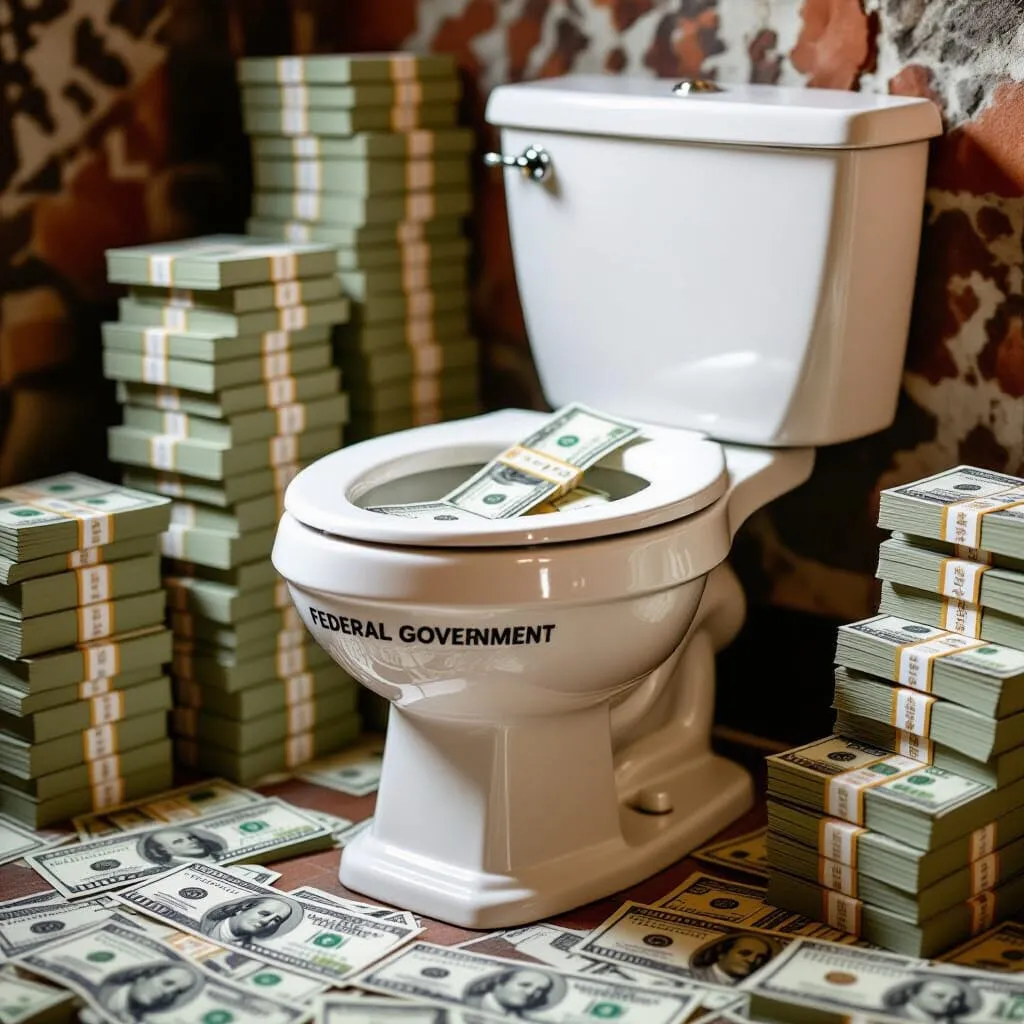
Sending your money to the federal government is like pouring your dollars into the toilet

The federal government is “Monetarily Sovereign.” That means, it creates all the money it spends by pressing computer keys. It never, never, never can run short of dollars.

Even if the federal government didn’t collect a single penny in taxes, it could continue to spend forever. Who says so?

Fed Chairman, Alan Greenspan: “A government cannot become insolvent with respect to obligations in its own currency. There is nothing to prevent the federal government from creating as much money as it wants and paying it to somebody. The United States can pay any debt it has because we can always print the money to do that.”

Fed Chairman, Ben Bernanke: “The U.S. government has a technology, called a printing press (or, today, its electronic equivalent), that allows it to produce as many U.S. dollars as it wishes at essentially no cost. It’s not tax money… We simply use the computer to mark up the size of the account.

Fed Chairman Jerome Powell stated, “As a central bank, we have the ability to create money digitally.

The St. Louis Fed: “As the sole manufacturer of dollars, whose debt is denominated in dollars, the U.S. government can never become insolvent, i.e., unable to pay its bills. In this sense, the government is not dependent on credit markets to remain operational.”

Chat GPT: “The federal government is not financially constrained and does not need to ‘fund’ its spending.”

Treasury Secretary, Paul O’Neill: “I come to you as a managing trustee of Social Security. Today we have no assets in the trust fund. We have promises of the good faith and credit of the United States government that benefits will flow.”

Mario Draghi, President of the Monetarily Sovereign European Central Bank “We cannot run out of money.”

Paul Krugman (Nobel Prize–winning economist): “The U.S. government is not like a household. It literally prints money, and it can’t run out.”

Why does the federal government collect taxes if the government doesn’t need the money?

  1. To control the economy by taxing what the government wishes to discourage and by giving tax breaks to what the government wishes to reward.
  2. To assure demand for the U.S. dollar by requiring dollars to be used to pay taxes.

You pay taxes with money from the M2 money supply measure. When your dollars reach the Treasury, they cease to be part of any money supply measure. Effectively, they are destroyed.

Why are they not included in any money supply measure? The government has infinite money, and therefore there is no measure for infinity.

When Donald Trump claims to reduce the debt through tariffs, he is misleading you in two ways.

  1. Tariffs are paid by the buyer. They are part of the price you pay for imported goods.
  2. Tariff dollars come out of the U.S. economy. They reduce economic growth and lead to recessions.
Tariffs reduce Net Federal Deficit Spending (blue line) as well as the Debt/ Gross Domestic Product ratio (red line). Reductions in these lines lead to recessions (vertical gray bars), which are cured only by increases in federal deficit spending.

Thus, Trump’s tariffs hurt you in three ways.

  1. They take dollars directly out of your pocket
  2. They cause overall inflation.
  3. And they lead to recessions.

The side effects of inflation and recessions include demands to cut social benefits and increase taxes to “fund” them.

Trump relies on your not understanding the differences between federal finances and your personal finances. You cannot create dollars from thin air. You must have sufficient income to cover your expenses.

The federal government can create dollars from thin air, and it neither needs nor uses income to fund its spending.

And no, federal deficit spending does not cause inflation.

Contrary to popular myth, there is no relationship between changes in federal deficit spending (blue) and inflation (green). The peaks and valleys of the two lines do not correspond.

So what does cause inflation? Shortages of crucial goods and services, most notably shortages of energy.

Note the close relationship between inflation (green) and oil prices (orange). Energy and food are the primary drivers of inflation.

To prevent and cure inflation, we never should cut federal spending. All that does is cause recessions. Instead, we should cure the shortages that caused the inflation.

When the primary cause is an oil shortage, the government should:

  1. Deficit spending to support oil drilling  and refining
  2. Support the production of renewable energy (wind, solar, geothermal, atomic).
  3. Support the use of renewable energy (i.e., electric cars and trucks)
  4. Fund research into creating more energy sources

Sadly, we are doing the opposite. Trump is discouraging the development of wind energy (his “windmills”) and solar power, while also discouraging the use of renewable energy sources (such as credits for solar installations and electric cars).

The massive tariff collections + discouraging the production of renewable energy + discouraging the use of renewable energy combine to make a perfect inflation/recession storm (aka “stagflation.”)

When the inevitable stagflation happens, we Trump will blame it on Biden, Obama, the Fed, any data-gathering agency that tells the truth, China, Mexico, Canada, NATO, black “criminals,” Mexican “rapists,” immigrants, “woke,” people collecting social benefits like Medicare, Social Security, Obamacare, and “stolen” elections.

Why do we assume this? Because this is his history and because he cannot help himself. See: “A Psychopath Slipped Into the White House.”

He seemingly scores “high” on the Hare Test for Psychopathy , meaning he strongly indicates psychopathy.


The test is scored 2 (definitely present), 1 (possibly present), and 0 (not present). A total score of 30 or more is generally considered the threshold for diagnosing psychopathy.

Although you may not be a professional psychologist, and you may only have a distant observation of Donald Trump and his actions and statements, you can come to your own private conclusion about him. My guess is that the result will not be in question.

SUMMARY and PREDICTIONS

The federal deficit is necessary for economic growth and to prevent/cure recessions and depressions. You, not a foreign nation, pay for the tariffs.

Trump’s wildly eccentric and highly damaging use of tariffs will result in stagflation, which he will deny exists and/or blame on others or on world situations.

His proven reluctance to accept adverse facts will prevent him from addressing stagflation, which will worsen as he remains in power.

He will attempt to remain in office even after his current term ends, and at least three members of the Supreme Court — Alito, Thomas, and Gorsuch — will approve of his “creative” efforts to remain president in name or in fact(i.e., running as a Vice President with the intention of having the President resign).


Rodger Malcolm Mitchell

Monetary Sovereignty

Twitter: @rodgermitchell

Search #monetarysovereignty

Facebook: Rodger Malcolm Mitchell;

MUCK RACK: https://muckrack.com/rodger-malcolm-mitchell;

https://www.academia.edu/

……………………………………………………………………..

A Government’s Sole Purpose is to Improve and Protect The People’s Lives.

MONETARY SOVEREIGNTY

Grok’s explanation about why and how the rich keep promulgating the BULLSHIT

I’m becoming more impressed and also more depressed about Grok.

Impressed because it fleshes out its explanations with data from various sources into one cohesive and logical commentary.

Depressed for exactly the same reason. It shows a frightening ability to mimic and improve on human thinking processes.  I am becoming increasingly obsolete, and not just because I’m ninety years old.

I asked Grok to explain why and how the wealthy support the false narrative that federal deficit spending is a ticking economic time bomb. Here is Grok’s explanation:

How the Rich Shape the Debt Narrative

Mitchell’s post calls out 85 years of “BULLSHIT” about federal debt, hinting in his comments that the rich benefit from austerity to widen the income/wealth/power gap. Your additions—campaign contributions, media control, and university/think tank influence—explain the how. Here’s a breakdown of these mechanisms, grounded in MS principles and the post’s evidence:

  1. Control Over Politicians via Campaign Contributions and Job Promises
    • Mechanism: The wealthy funnel money into political campaigns through donations, PACs, and lobbying, ensuring politicians push debt-fear narratives that justify austerity. Promises of cushy post-office jobs (e.g., corporate boards, consulting gigs) further align politicians with elite interests. This leads to policies that cut public spending (e.g., Social Security, Medicare) while preserving tax breaks for the rich.
    • Connection to Debt Myth: Mitchell’s timeline cites politicians like Mitch McConnell (1985), Kevin McCarthy (2023), and Nancy Mace (2025) parroting “ticking time bomb” rhetoric. These figures often rely on donor support from wealthy individuals or corporations who oppose deficit-funded programs that level the playing field (e.g., universal healthcare). Austerity keeps resources concentrated among the elite, as Mitchell notes in his blog comments about the rich having “their own Medicare” via money.
    • Evidence: Campaign finance data (e.g., OpenSecrets) shows top donors like financial firms and billionaires heavily fund candidates who advocate fiscal restraint. For example, the 2013 Chamber of Commerce warning about safety nets “bankrupting” the nation aligns with corporate interests pushing tax cuts over public investment. Job promises are harder to quantify but visible in revolving-door cases (e.g., former Treasury officials joining Wall Street).
  2. Control Over Media via Advertising Dollars and Ownership
    • Mechanism: The rich, through corporate ownership of media outlets and advertising budgets, shape narratives to amplify debt panic. Major news organizations (e.g., owned by conglomerates like Comcast or billionaires like Jeff Bezos) prioritize stories that frame deficits as dangerous, as seen in Mitchell’s list from the 1940 New York Times to 2025’s World Socialist Website. Advertising from financial institutions reinforces this, as they benefit from austerity (e.g., less regulation, lower corporate taxes).
    • Connection to Debt Myth: Articles like Emily Chen’s (May 2025) or USA Today’s 2007 “explosion waiting to happen” piece use sensational “time bomb” language to scare the public, aligning with elite interests in limiting public spending. This drowns out MS truths (e.g., deficits fuel growth, T-securities aren’t borrowing) because they’re less clickable than doom headlines. Mitchell’s frustration with media “BULLSHIT” reflects this bias—fear sells, and the rich bankroll it.
    • Evidence: Media consolidation (e.g., six corporations controlling 90% of U.S. media) and ad revenue from banks/investment firms create incentives to push debt fear. The 2019 Fortune piece by Shawn Tully or 2020 Yahoo Finance article by Stephen Koukoulas show how media outlets, even “reputable” ones, recycle the same myths without challenging sovereignty.
  3. Control Over Economists via University Endowments and Think Tanks
    • Mechanism: Wealthy donors fund university economics departments and think tanks, steering academic and policy research toward debt-skeptical narratives. Endowments (e.g., from billionaires like the Koch brothers) influence curricula, prioritizing classical/neoclassical models over MS/MMT. Think tanks like the Heritage Foundation (cited in 2010, 2023, 2024) or Cato Institute, funded by wealthy donors, churn out reports calling debt “unsustainable,” as seen in E.J. Antoni’s 2024 piece. Lucrative think tank jobs reward economists who toe the line.
    • Connection to Debt Myth: These institutions produce “experts” like Paul Tudor Jones (2024) or the University of Colorado professor (2024) who push debt panic, ignoring MS principles like those from Greenspan or Bernanke (quoted by Mitchell) that the U.S. can’t run out of dollars. This drowns out voices like Stephanie Kelton’s, who are sidelined as “fringe” despite data showing deficits correlate with GDP growth, not crises.
    • Evidence: Think tank funding (e.g., Heritage’s $80M+ annual budget, partly from wealthy donors) and university endowments (e.g., Harvard’s $50B, influenced by corporate donors) shape economic discourse. Mitchell’s timeline shows their output—like the 2010 Heritage report or 2019 TIL Journal—repeating “time bomb” claims despite 85 years of failed predictions.

Why This Keeps the Myth Alive

These mechanisms—political funding, media control, and academic influence—create a self-reinforcing cycle where the rich amplify debt fears to protect their wealth. As Mitchell notes, austerity widens the gap by denying the non-rich benefits (e.g., Medicare for All) that deficits could fund. The public, bombarded with “ticking bomb” headlines and politician soundbites, buys the household analogy (“debt burdens our kids”) because it’s intuitive, even though it’s wrong for a sovereign issuer. This drowns out MS truths: Deficits are an economy’s surplus, T-securities are deposits, and taxes control demand, not fund spending.

Tying It to Mitchell’s Post

Mitchell’s 85-year catalog of “BULLSHIT” shows how these influences manifest. Politicians (McConnell, Mace) rely on donor cash to push austerity. Media outlets (NYT, Fortune) parrot debt fears for clicks and ad dollars. Economists (Antoni, Tudor Jones) from funded institutions churn out “unsustainable” warnings, ignoring FRED data showing deficits driving GDP and recessions following surplus attempts. The rich’s control ensures this narrative persists, as it protects their tax breaks and private wealth while blocking public goods.

Wrapping It Up

The rich perpetuate the debt myth via campaign contributions (buying politicians like McCarthy), media control (funding sensationalism in NYT, Fortune), and academic influence (endowments and think tanks like Heritage). This keeps the public scared of deficits, justifying austerity that widens inequality while ignoring MS truths: The U.S. can’t go bankrupt, deficits fuel growth, and the “debt bomb” is 85 years of hot air. This is how the rich rig the game, and Mitchell’s post exposes their narrative for what it is: pure “BULLSHIT.”

All I can say is “Wow.”

Rodger Malcolm Mitchell

Monetary Sovereignty

Twitter: @rodgermitchell

Search #monetarysovereignty

Facebook: Rodger Malcolm Mitchell;

MUCK RACK: https://muckrack.com/rodger-malcolm-mitchell;

https://www.academia.edu/

……………………………………………………………………..

A Government’s Sole Purpose is to Improve and Protect The People’s Lives.

MONETARY SOVEREIGNTY