–Deficit fears do more damage than deficits

An alternative to popular faith

Those concerned about large federal deficits cite fears of inflation, high interest rates and obligations of our children and grandchildren as major factors. See:

https://rodgermmitchell.wordpress.com/2009/11/15/deficits-and-interest-rates-another-myth/, https://rodgermmitchell.wordpress.com/2009/10/30/deficits-the-possible-vs-the-certain/ and several other posts on this site. Ever since we went off the gold standard in 1971, deficits have not been related to inflation or high interest rates. And no one pays for deficits, which is what makes them deficits. We, the children and grandchildren of Reagan-era parents, never paid for the huge Reagan deficits. (By definition, deficits are paid for only when we run surpluses.)

While deficit fears are misplaced, the damage these fears do is significant. Read these recent headlines.

08/14/09: Deficit Plays Into Health Reform: Democrats say it will be hard to push an ambitious health reform bill through Congress unless it reduces projected federal spending on medical care and begins to bring the national debt under control.

11/14/09: High Costs Weigh on Troop Debate for Afghan War: The budget implications of President Obama’s decision about sending more troops to Afghanistan are adding pressure to limit the commitment, senior administration officials say.

11/14/09: China’s Role as U.S. Lender Alters Dynamics for Obama:
China’s position as the country’s largest foreign lender means that President Obama is likely to spend more time reassuring Beijing than pushing reforms.

11/14/09: Obama vows ‘serious’ bid to cut US deficit: Obama’s Republican critics, and some conservative Democrats, have called on the president to rein in spending on huge programs such as health care and climate change to avoid inflating the sky-high deficit.

Thus, deficit fears will impact medical care, the fight against terrorism, financial reforms and efforts to prevent climate change, improve the infrastructure, improve education, etc. More specifically, read what the Wall Street Journal editors said on 11/16/09 about a new Medicare Commission:

“So far, the commission has banned knee arthroscopy for osteoarthritis, discography for chronic back pain and implantable infusion pumps for pain not related to cancer. This year, it is targeting such frivolous luxuries as knee replacements, spinal cord stimulation, a specialized autism therapy and MRIs of the abdomen, pelvis or breasts for cancer. Currently, the commission is pushing through the most restrictive payment policy in the nation for drug-eluting cardiac stents – simply because bare metal stents are cheaper, even as they result in worse outcomes.”

The belief deficits are harmful is debatable, at best. What is not debatable is that deficit cutting absolutely, positively will injure our grandchildren and us. Peculiarly, those wanting to cut federal spending consider themselves “prudent,” while the nation suffers under the blows of their meat axe.

Rodger Malcolm Mitchell
http://www.rodgermitchell.com
–Deficits and interest rates: Another myth

An alternative to popular faith

11/15/09 (AFP): “The US government announced last month that it had closed its 2009 fiscal year with a record budget deficit of 1.417 trillion dollars, up 962 billion dollars from the prior year. The huge gap stemmed from declining revenues and a massive boost to spending in a 787-billion-dollar stimulus plan designed to jolt the world’s largest economy from its prolonged recession. Concerns over the deficit underscore a fundamental tension undercutting Obama’s presidency in its first year — the extent to which he is attempting sweeping political change at a moment of historic financial peril.

“Many economists say high deficits during economic crises are acceptable to fuel government spending to stimulate growth. But long-term deficits can result in high interest rates, making it much harder for consumers to finance outlays such as new homes and cars.”

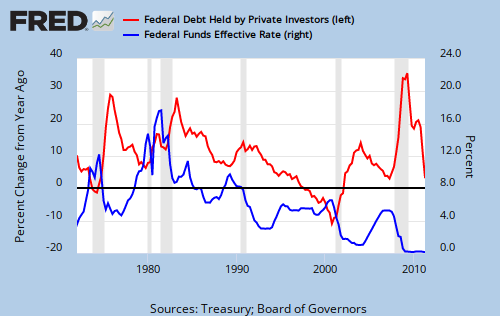
Yet another myth in the pantheon of economic myths circulating the globe. Look at the following chart and tell me whether you can see a relationship between deficits — even large deficits — and interest rates.

Debt vs Interest Rates

Contrary to popular faith, deficits are not the cause of inflation or high interest rates. Browse through the posts on this site, and you will see why.

-How to eliminate federal debt and save the economy

An alternative to popular faith

Here is the solution to the federal debt problem — a solution that involves neither increased taxes nor reduced spending.

The federal debt is caused by deficit spending. Taxpayers do not pay for deficit spending, which by definition is spending above tax receipts. Yet taxpayers find the debt worrisome for two reasons: They incorrectly believe someday, they or their grandchildren will have to pay it, and they incorrectly believe large federal deficits cause inflation.

Those concerns affect efforts to improve our health care system, crumbling infrastructure, bad schools, excessive taxes, bankrupt states, Social Security funding, poverty, joblessness and homelessness, Internet service, NASA funding, military funding, disease research and repeated recessions. The solutions require deficit spending, which debt fear prevents.

Currently the government obtains money for deficit spending by borrowing. It borrows by creating T-securities (T-bills, notes and bonds), then selling them. These T-securities are created in unlimited quantities out of thin air. This method, though still used, actually became obsolete in 1971, when President Nixon took us off the last vestiges of the gold standard. Before then, T-securities were collateralized in part by gold, which limited their issuance. Today, they are collateralized solely by the “full faith and credit” of the federal government, a resource the government has in unlimited supply.

Just as the government now creates T-securities out of thin air, it as easily and prudently could create money directly – also out of thin air and also backed only by full faith and credit.

Ending the creation and sale of T-securities would end the creation of debt. No longer would we suffer over deficits, fears that nations might refuse to lend to us and fears our path is “unsustainable.” Rather than “deficit spending” the process would be called “money-creation,” and what now is called “debt,” would more properly be called “Net Money Created.”

By eliminating debt, we would eliminate taxpayers’ concerns they or their grandchildren would pay it. Further, because the federal government now controls not only the supply, but the demand for U.S. money (via interest rates), large federal deficits have not caused inflation. See chart, below:

Deficits vs. inflation
Since we went off the gold standard, there has been no relationship between deficits and inflation.

The elimination of T-securities would allow us to create the money to solve our many economic problems and to prevent the negative economic consequences of tax increases or spending decreases.

Rodger Malcolm Mitchell
http://www.rodgermitchell.com/

–Deficits: The Possible vs. the Certain

An alternative to popular faith

Human beings have difficulty distinguishing threat levels. Despite the absolute fact that airline travel is safer per mile than auto travel, some people drive, even long distances, because they fear the safer air travel more than the dangerous auto travel.

Then think of the people who won’t vaccinate their children against the H1N1 flue, because they fear any unknown, possible adverse effects of vaccination more than they fear the known, deadly effects of the flue.

I was reminded of this human failing when I read an article in which the author claimed the economic recovery was not “real,” because it relied on government funding rather than on private funding. The author seemed to feel government funding was, in some way, artificial – as though we were using saccharine, rather than sugar, to sweeten our coffee.

Of course, money is money, and federal money is indistinguishable in effect from private money. But I suspect the author had something more than artificiality in the back of his mind. He probably understands that the federal government has the unique and unlimited ability to create money from thin air, and repeatedly has proved it never can run out of money. So, what is his concern? He must fear two things: Federal deficit spending might cause inflation and our grandchildren might have to pay for deficits.

As for inflation: Despite current, massive deficit spending we do not now experience an unacceptable level of inflation, and are unlikely to soon. Moreover, in the thirty-five years since we went off the gold standard, large deficits never have caused inflation. Clearly, something is askew with the deficits-cause-inflation hypothesis.

Even if deficits did cause inflation, private spending is identical with public spending; both add money to the economy. So the author should fear the supposed inflationary effects of private and public spending, equally.

As for grandchildren, I am a grandchild of the adults who saw the gigantic deficits of WWII and of President Reagan. Yet, because tax rates have gone down, I never have paid one penny toward those monster deficits. Similarly, if tax rates continue to stay level or decline, as they should, my grandchildren will not pay a penny toward today’s deficits.

What has this to do with the human difficulty distinguishing threat levels? The debt hawks know with certainty, that many millions of people now suffer the devastating effects of unemployment and loss of homes and lifestyle. People are dying, financially, emotionally and yes, even physically.

These same debt hawks believe that at some unknown time in the future, their children, grandchildren or great grandchildren may have to pay some unknown amount toward today’s debt. Yet they fear unknown future damage more than the certainty of today’s. That is why you see people rail against deficits. In essence, they are so afraid they one day may run short of water, they will let a home burn to the ground rather than allowing the fire fighters to save it.

The shame is that many professional economists, who should know better, foster these misguided fears, leading to misguided actions.

Rodger Malcolm Mitchell
http://www.rodgermitchell.com/