–The debt ceiling, the ultimate expression of Congressional ignorance

The debt hawks are to economics as the creationists are to biology. Those, who do not understand Monetary Sovereignty, do not understand economics. Cutting the federal deficit is the most ignorant and damaging step the federal government could take. It ranks ahead of the Hawley-Smoot Tariff.
========================================================================================================================================================

We all are ignorant of many things, but Congress has managed to demonstrate an inhuman, almost surreal level of ignorance in its wrestling with the debt ceiling. Each day, we read statements from otherwise intelligent people, that somehow manage to exceed in ignorance, the statements from the previous day.

The debt ceiling is Congress’s wooly-brained attempt to limit the spending which it itself authorizes. It’s like a person who goes shopping, and intentionally takes less money than they want to spend, because they know that once in the store, they won’t be able to control themselves. What an admission! Congress tells the world, “The majority of us is so foolish, so imprudent, so clueless, we need an artificial control to prevent our running amok — and we are the foolish, imprudent, clueless people guiding America.” As the kids say, OMG!

Those understanding Monetary Sovereignty know, since 1971 the federal government has had the unlimited ability to create dollars. It cannot “go broke” as House Speaker John A. Boehner often claims. Its debt is not “unsustainable,” as the media like to declare. The government could end all taxes and end all borrowing, while tripling its deficit spending, all with no difficulty. It could redeem every T-security (i.e. pay all debt) tomorrow, without breaking a sweat. So what does “going broke” and “unsustainable” mean?

The sole constraint on federal deficit spending is inflation.

So, the sole “purpose” for the purposeless debt ceiling must be to prevent inflation — and we are nowhere near that. Today, millions do not have health care insurance, and millions more have inadequate health care insurance. Millions of children go to poor schools, live in poor housing or on the street. Roads and bridges are falling apart. States are not paying their bills. Small businesses are failing for lack of payment by government agencies. Research and development has been reduced. And we labor with unemployment and the human suffering it causes, which suffering is exacerbated by a debt ceiling, and could be alleviated with federal support.

Here is a question you may wish to put to your Congressperson: “How, on balance, does having a debt ceiling benefit America more than it harms America?” I’ll be glad to publish their answers, here.

Rodger Malcolm Mitchell
http://www.rodgermitchell.com

No nation can tax itself into prosperity, nor grow without money growth.
–Watch, as politicians flush Medicare, Medicaid and Social Security down the drain

The debt hawks are to economics as the creationists are to biology. Those, who do not understand Monetary Sovereignty, do not understand economics. Cutting the federal deficit is the most ignorant and damaging step the federal government could take. It ranks ahead of the Hawley-Smoot Tariff.
====================================================================================================================================================================================================

I’ll give you straight talk; I won’t mince words. It was inevitable, the debt hawks, not having found enough places to cut federal benefits, now want to cut your Medicare, Medicaid and Social Security, as well as just about every other federal benefit they could think find:

By ERIK SCHELZIG Associated Press, Feb. 27, 2011

House Republicans specifically want to target entitlement programs, like Medicaid and Medicare, the speaker (John Boehner) said.
“To not address entitlement programs, as is the case with the budget the president has put forward, would be an economical and moral failure,” Boehner said. “By acting now, we can fulfill the mission of health and retirement security for all Americans without making changes for those in or near retirement.”

Your benefits from these three programs already are far too low, and the debt hawks want to cut more. Why? They have absolutely no idea. Write to any debt hawk and ask this simple question: “Why do you want to cut the deficit?” If you get any answer at all (unlikely), it will be something nebulous like, “The deficit is unsustainable,” or “We’re living beyond our means.” In short, generalized BS based on nothing.

Never, will you receive a solid statement of exactly what would happen in the future, if the government keeps spending. Never will you be shown any supporting data. The reason: What will happen is: We will prosper.

But here is a solid statement of what will happen if government spending declines: We will have another recession or a depression. We will have fewer doctors, less medical research, poorer roads and bridges, worse education, poorer security, more states not able to pay their bills, more poverty and overall a reduction in our quality of life. How do I know? Read some of the posts in this blog, beginning with Summary, and work your way forward.

I’m sure you recall all that phony wailing about our children and grandchildren being hurt by deficits. Total nonsense. Use your brain. What do you think cutting federal programs will do to our children and grandchildren?

And the gall of these people talking about “fulfilling the mission of health and retirement security” by cutting spending. That’s classic double-speak. It’s like the southern senators criticizing the freedom marchers for “upsetting law and order.” No, Jim Crow upset law and order, and to fulfill the mission of health and retirement requires more money, not less.

And then there is the complete crap about how cutting federal spending somehow will alleviate unemployment. Are you kidding? What next? Cure hunger by withholding food?

In short, cutting federal spending is nuts. Anyone who thinks the economy works better or can grow, with less money, is equally nuts. The Tea Party anti-government mantra is the biggest fraud ever perpetrated on America. It makes absolutely no sense at all. Every dollar cut from the so-called “deficit” (more properly, “money supply”), is a dollar taken right out of the economy and right out of your pocket. These Tea Partiers make Bernie Madoff look honest.

Boehner wants to cut social programs “without making changes for those in or near retirement”. In other words, he wants to screw you young people. Why? Because he knows the older people would vote the Republicans out of office, if they get screwed, but he figures you young folks are so detached from retirement, you won’t realize what is being done to you until it’s too late. Anyway, aren’t most rich people older? No need to upset the wealthy contributors.

Today, you may not understand Monetary Sovereignty (though the basic concept is dead simple), but I suspect you’ll begin to understand it better when Medicare, Medicaid and Social Security and the rest of the economy go down the drain, and you’re left with insufficient medical care, insufficient retirement and a lousy world for your kids and grandchildren.

Then, you’ll have only yourself to blame, because you didn’t even take the trouble to learn Monetary Sovereignty, and instead, like little obedient sheep, you marched to the voting booth and elected those jerks. You didn’t contact your Congressperson; you didn’t write to the media; you didn’t argue; you didn’t demand. You just bent over and let them do it to you.

And that, my friends, is the straight talk I promised you.

Rodger Malcolm Mitchell
http://www.rodgermitchell.com

No nation can tax itself into prosperity, nor grow without money growth.
Monetary Sovereignty, Monetary Sovereignty, Monetary Sovereignty, Monetary Sovereignty,Monetary Sovereignty, Monetary Sovereignty, Monetary

–Oil hits $100 per barrel. What does this mean for the economy?

The debt hawks are to economics as the creationists are to biology. Those, who do not understand Monetary Sovereignty, do not understand economics. Cutting the federal deficit is the most ignorant and damaging step the federal government could take. It ranks ahead of the Hawley-Smoot Tariff.
====================================================================================================================================================================================================
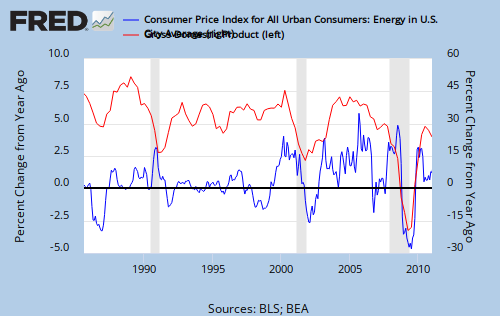
Oil hits $100 per barrel. What does this mean for the economy? Here are some thoughts:

There is a close historical relationship between oil prices and inflation. If this relationship continues, inflation soon will rear its ugly head.

The economists, media and politicians wrongly will blame the federal deficit (which since the end of the gold standard, has had no relationship with inflation), and will work even harder to cut federal spending. This cut will slow or even end the recovery. Meanwhile, the Fed will raise interest rates, which contrary to popular myth, actually is stimulative (high rates increase federal interest payments into the economy).

In fact, if you’re looking for a relationship, check this out: Since 1985, oil price changes have generally paralleled GDP changes. Rising oil = rising GDP:

GDP vs oil

I suspect the reason is: As GDP increases, it increases the demand for oil, which responds with price rises (either via market forces or via Saudi perception of demand. So, at least partly, the recent increases in GDP are responsible for the $100 oil.

So, in a convoluted, round-about way, rising oil prices will hurt the recovery, though in fact, there seems to be no direct relationship between the two. The pundits will blame high federal deficits, higher interest rates and higher oil prices for our reduced growth, when the real culprit will be reduced federal deficits.

Rodger Malcolm Mitchell
http://www.rodgermitchell.com

No nation can tax itself into prosperity, nor grow without money growth.
Monetary Sovereignty, Monetary Sovereignty, Monetary Sovereignty, Monetary Sovereignty,Monetary Sovereignty, Monetary Sovereignty, Monetary

–Have we come to the end of empiricism in economics?

The debt hawks are to economics as the creationists are to biology. Those, who do not understand Monetary Sovereignty, do not understand economics. Cutting the federal deficit is the most ignorant and damaging step the federal government could take. It ranks ahead of the Hawley-Smoot Tariff.
==============================================================================================================================================================================================

Have we come to the end of empiricism in economics? The increasing influence of the Tea Party and its philosophies, makes this question especially timely.

To quote from Wikipedia: “Empiricism is a fundamental part of the scientific method that all hypotheses and theories must be tested against observations of the natural world, rather than resting solely on a priori reasoning, intuition, or revelation. Hence, science is considered to be methodologically empirical in nature.”

If economics is a science, all hypotheses in economics must be tested against observed reality, not against intuition or faith. Here are some observed realities in economics:

1. Being on a gold standard requires a nation to hold gold in an amount equal to, or greater than, the amount of sovereign money it issues, according to an agreed-upon formula.
2. In August 1971, the U.S. federal government exited the gold standard.
3. Exiting the gold standard gave the U.S. government the legal ability to create unlimited numbers of dollars without being restricted by gold inventories.
4. Being able to create dollars without limits, the U.S. government does not need to obtain dollars from any other source.
5. Not needing to obtain dollars, the U.S. government needs neither to borrow dollars nor to levy taxes. It merely can create dollars to support any spending need.
6. The above is part of “Monetary Sovereignty.”
7. Not all entities are Monetarily Sovereign. The U.S. states, counties and cities, and the euro nations, are monetarily non-sovereign. They do not have the legal ability to create unlimited quantities of money.
8. Because a Monetarily Sovereign nation can create unlimited money, it cannot go “broke,”i.e., be unable to pay its debts, nor can paying any debt be a financial burden, nor must future generations be forced to pay taxes.
9. Again, quoting from Wikipedia, “A commodity is a good for which there is demand, but which is supplied without qualitative differentiation across a market.” The U.S. dollar is a commodity. It is freely traded on exchanges, and all U.S. dollars are identical.
10. A decrease in the perceived value of a dollar, compared to the perceived values of goods and services, is known as “inflation.”
11. The value of a commodity is based on supply and demand. An increase in supply without a corresponding increase in demand, generally reduces the value of a commodity.
12. Demand is based on risk and reward. An increase in risk, without a corresponding increase in reward, generally reduces the value of a commodity. For money, risk is inflation and reward is interest.

All of the above are empirical. While there may be some legitimate quibbles about the exact wording, I suspect there is agreement that all of the above have been the subject of countless observations.

13. Therefore, the constriant on money creation by a Monetarily Sovereign nation is neither taxes nor borrowing, but inflation.
14. Inflation can be prevented/cured by reducing the supply of, or increasing the demand for, money.

These last two are not empirical, but follow logically from the above empirical statements.

15. Reductions in money supply growth have been associated with recessions and depressions. Increases in money supply growth have been associated with recoveries.

This last statement is not itself empirical, but is based on empirical data. See: Understanding economics.

The following statements neither are empirical, nor are they derived from empiricism. No facts support these statements. They are not science, but rather are based on intuition and popular faith. Yet they not only are parroted, but are believed, by many politicians, economists and members of the general public.

A. Knocking on wood will improve my luck.
B. The federal deficit (or debt) is unsustainable [or a ticking time bomb].
C. Taxpayers or taxpayers’ children will pay for federal spending.
D. Reducing the federal deficit (or debt) will improve Americans’ quality of life
E. Reducing the federal deficit (or debt) will improve security, defense, education, housing, the infrastructure and/or the ecology.
F. The federal deficit (or debt) is similar to your personal debt.
G. The federal deficit (or debt) is similar to states’ debt
H. The U.S. government is broke or going broke.
I. The federal Debt/GDP ratio is too high.
J. When the federal Debt/GDP ratio reaches [any figure], the U.S. economy will suffer.
K. Ireland’s [or any euro nation’s] finances are similar to those of the U.S.
L. The federal debt ceiling is a good thing with a good purpose.
M. Social Security (or Medicare) will go broke without a tax increase or a benefit decrease.
N. Cutting the deficit (or debt) will reduce unemployment.
O. Small government is better than big government
P. Friday the 13th is an unlucky day.

So as Congress, led by the Tea Party and freshman senators, marches toward a debt ceiling showdown, we ask again, have we come to the end of empiricism in economics? Have we come to the end of economics?

Rodger Malcolm Mitchell
http://www.rodgermitchell.com

No nation can tax itself into prosperity, nor grow without money growth.