Answer: All three are false narratives. The first two are meant to teach children valuable lessons. The third should teach adults a valuable lesson.
That lesson is: Don’t believe the Committee for a Responsible Federal Budget (CRFB) when it howls like a wolf, squawks like a chicken, and pontificates in solemn terms that Social Security and Medicare “trust funds” are running short of dollars.
The Trustees show that the Social Security and Medicare Hospital Insurance (HI) trust funds rapidly approach insolvency. Their funding imbalances need to be addressed sooner rather than later to prevent across-the-board benefit cuts or abrupt changes to tax or benefit levels.
In effect, the CRFB claims:
1. Social Security and Medicare benefits are paid for by trust funds.
2. These “trust funds” will run short of money.
3. The solution to Medicare or Social Security insolvency requires cutting benefits and/or increasing taxes.
All three are factually FALSE.
1. SOCIAL SECURITY AND MEDICARE BENEFITS ARE PAID FOR BY TRUST FUNDS
Federal trust funds bear little resemblance to their private-sector counterparts, and therefore the name can be misleading.
A private sector “trust fund” implies a secure source of funding.
(A federal trust fund merely tracks inflows and outflows for specific programs. There is no secure source of funding.)
In private-sector trust funds, receipts are deposited, and assets are held and invested by trustees on behalf of the stated beneficiaries.
In a federal trust fund, the receipts — as part of the M2 money supply measure — are destroyed upon receipt. They no longer are part of any money supply measure.
There are no stated beneficiaries, as the criteria for beneficiaries change daily.)
The federal government owns the accounts and can, by changing the law, unilaterally alter the purposes of the accounts and raise or lower collections and expenditures.
The federal government (Congress and the President) can do whatever they wish with the “trust funds”: Add to them, subtract from them, or change them to pay for anything or nothing.
At the click of a computer key or the passage of a law, the balance in any federal “trust fund” could be changed to $100 trillion or $0 or anywhere in between.
Alan Greenspan: “A government cannot become insolvent with respect to obligations in its own currency.”
If Congress and the President wished, the Medicare “trust fund” could be changed to pay for Las Vegas vacations, jewelry, Congressional vacations, etc. Almost every year, the federal government arbitrarily changes what Medicare will pay for and how much it will pay.
In fact, that is exactly what the CRFB suggests when it writes about “benefit cuts or abrupt changes to tax or benefit levels.”
In a real “trust fund,” the trustees would not have that control.
2. THESE TRUST FUNDS WILL RUN SHORT OF MONEY
Wrong.
The United States government is unlike state and local governments. It also is unlike euro governments, private businesses, you, and me. The U.S. government uniquely is Monetarily Sovereign. It is sovereign over the United States dollar.
In the 1780’s it created the original dollars from thin air and gave them an arbitrary value. Today, the government continues to create dollars from thin air and continues to provide them with an arbitrary value.
Ben Bernanke: “The U.S. government has a technology, called a printing press (or, today, its electronic equivalent), that allows it to produce as many U.S. dollars as it wishes at essentially no cost.”
The government never unintentionally can run short of its own sovereign currency, the dollar. Even if the federal government didn’t collect a penny in taxes, it could continue spending forever.
This absolute control over the U.S. dollar means no federal government agency can run out of dollars unless Congress and the President will it.
The only way Medicare or Social Security or any other federal agency can run short of dollars is if Congress and the President want them to run short of dollars.
3. THE SOLUTION TO SOCIAL SECURITY AND MEDICARE INSOLVENCY REQUIRES CUTTING BENEFITS OR INCREASING TAXES
Wrong.
Despite all the pretense about fake “trust funds,” Federal taxes (which include FICA) do not fund Medicare or Social Security. Those FICA dollars deducted from your paycheck (but tellingly, not deducted from other sources of income received by the wealthier among us) — those FICA dollars do not pay for anything.
They merely become part of the federal government’s infinite supply, and effectively are destroyed. (You mathematicians know that infinity plus any amount still = infinity. Thus, your tax dollars do not increase the federal government’s supply of dollars by even one cent.)
In fact, with regard to Medicare Part B, there is a wholly different pretense.
While Medicare Part A (pays for hospitals and doctors, Part B pays for clinical research, ambulance services, durable medical equipment, and some drugs. And Medicare recipients are charged extra, above FICA, ostensibly to pay for Part B.
But in reality, those charges, like all dollars coming into the federal government, are destroyed upon receipt.
The solution for Social Security and Medicare insolvencies is simply for the federal government to pay for them, which it could do the same way it pays for everything: By creating new dollars, ad hoc.
So group the warnings about Social Security and Medicare “trust fund” insolvency along with the boy who cried, “wolf” and Henny Penny’s “the sky is falling” as silly, little lies. There are no “trust funds.” Congress and the President have absolute control over all federal agency finances.
All your tax dollars are for naught. The federal government could and should provide free, comprehensive, no-deductible Social Security and Medicare for every man, woman, and child in America.
Continuing with the CRFB’s charade:
The Social Security Trustees estimate the Social Security Old-Age and Survivors Insurance (OASI) trust fund will deplete its reserves by 2034 and the Social Security Disability Insurance (SSDI) trust fund will not become depleted within the 75-year projection window for the first time since the 1983 Trustees’ report.
On a combined theoretical basis, assuming revenue is allocated between the trust funds in the years between OASI and SSDI insolvency, Social Security will become insolvent by 2035. Upon insolvency, all beneficiaries will face a 20 percent across-the-board benefit cut, which will grow to 26 percent by 2096.
The Trustees estimate a 75-year actuarial shortfall of 3.42 percent of taxable payroll for Social Security, which is slightly lower than the 2021 report’s estimate of 3.54 percent of payroll, but higher than any other year prior.
And blah, blah, blah. The CRFB substantiates the old saying, “Figures don’t lie, but liars figure,” by providing statistics to make their lies sound factual.
Ooh, it must be true. There even is a graph. Except the graph is phony. The “Trust Fund Exhaustion” is based on the lie that Social Security benefits are paid by the fake “trust fund.” It’s not a trust fund and it pays for nothing. It’s just a record of ins and outs.
And here is another graph of lies:
Same story. The “Trust Fund Exhaustion” is based on a lie. The phony “trust fund” pays for nothing.
Why does the CRFB tell such big lies?
I suppose it’s possible they don’t know they are lying, and that they are providing the misinformation out of economic ignorance.
Actually, I don’t think so. My belief, based on no data, is that they know it’s a lie. If I am correct, why are they lying?
It all comes down to Gap Psychology, the human desire to distance ourselves from lower income/wealth/power people, while coming closer to the higher income/wealth/power people.
Rich is a comparative word, not an absolute. You only can be rich if someone else is poorer. Without the Gaps, no one would be rich. We all would be the same. So, to become richer, you need the Gap below you to widen and/or the Gap above you to narrow.
And that even includes the rich, who want to be richer, which they can accomplish by making the rest of us poorer.
Because the rich control the politicians, it is no coincidence that FICA is deducted from salaries rather than from the investment income that is the major part of the income received by the rich.
And there even is a cap on the incomesubject to FICA.
And then there are all the tax loopholes available to the rich — you know, those loopholes that made it possible for billionaire Donald Trump to avoid paying any taxes at all in 8 of the past 10 years. (How does it feel to know you’ve paid more taxes than a billionaire?)
Part of the plan by the rich, to widen the Gap below them, is to make you pay unnecessarily for Social Security and Medicare, and not only to pay more, but to have your benefits cut and taxed.
So the CRFB, as a paid mouthpiece for the rich, does everything it can to “prove” you should pay more taxes and receive less in benefits, thereby widening the Gap between you and the rich.
And they have been quite successful. Now that you have seen their phony statistics, here are some real statistics: Inequality is rising. The rich are growing richer; the poor are becoming poorer.
The Gini coefficient measures inequality, where “0” represents perfect equality (Everyone has the same) and “1” represents perfect inequality (where one person has everything). The higher the line, the more unequal the measure is.
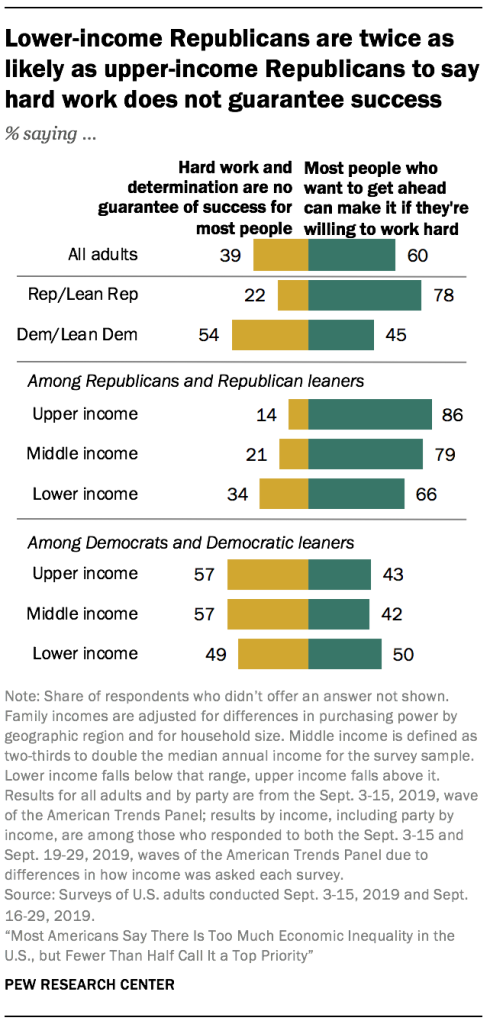
And finally, of the two major political parties, one, the Republicans, tend to believe the poor are poor because they are dumb and lazy, while the rich are rich because they are smart and work hard. Here is one example of that belief:
IN SUMMARY
The U.S. federal government is Monetarily Sovereign. It never unintentionally can run short of its own sovereign currency, the U.S. dollar. Even if $0 federal taxes were collected, the federal government could continue spending forever.
Medicare and Social Security, as agencies of the U.S. government, cannot run short of dollars unless that is what Congress and the President want. The federal government funds all its agencies’ pending by creating new dollars, ad hoc. All tax income is destroyed upon receipt.
The Medicare and Social Security “trust funds” are not trust funds. These fake trust funds do not pay for benefits, but only keep records of dollar inflow and federal spending. As mere record keepers, they neither can be solvent nor become insolvent.
There is no financial reason to cut Medicare or Social Security benefits or to increase taxes, or even to continue collecting taxes. The federal government funds benefits paid by both programs regardless of tax income.
“Rich” is a comparative, not an absolute. According to Gap Psychology, people generally wish to widen the income/wealth/power Gaps below and to narrow those Gaps above. The rich can become richer by acquiring more for themselves and/or by forcing those below to acquire less.
The rich run America by bribing politicians, the media, and economists. To make themselves richer, the rich widen the Gap below by backing false narratives and laws that reduce federal benefits to the poorer while increasing taxes on the poorer.
Gap Psychology describes the common desire to distance oneself from those “below” in any socio-economic ranking, and to come nearer those “above.” The socio-economic distance is referred to as “The Gap.”
Wide Gaps negatively affect poverty, health and longevity, education, housing, law and crime, war, leadership, ownership, bigotry, supply and demand, taxation, GDP, international relations, scientific advancement, the environment, human motivation and well-being, and virtually every other issue in economics.Implementation of Monetary Sovereignty and The Ten Steps To Prosperity can grow the economy and narrow the Gaps: Ten Steps To Prosperity:
In most people’s minds, AARP is an organization that supports us old folks. Well, maybe:
60 Minutes reportedin a 1978 exposé that AARP had been established as a marketing device by Leonard Davis, founder of the Colonial Penn Group insurance companies. Until the 1980s AARP was controlled by Davis, who promoted its image as a non-profit advocate of retirees in order to sell insurance to members.
AARP severed ties with Davis in 1979 and began dropping Colonial Penn products. AARP sought competitive bids for insurance coverage and in 1981 chose Prudential Insurance Company of America to underwrite the group health plan for AARP members.
The organization was originally named the American Association of Retired Persons, but in 1999, it officially changed its name to “AARP” to reflect that its focus was no longer American retirees.
AARP no longer requires that members be retired, and there are no longer any age restrictions even for a full membership.
If AARP truly wished to support old people, or any other members, it surely would understand the way Social Security and Medicare are financed. Even more than “understand,” it would broadcast the truth to the world.
Sadly, instead of broadcasting the truth, AARP promulgates the Big Lie that Social Security and Medicare rely on trust funds, which are supported by the regressive FICA tax.
AARP, and all others who repeat the Big Lie, claim that lacking tax increases or benefit decreases, Social Security (and Medicare) cannot survive, a claim that is not made regarding other federal agencies.
Here is what AARP says:
And no wonder: The program, now 86 years old, has become the bedrock of our retirement finances. Which begs the question: Why are its finances not more secure?
As a federal agency, the finances are as secure as the finances of any other federal agency, i.e. Social Security has unlimited finances subject to the whims of Congress and the President.
To answer that, AARP talked with dozens of experts about Social Security and its future viability. Here’s what we learned.
If AARP did indeed talk with “dozens of experts,” it would have learned the facts. Based on AARP’s claims, it didn’t talk with real experts, or it intentionally is lying:
“Those who tend to distrust the government seem to have less faith that Social Security will be there for them in its current form,” said Michael Baughman, a financial planner in Tryon, North Carolina.
Social Security’s finances are unquestionably on a downward slope, and fixing them is primarily in the hands of the U.S. Congress.
If no action is taken, the moment of crisis — meaning when the program would no longer have enough money to fully pay its promised benefits — will happen in just over a decade.
That much is true: The financial future of Social Security is in the hands of Congress, but not in the way AARP wants you to believe.
The “moment of crisis” is an invented problem, the result of the myth that Social Security is funded by FICA.
It is not.
Quote from Luther Gulick, an expert on public administration and one of the founders of the American Society for Public Administration”
I raised (with Franklin D. Roosevelt), the question of the ultimate abandonment of the pay roll taxes in connection with old age security and unemployment relief in the event of another period of depression.
I suggested that it had been a mistake to levy these taxes in the 1930’s when the social security program was orgiginally adopted.
FDR said, “I guess you’re right on the economics. They are politics all the way through. We put those pay roll contributions there so as to give the contributors a legal, moral, and political right to collect their pensions and their unemployment benefits.
With those taxes in there, no damn politician can ever scrap my social security program. Those taxes aren’t a matter of economics, they’re straight politics.”
FDR also mentioned the psychological effect of contributions in destroying the “relief attitude.”
FICA is the single, most regressive tax in America. Despite Roosevelt’s intentions, it has the opposite of the desired effect. FICA widens the Gap between the rich and the rest. Wikipedia.
The rich receive and control a massive percentage of income, wealth, and power in America, but the middle classes and the poor pay almost all of the FICA tax.
It is conceivable that self-described billionaire Donald Trump, for instance, never has paid a penny into the so-called Social Security (non-existent) “trust fund.”
In any event, all FICA dollars are destroyed upon receipt by the Treasury, so it is functionally impossible for FICA to fund Social Security, Medicare or anything else.
Like all federal taxes (and unlike state/local taxes), FICA very simply is your money flushed down a giant federal toilet, never to be seen again.
The tax dollars you send to the U.S. Treasury, are not used for anything. They are destroyed upon receipt.
Reid Ribble, a former Republican congressman from Wisconsin’s 8th District, says, “Republicans have never wanted to increase revenue, and just dealing with it on the benefit side is not politically feasible.”
In simple English, Republicans say they don’t want to increase FICA or decrease benefits. Democrats say the same, though for different reasons. So that produces a conundrum for those who believe in the trust fund myth.
The most likely FICA increase would be to make richer people pay more, which Republicans, being the “Party of the Rich” loathe.
Republicans wouldn’t mind a benefit decrease, but Democrats would hate that. Instead, Dems would prefer charging FICA to the rich, which is a no-go for the GOP.
Without Social Security benefits, 21.7 million more Americans would be below the poverty line, according to the Center on Budget and Policy Priorities.
Social Security does more than send eligible retirees a payment every month. It provides ongoing income to surviving spouses and their children as well.
Social Security Disability Insurance (SSDI) helps pay the monthly bills for qualified disabled workers and their families.
Although most of those whom Social Security keeps out of poverty are older adults, 6.9 million are under age 65, including 1.2 million children.
Not surprisingly, Social Security has widespread support. “It’s crystal clear that Americans of all generations value the economic stability Social Security has offered for the last 86 years — even more so as we face the health and economic challenges of a global pandemic,” says Nancy LeaMond, AARP executive vice president and chief advocacy and engagement officer.
Middle- and lower-income Americans love Social Security. The rich Americans? Not so much.
The rich would be perfectly happy if no one collected SS benefits. Eliminating all social benefits would widen the Gap between the rich and the rest.
(Without the Gap, no one would be rich, and the wider the Gap, the richer are the rich. Widening the Gap is the only way the rich become richer.)
And now, in all its glory, comes the Big Lie:
Absent any change in law, the Social Security trust funds — the financial accounts that the program draws from when annual payments to Americans are larger than annual tax collections — will be out of money in about 12 years.
At that point, the program would have only ongoing tax revenue with which to fund payments; calculations show that would cover only 78 percent of promised benefits.
The so-called Social Security “trust fund” (and Medicare “trust fund”) are not trust funds at all. They simply are balance sheet lines over which Congress and the President have total control.
The numbers in the “trust funds” arbitrarily can be changed by Congress and/or the so-called “trust funds” could be eliminated tomorrow, with Congress supporting SS the way it supports every other federal agency: By allocating funds.
Here is what the Peter G. Peterson Foundation, a right-wing group that has no love for the poor, admits about federal “trust funds.”
A federal trust fund is an accounting mechanism used by the federal government to track earmarked receipts (money designated for a specific purpose or program) and corresponding expenditures.
The largest and best-known funds finance Social Security, Medicare, highways and mass transit, and pensions for government employees.
Federal trust funds bear little resemblance to their private-sector counterparts.
In private-sector trust funds, receipts are deposited and assets are held and invested by trustees on behalf of the stated beneficiaries.
In federal trust funds, the federal government does not set aside the receipts or invest them in private assets.
Rather, the receipts are recorded as accounting credits in the trust funds, and the receipts themselves are comingled with other receipts that Treasury collects and spends.
For a more detailed view of real (not federal) trust funds, see: What Is A Trust Fund?This is how real trust funds work. It is not how the Social Security faux “trust fund” works.
There are three parties involved in all trust funds:
The grantor: This person establishes the trust fund, donates the property (such as cash, stocks, bonds, real estate, art, a private business, or anything else of value) to it, and decides the management terms.
The beneficiary: This is the person for whom the trust fund was established.
The trustee: The trustee, which can be a single individual, an institution, or multiple trusted advisors, is responsible for making sure the trust fund maintains its duties as laid out in the trust documents and according to applicable law.
The primary difference is that a real trust fund holds money or other assets in trust. It’s not a simple checking account that accepts and doles out dollars at will.
To Congress, 2034 is a long way off. But the sooner the legislature acts, the quicker and easier it will be to bolster the trust funds’ reserves, due to simple math: Smaller revenue or benefit changes made now would accrue over time, which is a far more efficient way to secure the funds than paying for a last-minute major repair job.
Real trust funds don’t have reserves that need to be “bolstered.” And since the Social Security “trust fund” must be “bolstered,” and the benefits can be changed at will, what is the purpose of that “trustfund”?
It’s nothing more than a line in a balance sheet.
Fully 12.4 percent of your gross income has gone to Social Security each paycheck by way of the Old-Age, Survivors, and Disability Insurance (OASDI) payroll tax.
The amount of wages subject to the payroll tax is capped and indexed annually; in 2022, a worker pays the tax on wages up to $147,000.
For a self-employed worker clearing that amount or more, that means an annual OASDI tax bill of about $18,200.,
The math goes like this: If you earn $147,000 a year, you pay $18,200 in FICA taxes, about twelve percent of your pay.
But if you earn $10,000,000 a year, you pay . . . that’s right, that same $18,200 . . . about 2 tenths of one percent of your pay.
If all your income came from sources other than salary (as does the income of most rich people, you would pay $0 FICA.
That difference demonstrates one of the ways the rich have bribed Congress to widen the Gap between the rich and the rest.
But it’s even worse than that:
After the Social Security Administration (SSA) pays beneficiaries, any tax dollars that are left overgo into the trust funds, now totaling $2.91 trillion, to be tapped at a time when taxes coming into the system aren’t enough to cover ongoing benefit payments.
No “leftover” tax dollars go anywhere. The federal government does not save any tax dollarssent in, simply because it already has the unlimited ability to create infinite dollars to pay out. All tax dollars are destroyed.
When you send a tax check to the Treasury, the dollars come out of your checking account Those dollars are part of the M1 money supply measure which includes “physical currency and coin, demand deposits, travelers checks, other checkable deposits and negotiable order of withdrawal (NOW) accounts.
The instant your check is received by the Treasury, it no longer is part of M1. It ceases to exist in any money supply measure. (The federal government has an infinite supply of money, so there is no money measure of federal money.)
M1 is reduced, and effectively, your tax dollars are destroyed.
To make up for its income shortfall, the SSA this year will start drawing on the trust funds. Based on recent calculations, absent any major changes, the funds will run dry in 2034.
That’s 24 years earlier than the SSA estimated when the system was last overhauled in 1983.
There are no funds to “run dry.” Two simple computer key taps, one labeled “Assets” and one labeled “Liabilities” will instantly restore the trust fund’s balance sheets.
How did we get here? As long predicted, demographics explain a good deal: In a decade, the entirety of the boomer generation — some 70 million Americans born between 1946 and 1964 — will have hit retirement age.
As a result, the number of people receiving Social Security benefits come 2034 will be more than double the beneficiaries in 1985.
But what wasn’t known as accurately was how much longer those boomers would live. “From 1940 to 2019, life expectancies at age 65 have increased by about 6.5 years,” says Amy Kemp, chair of the Social Security Committee of the American Academy of Actuaries.
The impact: Many workers will be receiving benefits for a longer period of time. And those with higher incomes, which are generally those who receive higher benefit amounts, tend to live longer on average.
At the same time, there has been a continued decline in the nation’s birth rate; that means there are fewer younger workers to support the benefitspromised to older workers.
In 1955, there were more than eight workers supporting each Social Security beneficiary. Now there are 2.7 workers per beneficiary.
All of the above is total beeswax. The question was, “How did we get here?” The answer is: By pretending that our Monetarily Sovereign government’s finances are like personal finances and that it can run short of dollars.
Contrary to the nonsense you repeatedly are told, the contributions made by young workers do not fund the benefits paid to old workers. The contributions made by young workers do not fund anything. They are destroyed.
Additionally, the country’s growing income inequality has had a negative effect on the amount of payroll taxes going into the trust funds, as wages above the payroll tax cap have grown much faster than wages under the cap.
And why is there a “cap”? Because that is the way the rich, who run America, want it. They want the Gap between the rich and the rest, to widen as much as possible.
If nothing is done, Social Security is projected to still be able to pay roughly three-quarters of promised benefits for the remainder of the century.
Or, if the government and AARP would tell the truth, they would say, “Social Security will be able to pay all promised benefits in perpetuity, whether on not it collects a penny in FICA taxes.”
So what needs to happen to secure Social Security for the long term?
There are variables that are out of the direct control of the SSA or Congress, such as the economy, wages, life expectancy, and birth rates.
But if projections hold more or less true, on paper the options are fairly simple: Congress will have to raise taxes, modify benefits or do some of both.
Both of those totally unnecessary actions will widen the Gap between the rich and the rest, effectively making the rich richer — exactly what the rich want.
Those options come down to any variation of a handful of leading approaches discussed by policymakers. Here are several, starting with ways to bring more money into the system.
Adjust the cap. This year, someone with $1 million in work income would pay the same amount of OASDI tax as someone with $147,000 in wages.
Intentionally misleading. “Work income” does not include income from rent, certain types of royalties, capital gains, and dividends. They are not subject to FICA taxes.
However, you have to pay the tax on all earned income including your salary, tips, commissions and anything else that counts as wages.
How convenient for the rich, since most (or all) of their income is derived from rent, royalties, capital gains and dividends.
Eliminating the taxable wage cap would keep the trust funds solvent until 2060, according to Social Security.
The Big Lie. The so-called “trust funds” are as solvent as Congress wants them to be. Raising or lowering the taxable wage cap would not affect “trust fund” solvency.
Also, it would have a scant effect on the rich, who get most of their income from non-wage sources.
Increase payroll tax rates. As noted, the current rate is 12.4 percent. Some propose raising that incrementally — say, by 2 percentage points, to 14.4 percent — as a way to bring additional dollars into the trust funds.
But some experts note that such tax increases would be hardest felt by those who earn lower wages or are self-employed.
But that’s the plan, isn’t it. That’s how the Gap is widened, i.e. how the rich get richer.
Broaden the base.Not all state and local employees are covered by Social Security. Some have only public pension coverage.
Bringing all newly hired state and local workers into the Social Security system would create a large new influx of cash, although it would mean more beneficiaries to pay later.
Yes, by all means, let’s soak all those low-paid state and local workers, so that the states will be forced to raise salaries. And where will the states get the money to raise salaries? From other taxpayers, of course.
Broaden the definition of income. Certain forms of income are not subject to SSA payroll taxes, such as the value of employer-sponsored group health insurance.
Gradually eliminating such exclusions — and collecting payroll taxes on the additional income — would keep the trust funds healthy for roughly four additional years.
It would have no effect on the ability of Social Security to pay benefits, and the rich simply would find other forms of income, and continue to dodge the useless tax.
A significantly larger target, and so more politically challenging, would be to levy a Social Security tax on annual investment income, as opposed to just payroll taxes.
The other side of the coin is implementing changes that reduce benefits to certain Social Security beneficiaries.
It’s all sleight of hand to make you believe the Big Lie that federal taxes fund federal spending.
Introduce more progressivity. Typically referred to as “means testing,” this approach calls for adjusting the size of your Social Security payments based on your wages, wealth, or income.
And you don’t think the Donald Trumps of the world will find dodges to that. He already has increased the value of his assets when asking for a loan, and decreased the value of the same assets when paying taxes.
A “wealth tax” is computationally impossible, because the values of most assets is too debatable.
Cut benefits for new recipients. Another approach would be to pay newly eligible retirees a little less per month than promised.
Reduce the cost-of-living adjustment (COLA).Each year, the SSA usually adjusts beneficiary payments to help protect their purchasing power from inflation.
The yardstick used is the government’s Consumer Price Index for Urban Wage Earners and Clerical Workers, or CPI-W, which takes into account the price increases for everything from apples to gasoline to rent.
Change benefit calculations. Adjusting the complex formulas used to determine your Social Security payments could result in modestly lower benefits that could help increase the life of the trust funds.
Up the retirement age. You can start taking Social Security, with reduced benefits, at age 62. Wait until you’re 67 (if you turn 62 in 2022) and you qualify for your full benefit.
This last dumb idea is known as the “Work ‘Til You Drop” provision. All of the “solutions” rely on the same faulty belief, that federal taxes fund federal spending.
Some have suggested scrapping the entire program and converting it to individual account plans similar to a 401(k) retirement program, in which you contribute some or all of your current payroll taxes to a self-managed retirement account invested in stocks, bonds and other securities; you would bear the risks and rewards of your choices.
The above completely reverses the fundamental purpose of Social Security, which is to aid the middle- and low-income Americans, who can’t afford retirement, or don’t know how to manage money in their old ages.
Experts also note that such a program would mean the trust funds would be depleted sooner, putting current benefits at even greater risk.
Oh, those mythical, phony”trust funds.” We certainly don’t want to deplete what doesn’t even exist, do we?
Legislators in Congress routinely propose bills to alter Social Security, ranging from small adjustments to substantive overhauls.
In fact, so far in the 2021–2022 legislative session, dozens of members of Congress have introduced bills related to Social Security. To date, none has moved to a full vote.
But not one member of Congress has acknowledged the underlying fact that Social Security is funded by federal spending, which is infinitely available.
This lack of action isn’t surprising, given Congress’ big disagreements on Social Security reform.
To our well-bribed Congress, SS “reform” always means “more tax and less benefit,” all to widen the Gap.
The 1983 legislation negotiated between House Speaker Tip O’Neill and President Ronald Reagan that has kept the program solventover the past four decades was a squeaker (though it ultimately won large bipartisan support).
SS is a solvent as Congress wants it to be. All Congress and the President need do is vote to add a few trillion to the budget for social purposes. No need to struggle with phony fixes.
That bill gradually raised full retirement age for beneficiaries to 67, levied taxes on Social Security payments for some beneficiaries, and increased taxes, all of which would be difficult to reach consensus on in Congress today.
Cutting benefits and increasing taxes did nothing to increase SS solvency.
Today, 12 percent of men and 15 percent of women on Social Security rely on it for 90 percent or more of their income. Even a modest reduction in benefits would hit them hard.
And 37 percent of men and 42 percent of women on Social Security get 50 percent or more of their income from the program.
And yet, not only do we hit these people with a FICA tax, but we also tax benefits. If the government really was trying to help people, this would make absolutely no sense.
But that is not what the government is bribed to do. It is bribed to make the rich richer.
With around 65 million people today receiving benefits, that means tens of millions of Americans depend heavily on the program. And already, their payments aren’t high.
The average retirement benefit from Social Security was $1,555 a month in 2021, or $18,660 a year. The average rent for a one-bedroom apartment in the U.S.? About $1,680 a month, according to Apartmentguide.com.
“When I did my research on it, probably the hardest-hit recipient of Social Security was a widow who has outlived her family savings and is now living in old age, strictly on Social Security,” Ribble says. “She’s trying to live off a $700- or $800-a-month payment.”
And the above is after the same widow was forced to pay12% of her salary on useless FICA. (Yes, 12%, not 6%, because employers take their share into consideration when calculating salary affordability.)
If history is any guide, there’s reason to hope that Congress will find a solution. Says Social Security’s Goss: “We’ve never reached the point where we depleted the reserves and had to reduce benefits.”
More false propaganda from the government. Those reserves don’t fund benefits.
In 2022, AARP will continue to urge members of Congress to shore up Social Security’s long-term finances and keep the promises made to all current and future beneficiaries.
We have fought hard against arbitrary cuts to the cost of living adjustment (COLA) and against bills like the Trust Act that target Social Security as a way to deal with budget deficits.
And we fought hard to ensure that those on Social Security would be able to get economic stimulus payments without having to file separately.
AARP also has “fought hard” to maintain the fiction that federal FICA taxes fund SS benefits.
Given that Big Lie, there can be no solution that does not include a tax increase or a benefit decrease. That’s simple arithmetic.
If you begin with the wrong premise, you cannot arrive at a correct solution.
State taxation: Twelve U.S. states now tax Social Security benefits. In 2022, AARP will work at the state level to eliminate this tax burden for more retirees and their families.
How about working at the federal level, to eliminate those tax burdens? Not paid to do that, AARP?
IN SUMMARY
Federal taxes — payroll taxes, income taxes, luxury taxes, all other federal taxes do not fund federal spending. Contrary to the Big Lie, all federal taxes are destroyed upon receipt by the federal government.
Unlike the monetarily non-sovereign state and local government, our Monetarily Sovereign federal government creates all its spending money ad hoc. It neither needs nor uses income for any purpose.
The ostensible purpose of federal taxes is to guide the economy by taxing what the government wishes to discourage and by giving tax breaks to what the government wishes to encourage. Another purpose is to assure demand for the U.S. dollar, which is necessary for paying taxes.
The real purpose of federal taxes is to make the rich richer, by widening the Gap between the rich and the rest.
To effect this result, the rich bribe the media via advertising dollars and media ownership. And the rich bribe the economists via promises of jobs at “think tanks” and via contributions to universities.
And the rich bribe the politicians via political contributions and promises of lobbying jobs.
All that bribery is expensive, but worthwhile for the rich, as the Gap has widened greatly, i.e. the rich have become richer.
[No rational person would take dollars from the economy and give them to a federal government that has the infinite ability to create dollars.]
Rodger Malcolm Mitchell
Monetary SovereigntyTwitter: @rodgermitchellSearch #monetarysovereigntyFacebook: Rodger Malcolm Mitchell
……………………………………………………………………..
THE SOLE PURPOSE OF GOVERNMENT IS TO IMPROVE AND PROTECT THE LIVES OF THE PEOPLE.
Gap Psychology describes the common desire to distance oneself from those “below” in any socio-economic ranking, and to come nearer those “above.” The socio-economic distance is referred to as “The Gap.”
Wide Gaps negatively affect poverty, health and longevity, education, housing, law and crime, war, leadership, ownership, bigotry, supply and demand, taxation, GDP, international relations, scientific advancement, the environment, human motivation and well-being, and virtually every other issue in economics.Implementation of Monetary Sovereignty and The Ten Steps To Prosperity can grow the economy and narrow the Gaps:
Ten Steps To Prosperity:
The Ten Steps will grow the economy and narrow the income/wealth/power Gap between the rich and the rest.
MONETARY SOVEREIGNTY
(Every spending cut demanded by conservatives is designed to widen the income/wealth/power Gap between the rich and the rest, while the few spending increases backed by the conservatives are designed to reward and protect the rich.)
Alan Greenspan: “A government cannot become insolvent with respect to obligations in its own currency.”
Ben Bernanke: “The U.S. government has a technology, called a printing press (or, today, its electronic equivalent), that allows it to produce as many U.S. dollars as it wishes at essentially no cost.”
Quote from Ben Bernanke when, as Fed chief, he was on 60 Minutes:
Scott Pelley: Is that tax money that the Fed is spending?
Ben Bernanke: It’s not tax money… We simply use the computer to mark up the size of the account.
Statement from the St. Louis Fed:
“As the sole manufacturer of dollars, whose debt is denominated in dollars, the U.S. government can never become insolvent, i.e., unable to pay its bills. In this sense, the government is not dependent on credit markets to remain operational.”
Press Conference: Mario Draghi, President of the ECB, 9 January 2014
Question: I am wondering: can the ECB ever run out of money?
Mario Draghi: Technically, no. We cannot run out of money.
https://www.ecb.europa.eu/press/pressconf/2014/html/is140109.en.html
Here is what the “trust fund” scare-mongers like the Committee for a Responsible Federal Budget (CRFB) is telling you: “Major Trust Funds Are In Trouble”:
The common interpretation of Shakespeare’s, “A rose by any other name would smell as sweet” is wrong. Words count. That is why products are given “fresh,” “sweet,” or otherwise positive names.
You never will see a toothpaste or a perfume named, “deadly stinkwort.”
When you misname something you create a false impression of what the thing really is.
Sadly, many things in economics are misnamed. The federal “debt” is not a real debt. It is the total of deposits into Treasury Security (T-bill, T-note, T-bond) accounts.
The federal “deficit” more accurately should be termed the “economic surplus,” because the private sector is enriched.
The “trade deficit” is a “trade surplus,” because the economy receives net goods and services.
And federal “trust funds” are nothing at all like real trust funds. Instead, they merely are bookkeeping balances.
A federal trust fund is an accounting mechanism used by the federal government to track earmarked receipts (money designated for a specific purpose or program) and corresponding expenditures.
The largest and best-known trust funds finance Social Security, portions of Medicare, highways and mass transit, and pensions for government employees.
Federal trust funds bear little resemblance to their private-sector counterparts, and therefore the name can be misleading.
A “trust fund” implies a secure source of funding. However, a federal trust fund is simply an accounting mechanism used to track inflows and outflows for specific programs.
In private-sector trust funds, receipts are deposited and assets are held and invested by trustees on behalf of the stated beneficiaries.
In federal trust funds, the federal government does not set aside the receipts or invest them in private assets.
Rather, the receipts are recorded as accounting credits in the trust funds, and then combined with other receipts that the Treasury collects and spends.
Further, the federal government owns the accounts and can, by changing the law, unilaterally alter the purposes of the accounts and raise or lower collections and expenditures.
Thus, the federal government can do whatever it wishes with the “trust funds.” It can add to them, subtract from them, or change them from the wrongly presumed mission of supporting federal expenditures.
At the click of a computer key or the passage of a law, the balance in the federal “trust funds” could be changed to $100 trillion or $0, and neither would affect taxpayers.
Thus, the notion that any federal “trust funds” are, as the CRFB claims, “in trouble,” is a lie, unless “trouble” comes from those who don’t wish you to understand the differences between the private sector’s real trust funds vs. the federal government’s phony “trust funds.”
(The scare-mongers always “forget” to tell you that Medicare Part B, doesn’t even pretend to be funded via a troubled trust fund. The federal government simply pays for it.)
So why do they broadcast the Big Lie, that federal taxes fund federal spending, and trust funds are going broke, when in fact, federal taxes fund nothing, and the trust funds have whatever Congress and the President want them to have?
They do it because of Gap Psychology, the desire to distance oneself from those below on any social scale.
In some cases, these distinguished people do it because they are paid by the rich. In other cases, they do it because they are rich.
They wish to grow richer by keeping the middle- and lower-income/wealth/power people down. And this is how they want to do it, as the CRFB summarizes:
Policymakers must turn their attention to long-term debt and deficit reduction to get the country on solid fiscal ground.
This includes action to secure Social Security and other trust funds headed toward insolvency, limit the growth of health care and other costs, and raise additional tax revenue.
Here is what those terms mean:
“Debt and deficit reduction” means cut spending and increase taxes
“Secure Social Security” means cut benefits by raising the minimum age (as we have been doing), and with an adverse formula for inflation (as has been attempted)
“Limit the growth of health care” means larger deductibles, fewer procedures covered, and fewer people covered or eliminating a program altogether (i.e. Obamacare).
“Raise additional tax revenue” by increasing the FICA percentage and by raising the maximum salary collection level (but not to the level where it would impact the rich).
In short, the debt scare-mongers want to take dollars from the lower- and middle-income groups and give the dollars to a federal government that has an infinite supply of them.
They want to starve the economy and impoverish the lower- and middle-income groups, thus making the rich richer by comparison. During the resultant recessions and depressions, the rich grow richer by gobbling up assets, while cutting payrolls.
Gap Psychology describes the common desire to distance oneself from those “below” in any socio-economic ranking, and to come nearer those “above.” The socio-economic distance is referred to as “The Gap.”
Wide Gaps negatively affect poverty, health and longevity, education, housing, law and crime, war, leadership, ownership, bigotry, supply and demand, taxation, GDP, international relations, scientific advancement, the environment, human motivation and well-being, and virtually every other issue in economics.Implementation of Monetary Sovereignty and The Ten Steps To Prosperity can grow the economy and narrow the Gaps:
Social Security certainly needs “strengthening and improving.”
The amounts being paid are at starvation levels. The people who need it most often receive the least or none at all.
It contains an unnecessary “gambling” element; you must try to guess how long you will live, to determine when you should begin to receive benefits.
The sole purpose of FICA
Most of Social Security’s shortcomings are based on the myth that it is funded by FICA. It is not. FICA funds nothing — not Social Security, not Medicare, nothing.
They do not enter the economy. Federal spending is unrelated to tax collections, which is why there is a $20 trillion federal “debt.”
According to misleading statements by the federal government:
The Social Security Trust Funds are the Old-Age and Survivors Insurance (OASI) and the Disability Insurance (DI) Trust Funds. These funds are accounts managed by the Department of the Treasury.
They serve two purposes: (1) they provide an accounting mechanism for tracking all income to and disbursements from the trust funds, and (2) they hold the accumulated assets.
These accumulated assets provide automatic spending authority to pay benefits. The Social Security Act limits trust fund expendituresto benefits and administrative costs.
The funds do provide an unnecessary accounting mechanism, but they do not hold anything. They aren’t even trust funds.
According to The Motley Fool there are three elements to a trust fund:
The Grantor: The person who establishes a trust fund and contributes property to it.
The Beneficiary: The person or people who will eventually benefit from the assets in the trust fund.
TheTrustee: The person or organization responsible for administering the trust as it was intended.
In the Social Security “trust funds,” the grantor is the federal government, which supposedly populates the funds, but uses your property.
The trustee is the federal government which supposedly manages the assets, except you make the biggest management decisions of all: When to begin taking benefits.
Though Congress legislated the Trust Fund, it is not the grantor, because a grantor puts his own property into a trust, which Congress did not do.
As for the Board of Trustees, who in a true trust would hold the legal title to its property, (the Board not have) title to anything.
Nor do the purported trust “beneficiaries” have property in the fund to which they have an enforceable property right, as beneficiaries of a true trust do.
Board Chairman Altmeyer revealed that Social Security maintains no accounts containing funds earmarked for individuals, and never had.
Its accounts, then, are just record-keeping entities: file folders, not piggy banks.
Assistant Attorney General Robert Jackson stated that under Social Security, “There is no contract created by which any person becomes entitled as a matter of right to sue the United States or to maintain a claim for any particular sum of money. Not only is there no contract implied but it is expressly negatived, because it is provided in the act, section 1104, that it may be repealed, altered, or amended in any of its provisions at any time.”
And the government’s brief for the Supreme Court case Flemming v. Nestor (1960) argued that a current or prospective Social Security beneficiary does not acquire an interest in the Trust Fund—that is, a property right to its assets—and that the belief that Social Security benefits are “fully accrued property rights” is “wholly erroneous.” The Court concurred.
All this confirms the observations by Suffolk University Law School Professor Charles Rounds, a fellow of the American College of Trust and Estate Counsel:
“Despite the term ‘trust,’ the Social Security system contains nothing that remotely resembles the common law trust.
“There is no segregation of assets, no equitable property rights, no private right of enforcement (all characteristics of the common law trust).
“It is merely a system of taxation and appropriation sprinkled with trust terms to hide its true nature.”
Demonstrating the uselessness of FICA, is the “tax holiday”:
The Middle Class Tax Relief and Job Creation Act of 2012 temporarily reduced the amount of Federal Insurance Contributions Act (“FICA”) taxes owed by employees by two percentage points from 6.2% to 4.2%. This reduction expired on December 31, 2012.
The “holiday” resulted in no change in Social Security benefits.
The purpose of the tax holiday was to stimulate economic growth, particularly favoring the lower- and middle-income Americans. Isn’t that something the government should do all the time?
To summarize, so far:
Federal taxes do not fund federal spending, nor do they fund Social Security benefits. Federal spending does not rely on federal taxing.
The federal government, being Monetarily Sovereign, cannot run short of its own sovereign currency, the U.S. dollar. It creates dollars, ad hoc, by paying creditors.
Just as the federal government cannot run short of dollars, no agency of the federal government can run short of dollars, unless Congress wills it.
There are no Social Security trust funds. They are just bookkeeping devices.
The non-existent “trust funds” cannot run short of dollars unless Congress wills it.
Keep these points in mind as you read excerpts from the following article:
The Social Security 2100 Act proposed by (Democrat) Connecticut Representative John Larson is getting closer to being passed by the House of Representatives. If it were to be approved and become law, it would both improve the program’s benefit structure and its financial picture.
The biggest item on the benefit side is that it guarantees a benefit of at least 125 percent of the poverty level for anyone who has worked for at least 30 years.
The logic here is straightforward; we should be able to ensure that anyone who has put in a full lifetime of work will not be in poverty in their retirement years.
An income of “At least 125 percent of the poverty level” does not guarantee anyone will not be in poverty, unless the government also can guarantee no one will live in a higher-cost area like New York, much of California, or many big American cities.
Further, why is it necessary for someone to have “worked for at least 30 years”? Is there a moral code requiring labor for 30 years.
And what about people whose labor is not as a salaried employee? Does their labor not count?
The second big change on the benefit side is that it changes the cost-of-living formula for adjusting benefits by tying it to an index of consumption items purchased by the elderly rather than the overall Consumer Price Index.
The inflation adjustment for Social Security benefits has long been a major issue, with many politicians wanting to change the formula to reduce benefits.
Well, of course, that is what “many politicians” want. It is what the rich, motivated by Gap Psychology, pay them to “want.”
The third feature on benefits is a change in the formula that will increase average benefits for a bit less than $400 a year. This has provoked some opposition since this increase will go to not just lower-income seniors, but also middle-class and relatively affluent seniors.
The average benefit this year is just over $17,600, certainly not enough to maintain a middle-class lifestyle.
All this effort for a $400 per year benefit increase? And if $17,600 is “not enough to maintain a middle-class lifestyle” (It isn’t), would an increase of $400 to $18,000 be enough?
Hardly.
And now we come to the most economically ignorant part:
Rep. Larson proposes to cover this increase, as well as the projected Social Security shortfall, by having a gradual increase in the payroll tax and applying the tax to very high-income workers.
On the latter point, the income subject to the payroll tax is currently capped at just under $133,000. This means that someone earning millions of dollars each year would pay no more in Social Security taxes than someone earning $132,900.
Larson’s bill would make wages over $400,000 subject to the tax.
Note that the tax is on wages. But rich people receive most of their income from non-wage sources: Stocks, bonds, rents, etc.
And, as we have shown, taxes do not fund Social Security benefits. FICA taxes merely remove dollars from the economy, with a disproportionate coming from the pockets of the middle- and lower-income people.
In addition to being unnecessary and a burden on the economy, FICA is, and would remain, the most regressive tax in America.
No wonder the rich love it. FICA widens the Gap between the rich and the rest.
His other change is an increase in the payroll tax of 0.1 percentage point annually, split between workers and employers. This increase would continue for 24 years, for a total increase of 1.2 percentage points on both the worker and the employer.
While this is a middle tax increase, it is much smaller than increases we saw in the decades of the 1950s, 1960s, 1970s, and 1980s. More importantly, if we can sustain decent wage growth, it is a tax that should be easy to bear.
It is an unnecessary tax that is especially “easy to bear” for the rich, for they pay so little of it.
The article continues:
After adjusting for prices, wages have risen 1.5 percent annually over the last five years. If we can continue this pace of wage growth, the Larson bill would take back much less than 10 percent of the pay increase in taxes.
Of course, wage growth may not continue, but then our focus should be on getting decent wage growth, not blocking revenue needed for Social Security.
One wonders what “take back” means. The wage increases come from the private sector, and the taxes go to the federal government. So the government would not be taking “back” anything. It simply would be taking.
The article ends with this bit of nonsense:
In short, this is a well-considered bill that would accomplish good for current and future retirees. Congress should move on it.
No, it is an ill-considered bill, put forth by a Congress that either is ignorant of economics, or has been paid by the rich to widen the Gap between the rich and the rest — or both.
There is nothing “bold” about the plan, and it does nothing to “strengthen” Social Security, which is infinitely strong, based on the federal government’s infinite ability to fund it.
A “bold” plan would be to institute the “Ten Steps to Prosperity” (below), beginning with Step #1, Eliminate FICA.
Gap Psychology describes the common desire to distance oneself from those “below” in any socio-economic ranking, and to come nearer those “above.” The socio-economic distance is referred to as “The Gap.”
Wide Gaps negatively affect poverty, health and longevity, education, housing, law and crime, war, leadership, ownership, bigotry, supply and demand, taxation, GDP, international relations, scientific advancement, the environment, human motivation and well-being, and virtually every other issue in economics.
Implementation of Monetary Sovereignty and The Ten Steps To Prosperity can grow the economy and narrow the Gaps:




:strip_icc():format(webp)/what-is-a-trust-fund-357254_final1-5b3e687ac9e77c00370bae43-72eaa014efbf46a9a42fd1b90a5251b9.jpg)