- Force people to eat less, or to
- Help farmers grow more.
- Force people to drive less and to heat their homes less, or to
- Help refineries produce more oil and help increase the availability of renewable energy.
- Force people to buy fewer cars and motorcycles, or to
- Help car manufacturers produce more cars and motorcycles.
- Force manufacturers and sellers to ship less, or to
- Help manufacturers and sellers to ship more.
- Force builders to build fewer homes and buildings, or to
- Help lumber growers grow more and/or help builders find substitutes for lumber.
- Force manufacturers use fewer chips, or to
- Help computer chip manufacturers produce more chips
- Make people use fewer diapers, fewer incontinence supplies, fewer sanitary napkins and tampons, and less toilet paper, or to
- Help manufacturers produce more diapers, incontinence supplies, sanitary napkins and tampons, and more toilet paper.
- Force labor to accept lower wages, or to
- Help employers pay higher wages so more people will want to work.
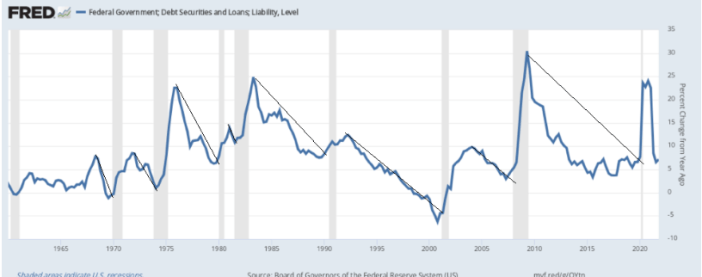

Example: The notorious Zimbabwe hyperinflation was created when the government took farmland from farmers and gave it to people who didn’t know how to farm. The predictable result: A food shortage. The price of food skyrocketed.
Rather than spend to help farm owners grow more food, the government simply printed currency in higher denominations. This did nothing to cure the food shortage and its resultant inflation, but it created the illusion that currency printing caused the inflation.
All hyperinflations in history have followed the same scenario: Shortages cause higher prices; the government prints currency rather than curing the shortages.
Deficit spending to increase supplies of goods and services, instead of merely printing currency, is the way to cure inflation without causing a recession. Deficit spending prevents recessions and grows the economy, which is exactly what it did during the COVID crisis. Were it not for federal deficit spending, we would have had a COVID depression in 2020 and 2021. Today, the federal government should increase deficit spending to prevent recession, while using those additional dollars to encourage more farming, oil and gas drilling and refining, renewable energy production, sales of cars and motorcycles, home building, lumber growing and harvesting, and lumber-substitute development, computer chip manufacturing, and more people to join the workforce. The latter can be accomplished by ending the FICA tax and raising the minimum standard deduction. Additionally, the federal government should fund Medicare for All, which would reduce employment costs for employees and employers. Further, because the U.S. federal government is Monetarily Sovereign, deficit spending is not “paid for” by federal taxes. The U.S. federal government pays for all its spending by creating new dollars, ad hoc. Even if the federal government collected $0 in taxes, it could continue to deficit spend, forever. (A little secret: The federal government destroys all the tax dollars it receives, creating new dollars as needed.) The purpose of federal taxing is not to provide the government with the dollars it spends, but rather to control the economy by taxing what the government wishes to discourage, and by giving tax breaks to what it wishes to encourage. In the unlikely event that America can escape inflation without suffering a recession, it will not be because of what Chairman Powell is doing. It will be despite what Chairman Powell is doing. Fasten your seat belts. Powell doesn’t know what he is doing.[No rational person would take dollars from the economy and give them to a federal government that has the infinite ability to create dollars.]
Rodger Malcolm Mitchell Monetary Sovereignty Twitter: @rodgermitchell Search #monetarysovereignty Facebook: Rodger Malcolm Mitchell………………………………………………………………………
THE SOLE PURPOSE OF GOVERNMENT IS TO IMPROVE AND PROTECT THE LIVES OF THE PEOPLE.
The most important problems in economics involve:- Monetary Sovereignty describes money creation and destruction.
- Gap Psychology describes the common desire to distance oneself from those “below” in any socio-economic ranking, and to come nearer those “above.” The socio-economic distance is referred to as “The Gap.”
- Eliminate FICA
- Federally funded Medicare — parts A, B & D, plus long-term care — for everyone
- Social Security for all
- Free education (including post-grad) for everyone
- Salary for attending school
- Eliminate federal taxes on business
- Increase the standard income tax deduction, annually.
- Tax the very rich (the “.1%”) more, with higher progressive tax rates on all forms of income.
- Federal ownership of all banks
- Increase federal spending on the myriad initiatives that benefit America’s 99.9%
MONETARY SOVEREIGNTY


 The poor you will always have with you, and you can help them any time you want.


 #Monetary Sovereignty - Mitchell
