Ignorance or Lies? The single worst economic scare-mongering bullshit ever encountered.

J.D. Tuccille, the Libertarians, and surprisingly, the highly respected University of Pennsylvania’s Penn Wharton School may have set a world record for utter nonsense and wrongheaded scaremongering Moving on from the “ticking debt time bomb” that never explodes, we have arrived at “20 Years to Disaster.” Don’t you love predictions of 20 years? They are so safe. You can’t be proved wrong. Twenty 20 years from now, the world will have changed many times, and anyway, no one will remember what you said. Aside from the idiocy of making a 20-year economic prediction, the entire premise of the article is wrong.

20 Years to Disaster The United States has about 20 years for corrective action after which no amount of future tax increases or spending cuts could avoid the government defaulting on its debt.” J.D. TUCCILLE | 11.6.2023 7:00 AM

For decades, budgetary experts have warned that the U.S. federal government is backing itself—and the country—into a corner with expenditures that consistently exceed revenues, driving the national debt ever higher.

What Tuccille, the Libertarians, and the Wharton School seem not to understand is that federal deficits are absolutely necessary for economic growth. You have seen this graph many times: GRAPH I
Federal “Deficits” (red) and Gross Domestic Product (blue) rise in parallel.
And this graph: GRAPH II.
Before every recession (vertical gray bars), federal deficits (blue) decline. Then, to cure the recession, the government increases federal deficit spending.

The latest red flag is raised by the University of Pennsylvania’s Penn Wharton Budget Model (PWBM), which says that the federal government has no more than 20 years to mend its ways. After this time, it will be too late to remedy the situation.

Every time the federal government “controls” (i.e. cuts) spending, we have recessions if we are lucky and depressions if we are not as fortunate:

U.S. depressions come on the heels of federal surpluses.

1804-1812: U. S. Federal Debt reduced 48%. Depression began 1807. 1817-1821: U. S. Federal Debt reduced 29%. Depression began 1819. 1823-1836: U. S. Federal Debt reduced 99%. Depression began 1837. 1852-1857: U. S. Federal Debt reduced 59%. Depression began 1857. 1867-1873: U. S. Federal Debt reduced 27%. Depression began 1873. 1880-1893: U. S. Federal Debt reduced 57%. Depression began 1893. 1920-1930: U. S. Federal Debt reduced 36%. Depression began 1929. 1997-2001: U. S. Federal Debt reduced 15%. Recession began 2001.

Having learned nothing from history, Tucille, the Libertarians, and Wharton continue the same old ignorance about federal deficit spending: They equate personal finances with our Monetarily Sovereign government’s finances, not recognizing the massive differences between the two. While monetarily, non-sovereign entities like you and me need to run balanced budgets over the long term, or we’ll face bankruptcy, the federal government must never run a balanced budget and never will face bankruptcy.

20 Years to Control Spending

“Under current policy, the United States has about 20 years for corrective action after which no amount of future tax increases or spending cuts could avoid the government defaulting on its debt whether explicitly or implicitly (i.e., debt monetization producing significant inflation)” Jagadeesh Gokhale and Kent Smetters, authors of the October 6 Penn Wharton Budget Model brief, write in summarizing their findings.

“Unlike technical defaults where payments are merely delayed, this default would be much larger and reverberate across the U.S. and world economies.”

To say that the above is 100% bullshit would be to insult bullshit. Here’s why:
    1. The federal government, being Monetarily Sovereign, has the infinite ability to create its sovereign currency, the U.S. dollar. It has infinite dollars with which to pay its bills. It never needs to default.
    2. Despite concerns about “debt monetization” (aka “money printing’) causing inflation, this never has happened to any nation in world history. All inflations have been caused by shortages of crucial goods and services, most often oil and food.
    3. Many years of massive U.S. federal deficits didn’t cause today’s inflation. Only when COVID caused shortages of oil, food, computer parts, shipping, metals, lumber, labor, etc., did inflation arise. Now, the government’s massive spending to prevent and cure recession continues while inflation ebbs. The massive federal spending has helped cure the shortages and thus cure the inflation.

The reason for worrying about accumulating deficits and the resulting growing debt, the authors explain, is that “government debt reduces economic activity by crowding out private capital formation and by requiring future tax increases or spending cuts to accommodate future interest payments.”

1. The historical fact that increasing government deficit spending increases economic activity (See Graph I, above) seems lost on the Wharton authors. Mathematically, GDP = Federal Spending + Nonfederal Spending + Net Exports 2. There is no historical example of “crowding out of capital formation.” In fact, the federal money added to the economy increases the funds available to the private sector for capital formation. 3. Future tax increases are not necessary because federal taxes do not fund federal spending:

A. All federal tax dollars are destroyed upon receipt by the U.S. Treasury. The tax dollars come from the M2 money supply measure, but when they reach the Treasury, they become part of no money supply measure. The reason: The Treasury’s money supply, being infinite, cannot be measured.

B. Even if the federal government collected zero tax dollars, it could continue spending forever. It has the infinite ability to create spending dollars.

C. The purposes of federal taxes are not to fund federal spending but rather:

a. To control the economy by taxing what the government wishes to discourage and giving tax breaks to what the government wishes to reward.

b. To assure demand for and acceptance of the U.S. dollar by requiring taxes to be paid in dollars.

c. To fool the public (and presumably Wharton economists) into believing federal benefits require federal taxes. (This last purpose is promulgated by the rich to discourage the populace from demanding benefits that would narrow the Gap between the rich and the rest.)

If debt gets too big, lenders can’t be paid back, credibility is shot, the dollar loses value, and the economy tanks.

This is the oft-claimed “ticking time bomb” that never seems to explode. There never has been and never will be a time when the federal debt “gets too big” to be paid. Again, the Wharton economists demonstrate they don’t understand the differences between a Monetarily Sovereign government and a monetarily non-sovereign government.

Alan Greenspan: “A government cannot become insolvent with respect to obligations in its own currency. There is nothing to prevent the federal government from creating as much money as it wants and paying it to somebody. The United States can pay any debt it has because we can always print the money to do that.”

Ben Bernanke: “The U.S. government has a technology, called a printing press (or, today, its electronic equivalent), that allows it to produce as many U.S. dollars as it wishes at essentially no cost. Scott Pelley: Is that tax money that the Fed is spending? Ben Bernanke: It’s not tax money… We simply use the computer to mark up the size of the account.

Statement from the St. Louis Fed: “As the sole manufacturer of dollars, whose debt is denominated in dollars, the U.S. government can never become insolvent, i.e., unable to pay its bills. In this sense, the government is not dependent on credit markets to remain operational.”

“It would be an unfettered economic catastrophe,” economists Joseph Brusuelas and Tuan Nguyen predicted earlier this year of such a scenario. “Our model indicates that unemployment would surge above 12% in the first six months, the economy would contract by more than 10%, triggering a deep and lasting recession, and inflation would soar toward 11% over the next year.”

Strange how history says exactly the opposite. Following many years of massive federal spending, unemployment was at historical lows. The reason: Federal spending stimulated GDP growth, which required more labor.

So long as investors believe federal officials will eventually balance their books, you have a grace period as debt grows—that is until the debt burden is so enormous that it crushes economic activity.

History shows that balancing the federal books creates recessions and depressions. The so-called “debt burden” is not debt, and it’s not a burden. It’s deposits into Treasury security bills, notes, and bond accounts which are owned by the depositors. It’s not debt because the government never touches the dollars in those accounts. The government creates dollars at will. It has no need to borrow dollars, and indeed, the U.S. federal government never borrows dollars. To “pay off” the debt (that isn’t debt), the government merely returns the dollars in the accounts to their owners. This is no burden at all. The purpose of T-securities is not to provide spending money to the government but rather to give the world with a safe, interest-paying place to store unused dollars. This makes the dollar an attractive international medium of exchange.

“Even with the most favorable of assumptions for the United States, PWBM estimates that a maximum debt-GDP ratio of 200 percent can be sustained,” the authors add. “This 200 percent value is computed as an outer bound using various favorable assumptions: a more plausible value is closer to 175 percent, and, even then, it assumes that financial markets believe that the government will eventually implement an efficient closure rule.” (That’s a mix of tax and spending changes to curtail deficits and debt.)

As we have demonstrated numerous times, the Debt/GDP ratio is meaningless. It tells nothing about the current or future health of an economy. It predicts nothing; it evaluates nothing. It is 100% meaningless. That is why economists who don’t understand the fundamentals of Monetary Sovereignty love to quote it.

The 20-year countdown assumes that investors remain optimistic about the willingness and ability of U.S. officials to bring spending in-line with tax revenues. “Once financial markets believe otherwise, financial markets can unravel at smaller debt-GDP ratios,” according to the PWBM analysis.

We suspect financial markets understand history better than the economists at Wharton. We suspect they know that when the federal government spends more, stock prices rise.
As federal deficit spending has increased, the value of corporate stock has risen.

As PWBM points out, “Financial markets demand a higher interest rate to purchase government debt as the supply of that debt increases… Forward-looking financial markets should demand an even higher return if they see debt increasing well into the future. Those higher borrowing rates, in turn, make debt grow even faster.”

That’s already happening.

Increasing Costs and a Looming Deadline To finance trillions of dollars in spending beyond what incoming revenue can support, the US Treasury is now issuing more debt in the form of Treasury securities than global financial markets can readily absorb,” Yahoo! Finance’s Rick Newman wrote on October 30.

“That forces the borrower—the US government—to pay higher interest rates, which in turn pushes up borrowing costs for consumers and businesses in much of the Western world.”

Again, the Wharton experts misunderstand Monetary Sovereignty and the realities of federal financing. The federal government does not finance spending by borrowing (“issuing debt.”) It finances spending by creating dollars, ad hoc. It can allow as much or as little in T-security deposits as it wishes. If the public fails to invest as much as the Federal Reserve wishes (to stabilize the dollar), the Fed merely uses its infinite money creation ability to fill the gap. Federal spending never is constrained by the public’s desire to own T-securities. As for interest rates, the Fed sets them not to attract depositors but to control inflation. If the Fed smells inflation, it raises rates. If the inflation scare passes, the Fed lowers rates. This has nothing to do with any need for deposits into T-security accounts. (Sadly, raising interest rates, far from moderating inflation, exacerbates it by raising prices. The only thing that moderates inflation is federal spending to ease shortages of critical goods and services.)

Just when the U.S. federal government hits that magic unsustainable debt-to-GDP ratio of between 175 and 200 percent depends on investor confidence and how much the markets charge to finance more borrowing. PWBM estimates it will happen between 2040 and 2045—if we’re lucky.

The notion of a “magic, unsustainable debt-to-GDP ratio” is utter nonsense. Japan already has exceeded that meaningless ratio.

The U.S. Treasury concedes that “since 2001, the federal government’s budget has run a deficit each year. Starting in 2016, increases in spending on Social Security, health care, and interest on federal debt have outpaced the growth of federal revenue.”

The 2001 Clinton surplus caused the 2001 recession.  See Graph I.

Options for Fixing the Mess In September, PWBM explored three policy options to render fiscal policy less disastrous: increasing taxes on high incomes, reforms to Social Security and Medicare that reduce payouts and increase taxes, and a mix of tax increases and spending cuts.

Increasing taxes on high incomes would help narrow the Gap between the rich and the rest, which would be a good thing. It would do nothing to improve the federal government’s already infinite ability to pay its creditors. “Reforms” to Social Security and Medicare (i.e. cuts to benefits paid to those who need them most, while increasing taxes on those who can afford them least) also would do nothing to improve the federal government’s bill-paying ability. The “mix of tax increases and spending cuts” would take spending dollars from the private sector and cause a recession or depression.  Remember this equation: GDP = Federal + Nonfederal Spending + Net Exports. Spending cuts and tax increases would decrease Federal + Nonfederal Spending, which would reduce GDP, i.e. cause a recession or depression. Simple mathematics.

The authors predict entitlement reforms and a mix of tax increases and spending cuts would both stabilize the debt-to-GDP ratio, with entitlement reform allowing the greatest economic growth.

Hmmm. Giving the economy fewer Social Security and Medicare dollars and taking dollars from the economy by increasing taxes would “allow the greatest economic growth”???? Also, pouring water out of a bucket fills it??

The St. Louis Federal Reserve Bank has tax revenues hitting 19 percent of GDP last year—the highest share in two decades. The IRS may scream about a “tax gap” between what is owed and what it collects, and lawmakers may supercharge the tax agency with funds, but fixing the federal government’s spendthrift ways by squeezing taxpayers won’t just be unpopular—it’s a scheme that defies historical trends.

Spending cuts and entitlement reforms will also elicit resistance. But at least they’re within reach of lawmakers who could spend no more than they collect—or even to run surpluses to pay down debt.

Twenty years to fix the federal budget should be plenty of time. But brace yourself. The record so far suggests it won’t be enough.

The above is so staggeringly ignorant one scarcely can believe it was written by humans. Indeed, it must have been written by an Artificial Intelligence gone rogue. Cuts to federal spending and tax increases do the same: They take dollars out of the economy and cause recessions and depressions. The Libertarian (aka anarchist) comments are not surprising. Anti-government ignorance is expected from them. But, if this is the best to come out of Wharton, heaven help its students. Rodger Malcolm Mitchell Monetary Sovereignty Twitter: @rodgermitchell Search #monetarysovereignty Facebook: Rodger Malcolm Mitchell

……………………………………………………………………..

The Sole Purpose of Government Is to Improve and Protect the Lives of the People.

MONETARY SOVEREIGNTY

The federal debt con on you

Here is what former Federal Reserve Chairmen said when they were being honest:

Ben Bernanke: “The U.S. government has a technology, called a printing press (or, today, its electronic equivalent), that allows it to produce as many U.S. dollars as it wishes at essentially no cost.”

Alan Greenspan: “A government cannot become insolvent with respect to obligations in its own currency.”

Ben Bernanke says he never expected interest rates to stay at zero for so long - MarketWatch
On 60 Minutes Ben Bernanke explained that federal tax money is not spent: Scott Pelley: “Is that tax money the Fed is spending?” Bernanke: “It’s not tax money . . . We simply use the computer to mark up the account.”
Get it? The U.S. government cannot run short of dollars unless it wants to. Now mull that over and explain to yourself why the federal government, having the infinite ability to create dollars, should be concerned about the dollars it supposedly owes. Read the following articles as you keep that infinite ability in mind:

Yellen says US is projected to hit debt ceiling on Jan. 19 by Aris Folley – 01/13/23 12:46 PM ET

Treasury Secretary Janet Yellen said the U.S. is projected to reach its roughly $31.4 trillion borrowing limit in less than a week.

The question, “Why does the U.S. government have a borrowing limit?” leads to two questions:
  1. Why does the U.S. government, which is Monetarily Sovereign (i.e., having that infinite ability to create its own sovereign currency), borrow dollars?Answer: The U.S. government never borrows dollars. It accepts deposits into Treasury Security accounts, the purpose of which is not to supply the government with its own dollars (The government never touches those deposits.)The purpose of T-bills, T-notes, and T-bonds is to provide a safe place for dollar users to store unused dollars. This helps stabilize the dollar.
  2. Why does the U.S. government limit acceptance of deposits into T-security accounts (aka “debt”).Answer: There is no rational financial reason. The con is to make the public believe falsely that federal finances are like personal finances, where spending must be limited to income.But federal finances are entirely different.The federal government cannot run short of dollars.The con goes something like this:Congress cannot control its spending, so to be “prudent,” a law that limits spending is needed. Unfortunately, this is all hogwash. Spending does not need to be controlled (as demonstrated by the repeated increases in the “debt limit) the debt limit law does not control spending. It controls paying for what already has been spent.

Yellen shared the estimate in a letter to Speaker Kevin McCarthy (R-Calif.) on Friday. She also warned the department would soon have to begin taking “extraordinary measures” to stave off a default to buy time for Congress to find a bipartisan solution.

Those measures include temporarily redeeming existing and suspending new investments of the Civil Service, Retirement and Disability Fund and the Postal Service Retiree Health Benefits Fund, as well as suspending reinvestment of the Government Securities Investment Fund of the Federal Employees Retirement System Thrift Savings Plan.

We’ve accented the word “temporarily” to demonstrate that Yellen, Congress, and the world know the debt limit will be raised. It will happen only after the Republican Representatives have had their chance to parade their fake thrift by giving speeches about spending cuts Then, they will return to spending. It’s all a charade for the benefit of you, the voting public.

Yellen added that the funds would be “made whole” after the debt limit impasse has ended. 

“Impasse has ended” means the limit will be raised again after all the lies have been told. How will the funds be made “whole?” The government will do what it always has done: It will create new dollars from thin air, to pay all its bills. That is precisely what the government has done every year of the phony debt ceiling and will continue to do in the future.

While the secretary said it’s unlikely cash and extraordinary measures will run out before early June, she stressed the measures will only last for “a limited amount of time” and pressed for Congress to “act in a timely manner” to raise or suspend the ceiling.

The letter to McCarthy comes as a high-stakes fight over raising the debt ceiling looms over the further Congress after Republicans took back control of the lower chamber last week.

McCarthy has pressed for any action to address the debt ceiling to be tied to spending cuts sought by Republicans.

The “spending cuts sought by Republicans are cuts to social programs — Medicare, Social Security, poverty aids — whatever helps those who are not rich. Benefits to the rich will not be cut, as the rich are the main contributors to the Republican party. Also, anything that will help grow the economy will be cut because, in advance of the next elections, the Republicans want the Biden administration to be blamed for a weak economy.

However, proposals for significant cuts are likely to find trouble in the Senate, where Democrats still hold control.

“If you’re going to ask for an increase in the limit, at some point in time, you’ve got to sit down and say why are we hitting the limit? Why are we maxing out the credit card?”

The “credit card” analogy often is used. It is a false analogy, and anyone using it is ignorant about federal finance, a liar, or both. The federal government does not use anything even remotely resembling a credit card. It pays all its financial obligations the same way: It creates new dollars, ad hoc. There is no credit card. There is no borrowing. In fact, the federal “debt” isn’t even a real debt. The T-security accounts are mere dollar storage — similar to bank safe deposit boxes. The government never touches those dollars. It creates all the dollars it uses. The dollars remain the property of the depositors. Just as your bank does not count what you have in your bank safe deposit box as “debt,” the federal government does not owe the contents of T-security accounts. To pay off this misnamed “debt,” the government merely returns the contents of those accounts. This is not a burden on the government or on taxpayers or on T-security holders. Previous Fed Chairmen have testified that the federal government cannot run short of dollars. Even if the government collected $0 in taxes, it still could continue spending forever. It’s a little-known secret that federal taxes are unlike state/local government taxes. All taxes are paid with dollars from the M2 money supply measure, but when federal tax dollars hit the U.S. Treasury, they disappear from any money supply measure. They effectively are destroyed. Yes, those tax dollars you work so hard to earn and you waste so much time and money calculating and paying are destroyed upon receipt by the federal government. Never used, never needed, the purpose of federal taxes is not to fund federal spending. They help the government control the economy by punishing what the government doesn’t like and by rewarding, via tax breaks, what the government wishes to aid. (By contrast, state/local tax dollars remain in the economy as part of one or more money supply measures.) The entire “debt limit” scene is a kabuki play designed to impress you. The Republicans want to make the rich richer by widening the Gap between the rich and the rest. The Gap is what makes the rich richer. Without the Gap, no one would be rich — we all would be the same — and the wider the Gap, the richer are the rich. To widen the Gap, the Republicans try to cut benefits to the populace, all in the name of “prudence.” The Democrats try to demonstrate their frugality chops by pushing the “debt limit” button, but only when they are out of office, so the Republicans can be blamed for a weakened economy. This con has been running for your amusement since 1939 when the so-called debt was called a “ticking time bomb.” That bomb has been ticking for 84 years and presumably will continue ticking as long as liars are in Congress, i.e., forever. Here is another article on the same subject:

Will the U.S. Ever Pay Off Its Debt? Ways to Reduce the National Debt By Kimberly Amadeo Updated on October 4, 2022 Reviewed by Robert C. Kelly Fact checked by Emily Ernsberger.

Congress has made many attempts to lower the national debt, but it hasn’t been able to reduce the growth of what the nation owes.

Yes, Congress has made many attempts to lower the federal debt.

For clarity, federal debt is not real debt. It is the net total of deposits into Treasury security accounts — T-bills, T-notes, T-bonds — since the nation’s founding. To pay off this “debt,” the government merely returns the accounts’ balances.

The national debt is a nonsensical figure that totals the above T-security accounts plus all U.S. private debt (mortgages, credit card debt, etc.) It’s something like adding water in the lakes to alcohol to find the total amount of liquid in America.

The U.S. debt is the outstanding obligation owed by the federal government.

Now, the author refers confusingly to “U.S. debt.” Presumably, she means federal debt, though it is not owed by the federal government any more than the contents of a bank safe deposit box are owed by the bank. Those deposits are owned by the depositors and are merely held for security by the U.S. Treasury.

It exceeded $31 trillion in for the first time on Oct. 4, 2022, and it has increased by at least $1 trillion each year since 2016.1 

Federal debt is at its highest point in American history. Raising taxes and cutting spending are two of the most popular solutions for reducing debt, but politicians may be hesitant to do both.

The word “solutions” indicates that the writer believes the federal “debt” is a problem. It isn’t. The federal government quickly could pay off the entire federal “debt” today merely by returning all the dollars that exist in T-security accounts. This would cost America and American taxpayers $0. Sadly, the “solutions” for reducing the federal “debt” often involve reducing federal deficit growth or even running federal surpluses. This is what happens when the government reduces deficit growth:  
Reductions in federal deficit growth introduce recessions, which then must be cured by increases in deficit spending. The red line is federal deficit growth. Vertical gray bars are recessions.
This is what happens when the federal government reduces the federal “debt” by running surpluses:

1804-1812: U. S. Federal Debt reduced 48%. Depression began 1807. 1817-1821: U. S. Federal Debt reduced 29%. Depression began 1819. 1823-1836: U. S. Federal Debt reduced 99%. Depression began 1837. 1852-1857: U. S. Federal Debt reduced 59%. Depression began 1857. 1867-1873: U. S. Federal Debt reduced 27%. Depression began 1873. 1880-1893: U. S. Federal Debt reduced 57%. Depression began 1893. 1920-1930: U. S. Federal Debt reduced 36%. Depression began 1929. 1997-2001: U. S. Federal Debt reduced 15%. Recession began 2001.

When the federal government runs a surplus (taxes exceed spending), we usually have a depression. The reason: Recessions and depressions are measured by decreases in Gross Domestic Product, which is:

GDP = Federal Spending + Non-federal spending + Net Exports

Federal spending decreases also cause non-federal spending decreases in an overall decrease in money creation. The economy shrinks and, in an endless feedback loop, will continue to shrink unless the federal government cures the depression or recession with a healthy dose of deficit spending. The author posts this illustration that is utter nonsense: Text reads: "4 ways the US can pay off its debt: cut government spending; raise taxes; drive economic growth at a faster rate; shift spending to areas that create the most jobs" She begins with “Cut government spending” and “raise taxes,” i.e., reduce deficit growth — precisely what we see causes recessions. Then she adds, “Drive economic growth at a faster rate,” but does not say how to do that when government spending falls and taxes rise. Finally, she says, “Shift spending to areas that create the most jobs.” Again, she doesn’t explain how that would be done with less spending and higher taxes, but spending in areas that have more jobs may not be efficient, economically.

Diverting spending from the military to other sectors may boost job growth, which could spur consumer spending and help the economy.

She doesn’t explain why diverting spending from the military boosts job growth. The military not only is a massive employer, but far more importantly is a massive consumer. It purchases everything from weapons to research to all sorts of ancillary products and services, many of which transition to non-military use (think GPS, etc.) And of course, the military defends us, but hey, when you’re cutting deficits, who cares about defense. Right?

What’s Stopping the U.S. From Paying Down Its Debt?

Most creditors don’t worry about a nation’s debt, also known as “sovereign debt,” until it’s more than 77% of gross domestic product (GDP).

That’s the point at which added debt cuts into annual economic growth, according to the World Bank.

When economists don’t know what they are talking about, it usually is because they don’t understand Monetary Sovereignty. There is a vast, sometimes diametric, difference between a Monetarily Sovereign government and a monetarily non-sovereign government. Studies that lump the two usually come to wrong conclusions. It’s like lumping professional football and backyard croquet into a study of athletics on health. The above-referenced World Bank study is a classic example:

“Finding The Tipping Point — When Sovereign Debt Turns Bad” Authors/Editors: Thomas Grennes, Mehmet Caner, Fritzi Koehler-Geib

Public debt has surged during the current global economic crisis and is expected to increase further. This development has raised concerns whether public debt is starting to hit levels where it might negatively affect economic growth.

Does such a tipping point in public debt exist? How severe would the impact of public debt be on growth beyond this threshold? What happens if debt stays above this threshold for an extended period of time?

The present study addresses these questions with the help of threshold estimations based on a yearly dataset of 101 developing and developed economies spanning a time period from 1980 to 2008. 

Of the “101 developing and developed economies” few would be massive, developed, Monetarily Sovereign. Perhaps, three or four, and none of those is like the United States. It’s a phony study that ignores reality, namely the non-effect of the “Debt”/GDP ratio on GDP growth in America.
A comparison of GDP growth (red) vs. “debt”/GDP (blue). There is no evidence that high “debt/GDP levels adversely affect GDP growth.
In America at least, no evidence points to the assumption that a high “debt”/GDP ratio negatively affects GDP growth. It’s just a belief unfounded in data.

At the end of the second quarter of 2021, the U.S. debt-to-GDP ratio was 125%.3 That’s much higher than the tipping point and is a concern for many.

“Much higher than the (fake) tipping point and a concern for many (unsupported by data).

Over $22 trillion of that national debt is public debt, which is what the government owes to investors and taxpayers.

“Owed to investors” are the dollars deposited into T-security accounts, which the government could pay off tomorrow simply by returning those dollars. “Owed to taxpayers” are tax overpayments, which the government could pay off tomorrow simply by creating dollars ad hoc.

Congress places a limit on public debt. It increased the limit by $2.5 trillion in December 2021 to nearly $31.4 million.

Why isn’t the U.S. eliminating its debt and paying people back? There are a few reasons.

U.S. economic growth has historically outpaced its debt. The U.S. debt was $258.68 billion in August 1945, but the economy outgrew that in a few years. GDP more than doubled by 1960. Congress believes that today’s debt will be dwarfed by tomorrow’s economic growth.

As always, remember that federal “debt” is the total of deposits into T-security accounts. Whether economic growth is greater or less than deposit growth says nothing about the economy’s health. The federal government has the right to stop accepting deposits. This would not injure economic health.

Members of Congress have a lot to lose by cutting spending. They could lose their next election if they cut Social Security or Medicare benefits.

Yes, they could, and well deservedly so. Also, tarred and feathered might be appropriate because it would be an unnecessary penalty for the non-rich.

Raising taxes can be politically unpopular. Experts believe President George H.W. Bush lost reelection because he raised taxes after promising he wouldn’t at the 1988 Republican convention.

He raised taxes in 1990 to reduce the deficit, and voters remembered.

He lost because he broke his promise. But he should have lost because the federal government neither needs nor uses tax dollars. As described earlier, federal tax dollars (unlike state/local tax dollars) are destroyed upon receipt by the Treasury. Bush unnecessarily impoverished the private sector (aka “the economy”). He deserved to lose his job.

There are two main themes in most discussions about paying off the national debt: cutting spending and raising taxes.

There are other options that might not enter most conversations but can aid in debt reduction, too.

The 2010 bipartisan Simpson-Bowles report is a good example of how the government could cut spending to reduce debt.

The report proposed balancing the budget through a mix of spending cuts and tax reform.

Congress didn’t adopt the complete plan, but the government did implement parts of it with some success. Note A 2015 report from the Committee for a Responsible Federal Budget indicated that although a piecemeal approach reduced debt, full-fledged adoption of the Simpson-Bowles plan may have produced a significantly lower debt-to-GDP ratio.

It also would have produced a depression, which we have discussed here: Hoover, Smoot and Hawley reincarnated as Obama, Bowles and Simpson and here: Erskine Bowles and Alan Simpson reveal why the nation is in trouble: Them. Very simply, Simpson-Bowles suggested cutting Social Security and Medicare while increasing FICA in order to impoverish the working class at the behest of the rich. And for what purpose? To reduce the so-called “debt” which as we repeatedly have seen has no adverse effects on the economy. None. (The real purpose is to widen the Gap between the rich and the rest. Enriching the rich is what the bribed economists, media, and politicians are paid to do.)

Raising taxes can generate revenue that the government can use to pay down debt as well as invest in programs that support the economy.

But it can cut into tax revenue and hurt the economy if the government raises taxes too high.

Finding the correct balance is expressed by a concept known as the “Laffer Curve.”

Wrong on so many fronts. First, the government does not use taxes to pay down “debt,” i.e. deposits in T-security accounts. It merely returns the dollars already exisiting in those accounts. Second, federal tax revenue is destroyed upon receipt. Third, the Laffer Curve is a case of BBB (Bullsh*t baffles brains). You can click the above link to understand why, but it is telling that the author, Kimberly Amadeo, mentions this discredited hypothesis. It’s especially telling that she thinks the Laffer Curve finds “the correct balance,” which it absolutely does not do.

Increasing the GDP has a twofold benefit: It generates extra revenue to pay down debt, and it reduces the debt-to-GDP ratio if GDP growth outpaces debt growth.

Federal revenue does not pay down anything. All federal revenue is destroyed. All payments are made with newly created dollars. The debt-to-GDP ratio is meaningless.

Driving economic growth is one way to reduce the national debt, but Congress tends to disagree on how to create that growth.

Most Democrats push increased spending, while most Republicans champion lower taxes.

Both are correct. Increased spending adds more growth dollars to the economy. Lower taxes remove fewer growth dollars from the economy.

However, unlimited growth is an unrealistic goal, so growth alone can’t solve the federal debt.

Spending Congress could shift spending from defense to job-creation areas like infrastructure and education. Almost 15% of government spending goes to the military. But past studies indicate that money spent on the military is less effective in creating jobs than money spent in other areas.

According to a report from the Political Economy Research Institute at the University of Massachusetts, Amherst, $1 billion in education and mass transit spending could produce more than twice the jobs created by military spending.

Job creation can help boost the GDP, which can help lower the nation’s debt-to-GDP ratio in many cases.

Job creation does not rely on reduced military spending. The federal government has the infinite ability to spend.

What is the U.S. debt limit? The debt ceiling is the limit on what the U.S. government can borrow to pay bills that have come due. Congress puts this limit in place each year.

The debt limit isn’t about future debt. Instead, it’s about paying for spending that Congress authorized in previous years. If Congress does not raise the federal debt as needed, then the U.S. government cannot pay its bills and will default.

The final paragraph further demonstrates the ridiculousness of the “debt ceiling.” Either it will be raised or it won’t. If it’s raised, that merely proves it’s a sham. If it isn’t raised, the U.S. will become a deadbeat nation and the world’s financial systems will fall into chaos. Given that those are its only two possible outcomes, which fool would like it to continue? Rodger Malcolm Mitchell Monetary Sovereignty Twitter: @rodgermitchell Search #monetarysovereignty Facebook: Rodger Malcolm Mitchell

……………………………………………………………………..

The Sole Purpose of Government Is to Improve and Protect the Lives of the People.

MONETARY SOVEREIGNTY


Can’t leave your job because of healthcare insurance? Here’s news.

Are you in one of these positions? You want to ask for a raise, but you fear you could get fired. Or, you would like to change jobs or quit working altogether.

But you are held captive by your health care insurance. Your company pays some of the premiums, and you can’t afford to pay the total amount yourself.

Or you have a pre-existing condition and will not be able to find another policy. It’s about to get even worse for you and for your company:

Higher premiums are coming. Much higher Data: Kaiser Family Foundation

It cost an average of $22,463 to cover a family through employer-sponsored health insurance in 2022, according to an annual benefits survey from the Kaiser Family Foundation.

Though your employer may seem to pay the $22,463, you actually pay it. Your employer figures those dollars as part of your employment cost and your salary, sick days, vacation days, lunchroom, and any other perks you receive.

If there were no healthcare costs, your employer could raise your salary by that average of $22,463. Instead of paying it to you, he pays it to the health care insurance company.

Why it matters: Nearly 159 million Americans get health coverage through work, and coverage costs and benefits have become a critical factor in a tight labor market.

While families and individuals paid similar amounts for coverage in 2022 and 2021, premiums have increased by 20% over the past five years, KFF said.

And because many premiums for 2022 were finalized in the fall of 2021, before the effects of inflation were clear, KFF expects a higher increase in average premiums for 2023 than what’s been observed in recent years.

A single person paid $7,911 on premiums in a year for their employer health plan in 2022.

Again, while it may seem that you only paid “only” $7,911, you actually paid the full premium in lost wages — wages you should have received, but didn’t.

Between the lines: Employers are making tough choices in a competitive labor market and in some instances, absorbing rising costs of coverage instead of passing them on to workers.

An October survey of 1,200 small businesses found that nearly half of them have increased the cost of their goods or services to offset the rising costs of health care. Four in 10 businesses surveyed stopped offering health insurance altogether.

Angry about inflation? Much of the blame goes to the ballooning cost of health care. You pay inflated costs directly via premiums and insurance deductibles, and indirectly via the lost wages your employer would have paid you.


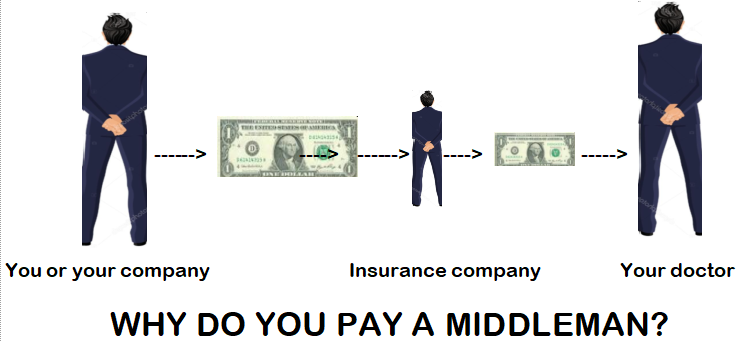
In fact, why do you or your company pay anyone, when the federal government is perfectly capable of paying your doctor, hospital, nurses, pharmaceutical company, and medical equipment manufacturer with no help from you?

You also pay the inflated costs of the goods and services you purchase from companies that have had to raise their prices to cover increased insurance costs.

In short, employer-supplied health care insurance is a net loser for everyone except for the insurance companies.

It cuts your salary while increasing what you pay for goods and services.


When the federal government pays, you get more and it costs you nothing.

The cost of care is expected to continue to increase in the coming years, putting added pressure on employers to offer competitive benefits packages.

Employer-sponsored plans have seen increased demand for mental health services, and 44% of companies surveyed with 200 or more employees offered mental health or self-care apps as benefits, accompanying research in Health Affairs says.

Covered workers are picking up a portion of the cost when they visit in-network physicians: Average copayments were $27 for primary care and $44 for specialty care, and there was even more cost-sharing for hospital admissions or outpatient procedures.

A large majority of firms with 50 or more employees cover some telemedicine in their largest health plan. What’s next: Premiums are likely to surge next year as inflation persists.

“Premium increases may be even higher than the 3–4 percentage points that we have seen in recent years,” the Health Affairs study authors write.

It’s the classic vicious circle. The cost of health care goes up which directly increases inflation, Then, inflation pushes the cost of insurance up, which impacts your net salary. And ’round and ’round we go.

Your net take-home pay is numerically reduced by the insurance premiums, while it is functionally reduced by inflation.

Employer-provided health care insurance costs you both ways.

THE SOLUTION The U.S. federal government has infinite dollars. It neither needs nor uses tax dollars to pay its bills. Even if all federal tax collections totaled $0, the government could continue spending any amount, forever.

In fact, all federal tax dollars are destroyed upon receipt.

Without collecting a penny in taxes, the federal government could provide you and your family with free, comprehensive, no-limit health care insurance, that includes everything you can imagine — eyes, dental, psychiatric, every form of health-related equipment, etc.

Your healthcare could cost you nothing, either for services or for premiums. It could be Medicare for All only much, much better. And it wouldn’t increase the cost of goods and services, because, unlike employer-provided insurance, it wouldn’t increase employers’ costs.

Unlike employer-funded medical insurance, which does nothing for the economy, federally funded Medicare for All would grow the economy by adding stimulus dollars.

SO WHY NOT? Why don’t you have this plan, already? 

Because you have been led to believe three lies.

Lie #1. You shouldn’t trust the government to provide health care.

But, a comprehensive Medicare for All plan would not involve the government providing health care. The plan would involve the government only paying for health care.

The actual care still would be provided by your same doctors, nurses, hospitals, therapists, and equipment manufacturers. It merely would cut out the wholly unnecessary and costly middlemen, the insurance companies.

The insurance companies provide no medical function. They merely collect your dollars, take some for themselves, and pass the rest on to the real medical practitioners.

The government would function as your insurance company. The big differences would be no dollars would be taken from you, and the government never can run short of dollars.

Lie #2. Your taxes would go up.

The U.S. federal government, unlike state and local governments, is Monetarily Sovereign. It cannot unintentionally run short of U.S. dollars.

It can spend forever without collecting any tax dollars.

Compare the federal government to state and local governments. They are monetarily non-sovereign. While state and local taxes fund state and local spending, federal taxes do not fund federal spending.

The purpose of federal taxes is not to help the government spend, but rather:

a. To control the economy by taxing what the government wishes to reduce and giving tax breaks to what the government wishes to reward.

b. To create demand for the U.S. dollar by requiring taxes to be paid in dollars.

c. To reduce your demand for services (like free health care insurance), by making you believe taxes are necessary to pay for benefits.

Lie #3. Federal spending causes inflation.

No inflation ever has been caused by spending. All inflations, including the current one, are caused by shortages of key goods and services, most often oil and food.

During and after the Great Recession of 2008, we had massive government spending without inflation. We only experienced inflation when COVID caused shortages of oil, food, lumber, computer chips, shipping, labor and other products and services.

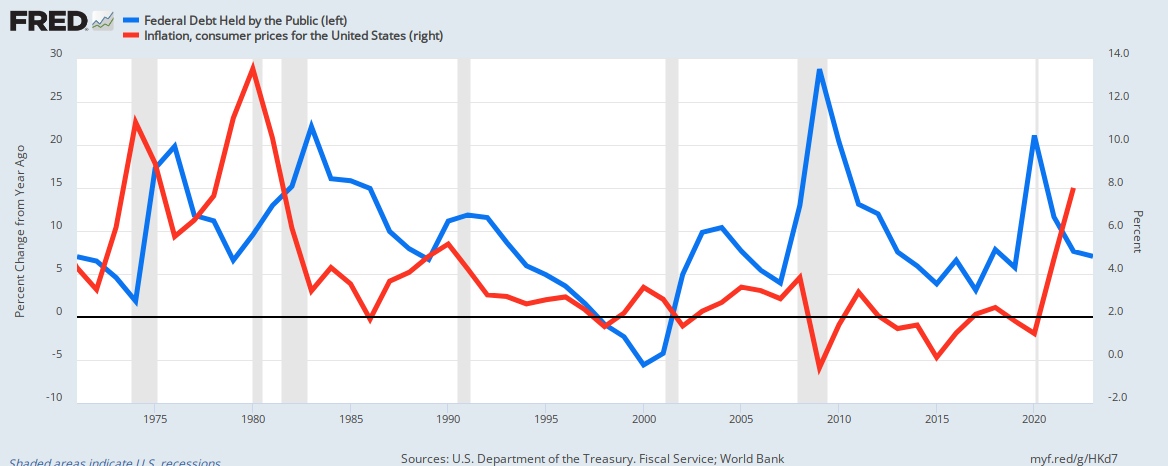
Inflation (red line) doesn’t parallel federal deficit spending (blue line).

If you understood that the federal government has infinite money and does not need or use taxes, you would demand Medicare for All, Social Security for All, College for All, Food Assistance for All, Housing Assistance for All, etc.

Why don’t we have it?

The very rich, who run America, don’t want it. They are rich because of the income/wealth/power Gap between them and you. The wider the Gap, the richer they are. But the more free benefits you receive, the narrower the Gap becomes.

Your free benefits actually make the rich less rich.

So the rich bribe the politicians (via campaign contributions and promises of employment), the media (via advertising dollars and media ownership), and the economists (via donations to schools and employment in think tanks).

The rich bribe these people to tell you “the Big Lie” that federal taxes fund federal spending, and if you want more benefits you’ll have to pay for them.

It’s all a con to keep you ignorant. An ignorant public is a docile public, which is exactly what the rich want. It keeps them rich.

Sen. Bernie Sanders recommended a Medicare for All plan, but his plan had three serious faults:

Fault #1. It claimed to rely on tax collections, the same fault current Medicare has. So Sanders struggled to show how it was tax-neutral.

That was unnecessary. He should have explained that federal taxes do not fund federal spending and that the federal government would do what it always does: Create dollars, ad hoc, to pay every bill.

Fault #2. It was not comprehensive. It still required co-pays and didn’t cover many medical problems. This was done to save money and balance against tax collections — an unnecessary step.

The federal government does not need to save dollars. It has infinite dollars. It never can run short of dollars, even if it collects zero taxes.

Former Federal Reserve Chairman Alan Greenspan: “A government cannot become insolvent with respect to obligations in its own currency.”

Former Federal Reserve Chairman Ben Bernanke: “The U.S. government has a technology, called a printing press (or, today, its electronic equivalent), that allows it to produce as many U.S. dollars as it wishes at essentially no cost.”

The scare stories about federal “debt” and deficits are just that: Scare stories. False scare stories.

So called federal “debt” and deficits are no burden on a government with the infinite ability to pay its bills. If the federal government and your political representatives were doing their job, you would have free, comprehensive Medicare for All right now.

Why do you pay a middleman when the government can provide better service, free?      


Rodger Malcolm Mitchell
Monetary Sovereignty

Twitter: @rodgermitchell Search #monetarysovereignty
Facebook: Rodger Malcolm Mitchell

……………………………………………………………………..

The Sole Purpose of Government Is to Improve and Protect the Lives of the People.

MONETARY SOVEREIGNTY

MMT’s divorce from reality: Jobs Guarantee and inflation fear

Modern Monetary Theory (MMT) is a cousin to Monetary Sovereignty (MS), in that both concepts acknowledge the indisputable fact that the U.S. federal government’s ability to spend is not constrained by the availability of funds.
Modern monetary theory and Monopoly money : r/wallstreetbets
Neither the federal government nor any federal agency can run out of money unless Congress wants it to. Federal “Trust Funds” are a lie to prevent you from receiving federal benefits.
In short, the Monetarily Sovereign federal government cannot run short of dollars. It cannot “go broke.” It neither needs nor uses tax dollars. Similarly, no agency of the federal government (Medicare, Medicaid, Social Security, et al) can run short of dollars unless Congress wants it to. Even if all federal tax collections were $0, the government could continue spending, forever. This is true of all sovereign issuers of a sovereign currency. Federal taxes do not pay for federal spending. The federal government pays for all spending by creating new dollars. Federal tax dollars are destroyed upon receipt.

Alan Greenspan: “A government cannot become insolvent with respect to obligations in its own currency.”

Ben Bernanke: “The U.S. government has a technology, called a printing press (or, today, its electronic equivalent), that allows it to produce as many U.S. dollars as it wishes at essentially no cost.”

Quote from Ben Bernanke when, as Fed chief, he was on 60 Minutes: Scott Pelley: Is that tax money that the Fed is spending? Ben Bernanke: It’s not tax money… We simply use the computer to mark up the size of the account.

Statement from the St. Louis Fed: “As the sole manufacturer of dollars, whose debt is denominated in dollars, the U.S. government can never become insolvent, i.e., unable to pay its bills. In this sense, the government is not dependent on credit markets to remain operational.”

Press Conference: Mario Draghi, President of the ECB, 9 January 2014 Question: I am wondering: can the ECB ever run out of money? Mario Draghi: Technically, no. We cannot run out of money.

Sadly, MMT believers go astray with two false beliefs: MMT’s Jobs Guarantee and the belief that federal deficit spending can cause inflation. I. JOBS GUARANTEE Briefly, JG is just what it sounds like: The government guarantees it will find or provide (it’s not clear which) a job for anyone who wants a job. We have published many articles describing the foolishness of that proposal. Rather than repeat the many, many reasons why the JG is naive, wrongheaded, and damaging, we’ll just provide you with these references:
How the MMT “Jobs Guarantee” ignores humanity. MMT’s “Jobs Guarantee”: The final nail in the coffin of this naive, foolish program One more reason why the MMT Jobs Guarantee is a con job The MMT Jobs Guarantee con job More proof the MMT’s “Jobs Guarantee” can’t work The Jobs Guarantee (JG) mouse Another word on MMT’s Jobs Guarantee and “The Rise Of Bullshit Jobs” Life in a Jobs Guarantee (JG) World The JG (Jobs Guarantee) vs the GI (Guaranteed Income) vs the EB (Economic Bonus) Why Modern Monetary Theory’s Jobs Guarantee is like the EU’s euro: A beloved solution to the wrong problem. Will people still work if the government gives them money?
Now, circumstances have arrived to demonstrate reality in the face of MMT’s academic ignorance.
All those people quitting jobs, where are they going? Kristin Schwab, Oct 28, 2021 You may have heard the news that last week’s initial unemployment claims fell to a new pandemic low. But even though layoffs are decreasing, it’s also true that lots of workers are leaving their jobs and lots of employers are still having trouble filling them. So, where are the workers who are leaving jobs going? Right now, it is statistically more difficult to become a receptionist than to get into Harvard. That’s according to data from ZipRecruiter, where Julia Pollak is chief economist. “I have a lot of bad news for job seekers in certain occupations. Some are much more competitive even,” Pollak said. Some of these jobs are specialized or senior roles, but a lot of them are what Pollak calls pleasant jobs with predictable schedules, such as in customer service or communications — and fields like airport security.
Guess what, MMT? People aren’t simply mindless pegs to be fitted into crap-job holes as JG would do. Human beings have desires. They want — no, demand — good jobs: Good pay, good conditions, good futures. MMT’s JG program, designed by academics who have not experienced reality, relies on people being so desperate they will take any job offered. When people are selective about their lives, JG falls apart.
“So, jobs where you have some degree of prestige, perhaps a uniform and a union looking out for your interests,” Pollak said. The growing interest in jobs that are more stable and offer better pay and benefits makes sense when you compare them to jobs that require similar skills and are begging people to come back — think less predictable or less protected industries like trucking and restaurants.
Imagine that, MMT, people want stability, better pay, and better benefits, not what a federal JG bureaucracy offers them.
“If you’re a worker at a restaurant and suddenly the restaurant is short-staffed, it’s going to be that much harder for you to actually manage your shift,” said Daniel Zhao, an economist at Glassdoor. People are tired, burned out and fed up. And a lot of them are looking for a new work-from-home lifestyle. Glassdoor said searches for remote roles is up more than 350% in the last year. Whether everyone can get one is a different story.
The paternalistic Jobs Guarantee was a depression-era solution, that is as appropriate as a hand-crank calculator in today’s computer age. Sadly, MMT still doesn’t get it. Instead of JG nonsense, we finally are leaning toward Step #3 of the Ten Steps to Prosperity: Social Security for All. II SOCIAL SECURITY FOR ALL The following article calls it, “Guaranteed Basic Income” (GBI). Different name, same fundamental concept: Instead of finding crap jobs for the poor, simply give people money.
Guaranteed basic income is coming By Alice Yin and John Byrne Chicago Tribune, The Tribune’s Gregory Pratt contributed Thousands of struggling Chicago residents will receive monthly cash payments from the city of Chicago as it becomes home to one of the largest guaranteed income programs in the U.S. Mayor Lori Lightfoot’s $31.5 million basic income program is just a sliver of the total $16.7 billion budget, which will be buoyed by federal COVID-19 relief funds and won City Council approval Wednesday. Few details of the pilot have been hammered out yet, except that 5,000 households will receive $500 per month for a year — with no strings attached. The lowest-income residents who suffered financial blows from the COVID-19 pandemic will be the focus. When the funds go out, Chicago will join a contingent of American cities that have warmed up to the concept of guaranteed income. Once deemed a pipe dream in mainstream politics, the idea of handing unconditional cash directly to those in need has particularly gained steam during the coronavirus-fueled recession, when most Americans saw multiple rounds of stimulus checks and other temporary social safety net expansions. However, guaranteed income pilots have launched before the pandemic too, such as in Stockton, California, under former Mayor Michael Tubbs. The program doled out $500 monthly payments to a small subset of low-income families. In June 2020, Tubbs started the coalition Mayors for a Guaranteed Income, which now has more than 50 mayors on board, more than two dozen of whom are piloting the concept in some form. Though Lightfoot has touted her proposal as the largest in U.S. history, Los Angeles is in the process of implementing its own guaranteed income pilot targeting 3,000 households with $1,000 a month for a year. Andrew Yang, a Democratic presidential candidate in 2020, has also championed a more far-reaching version of cash assistance known as universal basic income, which would go out to all adults regardless of means.
Rather than insisting on the Puritanical demand that people must labor in order to survive (i.e JG), more enlightened city governments recognize that at least at some basic level, poverty is harmful to the whole nation, and Americans have a right to live. The irony is that monetarily non-sovereign cities (which are financially limited) are doing it rather than the Monetarily Sovereign federal government, which is financially unlimited. But that is why the efforts are so small, with just a few thousand households receiving benefits.
Not all Chicago aldermen were on board with Lightfoot’s plan. Her overall budget passed 35-15, with some of the opposition pointing to the basic income program. Southwest Side Ald. Matt O’Shea said after the vote that the pilot won’t work because “in two years, we won’t be able to afford it.” He’d rather see resources spent on boosting child care and “getting people back to work,” he said. “Just giving money out to people when there’s tens of thousands of jobs in our city right now, that’s not something I can support,” O’Shea said.
But that is the whole point. There are “tens of thousands of jobs” people don’t want. Arrogant academic snobs claim the “underclass” should be grateful to work crap jobs for crap wages. Those are Gap Psychology words. They serve only to widen the Gap between the rich and those below. JG is cruel and ignorant. It dooms people to failure. It is bad economics. Giving people money turns them into consumers whose spending helps the entire economy. Apparently, people are tired of the “work ’til you drop” routine. They have the strange desire to lead pleasant lives, no matter what the rich tell them. If people won’t work, it’s not because of laziness, as the rich love to claim. It’s because the jobs are unattractive.
Back in March, when aldermen held a hearing on a proposal over direct monthly checks, caucus chairman Jason Ervin said it would be a “slap in the face” to proceed with guaranteed income before setting up a reparations programs for descendants of slaves.
That’s a perfect example of the old, “We can’t do this before we do that” stalling routine. It’s like this: “We can’t feed them until we clothe them, and we can’t clothe them until we house them, and we can’t house them until we educate them, and we can’t educate them until we give them free healthcare, and we can’t afford to give them free healthcare until we raise taxes — and we can’t raise taxes because no one wants that. “So we can’t do anything. Sorry.”
One of City Council’s loudest voices for direct cash assistance has been Northwest Side Ald. Gilbert Villegas, who said his mother received a monthly $800 stipend through the Social Security survivors death benefits program after his father died. Villegas introduced a proposal ordinance this spring that largely resembled Lightfoot’s plan of $500 monthly payments to 5,000 households, but it did not pass.
Villegas’s mother received benefits from a federal agency, that is funded from an unlimited source. City governments are not unlimited sources.
Still, Villegas said he’s prepared to go all-in on helping work out the details of Lightfoot’s program. He wants an eligibility threshold of households earning 300% or less of the federal poverty level, and Chicago Public Schools families should be prioritized, he said.
The problem with income eligibility programs is they are expensive to administer, unfair to those who barely miss out, and subject to cheating.
Though most guaranteed income programs are still nascent, researchers have examined the effects — with limitations. The current pilots in place are narrow in size and duration, said Carmelo Barbaro, executive director of the University of Chicago Inclusive Economy Lab. Still, there is promise in further investigating the results because unlike other safety-net programs, direct cash assistance is simpler to implement, he said. Broadly accessible and unconditional cash transfers like Chicago’s guaranteed income pilot are intended to address those limitations of existing programs,” Barbaro wrote in an email. “The cost of such programs is higher, but the benefits could also be higher.”
No deductible, comprehensive Social Security for All is affordable for the federal government (as are all federal expenses). It would be simple to administer, and massively beneficial to the economy.
University of Pennsylvania professor Ioana Marinescu, an economist who has also studied such programs, said the early signs show that some of the outcomes feared by critics may not have materialized. A 2014 research review on the effect of cash transfers on alcohol and tobacco purchases, for example, found virtually no change in or even a decrease in spending on these so-called temptation goods. “There’s advantages to cash in terms of flexibility,” Marinescu said. “There could be drawbacks if you’re worried that people misuse the cash. But that doesn’t seem to be the case based on the empirical evidence.”
The rich like to portray the poor as ignorant sloths who will use any extra money for drinking, gambling, smoking, and drugs. That gives the rich a fake excuse to widen the Gap and thereby make themselves richer. Republicans, the party of the rich, invariably vote against money for the poor. (The Gap is what makes the rich rich. Without the Gap, no one would be rich. We all would be the same. The wider the Gap, the richer the rich are.) The lack of money is the biggest problem in any economy. The best way to cure that problem is to give people money. The rich hate it, and invent excuses for not doing it, because they don’t want the Gap between the rich and the rest to be narrowed. III Inflation Contrary to popular myth, inflation never is caused by “too much” federal deficit spending. Inflation always is caused by shortages of key goods and services.
There is no correlation between federal deficit spending (blue line) and inflation (red line).
Today’s inflation is related to shortages of energy, labor, food, and computer chips. Inflation actually can be cured by additional federal spending to pay for scarce goods and services. In Summary
  1. The Monetarily Sovereign federal government has infinite access to dollars. Neither the government nor any agency of the government can run short of dollars unless Congress wants that to happen.
  2. Federal taxes do not “pay for” federal spending. Federal spending is paid for by the creation of new dollars, which the government has the infinite ability to do.
  3. Federal spending does not cause inflation. Inflation is caused by the scarcity of key goods and services. Federal spending can cure inflation by paying for scarce goods and services.
  4. America is not short of jobs. America is short of good jobs. Modern Monetary Theory’s Jobs Guarantee will solve zero problems, and in fact exacerbate a “crap jobs” economy.
  5. Poverty, the lack of money, is bad for the American economy. Poverty is not cured by bad jobs, but rather by putting money in the hands of the impoverished. This creates new consumers, whose purchases grow the economy,  which grows businesses that are able to provide attractive jobs.
It all begins putting with money into the hands of the people, which the U.S. federal government has the infinite ability to provide. Rodger Malcolm Mitchell Monetary Sovereignty Twitter: @rodgermitchell Search #monetarysovereignty Facebook: Rodger Malcolm Mitchell

……………………………………………………………………..

THE SOLE PURPOSE OF GOVERNMENT IS TO IMPROVE AND PROTECT THE LIVES OF THE PEOPLE.

The most important problems in economics involve:
  1. Monetary Sovereignty describes money creation and destruction.
  2. Gap Psychology describes the common desire to distance oneself from those “below” in any socio-economic ranking, and to come nearer those “above.” The socio-economic distance is referred to as “The Gap.”
Wide Gaps negatively affect poverty, health and longevity, education, housing, law and crime, war, leadership, ownership, bigotry, supply and demand, taxation, GDP, international relations, scientific advancement, the environment, human motivation and well-being, and virtually every other issue in economics. Implementation of Monetary Sovereignty and The Ten Steps To Prosperity can grow the economy and narrow the Gaps: Ten Steps To Prosperity:
  1. Eliminate FICA
  2. Federally funded Medicare — parts A, B & D, plus long-term care — for everyone
  3. Social Security for all
  4. Free education (including post-grad) for everyone
  5. Salary for attending school
  6. Eliminate federal taxes on business
  7. Increase the standard income tax deduction, annually. 
  8. Tax the very rich (the “.1%”) more, with higher progressive tax rates on all forms of income.
  9. Federal ownership of all banks
  10. Increase federal spending on the myriad initiatives that benefit America’s 99.9% 
The Ten Steps will grow the economy and narrow the income/wealth/power Gap between the rich and the rest.

MONETARY SOVEREIGNTY