If you enjoy watching weird hypocrisy in action, you’ll love this.
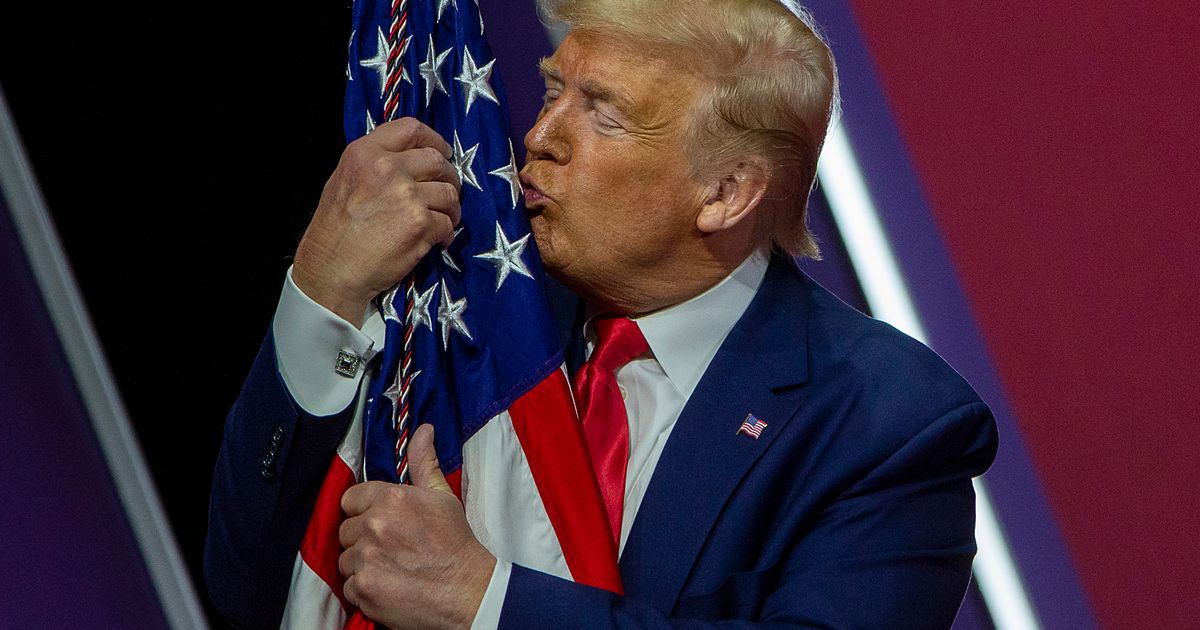
Draft-dodger “patriot” hugs and kisses flag and calls American war dead, “suckers” and “losers.”States Move To Force Sports Teams To Play the National AnthemThree states have advanced constitutionally questionable laws.JASON RUSSELL | 6.16.2021 5:20 PMFor the first time, some states are moving to turn the decades-old cultural norm of playing the national anthem before a sporting event into a legal requirement.
Remember that these are the same Trumper conservatives who claim that the government intrudes too much on our freedoms. (Or does that apply only to guns?)
Right-wing “patriots” bearing flags while attempting a coup against the American government.On Wednesday, Texas’ Republican Gov. Greg Abbott signed into law Senate Bill (S.B.) 4, which will require professional sports teams to play the national anthem at the start of each preseason, regular season, and postseason game hosted in Texas.
Hey, what about amateur sports teams? Why are they not required to be “patriotic.”
Why doesn’t this apply to checkers and chess? Kids playing tag in the schoolyard?
And why only at the start of games? What about during and after games?
And why only sports? What about all TV and radio shows? Plays and concerts? Every workday?
Chief of staff John Kelly and Gen. Joe Dunford were there. Not “patriot” Trump. Too rainy.
We mandatory patriots need to know.
And by the way, does singing the National Anthem make one a patriot? Hmmm . . . If only Benedict Arnold had sung, “Oh, say can you see . . . “
The law requires all financial agreements between pro sports teams and state and local governments to include written verification that the team will play the anthem.
What instruments must be used? Will a harmonica do? Drumming on a garbage pail? Are undocumented immigrants excused from playing?
And how much of the National Anthem will be required by law. Just a couple of notes? Or all four verses?
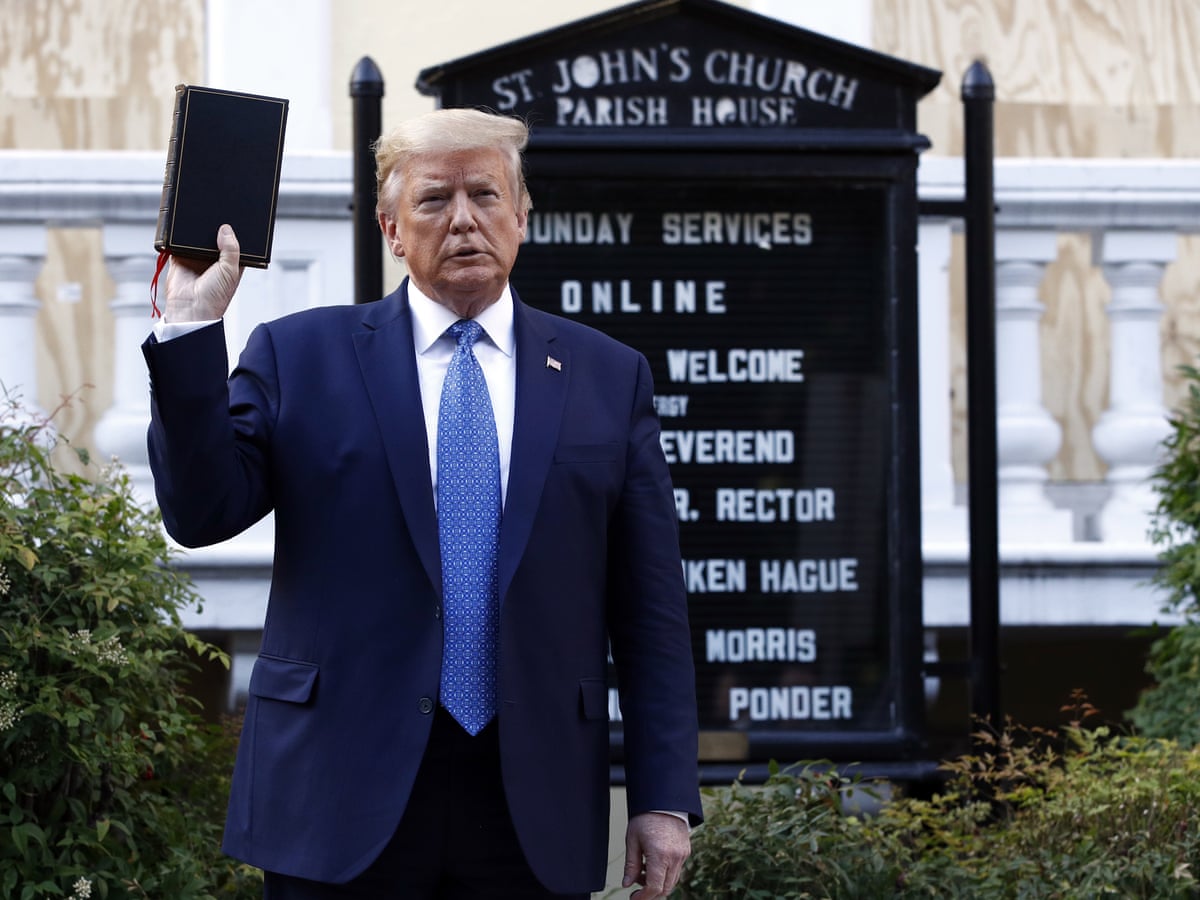
Anyway, must it be sung, or just played without the words? Are we required to look at a photo of Donald Trump holding a Bible, while we sing?
This very religious man, who never attends church, and breaks with the Ten Commandments at every opportunity, is showing you the Bible
A similar bill was signed into law in Louisiana on Monday that would require the playing of the national anthem before all sporting events at venues that were subsidized by state or local governments.
Does receiving unemployment or working for the DMV count as “subsidized” by state or local governments? Public school teachers running a spelling bee contest?
Hey, how about requiring everyone to recite the Pledge of Allegiance before and after every game? Now that would be patriotic.
The right-wing Wisconsin Assembly passed legislation nearly identical to the Louisiana law, but it has since sat dormant in the Wisconsin Senate for more than a month.
So does the Wisconsin GOP seem to be kicking the can down the road? Does can-kicking count as a sporting event?
The Supreme Court has, time and time again, set precedents that the government can’t compel speech, even as a condition of doing business with the government.
Now that we have a super-majority conservative SCOTUS, will it ignore precedent as it is predicted to do with Rowe v. Wade?
Three QAnonesque Questions:
What is the secret reason why the freedom-loving politicians of Texas, Wisconsin, and Louisiana voted to require teams to play the National Anthem before games?
Why is Trump hugging the flag and showing you the Bible?
In one word, what do all these patriots have in common?
Gap Psychology describes the common desire to distance oneself from those “below” in any socio-economic ranking, and to come nearer those “above.” The socio-economic distance is referred to as “The Gap.”
Wide Gaps negatively affect poverty, health and longevity, education, housing, law and crime, war, leadership, ownership, bigotry, supply and demand, taxation, GDP, international relations, scientific advancement, the environment, human motivation and well-being, and virtually every other issue in economics.Implementation of Monetary Sovereignty and The Ten Steps To Prosperity can grow the economy and narrow the Gaps:
Ten Steps To Prosperity:
The people who claim the USA isn’t racist are the worst racists?
When one member of a group fails, the bigots will hate the entire group for this failure? If a group succeeds, the bigots will despise it for its success.
Liberals think the purpose of government is to protect the poor and powerless from the rich and powerful. Conservatives think the purpose of government is to protect the rich and powerful from the poor and powerless.
It takes two things to put people in chains: The ignorance of the oppressed and the treachery of their leaders.
Hatred and fear are evil twins. It is impossible to hate someone without fearing them.
The brainless are too brainless to understand how little they know. The intelligent are smart enough to understand how little they know.
Dictators always claim that patriotism is obedience to them. Their disciples agree. Fake, hyperpatriots “love America,” but hate the Americans who disagree with them.
Loyalty, like obedience, usually is a one-way street. Divorce and dog leashes are proof.
A liar believes everyone is lying; a cheater believes everyone is cheating; a hater believes hatred is normal.
The more federal budgets are cut and federal taxes increased, the weaker an economy becomes. No economy can tax itself into prosperity, nor grow without money growth. Cutting federal deficits to grow the economy is like applying leeches to cure anemia.
Many people expect the Federal Reserve to control inflation. But inflation is not a financial problem. Inflation is a scarcity problem that only Congress can fix.
It is easier to have sympathy than empathy. Actually, no one has empathy. “I feel your pain” is a lie.
We wish to distance ourselves from those below us on any social scale, while coming closer to those above. This is Gap Psychology.
Austerity is the government’s method for widening the gap between rich and poor.
Everything in economics devolves to motive, and the motive always involves the Gap between the richer and the poorer.
The Gap is what makes the rich, rich. To widen the Gap, the rich can obtain more for themselves, or make sure the poor have less.
Everyone lies. Most of our lies are to ourselves.
No life form in the universe is less knowlegable than a voter.
Until the 99% understand the need for federal deficits, the upper 1% will rule.
To survive long-term, a monetarily non-sovereign entity must have a positive balance of payments.
Those, who do not understand the differences between Monetary Sovereignty and monetary non-sovereignty, do not understand economics.
Where reality differs from belief, those who question least choose belief.
The more we learn,
the more we begin to see,
if we were tasked with building a universe,
this is the only way it could be.
In politics, people tend to support those who most resemble them. Women tend to support women. Blacks tend to support blacks; Jews tend to support Jews; Evangelicals tend to support Evangelicals; New Yorkers tend to support New Yorkers, Latinos tend to support Latinos; and stupid, immoral, close-minded, bigoted liars tend to support stupid, close-minded, immoral, bigoted liars. Know yourself by whom you follow.
Gap Psychology describes the common desire to distance oneself from those “below” in any socio-economic ranking, and to come nearer those “above.” The socio-economic distance is referred to as “The Gap.”
Wide Gaps negatively affect poverty, health and longevity, education, housing, law and crime, war, leadership, ownership, bigotry, supply and demand, taxation, GDP, international relations, scientific advancement, the environment, human motivation and well-being, and virtually every other issue in economics.Implementation of Monetary Sovereignty and The Ten Steps To Prosperity can grow the economy and narrow the Gaps:
Ten Steps To Prosperity:
Lately, we’ve been hearing and reading a great deal about inflation, and how it’s either nothing to worry about or it’s the end of the world, depending on the motive of the author.
Currently, the Republicans are all atwitter about inflation, because they ascribe it to federal benefits for the not-rich, which they loathe — both the not-rich and the benefits for them.
The Democrats pooh-pooh inflation as nothing-to-worry-about because they want to put more dollars into the pockets of the poor while buying votes.
But what exactly is “inflation”? Surely, the science of economics can provide the answer to so basic a question.
For your confusion, I turn you to “The Definition of Inflation” by Ludwig von Mises.
No, not really.
It’s nonsense. I mention it, not as a reference, but as a reference to the confused nature of economics.
“Inflation,” as most people (except von Mises) think of it, is a general increase in prices. That might seem simple enough on its face, but dig below and it becomes rather muddled.
According to Investopedia:
PCE Price Index (PCEPI) vs. Consumer Price Index (CPI)The CPI is the most well-known economic indicator and usually gets a lot more attention from the media. But the Federal Reserve prefers to use the PCE Price Indexwhen gauging inflation and the overall economic stability of the United States.There are other indicators that are used to measure inflation, including the Producer Price Index and the GDP Price Index.So why does the Fed prefer the PCE Price Index? That’s because this metric is composed of a broad range of expenditures. The PCE Price Index is also weighted by data acquired through business surveys, which tend to be more reliable than the consumer surveys used by the CPI.The CPI, on the other hand, provides more granular transparency in its monthly reporting. As such, economists can more clearly see categories like cereal, fruit, apparel, and vehicles.Another difference between the PCE Price Index and CPI is that the PCE Price Index uses a formula that allows for changes in consumer behavior and changes that occur in the short term. These adjustments are not made in the CPI formula.These factors result in a more comprehensive metric for measuring inflation. The Federal Reserve depends on the nuances that the PCE Price Index reveals because even minimal inflation can be considered an indicator of a growing and healthy economy.
In reading the above you might conclude that each measures inflation in a slightly different way, but overall, the results should be similar, differing only in detail. Right?
Well, here they are:
The above graph shows each measure on the index: November, 1970 = 100.
Hmmm . . . Three of the four are similar, but the blue line, Personal Consumption Expenditures (PCE), the one the “Federal Reserve prefers to use,” shows massively different inflation.
So, how much has been the “general increase in prices”? Has there been a lot of inflation? A little? Economists can’t tell you.
Let’s look at exactly the same basic data, but instead show Annual Percentage Change from the Year Ago:
The prior graph indicated that inflation at some unknown level, has existed for many years, though measurements differ significantly.
The second graph shows that year-to-year inflation changes generally have trended down. The outlier continues to be the Fed’s preference, PCE, while GDP Price Index and Consumer Price Index move in lockstep, as would be expected.
Now, we’ll include federal deficit spending, the great bugaboo of the right-wing (except when the deficits favor the rich):
We find no relationship between deficits and any commonly-used measure of inflation.
Look closely, and you will see that the maroon line (Federal Debt Held By The Public), the measure of federal deficit spending, does not move in concert with any measure of inflation.
There simply is no evidence to support the commonly held notion that inflation is caused by federal deficit spending. The belief in the monetary cause of inflation simply is wrong, though that belief is a primary source of federal debt fear.
Here is the “logic,” as expressed by Investopedia:
Financing a DeficitAll deficits need to be financed. This is initially done through the sale of government securities, such as Treasury bonds (T-bonds).
Wrong. Treasury securities do not finance anything.
They merely are deposits into T-security accounts, the money in which is not touched by the federal government.
Like the money in safe deposit boxes, the dollars just sit in the T-security accounts, gathering interest until maturity, at which time the contents of those accounts are returned to the owners.
Federal deficit spending is financed by federal money creation, not by borrowing.
Individuals, businesses, and other governments purchase Treasury bonds and lend money to the government with the promise of future payment.
No “lending” is involved. The federal government has no need for, nor use of, the dollars residing in Treasury Security accounts.
To pay for its deficit spending, the federal government sends instructions (not dollars) to each creditor’s bank, instructing the bank to increase the balance in the creditor’s checking account.
The instant the bank does as instructed, new dollars are created and added to the money measure known as M1.
The bank then clears the transaction through the Federal Reserve, a federal government agency, and the circle is closed. The government simply creates its own laws and approves its own money creation.
The clear, initial impact of government borrowing is that it reduces the pool of available funds to be lent to or invested in other businesses.
As noted earlier, the U.S. federal government, being Monetarily Sovereign, has the unlimited ability to create U.S. dollars. So it does not borrow dollars.
The so-called “borrowing” (i.e. deposits into T-security accounts) would “reduce the pool of available funds to be lent to or invested in other businesses,” but for three facts:
Federal deficit spending adds dollars to the economy, which increases the pool of available funds
The deposits earn interest dollars created ad hoc, by the federal government, which also increases the pool of available funds.
Upon maturity, the dollars in the T-security accounts are returned to M1, which again adds to the pool of available funds.
This is necessarily true: an individual who lends $5,000 to the government cannot use that same $5,000 to purchase the stocks or bonds of a private company.
But some other individual, the individual who sold the $5,000 worth of goods and services to the federal government, has received newly-created $5,000 that can be used “to purchase the stocks or bonds of a private company.”
Thus, all deficits have the effect of reducing the potential capital stock in the economy.
Wrong. All federal deficits have the effect of increasing the potential capital stock in the economy, which why, as federal debt has increased, there is more capital stock in the economy today than there was in prior years.
This would differ if the Federal Reserve monetized the debt entirely; the danger would be inflation rather than capital reduction.
The so-called federal debt already is monetized by the money-creation involved in the federal government paying for goods and services.
Additionally, the sale of government securities used to finance the deficit has a direct impact on interest rates.
It isn’t thesale of T-securities that impacts interest rates. It’s the existence of T-securities that gives the Fed a platform for controlling interest rates.
Accepting an extra billion or trillion dollars in T-security deposits doesn’t change that fact.
Federal Limits on DeficitsEven though deficits seem to grow with abandon and the total debt liabilities on the federal ledger have risen to astronomical proportions, there are practical, legal, theoretical and political limitations on just how far into the red the government’s balance sheet can run, even if those limits aren’t nearly as low as many would like.
As a practical matter, the U.S. government cannot fund its deficits without attracting borrowers.
False.They probably mean, without attracting lenders, but that too would be false.
Deficits are the difference between tax collections and federal spending, which already is funded by federal money creation.
Deficits are not funded. It is the spending that is funded. And there are no financial limits to federal spending.
Backed only by the full faith and credit of the federal government, U.S. bonds and Treasury bills (T-bills) are purchased by individuals, businesses, and other governments on the market, all of whom are agreeing to lend money to the government.
True that U.S. Treasury securities are backed only by the full faith and credit of the U.S. government.
But the federal government does not borrow U.S. dollars. Even if the U.S. government didn’t offer a single T-bill, T-note, or T-bond, it could continue deficit spending forever.
No one lends money to a government that has, via its own laws, given itself the unlimited ability to create its own sovereign currency.
The U.S. federal government never unwillingly can run short of laws, and it never unwillingly can run short of dollars.
The Federal Reserve also purchases bonds as part of its monetary policy procedures. Should the government ever run out of willing borrowers, there is a genuine sense that deficits would be limited and default would become a possibility.
If interest payments on the debt ever become untenable through normal tax-and-borrow revenue streams, the government faces three options. They can cut spending and sell assets to make payments, they can print money to cover the shortfall, or the country can default on loan obligations. The second of these options, an overly aggressive expansion of the money supply, could lead to high levels of inflation, effectively (though inexactly) capping the use of this strategy.
The author has no understanding of the financial differences between monetary non-sovereignty (you, me, cities, counties, states, businesses) vs. Monetary Sovereignty (the federal government).
Neither taxing nor borrowing supplies dollars to the federal government. Tax dollars are destroyed upon receipt. And the federal government (unlike state and local governments) does not borrow.
The purpose of federal taxes (unlike state/local taxes) is not to provide spending money to the government. The purpose of federal taxes is to:
Help the government control the economy by taxing what it wishes to discourage and by giving tax-breaks to what it wishes to encourage, and
To make the populace believe that benefits are limited, a myth promulgated by the very rich in order to widen the Gap between the rich and the rest.
The federal government always creates new dollars to pay for interest, and this never leads to inflation.
The Bottom LineDeficits are seen in a largely negative light.
While macroeconomic proposals under the Keynesian school argue that deficits are sometimes necessary to stimulate aggregate demand, other economists argue that deficits crowd out private borrowing and distort the marketplace.
Deficits always are necessary to stimulate demand. When deficits are lacking, or even too small, the economy falls into recession or depression.
A growing economy requires a growing supply of money, and this is created via federal deficit spending.
Recessions (vertical gray bars) are preceded byreductions in deficit growth, and are cured byincreases in deficit growth.
U.S. depressions tend to come on the heels of federal surpluses.
1804-1812: U. S. Federal Debt reduced 48%. Depression began 1807.
1817-1821: U. S. Federal Debt reduced 29%. Depression began 1819.
1823-1836: U. S. Federal Debt reduced 99%. Depression began 1837.
1852-1857: U. S. Federal Debt reduced 59%. Depression began 1857.
1867-1873: U. S. Federal Debt reduced 27%. Depression began 1873.
1880-1893: U. S. Federal Debt reduced 57%. Depression began 1893.
1920-1930: U. S. Federal Debt reduced 36%. Depression began 1929.
1997-2001: U. S. Federal Debt reduced 15%. Recession began 2001.
Since deficit spending adds dollars to the economy, it is senseless to claim that deficits crowd out private borrowing. Deficits have grown massively over the years, and there has been no “crowding out” of private borrowing.
Still, other economists suggest that borrowing money today necessitates higher taxes in the future, which unfairly punishes future generations of taxpayers to service the needs of (or purchase the votes of) current beneficiaries. If it becomes politically unprofitable to run higher deficits, there is a sense that the democratic process might enforce a limit on current account deficits.
And yet, there has been no relationship between tax levels and federal deficits. No future generations have been punished. And the democratic process has not enforced a limit on federal deficits.
All of the above demonstrates the “science” of economics’s uncanny ability to ignore the facts in plain sight, and instead promulgate unproven and unprovable hypotheses.
.
IN BRIEF:Many people expect the Federal Reserve to control inflation. But inflation is not a financial problem. Inflation is a scarcity problem that only Congress and the President can fix.
Money is neutral. Deficit spending is not an inflation issue. The amount of deficit spending is not an inflation issue. The issue is how the money is spent.
Deficit spending that causes shortages is inflationary. Deficit spending the cures shortages is anti-inflationary.
Rodger Malcolm Mitchell
Monetary SovereigntyTwitter: @rodgermitchellSearch #monetarysovereignty Facebook: Rodger Malcolm Mitchell ………………………………………………………………………………………………………………………………
THE SOLE PURPOSE OF GOVERNMENT IS TO IMPROVE AND PROTECT THE LIVES OF THE PEOPLE.
Gap Psychology describes the common desire to distance oneself from those “below” in any socio-economic ranking, and to come nearer those “above.” The socio-economic distance is referred to as “The Gap.”
Wide Gaps negatively affect poverty, health and longevity, education, housing, law and crime, war, leadership, ownership, bigotry, supply and demand, taxation, GDP, international relations, scientific advancement, the environment, human motivation and well-being, and virtually every other issue in economics.Implementation of Monetary Sovereignty and The Ten Steps To Prosperity can grow the economy and narrow the Gaps:
Ten Steps To Prosperity:
INFLATION! You can hear it now, can’t you? The sound of hands wringing in concert.
The GOP is owned by the very rich. And the rich are terrified that you ever-so-slightly will narrow the Gap between you and them.
So their GOP flunkees, having already given a huge tax deduction to their rich patrons, now will tell you that the Democrats’ stimulus packages are wrecking the economy and causing not just inflation, but hyperinflation.
It’s all a great big fat lie, a repeated myth designed to calm your requests for more stimulus dollars to flow to your benefit.
It goes like this:
Because the unemployment benefits are too generous, people won’t come back to work. So the GOP solution is to cut benefits, thereby starving people into working for low pay at unpleasant jobs.
The inflation theory is that increasing the supply of dollars when the demand for dollars remains constant, reduces the value of the dollar, and that reduction is known as “inflation.”
The GOP solution to inflation and unemployment.
Nice hypotheses, except:
There is a way to pay people good wages and also encourage work, and
The value of dollars does not decrease just because the supply increases.
Dollars are not like oranges, oil, or opera tickets. Money is a unique commodity. Increase the supply and people want still more.
Give a person a million or a billion, and he will want yet another million or billion. Ask Jeff Bezos, Elon Musk, Mark Zuckerberg, or Warren Buffet. They all still work — for money.
The one thing that affects the demand for money is the reward for owning money, i.e. interest rates, and that effect is modest. So, though interest rates today are quite low, the demand for dollars remains high.
As I have demonstrated in previous posts, inflations have not been caused by federal deficits. Nor have hyperinflations. All have been caused by shortages.
Inflations are caused by shortages, not by money supply.
If deficit spending (red line) caused inflations (blue line) you would expect to see the two lines reasonably parallel. But there seems to be no relationship between the lines. Cuts in deficit spending lead to recessions (gray bars).
The shortages that most likely to lead to inflations involve food, energy, and personnel.
Consumer prices surge again, rising 5% over the past yearBy Martin Crutsinger Associated PressWASHINGTON — American consumers absorbed another surge in prices in May — a 0.6% increase over April and 5% over the past year, the biggest 12-month inflation spike since 2008.The May rise in consumer prices that the Labor Department reported Thursday reflected a range of goods and services now in growing demand as people increasingly shop, travel, dine out and attend entertainment events in a rapidly reopening economy.The increased consumer appetite is bumping up against a shortage of components, from lumber and steel to chemicals and semiconductors, that supply such key products as autos and computer equipment, all of which has forced up prices. And as consumers increasingly venture away from home, demandhas spread from manufactured goods to services — airline fares, for example, along with restaurant meals and hotel prices — raising inflation in those areas, too.Among specific items in May, prices for used vehicles, which had surged by a record 10% in April, shot up an additional 7.3% and accounted for one-third of May’s overall price jump. The price of new cars, too, rose 1.6% — the largest one-month increase since 2009.The jump in new and used vehicle prices reflects supply chain problems that have caused a shortage of semiconductors.The lack of computer chips has limited production of new cars, which, in turn, has reduced the supply of used cars. As demand for vehicles has risen, prices have followed.But higher prices were evident in a wide variety of categories in May, including household furnishings, which rose 0.9%, driven by a record jump in the price of floor coverings. Airline fares rose 7% after having increased 10.2% in April. Food prices rose 0.4%, with beef prices jumping 2.3%. Energy costs, though unchanged in May, are still up 56.2% in the past year.
The problem isn’t excessive money. Furnishings, floor coverings, airline tickets, beef, and oil prices all reflect the lack of production or availability, which in turn reflects the lack of demand during COVID-19.
Only now, is supply beginning to grow to meet demand.
From the cereal maker General Mills to Chipotle Mexican Grill to the paint maker Sherwin-Williams, a range of companies have been raising prices or plan to do so, in some cases to make up for higher wages they’re now paying to keep or attract workers.
The GOP’s solution to the shortage of workersis to stop paying unemployment compensation.
For the benefit of the rich, the GOP wishes to starve the people until they are forced to return to low wages and poor working conditions.
That “solution” is a disgusting, medieval approach when a modern solution is available.
The solution is not for the federal government to pay the unemployed instead of salaries, but rather for the government to pay everyone in addition to salaries.
Don’t compensate people for staying home. Compensate people for being people. Institute Social Security for all.
That way, there would be no temptation to stay home (when salaries are lower than the unemployment pay), and the public would be enriched, which means the entire economy would be enriched.
This week, for example, Chipotle Mexican Grill announced it was boosting menu prices by roughly 4% to cover the cost of raising its workers’ wages. In May, Chipotle had said that it would raise wages for its restaurant workers to reach an average of $15 an hour by the end of June.Andrew Hunter, a senior U.S. economist at Capital Economics, noted that the price category that covers restaurant meals jumped 0.6% last month. He took that as evidence that labor shortages at restaurants, hotels and other service sector companies are beginning to fuel wage and price increases.
The best cure for inflation, i.e. the best cure for shortages, is for the federal government to spend more either to obtain and distribute the scarce goods or to encourage the production of the scarce goods.
Rather than paying people to be unemployed, let employment serve as the marginal reward for labor.
And finally, the purpose of federal taxes is not to supply money to the federal government, which already has the unlimited ability to create money.
The purpose of federal taxes is to discourage what the government doesn’t want by taxing it, and to encourage what the government does want by giving tax breaks.
So why does the federal government tax businesses? To discourage the profits that pay salaries? It makes no sense.
Rather than discouraging business profits by taxing, encourage business profits and salaries by eliminating business taxes.
Punishing the poor to send them back to work, is a solution only in the eyes of the rich and the GOP.
SUMMARY
Federal deficit spending does not cause inflations. Shortages of goods and services cause inflations.
Cuts in federal deficit spending lead to recessions and depressions.
A Monetarily Sovereign federal government can prevent/cure inflations by more spending to cure shortages
Paying people not to work (unemployment compensation) should be eliminated in favor of Social Security for All.
The purpose of federal taxes is not to provide the government with spending money, but rather to discourage what the federal government wishes to limit.
Gap Psychology describes the common desire to distance oneself from those “below” in any socio-economic ranking, and to come nearer those “above.” The socio-economic distance is referred to as “The Gap.”
Wide Gaps negatively affect poverty, health and longevity, education, housing, law and crime, war, leadership, ownership, bigotry, supply and demand, taxation, GDP, international relations, scientific advancement, the environment, human motivation and well-being, and virtually every other issue in economics.Implementation of Monetary Sovereignty and The Ten Steps To Prosperity can grow the economy and narrow the Gaps:
Ten Steps To Prosperity:





 The prior graph indicated that inflation at some unknown level, has existed for many years, though measurements differ significantly.
The second graph shows that year-to-year inflation changes generally have trended down. The outlier continues to be the Fed’s preference, PCE, while
The prior graph indicated that inflation at some unknown level, has existed for many years, though measurements differ significantly.
The second graph shows that year-to-year inflation changes generally have trended down. The outlier continues to be the Fed’s preference, PCE, while  We find no relationship between deficits and any commonly-used measure of inflation.
Look closely, and you will see that the maroon line (Federal Debt Held By The Public), the measure of federal deficit spending, does not move in concert with any measure of inflation.
There simply is no evidence to support the commonly held notion that inflation is caused by federal deficit spending. The belief in the monetary cause of inflation simply is wrong, though that belief is a primary source of federal debt fear.
Here is the “logic,” as expressed by Investopedia:
We find no relationship between deficits and any commonly-used measure of inflation.
Look closely, and you will see that the maroon line (Federal Debt Held By The Public), the measure of federal deficit spending, does not move in concert with any measure of inflation.
There simply is no evidence to support the commonly held notion that inflation is caused by federal deficit spending. The belief in the monetary cause of inflation simply is wrong, though that belief is a primary source of federal debt fear.
Here is the “logic,” as expressed by Investopedia:
 To pay for its deficit spending, the federal government sends instructions (not dollars) to each creditor’s bank, instructing the bank to increase the balance in the creditor’s checking account.
The instant the bank does as instructed, new dollars are created and added to the money measure known as
To pay for its deficit spending, the federal government sends instructions (not dollars) to each creditor’s bank, instructing the bank to increase the balance in the creditor’s checking account.
The instant the bank does as instructed, new dollars are created and added to the money measure known as 
 No one lends money to a government that has, via its own laws, given itself the unlimited ability to create its own sovereign currency.
The U.S. federal government never unwillingly can run short of laws, and it never unwillingly can run short of dollars.
No one lends money to a government that has, via its own laws, given itself the unlimited ability to create its own sovereign currency.
The U.S. federal government never unwillingly can run short of laws, and it never unwillingly can run short of dollars.


