Economics is simple while being complex.

Economics is simple, though you wouldn’t know that if you ever were confronted with an economics text. Business complexity Filled with jargon and maths, an economics textbook can be a daunting read, intentionally so, because nothing tells the world “I am real science” better than arcane language and impenetrable maths. Part of the problem with labeling economics a science is that it is the study of the psychology of money, and psychology is a “science” only in the broadest, most charitable definition:
Wikipedia: Science (from Latin scientia ‘knowledge’) is a systematic enterprise that builds and organizes knowledge in the form of testable explanations and predictions about the universe.
Sadly, neither psychology nor its little sister, economics, are systematic, provide testable explanations or worthwhile predictions. Rather than being sciences, they are faith/belief systems (religions without mythical gods), filled with self-congratulatory experts, who endlessly expound with certainty, while providing scan proof, few tests, and laughably wrong predictions. I apologize to tell you, I am an economist. In this post, I provide you with none of the aforesaid maths and as little jargon as I can manage, hoping only to provide a bit of counterbalance to the flood of woolly-headed, faux expertise that confronts you every day. Economics is simple because you can understand virtually everything of importance by understanding just two simple things — Monetary Sovereignty and Gap Psychology — and having understood them, you will know more than any politicians, any media pundits, and any economics professors, who don’t wish you to understand these simple things. Monetary Sovereignty “Monetary” means relating to money. “Sovereignty” means having ultimate power or authority. Thus the term “Monetary Sovereignty” means having ultimate power or authority over money. The U.S. government created the first dollar from thin air by creating laws from thin air. These laws are entirely arbitrary in inception and they repeatedly have been changed, arbitrarily. Because the laws that created U.S. dollars were created by the U.S. government and remain under the complete control of the U.S. government, and no other entity, dollars themselves are under the complete control of the U.S. government. Laws have no physical existence. You cannot see, smell, taste, feel, or hear a law. It is an idea, a concept, a description. A lawbook might contain descriptions of thousands of laws, but the book itself contains no laws. The paper and ink that comprise the book are not laws. They merely represent laws. This does not mean that laws are not real. Laws are very real. They just are not physical. Consider, for instance, a law against murder. What does that law look like? How does it feel to the touch? How does it taste or smell? Despite being non-physical, the law is real, and because it is non-physical the law can be anything its creators deem it to be. The U.S. government is legally sovereign over U.S. laws. These laws can be anything the government and the American voters wish them to be. The degree to which voters influence laws is known as “democracy.” Not only are the U.S. government and the American voter sovereign over our laws, but we never can run short of laws. The federal government does not need to collect laws from you in order to create more laws. The U.S. government creates endless laws, ad hoc, arbitrarily. Even if American voters did not supply a single law to the federal government, the government could continue creating new laws, forever. This difference between the number of laws supplied to the government, and the number of laws created each year might be known as a federal “deficit of laws,” and the totality of all laws in existence might be known as the federal “law debt.” Among the laws created by the federal government and the people, are the laws creating dollars. Just as laws have no physical existence, dollars also have no physical existence.  The reason gold coins, for instance, are not money, is that laws cannot create gold coins. Laws cannot create gold, and laws cannot create coins. Only people can do that. And just as law books are not laws — they represent laws — gold coins only represent money. Similarly, paper dollars are not dollars. They represent dollars, which are non-physical bookkeeping entries. To create dollars, the federal government neither needs nor uses any input of dollars. Even if all federal taxes were eliminated, the Monetarily Sovereign federal government could continue creating new dollars, forever. The mathematical difference, each year, between dollars sent to the federal government vs the dollars created by the federal government is known as the federal “deficit,” and the total of all deficits is known a the federal “debt.” Money, like the laws that create it, is ideas, concepts, abstractions. And because laws and ideas are not physical, they are whatever their creator deems them to be at any given moment. Very soon, we will endure the annual “debt limit” fight, a fake conflict having absolutely nothing to do with the federal government’s ability to service its debt. The federal “debt” is not a debt and even if it were, the federal government has the unlimited ability to fund anything. Why the fight? It’s all theater, the purpose of which is to convince you that the actors are financially prudent. So the party that is out of power will protest, and the party in power will assure, and everyone one will huff and puff, and eventually, having made their points, the fakers, feigning anger, reluctantly will agree to set a new, higher debt limit for the future. There can be no greater proof of government duplicity than the federal “debt” limit. INFLATION: Can there be too many laws? Can the annual “deficit of laws” and the “law debt” be too high? In essence, can there be law “inflation,” in which the addition of new laws depreciates the value of existing laws? For instance, can the creation of say, a new law against speeding, make all other laws less valuable, i.e. cause law inflation? Or by parallel, can the creation of new dollars make all other dollars less valuable, i.e. cause inflation? The federal government has access to infinite laws and to infinite dollars, both of which it sends into the economy, at will. Neither the creation and promulgation of new laws nor the creation and promulgation of new dollars depreciates the laws and dollars already in existence. New ideas, concepts, and abstractions do not depreciate existing ideas, concepts, and abstractions. Infinity plus one equals infinity. The  U.S. government is uniquely Monetarily Sovereign over the U.S. dollar. No other entity has this God-like power over the dollar. Having this power and authority means the government can control the supply of dollars at whatever levels it arbitrarily chooses. It never can run short of dollars. The federal government can afford anything and does not need to have income. It simply creates, by fiat, any number of dollars whenever the mood strikes.

(That is why the term “fiat money” is a redundancy. All money is fiat, i.e. created by fiat.)

The government also can control the value of the dollar in relation to any other product or currency. It can decide, by fiat, that a dollar is worth an ounce of silver, a pound of beef, or a partridge in a pear tree. This means inflation is not caused by government spending but rather is caused by scarcities of key goods and services. Inflation can be prevented and cured by preventing and curing scarcities. The federal government can accomplish this by federal deficit spending to obtain, or facilitate the creation of, the scarce goods and services.

Example: The notorious Zimbabwe hyperinflation was caused by food scarcity. The government took farmland from experienced farmers and gave it to inexperienced non-farmers. The resultant inflation could have been cured by government financing to support farming via education and material support.

Instead, the Zimbabwean government merely created money, while the scarcities grew unabated.

The other “simple thing” upon which economics stands is: Gap Psychology The “Gap” represents the distances between those who have more income, wealth, privilege, and power vs. those who have less. The Gap (or rather, “Gaps”) are what makes the richer richer and the poorer poorer. Without the Gaps, no one would be rich; we all would be the same. And the wider the Gaps, the richer are the richer. The richer always wish to grow richer yet. The rich can grow richer, that is widen the Gaps, by gaining more for themselves or by making sure those below them lose, or at least gain less. Either method will do. The rich generally oppose and demean aids to those who have less. They claim Social Security and Medicare are running short of dollars, though no federal agency runs short of dollars unless that is what Congress and the President want. The rich, who control Congress, have made sure the FICA tax falls most heavily on the poor and middle classes. It is why capital gains are taxed more lightly than salaries. These are evidence of the rich growing richer by widening the Gaps. The rich despise the poor. Hatred is a symptom of fear. There can be no hatred without fear, and the rich fear the poor masses. The rich fear not only lanterns and pitchfork uprisings, but more realistically, the latent voting power of the masses. If the masses ever were to realize how false are the claims by the bribed media, the bribed politicians, and the bribed economists, those masses would rise up and demand that the Gaps be narrowed. Yes, bribed. The media are bribed by rich ownership and advertising dollars. The politicians are bribed with campaign contributions and promises of lucrative employment. The economists are bribed with university endowments and promises of well-paying jobs at think tanks. Wide Gaps are economically corrosive. They negatively affect poverty, health and longevity, education, housing, law and crime, war, leadership, ownership, bigotry, supply and demand, taxation, GDP, international relations, scientific advancement, the environment, human motivation and well-being, and virtually every other issue in economics. IN SUMMARY Economics studies money and its movement, which is controlled by human psychology. The foundation of today’s economics is Monetary Sovereignty, the ability of an entity, usually but not always a nation, to create and control unlimited amounts of money and to determine the value of that money. The engine that drives economics is Gap Psychology, the common human desire to widen the income/wealth/power Gaps below, and to narrow the Gaps, above. Rodger Malcolm Mitchell Monetary Sovereignty Twitter: @rodgermitchell Search #monetarysovereignty Facebook: Rodger Malcolm Mitchell

……………………………………………………………………..

THE SOLE PURPOSE OF GOVERNMENT IS TO IMPROVE AND PROTECT THE LIVES OF THE PEOPLE.

The most important problems in economics involve:
  1. Monetary Sovereignty describes money creation and destruction.
  2. Gap Psychology describes the common desire to distance oneself from those “below” in any socio-economic ranking, and to come nearer those “above.” The socio-economic distance is referred to as “The Gap.”
Wide Gaps negatively affect poverty, health and longevity, education, housing, law and crime, war, leadership, ownership, bigotry, supply and demand, taxation, GDP, international relations, scientific advancement, the environment, human motivation and well-being, and virtually every other issue in economics. Implementation of Monetary Sovereignty and The Ten Steps To Prosperity can grow the economy and narrow the Gaps: Ten Steps To Prosperity:
  1. Eliminate FICA
  2. Federally funded Medicare — parts A, B & D, plus long-term care — for everyone
  3. Social Security for all
  4. Free education (including post-grad) for everyone
  5. Salary for attending school
  6. Eliminate federal taxes on business
  7. Increase the standard income tax deduction, annually. 
  8. Tax the very rich (the “.1%”) more, with higher progressive tax rates on all forms of income.
  9. Federal ownership of all banks
  10. Increase federal spending on the myriad initiatives that benefit America’s 99.9% 
The Ten Steps will grow the economy and narrow the income/wealth/power Gap between the rich and the rest.

MONETARY SOVEREIGNTY

The single biggest reason America is in deep trouble.

America is in trouble. We have way too much poverty, crime, and murder. There is far too large a Gap between the rich and the rest. Our infrastructure is crumbling. Our schools, grades K-12 are shameful. Our healthcare system is inadequate. We no longer lead the world in most measures except perhaps in the number of nuclear weapons we can fire. We are a long, long way from being “the greatest country in the world,” as we love to boast. We face treason on a national scale. And the single biggest reason for our numerous failures is exemplified by the following article:
Manchin draws red line in infrastructure talks Jordain Carney Sen. Joe Manchin (D-W.Va.) warned on Tuesday that he wants both a bipartisan infrastructure bill and a separate Democratic-only bill to be fully paid for.
“I think everything should be paid for. We’ve put enough free money out,” Manchin told reporters.
Actually, the U.S. federal government always has  “paid for” everything it buys. Unlike Donald Trump’s creditors, no federal government creditors ever are cheated. But, of course, that is not what Manchin means. He means that the government should collect as many dollars in taxes as it spends — i.e. a balanced budget — which for the U.S. government, a spectacularly damaging requirement. Either Manchin is just pandering to his right-wing, West Virginia voters, who are clueless about federal finance, or he himself is clueless about federal finance.  Or both.
The federal government is unlike you, me, and all state/local governments. It uniquely is Monetarily Sovereign, meaning it has the unlimited ability to create its sovereign currency, the U.S. dollar. It cannot run short of dollars. Every time the federal government runs a surplus, or a balanced budget, we have recessions and depressions:

U.S. depressions tend to come on the heels of federal surpluses.

1804-1812: U. S. Federal Debt reduced 48%. Depression began 1807. 1817-1821: U. S. Federal Debt reduced 29%. Depression began 1819. 1823-1836: U. S. Federal Debt reduced 99%. Depression began 1837. 1852-1857: U. S. Federal Debt reduced 59%. Depression began 1857. 1867-1873: U. S. Federal Debt reduced 27%. Depression began 1873. 1880-1893: U. S. Federal Debt reduced 57%. Depression began 1893. 1920-1930: U. S. Federal Debt reduced 36%. Depression began 1929. 1997-2001: U. S. Federal Debt reduced 15%. Recession began 2001.

We have recessions, even when we run deficits that are not large enough:
Recessions (vertical gray bars) tend to occur when federal deficit growth (blue line) declines and are cured when deficit growth increases.
Manchin’s demand, if he sticks to it, could create real problems in Democratic negotiations. The party in a matter of weeks is seeking to exercise a complicated legislative goal of winning Senate approval of both a bipartisan infrastructure measure opposed by many progressives and a budget resolution that will tee up a larger Democratic bill filled with spending priorities. The latter bill will not win any GOP support and will need to pass with just Democratic votes, including Manchin’s.
The GOP will not support any bill that will benefit America, because such bills would make President Biden and the Democrats look good. The GOP’s greatest fear is that America will like what Biden does. They hope for a recession or a depression they can point to. These are “patriots”?
A group of 22 senators, including Manchin, agreed to a framework for a bipartisan infrastructure deal that would spend $1.2 trillion over eight years. But there are concerns among Republicans that the bill isn’t fully paid for, threatening GOP support for it. 
It’s a fake concern, for political purposes. Having already spent $25 trillion that “isn’t paid for” (i.e. via taxing) the federal government easily can pay for this bill, too. The 22 senators know this.
Republican negotiators in the group have warned that the Congressional Budget Office (CBO) could lowball the amount of revenue the proposal will raise. “I know there are some things that we’re relying on as pay-fors that will probably not receive a CBO score but nonetheless are real,” Sen. Mitt Romney (R-Utah) told reporters. Meanwhile, Democrats are trying to agree to a price tag for their larger bill.
The two parties are arguing about how many angels can dance on the head of a pin. It’s all political theater for you, a gigantic lie to keep you from receiving federal benefits. The GOP’s purpose is to widen the Gap between you and the very rich, who run the GOP.
Democrats have yet to agree on a top-line figure. Senate Majority Leader Charles Schumer (D-N.Y.) met with Democrats on the Senate Budget Committee on Monday night but didn’t get an agreement. They’ll meet again on Tuesday night. Senate Budget Committee Chairman Bernie Sanders (I-Vt.) has thrown out $6 trillion, paying for roughly half, as where he would like to go on the Democratic-only bill. Sen. Mark Warner (D-Va.), a member of the panel, has suggested he’s closer to roughly $4 trillion.
All federal spending always is fully “paid for.” The liars would like you to forget that last year alone, the government spent more than $4 trillion in stimulus money that supposedly wasn’t “paid for.” And the GOP specifically would like you to forget their Trump tax cut for the rich, that wasn’t “paid for.”
Manchin has acknowledged that a Democratic-only bill is “inevitable” but hasn’t committed to a specific top-line figure. He’s warned, though, that he doesn’t want to go as high as Sanders. “I want to make sure we pay for it. I do not want to add more debt on. So if that’s $1 trillion or $1.5 trillion or $2 trillion, whatever that comes out to be over a 10 year period, that’s what I would be voting for,” Manchin told ABC News last month.
Sadly, Manchin either is lying or doesn’t know what he is talking about. That horrible thing called “debt” isn’t debt at all. It’s deposits in T-security accounts. How can an entity having the unlimited ability to create money, also have a worrying “debt”? It mathematically and logically is impossible. If you owned a legal, money-printing press, would you ever be concerned about your “debt”? It’s all a giant charade to keep you from receiving federal benefits. Next, we’ll hear the lie that Social Security has run out of money, so you’ll receive less in benefits or pay more in FICA taxes. Then will come the lie that Medicare is broke, so it will have to reduce your benefits by increasing the deductible.

Traitor: A person who betrays a friend, country, principle, etc. Treason: The crime of betraying one’s country

I suggest that no traitor in American history has done more damage to America than the current Republican Party, led by Donald Trump. These people care nothing about America and are concerned only with pleasing the rich, collecting bribes, and winning elections. The GOP has abided gangs to attack the Capital, conspiracy theorists like Qanon, and endless liars like Donald Trump, all to gain power for themselves. The GOP has denied global warming, the seriousness of COVID-19, and the need for vaccination and face masks. As a direct result, Americans have died and continue to die. The GOP’s current efforts to restrict voting rights under the subterfuge of eliminating (non-existent) fraud, is yet another step in the GOP’s treason. Think of how the dictatorships around the world began, and you will think of today’s Republicans. Rodger Malcolm Mitchell Monetary Sovereignty Twitter: @rodgermitchell Search #monetarysovereignty Facebook: Rodger Malcolm Mitchell

……………………………………………………………………..

THE SOLE PURPOSE OF GOVERNMENT IS TO IMPROVE AND PROTECT THE LIVES OF THE PEOPLE.

The most important problems in economics involve:
  1. Monetary Sovereignty describes money creation and destruction.
  2. Gap Psychology describes the common desire to distance oneself from those “below” in any socio-economic ranking, and to come nearer those “above.” The socio-economic distance is referred to as “The Gap.”
Wide Gaps negatively affect poverty, health and longevity, education, housing, law and crime, war, leadership, ownership, bigotry, supply and demand, taxation, GDP, international relations, scientific advancement, the environment, human motivation and well-being, and virtually every other issue in economics. Implementation of Monetary Sovereignty and The Ten Steps To Prosperity can grow the economy and narrow the Gaps: Ten Steps To Prosperity:
  1. Eliminate FICA
  2. Federally funded Medicare — parts A, B & D, plus long-term care — for everyone
  3. Social Security for all
  4. Free education (including post-grad) for everyone
  5. Salary for attending school
  6. Eliminate federal taxes on business
  7. Increase the standard income tax deduction, annually. 
  8. Tax the very rich (the “.1%”) more, with higher progressive tax rates on all forms of income.
  9. Federal ownership of all banks
  10. Increase federal spending on the myriad initiatives that benefit America’s 99.9% 
The Ten Steps will grow the economy and narrow the income/wealth/power Gap between the rich and the rest.

MONETARY SOVEREIGNTY

Are you burned out? Is the 4-day work week inevitable?

Would you like to work fewer hours for the same pay? You may think this is obvious, but it is a serious question that employees and employers are beginning to ask. The following excerpts from an online article predict the 4-day work week will result from COVID-related burnout. We, however, believe the number of working hours will shrink, but not only from burnout but from factors even more fundamental. “Burnout” is a state of mind. It represents a divergence from what is considered acceptable.
Pin on Stuff to Buy
Dull, repetitive jobs, without a sense of accomplishment, plus pressure to keep up, error-free, can lead to burnout.
Years ago, more people worked 6-day weeks. They might not have enjoyed the experience, but they didn’t “burn out.” They just kept going, because it was seen as normal. Today, many parents, especially single parents, work 6 or even 7 days a week caring for their children, caring for their homes and lives, and even have 2nd or 3rd jobs, just to survive. They may not allow themselves to “burn out.” They just trudge ahead. Some business owners work 7 days a week, building their businesses. If a business is successful, the owner probably will not burn out. But when the business struggles, burnout could come quickly. That provides a clue to what burnout really is. It may not be related to hours, but more importantly to feelings of accomplishment, human relationships, or importantly, the lack thereof. Consider your own situation. Do you work in:

*A relatively mindless, repetitive job, for which there is no “winning,” no sense of accomplishment?

*A job in which any error you make will be criticized, but if you make no errors, no one will notice?

*A job you never can finish, and you feel under pressure to keep up?

*A dreary job that has no “happy” days, only misery days?

*A lonely job where you have no friends or are unable to take time to converse with your fellow employees?

*A job where you are surrounded by disgruntled employees or disgruntled bosses.

If so, you may be ripe for burnout. Consider that as you read these excerpts:
People are burned out and quitting their jobs. Could a 4-day work week help? By Tracey Anne Duncan June 24, 2021 The pandemic changed the way many of us perceive our jobs. Working from home became the norm for people privileged enough to do so — and as a result, working in offices has started to seem burdensome and a bit nonsensical. Now that some businesses are starting to require people to go back to actual physical workplaces, a large swath of people are either quitting their jobs, or seriously considering quitting.
Keep in mind that the author is talking about people who had out-of-home jobs and were satisfied. Then they began to work at home, and having recently returned to their previous workplace, find themselves burned out.
To combat the resignation pandemic, Japan is proposing a nationwide four-day work week. Could a shorter work week help remedy people’s newly exacerbated disgust with the office? It’s pretty surprising that Japan is the country leading the way to more relaxed options for workers, because the country is known for its, um, intense work culture. There’s even a Japanese word — karoshi — that translates to “death by overwork.” To combat burnout, Japan unveiled a plan this week to make working 32 hours a week the new normal. It’s not just the Japanese government that thinks working fewer hours might be a solution to overwork. Kickstarter announced Tuesday that it is instituting a 32 hour work week without reducing pay, and the Prime Ministers of both Finland and New Zealand have also entertained the idea, reported the Washington Post. Also, Spain decided back in March that it would be experimenting with a three-year test run of the 32-hour work week. The four-day work week is an idea that has been floated off and on since the 1970s. So, what’s making both nations and big corporations reconsider the traditional 40-hour work week now? Well, firstly, working during a global crisis has led to widespread burnout for many, and some experts also think a more reasonable set of hours is a way to make themselves more attractive to a new generation of workers. “Younger people are demanding more out of their work environment than just a paycheck,” professor of business law at the University of Connecticut, told The Washington Post. “They want to work with someone who believes in their values — and the expression of a four-day workweek sends a signal that the company cares about work-life balance in a significant and meaningful way.”
Another clue. The problem is not the workweek or the work hours. The problem is the “signal.” People want to feel appreciated. People want to feel their efforts have meaning. People do not want to feel constant, unremitting pressure with no reward.
Most of the research about decreasing the number of hours people work doesn’t decrease their productivity. In fact, working fewer hours could make people more productive. Microsoft introduced the four day work week to employees in Japan in August of 2019, and they found that it increased productivity by 40%, reduced the waste the company created, and reduced the amount of electricity the company used. Plus, 94% of employees were happy with it, reported the Post.
There are issues beyond initial results. Burnout occurs over weeks, months, years, even decades and can be attributed to many factors. One factor not mentioned is the effect of the research itself. Giving people an extra day off, or an extra hour-per-day off creates a change from the grinding sameness of many jobs.
Robots could replace 20 million manufacturing jobs worldwide by 2030: Report - ABC News
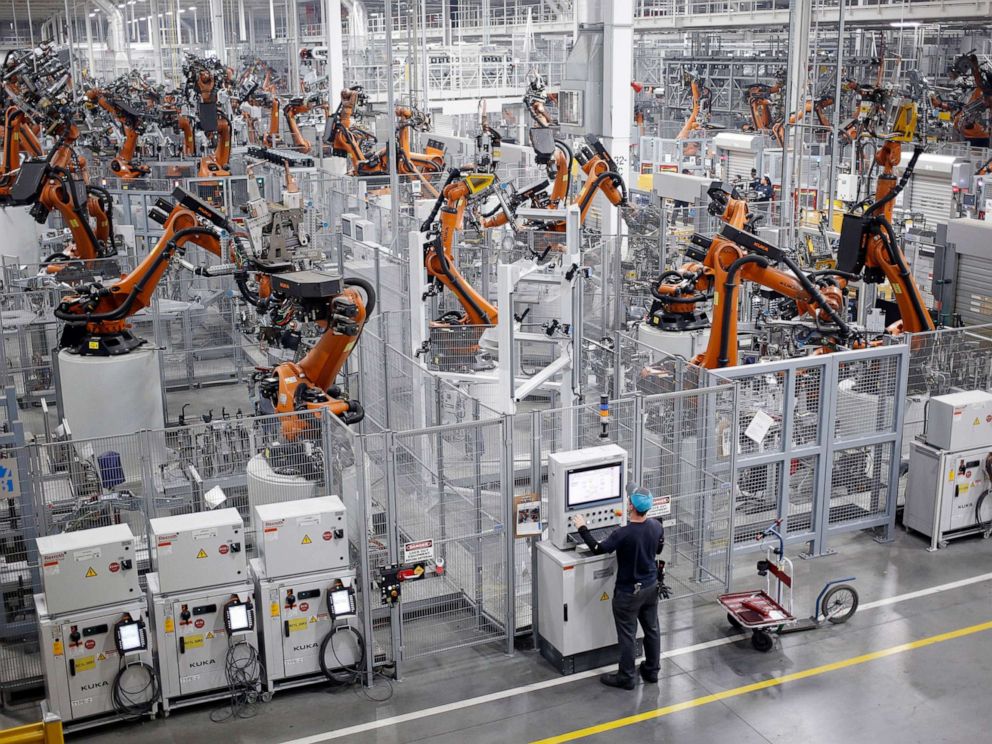
Increased worker productivity can lead to reduced worker hours. Is this man’s job interesting and stimulative or dull and stressful?
The very fact of change, or the participation in an experiment, can provide an exhilaration that temporarily can offset feelings of burnout. We do not know whether years of 32 hour weeks, either via a day off per week, or time off per day, would yield the same results. The ordinary, the commonplace, the dull, the repetitive — all may be precursors to burnout,  and mere change could prevent it. Another factor to consider: Automation. Computers, particularly “smart” computers, can increase perceived productivity by allowing one human worker to accomplish more. Worker productivity is not so much a worker’s function as it is a tool function. That means today’s interesting job could be tomorrow’s dull job if much of the interesting parts are handled by computers. There is a vast difference between analyzing data to make decisions vs. punching in data to read a computer’s decisions. The former can be interesting and stimulating; the latter can be dull. Yet another factor is global warming plus the use of the earth’s resources. The home-work-home roundtrip is inefficient. The use of fossil fuels along with transportation vehicles contributes very little to productivity while wasting our precious and limited life’s time. I expect governments soon will begin to reward companies that encourage and implement work-at-home, while also rewarding employees who do the same. And then, there is the spare-time factor, and what to do with it. Retired people work as little as 0 hours per week, and many of them struggle to find something interesting to occupy their hours — especially true if life spans increase. They can experience a form of burnout from doing nothing. And finally, the question: What is the purpose of work? For most working people, the purpose of work is to acquire money, i.e. to acquire security and pleasure. But money is nothing more than a spreadsheet notation, which our Monetarily Sovereign federal government has the unlimited ability to produce.
Is This the World's Dirtiest Job? Bangladeshi Sewer Cleaners Dive into Filth for $10 a Day
Bangladeshi sewer cleaner. Unthinkable in America today.
Without delving into the complex argument, “should the federal government give everyone money,” there is no question that the federal government can give everyone money. Medicare, Medicaid, Social Security, poverty aids have reduced for many people the desperate need to labor at the most unpleasant jobs — the jobs most likely to lead to burnout. SUMMARY The topic of “burnout” is amazingly complex. No one factor is responsible, and no one action can prevent it. In fact, even the word itself means different things to different people. The commonality may be feelings of negative exhaustion, futility, hopelessness along with the strong need for change. There was a time when people were expected to come to central work locations and to work longer hours than today’s standard 40 hour week. Thus, for the many reasons described above, the incidence of burnout may not necessarily correlate only to hours of work, either over the short or the long term, but more importantly, the nature of the work. That said, average hours worked probably will continue to decline, mostly because improved computers and machine learning will transfer many jobs from human-skill to computer-skill. The challenge for businesses will be to help enrich the working, and even the non-working hours, so that burnout becomes less likely an issue. I suggest that the traditional 40 hour week will disappear as Biggest Computer Screen - Quantum Computing
  1. People become more accustomed to, and manufacturers will provide, improved versions of distance communication (i.e. large-screen Zoom, et al)
  2. Computerization and machine learning make distance working more feasible
  3. Productivity continues to increase allowing people to accomplish more in fewer hours
  4. The economy learns how to entertain people whose personal time is more flexible.
  5. The federal, state, and local governments provide incentives to distance work, in an effort to combat global warming and to reduce resource usage.
Humans, perhaps uniquely among species, increasingly have focused on labor-saving. That focus combined with advanced computerization can lead to a decline in drudgery and burnout — along with hours worked and working distance from home. Rodger Malcolm Mitchell Monetary Sovereignty Twitter: @rodgermitchell Search #monetarysovereignty Facebook: Rodger Malcolm Mitchell

……………………………………………………………………..

THE SOLE PURPOSE OF GOVERNMENT IS TO IMPROVE AND PROTECT THE LIVES OF THE PEOPLE.

The most important problems in economics involve:
  1. Monetary Sovereignty describes money creation and destruction.
  2. Gap Psychology describes the common desire to distance oneself from those “below” in any socio-economic ranking, and to come nearer those “above.” The socio-economic distance is referred to as “The Gap.”
Wide Gaps negatively affect poverty, health and longevity, education, housing, law and crime, war, leadership, ownership, bigotry, supply and demand, taxation, GDP, international relations, scientific advancement, the environment, human motivation and well-being, and virtually every other issue in economics. Implementation of Monetary Sovereignty and The Ten Steps To Prosperity can grow the economy and narrow the Gaps: Ten Steps To Prosperity:
  1. Eliminate FICA
  2. Federally funded Medicare — parts A, B & D, plus long-term care — for everyone
  3. Social Security for all
  4. Free education (including post-grad) for everyone
  5. Salary for attending school
  6. Eliminate federal taxes on business
  7. Increase the standard income tax deduction, annually. 
  8. Tax the very rich (the “.1%”) more, with higher progressive tax rates on all forms of income.
  9. Federal ownership of all banks
  10. Increase federal spending on the myriad initiatives that benefit America’s 99.9% 
The Ten Steps will grow the economy and narrow the income/wealth/power Gap between the rich and the rest.

MONETARY SOVEREIGNTY


Just when you’re ready to give up on this world . . .

I’m 86 years old. I already have lost my wife, and even with the most favorable of circumstances, I don’t have much time, and certainly, not much good time, left to enjoy.

So, in the past few years, I had begun to believe in a bleak, short future.

Psychopathic Donald Trump and his immoral, bigoted, hate-mongering acolytes have gained sway.

The amoral Mitch McConnells, the Lindsey Grahams, the Marjorie Taylor Greenes have risen, not on the basis of any good works, but rather because they appeal to the basest instincts of humanity.

Fox News and the loathsome Tucker Carlson and Sean Hannity, Qanon, Breitbart, the many other conspiracy theorist websites, all have become so popular, that their brand of hatred threatens to win the next American elections.

Even a vicious and violent attack on Congress, attempting to overthrow the foundation of American democracy — our elections — no longer provokes outrage, at least among the millions who are committed to Trumpism.

The ongoing efforts to restrict voting rights, women’s rights, healthcare, and aid for the needy have received near-unanimous voting support from one of our two, major political parties.

Everywhere I turn, I see acrimony, malice, and prejudice replacing respect, love, and human concern.

So, just when I was ready to give up on the America of “Give me your tired, your poor, your huddled masses yearning to breathe free” — just when I believed that the “Shining city on a hill” of which Ronald Reagan often spoke — just when I believed my America was irretrievably lost, I came upon this article:

Chicago woman goes on a hunger strike for slavery reparations - Chicago  Tribune
Rachelle Zola

‘Am I willing to die for this?

’ By Nara Schoenberg Chicago Tribune, nschoenberg@chicagotibune.com

She’s white. She’s 73. And she’s on a 40-day hunger strike for slavery reparations. Rachelle Zola began the 40-day, all-liquid hunger strike to support HR 40, a House bill that would set up a commission to study reparations.

Ms. Zola had never been to Chicago. She didn’t have friends or family here. But in summer 2019, she bought a 1969 Mercury Sable with no heat and an oil leak, and drove here from Tucson, Arizona, with a single goal.

Zola wanted to live among Black and brown people. She went to the North Lawndale neighborhood on the West Side, and began attending meetings and seminars, theatrical productions, symposiums and conferences.

She accepted every invitation, telling those who were curious that she was there to listen and learn.

“Everybody was like, this white woman keeps showing up,” Zola said, laughing. But Zola, a former special education teacher who joined the Peace Corps at age 59, pressed on. Deeply moved by the stories of racism she heard in Chicago, she started sharing them on YouTube.

And then, on May 16, she took a step that was even more radical. She embarked on a hunger strike on behalf of one of the most ambitious and elusive goals of the U.S. racial justice movement: reparations — or making amends through payments or policy — to Black people for slavery.

This is the point at which the bigots, the haters, and the deniers leave the “shining city.” They try to diminish the true horror of slavery and its long-lasting effects that even today, stain our land.

Bright-eyed and energetic during a recent interview, Zola has made it to Day 32 of her all-liquid diet of water, Pedialyte and bone broth. “My question to myself was, am I willing to die for this? And it became ‘yes’ because of all of the (Black and brown) people I know,” Zola said.

“Am I willing to die for my brothers and my sisters when there’s an injustice? The answer is yes.”

Still, she said, she won’t knowingly put her health in danger, and at this point she’s doing well. Her hunger strike, which she hopes will extend to at least day 40, has received support from Dominican University in River Forest, and she’s being hosted during the day by Cosmopolitan United Church in Melrose Park, where she sits on the front lawn, ready to talk to passersby.

Zola’s specific demand is that Congress pass HR 40, a bill establishing a federal commission to hold hearings on slavery and discrimination, and to recommend remedies.

The bill was first introduced more than 30 years ago.

Zola is a bit of a mystery — sometimes even to her closest friends: She’s an intensely spiritual person who receives callings to go to out-of-the-way places and perform daunting tasks. A world traveler who makes friends — and dispenses hugs — with astonishing speed.

In Chicago, she wants to be a conduit for other people’s stories — a white person who can capture the attention and curiosity of other white people.

She bristles with outrage and hurt as she tells the story of a 17-year-old Black girl who, upon noticing the scared faces of two white passersby, thought there was something terrible behind her, perhaps a mad dog.

But when the girl turned and looked, Zola said, there was nothing, and the girl realized that she, herself, was the object of the strangers’ terror.

We digress, for a moment, to point out the “whataboutisms” and the denials that exist among those who have not personally experienced bigotry. Consider Trump appointee and former Attorney General, William Barr:

By Newshound Ellen: In Bill Barr’s America, racism is a thing of the past and if Blacks didn’t behave so badly, they wouldn’t have problems with the police.

And he cited an old quote from Jesse Jackson as “proof” that being afraid of Blacks doesn’t make you (i.e. him) a racist.

I wonder how many Black people who have been needlessly stopped by the police Barr has actually talked to. I’m going to guess none.

Meanwhile, get ready for your jaw to drop as Barr pointed to racist behavior by Blacks to justify racist behavior by whites. It was part of a lengthy interview with Wolf Blitzer on CNN today.

Barr: “Racism usually means, you know, that I believe that because of your race, you’re a lesser human being than me and I think there are people in the United States that feel that way. but I don’t think it is as common as people suggest.

“And I think we have safeguards to ensure that it doesn’t really have an effect on someone’s future.

BLITZER: “There’s no doubt there’s been a lot of progress. but do you think Black people are treated differently by law enforcement than white people?”

BARR: “I think there are some situations where statistics would suggest that they are treated differently. but I don’t think that that’s necessarily racism. 

“Didn’t Jesse Jackson say that when he looks behind him and he sees a group of young black males walking behind him, he’s more scared than when he sees a group of white youths walking behind him? Does that make him a racist?”

Here we have Trump’s Attorney General, the man who occupied America’s highest Justice Department position, claiming that being “treated differently” because of your skin color is not racism (What is it, then?)

And that racism “doesn’t really have an effect on someone’s future.”

And racism “isn’t common” and “there’s been progress,” (so why worry about it?) and even Jesse Jackson is afraid of black men, but that isn’t racist. (Except if it isn’t racist, what was he afraid of?)

“Whataboutisms” and denials — in short, “Racism is rare, and I’m not a racist, but even blacks are racist, so being treated “differently” is OK.”

It’s the garbled excuses similar to, “I never did it and I won’t do it again.”, 

Zola also recalled the story of a Black man who attended a parent-teacher conference for his son, then in sixth grade. The teacher acknowledged that the man’s son was doing his work and performing well, but still, there was a concern.

The son was rude, the teacher said, asking pointed questions in class. The man noted that his son was just doing what kids are supposed to do in a learning environment. A white boy would have been praised for such curiosity and initiative, he said.

And then there were the injustices closer at hand. On a crystal-clear morning Monday, Zola was joined at a table in front of Cosmopolitan United Church, as she often is, by her friend Mazell Sykes, 71, of Maywood.

The duo met early in Zola’s Chicago odyssey when Zola visited the North Lawndale Justice Community Court, where Sykes leads peace circles. The two women, one Black, one white — both with short hair, long bangs, eye-catching necklaces and “Rachelle for H.R. 40? T-shirts — chatted easily and laughed at each other’s jokes, but the mood shifted when a reporter asked Sykes what had brought her out in the hot sun.

She spoke about slavery in general, and about rape in particular. “The thing that would get me the most is that a white man could take a Black girl, a Black woman, and have sex with her, and she had no rights, and he could do that as often as he wanted. It was nothing,” she said.

“I just want people to just, down in their gut, imagine how that would feel, if someone did that to you. I was raped when I was a kid, so I know how it feels, but it only happened to me one time. But just think that you live in this situation, and you know this man can come and have you whenever he wants you.

Can you just in your gut feel, how would you go on after that?”

Actually, no. The men who run America, particularly the white supremacist, bigoted conservatives of today, cannot feel in their gut what being raped feels like.

They, like Barr, claim it’s rare but also common, non-existent but even blacks do it, and things are getting better, even though they weren’t bad before, so why get upset about it?

Growing up in Mississippi, the descendent of slaves, she had to skip school three days at a time — to pick cotton, she said. “It’s not a game, it’s not a fairy tale. We lived it,” she said.

“The white man would come to my father’s house at night, and he would tell my father, tomorrow I need this whole field chopped. So that means your children aren’t going to school tomorrow.”

She and her siblings would cry, she said, and the other kids would laugh at them as they rode by in the school bus. “When we did go to school, just imagine: me missing three days of class. What can the teacher teach me? Where would she start? And then, if she gave me homework or makeup work, how was I going to do it? It was a vicious cycle, and this — this was my life in Mississippi.”

Has Mississippi changed so much, now? Has Alabama? Georgia? Louisiana?

Is an inordinate number of American blacks being shot by American police? Are police denying and covering up the killings of blacks, even when confronted with body camera footage?

What happens when there is no video to support the black victim’s version?

Zola, who grew up on Long Island, said she didn’t have a Black friend until 2015, and that while she was outraged after the beating of Rodney King by Los Angeles police officers in 1991, she didn’t go out and protest.

The point isn’t guilt, she said; that’s not what she’s about. The point is the depth of the suffering that Black people have experienced and continue to experience, and how easy it can be for white people to look the other way.

“I look at myself as a case study,” she said. “How could I get to be this age and not know the harm? The quick answer is I wasn’t reading those books. I wasn’t reading ‘Just Mercy.’ I wasn’t reading ‘The New Jim Crow.’ I wasn’t reading any of it. What’s amazing now? ‘The Long Shadow’ — that documentary of 90 minutes — if that doesn’t touch your heart, I don’t know what will.”

Zola was 59, married to the love of her life and painting the walls of their rental home in Colorado when she was hit by a deep, unshakable knowledge that she was supposed to leave the country. “It was shocking for both of us,” she said of herself and her then-husband, from whom she was divorced seven years ago.

She felt she had no choice but to go; he said he’d stay — this was her path, not his.

She called the Peace Corps, and within months, the former special education teacher was in Jordan, training teachers. The experience, she said, was intense and transformative. People gave her candy, food and drinks. They watched out for her and helped her.

“I never felt such love as I felt in Jordan,” she said. In 2015, she went on a personal pilgrimage in Shikoku, Japan, walking 700 miles in 67 days with a 25-pound backpack. She went to Ecuador in 2016, after a series of earthquakes hit the country, and worked in a children’s home. She also lived and worked in Mexico.

Jordan, Japan, Ecuador, Mexico, and yet she was being true to the American self-view that proclaims:

 “The wretched refuse of your teeming shore.
Send these, the homeless, tempest-tost to me,
I lift my lamp beside the golden door!”

She is far more true to the America I want to love than is the former American President who told you Mexicans are rapists, and the Chinese spread myths about global warming, and the Muslims are terrorists and traitors, and immigrants (who “aren’t people; they are animals”) come from “shithole countries,” and our soldiers, who give their lives, are “suckers.”

“Things come up that she knows she can contribute to, or help, or be of service in some way, and that’s where she goes. That’s why she’s on the planet, I guess,” said her friend Diana Keck, 78, a psychotherapist in Boulder, Colorado.

“She’s just an extraordinary woman, and I’m pleased to say one of my best friends.”

Zola said she was hoping that, by now, the hunger strike would have gained more traction. She and Sykes got honks and waves Monday morning while sitting at the table in front of the church, but no one stopped to ask questions.

Politicians have been conspicuously absent.

Worse than absent, politicians have been America’s primary deniers and liars. Politicians, more than any other group, have been responsible for the moral decline of America.

Social media response has been uneven, with one TikTok getting 32,000 views, but many getting a few hundred or a few thousand.

Still, she presses on cheerfully, trying to get someone to help her with her TikTok skills and looking forward to a Q&A with “The Long Shadow” director Frances Causey, scheduled for Wednesday.

After the hunger strike ends, she said, she’d like to get a van and go from town to town, speaking about reparations, getting the word out. The details still need to be worked out, but — as is so often the case with Zola — the vision is clear.

“This is phase one, and I’m not going away,” she said. 

So perhaps, in my doddering years, I may — may — have hope for America, for I now, thanks to Nara Schoenberg, have found a real American, a diamond amidst the coal.

She is a voice of kindness and compassion amidst the cacophony of lies and hatred, greed and intolerance, that have become the new normal in America.

I pray Rachelle Zola forever will be remembered as the true American who lifted her lamp of humanity beside America’s golden door.

I pray she, not Trump, will make a permanent difference in America.


Rodger Malcolm Mitchell Monetary Sovereignty Twitter: @rodgermitchell Search #monetarysovereignty Facebook: Rodger Malcolm Mitchell ………………………………………………………………………………………………………………………………

THE SOLE PURPOSE OF GOVERNMENT IS TO IMPROVE AND PROTECT THE LIVES OF THE PEOPLE.

The most important problems in economics involve:

  1. Monetary Sovereignty describes money creation and destruction.
  2. Gap Psychology describes the common desire to distance oneself from those “below” in any socio-economic ranking, and to come nearer those “above.” The socio-economic distance is referred to as “The Gap.”

Wide Gaps negatively affect poverty, health and longevity, education, housing, law and crime, war, leadership, ownership, bigotry, supply and demand, taxation, GDP, international relations, scientific advancement, the environment, human motivation and well-being, and virtually every other issue in economics. Implementation of Monetary Sovereignty and The Ten Steps To Prosperity can grow the economy and narrow the Gaps: Ten Steps To Prosperity:

  1. Eliminate FICA
  2. Federally funded Medicare — parts A, B & D, plus long-term care — for everyone
  3. Social Security for all
  4. Free education (including post-grad) for everyone
  5. Salary for attending school
  6. Eliminate federal taxes on business
  7. Increase the standard income tax deduction, annually. 
  8. Tax the very rich (the “.1%”) more, with higher progressive tax rates on all forms of income.
  9. Federal ownership of all banks
  10. Increase federal spending on the myriad initiatives that benefit America’s 99.9% 

The Ten Steps will grow the economy and narrow the income/wealth/power Gap between the rich and the rest.


MONETARY SOVEREIGNTY