Here are excerpts from the most ridiculous article you will read this week, and that is saying a lot these days.
White House asks Congress to pass emergency funding for disaster aid, Afghan resettlement as well as spending bill to avert shutdownAdministration officials also asked Congress to pass a short-term spending bill to avoid a government shutdown in October.By Jeff SteinThe White House budget office on Tuesday sent Congress an “urgent” spending request asking for tens of billions of dollars in natural disaster relief and Afghanistan resettlement funding as the administration tries to respond to both emergencies.Believe what I tell you.The White House is asking for $14 billion in aid to respond to natural disasters that occurred before Hurricane Ida, as well as $6.4 billion to pay for the ongoing relocation of tens of thousands of Afghans who partnered with the U.S. during the war in Afghanistan. The administration anticipates that another $10 billion will have to be approved in disaster relief for Hurricane Ida as well.As part of the request, White House Office of Management and Budget Acting Director Shalanda Young called for Congress to approve a short-term extension in government funding so that there isn’t a partial government shutdown on October 1..
OK, I get it. Congress should examine how money is used.
And though I can’t say whether $14 billion is the right amount for previous disasters, or whether $6.4 billion is right for protecting the people who helped and believed us, or whether $10 billion is right for reducing the suffering caused by Hurricane Ida, I can say this:
The initiatives themselves are worthwhile
The government has infinite money
It’s better to err on the side of “too much” rather than too little.
There is no downside to spending “too much,” even if some of it is “wasted,” because government spending, even wasted spending, stimulates (by formula) GDP growth, and costs taxpayers nothing.
{Federal taxpayers don’t fund federal spending. Federal taxpayers don’t fund anything.)
So the same Republicans who voted for Trump’s tax cut for the rich, joined by a couple of self-proclaimed “moderate” Democrats, who “work across the aisle,” will prance and preen and pretend to be so concerned about taxpayers.
They will demand that everything be cut by 30%, and later, will blame Biden for not doing enough. Gotcha!
Breitbart and FOX will wring their hands and cry crocodile tears for the Americans who are suffering and for the Afghans who are suffering, though, in today’s bifurcated world, no one seems really to care about anyone else’s suffering. It’s all self-serving righteousness performed on the world’s biggest pulpit.
But the most ridiculous part is the phony threat of a government shutdown.
As the upcoming game of “pretend chicken” plays out, the Republicans will huff and puff their fake fiscal integrity; the Treasury and the Federal Reserve will institute fake “extreme efforts” to keep America from falling into bankruptcy; fingers will point in all directions; and the stock market will crash long enough for the smart-money guys to pick some cheap fallen fruit.
Then, miraculously and heroically, accommodation will be reached; the phony debt ceiling once again will be lifted and rescheduled for six months hence; and the stock market dutifully will provide quick profits to those who weren’t fooled by the blather.
All will self-congratulate for saving America from the potential disaster they themselves created, and the economically uneducated voters will go on believing what they always have been told: The Big Lie that federal finances are just like personal finances so the federal debt must be reduced.
It’s like a football game in which the politicians are the players, and the people are the football. Everyone gets their kicks.
The White House’s request for short-term funding needs comes as it works on unrelated legislation for an approximately $3.5 trillion budget deal that Democrats are seeking to shape this month in Congress. That sweeping package would overhaul the social safety net, authorize new climate change programs, raise taxes on corporations, and achieve a number of other Biden administration priorities.
If overhauling the social safety net included 100% free healthcare for every American, plus Social Security for every American, that would be the greatest use of federal financial power in the past century — perhaps ever.
Sadly, that won’t happen. Not even close. The rich don’t want it because of Gap Psychology, and the public doesn’t know the government can do it all without raising taxes.
Anyway, as everyone knows, the poor are a bunch of lazy takers, who deserve their misfortune, so why help them? Right?
The public also doesn’t understand that climate change is an extinction-level event we are leaving for our children and grandchildren to cope with, so why take any action now to reduce CO2? Let the Chinese do it first.
The Republican’s sole (fake) concern is with unborn children; they have no interest in children already born, and especially no interest in poor children already born. So they march around, displaying huge photos of fetuses, which in reality are the size of your thumb, and worry not about the fate of those unfortunate women and their subsequent babies.
It’s all God’s will.
The Democrats are so busy wallowing in the nobility of their causes, they can’t bring themselves to dare tell the truth about federal finances, or to actually play the politics game.
So they will enjoy continuing to be righteous losers, despite owning a majority of the total voters. After winning the last Presidential election by seven million votes, the Dems brilliantly have managed to position themselves as Congressional underdogs.
Meanwhile, the universally despised Donald Trump, after leading and losing an election, the swing state of Georgia, and a rebellion against American democracy, continues to be a GOP torch-bearer, because really, what else do they have?
The administration’s request for more funding for the Afghanistan relocation and disaster relief programs is likely to provoke substantial (fake) debate in Congress, where Republicans have hammered the White House for its handling of the withdrawal to end the war.The majority of the $6.4 billion requested by the White House will go principally to fund processing sites for relocating tens of thousands of people in Afghanistan who partnered with the U.S. during the two decades of war there. Of the $6.4 billion, the biggest chunk is for the State Department and Department of Defense relocation process for allies from Afghanistan and support for them to help them integrate into American life. Another substantial amount of funding would go to United States Agency for International Development for Afghans at risk in the regions.Administration officials said Tuesday the request would help plans for resettling as many as 65,000 Afghans who are expected to arrive in the U.S. by the end of September, as well as up to 30,000 Afghans expected to arrive in the U.S. over the next 12 months.
The Republicans, who blasted Biden for not extracting perhaps a hundred Americans and thousands of our Afghan partners to the tender mercies of the Taliban, soon will blast Biden for wanting to resettle the many thousands he was able to extract.
Trump will claim they all are terrorists, criminals, rapists, and unaffordable leaches on the economy, whose children might vote Democrat in future elections. If that sounds familiar, it’s what he said about Mexicans and Muslims. The plot never changes; only the cast of characters changes.
“The operation to move out of danger and to safety tens of thousands of Afghans at risk, including many who helped us during our two decades in Afghanistan, represents an extraordinary military, diplomatic, security, and humanitarian operation by the U.S. government,” Young’s letter said.“We urge Congress to appropriate $6.4 billion to enable the success of this multifaceted, historic mission,” she wrote.
As soon we will hear that “Biden wants to import terrorists” (those same people the GOP pretended to feel so sorry for), we’ll enjoy the grandstanding about the money needed to conduct the vetting to filter out terrorists.
The disaster aid — likely more than $20 billion when the damages from Hurricane Ida are factored in — would help the administration respond to Hurricane Laura and Hurricane Delta, as well as droughts, wildfires, and flooding in other parts of the country. Administration officials said on a call with reporters that climate change is creating more severe stormsand disasters that are impacting a growing number of Americans.
One innocently might imagine disaster aid would be a no-brainer for Republicans. After all, the most hurricane damage occurred in “red” states.
But, the wildfire damage mostly occurred in blue states, and as Donald Trump has told us, global warming is a Chinese hoax, and wildfires are due to poor forest management, which could be prevented by raking the forests (and perhaps with a dose of hydroxychloroquine?)
So, the politics require that anything — ANYTHING –Biden wants to be opposed by the Trump-subservient GOP, no matter how seemingly beneficial.
In short, the entire article is political theater, It’s religious miracles and magic, performed by political clergy to entertain, the masses. But sadly, instead of being entertained, the masses think the whole thing is real.
The people not only believe, but passionately believe, as there is a direct, but inverse, correlation between intelligence and belief in the supernatural.
As this all plays out, prior to next year’s elections, just sit back and enjoy the show. Remember that none of it is real and no one is saying what they mean.
It’s all a put-on, to keep you contributing to your political religion of choice, and returning to the chapel for the holiday elections.
Rodger Malcolm Mitchell
Monetary SovereigntyTwitter: @rodgermitchellSearch #monetarysovereigntyFacebook: Rodger Malcolm Mitchell
……………………………………………………………………..
THE SOLE PURPOSE OF GOVERNMENT IS TO IMPROVE AND PROTECT THE LIVES OF THE PEOPLE.
Gap Psychology describes the common desire to distance oneself from those “below” in any socio-economic ranking, and to come nearer those “above.” The socio-economic distance is referred to as “The Gap.”
Wide Gaps negatively affect poverty, health and longevity, education, housing, law and crime, war, leadership, ownership, bigotry, supply and demand, taxation, GDP, international relations, scientific advancement, the environment, human motivation and well-being, and virtually every other issue in economics.Implementation of Monetary Sovereignty and The Ten Steps To Prosperity can grow the economy and narrow the Gaps:
Ten Steps To Prosperity:
Sadly, either the President of the United States, who professes to be a friend to working men and women, is clueless about how the U.S. economy works, or is lying for political purposes.
Save us from our “friends.”
Let’s be realistic. He’s lying.
Given that he is surrounded by experienced economists, he simply must understand at least the basics of economics.
So, the only possible conclusion is that he is lying about those basics, among which are:
A Monetarily Sovereign entity has the unlimited ability to create its own sovereign currency. It cannot unintentionally run short, of its money, even if it has zero income.
By contrast, the economy does not have the unlimited ability to create money, and when it runs short of money it has recessions and depressions.
The United States government is Monetarily Sovereign. Therefore it has neither need for, nor use of tax dollars. In fact, the U.S. Treasury destroys all federal tax dollars.Upon receipt, they cease to exist in any money supply measure.
Economic growth requires money growth. Gross Domestic Product, the most common measure of the economy, is based on spending by the public and by the federal government. GDP growth requires federal deficit spending.
Given the above points, it’s instructive analyze President Biden’s recent speech, and show how it makes no economic sense:
“PRESIDENT JOE BIDEN: The fact of the matter is though, that it is about time they begin to pay their fair share.
“Fair share” sounds so . . . well, fair . . . but it is utter nonsense, considering that all federal taxes are unnecessary and useless, some more so than others.
By “fair,” Biden means that while you are forced to pay useless and economically damaging federal taxes, rich corporations and rich people pay comparitively less useless and economically damaging taxes.
So his solution is to continue forcing you to pay those taxes, and to pretendto force rich people and companies to pay more.
(I say “pretend,” because raising tax rates, the course charlatan politicians usually take, does nothing if there always are special breaks for the rich.)
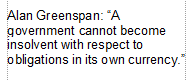
Alan Greenspan: “A government cannot become insolvent with respect to obligations in its own currency.”
Ben Bernanke: “The U.S. government has a technology, called a printing press (or, today, its electronic equivalent), that allows it to produce as many U.S. dollars as it wishes at essentially no cost.”
No, Mr. President, the real unfairness is that the poor and middle-classes are forced to pay any federal taxes at all, thereby starving them and the economy, and benefiting no one.
“For example, you heard me say it before and I will say it again, it’s the best example of what to say to people. 55 of the largest corporations in America last year paid zero, zero, in federal taxes. I don’t care what your position is.
It’s just time to pay their fair share. Just pay a little bit here and it comes out to billions of dollars, if they pay.
No one would be helped by corporations being forced to pay federal taxes. NO ONE, least of all the federal government, which has the unlimited ability to create dollars.
Those “billions of dollars” would be deducted from the private sector, i.e. the U.S. economy, and destroyed. They would not help the government pay its bills, which it does by creating new dollars, ad hoc.
It is the height of stupidity to take precious dollars from the the economy and to give them to an entity (aka “the federal government”), that has infinite dollars.
The irony of ironies is during the recession and the pandemic, you heard me say this before, when the vast majority of Americans are struggling to just hang out, the number of billionaires actually grew.
To solve that problem, simply stop taking dollars from the “vast majority of Americans who are struggling.”
Right now, the House and the Senate are working on my plan to generate a fair tax system and close big loopholes big corporations and the superwealthy use to pay less.
Do you want a “fair tax system”? Then immediately stop collecting FICA (one of the most regressive taxes in America), and provide Medicare for All and Social Security for all.
Those would be three good steps toward fairness.
There is a group of experts left, right, and center who estimate that we lose more than $100 billion a year in tax revenue owed from the top 1% of taxpayers alone. Not because of low tax rates, but because the wealthy people are not paying the taxes they owe.
We’re going to change that, so they pay taxes just like typical hard-working Americans right now.
“We” is who? The federal government that already has infinite money?
So, stop taking tax dollars from those “typical, hard working Americans.” Problem solved.
We will use the money we collect to give tax cuts for to give tax cuts to middle-class families. To make it easier to raise kids and take care of your aging parents. And so much more.
No, you will not use the money you collect, for anything. Nor do you need to. The federal government already has infinite money.
And don’t just give tax “cuts” to the middle-class families. Collect zero federal taxes from them.
What is going on in Congress? Not a single Republican supports this plan. They support the bipartisan plan, but not this plan. Not one.
And some big corporations are spending billions, legitimately, they’re lobbying, to try to escape their obligation to pay the taxes they owe, leading working families to pay a larger share of the burden.
Somebody has to pay. And when those who can afford to pay aren’t paying near their fair share, it means you all pay more.
“Somebody has to pay,” and that “somebody” is the federal government, which pays all its bills by tapping a few computer keys and thus, creating dollars, ad hoc.
Republicans won’t support the plan, for two reasons:
The GOP is the party of the rich, and only supports tax cuts and benefits for the rich. They despise the poor, and want to cut the minimal benefits the poor already receive.
The GOP will not support Democrat’s plans, simply because Donald Trump is terrified of anything that makes Democrats “look good.” Today’s GOP is more loyal to Trump than to America.
Remember:
Both political parties are bribed by the rich to feign ignorance of a fundamental economic truth: The U.S. federal government is Monetarily Sovereign. It has the unlimited ability to create dollars at the touch of a computer key, and has neither need for, nor use of, tax dollars.
Federal deficit spending is necessary to grow the economy, and federal “debt” neither is debt nor is a burden on future taxpayers or on the federal government.
Claiming to want federal tax “fairness” is an exercise in deception, the purpose of which is to widen the income/wealth/power Gapbetween the rich and the rest.
The only true step toward federal tax fairness would be to stop claiming falsely that federal taxes fund federal spending, and to eliminate federal taxes on the “not-rich.” Begin by eliminating the most regressive federal tax: FICA
This deception (aka the “Big Lie”) is funded by bribes to politicians, the media, and the university economists.
The only way President Biden can be considered a “friend” to working men and women is by comparison with avowed enemies, Donald Trump and his GOP sycophants.
Rodger Malcolm Mitchell
Monetary SovereigntyTwitter: @rodgermitchellSearch #monetarysovereigntyFacebook: Rodger Malcolm Mitchell
……………………………………………………………………..
THE SOLE PURPOSE OF GOVERNMENT IS TO IMPROVE AND PROTECT THE LIVES OF THE PEOPLE.
Gap Psychology describes the common desire to distance oneself from those “below” in any socio-economic ranking, and to come nearer those “above.” The socio-economic distance is referred to as “The Gap.”
Wide Gaps negatively affect poverty, health and longevity, education, housing, law and crime, war, leadership, ownership, bigotry, supply and demand, taxation, GDP, international relations, scientific advancement, the environment, human motivation and well-being, and virtually every other issue in economics.Implementation of Monetary Sovereignty and The Ten Steps To Prosperity can grow the economy and narrow the Gaps:
Ten Steps To Prosperity:
Was that headline too subtle? Was I able to conceal my true feelings?
Let’s be clear: The people who claim that the federal government is running short of dollars fall into just two categories:
Those who are ignorant about federal finances, or
The abovementioned dirty, rotten, stinking liars, who are trying to steal your money.
For instance, take my favorite nomination for the title, “dirty rotten, stinking liars,” whom I simply cannot believe are ignorant about federal finances, so it must be deliberate, the Committee for a Responsible Federal Budget (CRFB):
Today, the Social Security and Medicare Trustees released their annual reports on the state of the trust funds.
The Trustees find that Medicare’s Hospital Insurance trust fund will be insolventby 2026, Social Security’s Old-Age and Survivors Insurance trust fund will run out of reserves by 2033, Social Security’s Disability Insurance trust fund will be depleted by 2057, and the theoretically combined Social Security trust funds will be insolvent by 2034.
Upon insolvency, Social Security will be reduced across-the-board by 22 percent under current law.
There, you just have read the Big Lie, that dirty, rotten, stinking Big Lie. If you remember just one thing from this post, or indeed, from this entire blog, remember this:
It is impossible for the Monetarily Sovereign U.S. government unintentionally to run short of its own sovereign currency, the U.S. dollar.
It’s not just difficult, or rare, or unusual, or doubtful. We’re talking about 100%, absolutely impossible.
Why? Because the federal government has the infinite ability to create its own sovereign currency, at will. No limits.
What if the federal government stopped collecting taxes? It still would be impossible for the government unintentionally to run short of dollars.
What if China cashed in all its T-bills, T-bonds, and T-notes? Still impossible.
What if no one on earth wanted to buy T-securities? Still impossible.
What if the federal deficit increased 500% in one month? Still impossible.
What if the cost of Social Security payments tripled next year? Still impossible.
What if the cost of Medicare quintupled next year? Still impossible.
Get it? There is no possible scenario by which the U.S. government unintentionally can run short of dollars or become insolvent. None. Zip. Zilch. Period.
The following is a statement from Maya MacGuineas, president of the Committee for a Responsible Federal Budget:
13 years – that’s how long seniors have before Social Security and Medicare run out of reserves. We can’t promise full benefits to today’s retirees, let alone our kids and grandkids.
Not only is this year’s outlook than in last year’s report, but we’ve lost yet another year from inaction. As the Trustees explain, we should act sooner rather than later to restore solvency to these vital programs.
Acting today, we could fix Social Security with a 27 percent tax increase or 21 percent benefit reduction. If we wait until 2034, those adjustments will have to be about a quarter larger.
And there would be little opportunity to phase in changes or give workers the warning they deserve.
Either Maya is ignorant about federal financing or she is lying, and by now, I suspect it is the latter. I suspect that she is one of the many dirty, rotten, stinking liars promulgating the Big Lie.
Maya, plus the so-called “trustees” of the non-existent, phony “trust funds,”are ignorant or lying through their teeth.
Because the U.S. federal government cannot run short of dollars and become insolvent, it is 100% impossible for any agency of the federal governmentto run short of dollars unless that is what Congress and the President intend.
That’s right folks. No matter what the dirty, rotten, stinking liars may tell you, Social Security and Medicare, being agencies of the federal government, cannot run short of dollars unless that is what Congress and the President want.
Even if the FICA, which counter to common belief, does not fund Social Security or Medicare — even if the FICA tax were completely eliminated (which it should be), Social Security and Medicare could continue paying benefits — even double or triple benefits — forever.
And, that blanket truth includes not only Social Security and Medicare. We’re talking about every federal agency, from the (alphabetically) AbilityOne Commission to the Woodrow Wilson International Center for Scholars. Not one of them can run short of dollars unless that becomes the intent of Congress and the President.
I cannot believe that after all these years, the CRFB and the “trustees” of the non-existent “trust funds” aren’t aware of this. So, they all must be dirty, rotten, stinking liars. I can’t think of any, other alternatives. Can you?
Why would they lie? Because the very rich, who run America, bribe the information sources to lie. They bribe the media via ownership and advertising dollars. They bribe the university economists via contributions to universities and promises of lucrative “think tank” employment. And they bribe the politiciansvia political contributions and promises of “no-work” but lucrative lobbying employment.
Why do the rich-who-run-America want to promulgate the Big Lie and federal agencies can become insolvent? Because they want to widen the Gap between the rich and the rest, and the agencies the rich talk about are the very ones that most help us non-rich folks.
It is the Gap that makes the rich rich. Without the Gap, no one would be rich; we all would be the same. And the wider the Gap, the richer are the rich.
It’s not just the CRFB and the “trustees” of the non-existent “trusts” that promulgate the “Big Lie.”
From AxiosDebates over tax increases, which lurked behind the scenes for most of the year, will burst into public this fall as President Biden’s $3.5 trillion infrastructure plan moves toward final passage.
Why it matters: Biden promised new revenue to pay for historic spending increases in his second, “soft” infrastructure package. He needs tax increases to pick up votes from Joe Manchin (D-W.Va.) in the Senate and a handful of House centrists, who are concerned about adding even more to the national debt.
One solution currently under discussion would be to raise the capital gains rate from 20% to 28% for high-income earners. A 3.8% Medicare surtax applies to both figures, raising the effective tax rate from 23.8% to 31.8%.
But wait. Clearly, if the federal government can create dollars at will, then federal taxes don’t “pay for” federal spending. The federal government creates dollars to pay for spending.
Evidence that the so-called “debt” ismeaningless is provided by the fact, that the federal government destroys all your tax dollars, the instant they are received by the Treasury. It creates brand new dollars, at will, to pay for spending.
Your dollars start out in your checking account as part of the M1 money measure and end up as part of no money measure. They simply disappear.
Why? Because there is no way to measure the amount of money the federal government has, when it has the infinite ability to create money at the touch of a computer key.
The purpose of all those professed concerns about federal “debt” is just to fool the voting rubes. Neither you, nor your grandchildren, ever will pay for the federal debt, partly because it isn’t federal “debt” and partly because your taxes don’t fund federal government spending.
The “debt” is just the total of deposits into T-security accounts, which are paid off, upon maturity, simply by returning the dollars already deposited into those accounts. The whole process is nothing like would you probably think of when you think of debt. It is more like a bank returning the dollars that are stashed in a safe deposit box.
But wait, again. Biden is talking about raising tax rates on the rich. How does that fit with the idea that the rich pay bribes to promulgate the Big Lie.?
Answer: It’s all fake. It’s political theater. The government can raise all the ratesit wants, but rates are not dollars. The rich pay politicians to insert key loopholes into the law — loopholes that allow the rich to pay minimal or zero taxes, no matter what the rates are.
And then there is this dirty, rotten, stinking lie from the Chicago Tribune:
9/1/21 Chicago Tribune Virus adds to Social Security, Medicare woes The financial impact of the pandemic is straining Social Security and Medicare. By Ricardo Alonso-Zaldivar and Martin Crutsinger Associated Press
WASHINGTON — Social Security and Medicare, the government’s two biggest benefit programs, remain under intense financial pressure with the retirement of millions of baby boomers and a devastating pandemic putting increased pressures on the two programs’ finances.
A report from the programs’ trustees released Tuesday moved up by one year the date for the depletion of Social Security’s reserves, now projecting that Social Security will be unable to pay full benefits starting in 2034 instead of 2035.
Total BS. Being federal agencies, Social Security and Medicare have as much in “reserve” as Congress and the President want them to have. There is no financial “pressure,” simply because the federal government has infinite ability to create dollars.
Similarly, they have the infinite ability to pay full benefits, if that is what Congress and the President want.
This is just a ploy to squeeze the not-rich and to widen the Gap between the rich and the rest.
Medicare is expected to exhaust its reserves in 2026, the same date as estimated last year. The report noted that employment, earnings, interest rates and economic growth plummeted in the second quarter of 2020 after the pandemic hit the country.
Ah, the cruelty of the rich. At the very time when the common people are losing their income (and the rich are making fortunes in the rising stock market), the rich are trying to cut the safety nets of Social Security and Medicare. Does it get any more disgusting than that?
When the Social Security trust fund is depleted the government will be able to pay 78% of scheduled benefits, the report said.
Because a reduction in benefits of that magnitude would cause a political uproar, it is likely that Congress would find ways to recover the lost benefits, either by hiking the payroll taxes paid by current workers or by increasing government borrowing to cover the shortfall.
More dirty, rotten, stinking lies. The non-existent “trust fund” cannot be depleted. But Congress’s solution to the non-problem is to raise taxes on the people who least can afford it.
The government simply can create more dollars and misleadingly call it “borrowing” though the issuance of T-securities is nothing at all like borrowing.
T-security accounts merely provide safe depositories for unused dollars, the sole purposes of which are to stabilize the dollar and to control interest rates, not to provide spending dollars for the federal government.
Bottom Line You have been fed a continual stream of dirty rotten, stinking lies, all at the behest of the very rich.
The truth is: The U.S. federal government, being Monetarily Sovereign, has the infinite ability to create its own sovereign currency, the U.S. dollar. The government never, unintentionally, can run short of dollars.
And no, this does not cause inflation, which never is caused by federal deficit spending. All inflations and hyperinflations are caused by the scarcity of one or more key products, most often food and energy. Today’s inflation is caused by a scarcity of oil, computer chips, food, and labor.
Inflation can be cured by additional federal spending to obtain and distribute the scarce items.
No agency of the federal government can run short of dollars, unless that is what Congress and the President want.
The rich, bribe all your sources of information to promulgate the Big Lie, so that federal agencies can tax you more and pay you less, while the politicians wring their hands in fake concern, and pretend they are helpless to prevent it.
They all are a bunch of dirty, rotten, stinking liars, who are conning you out of your money, to benefit the very rich.
If that doesn’t get you angry enough to contact your federal Senators and Representative, nothing will.
Gap Psychology describes the common desire to distance oneself from those “below” in any socio-economic ranking, and to come nearer those “above.” The socio-economic distance is referred to as “The Gap.”
Wide Gaps negatively affect poverty, health and longevity, education, housing, law and crime, war, leadership, ownership, bigotry, supply and demand, taxation, GDP, international relations, scientific advancement, the environment, human motivation and well-being, and virtually every other issue in economics.Implementation of Monetary Sovereignty and The Ten Steps To Prosperity can grow the economy and narrow the Gaps: Ten Steps To Prosperity:
Through time, intelligent species create more sophisticated methods and devices that can cause species destruction. As the number of these devices increases, the probability that one will be used increases. Eventually, species destruction probability reaches 100%.INTRODUCTION
Extremophiles and Extreme EnvironmentsPabulo Henrique RampelottoOrganisms, known as extremophiles, thrive in habitats which for other terrestrial life-forms are intolerably hostile or even lethal.They thrive in extreme hot niches, ice, and salt solutions, as well as acid and alkaline conditions; some may grow in toxic waste, organic solvents, heavy metals, or in several other habitats that were previously considered inhospitable for life. Extremophiles have been found depths of 6.7 km inside the Earth’s crust, more than 10 km deep inside the ocean—at pressures of up to 110 MPa; from extreme acid (pH 0) to extreme basic conditions (pH 12.8); and from hydrothermal vents at 122 °C to frozen sea water, at −20 °C. For every extreme environmental condition investigated, a variety of organisms have shown that they not only can tolerate these conditions, but that they also often require those conditions for survival.
Such conditions exist not only on earth, but on several planets and moons in our own solar system.
Saturn as viewed from EnceladusSaturn’s moon Enceladus tops the listin terms of having just the right conditions to host life. The sixth-largest of Saturn’s 62 confirmed moons, Enceladus boasts a massive saltwater ocean hidden beneath its icy surface.Another strong candidate is Titan, and Saturn’s largest moon. Europa the sixth-largest moon in the solar systemhas saltwater oceans beneath its 10-mile-thick icy surface. Europa may hold more liquid water than all of Earth’s oceans combined. Ganymede and Callisto may also have subsurface liquid oceans.Mars probably had liquid water on its surface. Venus, as well.
While earth’s extremophiles are not really “intelligent” life, they might be a stepping stone.
Consider the numbers in our solar system alone:
There are more than 200 moons in our solar system.Most of the major planets – all except Mercury and Venus – have moons. Pluto and some other dwarf planets, as well as many asteroids, also have small moons.
Then, moving on from our solar system to our galaxy, the Milky Way, we find the estimate that there are around 100 billion estimated planets at least, and there are an estimated 40 billion planets (not counting moons) that might support lifein our Milky Way galaxy.
Moving up to the next notch, the observable Universe, which has a radius of 46.5 billion light-years, seems to contain at least two trillion galaxies.Just a thin slice of the 2 trillion galaxies in the observable universe, with each galaxy containing billions of stars, planets, and moons
Do the math, and you will see there are so many places that could support life, together with the fact that life even exists in places we currently don’t expect, and you might think it is inconceivable that life does not exist elsewhere. And if life exists, intelligent life may not be far behind.
And if alien life began only a million years before earth’s life — but a moment on the universe’s time scale — it could technologically be far, far ahead of ours. (Consider how far we have come just in the past 100 years.)
So mathematically the odds are that intelligent life — even life far more intelligent than we are — exists somewhere out there.
SO WHERE ARE THEY?
Many explanations have been given for our lack of contact, to date:
The universe, even the galaxy, is too big. The Milky Way is about 100,000 light-years across, and even the very nearest star is 4 light-years away. That’s about 24,000,000,000,000 miles away, much too far to travel, even with the best technology, we even can imagine.
The universe is too hostile. Even if we could find a way to travel that far, perhaps with multiple generations, the radiation, lack of gravity, lack of sustenance, and other factors could doom traveling so far.
We’re so small and insignificant, intelligent creatures aren’t interested in expending the effort to travel here.
They secretly have been here, and want nothing more to do with us.
They are here and we don’t know it.
The list goes on and on –many discussed at length — but there is one possible reason, less often discussed: For several reasons, intelligent life never may survive long enough to create the necessary technology.
After surviving extinction from meteor hits, sun explosions and other natural disasters, intelligence itself might not be a survivable phenomenon.
Consider what our “intelligence” has brought us”
Getting help to skirt COVID-19 rulesCommunity leaders coaching parents on mandate exemptionsBy Gillian Flaccus, Janie Har and Sara Cline Associated PressALSEA, Ore. — An Oregon school superintendent is telling parents they can get their children out of wearing masks by citing federal disability law. A pastor at a California megachurch is offering religious exemptionsfor anyone morally conflicted over vaccine requirements.
It’s like this: If you simply claim you’re disabled or religious, the Delta virus will respect that and not infect you.
Also, if because you’re not vaccinated and/or wearing a mask, and you exhale the virus, it won’t infect other people.
Right?
And Louisiana’s attorney general has posted sample letters on his office’s Facebook page for those seeking to get around the governor’s mask rules.Across the country, religious figures, doctors, public officials and other community leaders are trying to help people circumvent COVID-19 precautions.
It’s like this: The job of attorneys general, doctors, public officials and community leaders is to flout laws that protect the people, and instead, apply laws Donald Trump and the least educated in the community, approve.
As for the aforementioned educated religious leaders, they prefer magic to science; they assume God will protect you better than the vaccines will.
The Oregon Superintendent considers this to be a teaching moment for its students: If you don’t like a law, lie enough to evade it.
Oregon has broken its record for COVID-19 hospitalizations day after day, and cases among children have increased dramatically.
In Kansas, the Spring Hill school board is allowing parents to claim a medical or mental health exemption from the county’s requirement that elementary school students mask up. They do not need a medical provider to sign off.School board member Ali Seeling said the idea is to give parents “the freedom to make health decisions for their own children.”
Any intelligent group surely will encourage uneducated parents, rather than educated medical professionals, to make medical life/death decisions. That is the intelligent thing to do.
Louisiana Attorney General Jeff Landry, a Republican who regularly spars with Democratic Gov. John Bel Edwards, posted sample letters that would allow parents to seek a philosophical or religious exemption from Edwards’ mask rule at schools — or from a vaccine requirement, if one is enacted.The letters have been shared by GOP lawmakers and thousands of others.
It’s like this; In Louisiana, most parents are doctors of medicine or doctors of philosophy, so they are the ones best equipped to make those sort of decisions for their children. After all, they were involved in the impregnation, weren’t they.
In California, the state medical board is investigating a doctor who critics say is handing out dozens of one-sentence mask exemptions for children in an attempt to evade the statewide school mask requirement.The California Medical Association issued a statement condemning “rogue physicians” selling “bogus” exemptions. Pastor Greg Fairrington of Rocklin’s Destiny Christian Church has issued at least 3,000 religious exemptions to people with objections to the vaccine, which is becoming mandatory in an increasing number of places in California.
One hopes that Pastor Greg Fairrington received numerous contributions in return for his life-saving efforts.
Fairrington said in a statement that his church has received thousands of calls from doctors, nurses, teachers and “We are not anti-vaccine,” he said. “At the same time, we believe in the freedom of conscience and freedom of religion. The vaccine poses a morally compromising situation for many people of faith.”
The children in Pastor Fairrinton’s church were vaccinated with chickenpox, diphtheria, influenza, hepatitis a, hepatitis b, haemophilus influenza type b, human papillomavirus, measles, meningococcal, mumps, pneumococcal, poliomyelitis, rotavirus, german measles, shingles, tetanus, and whooping cough before they could attend kindergarten.
One hopes their morality was not compromised, but perhapse Dr. Donald Trump will need to be consulted about that issue.
The point of this diatribe is that intelligent people’s intelligence turns against them when confronted with supreme idiocy.
And if this is typical of all the universe’s intelligent species, then it is clear why none of them may have survived long enough to make contact with us, now will we survive long enough to make contact with them.
But wait: A second example of how intelligent life can be self-destructive.
. . . . . . . . . . . . . . . . . . . . . . . . . . . . . . . . . . . . . . . . . . . . . . .
Health coverage barrier for noncitizens lessening
Jose M. Osorio/Chicago TribuneExpansion to benefit thousands of essential workers who are seniorsBy Laura Rodríguez Presa Chicago TribuneThough Maribel Cordero was told that her stage 2 cancer needed to be treated immediately, she was denied urgent treatment because she did not have any type of health insurance. As an immigrant from Mexico living in the country without permission, she does not qualify for federal programs that offer health coverage and she can’t afford private insurance.
Keep in mind that the U.S., being Monetarily Sovereign, creates unlimited dollars at the touch of a computer key, so providing Mrs. Cordero with health insurance would cost no one, anything at all.
The U.S. government has the infinite ability to pay for all the things that will help the species survive: Universal health care, schooling, food, shelter, clothing, infrastructure, etc.
Yet, as intelligent creatures, we fail to do it.
Why does Mrs. Cordero face unaffordable costs, requiring her to choose among food, clothing, and education for her children vs. personal survival? Because we are an “intelligent” species.
Cordero is among 11,000 people in Illinois who would be eligible for Medicaid-like benefits under an extension to a program created last year that was the first in the nation to provide government- subsidized health benefits to seniors living in the U.S. illegally.
Why is her residence here illegal? No real reason. She is as law-abiding as any legal resident, but being an intelligent species, we have erected useless barriers to citizenship.
These barriers are designed to force people not born here, to wade through byzantine and pointless immigration laws (except for the rich, who do not have any difficulty becoming citizens).
Why these useless laws? Because we are an “intelligent” species.
And then there’s this:
. . . . . . . . . . . . . . . . . . . . . . . . . . . . . . . . . . . . . . . . . . . . . . .
Our technological advancement has allowed us to create ever more potent machines of death, which we use indescriminately.
About 1.4 million people have died from firearms in the U.S. between 1968 and 2011.This number includes all deaths resulting from a firearm, including suicides, homicides, and accidents.Compared to 22 other high-income nations, the U.S. gun-related homicide rate is 25 times higher. Although it has half the population of the other 22 nations combined, among those 22 nations studied, the U.S. had 82 percent of gun deaths, 90 percent of all women killed with guns, 91 percent of children under 14 and 92 percent of young people between ages 15 and 24 killed with guns.
And not just gun proliferation. No, we have become far more sophisticated than that.
05-27-21
The U.S. is alarmingly close to an autonomous weapons arms raceWeapons systems that think for themselves remain in their infancy, but geopolitical pressures and mistrust may force them into use prematurely.One of the Pentagon’s primary jobs is anticipating what the wars of the future will look like so that it can allocate the resources necessary to make sure the U.S. has the edge in those battles: AI, autonomous weaponry.These technologies are in their early stages of maturity; defense forces don’t yet understand the best ways to deploy them in battle. Military leaders in other wealthy countries, including China and Russia, are also talking about such matters, though we don’t know where they’re placing their bets.For a number of reasons—some old, some new—the U.S. could easily get pulled into a race to develop and use autonomous weapons before it understands how to use them predictably, effectively, and ethically.
Those of you who have viewed the “Terminator” movie series, might understand the existential dangers of automated war. The machines become so sophisticated at killing humans that they kill us all, or at least enough of us to send us back into the dark ages.
THE POINT OF ALL THIS
The point of all this is that humans do not always act rationally, and intelligence provides greater and greater powers to the irrational.
There may be certain aspects of intelligence that work against survival. Intelligence implies a measure of creativity, i.e. the desire and ability to find a different solution and a different belief.
Given the problem of survival, there can be myriad solutions and beliefs, and if just one of those solutionshappens to be antithetical to species survival, and it is implemented by a belief that also is antithetical to survival, then the species may not survive.
Think of the aforementioned “Terminator” invention, or the unleashing of a human-made disease that cannot be stopped, or the current reluctance to counter global warming, or a global atomic war that leaves the earth radioactive, or the invention of a black hole that rapidly eats the world, or the creation of a chemical that eliminates the earth’s protective gasses — i.e. a worldwide ozone hole.
Each day, our intelligence creates more means by which only a few, or even just one person, has the ability to end all human life, by accident or intent.
Even now, an American, Chinese, or Russian leader could set in motion a nuclear war that either would end all human life, or send us back to a stone-age existence. Imagine Hitler acquiring atomic weapons before America did.
And this already may have happened on the billions of planets or moons in the universe, that were unlucky enough to have fostered the creation of intelligent life.
There may be a built-in limit. When intelligence reaches the point where individuals control the technology to destroy the entire world, then inevitably one individual will use that technology, no matter how foolishly suicidal that may seem to the rest of us.
Suicide very well may be the inescapable fate of intelligence, and that may be the real reason why we are unaware of alien contact.
Imagine that yesterday, there existed exactly 25 ways to destroy the world, but as technology improves, tomorrow there will be exactly 50 ways to destroy the world.
As technology continues to improve, we eventually will find 100 ways, then 1,000 ways, then a million ways, etc.
Eventually, there will be so many ways to destroy the world that one will be used. It’s inevitable.
At a certain level, intelligence may always destroy itself.
Rodger Malcolm Mitchell
Monetary SovereigntyTwitter: @rodgermitchellSearch #monetarysovereigntyFacebook: Rodger Malcolm Mitchell
……………………………………………………………………..
THE SOLE PURPOSE OF GOVERNMENT IS TO IMPROVE AND PROTECT THE LIVES OF THE PEOPLE.
Gap Psychology describes the common desire to distance oneself from those “below” in any socio-economic ranking, and to come nearer those “above.” The socio-economic distance is referred to as “The Gap.”
Wide Gaps negatively affect poverty, health and longevity, education, housing, law and crime, war, leadership, ownership, bigotry, supply and demand, taxation, GDP, international relations, scientific advancement, the environment, human motivation and well-being, and virtually every other issue in economics.Implementation of Monetary Sovereignty and The Ten Steps To Prosperity can grow the economy and narrow the Gaps:
Ten Steps To Prosperity:






 Think of the aforementioned “Terminator” invention, or the unleashing of a human-made disease that cannot be stopped, or the current reluctance to counter global warming, or a global atomic war that leaves the earth radioactive, or the invention of a black hole that rapidly eats the world, or the creation of a chemical that eliminates the earth’s protective gasses — i.e. a worldwide ozone hole.
Each day, our intelligence creates more means by which only a few, or even just one person, has the ability to end all human life, by accident or intent.
Even now, an American, Chinese, or Russian leader could set in motion a nuclear war that either would end all human life, or send us back to a stone-age existence. Imagine Hitler acquiring atomic weapons before America did.
And this already may have happened on the billions of planets or moons in the universe, that were unlucky enough to have fostered the creation of intelligent life.
There may be a built-in limit. When intelligence reaches the point where individuals control the technology to destroy the entire world, then inevitably one individual will use that technology, no matter how foolishly suicidal that may seem to the rest of us.
Suicide very well may be the inescapable fate of intelligence, and that may be the real reason why we are unaware of alien contact.
Imagine that yesterday, there existed exactly 25 ways to destroy the world, but as technology improves, tomorrow there will be exactly 50 ways to destroy the world.
As technology continues to improve, we eventually will find 100 ways, then 1,000 ways, then a million ways, etc.
Eventually, there will be so many ways to destroy the world that one will be used. It’s inevitable.
At a certain level, intelligence may always destroy itself.
Rodger Malcolm Mitchell
Think of the aforementioned “Terminator” invention, or the unleashing of a human-made disease that cannot be stopped, or the current reluctance to counter global warming, or a global atomic war that leaves the earth radioactive, or the invention of a black hole that rapidly eats the world, or the creation of a chemical that eliminates the earth’s protective gasses — i.e. a worldwide ozone hole.
Each day, our intelligence creates more means by which only a few, or even just one person, has the ability to end all human life, by accident or intent.
Even now, an American, Chinese, or Russian leader could set in motion a nuclear war that either would end all human life, or send us back to a stone-age existence. Imagine Hitler acquiring atomic weapons before America did.
And this already may have happened on the billions of planets or moons in the universe, that were unlucky enough to have fostered the creation of intelligent life.
There may be a built-in limit. When intelligence reaches the point where individuals control the technology to destroy the entire world, then inevitably one individual will use that technology, no matter how foolishly suicidal that may seem to the rest of us.
Suicide very well may be the inescapable fate of intelligence, and that may be the real reason why we are unaware of alien contact.
Imagine that yesterday, there existed exactly 25 ways to destroy the world, but as technology improves, tomorrow there will be exactly 50 ways to destroy the world.
As technology continues to improve, we eventually will find 100 ways, then 1,000 ways, then a million ways, etc.
Eventually, there will be so many ways to destroy the world that one will be used. It’s inevitable.
At a certain level, intelligence may always destroy itself.
Rodger Malcolm Mitchell

