A supplement to: “Your periodic reminder. After 80 years, the federal debt still is a ‘ticking time bomb.’”

The post, “Your periodic reminder. After 80 years, the federal debt still is a “ticking time bomb,”Is Your Database The Next Ticking Time Bomb? - Database Trends and  Applications was a September 6, 2020, update to earlier posts, all showing the same thing:

Since 1940, economists and other misguided folks have lamented the growth of the U.S. federal debt, calling it a “ticking time bomb.”

Now, here is your updated periodic reminder.

After 83.5 years, the federal debt still is being called a “time bomb.” Having not exploded, it is the slowest time bomb in history.

We don’t need to go into too much detail. We’ve said it often enough:

  1. The federal “debt” is not debt in the usual sense. The federal government does not borrow. The so-called “debt” is the total of deposits into Treasury Security accounts at the Federal Reserve. The federal government does not touch these deposits, and the accounts can be paid off instantly by returning the balances to the account owners. No tax dollars are involved. No burden on future generations.
  2. Federal deficits add dollars to the economy. Federal deficits are necessary for economic growth. Recessions and depressions result from decreased deficit growth and are cured by increased deficit growth.
  3. The U.S. government, being Monetarily Sovereign, cannot run short of its own sovereign currency. It never can become insolvent. Even if federal tax collections totaled $0, the federal government could continue spending, forever. That is why the federal government never borrows.
  4. The U.S. debt-to-GDP ratio is absolutely meaningless with regard to federal solvency. The ratio could go to 1,000% and the U.S. government still would be able to pay its bills.

These facts do not penetrate the minds of the debt shriekers, who after all these years still do not understand the financial differences between a Monteraily Sovereign government (the U.S. federal government) and monetarily non-sovereign governments (state & local governments).

The former has the unlimited ability to create dollars. The latter, like you, and me, and the states can become insolvent. Vast difference.

So every year, every month, perhaps every day, we see warnings like this:

29 Aug 2020 LOS ANGELES, California: Commentary: America’s mountain of debt is a ticking time bomb. The United States not only looks ill, but also dead broke.This image has an empty alt attribute; its file name is mountain-of-debt.png

To offset the pandemic-induced “Great Cessation,” the US Federal Reserve and Congress have marshalled staggering sums of stimulus spending out of fear that the economy would otherwise plunge to 1930s soup kitchen levels.

The 2020 federal budget deficit will be around 18 per cent of GDP, and the US debt-to-GDP ratio will soon hurdle over the 100 per cent mark.

Such figures have not been seen since Harry Truman sent B-29s to Japan to end World War II.

Assuming that America eventually defeats COVID-19 and does not devolve into a Terminator-like dystopia, how will it avoid the approaching fiscal cliff and national bankruptcy?

To answer such questions, we should reflect on the lessons of World War II, which did not bankrupt the US, even though debt soared to 119 per cent of GDP. By the time of the Vietnam War in the 1960s, that ratio had fallen to just above 40 per cent.

World War II was financed with a combination of roughly 40 per cent taxes and 60 per cent debt.

It all is utter nonsense, exactly the same nonsense that has been published and spoken by self-anointed “experts, since 1940. Every year, those same-old warnings about the same-old “ticking time-bomb” that never seems to go off.

It would be laughable if not for the fact that many people still believe this stuff.

To clarify:

World War II was not financed with taxes or debt. It was financed the same way all federal spending is financed: The federal government, being Monetarily Sovereign, pays all its bills by creating new dollars, ad hoc.

Federal taxes are destroyed upon receipt. The tax check you send to the federal government is taken from your share of the M1 money supply. The instant it is received by the Treasury, it ceases to be part of any money supply measure, thus it effectively is destroyed.

Federal “debt” actually is deposits into T-security accounts, the dollars in which are not taken by the federal government.

Here is a partial list of the “boy-who-cried-wolf” calls that have emanated from the debt scare-mongers.

================================================================================================================================================================================================

September, 1940, the federal budget was a “ticking time-bomb which can eventually destroy the American system,” said Robert M. Hanes, president of the American Bankers Association.

September 26, 1940, New York Times, Column 8

By 1960: the debt was “threatening the country’s fiscal future,” said Secretary of Commerce, Frederick H. Mueller. (“The enormous cost of various Federal programs is a time-bomb threatening the country’s fiscal future, Secretary of Commerce Frederick H. Mueller warned here yesterday.”)

By 1983: “The debt probably will explode in the third quarter of 1984,” said Fred Napolitano, former president of the National Association of Home Builders.

In 1984: AFL-CIO President Lane Kirkland said. “It’s a time bomb ticking away.”

In 1985: “The federal deficit is ‘a ticking time bomb, and it’s about to blow up,” U.S. Sen. Mitch McConnell. (Remember him?)

Later in 1985: Los Angeles Times: “We labeled the deficit a ‘ticking time bomb’ that threatens to permanently undermine the strength and vitality of the American economy.”

In 1987: Richmond Times–Dispatch – Richmond, VA: “100TH CONGRESS FACING U.S. DEFICIT ‘TIME BOMB’”

Later in 1987: The Dallas Morning News: “A fiscal time bomb is slowly ticking that, if not defused, could explode into a financial crisis within the next few years for the federal government.”

In 1989: FORTUNE Magazine: “A TIME BOMB FOR U.S. TAXPAYERS

In 1992: The Pantagraph – Bloomington, Illinois: “I have seen where politicians in Washington have expressed little or no concern about this ticking time bomb they have helped to create, that being the enormous federal budget deficit, approaching $4 trillion.

Later in 1992: Ross Perot: “Our great nation is sitting right on top of a ticking time bomb. We have a national debt of $4 trillion.”

In 1995: Kansas City Star: “Concerned citizens. . . regard the national debt as a ticking time bomb poised to explode with devastating consequences at some future date.”

In 2003: Porter Stansberry, for the Daily Reckoning: “Generation debt is a ticking time bomb . . . with about ten years left on the clock.”

In 2004: Bradenton Herald: “A NATION AT RISK: TWIN DEFICIT A TICKING TIME BOMB

In 2005: Providence Journal: “Some lawmakers see the Medicare drug benefit for what it is: a ticking time bomb.”

In 2006: NewsMax.com, “We have to worry about the deficit . . . when we combine it with the trade deficit we have a real ticking time bomb in our economy,” said Mrs. Clinton.

In 2007: USA Today: “Like a ticking time bomb, the national debt is an explosion waiting to happen.

In 2010: Heritage Foundation: “Why the National Debt is a Ticking Time Bomb. Interest rates on government bonds are virtually guaranteed to jump over the next few years.

In 2010: Reason Alert: “. . . the time bomb that’s ticking under the federal budget like a Guy Fawkes’ powder keg.”

In 2011: Washington Post, Lori Montgomery: ” . . . defuse the biggest budgetary time bombs that are set to explode.”

June 19, 2013: Chamber of Commerce: Safety net spending is a ‘time bomb’, By Jim Tankersley: The U.S. Chamber of Commerce is worried that not enough Americans are worried about social safety net spending. The nation’s largest business lobbying group launched a renewed effort Wednesday to reduce projected federal spending on safety-net programs, labeling them a “ticking time bomb” that, left unchanged, “will bankrupt this nation.”

In 2014: CBN News: “The United States of Debt: A Ticking Time Bomb

On Jun 18, 2015: The ticking economic time bomb that presidential candidates are ignoring: Fortune Magazine, Shawn Tully,

On February 10, 2016, The Daily Bell“Obama’s $4.1 Trillion Budget Is Latest Sign of America’s Looming Collapse”

On January 23, 2017: Trump’s ‘Debt Bomb’: Deficit May Grow, Defense Budget May Not, By Sydney J. Freedberg, Jr.

On January 27, 2017: America’s “debt bomb is going to explode.” That’s according to financial strategist Peter Schiff. Schiff said that while low interest rates had helped keep a lid on U.S. debt, it couldn’t be contained for much longer. Interest rates and inflation are rising, creditors will demand higher premiums, and the country is headed “off the edge of a cliff.”

On April 28, 2017: Debt in the U.S. Fuel for Growth or Ticking Time Bomb?, American Institute for Economic Research, by Max Gulker, PhD – Senior Research Fellow, Theodore Cangeros

Feb. 16, 2018  America’s Debt Bomb By Andrew Soergel, Senior Reporter: Conservatives and deficit hawks are hurling criticism at Washington for deepening America’s debt hole.

April 18, 2018 By Alan Greenspan and John R. Kasich: “Time is running short, and America’s debt time bomb continues to tick.”

January 10, 2019, Unfunded Govt. Liabilities — Our Ticking Time Bomb. By Myra Adams, Tick, tick, tick goes the time bomb of national doom.

January 18, 2019; 2019 Is Gold’s Year To Shine (And The Ticking US Debt Time-Bomb) By Gavin Wendt

[The following were added after the original publishing of this article]

April 10, 2019, The National Debt: America’s Ticking Time Bomb.  TIL Journal. Entire nations can go bankrupt. One prominent example was the *nation of Greece which was threatened with insolvency, a decade ago. Greece survived the economic crisis because the European Union and the IMF bailed the nation out.

July 11, 2019National debt is a ‘ticking time bomb‘: Sen. Mike Lee

SEP 12, 2019, Our national ticking time bomb, By BILL YEARGIN
SPECIAL TO THE SUN SENTINEL | At some point, investors will become concerned about lending to a debt-riddled U.S., which will result in having to offer higher interest rates to attract the money. Even with rates low today, interest expense is the federal government’s third-highest expenditure following the elderly and military. The U.S. already borrows all the money it uses to pay its interest expense, sort of like a Ponzi scheme. Lack of investor confidence will only make this problem worse.

JANUARY 06, 2020, National debt is a time bomb, BY MARK MANSPERGER, Tri City Herald | The increase in the U.S. deficit last year was about $1.1 trillion, bringing our total national debt to more than $23 trillion! This fiscal year, the deficit is forecasted to be even higher, and when the economy eventually slows down, our annual deficits could be pushing $2 trillion a year! This is financial madness.there’s not going to be a drastic cut in federal expenditures — that is, until we go broke — nor are we going to “grow our way” out of this predicament. Therefore, to gain control of this looming debt, we’re going to have to raise taxes.

February 14, 2020, OMG! It’s February 14, 2020, and the national debt is still a ticking time bomb!  The national debt: A ticking time bomb? America is “headed toward a crisis,” said Tiana Lowe in WashingonExaminer.com. The Treasury Department reported last week that the federal deficit swelled to more than $1 trillion in 2019 for the first time since 2012. Even more alarming was the report from the bipartisan Congressional Budget Office (CBO) predicting that $1 trillion deficits will continue for the next 10 years, eventually reaching $1.7 trillion in 2030

April 26, 2020, ‘Catastrophic’: Why government debt is a ticking time bomb, Stephen Koukoulas, Yahoo Finance  [Re. Monetarily Sovereign Australia’s debt.]

August 29, 2020, LOS ANGELES, California: America’s mountain of debt is a ticking time bomb  The United States not only looks ill, but also dead broke. To offset the pandemic-induced “Great Cessation,” the US Federal Reserve and Congress have marshalled staggering sums of stimulus spending out of fear that the economy would otherwise plunge to 1930s soup kitchen levels. Assuming that America eventually defeats COVID-19 and does not devolve into a Terminator-like dystopia, how will it avoid the approaching fiscal cliff and national bankruptcy?

April 16, 2021NATIONAL POLICY: ECONOMY AND TAXES / MARK ALEXANDER /
The National Debt Clock: A Ticking Time Bomb: At the moment, our national debt exceeds $28 TRILLION — about 80% held as public debt and the rest as intragovernmental debt. That is $225,000 per taxpayer. Federal annual spending this year is almost $8 trillion, and more than half of that is deficit spending — piling on the national debt.

Money bomb Stock Photo by ©digiart 60550903
OK, it’s not a time bomb. It’s a money bomb with a short fuse. Same idea.

April 29, 2022, Don’t Wait! The National Debt Is Only Getting Worse
New CBO report shows that the longer Congress waits to deal with the debt, the bigger the problem becomes. By Eric Boehm: In short, taxes will have to go up and government services—including benefits from programs like Social Security and Medicare will likely have to be reduced. Debt-watchers have been warning for years that benefit cuts and tax increases will likely be needed to have any realistic shot at managing America’s long-term debt. (And, remember, we’re talking about what’s needed to merely stabilize the debt, not reduce or eliminate it).

=============================================================

Actually “debt-watchers have mongered the same warning for at least 82.5 years, and here we are, still growing and still no explosion from the mythical “debt bomb.”

Actually, if/when we do reduce the federal debt, we will have the same results we always have had: A recession or more likely, a depression:

1804-1812: U. S. Federal Debt reduced 48%. Depression began 1807.
1817-1821: U. S. Federal Debt reduced 29%. Depression began 1819.
1823-1836: U. S. Federal Debt reduced 99%. Depression began 1837.
1852-1857: U. S. Federal Debt reduced 59%. Depression began 1857.
1867-1873: U. S. Federal Debt reduced 27%. Depression began 1873.
1880-1893: U. S. Federal Debt reduced 57%. Depression began 1893.
1920-1930: U. S. Federal Debt reduced 36%. Depression began 1929.
1997-2001: U. S. Federal Debt reduced 15%. Recession began 2001.

Seemingly, that is what the “debt-watchers” want.

Rodger Malcolm Mitchell

Monetary Sovereignty Twitter: @rodgermitchell Search #monetarysovereignty Facebook: Rodger Malcolm Mitchell …………………………………………………………………………………………………………………………………………………………………………………………………………………………………………………………………………………………..

THE SOLE PURPOSE OF GOVERNMENT IS TO IMPROVE AND PROTECT THE LIVES OF THE PEOPLE.

The most important problems in economics involve:

  1. Monetary Sovereignty describes money creation and destruction.
  2. Gap Psychology describes the common desire to distance oneself from those “below” in any socio-economic ranking, and to come nearer those “above.” The socio-economic distance is referred to as “The Gap.”

Wide Gaps negatively affect poverty, health and longevity, education, housing, law and crime, war, leadership, ownership, bigotry, supply and demand, taxation, GDP, international relations, scientific advancement, the environment, human motivation and well-being, and virtually every other issue in economics. Implementation of Monetary Sovereignty and The Ten Steps To Prosperity can grow the economy and narrow the Gaps:

Ten Steps To Prosperity:

1. Eliminate FICA

2. Federally funded Medicare — parts A, B & D, plus long-term care — for everyone

3. Social Security for all or a reverse income tax

4. Free education (including post-grad) for everyone

5. Salary for attending school

6. Eliminate federal taxes on business

7. Increase the standard income tax deduction, annually. 

8. Tax the very rich (the “.1%”) more, with higher progressive tax rates on all forms of income.

9. Federal ownership of all banks

10.Increase federal spending on the myriad initiatives that benefit America’s 99.9% 

The Ten Steps will grow the economy and narrow the income/wealth/power Gap between the rich and the rest.

MONETARY SOVEREIGNTY

It’s 2021, and after 81 years, the “debt bomb” is about to explode. Again?

You repeatedly are told that the federal “debt” and “deficit” are too high, and danger to America. Further, you are told that the debt/GROSS DOMESTIC PRODUCT ratio is too high, and if it ever reaches 100, there will be a calamity.

All are wrong.

The federal “debt” is not a debt. It is the total of deposits into T-security accounts, which are similar to bank safe deposit accounts. The federal government never touches those dollars.

The federal deficit is the annual investment by the federal government into the private sector. The federal government has infinite money, and the private sector uses federal investments for economic growth.

The purpose of T-securities is not to supply the federal government with spending money. The purposes are:

  1. to provide a safe parking place for unused dollars. This stabilizes the dollar.
  2. to help the Fed control interest rates. This helps prevent inflation.

Because the federal government is Monetarily Sovereign, it pays its bills by creating new dollars ad hoc. It has no need to borrow or even to levy taxes. The federal government cannot unwillingly become insolvent.

Even if all tax collections fell to $0, the federal government could continue spending and paying its bills, forever.

Recessions tend to follow reductions in deficit growth:

Reduced Debt growth (red line) causes recessions (vertical gray bars), and increased Debt growth cures recessions

U.S. depressions tend to come on the heels of federal surpluses.

1804-1812: U. S. Federal Debt reduced 48%. Depression began 1807.
1817-1821: U. S. Federal Debt reduced 29%. Depression began 1819.
1823-1836: U. S. Federal Debt reduced 99%. Depression began 1837.
1852-1857: U. S. Federal Debt reduced 59%. Depression began 1857.
1867-1873: U. S. Federal Debt reduced 27%. Depression began 1873.
1880-1893: U. S. Federal Debt reduced 57%. Depression began 1893.
1920-1930: U. S. Federal Debt reduced 36%. Depression began 1929.
1997-2001: U. S. Federal Debt reduced 15%. Recession began 2001.

Despite all of the above, self-proclaimed “experts” continue to claim that the federal debt is a “ticking time bomb.” Since 1940, they have made the same claim, and have been wrong.

Yet, they seem incapable of learning from failure, so they continue to disseminate the easily disproved nonsense:

……………………………………………………………………………………………………………………………………………………………………………………………………………………..

September 1940, the federal budget was a “ticking time-bomb which can eventually destroy the American system,” said Robert M. Hanes, president of the American Bankers Association.

At this time, the federal debt was $40 Billion.

September 26, 1940, New York Times, Column 8

By 1960: the debt was “threatening the country’s fiscal future,” said Secretary of Commerce, Frederick H. Mueller. (“The enormous cost of various Federal programs is a time-bomb threatening the country’s fiscal future, Secretary of Commerce Frederick H. Mueller warned here yesterday.”) At this time, the federal debt was $237 Billion.

By 1983: “The debt probably will explode in the third quarter of 1984,” said Fred Napolitano, former president of the National Association of Home Builders. At this time, the federal debt was $1,137 Billion.

In 1984: AFL-CIO President Lane Kirkland said. “It’s a time bomb ticking away.” At this time, the federal debt was $1,307 Billion.

In 1985: “The federal deficit is ‘a ticking time bomb, and it’s about to blow up,” U.S. Sen. Mitch McConnell. (Remember him?) At this time, the federal debt was $1,507 Billion.

Later in 1985: Los Angeles Times: “We labeled the deficit a ‘ticking time bomb’ that threatens to permanently undermine the strength and vitality of the American economy.” At this time, the federal debt was $1,507 Billion.

In 1987: Richmond Times–Dispatch – Richmond, VA: “100TH CONGRESS FACING U.S. DEFICIT ‘TIME BOMB’” At this time, the federal debt was $1,890 Billion.

Later in 1987: The Dallas Morning News: “A fiscal time bomb is slowly ticking that, if not defused, could explode into a financial crisis within the next few years for the federal government.”

In 1989: FORTUNE Magazine: “A TIME BOMB FOR U.S. TAXPAYERS” At this time, the federal debt was $2,191 Billion.

In 1992: The Pantagraph – Bloomington, Illinois: “I have seen where politicians in Washington have expressed little or no concern about this ticking time bomb they have helped to create, that being the enormous federal budget deficit, approaching $4 trillion.” At this time, the federal debt was $3,000 Billion.

Later in 1992: Ross Perot: “Our great nation is sitting right on top of a ticking time bomb. We have a total national debt of $4 trillion.” At this time, the federal debt held by the public was $3,000 Billion.

In 1995: Kansas City Star: “Concerned citizens. . . regard the national debt as a ticking time bomb poised to explode with devastating consequences at some future date.” At this time, the federal debt was $3,604 Billion.

In 2003: Porter Stansberry, for the Daily Reckoning: “Generation debt is a ticking time bomb . . . with about ten years left on the clock.” At this time, the federal debt was $3,913 Billion.

In 2004: Bradenton Herald: “A NATION AT RISK: TWIN DEFICIT A TICKING TIME BOMB” At this time, the federal debt was $4,926 Billion.

In 2005: Providence Journal: “Some lawmakers see the Medicare drug benefit for what it is: a ticking time bomb.” At this time, the federal debt was $4,592 Billion.

In 2006: NewsMax.com, “We have to worry about the deficit . . . when we combine it with the trade deficit we have a real ticking time bomb in our economy,” said Mrs. Clinton. At this time, the federal debt was $4,829 Billion.

In 2007: USA Today: “Like a ticking time bomb, the national debt is an explosion waiting to happen.” At this time, the federal debt was $5,035 Billion.

In 2010: Heritage Foundation: Why the National Debt is a Ticking Time Bomb. Interest rates on government bonds are virtually guaranteed to jump over the next few years.   At this time, the federal debt was $9,019 Billion.

In 2010: Reason Alert: “. . . the time bomb that’s ticking under the federal budget like a Guy Fawkes’ powder keg.” At this time, the federal debt was $9,019 Billion.

In 2011: Washington Post, Lori Montgomery: ” . . . defuse the biggest budgetary time bombs that are set to explode.” At this time, the federal debt was $10,129 Billion.

June 19, 2013: Chamber of Commerce: Safety net spending is a ‘time bomb’, By Jim Tankersley: The U.S. Chamber of Commerce is worried that not enough Americans are worried about social safety net spending. The nation’s largest business lobbying group launched a renewed effort Wednesday to reduce projected federal spending on safety-net programs, labeling them a “ticking time bomb” that, left unchanged, “will bankrupt this nation.” At this time, the federal debt was $11,983 Billion.

In 2014: CBN News: “The United States of Debt: A Ticking Time Bomb” At this time, the federal debt was $12,780 Billion.

On Jun 18, 2015: The ticking economic time bomb that presidential candidates are ignoring: Fortune Magazine, Shawn Tully. At this time, the federal debt was $13,117 Billion.

On February 10, 2016, The Daily Bell“Obama’s $4.1 Trillion Budget Is Latest Sign of America’s Looming Collapse” At this time, the federal debt was $14,168 Billion.

On January 23, 2017: Trump’s ‘Debt Bomb’: Deficit May Grow, Defense Budget May Not, By Sydney J. Freedberg, Jr. At this time, the federal debt was $14,665 Billion.

On January 27, 2017: America’s “debt bomb is going to explode.” That’s according to financial strategist Peter Schiff. Schiff said that while low interest rates had helped keep a lid on U.S. debt, it couldn’t be contained for much longer. Interest rates and inflation are rising, creditors will demand higher premiums, and the country is headed “off the edge of a cliff.” At this time, the federal debt held by the public was $14,665 Billion.

On April 28, 2017: Debt in the U.S. Fuel for Growth or Ticking Time Bomb?, American Institute for Economic Research, by Max Gulker, PhD – Senior Research Fellow, Theodore Cangeros. At this time, the federal debt held by the public was $14,665 Billion.

Feb. 16, 2018  America’s Debt Bomb By Andrew Soergel, Senior Reporter: Conservatives and deficit hawks are hurling criticism at Washington for deepening America’s debt hole. At this time, the federal debt held by the public was $15,750 Billion.

April 18, 2018 By Alan Greenspan and John R. Kasich: “Time is running short, and America’s debt time bomb continues to tick.”

January 10, 2019, Unfunded Govt. Liabilities — Our Ticking Time Bomb. By Myra Adams, Tick, tick, tick goes the time bomb of national doom. At this time, the federal debt held by the public was $14,665 Billion.

January 18, 2019; 2019 Is Gold’s Year To Shine (And The Ticking US Debt Time-Bomb) By Gavin Wendt

[The following were added after the original publishing of this article]

April 10, 2019, The National Debt: America’s Ticking Time Bomb.  TIL Journal. Entire nations can go bankrupt. One prominent example was the *nation of Greece which was threatened with insolvency, a decade ago. Greece survived the economic crisis because the European Union and the IMF bailed the nation out.

July 11, 2019National debt is a ‘ticking time bomb‘: Sen. Mike Lee

SEP 12, 2019, Our national ticking time bomb, By BILL YEARGIN SPECIAL TO THE SUN-SENTINEL | At some point, investors will become concerned about lending to a debt-riddled U.S., which will result in having to offer higher interest rates to attract the money. Even with rates low today, interest expense is the federal government’s third-highest expenditure following the elderly and military. The U.S. already borrows all the money it uses to pay its interest expense, sort of like a Ponzi scheme. Lack of investor confidence will only make this problem worse. At this time, the federal debt held by the public was $15,801 Billion.

JANUARY 06, 2020, National debt is a time bomb, BY MARK MANSPERGER, Tri City Herald | The increase in the U.S. deficit last year was about $1.1 trillion, bringing our total national debt to more than $23 trillion! This fiscal year, the deficit is forecasted to be even higher, and when the economy eventually slows down, our annual deficits could be pushing $2 trillion a year! This is financial madness. There’s not going to be a drastic cut in federal expenditures — that is, until we go broke — nor are we going to “grow our way” out of this predicament. Therefore, to gain control of this looming debt, we’re going to have to raise taxes.

February 14, 2020, OMG! It’s February 14, 2020, and the national debt is still a ticking time bomb!  The national debt: A ticking time bomb? America is “headed toward a crisis,” said Tiana Lowe in WashingonExaminer.com. The Treasury Department reported last week that the federal deficit swelled to more than $1 trillion in 2019 for the first time since 2012. Even more alarming was the report from the bipartisan Congressional Budget Office (CBO) predicting that $1 trillion deficits will continue for the next 10 years, eventually reaching $1.7 trillion in 2030

April 26, 2020, ‘Catastrophic’: Why government debt is a ticking time bomb, Stephen Koukoulas, Yahoo Finance  [Re. Monetarily Sovereign Australia’s debt.]

August 29, 2020LOS ANGELES, California: America’s mountain of debt is a ticking time bomb  The United States not only looks ill, but also dead broke. To offset the pandemic-induced “Great Cessation,” the US Federal Reserve and Congress have marshalled staggering sums of stimulus spending out of fear that the economy would otherwise plunge to 1930s soup kitchen levels. Assuming that America eventually defeats COVID-19 and does not devolve into a Terminator-like dystopia, how will it avoid the approaching fiscal cliff and national bankruptcy? At this time, the federal debt held by the public was $14,665 Billion.

March 17, 2021The Democrats’ ‘Big’ Infrastructure Plan: A Giant Debt Bomb? by Rachel Bucchino, a reporter at the National Interest. Her work has appeared in The Washington Post, U.S. News & World Report and The Hill. Congress basically has two options: borrowing money or raising taxes, whether it uses reconciliation or not,” Stan Veuger, a resident scholar in economic policy studies at the American Enterprise Institute, said.

Rodger Malcolm Mitchell

Monetary Sovereignty Twitter: @rodgermitchell Search #monetarysovereignty Facebook: Rodger Malcolm Mitchell

……………………………………………………………………..

THE SOLE PURPOSE OF GOVERNMENT IS TO IMPROVE AND PROTECT THE LIVES OF THE PEOPLE.

The most important problems in economics involve:

  1. Monetary Sovereignty describes money creation and destruction.
  2. Gap Psychology describes the common desire to distance oneself from those “below” in any socio-economic ranking, and to come nearer those “above.” The socio-economic distance is referred to as “The Gap.”

Wide Gaps negatively affect poverty, health and longevity, education, housing, law and crime, war, leadership, ownership, bigotry, supply and demand, taxation, GDP, international relations, scientific advancement, the environment, human motivation and well-being, and virtually every other issue in economics. Implementation of Monetary Sovereignty and The Ten Steps To Prosperity can grow the economy and narrow the Gaps: Ten Steps To Prosperity:

  1. Eliminate FICA
  2. Federally funded Medicare — parts A, B & D, plus long-term care — for everyone
  3. Social Security for all
  4. Free education (including post-grad) for everyone
  5. Salary for attending school
  6. Eliminate federal taxes on business
  7. Increase the standard income tax deduction, annually. 
  8. Tax the very rich (the “.1%”) more, with higher progressive tax rates on all forms of income.
  9. Federal ownership of all banks
  10. Increase federal spending on the myriad initiatives that benefit America’s 99.9% 

The Ten Steps will grow the economy and narrow the income/wealth/power Gap between the rich and the rest.

MONETARY SOVEREIGNTY


An update of the biggest con job in American history: Tick, tick, tick. 80 years and the federal debt “ticking time bomb” still is ticking.

An update of the biggest con job in American history, that still is running:

Once again, I am compelled by recent articles to remind you that in 1940, when the phony federal debt was described as a”ticking time bomb,” America had not yet entered World War II.

The most popular songs were: Tommy Dorsey’s “I’ll Never Smile Again,” Bing Crosby’s “Only Forever,” and Artie Shaw’s “Frenesi

 The median annual income for a man in 1940 was $956. 

A postage stamp cost $.03.

A new car cost about $800 and for 18 cents, you could buy a gallon of gas.

And yes, the federal debt was called a “ticking time bomb.”

In 1940, when the federal debt first became a “ticking time bomb,” it was only $40-50 Billion. Today it exceeds $22 Trillion.

Year after year, that “ticking time bomb” of federal debt has kept ticking, and here we are, in 2020, with a  healthy economy, and still that phony bomb hasn’t exploded.

Eighty years of warnings, eighty years of being wrong, eighty years and many people still believe the doomsday sayers.

As we dance down Memory Lane, here they are, again:

……………………………………………………………………………………………………………………………………………………..

Back in 1940, the federal budget was a “ticking time-bomb which can eventually destroy the American system,” said Robert M. Hanes, president of the American Bankers Association.

September 26, 1940, New York Times, Column 8

By 1960: the debt was “threatening the country’s fiscal future,” said Secretary of Commerce, Frederick H. Mueller. (“The enormous cost of various Federal programs is a time-bomb threatening the country’s fiscal future, Secretary of Commerce Frederick H. Mueller warned here yesterday.”)

By 1983: “The debt probably will explode in the third quarter of 1984,” said Fred Napolitano, former president of the National Association of Home Builders.

In 1984: AFL-CIO President Lane Kirkland said. “It’s a time bomb ticking away.”

In 1985: “The federal deficit is ‘a ticking time bomb, and it’s about to blow up,” U.S. Sen. Mitch McConnell. (Remember him?)

Later in 1985: Los Angeles Times: “We labeled the deficit a ‘ticking time bomb’ that threatens to permanently undermine the strength and vitality of the American economy.”

In 1987: Richmond Times–Dispatch – Richmond, VA: “100TH CONGRESS FACING U.S. DEFICIT ‘TIME BOMB’”

Later in 1987: The Dallas Morning News: “A fiscal time bomb is slowly ticking that, if not defused, could explode into a financial crisis within the next few years for the federal government.”

In 1989: FORTUNE Magazine: “A TIME BOMB FOR U.S. TAXPAYERS

In 1992: The Pantagraph – Bloomington, Illinois: “I have seen where politicians in Washington have expressed little or no concern about this ticking time bomb they have helped to create, that being the enormous federal budget deficit, approaching $4 trillion.

Later in 1992: Ross Perot: “Our great nation is sitting right on top of a ticking time bomb. We have a national debt of $4 trillion.”

In 1995: Kansas City Star: “Concerned citizens. . . regard the national debt as a ticking time bomb poised to explode with devastating consequences at some future date.”

In 2003: Porter Stansberry, for the Daily Reckoning: “Generation debt is a ticking time bomb . . . with about ten years left on the clock.”

In 2004: Bradenton Herald: “A NATION AT RISK: TWIN DEFICIT A TICKING TIME BOMB

In 2005: Providence Journal: “Some lawmakers see the Medicare drug benefit for what it is: a ticking time bomb.”

In 2006: NewsMax.com, “We have to worry about the deficit . . . when we combine it with the trade deficit we have a real ticking time bomb in our economy,” said Mrs. Clinton.

In 2007: USA Today: “Like a ticking time bomb, the national debt is an explosion waiting to happen.

In 2010: Reason Alert: “. . . the time bomb that’s ticking under the federal budget like a Guy Fawkes’ powder keg.”

In 2011: Washington Post, Lori Montgomery: ” . . . defuse the biggest budgetary time bombs that are set to explode.”

June 19, 2013: Chamber of Commerce: Safety net spending is a ‘time bomb’, By Jim Tankersley: The U.S. Chamber of Commerce is worried that not enough Americans are worried about social safety net spending. The nation’s largest business lobbying group launched a renewed effort Wednesday to reduce projected federal spending on safety-net programs, labeling them a “ticking time bomb” that, left unchanged, “will bankrupt this nation.”

In 2014: CBN News: “The United States of Debt: A Ticking Time Bomb

On Jun 18, 2015: The ticking economic time bomb that presidential candidates are ignoring: Fortune Magazine, Shawn Tully,

On February 10, 2016, The Daily Bell“Obama’s $4.1 Trillion Budget Is Latest Sign of America’s Looming Collapse”

On January 23, 2017: Trump’s ‘Debt Bomb’: Deficit May Grow, Defense Budget May Not, By Sydney J. Freedberg, Jr.

On January 27, 2017: America’s “debt bomb is going to explode.” That’s according to financial strategist Peter Schiff. Schiff said that while low interest rates had helped keep a lid on U.S. debt, it couldn’t be contained for much longer. Interest rates and inflation are rising, creditors will demand higher premiums, and the country is headed “off the edge of a cliff.”

On April 28, 2017: Debt in the U.S. Fuel for Growth or Ticking Time Bomb?, American Institute for Economic Research, by Max Gulker, PhD – Senior Research Fellow, Theodore Cangeros

Feb. 16, 2018  America’s Debt Bomb By Andrew Soergel, Senior Reporter: Conservatives and deficit hawks are hurling criticism at Washington for deepening America’s debt hole.

April 18, 2018 By Alan Greenspan and John R. Kasich: “Time is running short, and America’s debt time bomb continues to tick.”

January 10, 2019, Unfunded Govt. Liabilities — Our Ticking Time Bomb. By Myra Adams, Tick, tick, tick goes the time bomb of national doom.

January 18, 2019; 2019 Is Gold’s Year To Shine (And The Ticking US Debt Time-Bomb) By Gavin Wendt

[The following were added after the original publishing of this article]

April 10, 2019, The National Debt: America’s Ticking Time Bomb.  TIL Journal. Entire nations can go bankrupt. One prominent example was the *nation of Greece which was threatened with insolvency, a decade ago. Greece survived the economic crisis because the European Union and the IMF bailed the nation out.

July 11, 2019National debt is a ‘ticking time bomb‘: Sen. Mike Lee

SEP 12, 2019, Our national ticking time bomb, By BILL YEARGIN
SPECIAL TO THE SUN SENTINEL | At some point, investors will become concerned about lending to a debt-riddled U.S., which will result in having to offer higher interest rates to attract the money. Even with rates low today, interest expense is the federal government’s third-highest expenditure following the elderly and military. The U.S. already borrows all the money it uses to pay its interest expense, sort of like a Ponzi scheme. Lack of investor confidence will only make this problem worse.

JANUARY 06, 2020, JANUARY 06, 2020, National debt is a time bomb, BY MARK MANSPERGER, Tri City Herald | The increase in the U.S. deficit last year was about $1.1 trillion, bringing our total national debt to more than $23 trillion! This fiscal year, the deficit is forecasted to be even higher, and when the economy eventually slows down, our annual deficits could be pushing $2 trillion a year! This is financial madness.there’s not going to be a drastic cut in federal expenditures — that is, until we go broke — nor are we going to “grow our way” out of this predicament. Therefore, to gain control of this looming debt, we’re going to have to raise taxes.


In Summary
The U.S. government is Monetarily Sovereign. It has the unlimited ability to create its own sovereign currency, the U.S. dollar.

The government has absolute control over all aspects of the dollar, including its value. Unlike state and local governments, and unlike businesses, and unlike the euro nations, and unlike you and me, the federal government can service any size debt without collecting a penny of income.

Yet, tick, tick, tick, the fake debt time bomb of terror keeps on ticking. The only question, “How many years of proven-wrong fear-mongering will you, the public fall for before the debt charlatans are excised from the news?”

By now, after 80 years of false warnings, you should have learned that phony concerns about the federal debt constitute the biggest con job in American history — and it still is running. And you still are buying it.

The fundamental purpose of this con job is to keep you from asking for benefits from the federal government — benefits the rich already receive, but because of Gap Psychology, don’t want you to have.

Is it possible that the rich really can fool all the people all the time?

Rodger Malcolm Mitchell
Monetary Sovereignty
Twitter: @rodgermitchell
Search #monetarysovereignty Facebook: Rodger Malcolm Mitchell

…………………………………………………………………………………………………………………………………………………………………………………………………………………………………………………………………………………………..

The most important problems in economics involve:

  1. Monetary Sovereignty describes money creation and destruction.
  2. Gap Psychology describes the common desire to distance oneself from those “below” in any socio-economic ranking, and to come nearer those “above.” The socio-economic distance is referred to as “The Gap.”

Wide Gaps negatively affect poverty, health and longevity, education, housing, law and crime, war, leadership, ownership, bigotry, supply and demand, taxation, GDP, international relations, scientific advancement, the environment, human motivation and well-being, and virtually every other issue in economics.

Implementation of Monetary Sovereignty and The Ten Steps To Prosperity can grow the economy and narrow the Gaps:

Ten Steps To Prosperity:

1. Eliminate FICA

2. Federally funded Medicare — parts A, B & D, plus long-term care — for everyone

3. Provide a monthly economic bonus to every man, woman and child in America (similar to social security for all)

4. Free education (including post-grad) for everyone

5. Salary for attending school

6. Eliminate federal taxes on business

7. Increase the standard income tax deduction, annually. 

8. Tax the very rich (the “.1%”) more, with higher progressive tax rates on all forms of income.

9. Federal ownership of all banks

10. Increase federal spending on the myriad initiatives that benefit America’s 99.9% 

The Ten Steps will grow the economy and narrow the income/wealth/power Gap between the rich and the rest.

MONETARY SOVEREIGNTY
Federal Budget: Doing right by doing “wrong.”

His adversaries in Congress accuse him of defying the law, acting like a king, and speaking and acting in a way that was unbecoming of the presidency.

He is an outspoken, temperamental populist given to fiery speeches laden with insults, blatant racism, and suggestions that his political enemies be hanged.

He rose to political power by aligning himself with a loyal base of poor mountaineers and small farmers seeking a political champion.

He is hated for his adamant opposition to racial equality and the rule of law. Rather than root out institutional white supremacy that had fueled the American Civil War, he thwarts attempts to bring blacks equal protection under the law.

“Everyone would and must admit that the white race is superior to the black,” he said.

He suggests deporting millions of black men. He accuses [his political opponents] of plotting a coup.

He casts himself as the only thing standing between whites and “negro domination.”

As you may have guessed, the above excerpt is from an article titled, The impeachment of Andrew Johnson,” though it sounds uncannily familiar, doesn’t it?

Donald Trump is the least intelligent, most immoral, least capable, most psychopathic President I’ve seen in my 84 years, and his administration’s record collection of temporary and acting incompetents (like substitute teachers) does nothing to improve his decision-making.

Yet despite himself, Trump sometimes accidentally does something right, though he probably doesn’t realize it — nor does Eric Boehm and the editors of Reason.com, as excerpts from the following article demonstrate:

BUDGET DEFICIT
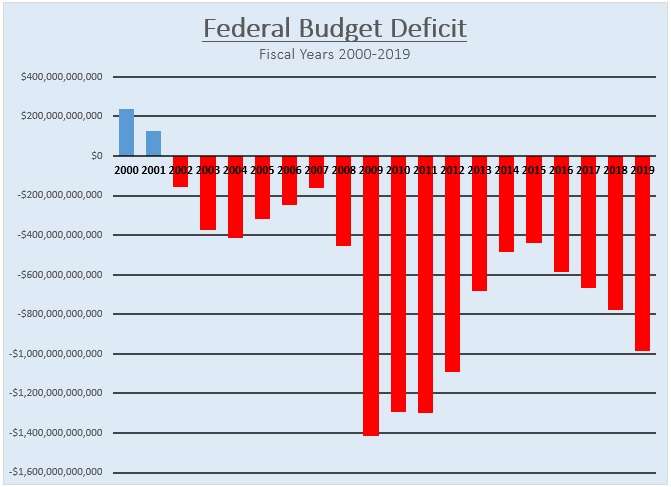
Federal Deficit Hit $984 Billion Last Year—a Nearly 50 Percent Increase Since Trump Took Office
In three years in office, Trump has added more to the national debt than President George W. Bush did in his entire two terms.
Eric Boehm | 10.25.2019

During the 2016 campaign, President Donald Trump said he’d be able to wipe out the national debt in eight years. Instead, after three years in office, he’s overseen a nearly 50 percent increase in the gap between how much the government takes in and how much it spends.

Chart by Eric Boehm. Source: U.S. Treasury data

The Treasury Department announced Friday that the official federal deficit for fiscal year 2019, which ended in September, was $984 billion—in line with what the Congressional Budget Office (CBO) estimated last month.

The announcement serves as official confirmation that the federal government’s mountain of red ink has grown dramatically during Trump’s first three years in the White House.

It is now approaching levels not seen since the early Obama years.

In order to “wipe out the national debt in 8 years,” (a 100% reduction in the debt) the Trump administration would have to run an 8-year surplus totaling about $20 trillion, i.e take $20 trillion out of the economy.

History has taught us that removing $20 trillion from the private sector — would cause, not just a recession, but a depression — and not just any old depression, but a depression the likes of which America never has experienced.

Every depression in U.S. history has been introduced with federal debt reduction, which takes dollars out of the private sector.

1804-1812: U. S. Federal Debt reduced 48%. Depression began 1807.
1817-1821: U. S. Federal Debt reduced 29%. Depression began 1819.
1823-1836: U. S. Federal Debt reduced 99%. Depression began 1837.
1852-1857: U. S. Federal Debt reduced 59%. Depression began 1857.
1867-1873: U. S. Federal Debt reduced 27%. Depression began 1873.
1880-1893: U. S. Federal Debt reduced 57%. Depression began 1893.
1920-1930: U. S. Federal Debt reduced 36%. Depression began 1929.
1997-2001: U. S. Federal Debt reduced 15%. Recession began 2001.

The economy usually is measured by Gross Domestic Product (GDP), and the formula for GDP is:

GDP =Federal Spending + Non-federal Spending + Net Exports.

To reduce federal debt one must reduce federal spending, and/or increase tax collections, both of which reduce GDP.

Federal deficit decreases cause recessions (vertical gray bars), which are cured by federal deficit increases.

By formula, federal debt reductions cut GDP.

The deficit is growing despite growth in tax revenues. The Treasury Department reported that while overall tax receipts rose by about 4 percent, federal spending grew by 8 percent.

In a statement, Treasury Secretary Steve Mnuchin said the data showed “President Trump’s economic agenda is working”; he also touted the low unemployment rate and ongoing economic growth.

One would think that deficit growth and economic growth happening simultaneously, and the fact that deficits pump growth dollars into the economy, would be sufficient to convince Trump, Mnuchin, and Eric Boehm that deficts grow the economy.

Sadly, such irrefutable evidence + mathematical logic don’t seem to be sufficient.

What’s really irresponsible is spending growth that’s outpacing revenue growth by a rate of 2-to-1.

Trump’s defenders will point out that he’s not solely responsible for setting the government’s budget.

That’s true, but he has the final say on all spending bills and he has been refusing to force the spending cuts Mnuchin says are necessary.

Why is “spending that’s outpacing revenue growth” (i.e. adding dollars to the economy) “irresponsible”?

Mnuchin never says, probably because it isn’t irresponsible; it’s necessary for economic growth.

When Congress passed a bipartisan budget plan in March 2017 that annihilated Obama-era spending caps, Trump begrudgingly signed the bill while promising that he’d never agree to another spending hike like that.

Earlier this year, when Congress passed another budget-busting spending bill, Trump signed it without so much as expressing a second thought.

Could it be that Trump intuitively understands that federal deficits spending adds growth dollars to the economy?

Perhaps nothing demonstrates Republicans’ complete abdication of fiscal conservatism as much as this: In three years in office, Trump has added more to the national debt than President George W. Bush did in his entire two terms. (Though Bush did have the advantage of starting out with a budget surplus in his first year.)

Fiscal conservatism, aka “austerity,” aka taking money from the private sector which needs the money, and giving it to the federal government, which doesn’t need the money, is the worst possible financial plan — unless one prefers recessions and depressions.

Recessions are caused by money shortages and cured by money supplements. The private sector is limited in its ability to create growth dollars; the federal government, being Monetarily Sovereign, is not limited.

Now we come to two of the most amazing sentences in Mr. Boehm’s article:

In the early Obama era, it was not uncommon to hear Republicans admit that Bush’s spendthrift ways had paved the way for worse.

Now, on an annual basis, Trump’s deficit spending is nearly as bad a Obama’s was over two terms.

During Bush’s 2nd term, the deficit averaged only about $250 Billion, at which point began the “Great Recession.”

During Obama’s 2 terms, the deficit averaged over $1 trillion, and the economy grew massively, and it continues to grow.

And yet, Mr. Boehm wants deficit reduction! It boggles.

Give Trump a few more years and I’m sure he’ll surpass Obama. That’s because the nature of the current budget deficit is fundamentally different from the peaks of the early 2010s.

Those deficits eventually tapered off for a variety of reasons. Recovery from the Great Recession boosted tax revenue.

The spending binge approved in response to the recession faded away.

And fiscally prudent Republicans imposed some modest caps on future spending growth.

But, Mr. Boehm, the deficit still averaged over $700 Billion — far more than the Bush later years — and the economy still grows, also far faster than during the Bush later years.

Coincidence, Mr. Boehm?

Now? The country is running a massive (and growing) deficit despite a decade of economic growth and a low unemployment rate.

“Higher outlays for Medicare, Social Security, Defense, and interest on the public debt” drove the deficit increase in fiscal year 2019, the Treasury Department says.

See how Boehm still doesn’t get it?

The “massive (and growing) deficit” has caused “a decade of economic growth and a low unemployment rate.”

Then Boehm goes on to exacerbate the ignorance:

The current deficit isn’t the result of temporary circumstances like World War II or a major recession.

It’s a systemic deficit, a result of poor budgeting and bad decision-making by members of Congress and the current administration.

It’s not going to resolve itself, and it’s on pace to get much worse.

We only can pray that he is correct and that the deficit will get much “worse,” i.e. pump much more growth money into the economy.

The Government Accountability Office (GAO) has called the federal government’s current fiscal situation “unsustainable,” and the CBO expects the national debt to hit “unprecedented levels” in the coming decades, well above the record highs set during World War II.

Ah, yes: “Unsustainable.” The favorite word of the economic ignorant. You probably have seen dozens of articles decrying the debt or deficit by using this word, and in not one of those articles did you ever see an explanation of why it supposedly is “unsustainable.”

The economic blowhards have been condemning the debt for longer than you have been alive, and still they have learned nothing. (See: “It is 2019, and the phony federal debt “time bomb” still is ticking.”)

“A deficit of this size following the longest span of economic growth in history shows just how reckless our leaders have become.

This is exactly the time when deficits should be contracting, not expanding,” Leon Panetta, co-chairman of the Committee for a Responsible Federal Budget, said in a statement.

No, Mr. Panetta. “The longest span of economic growth in history” was caused by deficits. Without deficits, there could have been no growth.

There is no time when deficits should be contracting unless one prefers a contracting economy.

And please don’t get me started on that Committee for a Responsible Federal Budget, which has been wrong forever about federal finances.

“But instead of getting our fiscal house in order and preparing for the next downturn, our leaders continue to binge on debt-fueled tax cuts and spending hikes rather than showing the leadership necessary to set our fiscal path.”

Clearly, Panetta believes (or more likely, is trying to make you believe) that our Monetarily Sovereign federal government can run short of its own sovereign currency, the U.S. dollar.

He also wants you to believe that federal financing is like personal financing.

You’ll notice (and this is important) that nowhere in Boehm’s diatribe is there any data showing how federal deficits have an adverse effect on the economy.

He simply spouts generalized reprimands like, “unsustainable,” “mountain of red ink,” “irresponsible,” “abdication of fiscal conservatism,” “spendthrift ways,” “spending binge,” “poor budgeting and bad decision-making,” and on and on.

But where, Mr. Boehm, are the data showing cause and effect — the data showing that large deficits cause some negative effect? They are nowhere to be found.

You will not find anywhere, a graph like the one above, showing that Federal deficit decreases cause recessions, which are cured by federal deficit increases.

The reason for the absence of such data: They do not exist.

A growing economy requires a growing supply of money, and federal deficit spending increases the money supply.

Even the ordinarily distasteful words “deficit,” and “debt,” are misleading, because they really represent surpluses for the economy.

Everything — language and the absence of data — has been gathered together to make you fear the one thing necessary to grow our economy: Federal deficit spending.

Why?

The very rich, who run America, do not want you to ask for more benefits from the federal government. This is their way making you agree to unnecessary limitations on what you receive from the government.

It’s a function of Gap Psychology, the desire of the rich to distance themselves from the rest of us. It is their way of becoming richer, for the larger the Gap the richer they are.

Democrats have abandoned all pretense of caring about the national debt, or even attempting to explain how they might pay for new federal programs.

And Republicans seem capable of offering nothing more than obviously false promises and empty rhetoric.

Mr. Boehm is right about the Democrats and Republicans duplicity, but not in the way he claims. These are the parties that have agreed on the useless — no, harmful — federal debt ceiling.

Both parties have capitulated the demands of the rich that you be misled.

Aside from that, Mr. Boehm’s article is one giant, misleading mess of false economics.

Rodger Malcolm Mitchell
Monetary Sovereignty
Twitter: @rodgermitchell
Search #monetarysovereignty Facebook: Rodger Malcolm Mitchell

…………………………………………………………………………………………………………………………………………………………………………………………………………………………………………………………………………………………..

The most important problems in economics involve:

  1. Monetary Sovereignty describes money creation and destruction.
  2. Gap Psychology describes the common desire to distance oneself from those “below” in any socio-economic ranking, and to come nearer those “above.” The socio-economic distance is referred to as “The Gap.”

Wide Gaps negatively affect poverty, health and longevity, education, housing, law and crime, war, leadership, ownership, bigotry, supply and demand, taxation, GDP, international relations, scientific advancement, the environment, human motivation and well-being, and virtually every other issue in economics.

Implementation of Monetary Sovereignty and The Ten Steps To Prosperity can grow the economy and narrow the Gaps:

Ten Steps To Prosperity:

1. Eliminate FICA

2. Federally funded Medicare — parts a, b & d, plus long-term care — for everyone

3. Provide a monthly economic bonus to every man, woman and child in America (similar to social security for all)

4. Free education (including post-grad) for everyone

5. Salary for attending school

6. Eliminate federal taxes on business

7. Increase the standard income tax deduction, annually. 

8. Tax the very rich (the “.1%”) more, with higher progressive tax rates on all forms of income.

9. Federal ownership of all banks

10. Increase federal spending on the myriad initiatives that benefit America’s 99.9% 

The Ten Steps will grow the economy and narrow the income/wealth/power Gap between the rich and the rest.

MONETARY SOVEREIGNTY