Thinking about Donald Trump’s misdeeds is like drinking from the proverbial fire hose. There are so many illegal and immoral actions they blend into a giant gusher of criminality.
Trump University, Trump Foundation, refusal to show tax returns, nepotism, profiting from the Presidency, false claima that tariffs make China pay millions into the U.S. Treasury, cheating on multiple wives, torturing children at the border, his rampant bigotry, twelve thousand lies, Mexico to pay for the wall, misogyny, bigotry, admiration of murderous dictators, the list goes on and on.
His followers repeatedly ignore the obvious, and in doing so, they become enablers for future misdeeds.Trump has been made to believe he can do anything, say anything, commit any outrages, and not be punished.
But this time, he has stepped over a line that even the most hypnotized of his followers cannot ignore. The ten words that finally should doom his presidency are:
Trump solicited a foreign government to interfere in American elections.
The foundation of America as a great nation is our free elections. Everything else, of which we are proud, emanates from there.
You are witness to history. Our President — our President! — tries to subvert our free elections by engaging in a covert operation with a foreign government to destroy the primary thing that defines America.
Traitors have been hung for less.
“We are buying American oil . . . I stayed at the Trump Tower . . . Thank you Mr. President, bye-bye.” No pressure.
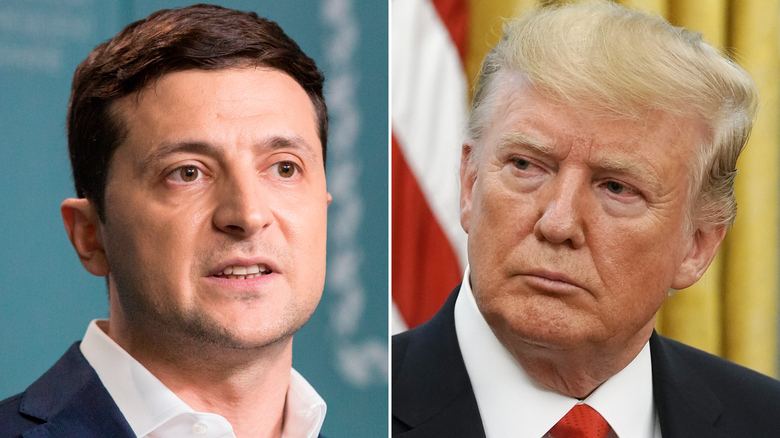
Here is the background: Trump held back almost $400 million in Congressionally approved, military aid for Ukraine at least a week before the notorious phone call to Volodymyr Zelenskyy, the president of Ukraine.
It’s a short phone call. Just a few minutes.
The sole purpose was to remind Zelenskyy that America was withholding those millions from Ukraine, and in return for our giving him the money, he should do Trump a favor: Dig up dirt on Trump’s key political opponent, before the elections, so as to change the outcome.
You can read the full transcript here, but the following are the key passages.
First, Trump, in his rambling, babbling style, reminds Zelenskyy that “we” have been very good to Ukraine:
I will say that we do a lot for Ukraine. We spend a lot of effort and a lot of time. Much more than the European countries are doing and they should be helping you more than they are. Germany does almost nothing for you.
All they do is talk and I think it’s something that you should really ask them about. When I was speaking to Angela Merkel she talks Ukraine, but she doesn’t do anything.
A lot of the European countries are the same way so I think it’s something you want to look at but the United States has been very very good to Ukraine.
Then, Trump suddenly realizes this reveals he’s asking for a quid pro quo, a payment for a political favor, so he says:
I wouldn’t say that it’s reciprocal necessarily because things are happening that are not good but the United States has been very, very good to Ukraine.
Trump thinks he is being so very subtle in reminding Zelenskyy that the U.S. is holding back hundreds of millions of dollars in military assistance that Congress appropriated, and he (Trump) has the power to release the money.
So, it’s not reciprocal “necessarily,” but . . . oh well, it is reciprocal.
Then Trump asks for his favor:
I would like you to do us a favor though because our country has been through a lot and Ukraine knows a lot about it. I would like you to find out what happened with this whole situation with Ukraine, they say Crowdstrike . . .
“Crowdstrike” refers to a conspiracy theory Rudy Guiliani has invented, regarding stolen E-mails.
Then comes the heart of the “favor:”
“Mr. Giuliani is a highly respected man. He was the mayor of New York City, a great mayor, and I would like him to call you.
“I will ask him to call you along with the Attorney General. Rudy very much knows what’s happening and he is a very capable guy. If you could speak to him that would be great.
“There’s a lot of talk about Biden’s son, that Biden stopped the prosecution and a lot of people want to find out about that so whatever you can do with the Attorney General would be great.
“Biden went around bragging that he stopped the prosecution so if you can look into it… It sounds horrible to me.”
Here, Trump has asked a foreign leader to interfere in America’s elections by getting dirt on his opponent and his opponent’s son.
It’s an illegal request, but Trump believes he will get away with it. Zelenskyy agrees to do the “favor.” Anything for that $400 million.
Since we have won the absolute majority in our Parliament, the next prosecutor general will be 100% my person, my candidate, who will be approved by the parliament and will start as a new prosecutor in September.
He or she will look into the situation, specifically to the company that you mentioned in this issue.
The issue of the investigation of the case is actually the issue of making sure to restore the honesty so we will take care of that and will work on the investigation of the case.
On top of that, I would kindly ask you if you have any additional information that you can provide to us, it would be very helpful for the investigation.
Zelenskyy asked Trump for additional information to “help with the investigation” of Trump’s political opponent and his son.
Zelenskyy assures Trump he will do the favor:
I also want to ensure you that we will be very serious about the case and will work on the investigation.
Trump says he will tell his two primary political operatives to call:
I will tell Rudy and Attorney General Barr to call.
Not only has Trump committed treason, but you’ll recall that this is not the first time.
“Russia, if you’re listening, I hope you’re able to find the 30,000 emails that aremissing,” he said, referring to the Democratic nominee Hillary Clinton’s deleted messages. “I think you will probably be rewarded mightily by our press.”
“Rewarded mightily by our press,” means, “I will be grateful.”
Perhaps, some Americans have become so numbed by Trump’s repeated transgressions that nothing he says or does can shock anymore.
And, perhaps he was right when he said, “I could stand in the middle of Fifth Avenue and shoot somebody and wouldn’t lose any voters.”
And perhaps committing crimes (Trump University, Trump Foundation) and repeatedly lying (Trump 12,000 lies) did not matter to his hypnotized followers.
But this latest outrage has gone far beyond anything Americans can ignore.
“Trump has already admitted the essentials – he called a foreign leader and asked him to use the legal engines of a foreign government to produce dirt on Trump’s American political rival,” said Frank Bowman, a law professor at the University of Missouri who has written a book about impeachment.
Paul Rosenzweig, a former federal prosecutor in Washington who worked on the special counsel investigation into Bill Clinton, said, “The founders spoke about things like promising pardons to your friends to protect your own criminality. They spoke about things like people being beholden to foreign governments. They spoke about profiting from the presidency.”
Trump flaunts his criminality in our faces and dares us to do something about it. This time the ten words finally may bring Trump’s followers to their senses and bring Trump to justice.
Trump solicited a foreign government to interfere in American elections.
A President trying to undermine our free elections, the foundation of American democracy. It doesn’t get worse than that.
“The Balancemakes personal finance easy to understand. It is home to experts who provide clear, practical advice on managing your money.
“With more than 24 million monthly visitors, The Balance is among the top-10 largest finance properties. Our more than 50 expert writers have extensive qualifications and expertise in their topics, including MBAs, PhDs, CFPs, other advanced degrees and professional certifications.
“The Balance family of sites have been honored by multiple awards in the last year, including The Telly Awards, The Communicator Awards, and Eppy Awards.”
That is truly impressive — 24 million people every month, 50 expert writers, multiple awards, college degrees. They are a major source of information for the public.
Specifically, let us consider their U.S. economy expert, Kimberly Amadeo:
KIMBERLY AMADEO
US Economy Expert
Kimberly is the author of The Obamacare Handbook and Beyond the Great Recession, and has been quoted as an economic expert by Fox Business, US News and World Report, and The Huffington Post.
She has authored hundreds of articles on economic topics ranging from health care reform to monetary policy to global trade. Kimberly has been the U.S. Economy Expert for The Balance, and prior to that, About.com, since 2006.
In addition, Kimberly has more than 20 years of senior-level corporate experience in economic analysis and business strategy, and received an M.S. in Management from the Sloan School of Business at M.I.T.
With that introduction, let us see what Ms. Amadeo has to say. Here are a few excerpts from one of this year’s articles:
US Federal Government Tax Revenue Who Really Pays Uncle Sam’s Bills?
BY KIMBERLY AMADEO Updated May 18, 2019
The U.S. government’s total revenue is estimated to be $3.643 trillion for Fiscal Year 2020.
That’s the most recent budget forecast from the Office of Management and Budget for October 1, 2019, through September 30, 2020.
The federal government, unlike state and local governments, never unintentionally can run short of dollars.
Taking more than $3.6 trillion from the economy every year represents a giant economic loss.
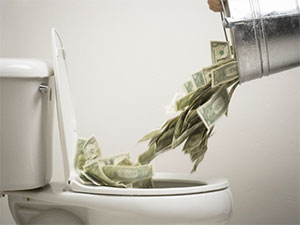
Visualize the effect of dumping more than $3.6 trillion down the toilet, every year. That is what your federal taxes accomplish.
Continuing with excerpts from Ms. Amadeo’s article, I’ll comment directly to her:
So where does the federal government’s revenue come from? Individual taxpayers like you provide most of it. Income taxes contribute $1.822 trillion, over half of the total. Another third, $1.295 trillion, comes from your payroll taxes.
Corporate taxes add $256 billion, only 7%. The Tax Cut and Jobs Act cut taxes for corporations much more than it did for individuals. In 2015, corporations paid 11% and income taxpayers paid 47%.
The best way to reduce the individual tax burden is to reduce government spending, not shift the burden to corporations.
No, Ms. Amadeo, the best way to reduce the federal individual tax burden is to reduce federal individual taxes.
Recessions (vertical gray bars) begin with declines in federal deficit growth (red line) and are cured by increases in federal deficit spending.
Federal spending benefits Americans. Reducing federal spending would reduce those benefits, and lead to recessions and depressions.
The government’s annual income only pays for 77% of spending. It creates a $1.1 trillion billion budget deficit.
The $1.1 trillion budget deficit inserts $1.1 trillion growth dollars into the economy. It more properly should be called an economic surplus.
When the federal government pays a creditor, it sends instructions to the creditor’s bank, instruction the bank to increase the balance in the creditor’s checking account.
The instant the bank does as instructed, new dollars are created and added to the nation’s money supply. Deficit spending is the federal government’s primary method for creating economic growth dollars.
Shouldn’t Congress only spend what it earns, just like you and me?
Here, Ms. Amadeo, you had the perfect opportunity to explain the difference between a Monetarily Sovereign federal government’s finances, and a monetarily non-sovereign individual’s finances.
While a Monetarily Sovereign entity never can run short of its own sovereign currency, I have no sovereign currency. So my income is less than my spending, I can run out of money. The federal government can’t.
Since the federal government neither needs nor uses income, and can create unlimited amounts of money, there is absolutely no reason for Congress to spend what it earns.
Pants on fire
By failing to explain this difference, Ms. Amadeo, you help perpetuate the Big Lie of federal – personal finance equivalence. Unfortunately, you expound upon the Big Lie, and write the single, most wrong-headed, completely false paragraphs in the entire article:
It depends on where the economy is in the business cycle. Congress should use deficit spending to boost economic growth in a recession. It uses stimulus spending to create jobs.
Once the recession is over, the government should live within its means and spend less. It should raise taxes, if needed, to reduce the deficit and the debt. That will keep the economy from overheating and forming dangerous bubbles. Congress should switch from expansionary to contractionary fiscal policy.
Think about it, Ms. Amadeo. Why would Congress want to “boost economic growth” only “in a recession”? It makes no sense at all. And later in your article, you contradict yourself on this point.
Today, as I write this comment, we are not in a recession. Why would I not want to “boost economic growth, today?
And stimulus spending creates jobs by growing the economy and by providing the goods and services the populace desires. Why is this a bad thing?
After missing the opportunity to educate, Ms. Amadeo, you execute a confused turnaround and write:
The revenue collected equals 16.3% of gross domestic product. That’s the nation’s measurement of economic output.
If that much production is going to the federal government, then you want to make sure it’s reinvested into the economy to support future growth.
Let’s examine that last phrase. “It” (federal tax revenue”) is not reinvested in anything. It is destroyed upon receipt.
Then, Ms. Amadeo, you admit that federal investment “into the economy to supports future growth,” but you previously opposed federal investment into the economy, unless there is a recession.
Revenues would be much higher without the Trump tax plan. It was also lowered by the extension of the Bush tax cuts and the Obama tax cuts. They were meant to fight the 2001 recession and the 2008 recession.
They were supposed to spur the consumer spending that drives almost 70% of economic growth.
But most people didn’t even realize this happened since the tax cut showed up as reduced withholding instead of a check.
Instead of spending the cuts, people used some of it to pay off debt. The recession scared people into saving more and using credit cards less. So, the budget didn’t expand enough to spur economic growth.
The above is mystifying. Do you, Ms. Amadeo, not realize that the deficit spending you decry — the deficit spending that began in 2008 — caused the recovery and 11-year massive growth that continues even today?
Now that the recession is over, those tax cuts should be reversed. Taxes should be increased, not cut.
An economic expansion is the time to pay off the debt, not add to it.
Uh, Ms. Amadeo, news flash: The recession has been “over” for 11 years. It ended because of federal deficit spending. Now you want to create another deficit by taking more dollars out of the economy?
And exactly why do you want to pay off the federal debt?
First, the federal government never can run short of dollars, so why does the “debt” trouble you?
Second, the so-called “debt” isn’t really debt in the classic sense. The federal debt is the total of deposits into Treasury Security (T-bill, T-note, T-bond) accounts, which are paid off every day, simply by returning the dollars in those accounts.
Thus, the so-called federal “debt” (unlike state and local government debts) is not a burden on the federal government, nor is it a burden on taxpayers.
What is a burden on taxpayers? Taxes.
IN SUMMARY
Kimberly Amadeo and THE BALANCE claim to reach more than 24 million readers each month. This platform would give them an excellent opportunity to educate the populace and to dismiss pernicious and damaging myths about the American economy.
Instead, out of ignorance or intent, they have chosen to perpetuate the Big Lie that federal finances are like personal finances, and that stimulative federal deficit spending should be reduced and limited to times of recession.
The Big Lie has led to many trillions of dollars unnecessarily being taken from the economy, a depletion that has resulted in repeated recessions and even depressions through the years.
Millions of people every month, rather than being enlightened, are told the world is flat.
Gap Psychology describes the common desire to distance oneself from those “below” in any socio-economic ranking, and to come nearer those “above.” The socio-economic distance is referred to as “The Gap.”
Wide Gaps negatively affect poverty, health and longevity, education, housing, law and crime, war, leadership, ownership, bigotry, supply and demand, taxation, GDP, international relations, scientific advancement, the environment, human motivation and well-being, and virtually every other issue in economics.
Implementation of Monetary Sovereignty and The Ten Steps To Prosperity can grow the economy and narrow the Gaps:
“Taxes are not needed to ‘pay for’ (federal) government spending. The logic is reversed: government must spend (or lend) the currency into the economy before taxpayers can pay taxes in the form of the currency. Spend first, tax later is the logical sequence.”
The U.S. government cannot run short of dollars.
U.S. federal taxes are not needed. The U.S. government, being Monetarily Sovereign, has the unlimited ability to create its own sovereign currency, the U.S. dollar.
The U.S. government never unintentionally can run short of dollars. Even if all federal tax collections totaled $0, the federal government could continue spending, forever.
The articles you read about the “unsustainable” federal debt are, very simply, wrong. There is no level of U.S. dollar obligations the federal government cannot easily sustain.
Ben Bernanke: “The U.S. government has a technology, called a printing press (or, today, its electronic equivalent), that allows it to produce as many U.S. dollars as it wishes at essentially no cost.”
Alan Greenspan: “Central banks can issue currency, a non-interest-bearing claim on the government, effectively without limit. A government cannot become insolvent with respect to obligations in its own currency.”
St. Louis Federal Reserve: “As the sole manufacturer of dollars, whose debt is denominated in dollars, the U.S. government can never become insolvent, i.e., unable to pay its bills. In this sense, the government is not dependent on credit markets (borrowing) to remain operational.
Professor Wray’s paper continues:
Some who hear this for the first time jump to the question: “Well, why not just eliminate taxes altogether?” There are several reasons.
First, it is the tax that “drives” the currency. If we eliminated the tax, people probably would not immediately abandon use of the currency, but the main driver for its use would be gone.
We disagree with the “taxes drive the currency” notion. Contrary examples abound. Professor Wray’s own “Roobucks”are not “driven” by taxes. They are driven by the discounts they provide. Bitcoin is not “driven” by taxes.
However, the real point is contained in the following paragraphs from Wray’s paper:
Further, the second reason to have taxes is to reduce aggregate demand. If we look at the United States today, the federal government spending is somewhat over 20% of GDP, while tax revenue is somewhat less—say 17%.
The net injection coming from the federal government is thus about 3% of GDP. If we eliminated taxes (and held all else constant) the net injection might rise toward 20% of GDP.
That is a huge increase of aggregate demand, and could cause inflation.
Ideally, it is best if tax revenue moves countercyclically—increasing in expansion and falling in recession.
That helps to make the government’s net contribution to the economy countercyclical, which helps to stabilize aggregate demand.
The implicit assumption of the above paragraphs is that the private sector’s money supply drives inflation, and the way to control inflation is to reduce the private sector’s money supply.
In a similar vein:
A Wikipedia article says, “Low or moderate inflation may be attributed to fluctuations in the real demand for goods and services, or changes in available supplies such as during scarcities. However, the consensus view is that a long sustained period of inflation is caused by money supply growing faster than the rate of economic growth.”
We disagree with Wray and with the Wikipedia author. A “long sustained period” of money supply growth cannot exceed a “long sustained period” of economic growth.
The money supply cannot grow faster than economic growth. The two are interdependent in the formula for GDP:
Real GDP = Real Federal Spending + Real Non-federal Spending + Real Net Exports
A decrease in taxes would increase the “Non-federal Spending” factor and GDP by the same amount. By formula, tax decreases increase GDP.
Inflation usually is defined as a general increase in prices. Another way to say it is, “Inflation reduces the purchasing power of each unit of currency.”
There are two levels of inflation: Intentional and unintentional. The intentional form is the amount that the central bank believes is helpful for a growing economy. The U.S. Federal Reserve has as its target rate, 2% inflation.
When annual inflation drifts above or below the 2% target, the Fed quickly raises and lowers interest rates, i.e. raises to rates combat inflation; lowers rates to stimulate inflation.
(The Fed also lowers interest rates to stimulate economic growth, which follows the common myth that stimulating growth and stimulating inflation require the same actions.)
The Fed’s target rate of inflation is maintained by interest rate control, which controls the demand for, and purchasing power of, U.S. dollars. Increasing the demand for dollars reduces inflation; decreasing the demand for dollars encourages inflation.
But what about high inflation, say of 50% or 50,000% annually or more. Such hyperinflations always are caused by shortages of food and/or energy (oil).
The famous Zimbabwe hyperinflation is a typical example. The government took farmland from white farmers and gave it to blacks who did not know how to farm. The inevitable food shortage caused hyperinflation.
In response, rather than trying to cure the food shortage, the Zimbabwe government began printing more currency.
This provided the illusion that currency printing caused the hyperinflation, when in fact, the hyperinflation caused the currency printing.
Think of a typical scenario this way: The inflation-adjusted money supply goes up. Where does the additional real money go? The vast majority goes to spending, which by definition, increases real GDP.
One might argue that some is saved, but since saved dollars are not spent, they cannot contribute to aggregate demand.
All increases in the real money supply increase real GDP.
Further, and most importantly, all decreases in the real money supply (because of taxes) decrease real GDP. Thus taxes, rather than being effective moderators of inflation, actually are recessive.
Recession is not the opposite of inflation. The two can occur simultaneously. The opposite of inflation is deflation. Taxes do not cause deflation. Deflation, i.e. price decreases, is caused by excess supplies of goods and services.
Thus, removing currency (via taxes) from the economy would have done nothing to cure the inflation, though it would have reduced real (inflation-adjusted) GDP economic growth, while it impoverished the populace.
There are several ways to prevent or cure inflation, but taxation is not one of them. Taxation merely takes dollars from the private sector and delivers them to the federal government, where your tax dollars are destroyed.
Taxation does nothing to address the fundamental cause of inflation: Shortages.
Imagine an inflation caused by a food shortage, and the automatic response is an increase in taxes. How would leaving fewer inflation dollars in the pockets of the people eliminate the food shortage?
It wouldn’t, of course.
Consider again, Zimbabwe: Rather than taxing, designed to reduce the currency supply (while impoverishing the people), or printing currency to increase the currency supply (thereby reducing the already diminished value of Zimbabe’s money), the Zimbabwe government should have taken steps to increase the food supply.
This might have included paying to educate Zimbabwe’s farmers and/or paying experienced farmers to manage farms or paying to import food from other nations.
These steps would have required the Zimbabwean government to spend more money to correct inflation — a counterintuitive response, but the only one based on financial reality.
In Summary
Any time a nation experiences an unwanted level of inflation, the correct early step is to increase interest rates, thus increasing the demand for, and the value of, the nation’s currency.
If the inflation has grown beyond interest rate increases as a sole solution, additional steps are needed:
Determine what exactly is causing the inflation
If the cause is a shortage of food or energy the government must either import the needed food or energy, or fund ways to increase the domestic production of food or energy.
If the government is monetarily non-sovereign (a euro nation, for instance), and cannot afford to fund imports or fund domestic production of the scarce commodities, it immediately should begin the process of issuing its own sovereign currency, i.e. it should make itself Monetarily Sovereign.
Raising taxes is exactly the wrong step since that will worsen the inflation problem, while adding recession to the burden.
Gap Psychology describes the common desire to distance oneself from those “below” in any socio-economic ranking, and to come nearer those “above.” The socio-economic distance is referred to as “The Gap.”
Wide Gaps negatively affect poverty, health and longevity, education, housing, law and crime, war, leadership, ownership, bigotry, supply and demand, taxation, GDP, international relations, scientific advancement, the environment, human motivation and well-being, and virtually every other issue in economics.
Implementation of Monetary Sovereignty and The Ten Steps To Prosperity can grow the economy and narrow the Gaps:




 #Monetary Sovereignty - Mitchell