Are you for or against Universal Basic Income. Do you understand Monetary Sovereignty?

I’ve researched the question, “What are the reasons against Universal Basic Income (UBI).” I call it “Social Security for All.”

Here is a summary of the anti-UBI claims:

1. Cost and Feasibility: One of the primary concerns is the high cost of UBI. For example, in the United States, a UBI of $12,000 per year for every adult would cost over $3 trillion annually/

2. Inflation: UBI could lead to inflation. If everyone has more money to spend, demand for goods and services might increase, driving up prices and potentially negating the benefits of the additional income.

3. Work Incentive: UBI might reduce the incentive to work. If people receive a guaranteed income regardless of employment, some may choose not to work, potentially leading to a decrease in the labor force and economic productivity.

4. Misuse of Funds: Recipients might misuse the funds, spending them on non-essential items rather than necessities. This could undermine the goal of reducing poverty and improving living standards.

5. Impact on Existing Welfare Programs: Implementing UBI might require cutting or restructuring existing welfare programs. This could harm those who rely on targeted support for specific needs, such as healthcare or housing.

6. Political and Social Challenges: Gaining political and public support for UBI can be difficult. Many people are skeptical of unconditional transfer programs and prefer welfare systems tied to employment or specific conditions.

Before I address #s 1 through 6, I’ll give you the real one:

7. It would narrow the income/wealth/power Gap between the rich and the rest. The Gap is what makes the rich rich. Without the Gap no one would be rich; we all would be the same.

The wider the Gap, the richer are the rich. The easiest way for the rich to remain rich is to make sure the Gap doesn’t narrow, so using their political and informational power, the rich invent and promulgate false reasons why UBI won’t work.

Now, let us address each of the reasons given for objecting to UBI.

1. Cost and Feasibility:

We already have a form of UBI, except it isn’t “U” (Universal). We call it “Social Security,” and it covers old and/or disabled people. All the ideas opposing UBI were put forth in the 1930s when Social Security first was proposed.

Contrary to popular myth, Social Security (as well as Medicare, the military, SCOTUS salaries, White House salaries, Congress’s salaries, and every other federal expenditure) are not funded by FICA or any other federal taxes.

These programs all are funded the same way: through federal money creation.

It is as simple as A, B, C.

A. When any federal government agency approves an invoice for payment, it sends instructions (not dollars) to the creditor’s bank, instructing the bank to increase the balance in the creditor’s checking account. The instructions are in the form of a check or a wire.

B. When the bank does as instructed ( by pressing a few computer keys), dollars are created by being added to the creditor’s checking account and to the money supply measure known as “M2.”

C. The bank then balances its books by clearing the payment through the Federal Reserve, which has the infinite power to approve all federal checks and wires.

So long as the federal government has the infinite power to pass laws and to issue instructions, it has the infinite power to pay any invoices it receives. The U.S. federal government, being the original creator of dollars from thin air, never unintentionally can run short of dollars.

You often have been told that Medicare, Social Security and/or their trust funds are running out of money. It is a false claim. Unlike state/local governments, the U.S. government is Monetarily Sovereign. With the infinite ability to create dollars, it could create the above-mentioned $3 trillion at the touch of a computer key.

The sole purpose of federal taxes (unlike state/local taxes) is not to provide the government with spending money. The dual purposes are to:

    • Control the economy by taxing what the government wishes to discourage and by giving tax breaks to what the government wishes to reward and
    • Assure demand for the dollar by requiring taxes to be paid in dollars.

Even if the federal government didn’t collect a single dollar in taxes, it could continue spending, forever.

Alan Greenspan: “A government cannot become insolvent with respect to obligations in its own currency. There is nothing to prevent the federal government from creating as much money as it wants and paying it to somebody. The United States can pay any debt it has because we can always print the money to do that.”

Ben Bernanke: “The U.S. government has a technology, called a printing press (or, today, its electronic equivalent), that allows it to produce as many U.S. dollars as it wishes at essentially no cost. It’s not tax money… We simply use the computer to mark up the size of the account.”

Statement from the St. Louis Fed: “As the sole manufacturer of dollars, whose debt is denominated in dollars, the U.S. government can never become insolvent, i.e., unable to pay its bills. In this sense, the government is not dependent on credit markets to remain operational.”

Mario Draghi, President of the Monetarily Sovereign European Central Bank: “We cannot run out of money.”

Further, UBI would grow the economy. It’s a mathematical certainty because the size of the economy is determined by this formula:

Gross Domestic Product (GDP) = Federal Spending + Nonfederal Spending + Net Exports.

By simple algebra, UBI would grow the economy because it would increase Federal Spending and, as a result, increase Nonfederal Spending, too.

When faced with the undeniable facts that UBI is affordable for the federal government and would grow the economy, those influenced by wealthy propaganda resort to excuse #2.;

 2. Inflation: The common yet erroneous belief is that “excessive” fedeal spending causes inflation. This belief is wrong on several fronts. 

First, no one knows what “excessive” means. The rich always claim federal spending is excessive (see: Historical claims the Federal Debt is a “ticking time bomb.” From Sept. 26, 1940, to July 22, 2024) because most federal spending goes to the poor. It narrows the Gap, a situation the rich despise.

By contrast, the rich favor tax deductions for the wealthy, which are not part of “spending” but widen the Gap just as federal spending does.

Economics is a pseudoscience loaded with hypotheses and flush with data — and ne’er the twain shall meet.

Some economists make this arguement based on intuition, but not on fact: They claim that people earn income by selling their labor on the labor market as a contribution to the production of goods and services for the economy. Income increases that aren’t directly related to correlating increases in production tend to result in higher prices.

It’s nonsense.

Which of these can claim their income is “directly related to correlating increases in production?” Taxi driver? School teacher? Musician? Flight attendant? Doctor? How about Elon Musk? If he made “just $100 million instead of a few billion, would that “directly relate to a correlating decrease in production”?

Pay has little to do with production and more with labor scarcity, politics, heredity, and other social factors. Queen Elizabeth’s pay had little to do with her output. I am retired, and my income has nothing to do with my production. Raising hotel workers’ skimpy pay or decreasing mortgage brokers’ high pay would not “directly relate to their production.”

The hypothesis is something that only an economics professor in a well-endowed think tank could dream up.

Inflation is not caused by federal spending. Inflation is caused by scarcities, most often scarcities of oil and food:

The peaks and valleys of inflation(red) do not match up with the peaks and valleys of federal spending (blue).


The peaks and valleys of inflation do match up with the peaks and valleys of oil prices, which are dictated by oil supply and demand.

Today, the federal government is spending more than ever, yet inflation is drifting down. The most recent inflation was COVID-related, not spending-related. It was caused by shortages of oil, food, computer chips, metal, lumber, shipping, and labor.

Raising everyone’s income by giving them money would not cause inflation. Scarcities of crucial items cause inflation.

Federal spending to cure scarcities cures inflation. The “federal spending causes inflation” meme is a fever dream promulgated by the rich to maintain the income/wealth/power Gap.

The common meme that inflation is “too much money chasing too few goods” is half right. Inflation is caused by too few goods (and services).

3. Work Incentive: Critics argue that UBI might reduce the incentive to work, decreasing the labor force and economic productivity. This is a favorite of the rich, who love to portray lower-income people as lazy slugs who, if given money, will simply loll about doing nothing. 

The truth is that poor labor is harder than rich labor unless one considers costly vacations, country clubs, and having servants do one’s work to be “labor.” Virtually everyone wants a better life, and that includes the poor. Given a stipend by the government, they will work to increase their standard of living, just as the rich do.

Similarly, the vast majority of the rich want to be richer. Almost no one is satisfied, and it is certainly not a low-income family that receives Social Security.

I trust this isn’t just a projection on my part, but I began collecting Social Security at age 65. I continued to work for a living until I was 73, not because I loved  work, but because I wanted more money to feel secure. I had what some may consider a lot, but I still wanted more.

That said, what is wrong with a decrease in the labor force? What is wrong with a four-day work week or a five-hour day? Work usually is not a purpose unto itself. The primary purpose of most work is to improve one’s life, however one defines “improve.”

For households in every quintile of the income distribution, the share of income required to pay for their 2019 consumption decreased, on average, because income grew faster than prices did over that four-year period.

Households in the top income quintile had the largest decline, on average, in the share of income required to pay for their 2019 consumption.

Translation: The rich kept earning more spending money than the rest of us did. Even though they had plenty of money, they wanted more, and worked for it. Why would the average and below-average income people be less motivated? They wouldn’t, but that is what the rich claim.

Artificial intelligence (AI) and automation are making it more possible to do less and accomplish more. A solution to the possible unemployment caused by AI may be UBI.

4. Misuse of Funds: Some argue that recipients might misuse the funds, spending them on non-essential items rather than necessities. This is another one the rich love — the notion that the poor are ignorant money managers and that if you give them money they’ll waste it on drugs and lottery tickets.

The reality is quite the opposite. By necessity, the poor have learned to be good money managers. In any event, it is none of the government’s business whether or not someone “misuses” their income. The idea the the government knows better is repulsive and bigoted.

5. Impact on Existing Welfare Programs: Implementing UBI might require cutting or restructuring existing welfare programs. Critics worry that this could harm those who rely on targeted support for specific needs, such as healthcare or housing.

This is easily prevented. Just don’t do it. Don’t include UBI income as part of any welfare criterion.

The current system — requiring someone to be poor to receive financial aid — is self-defeating. It encourages the very thing the rich claim to fear: people not working. It also leads to dishonesty and to gaming the system by mischaracterizing income.

6. Political and Social Challenges: Gaining political and public support for UBI can be difficult. Many people are skeptical of unconditional transfer programs and prefer welfare systems tied to employment or specific conditions.

This is the old “If I had to work for my money, why should he get money for doing nothing?” The solution would be to give every man, woman and child in America the same amounts regardless of their other income or wealth.

The money would mean little to the rich and much to the poor, but it would overcome the resistance of those who hate to see others receive something.

7. It would narrow the Gap between the rich and the rest. The Gap is what makes the rich rich. Without the Gap no one would be rich; we all would be the same.

The wider the Gap, the richer are the rich. The easiest way for the rich to remain rich is to make sure the Gap doesn’t narrow, so using their political and informational power, the rich invent and promulgate false reasons why UBI won’t work.

This is the single biggest hurdle to cross. The first six objections easily are overcome and/or are based on incomplete information. This one is based on the intense emotions of America’s most influential people.

A rich man might be generous about charity for the poor, but he doesn’t want poverty to be eliminated altogether. He needs the poor. Having a mansion is not as attractive if everyone else has a mansion. It’s the Gap that makes him rich, and narrowing the Gap makes him less rich, an unappealing prospect.

If a neighbor wins the lottery or even gets a more lucrative job, how does the rest of the neighborhood feel? What does Mark Zuckerberg think about Elon Musk having more money?

The majority of us suffers from Gap Psychology, the desire to distance ourselves from those below us on the income/wealth/power scale and to come closer to those above us. The conflict arises because those above us don’t want us closer and those below us want us closer.

SUMMARY

There are no good reasons not to begin a UBI program and plenty of reasons to start.

I suggest the following monthly payments:

  • $1,000 to every adult (18+)
  • $500 to every child
  • Include undocumented adults and children.

Assume:

  • 258 million adult (citizens) + 31 million adult (non-citizens) = 289 million total adults; Annual Cost: $289 billion * 12 = $3.468 trillion
  •  73 million children (citizens) + 14 million children(non-citizens) = 87 million children; Annual Cost: $43.5 billion * 12 = $522 billion
  • Combined Annual Cost: $3.468 trillion (adults) + $522 billion (children) = $3.99 trillion per year

This compares to the most recent (2023) federal expenditure of about $6.3 trillion.

Poverty generally is worse in the states that tend to vote Republican, the party that wrongly opposes social benefits, saying they are “unaffordable” and “socialism” — which they are not.

(Socialism is government control of industry, not just government funding. All governments fund things, but relatively few of those things can be called “socialism.”)

Government spending has a multiplier effect on GDP. The multiplier effect measures how much economic activity is generated by an initial amount of the expenditure. Estimates for the fiscal multiplier vary, but a typical range is between 0.5 and 2.0.

With a conservative multiplier of 1.5, GDP would grow about $6 trillion on top of the most recent 28.65 trillion for a new value of $34.65 trillion.

Consider this: The expanded Child Tax Credit (CTC) in 2021 provided up to $3,600 per child under 6 and $3,000 per child aged 6 to 17. The total cost of this expansion was approximately $105 billion for the year. It lifted about 3.7 million children out of poverty during its implementation.

Today, about 37.9 million people live below the poverty line.  The UBI described above would:

  1. Eliminate poverty in America
  2. Vastly increase economic growth
  3. Stimulate scientific progress
  4. Increase all areas of production.
  5. Improve the quality and availability of education
  6. Improve the infrastructure and help cut global warming
  7. And improve the entire American nation’s quality of life by using the brainpower now hampered by a lack of funding
  8. Do all this at no cost to anyone.

Think of it. The United States of America has the power to be the first large nation on earth to eliminate poverty. Millions of men, women, and children could begin to contribute to America’s success.

Too good to be true? No, too good only for those who don’t understand the power of human thought and desire, when funded by Monetary Sovereignty.

Rodger Malcolm Mitchell

Monetary Sovereignty

Twitter: @rodgermitchell

Search #monetarysovereignty

Facebook: Rodger Malcolm Mitchell;

MUCK RACK: https://muckrack.com/rodger-malcolm-mitchell;

https://www.academia.edu/

……………………………………………………………………..

The Sole Purpose of Government Is to Improve and Protect the Lives of the People.

MONETARY SOVEREIGNTY

Why state-funded Social Security or guaranteed income is a colossal mistake. It should be federal.

I long have favored a federal plan in which every man, woman, and child in America would receive a monthly stipend from the federal government. (Some call it UBI—Universal Basic Income. Others call it GI—Guaranteed Income, or Social Security for All.) A federally funded Social Security for All program was described in a post published seven years ago. Today, that post was brought to mind by the following article:

a $1,000 monthly ‘guaranteed income statewideThe proposal would have taxpayers fund statewide, $1,000 monthly ‘guaranteed income.’ A measure creating a task force to look into monthly guaranteed taxpayer-funded “unrestricted cash” subsidies to specific individuals in Illinois is being discussed in the state legislature.

An Illinois Senate appropriations committee would review “the landscape of cash supports available to low-income residents” and identify “populations without significant access to cash supports.”

The bill, as filed, says after the board is dissolved at the end of 2027, DHS would administer the program with monthly cash payments of $1,000 to Illinois residents, regardless of immigration status, who provide care for a child or specified dependent, recently gave birth or adopted a child or is enrolled in an educational or vocational program.

Dollar bills coming out of a horn of plenty.
By law, the Monetarily Sovereign U.S. government is an infinite horn of plenty, capable of creating an unending stream of dollars at the touch of a computer key without collecting a penny in taxes.

Mike Buehler, an opponent of the measure, said it’s irresponsible to discuss such a program without knowing how much it will cost taxpayers.

You may be surprised that I oppose this and other similar plans. Here is why:

1. Local governments are monetarily non-sovereign (unlike the federal government, which being Monetarily Sovereign, has the infinite ability to create dollars).

With few exceptions, local governments get their spending money from taxpayers.

The federal government gets its spending money by creating it ad hoc. The federal government does not spend tax dollars.

That is why it can run trillion-dollar deficits with no funding problem at all.

State, county, or city taxpayers pay for local government-funded UBI programs.

Most local tax dollars come from sales taxes and/or local income taxes, most of which are paid by middle—and lower-income residents. Extracting dollars from middle—and lower-income taxpayers is exactly the opposite of the UBI plan’s basic purpose.

2. While the federal government has unlimited access to dollars, local governments have limited abilities to pay for things. So, the benefits must be limited to local governments’ affordability estimates.

This, in turn, requires limiting benefits to specific groups and denying benefits to other groups, which creates two problems:

A. The government must set up a complex and expensive apparatus for monitoring recipients so that people do not cheat.

B. People just outside the limit of qualifications are unjustly deprived of aid, and/or try to find unanticipated ways to qualify.

“I understand that you would have to be a person with a child, or caring for someone in your home or school to be eligible for the benefits.

A local government would have to hire dozens (or thousands?) of people to monitor these qualifications. (Do you have a child? How old? Are you really “caring for” that boarder? Are you still in school, and exactly what is a “school.” How many days or hours do you attend? Additionally, there would be extensive and expensive paperwork filed, read, and authenticated.

That could be millions of people and the cost could be in the tens of billions of dollars,” Buehler told The Center Square. “And where’s the state going to come up with these funds and the only place to come up with that is to get it from the taxpayers.

Guaranteed income programs in Chicago and the Metro East St. Louis areas are ongoing, costing taxpayers millions. In 2022, the city of Chicago was in line to spend $31.5 million for $500 a month to go to 5,000 low-income residents.

That same year, Illinois legislators approved a pilot program using state taxpayer funds worth $3.6 million for the Metro East St. Louis area.

Inevitably, a state-run, money-restricted program would evolve to a “nanny-state,” where the money only could be used for approved purposes. And that would have to be monitored.

Ameya Pawar with the Economic Security Project said there are 150 different programs across the country. He gave examples of people using the money to buy sports goods for their children or even to take a vacation.

There is widespread belief that the poor who receive money from taxpayers, should be told what to do with the money (the poor supposedly being too ignorant to know what is best for them). Buying sports goods and taking vacations is not “good” for the poor. The nanny preference is only to feed starving children, not just make them happy with toys and entertainment. Note the hinted outrage Ameya Pewar expresses for recipients buying baseballs to entertain their kids.

“And all of this money that goes into the pockets to stabilize households flows through local businesses,” Pawar told the committee. “So you see some of this money back in sales taxes, and other taxes.”

No buying from Amazon allowed??

Buehler said there could be unintended consequences, like reducing work productivity and more.

“For regardless of immigration status, I think an unintended consequence could be a flood of migrants coming to Illinois looking for benefits and not having to work for it,” he said.

3. If one state, county, city, or village offers better benefits than another, people will tend to go where the money is and the taxpayers will pay. This is true for citizens as well as migrants.

And note the common but false belief  that the poor are so lazy and unmotivated, if you give them money, they won’t get jobs.

Pawar said the proposed statewide guaranteed program of “unrestricted cash” should be in addition to other taxpayer-funded safety net programs.

Programs like Supplemental Nutrition Assistance Program funds go to buy food. The Low Income Housing Energy Assistance Program is for heating bills. The Temporary Assistance for Needy Families program provides monthly cash assistance to low-income families with children.

“And to get this income, they may not necessarily spend that in their own best interest or the interest of the citizens at large,” he said.

Again, the taxpayer requirement exacerbated the nanny-state belief that the poor are too stupid to spend in their own best interests. “Why am I, as a taxpayer helping these people to take vacations, if I can’t afford one myself.” All the above-mentioned problems would be addressed by a federally-funded, Social Security program covering every man, woman, and child in America, regardless of income or wealth. The rich, poor, citizens, non-citizens, young, old, married, single, renter, homeowner, in or out of school, etc., all would receive the stated benefits — and unlike with state and local government programs, no one would pay a penny. Federal Social Security payments made to every man, woman, and child, require much less monitoring. Most importantly, affordability would cease to be an issue. The federal government can afford anything, and without collecting taxes. All of the money spent by the federal government would be added to the local economy, increasing everyone’s income.
8 Million Have Slipped Into Poverty Since May as Federal Aid Has Dried Up - The New York Times
8 Million Have Slipped Into Poverty Since May as Federal Aid Has Dried Up, October 15, 2020. (By Leigh Lynes: New studies show the effect of the emergency $2 trillion package known as the Cares Act and what happened when the money ran out.)
Here are excerpts from another article on the subject.

33 basic and guaranteed income programs where cities and states give direct payments to residents, no strings attached The concept of a “universal basic income” has inspired widespread interest in recent years.

Actually, there are “strings,” in the form of qualifications.

More than interest — when former US presidential candidate Andrew Yang announced that a UBI program of $1,000 direct payments to citizens every month would be the keystone policy of his platform, he drew an unexpected amount of grassroots support in a crowded primary year.

Guaranteed income programs have been gaining even more traction during the pandemic, which took a particular toll on low-wage workers and threw many Americans into poverty.

At least 11 direct-cash experiments went into effect this year, Bloomberg estimated in January.

Former Stockton, California mayor Michael Tubbs, took the idea to the next level by launching the Mayors for a Guaranteed Income network. As of this year, there are 60 mayors in the program, advocating — and launching pilot programs for — guaranteed income for their residents.

California recently launched the first statewide guaranteed income program in the US, providing up to $1000 per month to qualifying pregnant people and young adults leaving the foster care system.

“Young adults leaving foster care” and “pregnant people” comprise two, very narrow classes, and $1000 a month is a meager amount. The task of verifying qualifications would be costly. (Imagine trying to verify pregnancy for thousands of people, and who monitors when pregnancies end before birth?)

The basic income program that Tubbs launched in Stockton in 2019, the Stockton Economic Empowerment Demonstration, has been considered the model for other cities that have followed in its footsteps, offering low-income residents hundreds of dollars a month and measuring their job prospects, financial stability, and overall well-being afterward.

It seems like a massive and expensive project for just hundreds of dollars’ worth of benefits.

According to SEED, participants improved in all those metrics.

“Guaranteed income makes a case for investing in our undocumented neighbors and formerly incarcerated residents. In doing so, it addresses the reality of the nation’s fragmented, punitive welfare structure.”

Will taxpayers consider this a reward for being undocumented or incarcerated? (Want to make an easy few hundred dollars a month? Go to jail for some minor charge.)

This kind of program isn’t a new idea, however. The Eastern Band of Cherokee Indians Casino Dividend in North Carolina has been giving tribal members annual funds since 1997, for instance. Alaska has been paying residents out of its oil dividends since 1982.

The Eastern Band of Cherokee Indians Casino Dividend in North Carolina gets its money from casino revenue. Alaska gets its dividend money from oil. Neither collects taxes to pay recipients. That is a major consideration. Here are a few of the 33 examples mentioned in the above article.

Compton, California. Duration: December 2020 to December 2022. Income amount: $1,800 every three months for 2 years. Number of participants: 800

Tacoma, Washington,Duration: December 2021 to December 2o22, Income amount: $500 every month for 1 year, Number of participants: 110

Stockton, California, Duration: February 2019 to February 2021, Income amount: $500 every month for 2 years, Number of participants: 1ount: Based on the annual dividend from state-owned oil companies, ranged from roughly $2,000 per person in 2015 to $800 in years with lower gas prices.

 Oakland Resilient Families, Duration: Summer 2020 to present, Income amount: $500 per month for 18 months, Number of participants: 600

Alaska Permanent Fund , Duration: Annual, Income amount: Based on the annual dividend from state-owned oil companies, ranged from roughly $2,000 per person in 2015 to $800 in years with lower gas prices , Number of participants: Alaska residents

North Carolina, Cherokee Tribe, The Eastern Band of Cherokee Indians Casino Dividend pays every tribe member annually, Duration: Annual, Income amount: $4,000 – $6,000 per year, Number of participants: Every tribal member.

The Alaska and Cherokee programs succeed long term because they are not funded by taxpayers. A federally funded program would succeed for the same reason. Federal spending is not taxpayer funded. When state and local taxpayers fund a spending program, the result is that a large group of middle- and low-income people transfers some of their money to a smaller group of middle- and low-income people. The large group includes all those who pay sales and income taxes. The small group is all those who receive those tax dollars. It’s just dollars rotating within the municipality, enriching some residents at the expense of others. The municipality’s economy receives nothing. By contrast, when the federal government funds a guaranteed income program the government creates new dollars and sends them to the nation’s recipients. The result is that there is no expense to anyone, but the nation’s economy is enriched with net dollars. (GDP = Federal Spending + Nonfederal Spending + Net Exports). Guaranteed income programs help narrow the income/wealth/power Gap between the rich and the poorer. While reducing poverty, in of itself, is a worthwhile goal, narrowing the Gap also helps address related, social problems:

Wide Gaps affect not only poverty itself, but health and longevity, education, housing, law and crime, war, ownership, bigotry, taxation, GDP, scientific advancement, the environment, human motivation and well-being, and virtually every other issue related to economics. 

The most successful guaranteed income programs share several features:
  1. Funded by a Monetarily Sovereign government or by state owned and controlled businesses. This takes taxpayer costs out of the equation.
  2. Minimal requirements for participants achieve voter support by making the plan fairer.
  3. Significant benefits. Trivial payments, i.e. $100 a month, etc. will not generate positive voter sentiment.
  4. Easy entry and supervision. Difficult entry results in negative feelings by voters. Easy supervision lowers costs.
  5. Easily understood goal.
A family -- father, mother, two children -- happily receiving dollars from the federal government
Many good reasons for, and no good reasons why not.
A national Social Security for All plan, with a minimum benefit if $5,000 per year for each adult (18 and over) and $2,500 a year for a child would begin to address the abovementioned social problems. The Cost: The U.S. has about 260 million adults (18+) and about 70 million children. At the $5,000/2,500 level, the benefit cost of the Social Security for All would be $1.3 trillion for adults and $175 billion for children, totaling somewhat south of only $1.5 trillion. Why do I say “only”? By comparison:
    1. In 2023, the federal government spent about $6.2 trillion.
    2. The Gross Domestic Product (GDP) for the year 2023 had a current-dollar value of $27.36 trillion.
    3. In 2023, the U.S. federal government collected a total of approximately $4.71 trillion in tax revenue.
    4. In fiscal year 2023, the federal government’s spending exceeded its revenues, resulting in a deficit of $1.70 trillion
    5. By the end of 2023, the cumulative federal deficit was $26.236 trillion.
    6. The U.S. M2 money supply is about $20 trillion.
Given that:

Alan Greenspan: “A government cannot become insolvent with respect to obligations in its own currency. There is nothing to prevent the federal government from creating as much money as it wants and paying it to somebody. The United States can pay any debt it has because we can always print the money to do that.”

and

Ben Bernanke: “The U.S. government has a technology, called a printing press (or, today, its electronic equivalent), that allows it to produce as many U.S. dollars as it wishes at essentially no cost.”

A Monetarily Sovereign government spending $1.7 trillion to send an additional $5,000 to every adult and $2,500 to every child — and at no cost to anyone — would seem to be a bargain price and a great investment for America. Further, because of the multiplier effect*, that additional $1.7 trillion in federal spending, would increase Gross Domestic Product far more than $1.7 trillion.

*Per Investopedia: A government increases spending or decreases taxes in part to inject more money into the system.

Such fiscal policy has a multiplier effect. That is, every dollar spent can be expected to cause an increase in the gross domestic product (GDP) by more than a dollar.

This is due to the sheer momentum created by the policy. Consumers spend more so businesses produce more goods.

Businesses have to hire more to produce more goods, so more people have more money to spend on goods.

The same phenomenon occurs for both government spending increases and tax cuts. Either tends to increase GDP disproportionately.

A cut in government spending can reduce GDP by a greater degree than the amount saved by the cut.

The expanded Child Tax Credit had a multiplier effect of 1.25 on GDP in the first quarter of 2021, according to an analysis by Moody’s Analytics. The increase in the Supplemental Nutrition Assistance Program boosted GDP by a 1.61 multiplier effect in the same period. Increased defense spending had a 1.24 multiplier effect.

Infinite benefits at no cost to anyone: Can any knowledgeable person object to Social Security for All? Rodger Malcolm Mitchell Monetary Sovereignty Twitter: @rodgermitchell Search #monetarysovereignty Facebook: Rodger Malcolm Mitchell

……………………………………………………………………..

The Sole Purpose of Government Is to Improve and Protect the Lives of the People.

MONETARY SOVEREIGNTY

Do you favor a Universal Basic Income? Pro, Con and Chaos

We’ll begin with a reminder of a few facts:
  1. The U.S. federal government is Monetarily Sovereign. It has infinite dollars at its disposal. It never unintentionally can run short of U.S.  dollars.
  2. Unlike state and local governments, the federal government is not funded by taxpayers. Instead, it pays all its bills by creating new dollars ad hoc.
  3. Even if the federal government did not collect a single penny in taxes, it still could continue spending as always.
  4. 37.9 million people are living in poverty in the U.S., according to 2021 Census Bureau figures.
  5. Congress is in a political battle over a meaningless — no, fraudulent — debt limit that handcuffs federal spending for no good reason.

Alan Greenspan: “The United States can pay any debt it has because we can always print the money to do that.”

Scott Pelley (On “60 Minutes”): “Is that tax money that the Fed is spending?” Ben Bernanke: “It’s not tax money… We simply use the computer to mark up the size of the account.”

With the federal government having limitless financial resources, why does poverty continue as a persistent problem in America?

The U.S. Could Help Solve Its Poverty Problem with a Universal Basic Income A universal basic income wouldn’t lead to adults leaving their jobs and could lift millions of children into a brighter future. By Michael W. Howard on January 6, 2023, Scientific American Magazine

When the child tax credit, first established in 1997, was expanded for a year in 2021, it was a major political and social win for the country. The Biden administration’s decision not only added to the amount of the tax credit and converted the payment from a year-end lump sum to monthly payments; it also abandoned the work requirement for parents.

This immediately affected one third of all children in the U.S., including 52 percent of Black children and 41 percent of Hispanic children, whose families were formerly excluded because the parents earned too little to qualify for the tax credit. ,

The tax credit expansion lifted 3.7 million children out of poverty by December 2021 without significantly reducing parents’ work participation.

Then in January 2022, the expanded tax credit expired, which plunged 3.7 million back into poverty, with higher percentage increases in poverty among Hispanic and Black children.

The credit showed us that cash assistance could help families stay afloat and, contrary to some political beliefs, parents would not leave the labor system because of it.

The child tax credit expansion is one step toward a universal basic income that could eliminate poverty without increasing unemployment. 

Providing a government-funded monthly payment to every individual would broadly lift them out of poverty while providing millions of children a better chance at a good education, improved health, and higher future earnings.

This payment would benefit millions and save hundreds of billions of dollars by reducing the social costs of poverty.

The question becomes: Can we convince our elected officials that poverty is not a moral failing but a social condition that can be addressed by establishing an income floor below which no one falls.

There is a widely held expectation that able-bodied adults should work for their income.

Empirical evidence from the means-tested minimum income experiments of the 1970s in the U.S. and recent analysis of a similar experiment in Manitoba, among other research, support the idea that few people actually stop working when they are simultaneously receiving a guaranteed income.

Such research also shows that those who stop working for wages do so for good reasons, such as attending school or taking care of young children, and that a modest guaranteed minimum income can enable people to work who otherwise could not.

The norm that every abled person receiving cash payments should be seeking a job can also be challenged.

First, holding a job is not the only form of work. Taking care of children and elders is work—work that is performed mostly by women without compensation.

A basic income is a way of supporting and recognizing that work without intrusive state monitoring and reinforcement of gendered division of labor.

Poverty negatively affects health and longevity, education, housing, law and crime, bigotry, supply and demand, GDP, scientific advancement, the environment, human motivation and well-being, and virtually every other economic issue. Why, then, are we more interested in Hunter Biden’s business dealings and Donald Trump’s groping of women than we are in poverty when the cure for poverty lies within easy reach?

11 Pros and Cons of Universal Basic Income By Kishore Bhatt,

Last Updated on March 15, 2021, by Filip Poutintsev

A Universal Basic Income (UBI) is an unconditional cash payment given at regular intervals by the government to all residents, regardless of their earnings or employment status.

It isn’t clear from the article whether non-citizens or even criminals would be included or excluded. I suggest that every resident, legal or not, except only convicted felons in jail, receive the UBI. No public purpose would be served by refusing to include non-citizens, as they have the same human needs and make the same contributions to the economy as citizens.

Pros and Cons of Universal Basic Income The intention behind the payment is to provide enough to cover the basic cost of living and provide financial security.

The concept is also seen as a way to offset job losses caused by technology. In times of crisis, a UBI can also provide a social safety net with minimum admin costs.

For a Monetarily Sovereign government, administrative costs are irrelevant.

Different programs outline who exactly receives the income—some state that all citizens would get it regardless of what they make, while other programs may only give it to those who fall below the poverty line.

A universal basic income has three key components. It is universal – no citizen is excluded. Everyone gets the same assistance, irrespective of their gender, wealth, age, or occupation.

It is unconditional, that is, the transfer is done without any per-condition which means the recipient does not have to perform any task to be eligible for the income.

It is direct – money reaches the targeted beneficiary directly, without the involvement of any middleman.

It also should not be taxed by the federal government or by any state/local government.

Automation has fundamentally changed the structure of the world’s economy. Elon Musk said, robotics will take away most people’s jobs, so a universal income is the only solution. Here are some of the pros and cons of UBI:

Pros of Universal Basic Income 1. Reduces Poverty A UBI is a program to be delivered in cash, unconditionally, and to everyone.

Namibia’s UBI program, the Basic Income Grant (trialed in 2007-2012), reduced household poverty rates from 76% of residents before the trial started to 37% after one year.

Child malnutrition rates also fell from 42% to 17% in six months.

Advocates for UBI believe that in some of the richest countries in the world, no one should be too poor to live. UBI would bring everyone’s income above the poverty line. It gives people enough money for their basic needs and necessities.

2. Fights Unemployment With advanced technology taking over more and more blue and white-collar jobs, UBI would act as a security net for the millions of people who will be left jobless by the tech revolution.

The concept of UBI is also seen as a way to offset job losses caused by technology.

Some people argue that a universal basic income gives people the incentive to do the jobs that they want to do and not the ones that they have to do.

Also, workers could afford to wait for a better job or better wages.

3. Greatly Improves Work Incentives Under existing arrangements, people may see their welfare payments reduced if they find work, gain promotion, work more hours, or gain better-paid work.

A critical reason “means-tested benefits” can be counterproductive. They decrease the net benefit of labor, especially at the lower levels. Example: A person receiving $5,000 a month, only if he earns nothing, is less likely to accept a $6,000 a month job. His labors would earn him a net of only $1,000 a month.

People find themselves in a poverty trap — a poverty trap that has been created by the same system that is supposed to be helping them out of poverty.

Under a Basic Income system, however, people will no longer be penalized for finding work or working harder. Finding work or increasing their hours won’t result in any reduction in their Basic Income payments.

4. Provides Financial Security Many of the jobs that we take for granted today are going to be gone in the future due to artificial intelligence, robotics, and other technology. People will be able to know that they will have enough money to meet their fundamental needs, even though their circumstances may change quite substantially.

In times of crisis, a UBI can also provide a social safety net.

5. Controls Discrimination UBI guarantees an income for non-working parents and caregivers, thus empowering important unpaid roles, especially for women.

Those who suffer domestic abuse, mainly women, become trapped in violent situations because they don’t have the means to leave them. UBI would make leaving an abusive partner easier from a financial point of view.

6. Boost Self-Employment and Entrepreneurship Somebody who wishes to work on new business ideas could use UBI income to support their initiative.

Even the most successful businesses often had a tough time making a decent profit in their early years. But to have a dynamic, enterprising economy, we need people to be able to take risks involved in starting a new business.

And UBI would enable more people to take those risks.

I’ll add to the “Pro” list: 7. The UBI dollars would be added to the private sector, increasing economic growth. Economic Growth usually is measured by Gross Domestic Product (GDP). GDP=Federal Spending + Non-federal Spending + Net Exports. Increased federal deficit spending mathematically must increase economic growth. Obviously, UBI would require federal spending. It also would result in more non-federal spending by the people receiving UBI, which leads to: 8. UBI would stimulate business growth by enriching customers’ spending ability. In response, businesses would hire more, pay more, and provide better working conditions to attract workers. 9. UBI would help utilize America’s brainpower by making it possible for more people to be educated through high school, college, and beyond. Those are the people who would create the inventions, arts, sciences, and businesses that advance America.

Cons of Universal Basic Income 1. Decreases Motivation to Work The biggest concern is that UBI would encourage millions of workers to stop working.

This is the false message about “paying people not to work.” Because the UBI would be given to everyone, it doesn’t pay people not to work. Work or not, everyone would be paid. As the earlier article showed, the “stop working” dictum is false:

1. a If people aren’t working, there is less taxable income.

For the federal government, “taxable income” isn’t an issue. It neither needs nor uses nor even retains tax dollars. It destroys them upon receipt and creates new dollars, ad hoc, to pay its bills.

The problem here is that people will get money without doing anything. It may encourage people to be lazy and live off benefits.

Free income may not incentivize people to get jobs and could make work seem optional.

Sneering at the poor reflects the false belief that the poor are poor because they are lazy, and if they only would try harder instead of getting drunk, taking drugs, and lounging in front of the TV, they no longer would be poor. Psychologically, this is how those who aren’t poor justify their better financial situations while exalting themselves in their own estimation. The reality is that the poor, on average, work harder in less gratifying jobs than those who have more income and wealth. Everyone wants a better life. America is one of the world’s wealthiest nations. On average, Americans have more money than the residents of almost any other country. Even poor Americans often lead better lives than the average people in many other countries. Yet we work. Think about it: If people with money were disincentivized from working, we would be a nation of the unemployed. But we work because we want more and better no matter what we have. That Chevy you once lusted for is no longer good enough. Now that you have more money, you’ll want a Lexus. If you make even more, you might want a Bentley, a Hawaiian vacation, and a second home in Florida. The sum of human wants never is satisfied. The poor have even greater desires than the rest of us and are even more motivated to have more money to pay for those wants. Giving a poor person extra money creates the taste for even more. So ingrained is the common myth of impoverished laziness that the author repeats it here;

2. Retards Economic Growth If people get money without doing anything, it may encourage people to be lazy. Some people may choose to work part-time instead of full-time.

Others may leave the labor force for years when they would have otherwise worked. If people transition away from full-time work, the economy will suffer.

UBI has the potential to directly decrease the growth of the economy, namely GDP growth, through reductions to labor force participation.

#1 and #2 repeatedly have been proven wrong.

3. Highly Expensive The best argument against UBI is its feasibility. UBI has been seen as a flawed idea, not least because it would be prohibitively expensive unless accompanied by deep cuts to the rest of the safety net.

Sacrificing all other social programs for the sake of a UBI is a terrible idea. According to a study, the cost of implementing UBI in the United States is estimated to be about 3.9 trillion annually.

The figure varies depending on whether children are included and at what benefit level. So, UBI is either very expensive or very stingy.

The authors, Bhatt and Poutintsev, must be ignorant of Monetary Sovereignty. The federal government has infinite spending dollars. Whether the cost is $3.9 trillion a year or $39 trillion, the government could create and spend those dollars with just a touch on a computer key. The federal debt has risen from about $50 billion in 1940 to about $ 30 TRILLION this year, and at no time has the government ever had difficulty paying its bills. Taxes aren’t the issue. The government simply creates the dollars to do it. Always has. Always will. The UBI can be considered “very expensive” (depending on how that term is defined), but there never is a reason for it to be “stingy.” As you ponder that, your thoughts may turn to inflation, which we will discuss after we review point #4,

4. Inequality/Injustice Is it necessary to give the same amount of money to billionaires as those born into poverty?

Universal Basic Income (UBI) takes money from the poor and gives it to everyone, increasing poverty and depriving the poor of needed targeted support.

UBI takes money from no one, not the poor or rich. Federal finances are different from state/local government finances. Federal taxes do not fund federal spending. Federal taxes remove money from the private sector (aka the economy). They are economically recessive. Federal spending adds money to the economy and is economically stimulative. While federal taxes go to the U.S. Treasury, where they are destroyed, state and local tax dollars go to banks, where they are recirculated and remain in the M2 money supply. State/local taxes are neither recessive nor stimulative, and state/local government spending likewise is neither recessive nor stimulative. The federal government does not spend taxpayer dollars. To pay for things, the federal government creates new dollars ad hoc, and these dollars grow the economy.

UBIs are less cost-effective than targeted welfare programs because many people lack more than just cash.

Some proponents have suggested UBI could be restricted to certain populations and only allowed for those who are below the poverty line.

“Targeted” welfare programs come with the implicit belief that government knows what is best for each family and can provide individualized solutions. I suggest the best course is to give people money and allow each person or family to determine their own best use of that money.

5. High Tax and Inflation There is a question, what gets cut to fund UBI? The answer is the cost of a universal basic income will have to be met through higher taxes. That will lead to higher taxes to pay for the benefits.

That would increase poverty and inequality rather than reduce them.

This question is based on ignorance of Monetary Sovereignty. The federal government has the infinite ability to pay any amount while not collecting any taxes at all. Nothing needs to be cut to fund UBI.

If everyone suddenly received a basic income, it would create inflation.

Inflation will be triggered because of increased demand for goods and services. There won’t be an improved standard of living in the long run because of inflated prices.

The above is based on the false belief that federal spending causes inflation. There is no evidence of that ever happening. All inflations through history have been caused by critical goods and services shortages, notably oil and food. While giving people money will cause an increase in demand for many products, it also causes an increase in supply as manufacturers respond.
The two lines would move on parallel paths if federal deficit spending (red) caused inflation (blue). There is no relationship between the movements of the lines.
 
Inflation is caused by shortages of crucial goods and services, the most important of which is oil. The lack of oil is quickly reflected in its price. Price changes in oil are substantially parallel to inflation changes.
The two above graphs demonstrate that federal deficit spending has not caused inflation, but oil shortages have.

Conclusion The concept of UBI has been under debate for some years in global forums. The main advantage is that it ensures a minimum income standard for everyone.

Opponents of UBI say that it does not reduce poverty, deprives the poor of needed targeted support, provides a disincentive to work, and weakens the economy

The opponents are demonstrably wrong. UBI absolutely would reduce poverty by providing the poor with money. Giving money to the poor and allowing them individually (instead that a government bureaucrat) to determine how best to use it is the best form of “targeted support.” Like all of us, the poor want more in life than just enough dollars to afford to laze at home rather than work. It is a terrible myth, fostered by the rich,  that the poor are inherently lazy, unambitious slugs with no desire for improvement. The UBI would strengthen the economy by adding dollars to the GDP and improving business sales. The Remaining Question That UBI works cannot be doubted. Medicare, Social Security, the earned income tax credit, and the child tax credit are relatives of UBI that have successfully reduced poverty and increased overall GDP. The federal government easily can afford any level of UBI.

Alan Greenspan: “There is nothing to prevent the federal government from creating as much money as it wants and paying it to somebody.”

Ben Bernanke: “The U.S. government has a technology, called a printing press (or, today, its electronic equivalent), that allows it to produce as many U.S. dollars as it wishes at essentially no cost.”

Statement from the St. Louis Fed: “As the sole manufacturer of dollars, whose debt is denominated in dollars, the U.S. government can never become insolvent, i.e., unable to pay its bills. In this sense, the government is not dependent on credit markets to remain operational.”

The remaining question is: How much UBI should the federal government provide? The U.S. economy and the economies of individuals in the U.S. comprise what in mathematics is known as a “level two chaotic system.”

A chaotic system is a dynamic system highly influenced by its beginnings. A chaotic system can’t be explained because it’s impossible to see how all its variables interact. There are two kinds of chaotic systems: level one chaotic systems and level two chaotic systems.

level-one chaotic system is not affected by predictions we make about it. For example, the weather is a level one chaotic system. We can make predictions about the weather tomorrow, but those predictions don’t have the ability to change the weather tomorrow.

level two chaotic system is affected by predictions we make about it. For example, the oil market is a level two chaotic system. If we predict that the price of oil will increase from $90 a barrel today to $100 a barrel tomorrow, traders will buy a bunch of oil today to benefit from the rise in price tomorrow. But this action increases oil prices today, changing the price of oil tomorrow.

Similarly, politics is a level two chaotic system. If someone were to have predicted the Arab Spring and told Egypt’s President Mubarak that a revolution was imminent, he would have taken action to prevent it, perhaps lowering taxes and increasing government handouts.

In doing so, he likely would have prevented the Arab Spring, nullifying the original prediction.

Level two chaotic systems are inherently unpredictable.

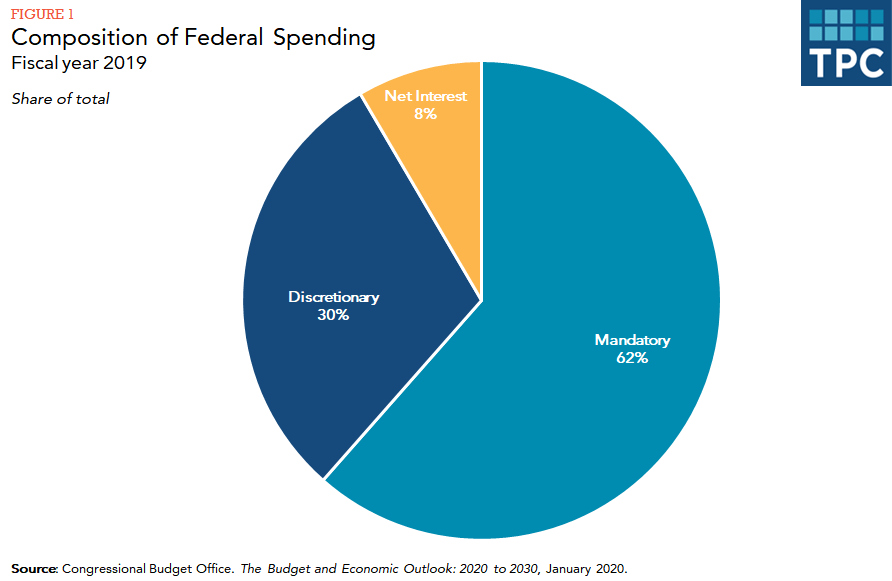
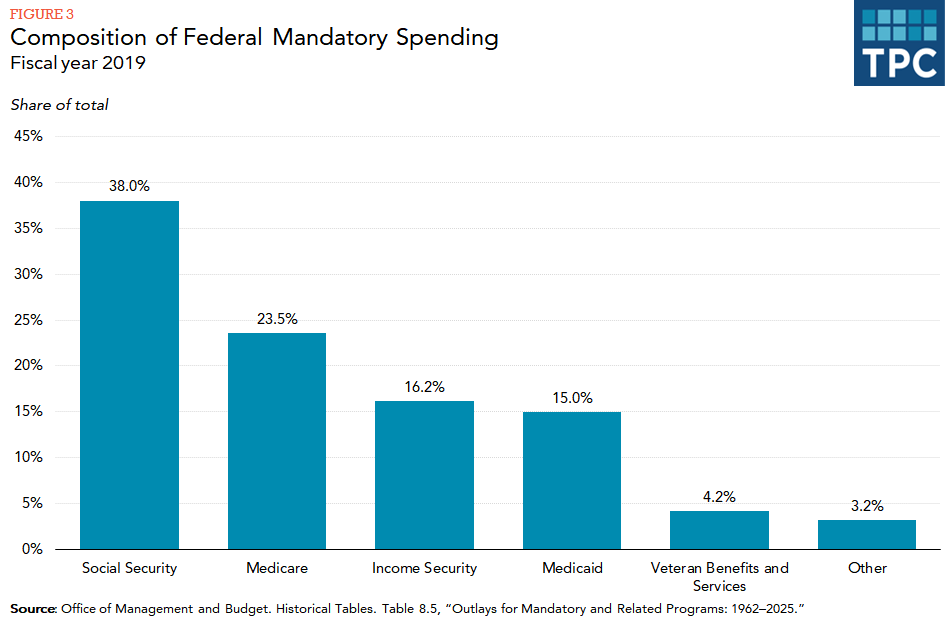
The classic example of chaos is the “butterfly effect,” wherein a butterfly flapping its wings in Brazil causes a hurricane to damage the coast of North Caroline. Economics is highly chaotic because it blends two chaotic systems, business, and psychology. Thus, while economists make predictions and are eager to point to successful forecasts, the fact is that forecasting success is, at best, intermittent. That said, while I feel sure that any level of UBI would reduce poverty and grow the economy, caution is the best approach to uncertainty. One thought would be to give each man, woman, and child in America $1000 per month — $12,000 per year —  tax-free. That would add about $4 trillion to the economy. For comparison: Federal spending totaled $4.4 trillion in 2019. Pie chart showing mandatory (62%), discretionary (30%) and net interest (8%) portions of federal spending in fiscal year 2019.Bar chart showing shares of federal mandatory spending on Social Security (38%), Medicare (23.5%), income security (16.2%), Medicaid (15%), Veteran Benefits/Services (4.2%) and other in fiscal year 2019.               The $1000 would be on top of whatever is received from Medicare, Social Security, and other benefit programs. After the first year, Congress could evaluate the program’s effectiveness in lifting the poor and growing the economy. There is no valid reason not to do it. It’s how America can regain its moral and economic leadership. Rodger Malcolm Mitchell Monetary Sovereignty Twitter: @rodgermitchell Search #monetarysovereignty Facebook: Rodger Malcolm Mitchell

……………………………………………………………………..

The Sole Purpose of Government Is to Improve and Protect the Lives of the People.

MONETARY SOVEREIGNTY
Economic Bonus (EB) and the comparative morals of two nations

The Ten Steps to Prosperity, which is at the end of most posts on this site, includes:

Step 3: Monthly bonus for all Image result for generous

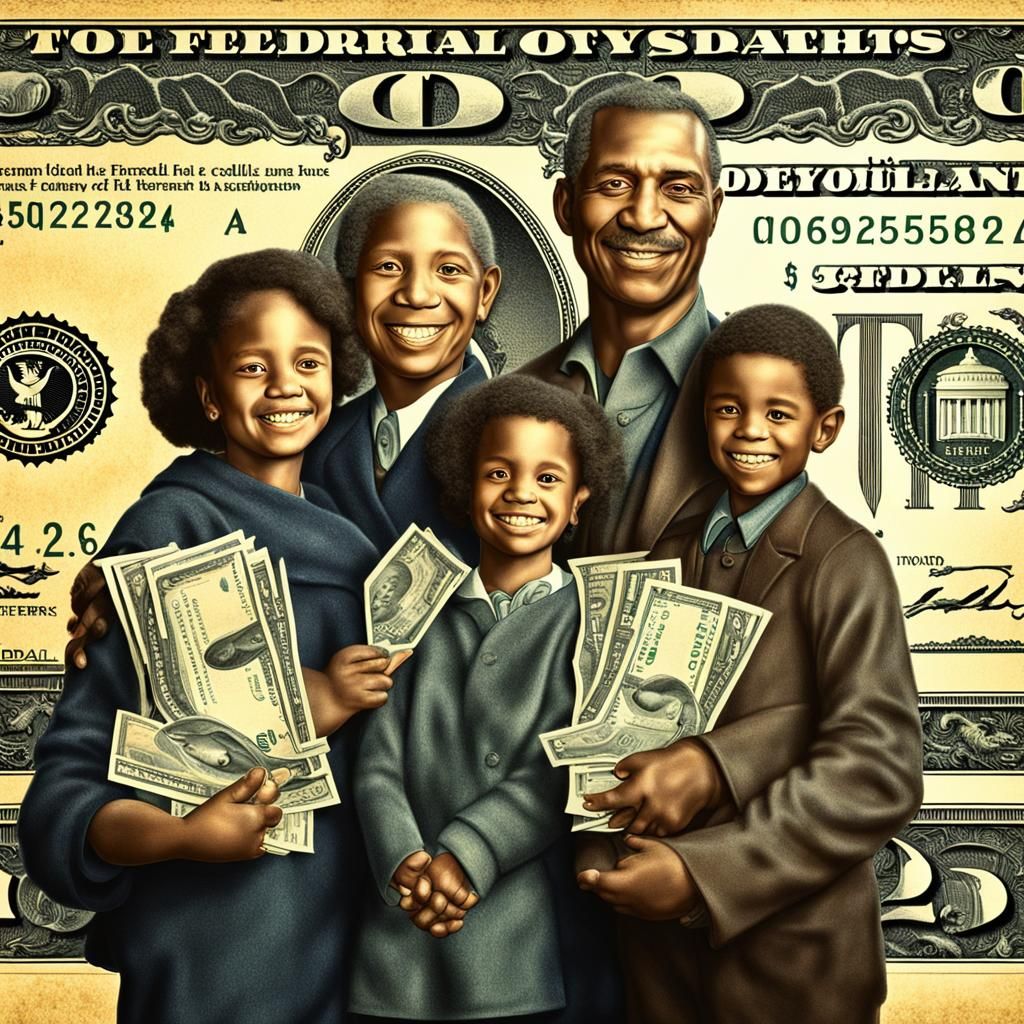
This step proposes we give a monthly Economic Bonus (EB) to every man, woman, and child in America, regardless of any other income or wealth they may have.

You would receive the same EB as the poorest receives and as Bill Gates receives.

No need to go through the convoluted steps our gigantic tax code demands, to determine what is “income,” and what kind of income it is, and when you received it and how you received it, etc., etc.

If you live in America, you receive your monthly EB.

The whole economy benefits by receiving dollars from the government, but the poorer would benefit proportionately more from this direct infusion.

It’s just more dollars for the economy, and it costs no one anything — not you, not me, not even our federal government, which creates dollars, ad hoc, by paying bills.

How much should the EB be? My early thought is $1K per month for each person above the age of 21, and $500 per month for everyone below that age.

Why not more? Or less? I wish I could give you a strong reason, but there is none. The U.S. government already has done something similar.

In a weak attempt to moderate the Great Recession of 2008, the government mailed each taxpayer a check for as much as $500, depending on their tax return.

Had the government sent every person $5,000 rather than the $500 maximum per family, the recession likely would have ended immediately.

Starting with $1K and $500 per month allows time to evaluate results. The program could be stopped during the first year, modified, or extended indefinitely.

Perhaps sending money to the “lazy” poorer, goes against our Puritan grain and our self-image of deserving what we get. But we should move past that notion.

There are many reasons people don’t have money, and unwillingness to work isn’t anywhere near the top of the list.

There have been three primary objections to EB:

  1. It would cost the federal government and taxpayers too much.
  2. It would cause inflation.
  3. It would encourage sloth and discourage people from working

Readers of this site understand that as a Monetarily Sovereign nation, the U.S. government never can run short of dollars, and so does not need or use tax dollars to fund its spending.

Those readers also know that our Monetarily Sovereign government has absolute control over the value of its sovereign currency, the U.S. dollar, so federal deficit spending does not and has not ever caused inflation.

Finally, moral readers understand that a nation can be considered great only if it is willing to care for the poorest and least powerful of its people.

Liberals think the purpose of government is to protect the poor and powerless from the rich and powerful. Conservatives think the purpose of government is to protect the rich and powerful from the poor and powerless.

Here is an article describing Finland’s experiment with something similar to EB, and the attempt to care for anyone who lacks sufficient income for a healthy productive life:

New Scientist Magazine, Feb 16, 2019
Universal income study finds money for nothing won’t make us work less
By Joshua Howgego

For the last two years the Finnish government has been giving 2000 unemployed people a guaranteed, no-strings-attached payment each month.

It is the world’s most robust test of universal basic income, and the preliminary results, released this morning, seem to dispel some of the doubts about the policy’s negative impacts.

Universal basic income comes in different flavours, but the essence of the idea is to give everyone a guaranteed income that covers their basic needs, like housing and food.

Here it differs from Step 3., Monthly Bonus for All, in that it has the specific goal of covering listed needs rather than merely to give everyone money.

But merely giving everyone money has the advantage of eliminating all argument about what “basic needs” are, and how much is “basic.”

(What kind of food? How much food? What kind of housing? What housing location? Is education basic? Etc.)

Crucially, the income is the same for everyone all the time – it does not get reduced if, for example, a person gets a job or a salary increase.

This approach is the same as for Step. 3.

The Finnish results were hotly anticipated because the experiment’s careful design promised robust evidence on UBI.

This is an exceptional experiment, both socially and globally,” said Pirkko Mattila, Finland’s minister of social affairs and health, at a press conference.

The experiment began in December 2016. Kela, the Social Insurance Institution of Finland, randomly selected 2000 people aged between 25 and 58 from across the country who were on unemployment benefits.

It then replaced those people’s unemployment benefits with a guaranteed payment of 560 euros a month. They would continue receiving the payments whether they got a job or not.

Continuing to receive payments, whether or not employed, is similar to what EB would offer.

The experiment ended on 31 December 2018 and compared the income, employment status and general wellbeing of those who received the UBI with a control group of 5000 who carried on receiving benefits.

The surveys also showed that the UBI group perceived their health and stress levels to be significantly better than in the control group.

“This is early data but nonetheless a significant moment as global interest gathers in basic income,” says Anthony Painter at the RSA think tank, which is working with the Scottish government to scope out a possible trial of UBI in Fife.

Supporters of UBI say that it frees people’s time for social goods like looking after children or serving their community, although this wasn’t measured in the Finnish trial.

Additionally, requiring unemployed people to continually prove they are looking for work creates a lot of stress for them, which is bad for their health and may mean they are less likely to be able to find work.

The above are just two of the many criticisms of the Modern Monetary Theory’s “Jobs Guarantee” (JG)proposal.

It also creates bureaucracy for the state.

The above is another of the many weaknesses of the JG proposal.

Not only would JG necessitate a huge bureaucracy, but the bureaucracy constantly would have to change with changes in the economy. As more or fewer people were unemployed, at any given time, they would need service.

On the other hand, basic income is expensive, even if it replaces existing benefits. And some say it could encourage people to work less.

“The criticism levelled at basic income that it would disincentivise work is not supported by [the Finnish] data,” says Painter.

There was no difference between the two groups in terms of the number of days in employment in 2017.

The fact that UBI and EB would be “expensive” (however that term is defined) is a feature, not a flaw — at least in the case of the U.S. government.

“Expensive” by any definition merely means that the government pumps more growth dollars into the economy.

Interestingly, Finland is monetarily no-sovereign. They use the euro, which is not their sovereign currency. Finland does not have the unlimited ability to create euros. It can run short of euros.

Yet it was Finland, and not the U.S., that felt the moral and economic needs to run the experiment. It makes one wonder about the comparative morals of the two nations.

UBI is a concept that originated at least 200 years ago. But over the past few years it has become a fashionable policy idea, with many countries exploring pilot studies.

One reason for the increased interest is the fear that automation might displace large numbers of people from employment – essentially robots taking our jobs.

There have been several other trials of the idea, but none were definitive. Take for example the Mincome experiment, in which the 10,000 citizens of Dauphin in Manitoba, Canada, were guaranteed a basic level of financial security in 1975.

Recent analysis of public records from the time showed that it was only young men and young women who spent less time in work during the trial, and this because they were either in college or looking after babies.

Again, the Puritanical “sloth” concern did not emerge.

Yet there was no control group. And it wasn’t a true basic income, because the money wasn’t given unconditionally — people’s earnings were topped up when they dropped below a threshold.

Painter points out that, because the Finish experiment chose people randomly from across Finland, it can’t tell us about any regional differences in the effects of UBI. “There is a strong case for further experiments,” says Painter. “It would be good to see ‘saturation’ pilots where everyone in an entire area receives a basic income.”

Today, the U.S. debates various, insufficient versions of Step 2, Federally Funded Medicare –Parts A, B & D, Plus Long Term Care — for everyone, and has not even addressed the easily-taken Step 1, Eliminate FICA — all because of non-existent cost issues.

Other nations, that do not have as much financial ability as the U.S. to support social benefits, recognize the need and move forward with experiments and actual implementation.

Meanwhile, the wealthy and Monetarily Sovereign U.S. focuses on how to reduce Social Security, reduce Medicare, and pay for walls and other ways to keep out refugees.

Yes, it makes one wonder.

Rodger Malcolm Mitchell
Monetary Sovereignty
Twitter: @rodgermitchell
Search #monetarysovereigntyFacebook: Rodger Malcolm Mitchell

…………………………………………………………………………………………………………………………………………………………………………………………………………………………………………………………………………………………..

The most important problems in economics involve the excessive income/wealth/power Gaps between the richer and the poorer.

Wide Gaps negatively affect poverty, health and longevity, education, housing, law and crime, war, leadership, ownership, bigotry, supply and demand, taxation, GDP, international relations, scientific advancement, the environment, human motivation and well-being, and virtually every other issue in economics.

Implementation of The Ten Steps To Prosperity can narrow the Gaps:

Ten Steps To Prosperity:

1. Eliminate FICA

2. Federally funded medicare — parts a, b & d, plus long-term care — for everyone

3. Provide a monthly economic bonus to every man, woman and child in America (similar to social security for all)

4. Free education (including post-grad) for everyone

5. Salary for attending school

6. Eliminate federal taxes on business

7. Increase the standard income tax deduction, annually. 

8. Tax the very rich (the “.1%) more, with higher progressive tax rates on all forms of income.

9. Federal ownership of all banks

10. Increase federal spending on the myriad initiatives that benefit America’s 99.9% 

The Ten Steps will grow the economy, and narrow the income/wealth/power Gap between the rich and you.

MONETARY SOVEREIGNTY