Rachel Greszler is a research fellow in economics at The Heritage Foundation. David Ditch is a researcher specializing in transportation issues for Heritage’s Hermann Center for the Federal Budget.Rachel Greszler and David Ditch, The Heritage Foundation on Aug 5, 2021Most Americans realize the federal government spent a lot of money, including three rounds of so-called “stimulus payments” that most households received. But those $3,200 worth of individual checks pale in comparison to total spending.If ordinary Americans had spent like the federal governmentdid in 2020, the median household that earns $68,703 would have spent $131,620 and put $62,917 on the credit card, despite already being $541,287 in debt.
As of 2021, the U.S. debt comes out to roughly $220,000 per household. That’s enough to buy about eight years’ worth of groceries, gas, clothing, and housing for the typical household.
The above is a completely meaningless and misleading comparison, that is supposed to shock you, but not to inform you. You are not, and never will be liable for the so-called, misnamed federal “debt.”It isn’t a debt, and no one is liable for it.
And even that figure doesn’t include the unfunded liabilities of Social Security and Medicare. Without a significant reduction in the size of those programs, each household’s total debt is actually over $660,000. That’s equal to the cost of a median family home, a new car, plus over five years’ worth of a typical household’s income.
Utter nonsense. All federal liabilities are “unfunded” until the government funds them by creating dollars, ad hoc.
The real purpose of the article is to groom you for acquiescence to right-wing calls for Social Security and Medicare cuts. But even if the FICA tax were eliminated, the federal government could support Social Security for All and a comprehensive Medicare for All, forever.
Then follow more meaningless comparisons, all designed only to be shocking. Your household will not ever pay a single penny to pay off the so-called federal “debt.”
However, even this massive a debt doesn’t seem all that bad. Interest rates are low, and the federal government has had little problem seemingly borrowing into oblivion without consequence. (The same could be said of Greece before a financial crisis ensued.)
The fact that interest rates are low is yet more meaningless tripe. The U.S. government sets interest rates at any level it chooses, and it pays interest by creating new dollars, ad hoc, which it has the infinite ability to do.
And by the way, Greszler and Ditch, is it ignorance, stupidity, or traitorousness that causes you to compare the Monetarily Sovereign United States (which has the unlimited ability to create its own sovereign currency, the dollar) with the monetarily non-sovereign Greece (which has no sovereign currency)?
But our currently low interest rate payments—equal to over $2,500 per household in 2021, or the cost of about 6 months’ worth of groceries—are on track to rise to about $6,400 per household in 2031. That’s four months of mortgage payments.
Again, more designed-to-deceive, meaningless, false equivalences between federal finances and personal finances
And that’s the equivalent of an interest-only mortgage. Those costs don’t even begin to reduce the principal amount of debt.
The so-called federal “debt” is not a debt in the usual sense. It is the total of deposits into Treasury Security accounts (similar to safe deposit boxes) which are no burden whatsoever on the government or on future taxpayers.
While ordinary Americans aren’t allowed to take out mortgages or open up new credit cards in their children’s names, the federal government does this every day.
Yet even more ignorant, stupid, or intentionally deceptive false comparisons between federal finances and personal finances. The Heritage fraud goes on and on.
The share of debt for a child born this year was $66,874. And that debt is on track to rise every year, reaching $111,552 by the time they’re 18 and either start working or head off to college. It will then hit $191,768 by the time they’re 30 and potentially raising young children.
The above implies that future children will have to pay for the so-called “debt.” It is a lie of the first order.
No one will pay for the “debt” because it is not debt. It is deposits that will be paid off as they always have been: By simply returning the dollars in those T-security accounts.
Fortunately, it’s not too late to prevent the nation from going broke.
It is impossible for the United States to “go broke.” Being Monetarily Sovereign (unlike Greece), the U.S. has the unlimited ability to create dollars. If needed, it could press one computer key and create a trillion dollars tomorrow.
Congress should cut out wasteful spending such as corporate welfare and excessive compensation for federal bureaucrats.
The Heritage Foundation, being right-wing, now complains about “corporate welfare.” Do they mean the Republicans’ tax cuts for businesses?
And really, how many federal bureaucrats receive “excessive compensation”?
Of course, the whole thing is meaningless, because all federal deficit spending, even so-called “wasteful” spending, benefits everyone by adding stimulus dollars to the economy.
Congress should stop shirking their responsibilities by placing an increasing amount of federal spending on autopilot, and instead seek to reform programs like Social Security and Medicare that are on a path to bankruptcy.
I have no idea what “autopilot” means in this context. I suspect the authors don’t know, either. But none of it matters.
The real purpose is to make you believe Social Security and Medicare should be cut. That is the goal of The Party of the Rich, the Republicans.
The rich, who support Heritage Foundation, always want to widen the Gapbetween the rich and the rest. The wider the Gap, the richer are the rich. It’s known as Gap Psychology — the desire to widen the income/wealth/power Gap below, and to narrow the Gap above.
So they repeatedly warn that Social Security and Medicare soon will run short of money, despite their being a federal agency that has available to them, infinite dollars.
Neither the federal government, nor any agency of the federal government, can go bankrupt unless Congress and the President want them to.
Congress should focus on core federal responsibilities and clear away countless programs that benefit narrow interest groupsat the expense of the public good.
The elderly and the poor — are they what Heritage considers to be “narrow interest groups”?? Or aren’t the rich — Heritage’s buddies — who really comprise the narrow interest groups?
Congress should recognize our looming debt disaster and step away from shortsighted spending plans.
Big problems like the unsustainable national debt won’t be solved quickly or easily. However, Congress must begin to take fiscal responsibility seriously as soon as possible.
The “unsustainable” national debt has been growing massively, and sustaining, since 1940, while organizations like Heritage have been crying “Wolf” again, and again, and again.
Otherwise, a Greece-like fate may await us.
And the article ends appropriately, with one, final, false comparison of monetarily non-sovereign Greece vs. Monetarily Sovereign America. The Big Lie is alive and well at Heritage.
Even, an organization as devoted to advancing the interests of the rich vs. the rest, should be embarrassed by the above article.
It is so wrongheaded and misleading as to be written by fools and approved by traitors. They do more to hurt America than do the most devoted Russian, Iranian, and Chinese spies.
Perhaps The Heritage Foundation should be renamed The Benedict Arnold Foundation.
Rodger Malcolm Mitchell
Monetary SovereigntyTwitter: @rodgermitchellSearch #monetarysovereigntyFacebook: Rodger Malcolm Mitchell
……………………………………………………………………..
THE SOLE PURPOSE OF GOVERNMENT IS TO IMPROVE AND PROTECT THE LIVES OF THE PEOPLE.
Gap Psychology describes the common desire to distance oneself from those “below” in any socio-economic ranking, and to come nearer those “above.” The socio-economic distance is referred to as “The Gap.”
Wide Gaps negatively affect poverty, health and longevity, education, housing, law and crime, war, leadership, ownership, bigotry, supply and demand, taxation, GDP, international relations, scientific advancement, the environment, human motivation and well-being, and virtually every other issue in economics.Implementation of Monetary Sovereignty and The Ten Steps To Prosperity can grow the economy and narrow the Gaps:
Ten Steps To Prosperity:
When you hear about the U.S. federal “debt,” or “deficits,” you probably visualize something akin to personal debt or deficits, corporate debt/deficits, or local government debt/deficits.
And when hear about federal “borrowing,” you probably visualize borrowing similar to personal, corporate, or local government borrowing.
If that’s what you’d visualize, you would be wrong.
Federal finances are nothing at all like personal, corporate, or local government finances.
The difference begins with the fact that the U.S. government is uniquely Monetarily Sovereign.
In the beginning of our nation, the federal government created laws from thin air. Some of those laws created the U.S. dollar from thin air– as many dollars as the government wished.
And those laws gave those dollars whatever value the government wished.
That is what being sovereign over the dollar means: Total, 100% control over the laws that have total 100% over all aspects of the dollar. In real effect, the federal government is God of the Dollar
Throughout the history of America, the U.S. federal government has continued to create as many dollars as it wished at whatever values it wished.
These values arbitrarily were changed many times, and even today the federal government creates dollars at will, just by pressing computer keys, and controls their value.
Neither you, nor any corporation, nor any local/state government has this ability with respect to U.S. dollars. You are monetarily non-sovereign.
The federal government’s unique and unlimited ability to create dollars and arbitrarily to control their value means.
Unlike you, businesses, and local governments, the federal government never unwillingly can run short of dollars.
Unlike you, businesses. and local governments, the federal government neither needs nor uses income.
Imagine that you own a dollar-creating machine that allows you legally to create any number of dollars you wished. You could press keys that create, a million dollars, or a billion, or a trillion, trillion, trillion dollars.
Would you need any other source of income?
Think logically: Would you ever need to borrow dollars?
Would you ever need to levy taxes on anyone, to acquire dollars?
Would you ever have any difficulty paying for anything?
And, in fact, the federal government does not borrow dollars. It levies taxes, but not to acquire dollars. And it can pay for anything at the touch of a computer key.
Federal taxes do not provide the federal government with spending money.The purpose of federal taxation is to control the economy by taxing what the government wishes to discourage, and by giving tax breaks to what the government wishes to encourage.
Even if all federal taxing ended, and tax collections equaled $0, the federal government could continue spending, forever.
BORROWING AND THE “DEBT”
The federal government never borrows.
Some people claim that T-securities — T-bills, T-notes, T-bonds — represent borrowing. That claim is wrong.
You, and businesses, and state/local governments borrow to acquire dollars you do not have, or to acquire dollars at a lower cost than you can earn by investing. When you buy a house or a car, you may finance the purchase if you don’t own enough dollars to cover the cost, or if the interest you would pay is less than you could earn with those dollars.
But the federal government has the ability to create infinite dollars at essentially zero cost. It has no reason to borrow.
So why does the government sell T-securities?
.
The purposes of T-securities are:
A. To provide safe, interest-paying “parking places” for unused dollars. This safety helps to stabilize the value of the dollar.
B. To help the Fed control interest rates, which is one of the methods by which the government controls the value of the dollar, i.e. controls inflation.
When you purchase a T-bill, note, or bond, you actually open a T-security account and deposit your dollars into your T-security account.
This account is comparable to a bank, safe-deposit box. The federal government never touches the dollars in your T-security account.
There, your dollars stay, earning interest, until maturity, at which time all the dollars in your account are returned to you.
The so-called federal “debt” is the total of the dollars in all T-security accounts. To pay off the “debt,” the federal government merely returns those dollars to the account holders. No tax dollars or future taxpayers are involved.
Contrary to what you repeatedly are told, your children and grandchildren will not pay off the “debt.” No one will. Paying off the “debt” merely involves the return of existing dollars.
Thus, the “debt,” no matter how large, never is a burden on the federal government, nor on taxpayers, nor on the economy.
In this regard, there is the mistaken belief that the federal government should borrow when interest rates are low, because that would constitute a reduced repayment burden. This belief is laughably wrong because:
The federal government does not borrow and is not a debtor liable for the federal debt.
The federal government sets interest rates at any level it wishes, and can do so, instantly.
The federal government has the infinite ability to pay for anything.
The interest the federal government pays constitutes growth dollars for a healthy economy.
THE “DEFICIT”
The federal “deficit” is the net amount that the federal government invests in the economy each year.
It is the difference between the number of dollars the government spends into the economy vs. the number of dollars the government takes out of the economy via taxation.
It would be far more accurate to replace “deficit” with “federal investment.”
The single most common measure of the economy is Gross Domestic Product (GDP), one formula for which is:
GDP = Federal Spending + Non-federal Spending + Net Exports.
All three terms, Federal Spending, Non-federal Spending, and Net Exports, add growth dollars to the economy. By formula, it is impossible for GDP to grow without growth dollars, andthe primary, long-term source of growth dollars is the federal government.
Virtually every recession and depression in U.S. history has resulted from insufficient “deficit” growth, i.e. insufficient federal investmentinto the economy.
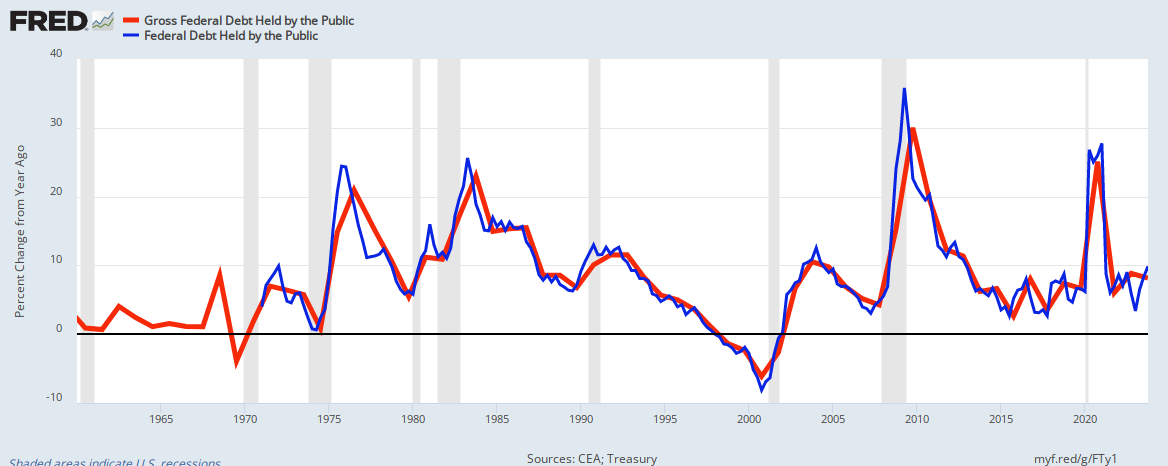
Recessions (vertical gray lines) follow reduced deficit growth (red and blue lines). Recessions are cured by increased deficit growth.
Depressions follow federal surpluses (i.e. complete elimination of net federal investment in the economy.)
1804-1812: U. S. Federal Debt reduced 48%. Depression began 1807.
1817-1821: U. S. Federal Debt reduced 29%. Depression began 1819.
1823-1836: U. S. Federal Debt reduced 99%. Depression began 1837.
1852-1857: U. S. Federal Debt reduced 59%. Depression began 1857.
1867-1873: U. S. Federal Debt reduced 27%. Depression began 1873.
1880-1893: U. S. Federal Debt reduced 57%. Depression began 1893.
1920-1930: U. S. Federal Debt reduced 36%. Depression began 1929.
1997-2001: U. S. Federal Debt reduced 15%. Recession began 2001.
To avoid recessions and depressions, the federal government consistently must invest new dollars into the economy. Although this investment commonly is known by the pejorative terms, “deficits” and “debt,” it should be called “economic investment.”
The U.S. federal government, being Monetarily Sovereign, and thus having the infinite ability to create its own sovereign currency, the U.S. dollar, never should reduce its annual investment in the economy. For a healthy economy, the so-called “deficit” and “debt” always should increase.
INFLATION
Contrary to common claims, inflation never is caused by “too much” federal deficit spending.
All inflations are caused by shortages of key goods and services, usually shortages of food or energy.
In fact, the best cure for inflations is additional “deficit” spending to increase the supply of the scarce goods and services. Example:
The notorious Zimbabwe hyperinflation began when the Zimbabwe government took farmland from farmers and gave it to people who did not know how to farm.
The resultant food shortage caused inflation, which could have been cured by additional government investment to assist the new farmers (via education and equipment) and to obtain food from overseas and distribute it to the populace.
Instead, the Zimbabwe government simply printed currency, which gave the illusion that government money-creation caused inflation. In reality, the scarcity of food caused inflation.
Scarcities cause prices to rise. All inflations are caused by scarcities.
Cure the scarcities and you cure the inflation.
GOLD
Let us discuss one more common myths in economics: When the U.S. dollar was “backed” by gold, this helped stabilize the dollar and encouraged trust in the dollar.
The term “back” is another word for “collateral,” which is “something pledged as security for repayment of a loan, to be forfeited in the event of a default.”
The reality: Gold never collateralized the U.S. dollar — not during the times when the U.S. was on various gold standards, and not today. Never.
The notion of “backing” comes from the belief that if something happened to reduce the value of the dollar, the holder of a dollar always could turn to gold.
This notion is utter nonsense.
During gold standard times, the U.S. government arbitrarily determined the exchange rate between the dollar and gold.
The U,S. Coinage Act of 1792 arbitrarily fixed the exchange rate at one dollar to 24.75 grains of fine Gold and 371.25 grains of fine Silver.
In 1862, Congress passed the Legal Tender Act. Paper currency was guaranteed only by the full faith and creditof the United States and could not be redeemed for Gold.
In 1875, Congress passed the Specie Payment Resumption Act, in which paper currency again could be redeemed for Gold.
In 1913, the Federal Reserve was allowed to print paper currency with 40% of the currency’s value to be reserved in Gold.
In 1933, gold had to be turned over to the government at $20.67 per ounce.
In 1934, the government arbitrarily set a new gold price of $35 per ounce
In 1971, dollars no longer could be redeemed for gold. Paper currency was ensured only by the full faith and credit of the United States.
Clearly, gold cannot “back” the dollar whilen the federal government has the unlimited ability to change the exchange value of gold at will. What kind of collateral is it that cannot be relied upon?
It would be akin to your house being collateral for your mortgage, but at any time, you could substitute a different house to back your mortgage.
So what does collateralize the U.S. dollar? The same thing that always has “backed” the dollar, from the day it first was created: The full faith and credit of the U.S. government. Period.
Every form of money, including the U.S. dollar, is a debt of the money issuer, and every debt requires collateral. The U.S. dollar is a debt of the federal government. The collateral for federal debt is “full faith and credit,” which involves certain, specific, and valuable guarantees:
A. – The government will accept only U.S. currency in payment of debts to the government
B. – The government unfailingly will pay all its dollar debts with U.S. dollars and will not default
C. – The government will force all your domestic creditors to accept U.S. dollars, if you offer them, to satisfy your debt.
D. – The government will not require domestic creditors to accept any other money
E. – The government will take action to protect the value of the dollar.
F. – The government will maintain a market for U.S. currency
G. – The government will continue to use U.S. currency and will not change to another currency.
H. – All forms of U.S. currency will be reciprocal, that is five $1 bills always will equal one $5 bill and vice versa.
IN SUMMARY
Federal “deficits” actually are the net annual investments in economic growth by the federal government. The economy cannot grow without money growth; insufficient money growth results in recessions, and federal surpluses result in depressions.
Federal “debt” is the total of government investments, which equals, by law, the total of deposits into T-security accounts. The federal government pays off those T-security accounts by returning the money to the account holders, and not with tax dollars. Thus, no one is liable today or in the future for paying off the “debt.”
Inflation is caused by shortages of key goods and services, not by “excessive” federal deficit spending.
All money is a debt of the money issuer. All debt requires collateral. Gold never has been the collateral for the U.S. dollar. The collateral for the U.S. dollar is, and always has been, the full faith and credit of the U. S. government.
Gap Psychology describes the common desire to distance oneself from those “below” in any socio-economic ranking, and to come nearer those “above.” The socio-economic distance is referred to as “The Gap.”
Wide Gaps negatively affect poverty, health and longevity, education, housing, law and crime, war, leadership, ownership, bigotry, supply and demand, taxation, GDP, international relations, scientific advancement, the environment, human motivation and well-being, and virtually every other issue in economics.Implementation of Monetary Sovereignty and The Ten Steps To Prosperity can grow the economy and narrow the Gaps:
Ten Steps To Prosperity:
Economics is simple, though you wouldn’t know that if you ever were confronted with an economics text.
Filled with jargon and maths, an economics textbook can be a daunting read, intentionally so, because nothing tells the world “I am real science” better than arcane language and impenetrable maths.
Part of the problem with labeling economics a science is that it is the study of the psychology of money, and psychology is a “science” only in the broadest, most charitable definition:
Wikipedia: Science (from Latin scientia ‘knowledge’) is a systematic enterprise that builds and organizes knowledge in the form of testable explanationsand predictions about the universe.
Sadly, neither psychology nor its little sister, economics, are systematic, provide testable explanations or worthwhile predictions. Rather than being sciences, they are faith/belief systems (religions without mythical gods), filled with self-congratulatory experts, who endlessly expound with certainty, while providing scan proof, few tests, and laughably wrong predictions.
I apologize to tell you, I am an economist.
In this post, I provide you with none of the aforesaid maths and as little jargon as I can manage, hoping only to provide a bit of counterbalance to the flood of woolly-headed, faux expertise that confronts you every day.
Economics is simple because you can understand virtually everything of importance by understanding just two simple things — Monetary Sovereignty and Gap Psychology — and having understood them, you will know more than any politicians, any media pundits, and any economics professors, who don’t wish you to understand these simple things.
Monetary Sovereignty“Monetary” means relating to money. “Sovereignty” means having ultimate power or authority. Thus the term “Monetary Sovereignty” means having ultimate power or authority over money.
The U.S. government created the first dollar from thin air by creating laws from thin air. These laws are entirely arbitrary in inception and they repeatedly have been changed, arbitrarily.
Because the laws that created U.S. dollars were created by the U.S. government and remain under the complete control of the U.S. government, and no other entity, dollars themselves are under the complete control of the U.S. government.Laws have no physical existence. You cannot see, smell, taste, feel, or hear a law. It is an idea, a concept, a description. A lawbook might contain descriptions of thousands of laws, but the book itself contains no laws. The paper and ink that comprise the book are not laws. They merely representlaws.
This does not mean that laws are not real. Laws are very real. They just are not physical.
Consider, for instance, a law against murder. What does that law look like? How does it feel to the touch? How does it taste or smell? Despite being non-physical, the law is real, and because it is non-physical the law can be anything its creators deem it to be.
The U.S. government is legally sovereignover U.S. laws. These laws can be anything the government and the American voters wish them to be. The degree to which voters influence laws is known as “democracy.”
Not only are the U.S. government and the American voter sovereign over our laws, but we never can run short of laws. The federal government does not need to collect laws from you in order to create more laws. The U.S. government creates endless laws, ad hoc, arbitrarily.
Even if American voters did not supply a single law to the federal government, the government could continue creating new laws, forever. This difference between the number of laws supplied to the government, and the number of laws created each year might be known as a federal “deficit of laws,” and the totality of all laws in existence might be known as the federal “law debt.”
Among the laws created by the federal government and the people, are the laws creating dollars. Just as laws have no physical existence, dollars also have no physical existence.
The reason gold coins, for instance, are not money, is that laws cannot create gold coins. Laws cannot create gold, and laws cannot create coins. Only people can do that. And just as law books are not laws — they represent laws — gold coins only represent money.
Similarly, paper dollars are not dollars. They represent dollars, which are non-physical bookkeeping entries.
To create dollars, the federal government neither needs nor uses any input of dollars. Even if all federal taxes were eliminated, the Monetarily Sovereign federal government could continue creating new dollars, forever.
The mathematical difference, each year, between dollars sent to the federal government vs the dollars created by the federal government is known as the federal “deficit,” and the total of all deficits is known a the federal “debt.”
Money, like the laws that create it, is ideas, concepts, abstractions. And because laws and ideas are not physical, they are whatever their creator deems them to be at any given moment.
Very soon, we will endure the annual “debt limit” fight, a fake conflict having absolutely nothing to do with the federal government’s ability to service its debt. The federal “debt” is not a debt and even if it were, the federal government has the unlimited ability to fund anything.
Why the fight? It’s all theater, the purpose of which is to convince you that the actors are financially prudent. So the party that is out of power will protest, and the party in power will assure, and everyone one will huff and puff, and eventually, having made their points, the fakers, feigning anger, reluctantly will agree to set a new, higher debt limit for the future.
There can be no greater proof of government duplicity than the federal “debt” limit.
INFLATION: Can there be too many laws? Can the annual “deficit of laws” and the “law debt” be too high? In essence, can there be law “inflation,” in which the addition of new laws depreciates the value of existing laws?
For instance, can the creation of say, a new law against speeding, make all other laws less valuable, i.e. cause law inflation?
Or by parallel, can the creation of new dollars make all other dollars less valuable, i.e. cause inflation?
The federal government has access to infinite laws and to infinite dollars, both of which it sends into the economy, at will.
Neither the creation and promulgation of new laws nor the creation and promulgation of new dollars depreciates the laws and dollars already in existence. New ideas, concepts, and abstractions do not depreciate existing ideas, concepts, and abstractions.
Infinity plus one equals infinity.
The U.S. government is uniquely Monetarily Sovereign over the U.S. dollar. No other entity has this God-like power over the dollar.
Having this power and authority means the government can control the supplyof dollars at whatever levels it arbitrarily chooses. It never can run short of dollars. The federal government can afford anything and does not need to have income. It simply creates, by fiat, any number of dollars whenever the mood strikes.
(That is why the term “fiat money” is a redundancy. All money is fiat, i.e. created by fiat.)
The government also can control the value of the dollar in relation to any other product or currency. It can decide, by fiat, that a dollar is worth an ounce of silver, a pound of beef, or a partridge in a pear tree.
This means inflation is not caused by government spending but rather is caused by scarcities of key goods and services.
Inflation can be prevented and cured by preventing and curing scarcities. The federal government can accomplish this by federal deficit spending to obtain, or facilitate the creation of, the scarce goods and services.
Example: The notorious Zimbabwe hyperinflation was caused by food scarcity. The government took farmland from experienced farmers and gave it to inexperienced non-farmers. The resultant inflation could have been cured by government financing to support farming via education and material support.
Instead, the Zimbabwean government merely created money, while the scarcities grew unabated.
The other “simple thing” upon which economics stands is:
Gap Psychology
The “Gap” represents the distances between those who have more income, wealth, privilege, and power vs. those who have less.
The Gap (or rather, “Gaps”) are what makes the richer richer and the poorer poorer. Without the Gaps, no one would be rich; we all would be the same. And the wider the Gaps, the richer are the richer.
The richer always wish to grow richer yet.
The rich can grow richer, that is widen the Gaps, by gaining more for themselves or by making sure those below them lose, or at least gain less.Either method will do.
The rich generally oppose and demean aids to those who have less. They claim Social Security and Medicare are running short of dollars, though no federal agency runs short of dollars unless that is what Congress and the President want.
The rich, who control Congress, have made sure the FICA tax falls most heavily on the poor and middle classes. It is why capital gains are taxed more lightly than salaries. These are evidence of the rich growing richer by widening the Gaps.
The rich despise the poor. Hatred is a symptom of fear. There can be no hatred without fear, and the rich fear the poor masses. The rich fear not only lanterns and pitchfork uprisings, but more realistically, the latent voting power of the masses.
If the masses ever were to realize how false are the claims by the bribed media, the bribed politicians, and the bribed economists, those masses would rise up and demand that the Gaps be narrowed.
Yes, bribed. The media are bribed by rich ownership and advertising dollars. The politicians are bribed with campaign contributions and promises of lucrative employment. The economists are bribed with university endowments and promises of well-paying jobs at think tanks.
Wide Gaps are economically corrosive. They negatively affect poverty, health and longevity, education, housing, law and crime, war, leadership, ownership, bigotry, supply and demand, taxation, GDP, international relations, scientific advancement, the environment, human motivation and well-being, and virtually every other issue in economics.
IN SUMMARY
Economics studies money and its movement, which is controlled by human psychology.
The foundation of today’s economics is Monetary Sovereignty, the ability of an entity, usually but not always a nation, to create and control unlimited amounts of money and to determine the value of that money.
The engine that drives economics is Gap Psychology, the common human desire to widen the income/wealth/power Gaps below, and to narrow the Gaps, above.
Rodger Malcolm Mitchell
Monetary SovereigntyTwitter: @rodgermitchellSearch #monetarysovereigntyFacebook: Rodger Malcolm Mitchell
……………………………………………………………………..
THE SOLE PURPOSE OF GOVERNMENT IS TO IMPROVE AND PROTECT THE LIVES OF THE PEOPLE.
Gap Psychology describes the common desire to distance oneself from those “below” in any socio-economic ranking, and to come nearer those “above.” The socio-economic distance is referred to as “The Gap.”
Wide Gaps negatively affect poverty, health and longevity, education, housing, law and crime, war, leadership, ownership, bigotry, supply and demand, taxation, GDP, international relations, scientific advancement, the environment, human motivation and well-being, and virtually every other issue in economics.Implementation of Monetary Sovereignty and The Ten Steps To Prosperity can grow the economy and narrow the Gaps:
Ten Steps To Prosperity:
America is in trouble. We have way too much poverty, crime, and murder.
There is far too large a Gap between the rich and the rest. Our infrastructure is crumbling. Our schools, grades K-12 are shameful. Our healthcare system is inadequate.
We no longer lead the world in most measures except perhaps in the number of nuclear weapons we can fire.
We are a long, long way from being “the greatest country in the world,” as we love to boast.
We face treason on a national scale.
And the single biggest reason for our numerous failures is exemplified by the following article:
Manchin draws red line in infrastructure talksJordain CarneySen. Joe Manchin (D-W.Va.) warned on Tuesday that he wants both a bipartisan infrastructure bill and a separate Democratic-only bill to be fully paid for.
“I think everything should be paid for. We’ve put enough free money out,” Manchin told reporters.
Actually, the U.S. federal government always has “paid for” everything it buys. Unlike Donald Trump’s creditors, no federal government creditors ever are cheated.
But, of course, that is not what Manchin means. He means that the government should collect as many dollars in taxes as it spends — i.e. a balanced budget — which for the U.S. government, a spectacularly damaging requirement.
Either Manchin is just pandering to his right-wing, West Virginia voters, who are clueless about federal finance, or he himself is clueless about federal finance. Or both.
The federal government is unlike you, me, and all state/local governments. It uniquely is Monetarily Sovereign, meaning it has the unlimited ability to create its sovereign currency, the U.S. dollar. It cannot run short of dollars.
Every time the federal government runs a surplus, or a balanced budget, we have recessions and depressions:
U.S. depressions tend to come on the heels of federal surpluses.
1804-1812: U. S. Federal Debt reduced 48%. Depression began 1807.
1817-1821: U. S. Federal Debt reduced 29%. Depression began 1819.
1823-1836: U. S. Federal Debt reduced 99%. Depression began 1837.
1852-1857: U. S. Federal Debt reduced 59%. Depression began 1857.
1867-1873: U. S. Federal Debt reduced 27%. Depression began 1873.
1880-1893: U. S. Federal Debt reduced 57%. Depression began 1893.
1920-1930: U. S. Federal Debt reduced 36%. Depression began 1929.
1997-2001: U. S. Federal Debt reduced 15%. Recession began 2001.
We have recessions, even when we run deficits that are not large enough:Recessions (vertical gray bars) tend to occur when federal deficit growth (blue line) declines and are cured when deficit growth increases.
Manchin’s demand, if he sticks to it, could create real problems in Democratic negotiations.The party in a matter of weeks is seeking to exercise a complicated legislative goal of winning Senate approval of both a bipartisan infrastructure measure opposed by many progressives and a budget resolution that will tee up a larger Democratic bill filled with spending priorities. The latter bill will not win any GOP support and will need to pass with just Democratic votes, including Manchin’s.
The GOP will not support any bill that will benefit America, because such bills would make President Biden and the Democrats look good. The GOP’s greatest fear is that America will like what Biden does.
They hope for a recession or a depression they can point to. These are “patriots”?
A group of 22 senators, including Manchin, agreed to a framework for a bipartisan infrastructure deal that would spend $1.2 trillion over eight years. But there are concerns among Republicans that the bill isn’t fully paid for, threatening GOP support for it.
It’s a fake concern, for political purposes. Having already spent $25 trillion that “isn’t paid for” (i.e. via taxing) the federal government easily can pay for this bill, too. The 22 senators know this.
Republican negotiators in the group have warned that the Congressional Budget Office (CBO) could lowball the amount of revenue the proposal will raise.“I know there are some things that we’re relying on as pay-fors that will probably not receive a CBO score but nonetheless are real,” Sen. Mitt Romney (R-Utah) told reporters.Meanwhile, Democrats are trying to agree to a price tag for their larger bill.
The two parties are arguing about how many angels can dance on the head of a pin. It’s all political theater for you, a gigantic lie to keep you from receiving federal benefits. The GOP’s purpose is to widen the Gapbetween you and the very rich, who run the GOP.
Democrats have yet to agree on a top-line figure. Senate Majority Leader Charles Schumer (D-N.Y.) met with Democrats on the Senate Budget Committee on Monday night but didn’t get an agreement. They’ll meet again on Tuesday night.Senate Budget Committee Chairman Bernie Sanders (I-Vt.) has thrown out $6 trillion, paying for roughly half, as where he would like to go on the Democratic-only bill.Sen. Mark Warner (D-Va.), a member of the panel, has suggested he’s closer to roughly $4 trillion.
All federal spending always is fully “paid for.”
The liars would like you to forget that last year alone, the government spent more than $4 trillion in stimulus money that supposedly wasn’t “paid for.” And the GOP specifically would like you to forget their Trump tax cut for the rich, that wasn’t “paid for.”
Manchin has acknowledged that a Democratic-only bill is “inevitable” but hasn’t committed to a specific top-line figure. He’s warned, though, that he doesn’t want to go as high as Sanders.“I want to make sure we pay for it. I do not want to add more debt on. So if that’s $1 trillion or $1.5 trillion or $2 trillion, whatever that comes out to be over a 10 year period, that’s what I would be voting for,” Manchin told ABC News last month.
Sadly, Manchin either is lying or doesn’t know what he is talking about. That horrible thing called “debt” isn’t debt at all. It’s deposits in T-security accounts.
How can an entity having the unlimited ability to create money, also have a worrying “debt”? It mathematically and logically is impossible.
If you owned a legal, money-printing press, would you ever be concerned about your “debt”?
It’s all a giant charade to keep you from receiving federal benefits. Next, we’ll hear the lie that Social Security has run out of money, so you’ll receive less in benefits or pay more in FICA taxes. Then will come the lie that Medicare is broke, so it will have to reduce your benefits by increasing the deductible.
Traitor: A person who betrays a friend, country, principle, etc.Treason: The crime of betraying one’s country
I suggest that no traitor in American history has done more damage to America than the current Republican Party, led by Donald Trump. These people care nothing about America and are concerned only with pleasing the rich, collecting bribes, and winning elections.
The GOP has abided gangs to attack the Capital, conspiracy theorists like Qanon, and endless liars like Donald Trump, all to gain power for themselves.
The GOP has denied global warming, the seriousness of COVID-19, and the need for vaccination and face masks. As a direct result, Americans have died and continue to die.
The GOP’s current efforts to restrict voting rights under the subterfuge of eliminating (non-existent) fraud, is yet another step in the GOP’s treason.
Think of how the dictatorships around the world began, and you will think of today’s Republicans.
Rodger Malcolm Mitchell
Monetary SovereigntyTwitter: @rodgermitchellSearch #monetarysovereigntyFacebook: Rodger Malcolm Mitchell
……………………………………………………………………..
THE SOLE PURPOSE OF GOVERNMENT IS TO IMPROVE AND PROTECT THE LIVES OF THE PEOPLE.
Gap Psychology describes the common desire to distance oneself from those “below” in any socio-economic ranking, and to come nearer those “above.” The socio-economic distance is referred to as “The Gap.”
Wide Gaps negatively affect poverty, health and longevity, education, housing, law and crime, war, leadership, ownership, bigotry, supply and demand, taxation, GDP, international relations, scientific advancement, the environment, human motivation and well-being, and virtually every other issue in economics.Implementation of Monetary Sovereignty and The Ten Steps To Prosperity can grow the economy and narrow the Gaps:
Ten Steps To Prosperity:

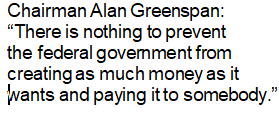

 Filled with jargon and maths, an economics textbook can be a daunting read, intentionally so, because nothing tells the world “I am real science” better than arcane language and impenetrable maths.
Part of the problem with labeling economics a science is that it is the study of the psychology of money, and psychology is a “science” only in the broadest, most charitable definition:
Filled with jargon and maths, an economics textbook can be a daunting read, intentionally so, because nothing tells the world “I am real science” better than arcane language and impenetrable maths.
Part of the problem with labeling economics a science is that it is the study of the psychology of money, and psychology is a “science” only in the broadest, most charitable definition:

 #Monetary Sovereignty - Mitchell