The world is flat

There was a time when people believed the world was flat. Their descendants now are economists.
Why bad ideas refuse to die | Science and scepticism | The Guardian
The earth is flat, Trump won, and your federal taxes fund federal spending.
Before I show you some “flat-earth” economic opinions about the federal tax, here are the facts: There are several money-supply measures, with the most liquid being termed, “M1.”
What Is M1? M1 is the money supply that is composed of physical currency and coins, demand deposits, travelers’ checks, other checkable deposits, and negotiable order of withdrawal (NOW) accounts. M1 includes the most liquid portions of the money supply because it contains currency and assets that either are or can be quickly converted to cash.
M1 includes the most easily spent forms of money. The dollars in your checking account are the M1 dollars you send to the U.S. Treasury. But what happens to those M1 dollars when they reach the U.S. Treasury? They disappear. They are not part of any money-supply measure. There is no money supply measure for dollars at the Treasury. You might think they become a part of the money the federal government “has,” but how much is that? How much money does the federal government have? Don’t feel bad if you don’t know. And don’t bother trying to “google” the answer. You won’t find it. You might just as well ask, “How many numbers are there?” The answer to both questions is: “Infinite.” The U.S. Treasury “has” infinite U.S. dollars. The U.S. federal government, being the original creator of the U.S. dollar (which it created from thin air by creating laws from thin air), has the infinite ability to create “dollar” laws and that gives it the infinite ability to create dollars). The federal government is Monetarily Sovereign. This is different from state/local governments which do not have that infinite ability to create dollars. They are monetarily non-sovereign. How does the federal government create dollars? Answer: By spending dollars. This is the process:
  1. To pay a creditor, the federal government sends instructions (not dollars) to the creditor’s bank.
  2. The instructions are in the form of physical checks (“Pay to the order of”) or electronic messages.
  3. The instructions tell the bank to increase the balance in the creditor’s checking (M1) account.
  4. The instant the bank obeys those instructions, new M1 dollars are created and added to the M1 supply.
  5. The bank then balances its books by clearing the instructions through the Federal Reserve, which debits the Treasury, the owner of infinite dollars. No money is destroyed because infinite minus any amount, still is infinite.
When you pay creditors, you follow the same first four steps. The difference is in step #5. The Federal Reserve sends your instructions back to your bank, telling your bank to reduce the balance in your checking account. At that moment, the dollars you created with your check, immediately are destroyed. There is a moment of time, between when your instructions create dollars and when the dollars are destroyed. Those dollars often are known as the “float.” When you spend, the money you create — the “float” — exists anywhere from a few seconds to a day or two. When the federal government spends, much of the float is permanent. It stays in the economy. The rest is destroyed by federal tax collections. The “float” money created by the federal government — the money that is not destroyed by taxes — is called the federal debt.  In short, federal spending creates dollars and federal taxing destroys dollars. The federal deficit is the net number of dollars added in any single year. The federal debt is the net total of all deficits. Contrary to popular wisdom, the federal deficit and debt are not a burden on the federal government. They are not a burden on future taxpayers. To “pay off” any part of the federal debt, the federal government merely returns dollars that exist in T-security accounts. No taxes are involved. The federal deficit and debt are assets to the economy. The larger the federal deficit and debt, the more money is added to the economy. If there were no federal deficit and debt, there would be no U.S. dollars. Gross Domestic Product (GDP) is the most common measure of the U.S. economy. The formula for GDP is:

GDP = Federal Spending + Non-federal spending + Net Exports

Mathematically, any reduction in the federal deficit and debt will reduce GDP. Most recessions and all depressions have been caused by reductions in deficit and debt growth.
Reductions in federal debt growth lead to inflation
Recessions are the vertical gray lines. Recessions repeatedly come on the heels of deficit growth reductions and are cured with deficit growth increases.
Federal surpluses remove dollars from the economy, which causes depressions and recessions.

1804-1812: U. S. Federal Debt reduced 48%. Depression began 1807. 1817-1821: U. S. Federal Debt reduced 29%. Depression began 1819. 1823-1836: U. S. Federal Debt reduced 99%. Depression began 1837. 1852-1857: U. S. Federal Debt reduced 59%. Depression began 1857. 1867-1873: U. S. Federal Debt reduced 27%. Depression began 1873. 1880-1893: U. S. Federal Debt reduced 57%. Depression began 1893. 1920-1930: U. S. Federal Debt reduced 36%. Depression began 1929. 1997-2001: U. S. Federal Debt reduced 15%. Recession began 2001.

No government can tax itself into prosperity, but governments easily can tax themselves into recession. While it is true that private banks create massive numbers of dollars simply by lending, this process begins with the very existence of U.S. dollars. The first dollars ever created constituted the beginning of the federal debt. If the federal government had not created dollars from thin air, there would be no dollars. How is the process different for state/local governments? For state/local governments, which like you, are monetarily non-sovereign, the process is identical to your personal spending process. Their money-creation instructions end up not at the Treasury but at private banks, so money the that is created, very quickly is destroyed when it comes out of the state/local government checking accounts. Why does the federal government levy taxes, if it has the infinite ability to create dollars? Answer: To control the economy by taxing what it wishes to discourage and by giving tax breaks to what it wishes to discourage. The federal government does not levy taxes to acquire spending money. So why would the federal government borrow dollars? Answer: The federal government does not borrow dollars. What erroneously is termed “borrowing” actually is the acceptance of deposits into Treasury security accounts. Those dollars are owned by the account holders and are not touched by the federal government. They remain in the accounts, gathering interest, until maturity, at which time the dollars are returned to the account owners. In short, while state/local governments do borrow and do spend taxpayers’ money, the federal government does neither.

The federal government neither borrows nor does it spend taxpayer dollars.

It creates new dollars, ad hoc, every time it pays for anything. Those Social Security dollars you receive each month are newly created. The Medicare dollars your doctor receives are newly created. The military salaries are newly created dollars. Every single dollar spent by the federal government is newly created. None are tax dollars. None are borrowed. Which now takes us to some words from “flat-earthers.”
How are U.S. taxpayer dollars spent? By: Dave Roos Your federal income tax dollars help to pay for the items on the federal budget. In fiscal year 2010, the government collected $2.4 trillion in tax revenue, but spent $3.5 trillion. The gap between revenue and spending is known as the budget deficit. The money the federal government borrows to cover the budget deficit is what creates the national debt, which stood at $14 trillion at the end of 2011.
Sorry Dave, you’re wrong about “U.S. taxpayer dollars.” And, you’re wrong about “federal government borrows.” And the gap between revenue and spending actually is net dollars added to the economy. Rather than being referred to with the pejorative word “deficit,” they more properly should be called, the “economic surplus.” And the Big Lie is everywhere:
Donald Trump Built a National Debt So Big (Even Before the Pandemic) That It’ll Weigh Down the Economy for Years The “King of Debt” promised to reduce the national debt — then his tax cuts made it surge. Add in the pandemic, and he oversaw the third-biggest deficit increase of any president. by Allan Sloan, ProPublica, and Cezary Podkul for ProPublica Jan. 14, 2021 One of President Donald Trump’s lesser-known but profoundly damaging legacies will be the explosive rise in the national debt that occurred on his watch. The financial burden that he’s inflicted on our government will wreak havoc for decades, saddling our kids and grandkids with debt. The national debt has risen by almost $7.8 trillion during Trump’s time in office. That’s nearly twice as much as what Americans owe on student loans, car loans, credit cards and every other type of debt other than mortgages, combined, according to data from the Federal Reserve Bank of New York. It amounts to about $23,500 in new federal debt for every person in the country.
Sorry, Allan and Cezary, but what your saying is total bull excrement. While Donald Trump ranks among the worst, most dangerous traitors in American history, his deficit increase was not “profoundly damaging,” nor is it a “financial burden” on the government, nor will it “wreak havoc,” nor will it saddle our kids and grandkids with debt. In fact, the deficits and debt grew the economy (as adding dollars to the economy always does), and they are not a burden on anyone. Allan and Cezary, the “havoc”  will come only when guys like you convince the nation that running federal surpluses is financially prudent, at which time we will sink into the recession or depression federal surpluses always cause. Ignorantly comparing federal debt to personal debt, and implying that each person in America owes the federal debt is so atrociously wrong as to get you fired if your bosses understood economics, which seemingly they don’t. This is the sort of nonsense one expects from flat-earthers and conspiracy theorists, not from your self-described “nonprofit newsroom that investigates abuses of power.” We’ll end this blog with one last bit of garden fertilizer:
JULY 8, 2020 How worried should you be about the federal deficit and debt? David Wessel Even before the pandemic, the federal deficit was large by historical standards and projected to rise. The sharp recession and the spending increases that Congress and the president approved in response has made the deficit even bigger. Big deficits mean a growing federal debt—the total the government owes—already at its highest point since World War II. Extraordinarily low interest rates allow the U.S. to shoulder a heavier debt burden, but the debt is on an unsustainable course and its size may limit the government’s ability or willingness to continue to fight the economic ill effects of the pandemic or future economic downturns.
Ah, David, so few words, so many errors. The federal government does not “owe” the debt any more than your bank “owes” you the contents of your safe deposit box. Like a safe deposit box, the deposits into T-security accounts are not touched by the government, and when you want your money back, your deposits simply are returned to you. Having infinite money, the government does not benefit from “extraordinarily low interest rates.” It could pay a 50% rate just as easily as a .0005% rate. No difference for a Monetarily Sovereign entity. And as for the debt being “unsustainable,” this is exactly the same claim that has been made by debt fools since 1940, when the debt was only $40 billion. David, your problem is you don’t know the difference between Monetary Sovereignty and monetary non-sovereignty, which means, you don’t understand economics. Monetary Sovereignty is the foundation of U.S. economics, and not understanding it is like not understanding heat in a baking class. Your comments would apply perfectly to state/local government deficits and debt, but they are truly laughable when applied to federal deficits and debt. Well, perhaps not laughable, because the Big Lie is far too damaging to be laughed at. Yes, folks, the earth is flat, politicians tell the truth, and your federal taxes fund federal spending. Believe all three. Rodger Malcolm Mitchell Monetary Sovereignty Twitter: @rodgermitchell Search #monetarysovereignty Facebook: Rodger Malcolm Mitchell

……………………………………………………………………..

THE SOLE PURPOSE OF GOVERNMENT IS TO IMPROVE AND PROTECT THE LIVES OF THE PEOPLE.

The most important problems in economics involve:
  1. Monetary Sovereignty describes money creation and destruction.
  2. Gap Psychology describes the common desire to distance oneself from those “below” in any socio-economic ranking, and to come nearer those “above.” The socio-economic distance is referred to as “The Gap.”
Wide Gaps negatively affect poverty, health and longevity, education, housing, law and crime, war, leadership, ownership, bigotry, supply and demand, taxation, GDP, international relations, scientific advancement, the environment, human motivation and well-being, and virtually every other issue in economics. Implementation of Monetary Sovereignty and The Ten Steps To Prosperity can grow the economy and narrow the Gaps: Ten Steps To Prosperity:
  1. Eliminate FICA
  2. Federally funded Medicare — parts A, B & D, plus long-term care — for everyone
  3. Social Security for all
  4. Free education (including post-grad) for everyone
  5. Salary for attending school
  6. Eliminate federal taxes on business
  7. Increase the standard income tax deduction, annually. 
  8. Tax the very rich (the “.1%”) more, with higher progressive tax rates on all forms of income.
  9. Federal ownership of all banks
  10. Increase federal spending on the myriad initiatives that benefit America’s 99.9% 
The Ten Steps will grow the economy and narrow the income/wealth/power Gap between the rich and the rest.

MONETARY SOVEREIGNTY

The insurance industry’s excuse for not wanting you to have Medicare

As readers of this blog know, the income/wealth/power Gap between the rich and the rest is what makes the rich rich. If there were no Gap, we all would be the same. No one would be rich. So, in their relentless efforts to become even richer, the rich try to widen that Gap, either by accumulating more for themselves or by preventing those below them from gaining more. This is the essence of Gap Psychology, the universal desire to widen the Gap below and to narrow the Gap above. One nefarious method used by the rich and their toadies is to pretend the federal government is running short of dollars, and supposedly cannot afford to fund social benefits. Never mind that the federal government, being Monetarily Sovereign, cannot run short of dollars. No Monetarily Sovereign entity ever unintentionally can run short of its own sovereign currency. Not now. Not ever. Even if the federal government collected $0 taxes, and had no other form of income, it still could continue spending, forever. Who says so? Well, how about:

Former Federal Reserve Chairman Alan Greenspan: “A government cannot become insolvent with respect to obligations in its own currency.”

Former Federal Reserve Chairman Ben Bernanke: “The U.S. government has a technology, called a printing press (or, today, its electronic equivalent), that allows it to produce as many U.S. dollars as it wishes at essentially no cost.”

Quote from Ben Bernanke when, as Fed chief, he was on 60 Minutes: Scott Pelley: Is that tax money that the Fed is spending? Ben Bernanke: It’s not tax money… We simply use the computer to mark up the size of the account.

Statement from the St. Louis Fed: “As the sole manufacturer of dollars, whose debt is denominated in dollars, the U.S. government can never become insolvent, i.e., unable to pay its bills. In this sense, the government is not dependent on credit markets to remain operational.”

Public health plan wrong approach, panel is told | Modern Healthcare
Janet Trautwein, CEO of the National Association of Health Underwriters

Press Conference: Mario Draghi, President of the ECB, 9 January 2014 Question: I am wondering: can the ECB ever run out of money? Mario Draghi: Technically, no. We cannot run out of money.

Who disagrees? The bought-and-paid-for mouthpiece for the insurance industry, Janet Trautwein, CEO of the National Association of Health Underwriters. She wrote:
Lowering the age for Medicare eligibility is a lousy idea we can’t afford Medicare’s eligibility age would be lowered from 65 to 60 under a spending package being negotiated in Congress. By Janet Trautwein Congress is hashing out the details of a $3.5 trillion spending package that could lower Medicare’s eligibility age from 65 to 60. The proposal would severely disrupt not just the Medicare program but the broader market for private insurance. And it would do so at a great cost.
Remember, that all she’s worried about is just five extra years of Medicare. Every pejorative she spouts about those five years presumably also would apply to the current 65+ Medicare. So she really is disparaging Medicare itself, one of the most popular federal programs in history. At “a great cost” to whom? Certainly not to the public who already pays outrageous amounts for private health care insurance, or does without insurance altogether. Read Trautwein’s weasel-worded response:
Lowering Medicare’s eligibility age would not significantly increase the number of people with insurance. Almost two-thirds of the more than 20 million people between the ages of 60 and 64 already have private health coverage. About 25% have public coverage through Medicaid or other government programs. And 11% of Americans purchase plans on the individual market, including through the Affordable Care Act’s exchanges. Less than 10% of people in this age group are uninsured.
Let’s parse the above deceptive paragraph, to clarify what it really says: “Not significantly” means, according to her own figures, about 13 million people. That’s not “significant”?? “Almost two-thirds of the more than 20 million people between the ages of 60 and 64 already PAY FOR private health coverage. “About 25% have to PAY FOR public coverage through Medicaid or other government programs. “And 11% of Americans PAY FOR insurance on the individual market, including through the Affordable Care Act’s exchanges. Get it? Trautwein is trying to sell you on the notion that you personally are better able to afford paying for health care insurance than is the Monetarily Sovereign federal government, the one entity in America that has access to unlimited dollars at no cost to anyone.
In other words, expanding Medicare would simply replace the soon-to-be seniors’ existing coverage, which is typically private, with publicly funded coverage.
And the federal government paying instead of you is supposed to be a bad thing?? And don’t be deceived, even if your job supplies you with “free insurance,” it isn’t free. Your employer figures in that cost when deciding how much to pay you. It comes right out of your salary.
Many of these 60- to 64-year-olds would be disappointed with their new benefits under Medicare. The program does not cover dependents, as do exchange plans or employer-sponsored insurance. So older adults who switch to Medicare may have to find new coverage for their spouses or children. Traditional Medicare doesn’t include benefits like dental care. But nearly 70% of employer-sponsored plans do.
The proposed Medicare for All plans do cover dependents and dental care.  But even if they didn’t, the cost for available supplements still would be far lower than people pay now. That is exactly why the CEO of the National Association of Health Underwriters opposes Medicare (Oh, did she neglect to mention that the insurance industry also opposed the spectacularly popular Original Medicare? Now, for all the same reasons, they oppose adding the 60-64 year olds.) If Medicare is inferior, why does the vast majority of seniors love it, and why can the 60-64 year olds hardly wait to join?
What’s more, enrolling in Medicare could result in higher costs for soon-to-be seniors. More than 1 million people between the ages of 60 and 64 have insurance through the exchanges. Seven in 10 of them receive tax credits to help purchase that coverage. After transitioning to Medicare — and forfeiting these subsidies — more than 15% of the proposed Medicare-eligible population could owe higher premiums based on their income. As a result, a recent study from consulting firm Avalere concluded that “simply expanding Medicare eligibility does not guarantee premium affordability.”
If the above were correct, what would those 60-64 year olds do? You guessed it. They would just stay with their private insurance. No law against that. Of course, that won’t happen, for the same reasons that Medicare is so popular among the 65+ age groups.
An expanded version of Medicare could also make employer-sponsored coverage more expensive. Medicare has the power to dictate what it will pay to health care providers. Private plans don’t have that luxury. So they end up paying providers much more than does Medicare.
And where do the private plans get the money to “pay providers much more than does Medicare”? Right, again. They get the money from the high premiums you pay. Trautwein actually wants you to believe that lower-cost benefits are something you should avoid.
If older people switch from higher-paying employer-sponsored plans to lower-paying Medicare, then providers may respond by raising rates for private plans. And that means higher premiums for the majority of Americans, who get coverage through their jobs.
Let’s be clear. Providers charge as much as the market will bear, i.e as much as they can. If they could charge more, they would. So you are being asked to pay doctors and hospitals more so that other people might possibly be able to pay less. Imagine this: The next time you go to your car dealer, clothing store, or grocery store, surely you’ll generously want to pay more, and not even use coupons, so that other shoppers can pay less. Right?
Rural health care providers may not be able to survive if their pool of patients becomes dominated by lower-paying Medicare beneficiaries. Already, one-quarter of rural hospitals are on the brink of closure. They can ill afford further cuts in pay.
There is no evidence that Medicare is causing rural health care providers to close. Quite the opposite. Medicare provides these hospitals with paid patients, who otherwise could not afford hospital fees or who would get their health care via the free emergency room. And now we come to the phony “federal-government-is-running-short-of-dollars” Big Lie:
Then there’s the effect of expansion on Medicare’s long-term fiscal health. One recent study from the American Action Forum projected that lowering Medicare’s eligibility age to 60 would add some 14 million people to the program at a cost of about almost $400 billion over 10 years.
That’s $400 billion, which our Monetarily Sovereign government easily could fund. In fact, the federal government could eliminate all taxes and still fund Medicare not just for the 60+ group, but for every man, woman, and child in America. Now, in desperation, Trautwein refers to the fake “trust fund” that supposedly (but not really) pays for Medicare, Part A. The federal government doesn’t have anything remotely resembling a real trust fund. What Trautwein and the government calls a “trust fund” is not a trust fund. It’s just a balance sheet entry, that unlike a real trust fund, can be changed at will by the government. To quote from the Peter G. Peterson Foundation website:

Federal trust funds bear little resemblance to their private-sector counterparts, and therefore the name can be misleading.

A “trust fund” implies a secure source of funding. However, a federal trust fund is simply an accounting mechanism used to track inflows and outflows for specific programs.

In private-sector trust funds, receipts are deposited and assets are held and invested by trustees on behalf of the stated beneficiaries.

In federal trust funds, the federal government does not set aside the receipts or invest them in private assets.

Rather, the receipts are recorded as accounting credits in the trust funds, and then combined with other receipts that the Treasury collects and spends.

Further, the federal government owns the accounts and can, by changing the law, unilaterally alter the purposes of the accounts and raise or lower collections and expenditures.

Here is her deceptive comment:
Medicare scarcely has enough money to cover the costs of its current beneficiaries. According to the latest report from its trustees, Medicare’s Hospital Insurance Trust Fund will be exhausted by 2026. At that point, the program will not be taking in enough tax revenue to pay claims. The federal government may have to unilaterally cut rates to providers, which would, in turn, undermine patients’ ability to access care.
Trautwein doesn’t want you to know that the federal government arbitrarily can change the numbers in the fake trust fund at any time and for any reason, or for no reason at all. She also doesn’t want you to know that Medicare Part B is more straightforward. It doesn’t even pretend to have a fake “trust fund.” It is funded directly by the federal government. Oops! Tax revenue doesn’t pay claims. It’s a dirty little secret that federal tax revenue doesn’t pay for anything. In fact, all federal (as opposed to local) tax dollars are destroyed by the Treasury upon receipt. They begin as part of the M1 money supply measure, (your private checking account). Then when they hit the Treasury, they cease to exist in any money supply measure. There is no measure of Treasury money because the Treasury has infinite dollars. The federal government always creates new dollars, at will, when it pays for anything.
With insolvency looming for Medicare, expanding the program is neither prudent nor fiscally appropriate. It would be wiser for Congress to enact reforms that would reduce the cost of health care for all patients, whether they’re publicly or privately insured. Legislators’ bipartisan work late last year addressing surprise medical bills stands out as a model for future action.
As Bernanke, Greenspan, the St. Louis Fed, and Draghi have told you, a Monetarily Sovereign entity like the U.S. federal government cannot become insolvent with respect to debt in its own sovereign currency. Because the federal government cannot become insolvent, none of its agencies can become insolvent, unless that is what Congress wants. Medicare, as a federal agency, cannot become insolvent unless Congress decides to make it insolvent. The “reforms” Trautwein pretends to want are exactly what she really objects to: Reducing the age limit for Medicare and cutting the costs of medicine. Finally, Trautwein unintentionally tells you why the “U.S. Ranks Last Among Seven Countries on Health System Performance Measures Commonwealth Fund)
Our health care system relies on a mix of private and public payers to ensure access to high-quality care. Disrupting that mix by adding more Americans to Medicare could raise costs for those in the private market — and reduce access to care for everyone.
The Commonwealth Fund article concludes:
Despite having the most expensive health care system, the United States ranks last overall compared with six other industrialized countries—Australia, Canada, Germany, the Netherlands, New Zealand, and the United Kingdom—on measures of quality, efficiency, access to care, equity, and the ability to lead long, healthy, and productive lives, according to a new Commonwealth Fund report.
The U.S. ranks last simply because that “mix of private and public payers” requires the public to fund what the federal government could fund at no cost to the public. There clearly is a correlation between those high private insurance charges and the cost of U.S. health care.
The U.S. stands out for not getting good value for its health care dollars: it spent $7,290 per capita on health care in 2007 but ranks last among seven countries.  Provisions in the new Patient Protection and Affordable Care Act that could extend health insurance coverage to 32 million uninsured Americans have the potential to improve the United States’s standing, according to Mirror, Mirror on the Wall: How the Performance of the U.S. Health Care System Compares Internationally, 2010 Update, by Commonwealth Fund researchers Karen Davis, Cathy Schoen, and Kristof Stremikis.
You can be sure that Janet Trautwein, CEO of the National Association of Health Underwriters and paid shill for the insurance industry, will continue to write misleading articles about why the much loved Medicare program should not be extended to more people. She’s paid to make you want to transfer dollars from your pockets to the insurance companies’ coffers. Rodger Malcolm Mitchell Monetary Sovereignty Twitter: @rodgermitchell Search #monetarysovereignty Facebook: Rodger Malcolm Mitchell

……………………………………………………………………..

THE SOLE PURPOSE OF GOVERNMENT IS TO IMPROVE AND PROTECT THE LIVES OF THE PEOPLE.

The most important problems in economics involve:
  1. Monetary Sovereignty describes money creation and destruction.
  2. Gap Psychology describes the common desire to distance oneself from those “below” in any socio-economic ranking, and to come nearer those “above.” The socio-economic distance is referred to as “The Gap.”
Wide Gaps negatively affect poverty, health and longevity, education, housing, law and crime, war, leadership, ownership, bigotry, supply and demand, taxation, GDP, international relations, scientific advancement, the environment, human motivation and well-being, and virtually every other issue in economics. Implementation of Monetary Sovereignty and The Ten Steps To Prosperity can grow the economy and narrow the Gaps: Ten Steps To Prosperity:
  1. Eliminate FICA
  2. Federally funded Medicare — parts A, B & D, plus long-term care — for everyone
  3. Social Security for all
  4. Free education (including post-grad) for everyone
  5. Salary for attending school
  6. Eliminate federal taxes on business
  7. Increase the standard income tax deduction, annually. 
  8. Tax the very rich (the “.1%”) more, with higher progressive tax rates on all forms of income.
  9. Federal ownership of all banks
  10. Increase federal spending on the myriad initiatives that benefit America’s 99.9% 
The Ten Steps will grow the economy and narrow the income/wealth/power Gap between the rich and the rest.

MONETARY SOVEREIGNTY

When even a Harvard economics professor gets it wrong, what hope is there for the average voter?

MANKIW
N. Gregory Mankiw is a well-known (in the economics community) professor of economics at prestigious Harvard University. So it is both remarkable and saddening that he seems to have no understanding of the economic reality that is Monetarily Sovereignty. He wrote an opinion piece that was accepted for publication by the prestigious New York Times, an acceptance that in itself also is remarkable and saddening. Here are excerpts from Professor Mankiw’s article, together with my comments:
Can America Afford to Become a Major Social Welfare State? Guest Essay, Sept. 15, 2021, By N. Gregory Mankiw  In the reconciliation package now being debated in Washington, President Biden and many congressional Democrats aim to expand the size and scope of government substantially. Americans should be wary of their plans — not only because of the sizable budgetary cost but also because of the broader risks to economic prosperity. The details of the ambitious $3.5 trillion social spending bill are still being discussed, so it is unclear what it will end up including. In many ways, it seems like a grab bag of initiatives assembled from the progressive wish list.
Mankiw’s use of such trigger phrases as, “Welfare State,” “expand . . . government substantially,” “sizable . . . cost,” “risks to economic prosperity,” “grab bag,” and “wish list,” all tell us about his anti-deficit spending proclivity. Apparently, he subscribes to the false notion that federal debt is harmful, and should be reduced. Unfortunately, that is not the only false notion to which he subscribes:
People of all ages are in line to get something: government-funded pre-K for 3- and 4-year-olds, expanded child credits for families with children, two years of tuition-free community college, increased Pell grants for other college students, enhanced health insurance subsidies, paid family and medical leave, and expansions in Medicare for older Americans.
And why are these wonderful benefits supposedly bad things? Read on:
If there is a common theme, it is that when you need a helping hand, the government will be there for you. It aims to assist people who are struggling in our rough-and-tumble market economy. On its face, that instinct doesn’t sound bad.
It doesn’t sound bad to me, either. But for an economics professor who seemingly doesn’t understand Monetary Sovereignty, good often is bad, primarily because good doesn’t make the poor suffer enough.
Many Western European nations have more generous social safety nets than the United States. The Biden plan takes a big step in that direction. Can the United States afford to embrace a larger welfare state? From a narrow budgetary standpoint, the answer is yes.
Yes, the Monetarily Sovereign, U.S. government easily can afford everything mentioned, and much more. So, again, what’s the problem?
But the policy also raises larger questions about American values and aspirations, and about what kind of nation we want to be. The Biden administration has promised to pay for the entire plan with higher taxes on corporations and the very wealthy. But there’s good reason to doubt that claim.
The “values and aspirations” phrase has to do with the Puritanical belief (by the “haves”) that the “have-nots” should be made to suffer and labor in order to receive assistance. (Of course, that does not apply to the born-rich or the got-rich-by-pure-luck recipients of excessive monetary largess.) Biden’s claim that he will “pay for” the plan with taxes, simply is a lie. Because the federal government is Monetarily Sovereign, federal taxes do not fund federal spending. Period. Even if all federal tax collections were $0, the federal government could continue spending, forever. (This is different for state/local/euro governments which are monetarily non-sovereign):

Alan Greenspan: “A government cannot become insolvent with respect to obligations in its own currency.”

Ben Bernanke: “The U.S. government has a technology, called a printing press (or, today, its electronic equivalent), that allows it to produce as many U.S. dollars as it wishes at essentially no cost.”

Budget experts, such as Maya MacGuineas, president of the Committee for a Responsible Federal Budget, are skeptical that the government can raise enough tax revenue from the wealthy to finance Mr. Biden’s ambitious agenda.
The fact that Mankiw considers MacGuineas to be a “budget expert” falls somewhere between laughable and shocking. She is a paid shill for the rich, “debt-is-a-ticking-time-bomb” fakers, who neither understand nor want you to understand, the substantial differences between federal finances and personal finances.
The United States could do what Western Europe does — impose higher taxes on everyone. Most countries use value-added tax, a form of a national sales tax, to raise a lot of revenue efficiently. If Americans really want larger government, we will have to pay for it, and a VAT could be the best way.
Here, Mankiw demonstrates his own misunderstanding of the differences between Monetary Sovereignty and monetary non-sovereignty. Many Western European nations are monetarily non-sovereign, meaning they do not have the unlimited ability to create their own sovereign currency. Why? Because they have no sovereign currency. They use the euro, which is the sovereign currency of the European Union, not of any Western European nation.
There are also broader economic effects. Arthur Okun, the former economic adviser to President Lyndon Johnson, addressed this timeless issue in his 1975 book, “Equality and Efficiency: The Big Tradeoff.” According to Mr. Okun, policymakers want to maximize the economic pie while slicing it equally. But these goals often conflict. As policymakers attempt to rectify the market’s outcome by equalizing the slices, the pie tends to shrink. Mr. Okun explains the trade-off with a metaphor: Providing a social safety net is like using a leaky bucket to redistribute water among people with different amounts. While bringing water to the thirstiest may be noble, it is also costly as some water is lost in transit.
That false metaphor would be apt if no water could be added to the bucket. But our Monetarily Sovereign federal government has infinite “water” (dollars) at its disposal. The bucket never is empty. So giving dollars to one group does not reduce the number of dollars available to other groups. The federal government has the infinite ability to provide infinite slices of pie. The pie need not “shrink.”
In the real world, this leakage occurs because higher taxes distort incentives and impede economic growth.
That distortion of incentives and reduction of economic growth is a function of all federal taxes, not just higher taxes. Since federal taxes pay for nothing (They are destroyed upon receipt by the Treasury), raising taxes to “pay for” spending is a useless — no, not just useless, but harmful –fools mission.
And those taxes aren’t just the explicit ones that finance benefits such as public education or health care. They also include implicit taxes baked into the benefits themselves. If these benefits decline when your income rises, people are discouraged from working. This implicit tax distorts incentives just as explicit taxes do.
Again, Mankiw cites the Big Lie that federal taxes fund federal spending. The implicit taxes include, for instance, Social Security benefits which needlessly decline as income increases. Does that discourage anyone from working? Doubtful. But this is the trope the rich love to cite: Paying unemployment benefits discourages people from working. It would be true only when salaries are so miserly, normal humans can’t survive on them. These are the starvation wages the rich want to pay.
Economists disagree about why European nations are less prosperous than the United States. But a leading hypothesis, advanced by Edward Prescott, a Nobel laureate, in 2003, is that Europeans work less than Americans because they face higher taxes to finance a more generous social safety net. In other words, most European nations use that leaky bucket more than the United States does and experience greater leakage, resulting in lower incomes. By aiming for more compassionate economies, they have created less prosperous ones. Americans should be careful to avoid that fate.
The above is so misleading as to be incomprehensible for a Harvard economist. Let’s begin with a bit of nit-picking. Prescott won the Sveriges Riksbank Prize in Economic Sciences in Memory of Alfred Nobel. He is not a “Nobel laureate.” There is no Nobel prize in Economics. Europeans may face higher taxes, but the reasons are mixed. For the monetarily non-sovereign nations, this sadly, is necessary. These nations voluntarily surrendered the single most valuable asset any government can have: Their Monetary Sovereignty. Like U.S. cities and states, They must levy taxes in order to pay for things. The Monetarily Sovereign nations don’t need to levy taxes in order to pay for things, but they (like the U.S. government) don’t want the taxpayers to know it. Why? Because the rich run governments, and the rich have rigged the U.S. tax system to widen the Gap between the rich and the rest. Do you remember when Warren Buffett admitted he pays taxes at a lower rate than does his secretary? And I am quite sure you pay more taxes than does billionaire Donald Trump, who actually paid zero taxes in eight of the past ten years. Did you pay zero taxes in eight of the past ten years? Although some European nations are Monetarily Sovereign, and so, don’t need to levy taxes, the rich who run those nations want the poor suckers to pay, pay, pay. There are various reasons why America is so prosperous: World War II, our size, our natural resources, our lack of intermural wars, just to name a few. The “leaky bucket theory isn’t one of those reasons. And now we come to: “the poor should labor, while the rich don’t need to” pseudo-moralistic meanderings of an economics professor who should be ashamed:
Compassion is a virtue, but so is respect for those who are talented, hardworking and successful. Most Americans descended from immigrants, who left their homelands to find freedom and forge their own destinies. Because of this history, we are more individualistic than Europeans, and our policies rightly reflect that cultural difference. That is not to say that the United States has already struck the right balance between compassion and prosperity. It is a continuing tragedy that children are more likely to live in poverty than the overall population. That’s why my favorite provision in the Biden plan is the expanded child credit, which would reduce childhood poverty. (I am also sympathetic to policies aimed at climate change, which is an entirely different problem. Sadly, the Biden plan misses the opportunity to embrace the best solution — a carbon tax.)
Call the above, Mankiw’s “I pretend to be compassionate but I’m not really” fake moralism.
But the entire $3.5 trillion package is too big and too risky.
Why is it “risky” for a government that has the unlimited ability to create dollars and spent $6.6 trillion in 2020, to budget another $3.5 trillion in spending? What exactly is the “risk”? No, it’s not inflation, which comes from scarcity, never from federal spending. No, it’s not insolvency. The federal government cannot unintentionally become insolvent (though Sen. McConnell threatens to force insolvency on us with the phony debt “ceiling”). No, it’s not reduced GDP. By formula, federal spending increases GDP.

(GDP = Federal Spending + Non-federal Spending + Net Exports)

There is, in fact, zero risk associated with the $3.5 trillion package.
N. Gregory Mankiw is a professor of economics at Harvard. He was the chairman of the Council of Economic Advisers under President George W. Bush from 2003 to 2005.
And we all know what a great economist was George W. Bush, who started his Presidency with a recession, and having learned nothing, ended his Presidency with another recession.
George W. Bush Presidency, 2001-2009 (GDP is red line. Vertical gray columns are recessions
In Summary Biden’s proposed $3.5 spending program would benefit hundreds of millions of Americans. It easily is affordable, requires zero tax increases, would not be a burden on anyone, and would not be inflationary. It has zero downsides, which is the real reason why the Republicans don’t want it. Rodger Malcolm Mitchell Monetary Sovereignty Twitter: @rodgermitchell Search #monetarysovereignty Facebook: Rodger Malcolm Mitchell

……………………………………………………………………..

THE SOLE PURPOSE OF GOVERNMENT IS TO IMPROVE AND PROTECT THE LIVES OF THE PEOPLE.

The most important problems in economics involve:
  1. Monetary Sovereignty describes money creation and destruction.
  2. Gap Psychology describes the common desire to distance oneself from those “below” in any socio-economic ranking, and to come nearer those “above.” The socio-economic distance is referred to as “The Gap.”
Wide Gaps negatively affect poverty, health and longevity, education, housing, law and crime, war, leadership, ownership, bigotry, supply and demand, taxation, GDP, international relations, scientific advancement, the environment, human motivation and well-being, and virtually every other issue in economics. Implementation of Monetary Sovereignty and The Ten Steps To Prosperity can grow the economy and narrow the Gaps: Ten Steps To Prosperity:
  1. Eliminate FICA
  2. Federally funded Medicare — parts A, B & D, plus long-term care — for everyone
  3. Social Security for all
  4. Free education (including post-grad) for everyone
  5. Salary for attending school
  6. Eliminate federal taxes on business
  7. Increase the standard income tax deduction, annually. 
  8. Tax the very rich (the “.1%”) more, with higher progressive tax rates on all forms of income.
  9. Federal ownership of all banks
  10. Increase federal spending on the myriad initiatives that benefit America’s 99.9% 
The Ten Steps will grow the economy and narrow the income/wealth/power Gap between the rich and the rest.

MONETARY SOVEREIGNTY

The Gaslighting of the American Public

In His Own Words – Digby's Hullabaloo
THE GASLIGHTING OF AMERICA
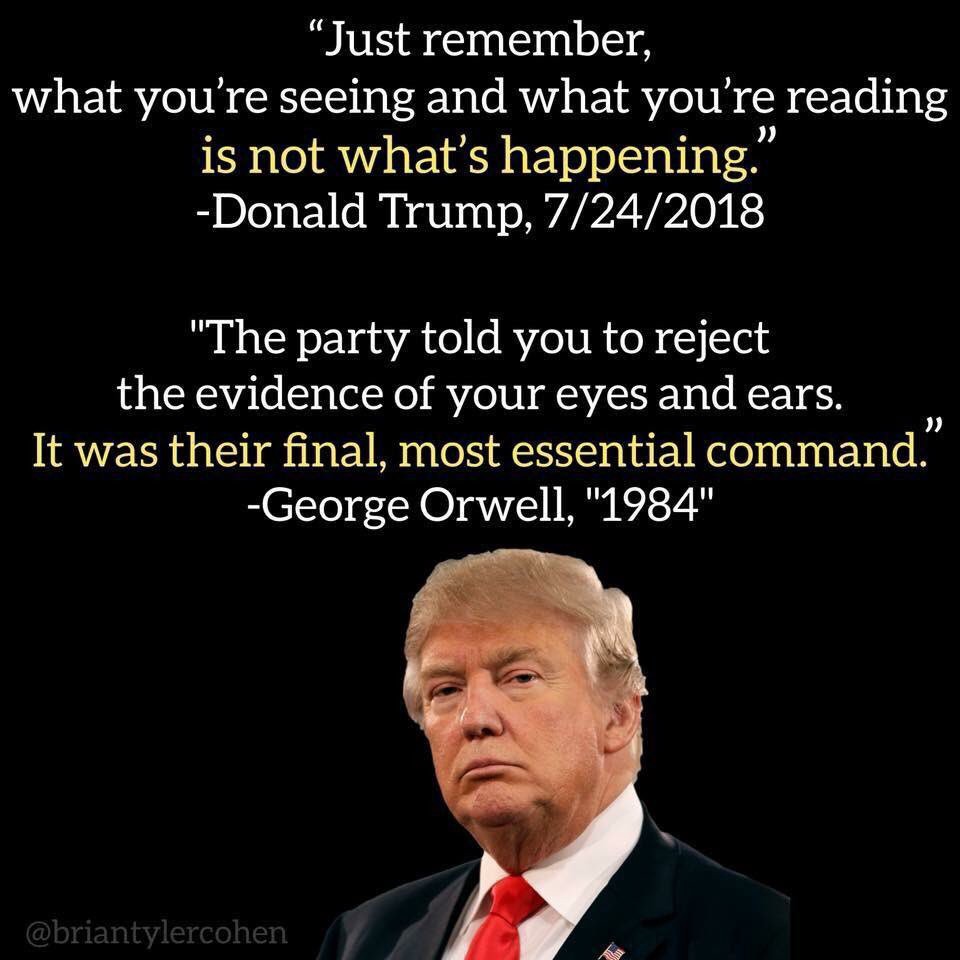
Wikipedia: The term “gaslighting describes someone (a “gaslighter”) who puts forth a false narrative that leads others to doubt their own perceptions.
It was the fundamental plotline of the movie, “Gaslight.” Over the years, there have been several comedic movies in which a character caught cheating by his wife, brazenly looks up and says to her, “Are you going to believe me or your eyes?”
This dynamic is generally only possible when the audience is vulnerable such as in unequal power relationships or when the audience is fearful of the losses associated with challenging the false narrative.
Donald Trump, and more recently his current Republican Party, have been gaslighting the American public for many years. They do it by denying the obvious, i.e denying what you see before your own eyes. The psychology is that if brazen deniers of fact deny often enough and forcefully enough, the weaker-minded among us will come to believe their own senses are wrong and that the deniers must be right. Eventually, the weakest-minded join the ranks of deniers and become inadvertent gaslighters, themselves. Here are just a few of the truths Trump and his Republican Party deny, despite all evidence. When you hear or read these denials, understand the deniers are trying to gaslight you. No President and political party in American history have been so focused on gaslighting America as has Trump and the GOP. Whether you believe them depends mostly on your confidence in your own senses and your understanding of the facts. Trump and the GOP have denied and/or continue to deny that:
  1. Climate change exists
  2. Human-caused climate change exists
  3. Climate change is a serious problem
  4. Poverty is a national problem, not the fault of the impoverished.
  5. Slavery was a serious historical problem
  6. Police focus negatively and unfairly on people of color
  7. Police are needlessly killing people of color
  8. Biden won the Presidential election
  9. Biden was elected, fairly
  10. Trump has no evidence of election fraud
  11. Masks help prevent sickening from COVID
  12. Vaccines help prevent sickening from COVID
  13. Masks help prevent the transmission of COVID
  14. COVID vaccines are safe
  15. COVID vaccines help prevent the transmission of COVID
  16. Trump is a pathological liar
  17. Trump encouraged an attempted coup.
  18. There was an attempted coup
  19. Trump tried to steal the Presidential election
  20. The Republican Party continues to try to steal elections
  21. Trump has surrounded himself with criminals
  22. Trump has surrounded himself with incompetent sycophants
  23. Trump is a massive liar
  24. Trump cheated on all three wives
  25. Trump cheated employees and lenders
  26. Trump cheated on his taxes
  27. The Trump Foundation was a scam
  28. Trump cheated students in his Trump University
  29. Trump molested many women
  30. Trump is a psychopath
  31. Social Security, Medicare, and all other federal agencies never can become insolvent.
  32. The U.S. Supreme Court is dominated by biased, right-wing, partisan political hacks.
  33. Republican-dominated states are trying to prevent people of color from voting.
  34. Trump and the Republican Party are fascists
Fox “News,” Breitbart, the numerous nutsy conspiracy blogs all attempt to gaslight you on behalf of Trump and the GOP. Hundreds of thousands of Americans have sickened and died because they yielded to right-wing gaslighting about COVID. And despite the results, the right-wing COVID gaslighting continues. But gaslighting is not limited to COVID. Gaslighting touches all aspects of your life, and always is done to benefit some power group, usually the very rich. They never will stop, so long as they are successful. Whether they continue to succeed depends on you and your psychological strength. It depends on your weakly yielding to gaslighting, and refusing to believe the facts right in front of you. You, your children, and the future of America are at risk from the gaslighters. Rodger Malcolm Mitchell Monetary Sovereignty Twitter: @rodgermitchell Search #monetarysovereignty Facebook: Rodger Malcolm Mitchell

……………………………………………………………………..

THE SOLE PURPOSE OF GOVERNMENT IS TO IMPROVE AND PROTECT THE LIVES OF THE PEOPLE.

The most important problems in economics involve:
  1. Monetary Sovereignty describes money creation and destruction.
  2. Gap Psychology describes the common desire to distance oneself from those “below” in any socio-economic ranking, and to come nearer those “above.” The socio-economic distance is referred to as “The Gap.”
Wide Gaps negatively affect poverty, health and longevity, education, housing, law and crime, war, leadership, ownership, bigotry, supply and demand, taxation, GDP, international relations, scientific advancement, the environment, human motivation and well-being, and virtually every other issue in economics. Implementation of Monetary Sovereignty and The Ten Steps To Prosperity can grow the economy and narrow the Gaps: Ten Steps To Prosperity:
  1. Eliminate FICA
  2. Federally funded Medicare — parts A, B & D, plus long-term care — for everyone
  3. Social Security for all
  4. Free education (including post-grad) for everyone
  5. Salary for attending school
  6. Eliminate federal taxes on business
  7. Increase the standard income tax deduction, annually. 
  8. Tax the very rich (the “.1%”) more, with higher progressive tax rates on all forms of income.
  9. Federal ownership of all banks
  10. Increase federal spending on the myriad initiatives that benefit America’s 99.9% 
The Ten Steps will grow the economy and narrow the income/wealth/power Gap between the rich and the rest.

MONETARY SOVEREIGNTY