Trump’s Larry Kudlow: The Social Security killer. Are you outraged?

Have you ever been outraged by the work of a bad plumber, a bad carpenter, a bad barber, or a bad surgeon?

Have you ever been outraged when your favorite sports team hired bad players, and your team performed poorly?

Under the “birds-of-a-feather” philosophy, President Donald Trump routinely hires the worst man (or woman) — incompetents and/or criminals — for the job.

Do you remember Michael Flynn, Anthony Scaramucci, Omarosa Newman, Scott Pruitt, John McEntee, Michael Cohen, Paul Manafort, et al?

Trump’s hires seldom benefit America. Their main talent is telling Trump how great he is.

Image result for larry kudlow
Larry Kudlow, Trump’s Social Security killer.

Which brings us to Larry Kudlow, Trump’s Director of the National Economic Council.

We have written about Kudlow in the past, here.  He is a perfect Trump appointment, an economist who denies science for the sake of Trump’s politics.

Example:

Washington Post: June, 2018: President Donald Trump’s top economic adviser, Larry Kudlow, said Friday that the federal deficit is “coming down rapidly,” contradicting estimates by nonpartisan analysts, Congress’s official scorekeeper and a branch of the White House.

That was only three months ago. This is now:

Kudlow suggests entitlement reform is coming
CNBC, Jacob Pramuk, Published Tue, 18 Sept 2018

Asked Monday if the Trump administration would address “entitlement reform,” White House chief economic advisor Larry Kudlow said it will “probably” look at “larger entitlements” next year.

Entitlement reform generally refers to changes or cuts to large government social programs such as Social Security, Medicare, Medicaid or food stamps.

“I don’t want to be specific, I don’t want to get ahead of our own budgeting, but we’ll get there,” Kudlow said at the Economic Club of New York. “But I agree, we have to be tougher on spending.”

Let’s analyze the above “Kudlowisms”:

First, Kudlow was lying about the deficit coming down. Trump doesn’t like deficits, so obediently, Kudlow denied the facts (a favorite Trump tactic), and made a ridiculous declaration based on the lie (another favorite Trump tactic).

Second, deficit reduction would be harmful to America (yet another favorite Trump tactic).  The federal government is uniquie. It is Monetarily Sovereign.

The U.S. federal government never can run short of its own sovereign currency, the U.S. dollar. Thus, there is no financial reason to cut federal deficits.

Ben Bernanke: “The U.S. government has a technology, called a printing press (or, today, its electronic equivalent), that allows it to produce as many U.S. dollars as it wishes at essentially no cost.”

Alan Greenspan: “A government cannot become insolvent with respect to obligations in its own currency.”

St. Louis Federal Reserve: “As the sole manufacturer of dollars, whose debt is denominated in dollars, the U.S. government can never become insolvent, i.e., unable to pay its bills.

By contrast, the U.S. economy requires an influx of dollars in order to grow. So when the federal government runs a deficit it sends some of its infinite supply of growth dollars into the economy.

Without deficit spending, the economy falls into depressions or recessions:

1804-1812: U. S. Federal Debt reduced 48%. Depression began in 1807.
1817-1821: U. S. Federal Debt reduced 29%. Depression began in 1819.
1823-1836: U. S. Federal Debt reduced 99%. Depression began in 1837.
1852-1857: U. S. Federal Debt reduced 59%. Depression began in 1857.
1867-1873: U. S. Federal Debt reduced 27%. Depression began in 1873.
1880-1893: U. S. Federal Debt reduced 57%. Depression began in 1893.
1920-1930: U. S. Federal Debt reduced 36%. Depression began in 1929.
1997-2001: U. S. Federal Debt reduced 15%. Recession began in 2001.

Deficit dollars are not tax dollars. The federal government, unlike state and local governments, does not spend tax dollars. The federal government spends dollars created, ad hoc, each time the federal government pays a bill.

These growth dollars are absolutely necessary to prevent recessions and depressions.

Third, entitlement “reform” is a euphemism for slashing Social Security, Medicare, Medicaid, food stamps and anything else that benefits the lower- and middle-income groups (still another favorite Trump tactic).

It’s not reform; it’s deform. Cutting deficit spending deforms the economy. There is no financial or economic benefit that comes from being “tougher on spending.”

Your taxes do not fund federal spending, which is why the so-called “debt” is now above $15 trillion. In fact, our Monetarily Sovereign federal government has the power to double federal spending, while cutting taxes in half.

And no, deficits do not cause inflation. There is no relationship between federal deficit spending and inflation:
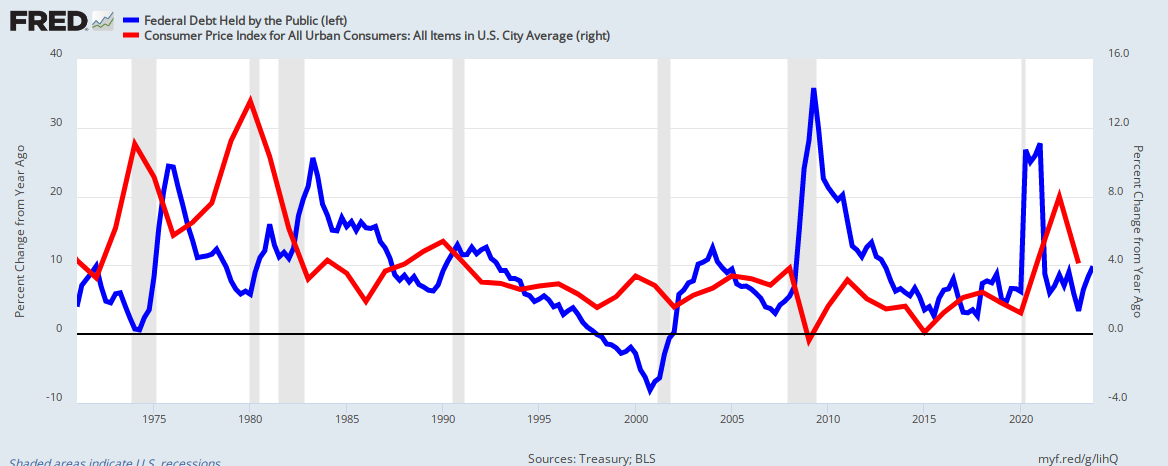
Federal deficits: Blue line. Inflation: Red line. Deficit reductions lead to recessions, which are cured by deficit increases.

(If deficits don’t cause inflation, what does? Shortages, most often of food and/or of energy. Because federal deficit spending tends to reduce shortages, there actually is an inverse relationship between deficits and inflation.)

Shielding Social Security and Medicare has always been a winning message for political candidates.

But now, numerous Democrats have sounded alarms about Republicans trimming spending on those programs in order to make up for the estimated $1 trillion or more last year’s GOP tax cuts are projected to add to budget deficits.

Jeff Merkley, a Democratic senator from Oregon and potential 2020 presidential candidate, tweeted that “Social Security and Medicare are on the line” in November’s midterms.

Fourth, there is one reason, and one reason only, to cut Social Security, Medicare, Medicaid, or food stamps: To widen the Gap between the rich and the rest.

The rich, who run America, always want to be richer. One way for the rich to be richer is for the rest of us to be poorer, in short, for the Gap to be wider.

And Trump’s willing lackey, Larry Kudlow, is just the man for the job.

An election is coming. There are only two reasons for you to vote for a Republican:

  1. You are in the upper 1% income/wealth group, and
  2. You don’t care what happens to Social Security, Medicare, Medicaid, and other social benefits.

Trump, Kudlow and the rest of the GOP wish to kill your benefits, not for any financial purpose, but rather to please the rich.

Are you outraged?

Rodger Malcolm Mitchell
Monetary Sovereignty
Twitter: @rodgermitchell; Search #monetarysovereignty
Facebook: Rodger Malcolm Mitchell

…………………………………………………………………………………………………………………………………………………………………………………………………………………………………………………………………………………………..

The single most important problems in economics involve the excessive income/wealth/power Gaps between the have-mores and the have-less.

Wide Gaps negatively affect poverty, health and longevity, education, housing, law and crime, war, leadership, ownership, bigotry, supply and demand, taxation, GDP, international relations, scientific advancement, the environment, human motivation and well-being, and virtually every other issue in economics.

Implementation of The Ten Steps To Prosperity can narrow the Gaps:

Ten Steps To Prosperity:
1. Eliminate FICA

2. Federally funded medicare — parts a, b & d, plus long-term care — for everyone

3. Provide a monthly economic bonus to every man, woman and child in America (similar to social security for all)

4. Free education (including post-grad) for everyone

5. Salary for attending school

6. Eliminate federal taxes on business

7. Increase the standard income tax deduction, annually. 

8. Tax the very rich (the “.1%) more, with higher progressive tax rates on all forms of income.

9. Federal ownership of all banks

10. Increase federal spending on the myriad initiatives that benefit America’s 99.9% 

The Ten Steps will grow the economy, and narrow the income/wealth/power Gap between the rich and you.

MONETARY SOVEREIGNTY

Black is white. Up is down. Income is outgo.

Image result for war is peace
If you believe that black is white, up is down, and income is outgo, you will love the short article that recently appeared in The Week online.

You will continue to read similarly misinforming articles prior to the November, ’18 elections.

The federal deficit is now projected to top $1 trillion in 2018
Peter Weber

For anyone harboring hopes that massive tax cuts pay for themselves . . .

Translation: “For anyone harboring hopes that taking less money from your pocket (i.e. tax cuts) will be matched by taking more money from your pocket . . .” (i.e. pay for themselves). . .

Sure, paying more taxes to pay for a tax cut is what we all hope for, isn’t it?  Peter Weber seems to think so.

. . .  the nonpartisan Congressional Budget Office has some bad news. The CBO said Tuesday that the federal deficit hit $895 billion in the first 11 months of fiscal 2018, an increase of $222 billion, or 32 percent, over the same period of 2017.

Translation: “Bad news. The federal government will pump 895 billion economic growth dollars into the private sector, in the first 11 months of this fiscal year, an increase of 222 billion economic growth dollars over the same period of 2017.”

The private sector, which requires income to grow, will receive $895 billion from the federal government, which has the unlimited ability to create dollars, and needs no income. So, why is this “bad news”?

The only “bad” part is that the amounts are too low. If instead of $895 billion, the amount were closer to $2 trillion, That would yield more economic growth and put more dollars into your pocket.

GDP = Federal Spending + Non-federal Spending + Net Exports. GDP cannot grow without federal deficits. Period.

The tax cuts Republicans pushed through in December plus spending increases pushed government outlays up about 7 percent while revenue grew by 1 percent, the CBO said.c

The federal government, being Monetarily Sovereign, neither needs nor uses any income, including tax income. Your tax dollars are destroyed upon receipt.

Why? Because the federal government has the unlimited ability to “print” its own sovereign currency, the dollar. It produces all the dollars it needs and uses.

No reason to ask anyone else (including you) for U.S. dollars.

The government took in about $105 billion more in individual and payroll taxes but $71 billion less in corporate taxes.

You, the public, paid more taxes, but the corporations paid less. The GOP’s new tax laws will exacerbate that imbalance, with the rich making out like bandits — yes, exactly like bandits.

Spending on interest on the public debt increased by $55 billion, or 19 percent.

This is one reason why, contrary to what you have been told, raising interest rates is stimulative for the economy, and gives you more money.

The deficit will near $1 trillion by the end of fiscal 2018 and almost certainly top it by the end of the calendar year.

That’s another $1 trillion added to the economy. The rich people want you to believe that’s bad for the economy, to prevent you from asking for federal benefits.

It’s all a gigantic con job, perpetuated, either in ignorance or intent, by writers like Peter Weber.

The myth that tax cuts, and federal deficits and debt are bad for the economy, and that your children will pay for the debt, and that we’ll become Zimbabwe and Argentina, has been foisted on you for almost 80 years, and amazingly, after all this time, most of the public still believes the lie.

At least, you don’t.

Rodger Malcolm Mitchell
Monetary Sovereignty
Twitter: @rodgermitchell; Search #monetarysovereignty
Facebook: Rodger Malcolm Mitchell

…………………………………………………………………………………………………………………………………………………………………………………………………………………………………………………………………………………………..

The single most important problems in economics involve the excessive income/wealth/power Gaps between the have-mores and the have-less.

Wide Gaps negatively affect poverty, health and longevity, education, housing, law and crime, war, leadership, ownership, bigotry, supply and demand, taxation, GDP, international relations, scientific advancement, the environment, human motivation and well-being, and virtually every other issue in economics.

Implementation of The Ten Steps To Prosperity can narrow the Gaps:

Ten Steps To Prosperity:
1. Eliminate FICA

2. Federally funded medicare — parts a, b & d, plus long-term care — for everyone

3. Provide a monthly economic bonus to every man, woman and child in America (similar to social security for all)

4. Free education (including post-grad) for everyone

5. Salary for attending school

6. Eliminate federal taxes on business

7. Increase the standard income tax deduction, annually. 

8. Tax the very rich (the “.1%) more, with higher progressive tax rates on all forms of income.

9. Federal ownership of all banks

10. Increase federal spending on the myriad initiatives that benefit America’s 99.9% 

The Ten Steps will grow the economy, and narrow the income/wealth/power Gap between the rich and you.

MONETARY SOVEREIGNTY

MMT’s “Jobs Guarantee”: The final nail in the coffin of this naive, foolish program

In previous posts (here, here, here, and others) I have given you many reasons why Modern Monetary Theory’s (MMT) “Jobs Guarantee” is naive foolishness.

For instance:

1. Jobs are not hard to find. Millions of jobs are available. It’s the right jobs that are hard to find. (Right skills, right pay, right location, right benefits, right working environment, right opportunities for advancement, right learning potential)

Image result for overburdened bureaucrat
“And I’m supposed to find them good jobs?

2. The federal government bureaucrats are ill-prepared to:

a. Find or create jobs,
b. interview,
c. hire,
d. supervise,
e. promote and demote,
f. switch jobs, and
g. fire the millions of people who should be fired.
h. while determining pay scales

for every kind of job in every city, suburb, and hamlet all over America.

3. The federal government is ill-prepared to provide healthcare, maternity leave, vacation days, IRAs and myriad other benefits appropriate to different employees all over the nation.

4. If people are hired only because they need jobs, rather than because the jobs need people, nothing prevents those jobs from being make-work.

Image result for workers standing around
“Good news! We just found you an interesting job. Stand around and look interested.”

And now comes proof, if more proof is needed, of the federal government’s incompetence in the whole “jobs” area:

The $1.7 Billion Federal Job Training Program Is a Massive Failure
The program’s goals might be admirable, but the reality is a whole different story.
Joe Setyon, Aug. 28, 2018

The Department of Labor’s Job Corps program is supposed to teach disadvantaged young people the skills they need to get good jobs. But the program, which costs taxpayers about $1.7 billion per year, is apparently a failure.

O.K., it doesn’t cost taxpayers one cent.

A Monetarily Sovereign government has the unlimited ability to create its own sovereign currency, which it does by the simple act of paying creditors.

Federal taxes do not fund federal spending. (See link.)

But even that isn’t the most important point.

About 50,000 students enroll in the program each year, about two-thirds of whom are high school dropouts, according to The New York Times. Results aside, the program’s goals are admirable. As The Wall Street Journal reported in April:

Launched in 1964, Job Corps works with 16- to 24-year-olds who grew up homeless or poor, passed through foster care, or suffered other hardships.

The goal is to equip these young adults with skills for careers in advanced manufacturing, the building trades, health care, information technology, business and more.

Unfortunately, that’s not what’s happening. A March audit from the Labor Department’s Office of Inspector General sampled 324 Job Corps participants who were five years removed from graduation.

The median annual income of 231 of those participants (wage records weren’t available for the rest), was just $12,486 as of December 2016.

The audit acknowledged that “Job Corps could not demonstrate beneficial job training outcomes.”

And that is the point. The federal government bureaucrats were supposed to do what high school “Workplace Preparation” courses accomplish — and predictably, they failed.

(Workplace preparation courses prepare students to move directly into the workplace after high school or to be admitted into select apprenticeship programs or other training programs in the community.

Courses focus on employment skills and on practical workplace applications of the subject content.

Many workplace preparation courses involve cooperative education and work experience placements, which allow students to get practical experience in a workplace.)

That’s not all. Job Corps spends about $50 million a year on “transition services” to help graduates find jobs.

But in 94 percent of the cases sampled, “Job Corps contractors could not demonstrate they had assisted participants in finding jobs.”

A 94% failure rate: These are the same federal bureaucrats who are supposed to find jobs for millions of people all over the country — millions of people who don’t have the “benefit” of federal jobs training??

A terrible waste of time for the job-seekers.

One former North Texas teacher, who quit in 2015, says the entire program is failing. “Job Corps doesn’t work,” the teacher, Teresa Sanders, tells the Times. “The adults are making money, the politicians are getting photo ops.

But we are all failing the students.

No surprise there. It’s what I’ve preached for years.

Labor Secretary Alexander Acosta admits the program “requires fundamental reform.”

“It is not enough to make changes at the margins,” he tells the Times. “We need large-scale changes.”

If a small program fails, the government’s approach is to make the program biggere, so that the failure can be bigger.

Despite its shortcomings, Jobs Corps is popular among both Republicans and Democrats in Congress (to Democrats, it’s a government program aimed at reducing poverty; to Republicans, it incentivizes hard work), so there’s only so much Acosta can do. “

Does that sound familiar, MMT? Reducing poverty and incentivizing work are two of MMT’s goals (i.e. excuses) for its Jobs Guarantee.

But why do we need to incentivize work? Why has sweat become a moral imperative?

You have a program with a rich and complicated history that’s one of the biggest leftovers from the war on poverty, and it is enormously complicated to make any significant changes,” Eric M. Seleznow, a former deputy assistant secretary for the Labor Department’s Employment and Training Administration during the Obama administration, tells the Times.

He notes that “competing interests from Congress, program operators, advocates, as well as complex legal requirements present a lot of challenges.”

If Job Corps is salvageable, then it can do some real good. But if real reforms aren’t going to happen, Congress should shut it down.

So let this be the final nail in the coffin of the “Jobs Guarantee, and instead, let us begin to focus on the Ten Steps to Prosperity (below).

Rodger Malcolm Mitchell
Monetary Sovereignty
Twitter: @rodgermitchell; Search #monetarysovereignty
Facebook: Rodger Malcolm Mitchell

…………………………………………………………………………………………………………………………………………………………………………………………………………………………………………………………………………………………..

The single most important problems in economics involve the excessive income/wealth/power Gaps between the have-mores and the have-less.

Wide Gaps negatively affect poverty, health and longevity, education, housing, law and crime, war, leadership, ownership, bigotry, supply and demand, taxation, GDP, international relations, scientific advancement, the environment, human motivation and well-being, and virtually every other issue in economics.

Implementation of The Ten Steps To Prosperity can narrow the Gaps:

Ten Steps To Prosperity:
1. Eliminate FICA

2. Federally funded medicare — parts a, b & d, plus long-term care — for everyone

3. Provide a monthly economic bonus to every man, woman and child in America (similar to social security for all)

4. Free education (including post-grad) for everyone

5. Salary for attending school

6. Eliminate federal taxes on business

7. Increase the standard income tax deduction, annually. 

8. Tax the very rich (the “.1%) more, with higher progressive tax rates on all forms of income.

9. Federal ownership of all banks

10. Increase federal spending on the myriad initiatives that benefit America’s 99.9% 

The Ten Steps will grow the economy, and narrow the income/wealth/power Gap between the rich and you.

MONETARY SOVEREIGNTY


Ten answers that are contrary to popular wisdom

We could have begun each answer with the words, “Contrary to popular wisdom . . .” for much of economics differs from what you, the public, are being told.Image result for popular wisdom

The federal government uniquely is Monetarily Sovereign. It invented and rules all the laws that create and regulate its sovereign currency, the U.S. dollar.

Federal financing is substantially different from your personal financing, your business’s financing, and your state’s, county’s, and your city’s financing.

If ever you have attempted to explain (or understand) Monetary Sovereignty, you probably have encountered these 10 questions:

1. “Is federal debt unsustainable? (I.e., can we continue running deficits forever. If you and I need to live within our means, must the federal government live within its means?)

A Monetarily Sovereign government never can run short of its own sovereign currency, so it has no “means” to live within.

Having the unlimited ability to create new dollars, the federal government can pay any obligation denominated in dollars, no matter how large. The federal government doesn’t even need to levy taxes.

The very act of paying its bills is the method by which the government creates new dollars. To pay a creditor, the federal government sends instructions (in the form of a check or a wire) to the creditor’s bank, instructing the creditor to increase the balance in the creditor’s checking account.

The moment the bank does as instructed, brand new dollars are created and added to the money supply called “M1.” No tax dollars are involved.

There are two ways dollars are created and two ways they are destroyed:

Dollars Are Created By:
A. Federal bill paying
B. All forms of dollar lending

Dollars Are Destroyed By:
A. Federal Taxing
B. Repayment of loans

2. “If the federal government doesn’t need tax dollars, why does the federal government levy taxes?”

There are two primary reasons:Image result for gap between the rich and the poor

A. To control the economy.  The government taxes things it wishes to rein in, and cuts taxes on things it wishes to encourage.

B. To fool the public. The very rich, who run the government, want the 99% to believe federal spending must be limited. This discourages the populace from asking for benefits and thereby widens the gap between the rich and the rest.

(The Gap is what makes the rich rich. Without the Gap, no one would be rich; we all would be the same. The wider the Gap, the richer they are.)

3. “If the government doesn’t need to obtain tax dollars in order to pay its bills, why does the government borrow dollars?”

Unlike state and local governments, the federal government doesn’t need to borrow, and indeed, it doesn’t borrow. The misnamed federal “borrowing” and “debt” is the total of deposits into T-security accounts.

When you buy a T-bill (or T-note or T-bond), you instruct your bank to take dollars from your checking account and deposit them into your T-bill account.

Because the federal government has no need for your dollars, it simply leaves your dollars in your account until your T-bill matures. It even adds dollars in the form of interest.

Then it “pays off” your T-bill by sending your dollars back to your checking account. Sending your dollars back to you is no burden on the federal government, and because no tax dollars are used, it is no burden on taxpayers, either.

4. If the federal government doesn’t need to borrow, why does it issue T-bills, T-notes, and T-bonds?

The purpose of T-securities accounts is not to acquire spending money. The purposes are to:

A. Provide a safe place for dollar-users to hold dollars. This safe-haven availability increases the demand for dollars and stabilizes the dollar.

B. To help the Fed control interest rates.

5. “If we just print money won’t we be like Zimbabwe and Argentina?”

Those sick economies not only have dysfunctional governments, but are in the midst of hyper-inflations, which are caused by shortages, most often shortages of food.

In fact, all hyperinflations are caused by shortages. Money “printing” is a wrong-headed government response to hyperinflations, much like pouring gasoline on a car fire.

Government money “printing” is a response to hyper-inflations, not a cause.

Decreases in deficit growth (red line) lead to recessions (vertical, gray bars). Inflation (blue line) does not correlate with deficit spending.

Deficit growth adds dollars to the economy, which increases Gross Domestic Product

GDP = Federal Spending + Non-federal Spending + Net Exports

All three of the above variables add dollars to the economy, which is necessary for economic growth.

Not only do decreases in deficit growth lead to recessions, but federal surpluses lead to depressions:

1804-1812: U. S. Federal Debt reduced 48%. Depression began in 1807.
1817-1821: U. S. Federal Debt reduced 29%. Depression began in 1819.
1823-1836: U. S. Federal Debt reduced 99%. Depression began in 1837.
1852-1857: U. S. Federal Debt reduced 59%. Depression began in 1857.
1867-1873: U. S. Federal Debt reduced 27%. Depression began in 1873.
1880-1893: U. S. Federal Debt reduced 57%. Depression began in 1893.
1920-1930: U. S. Federal Debt reduced 36%. Depression began in 1929.
1997-2001: U. S. Federal Debt reduced 15%. Recession began in 2001.

It functionally is impossible to grow an economy while reducing the money supply. This would be like trying to cure anemia by applying leeches.

6. If federal “debt” growth is economically beneficial, why is my state (or county, or city) broke? 

Your state (or county, or city) is monetarily non-sovereign. It does not have a sovereign currency. It uses the dollar, which is the sovereign currency of the federal government.

Monetarily non-sovereign entities (like you and me), can run short of dollars and be unable to pay our bills. The federal government cannot run short of dollars, or be unable to pay its bills. Federal finances are different from non-federal finances.

Your state, county, or city are broke because their outgo exceeds their income, and they cannot create dollars at will, the way the federal government can.

7. So why doesn’t the federal government merely give everyone a million dollars and make us all rich?

The Ten Steps to Prosperity,” recommends that the federal government give more money to Americans (via deficit spending) than it currently does.

There, of course, is a limit.

The limit to federal deficit spending is an inflation that cannot be managed via interest rate control.

Inflation is a reduction in the value of a dollar vs. the value of goods and services. The value of a dollar is: Value = Demand/Supply. So if we increase the Supply, without increasing the Demand enough, the dollar Value goes down, and we have inflation.

The formula for the Demand for dollars is: Demand=Reward/Risk. The government increases the Reward for owning dollars by raising interest rates. That is why raising rates is said to “strengthen” the dollar.

In short, the government should give more dollars and dollar-denominated benefits to the people. This would grow the GDP and narrow the Gap, so long as the Fed can control inflation by increasing the Demand for dollars.

8. Which is better for the U.S. economy: Exports or imports?

Imports of goods and services have more value to the U.S. economy than do exports.

Exports of goods and services actually means “importing dollars in exchange for labor and scarce materials.” But because our Monetarily Sovereign nation has the unlimited ability to create dollars, importing dollars has no value to the nation as a whole.

Imports of goods and services (i.e. “exports” of goods and services) add valuable and scarce assets to the economy while requiring less labor and scarce materials than would products and services created here.

The question can be restated: Which is better: Importing something that we have the unlimited ability to create and at no cost (i.e. dollars), or exporting something that costs effort and valuable raw materials (i.e. goods and services) to create?

9. Are illegal aliens a danger to, and a burden on, America? 

This question usually devolves to several concerns, none of which have anything to do with the legal status of immigrants.Related image

Concern 1. Illegal aliens cause crime. This repeatedly has been shown to be false. The crime rate for illegal aliens is lower than the crime rate for citizens. The reasons probably relate to the fear of being apprehended and deported, and to the reasons why desperate people elect dangerous illegal immigration.

Concern 2. Illegal aliens don’t work and don’t pay taxes, but use our benefits. This too has been shown to be questionable. These people made the hazardous trip to the U.S. in order to create better lives for their children and themselves. Though the federal government doesn’t need tax dollars, illegal immigrants tend to be hard-working, tax-paying people, who often are precluded from using most social services.

Concern 3. Illegal aliens bring drugs. The vast majority of drug smuggling is not done by illegal aliens. Drugs come in through legal entrances, via boats, trains, trucks, buses, and cars, rather than via the piddling amounts mothers and children could sneak through.

Concern 4. Illegal aliens steal jobs from American citizens. These people are consumers, who via their spending, actually create jobs. They themselves accept the lowest paid, most physically difficult jobs, that are not popular with U.S. citizens.

On balance, illegal aliens provide a huge benefit to the U.S., by being highly motivated to succeed, and by purchasing products and services from American businesses.

10. Even if the federal government never can run short of dollars, and can afford Medicare for All, won’t we run out of resources, like doctors, hospitals, and medicines?

We address this question in “A concern about ‘Medicare for All.'” Briefly summarizing that article:

A. Every major change, from cars, to phones, to planes, and to high-rise buildings leads to shortages of labor and materials that previously were not used.  Medicare itself created a shortage of medical personnel, so today hospitals all over the country have been expanding to provide more services.

B. Personnel shortages lead to higher pay which draws more people into the profession.

In summary, everyone has strong intuitions about economics, though economics realities are not intuitive. The reason is: Our federal government is Monetarily Sovereign, which is very unlike the personal experiences of the populace.

The people have been given the mistaken belief that federal finances are like personal, state, and local finances.

The above questions illustrate the common misunderstandings about our nation’s economy.

Rodger Malcolm Mitchell
Monetary Sovereignty
Twitter: @rodgermitchell; Search #monetarysovereignty
Facebook: Rodger Malcolm Mitchell

………………………………………………………………………………………………………………………………………………………………………………………………………………………………………………………………………………………………………………………………………..

The single most important problems in economics involve the excessive income/wealth/power Gaps between the have-mores and the have-less.

Wide Gaps negatively affect poverty, health and longevity, education, housing, law and crime, war, leadership, ownership, bigotry, supply and demand, taxation, GDP, international relations, scientific advancement, the environment, human motivation and well-being, and virtually every other issue in economics.

Implementation of The Ten Steps To Prosperity can narrow the Gaps:

Ten Steps To Prosperity:
1. Eliminate FICA
2. Federally funded medicare — parts a, b & d, plus long-term care — for everyone
3. Provide a monthly economic bonus to every man, woman and child in America (similar to social security for all)
4. F
ree education (including post-grad) for everyone
5. Salary for attending school
6. Eliminate federal taxes on business
7. Increase the standard income tax deduction, annually. 
8. Tax the very rich (the “.1%) more, with higher progressive tax rates on all forms of income.
9. Federal ownership of all banks
10. Increase federal spending on the myriad initiatives that benefit America’s 99.9% 

The Ten Steps will grow the economy, and narrow the income/wealth/power Gap between the rich and you.

MONETARY SOVEREIGNTY