Congress is just like professional wrestling

If you ever have watched professional wrestling, you know it is a sham — a lie to please the audience. The “wrestlers” (i.e. actors) play their roles. They express anger, hatred, and agony in their feigned attempt to win.Professional Wrestling | Bleacher Report | Latest News, Rumors, Scores and Highlights The audience screams in delight when the good guy (the better-looking one) wins, and the bad guy (big, fat, sneaky cheater) claims it was he who has been cheated. It’s all an act. They are professional liars. It’s theater. This brings us to the U.S. Congress and the following article:
GOP senators ready $1T infrastructure counteroffer to Biden By LISA MASCARO and JONATHAN LEMIRE WASHINGTON (AP) — Senate Republicans revived negotiations over President Joe Biden’s sweeping investment plan, preparing a $1 trillion infrastructure proposal that would be funded with COVID-19 relief money as a counteroffer to the White House ahead of a Memorial Day deadline toward a bipartisan deal.
Immediately, we come to the sham — the lie. Federal spending cannot be funded with COVID-19 relief money. That “money” exists, not as money, but only as a law, passed by Congress. The law says the federal government and its various agencies are allowed to create dollars from thin air, to be spent on COVID relief. Some COVID relief dollars do not yet exist; the rest already have been spent.  More accurately, the paragraph should read: “Congress would arbitrarily change its law to create fewer dollars for COVID relief and more dollars for infrastructure.”
The administration and the GOP senators remain far apart over the size and scope of the investment needed to reboot the nation’s roads, bridges and broadband — but also, as Biden sees it, the child care centers and green energy investments needed for a 21st-century economy. They also can’t agree on how to pay for it.
Congress will pay for it the same way they pay for everything. They will pass a law that says [fill in the blanks] “The following agencies __________ shall spend __________ dollars, created from thin air, for the purpose of __________ .” The agencies then will pay for goods and services by sending checks or wires to suppliers’ banks, telling the banks to increase the balance in the supplier’s checking accounts by __________ dollars. At the moment the banks do as they are instructed, new dollars are created and added to the nation’s M1 money supply. That is how your federal government creates U.S. dollars.
Biden had dropped his $2.3 trillion opening bid to $1.7 trillion, and Republicans had nudged their initial $568 billion offer up by about $50 billion late last week, but talks teetered as both sides complained the movement was insufficient.
The wrestlers circle one another, growling fake threats. It’s all for the show to impress the audience (i.e. the voters). No one in Congress cares how much money is spent. But they pretend to care because the voters have been brainwashed to care.
The Republicans have uniformly rejected Biden’s plan to pay for the investments by raising the corporate tax rate, from 21% to 28%.
Though state/local taxes pay for state/local government spending, federal taxes pay for nothing. The government creates all the money it spends ad hoc, by sending instructions to banks, not by collecting dollars from the private sector.
Instead, the GOP senators want to shift unspent COVID-19 relief funds to infrastructure, which may be a nonstarter for Democrats. Republicans also want to rely on gas taxes, tolls and other fees charged to drivers to pay for the highways and other infrastructure.
More fakery. The federal government does not “shift” dollars, nor does it “rely” on taxes, tolls, and other fees. It simply creates all the money it uses by passing laws.
“We are anxious to have a bipartisan agreement,” said Sen. Shelley Moore Capito, R-W.Va., who is leading the group of GOP negotiators.
“Bipartisan” means, “I get to take credit for the things my voters like, while I blame the other guy for the things my supporters don’t like.”
A GOP aide who spoke on condition of anonymity to discuss the private talks said the price tag would be $1 trillion over eight years, paid for by tapping funds that have been allocated as part of COVID-19 relief but not yet spent. The aide said about $700 billion remains in unspent virus aid.
If it’s unspent, it doesn’t exist. Money exists only when the federal government sends instructions to banks, telling the banks to credit checking accounts. It is impossible to tap funds that have not been created. The GOP aide really means new laws will have to be written, and if new laws are written, those laws can specify any amount to be spent in any way Congress deems. Congressional lawmaking and spending are not limited by anything, so there is no reason to cut COVID-19 relief.
Psaki declined to comment on the forthcoming GOP proposal, but Democrats on Capitol Hill were quick to rebuff dipping into coronavirus relief funds, particularly money that had been sent to the states and local governments that now seems less urgent as some jurisdictions reported better-than-expected balance sheets.
In the GOP world, Democrats doing “better-than-expected” is cause for change. Heaven forbid a Democrat’s federal program does better than expected.
The White House is expecting the Republican counteroffer by Thursday and doesn’t want to prejudge what’s in there. But a GOP plan to tap into rescue funds, aides believe, doesn’t work because much of that money has already been exhausted, and it could also diminish the COVID-19 response.
Diminishing the COVID-19 response is the whole point. It would allow the GOP to claim that the Democrats did something wrong. What are a few people’s lives compared to political talking points?
“My view is that we gave that to the cities and states and counties with the understanding that it may take a little time for them to spend it,” said Sen. Chris Van Hollen, D-Md., a longtime congressional budget expert. “I think it’d be a big mistake to try to claw that back.”
It’s a huge mistake, especially since the federal government has no need for the money, and in fact, the government destroys all dollars it receives.
Senate Republican leader Mitch McConnell, who tapped Capito to lead the GOP effort, gave a nod to the latest offer, saying the idea of repurposing the COVID-19 funds was “good advice” from Larry Summers, a Harvard professor.
Larry Summers is a perfect example of the Peter Principle, a man who has risen to his level of incompetence and stayed there.
McConnell has said repeatedly that “100% of my focus” is on stopping Biden’s agenda.
This is the same obstructionist McConnell who prevented a vote for Merrick Garland, and who said his first goal was to make Obama a one-term President, and who is famous for preventing votes on dozens of bills. He is 100% power politics and 0% America. Today’s GOP is compiling a record of mean-spiritedness (immigration policies, abortion policies, hatred of the poor and people of color) and just plain stupidity (Rep. Greene, denying the results of the election, denying global warming, COVID-19, and mask-wearing). They are the people who believe professional wrestling is real, and who cheer for the phony pain being inflicted, not understanding that it is all theater for fools, and that they are the fools. Stupid is sad. Mean is bad. But stupid mean is Republican. Rodger Malcolm Mitchell Monetary Sovereignty Twitter: @rodgermitchell Search #monetarysovereignty Facebook: Rodger Malcolm Mitchell ………………………………………………………………………………………………………………………………

THE SOLE PURPOSE OF GOVERNMENT IS TO IMPROVE AND PROTECT THE LIVES OF THE PEOPLE.

The most important problems in economics involve:
  1. Monetary Sovereignty describes money creation and destruction.
  2. Gap Psychology describes the common desire to distance oneself from those “below” in any socio-economic ranking, and to come nearer those “above.” The socio-economic distance is referred to as “The Gap.”
Wide Gaps negatively affect poverty, health and longevity, education, housing, law and crime, war, leadership, ownership, bigotry, supply and demand, taxation, GDP, international relations, scientific advancement, the environment, human motivation and well-being, and virtually every other issue in economics. Implementation of Monetary Sovereignty and The Ten Steps To Prosperity can grow the economy and narrow the Gaps: Ten Steps To Prosperity:
  1. Eliminate FICA
  2. Federally funded Medicare — parts A, B & D, plus long-term care — for everyone
  3. Social Security for all
  4. Free education (including post-grad) for everyone
  5. Salary for attending school
  6. Eliminate federal taxes on business
  7. Increase the standard income tax deduction, annually. 
  8. Tax the very rich (the “.1%”) more, with higher progressive tax rates on all forms of income.
  9. Federal ownership of all banks
  10. Increase federal spending on the myriad initiatives that benefit America’s 99.9% 
The Ten Steps will grow the economy and narrow the income/wealth/power Gap between the rich and the rest.

MONETARY SOVEREIGNTY

Does deficit spending cause inflation and unemployment?

The Republican Party has assumed three tasks:

  1. Oppose the Democrats wherever possible on any subject at any time.
  2. Oppose anything that benefits the lower half of the income/wealth/power population.
  3. Support the rich

This unofficial, but very real, platform is referenced in the following article from the May 23rd, 2021 Chicago Tribune”

Biden betting big on wage growth
GOP: President’s policies are already spurring inflation
By Josh Boak Associated Press
WASHINGTON — The Biden administration recently gave a bit of simple advice to businesses that are unable to find workers: Offer them more money.

Businesses are coping with spiking prices for goods such as steel, plywood, plastics and asphalt.

Yet workers, after enduring a year of job losses, business closures and social distancing, are no longer interested in accepting low wages.

Administration officials say the White House is not trying to target a specific wage level for workers. But officials say higher wages are a goal of President Joe Biden and a byproduct of his $1.9 trillion relief package and at least $3.5 trillion in additional spending being proposed for infrastructure and education.

Boosting wages gets at the central promise of the Biden presidency to improve the lives of everyday Americans and restore the country’s competitive edge in the world.

Republicans say that Biden’s policies have already let loose a torrent of inflation that will hurt the economy.

Several economic factors are pushing toward inflation, but wages probably are the least of them.

Changes in average wages (blue line) do not correspond with changes in inflation (red line).

For companies that have become more automated, wages have been assuming less and less importance.

Industries vary markedly by expenses as a percentage of revenue. See: HERE. Low margin, low automation business obviously would be affected most by salary increases.

Most businesses should shoot for salaries in the 30 percent to 38 percent range, according to Second Wind Consultants.

Taking a mid-point of 35%, your business grossing $100, would pay $35 in salaries. Giving every employee, say, a 25% raise, would cost you $8.75 per employee.

So, you either would have to cut your profits, raise prices by 8.75%, or find some means to lower costs (via efficiencies, automation, etc.)

But wait. Most of your employees pay the government 15% for FICA, (your business technically pays half, but that cost is passed on to employees as salary costs) so if the federal government merely stopped collecting FICA, that immediately would give each worker a 15% raise paid for by the federal government. 

Further, because FICA takes dollars from the private sector (aka “the economy), the elimination of FICA would stimulate economic growth by leaving more dollars in the pockets of consumers. 

You would benefit; your employees would benefit; the entire economy would benefit — all at no cost to anyone. 

But wait again.

The total cost of health care, including premiums and out-of-pocket costs for employees and dependents, was estimated to average $14,800 per employee in 2019.

And again, because employers consider healthcare costs to be “pass-through” (considered as part of the cost of compensation), that’s another $14,800 each employee does not receive.

And that problem could be eliminated by a federally funded, Medicare for All program.

White House economic adviser Jared Bernstein said the goal is “to pull forward a robust, inclusive recovery that provides good employment opportunities to people who are in the bottom half, who went to work, often in unsafe conditions, or had to stay home to take care of their families and deal with school closures and childcare constraints.”

The New York Federal Reserve reported a 26% increase over the past year in wage expectations by noncollege graduates. The lowest average salary they expect for a new job is $61,483, up more than $12,700 from a year ago.

The wage pressures feeds into some anxiety about inflation.

The Biden team sees the 0.8% month-over-month jump in consumer prices in April as temporary, a sign of consumer demand and the bottlenecks that naturally occur when an economy restarts.

But newly released minutes from the Fed’s April meeting suggest the U.S. central bank could raise interest rates earlier than previously indicated to stamp down inflation and potentially limit economic growth.

We have three primary controls over inflation.

First, there is the month-to-month incremental control: Interest rates. Raising rates makes money more valuable to own, which instantly dials down inflation in small, targeted steps.

Second, for large-scale inflation, which is caused by shortages of key assets like oil and food, we have the federal government’s ability to purchase these assets abroad or to fund their creation domestically, and to distribute them to the populace.

The third control is federal fiat. The government merely says something on the order of, “From now on, the dollar will be worth [a specified exchange rate]. The fiat approach was used on several occasions with regard to the gold exchange rate, but nothing says it couldn’t be used with regard to any basket of foreign currencies.

The popular myth is that raising interest rates “limits economic growth,” and that myth is why the stock market temporarily reacts negatively to interest rate increases. 

However, raising rates requires the federal government to pump more interest dollars (i.e. stimulus dollars) into the economy.

So, as is all-too-frequent in economics, this myth is directly in opposition to reality.

Changes in interest rates (blue line) very closely correspond to changes in GDP (red line). When interest rates go UP, GDP goes UP.


The Senate’s Republican leader, Mitch McConnell of Kentucky, has told voters that Biden’s decision to provide an additional $300 a week in unemployment benefits and the spending in his relief package are hurting the economy.

He said Thursday on Fox Business that the package “Democrats jammed through on a party-line vote” is “producing both people not wanting to work and raging inflation.”

“People not wanting to work” is the right-wing meme that actually means, “Poor people are lazy. They don’t want to work in the grueling jobs and for the slave wages our wealthy supporters want to pay.”

It is the GOP version of “Starve ’em until they are so desperate they will take any awful job and accept any awful wage.” 

Slave wages and slave conditions are why growing cotton was so profitable in the old South.

And as for “raging inflation,” that is a typical, Trump/GOP misstatement unless one considers a 10 year interest rate average below 2% to be “raging.”

To no one’s surprise, rates shot up in the past month, as COVID vaccinations finally freed people to mingle and shop.

But if rates don’t drop, the government still has the unlimited ability to control inflation.

The GOP approach is to give tax reductions to the rich, while starving the rest of the population to whip them to work.

Part of the dispute between Biden and Republicans is on how economies grow. The administration has embraced a philosophy of investing in workers and providing them with benefits to make it easier for them to juggle life responsibilities and jobs.

Republicans believe the key is to minimize taxes and other barriers for employers so that lower operating costs lead them to invest and hire.

In other words, if you give people no benefits, and the only available jobs are sweat labor at starvation wages, people will have to take those jobs, and the corporate executives will grow richer.

Republicans see the $300-a-week federal unemployment payment as discouraging people from working because they can earn more money by staying unemployed. Their view is that this limits how many jobs can be created and how high wages will rise.

There are 23 states — all with Republican governors and GOP-controlled legislatures — that plan to block the enhanced federal benefits in June, under the belief that the loss of income will cause people to take jobs.

Yes, that does work. Loss of income forces people to take bad jobs.

Aaron Sojourner, a labor economist at the University of Minnesota, warned that scrapping the benefits could reduce families’ incomes and possibly encourage employers to pay less such that workers’ incomes might be depressed.
“Lower wages is exactly the premise of the Republican position,” Sojourner said.

Sadly, the Democrats have not had the courage to tell what they surely must know: 

  1. Taxpayers do not fund federal spending.
  2. The federal government has the unlimited ability to pay for benefits
  3. The economy, and the people living in it, are much healthier during periods of federal deficit spending.
  4. The GOP and their wealthy backers want to starve the populace so that the rich will grow richer.

Rodger Malcolm Mitchell Monetary Sovereignty Twitter: @rodgermitchell Search #monetarysovereignty Facebook: Rodger Malcolm Mitchell …………………………………………………………………………………………………………………………………………………………………………………………………………………………………………………………………………………………..

THE SOLE PURPOSE OF GOVERNMENT IS TO IMPROVE AND PROTECT THE LIVES OF THE PEOPLE.

The most important problems in economics involve:

  1. Monetary Sovereignty describes money creation and destruction.
  2. Gap Psychology describes the common desire to distance oneself from those “below” in any socio-economic ranking, and to come nearer those “above.” The socio-economic distance is referred to as “The Gap.”

Wide Gaps negatively affect poverty, health and longevity, education, housing, law and crime, war, leadership, ownership, bigotry, supply and demand, taxation, GDP, international relations, scientific advancement, the environment, human motivation and well-being, and virtually every other issue in economics. Implementation of Monetary Sovereignty and The Ten Steps To Prosperity can grow the economy and narrow the Gaps: Ten Steps To Prosperity:

  1. Eliminate FICA
  2. Federally funded Medicare — parts A, B & D, plus long-term care — for everyone
  3. Social Security for all
  4. Free education (including post-grad) for everyone
  5. Salary for attending school
  6. Eliminate federal taxes on business
  7. Increase the standard income tax deduction, annually. 
  8. Tax the very rich (the “.1%”) more, with higher progressive tax rates on all forms of income.
  9. Federal ownership of all banks
  10. Increase federal spending on the myriad initiatives that benefit America’s 99.9% 

The Ten Steps will grow the economy and narrow the income/wealth/power Gap between the rich and the rest. MONETARY SOVEREIGNTY


A good news, bad news, good news, bad news tax story

First, the news, a short article from the May 14, edition of THIS WEEK Magazine:UM-Dearborn College of Business on Twitter: "In April, IRS agents spent the day on campus teaching students. The education and training program, called the Adrian Project, was a daylong simulation of a

President Biden wants to beef up the IRS budget significantly, said Jeff Stein in The Washington Post.
Biden is looking to increase the Internal Revenue Service’s budget by $80 billion over the next 10 years, with the money going toward increasing “the number of agents and giving the IRS new tools and technology to execute collections and crack down on avoidance” by the wealthiest families.
The White House says the extra boost could “raise as much as $700 billion,” helping pay for an expansive child-care and education plan.g
The IRS has lost roughly 18,000 full-time positions since 2010, “with the number of auditors falling to lows unseen since the 1950s.”
The head of the IRS told a Senate committee this month that tax cheats cost the government as much as $1 trillion a year.

In the above news, the good news snippets are: “beef up the IRS budget significantly,” and “increase the Internal Revenue Service’s budget by $80 billion,”  That’s $80 billion growth dollars going into the economy, together with more employment (perhaps 18,000 positions?) for agents.

Additional good news: “increasing the number of agents.” That’s 18,000 more employed Americans. More good news:  “tax cheats cost the government as much as $1 trillion a year.” That’s $1 trillion a year that is not being taken from the economy.

Yet even more good news: The desire to “crack down on avoidance by the wealthiest families.” That would help narrow the Gap between the rich and the rest, which helps address the biggest problem in economics.

The bad news is: “raise as much as $700 billion.” That means $700 billion growth dollars would be removed from the economy, dramatically cutting into Gross Domestic Product.

The additional bad news is: “ . . . helping pay for an expansive child-care and education plan. Helping pay for child-care and education is good news, but the bad news is that Biden and friends actually believe (or claim to believe) federal taxes pay for those benefits.

In claiming federal taxes pay for federal spending, Biden essentially has set the stage for falsely claiming the government “can’t afford” to pay for benefits to the public. It’s all part of the Big Lie that provides the rich, who run America, with a ready excuse for not supporting such benefits as Medicare for All, Social Security for All, college for all, etc.

The Big Lie is the perfect Gap Psychology tool to widen the Gaps between the have-more and the have-less.

In Summary: Unlike state/local taxes which pay for state/local government spending, federal taxes do not fund federal spending.

The federal government pays for its spending by creating new dollars, ad hoc. It has the unlimited ability to create its own sovereign currency.

Unlike state/local taxes, which immediately are returned to the economy as part of the money supply via deposits into bank checking accounts, federal taxes are destroyed upon receipt.

The sole purpose of federal tax collection is to control the economy by taxing what the government wants to discourage and giving tax breaks to what the government wants to encourage.

Oh, and there is one other purpose: To fool you into believing that certain benefits to you are “unaffordable,” because the federal debt supposedly is “unsustainable.” It’s all a feature of the Big Lie.

…………………………………………………………………………

Rodger Malcolm Mitchell [ Monetary Sovereignty, Twitter: @rodgermitchell, Search: #monetarysovereignty Facebook: Rodger Malcolm Mitchell ]

THE SOLE PURPOSE OF GOVERNMENT IS TO IMPROVE AND PROTECT THE LIVES OF THE PEOPLE. The most important problems in economics involve:

  • Monetary Sovereignty describes money creation and destruction.
  • Gap Psychology describes the common desire to distance oneself from those “below” in any socio-economic ranking, and to come nearer those “above.” The socio-economic distance is referred to as “The Gap.”

Wide Gaps negatively affect poverty, health and longevity, education, housing, law and crime, war, leadership, ownership, bigotry, supply and demand, taxation, GDP, international relations, scientific advancement, the environment, human motivation and well-being, and virtually every other issue in economics. Implementation of Monetary Sovereignty and The Ten Steps To Prosperity can grow the economy and narrow the Gaps: Ten Steps To Prosperity:

  1. Eliminate FICA
  2. Federally funded Medicare — parts A, B & D, plus long-term care — for everyone
  3. Social Security for all
  4. Free education (including post-grad) for everyone
  5. Salary for attending school
  6. Eliminate federal taxes on business
  7. Increase the standard income tax deduction, annually.
  8. Tax the very rich (the “.1%”) more, with higher progressive tax rates on all forms of income.
  9. Federal ownership of all banks
  10. Increase federal spending on the myriad initiatives that benefit America’s 99.9% 


The Ten Steps will grow the economy and narrow the income/wealth/power Gap between the rich and the rest.

MONETARY SOVEREIGNTY


And still the money supply = inflation myth survives

You see it all the time. Even my friends at Modern Monetary Theory (MMT) believe it: Inflation is caused by too much money in the economy. It must be correct intuitively, because the myth persists. For instance:

Business Insider
Inflation could spike to 20% in the next few years as the US money supply explodes, says Wharton professor Jeremy Siegel 5/15/2021
wdaniel@businessinsider.com (Will Daniel)
Wharton professor Jeremy Siegel said inflation could spike to 20% in the next two or three years due to “unprecedented” fiscal and monetary stimulus and an explosion of the US money supply.
“I’m predicting here that over the next two, three years, we could easily have 20% inflation with this increase in the money supply,” Siegel said in a recent interview with CNBC. Siegel went on to criticize Fed chair Jerome Powell for not acting to quell inflation in the near term. The Wharton professor called Powell the “most dovish chairman” that he’s ever seen and said that the Fed chair’s stance could “be a problem down the road.”

Fiscal stimulus adds growth dollars to the economy via increased government spending and/or lowering of taxes. In short, it’s increased deficit spending. The purpose is to increase economic growth and employment via increases in the money supply.

Fiscal stimulus is done by Congress and the President. It has nothing to do with the Fed. Monetary stimulus is done by the Fed. It also adds growth dollars to the economy, along with reduced interest rates.

Professor Siegel does not criticize the federal government for its fiscal stimulus (deficit spending) that has added much-needed dollars to the economy and has pulled us out of the COVID recession. He criticizes the Fed for adding much-needed dollars to the economy, while keeping interest rates low, which he believes will increase economic growth and employment.

Siegel likes the government putting its foot on the gas, but wants the Fed to undo what the government does by putting its foot on the brakes. Only in the “science” of economics does that make sense.

In the meantime, Siegel said he is bullish on stocks because fiscal and monetary support is going to keep flowing in.

Being “bullish on stocks” means he believes businesses will be more profitable and the economy will grow, because of the increased money supply.

Siegel noted that the total money supply in the US has gone up almost 30% since the start of the year alone.

But at the same time, he equates growth with inflation.

“That money is not going to disappear. That money is going to find its way into spending and higher prices,” Siegel said.
“The unprecedented monetary expansion, the unprecedented fiscal support, you know, I think excessive, was first going to flow into the financial markets, into the stock market, and then once we’re reopening, and we’re right at that cusp, it was going to explode into inflation,” he added.

Though Siegel claims the fiscal support is “excessive,” he doesn’t say what level of support would not be excessive. And he expects the Fed to cure the excessiveness by undoing what Congress and the President are doing. His use of the term “explode” reminds us of the claim that the growth of the federal debt is a “ticking time bomb,” a claim that has been made by thousands of “experts” for more than 80 years.

That bomb has yet to explode.

In Summary Siegel agrees that adding dollars to the economy grows the economy at a time when the economy suffers from recession. But he predicts that growth will come at a cost: Inflation. And though inflation currently is low, Siegel believes the Fed immediately should begin to fight inflation by undoing what the Congress and the President are doing.

He wants the Fed to cut the flow of dollars to the economy and to raise interest rates. Professor Siegel is wrong on all counts. Inflation is not caused by “excessive” money supply.

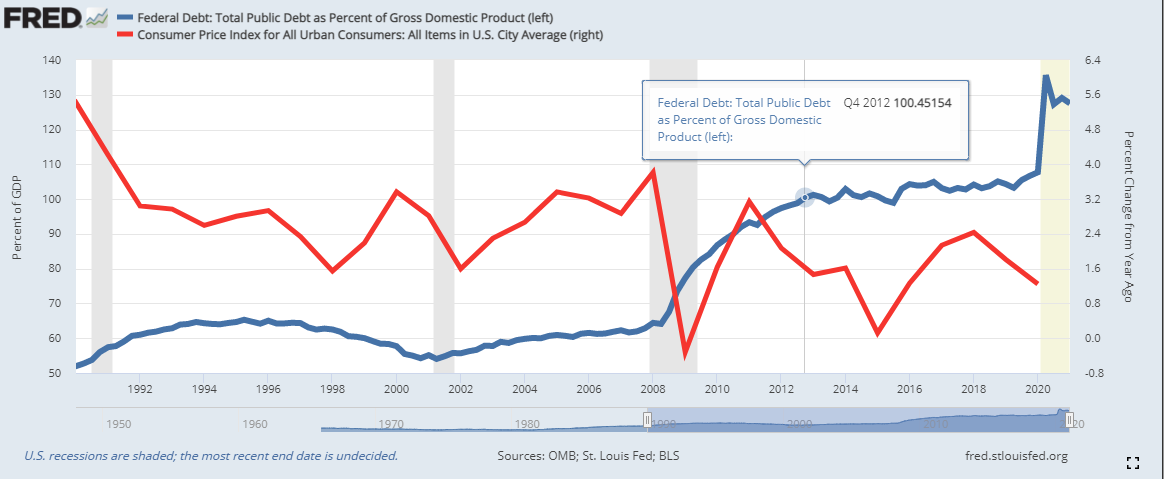
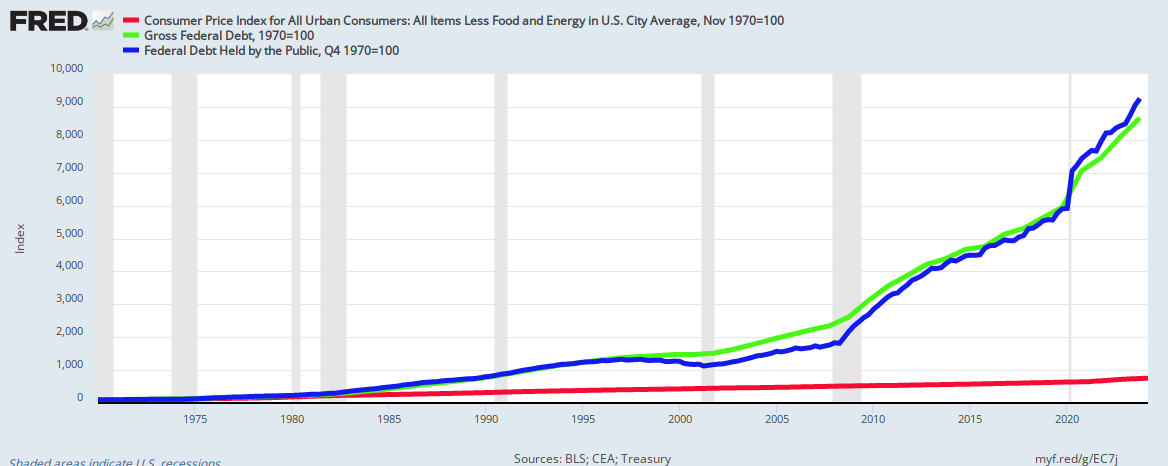
While federal debt growth (red line) has been massive, inflation (blue line) has been moderate.
There is no relationship between changes in federal debt and changes in inflation.

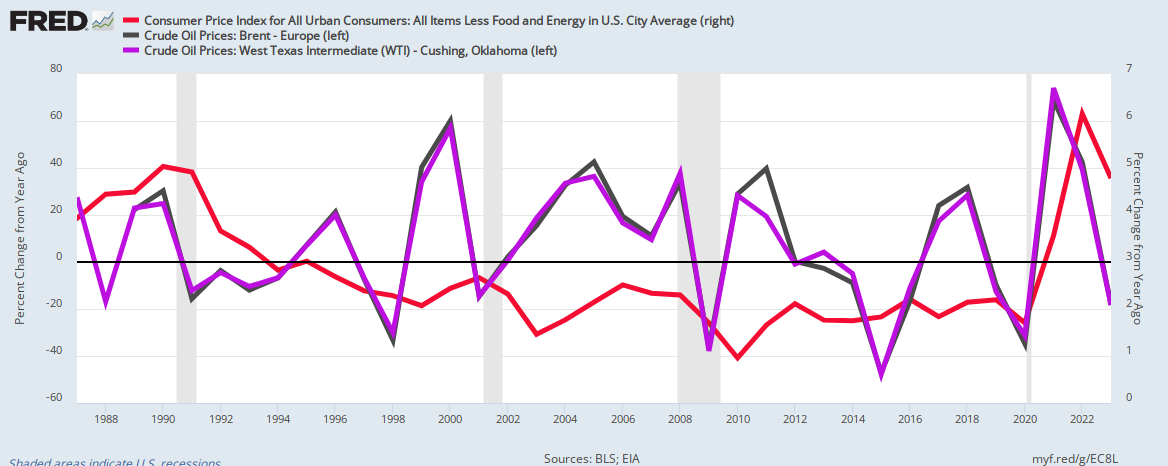
Inflation is caused by shortages of key goods, most often food and/or energy. Inflation actually can be cured by increased government spending to acquire the scarce goods and to distribute them to the populace.

…………………………………………………………………………

Rodger Malcolm Mitchell [ Monetary Sovereignty, Twitter: @rodgermitchell, Search: #monetarysovereignty Facebook: Rodger Malcolm Mitchell ]

THE SOLE PURPOSE OF GOVERNMENT IS TO IMPROVE AND PROTECT THE LIVES OF THE PEOPLE. The most important problems in economics involve:

  • Monetary Sovereignty describes money creation and destruction.
  • Gap Psychology describes the common desire to distance oneself from those “below” in any socio-economic ranking, and to come nearer those “above.” The socio-economic distance is referred to as “The Gap.”

Wide Gaps negatively affect poverty, health and longevity, education, housing, law and crime, war, leadership, ownership, bigotry, supply and demand, taxation, GDP, international relations, scientific advancement, the environment, human motivation and well-being, and virtually every other issue in economics. Implementation of Monetary Sovereignty and The Ten Steps To Prosperity can grow the economy and narrow the Gaps: Ten Steps To Prosperity:

  1. Eliminate FICA
  2. Federally funded Medicare — parts A, B & D, plus long-term care — for everyone
  3. Social Security for all
  4. Free education (including post-grad) for everyone
  5. Salary for attending school
  6. Eliminate federal taxes on business
  7. Increase the standard income tax deduction, annually.
  8. Tax the very rich (the “.1%”) more, with higher progressive tax rates on all forms of income.
  9. Federal ownership of all banks
  10. Increase federal spending on the myriad initiatives that benefit America’s 99.9% 
 

The Ten Steps will grow the economy and narrow the income/wealth/power Gap between the rich and the rest.

MONETARY SOVEREIGNTY