It’s 2021, and after 81 years, the “debt bomb” is about to explode. Again?

You repeatedly are told that the federal “debt” and “deficit” are too high, and danger to America. Further, you are told that the debt/GROSS DOMESTIC PRODUCT ratio is too high, and if it ever reaches 100, there will be a calamity.

All are wrong.

The federal “debt” is not a debt. It is the total of deposits into T-security accounts, which are similar to bank safe deposit accounts. The federal government never touches those dollars.

The federal deficit is the annual investment by the federal government into the private sector. The federal government has infinite money, and the private sector uses federal investments for economic growth.

The purpose of T-securities is not to supply the federal government with spending money. The purposes are:

  1. to provide a safe parking place for unused dollars. This stabilizes the dollar.
  2. to help the Fed control interest rates. This helps prevent inflation.

Because the federal government is Monetarily Sovereign, it pays its bills by creating new dollars ad hoc. It has no need to borrow or even to levy taxes. The federal government cannot unwillingly become insolvent.

Even if all tax collections fell to $0, the federal government could continue spending and paying its bills, forever.

Recessions tend to follow reductions in deficit growth:

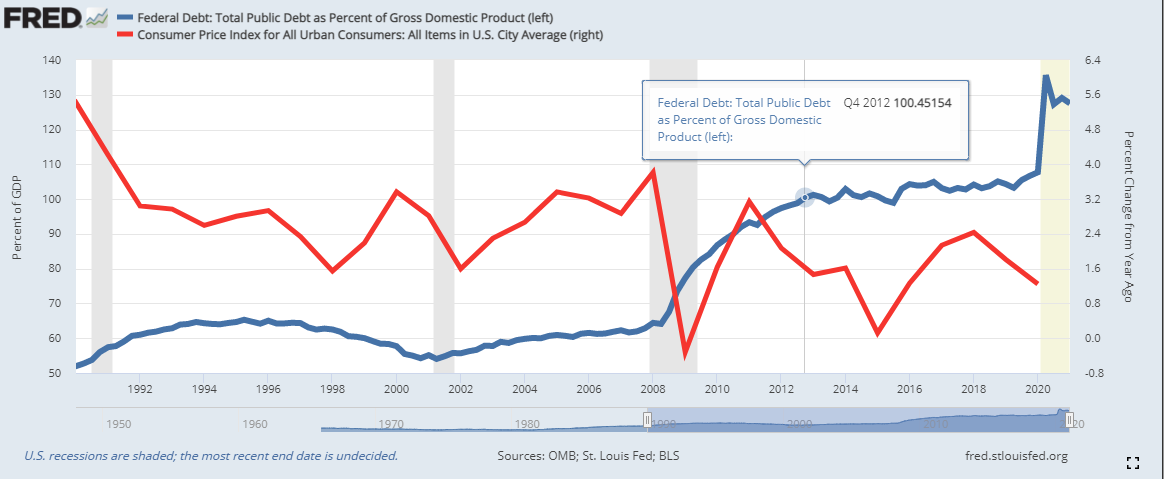
Reduced Debt growth (red line) causes recessions (vertical gray bars), and increased Debt growth cures recessions

U.S. depressions tend to come on the heels of federal surpluses.

1804-1812: U. S. Federal Debt reduced 48%. Depression began 1807.
1817-1821: U. S. Federal Debt reduced 29%. Depression began 1819.
1823-1836: U. S. Federal Debt reduced 99%. Depression began 1837.
1852-1857: U. S. Federal Debt reduced 59%. Depression began 1857.
1867-1873: U. S. Federal Debt reduced 27%. Depression began 1873.
1880-1893: U. S. Federal Debt reduced 57%. Depression began 1893.
1920-1930: U. S. Federal Debt reduced 36%. Depression began 1929.
1997-2001: U. S. Federal Debt reduced 15%. Recession began 2001.

Despite all of the above, self-proclaimed “experts” continue to claim that the federal debt is a “ticking time bomb.” Since 1940, they have made the same claim, and have been wrong.

Yet, they seem incapable of learning from failure, so they continue to disseminate the easily disproved nonsense:

……………………………………………………………………………………………………………………………………………………………………………………………………………………..

September 1940, the federal budget was a “ticking time-bomb which can eventually destroy the American system,” said Robert M. Hanes, president of the American Bankers Association.

At this time, the federal debt was $40 Billion.

September 26, 1940, New York Times, Column 8

By 1960: the debt was “threatening the country’s fiscal future,” said Secretary of Commerce, Frederick H. Mueller. (“The enormous cost of various Federal programs is a time-bomb threatening the country’s fiscal future, Secretary of Commerce Frederick H. Mueller warned here yesterday.”) At this time, the federal debt was $237 Billion.

By 1983: “The debt probably will explode in the third quarter of 1984,” said Fred Napolitano, former president of the National Association of Home Builders. At this time, the federal debt was $1,137 Billion.

In 1984: AFL-CIO President Lane Kirkland said. “It’s a time bomb ticking away.” At this time, the federal debt was $1,307 Billion.

In 1985: “The federal deficit is ‘a ticking time bomb, and it’s about to blow up,” U.S. Sen. Mitch McConnell. (Remember him?) At this time, the federal debt was $1,507 Billion.

Later in 1985: Los Angeles Times: “We labeled the deficit a ‘ticking time bomb’ that threatens to permanently undermine the strength and vitality of the American economy.” At this time, the federal debt was $1,507 Billion.

In 1987: Richmond Times–Dispatch – Richmond, VA: “100TH CONGRESS FACING U.S. DEFICIT ‘TIME BOMB’” At this time, the federal debt was $1,890 Billion.

Later in 1987: The Dallas Morning News: “A fiscal time bomb is slowly ticking that, if not defused, could explode into a financial crisis within the next few years for the federal government.”

In 1989: FORTUNE Magazine: “A TIME BOMB FOR U.S. TAXPAYERS” At this time, the federal debt was $2,191 Billion.

In 1992: The Pantagraph – Bloomington, Illinois: “I have seen where politicians in Washington have expressed little or no concern about this ticking time bomb they have helped to create, that being the enormous federal budget deficit, approaching $4 trillion.” At this time, the federal debt was $3,000 Billion.

Later in 1992: Ross Perot: “Our great nation is sitting right on top of a ticking time bomb. We have a total national debt of $4 trillion.” At this time, the federal debt held by the public was $3,000 Billion.

In 1995: Kansas City Star: “Concerned citizens. . . regard the national debt as a ticking time bomb poised to explode with devastating consequences at some future date.” At this time, the federal debt was $3,604 Billion.

In 2003: Porter Stansberry, for the Daily Reckoning: “Generation debt is a ticking time bomb . . . with about ten years left on the clock.” At this time, the federal debt was $3,913 Billion.

In 2004: Bradenton Herald: “A NATION AT RISK: TWIN DEFICIT A TICKING TIME BOMB” At this time, the federal debt was $4,926 Billion.

In 2005: Providence Journal: “Some lawmakers see the Medicare drug benefit for what it is: a ticking time bomb.” At this time, the federal debt was $4,592 Billion.

In 2006: NewsMax.com, “We have to worry about the deficit . . . when we combine it with the trade deficit we have a real ticking time bomb in our economy,” said Mrs. Clinton. At this time, the federal debt was $4,829 Billion.

In 2007: USA Today: “Like a ticking time bomb, the national debt is an explosion waiting to happen.” At this time, the federal debt was $5,035 Billion.

In 2010: Heritage Foundation: Why the National Debt is a Ticking Time Bomb. Interest rates on government bonds are virtually guaranteed to jump over the next few years.   At this time, the federal debt was $9,019 Billion.

In 2010: Reason Alert: “. . . the time bomb that’s ticking under the federal budget like a Guy Fawkes’ powder keg.” At this time, the federal debt was $9,019 Billion.

In 2011: Washington Post, Lori Montgomery: ” . . . defuse the biggest budgetary time bombs that are set to explode.” At this time, the federal debt was $10,129 Billion.

June 19, 2013: Chamber of Commerce: Safety net spending is a ‘time bomb’, By Jim Tankersley: The U.S. Chamber of Commerce is worried that not enough Americans are worried about social safety net spending. The nation’s largest business lobbying group launched a renewed effort Wednesday to reduce projected federal spending on safety-net programs, labeling them a “ticking time bomb” that, left unchanged, “will bankrupt this nation.” At this time, the federal debt was $11,983 Billion.

In 2014: CBN News: “The United States of Debt: A Ticking Time Bomb” At this time, the federal debt was $12,780 Billion.

On Jun 18, 2015: The ticking economic time bomb that presidential candidates are ignoring: Fortune Magazine, Shawn Tully. At this time, the federal debt was $13,117 Billion.

On February 10, 2016, The Daily Bell“Obama’s $4.1 Trillion Budget Is Latest Sign of America’s Looming Collapse” At this time, the federal debt was $14,168 Billion.

On January 23, 2017: Trump’s ‘Debt Bomb’: Deficit May Grow, Defense Budget May Not, By Sydney J. Freedberg, Jr. At this time, the federal debt was $14,665 Billion.

On January 27, 2017: America’s “debt bomb is going to explode.” That’s according to financial strategist Peter Schiff. Schiff said that while low interest rates had helped keep a lid on U.S. debt, it couldn’t be contained for much longer. Interest rates and inflation are rising, creditors will demand higher premiums, and the country is headed “off the edge of a cliff.” At this time, the federal debt held by the public was $14,665 Billion.

On April 28, 2017: Debt in the U.S. Fuel for Growth or Ticking Time Bomb?, American Institute for Economic Research, by Max Gulker, PhD – Senior Research Fellow, Theodore Cangeros. At this time, the federal debt held by the public was $14,665 Billion.

Feb. 16, 2018  America’s Debt Bomb By Andrew Soergel, Senior Reporter: Conservatives and deficit hawks are hurling criticism at Washington for deepening America’s debt hole. At this time, the federal debt held by the public was $15,750 Billion.

April 18, 2018 By Alan Greenspan and John R. Kasich: “Time is running short, and America’s debt time bomb continues to tick.”

January 10, 2019, Unfunded Govt. Liabilities — Our Ticking Time Bomb. By Myra Adams, Tick, tick, tick goes the time bomb of national doom. At this time, the federal debt held by the public was $14,665 Billion.

January 18, 2019; 2019 Is Gold’s Year To Shine (And The Ticking US Debt Time-Bomb) By Gavin Wendt

[The following were added after the original publishing of this article]

April 10, 2019, The National Debt: America’s Ticking Time Bomb.  TIL Journal. Entire nations can go bankrupt. One prominent example was the *nation of Greece which was threatened with insolvency, a decade ago. Greece survived the economic crisis because the European Union and the IMF bailed the nation out.

July 11, 2019National debt is a ‘ticking time bomb‘: Sen. Mike Lee

SEP 12, 2019, Our national ticking time bomb, By BILL YEARGIN SPECIAL TO THE SUN-SENTINEL | At some point, investors will become concerned about lending to a debt-riddled U.S., which will result in having to offer higher interest rates to attract the money. Even with rates low today, interest expense is the federal government’s third-highest expenditure following the elderly and military. The U.S. already borrows all the money it uses to pay its interest expense, sort of like a Ponzi scheme. Lack of investor confidence will only make this problem worse. At this time, the federal debt held by the public was $15,801 Billion.

JANUARY 06, 2020, National debt is a time bomb, BY MARK MANSPERGER, Tri City Herald | The increase in the U.S. deficit last year was about $1.1 trillion, bringing our total national debt to more than $23 trillion! This fiscal year, the deficit is forecasted to be even higher, and when the economy eventually slows down, our annual deficits could be pushing $2 trillion a year! This is financial madness. There’s not going to be a drastic cut in federal expenditures — that is, until we go broke — nor are we going to “grow our way” out of this predicament. Therefore, to gain control of this looming debt, we’re going to have to raise taxes.

February 14, 2020, OMG! It’s February 14, 2020, and the national debt is still a ticking time bomb!  The national debt: A ticking time bomb? America is “headed toward a crisis,” said Tiana Lowe in WashingonExaminer.com. The Treasury Department reported last week that the federal deficit swelled to more than $1 trillion in 2019 for the first time since 2012. Even more alarming was the report from the bipartisan Congressional Budget Office (CBO) predicting that $1 trillion deficits will continue for the next 10 years, eventually reaching $1.7 trillion in 2030

April 26, 2020, ‘Catastrophic’: Why government debt is a ticking time bomb, Stephen Koukoulas, Yahoo Finance  [Re. Monetarily Sovereign Australia’s debt.]

August 29, 2020LOS ANGELES, California: America’s mountain of debt is a ticking time bomb  The United States not only looks ill, but also dead broke. To offset the pandemic-induced “Great Cessation,” the US Federal Reserve and Congress have marshalled staggering sums of stimulus spending out of fear that the economy would otherwise plunge to 1930s soup kitchen levels. Assuming that America eventually defeats COVID-19 and does not devolve into a Terminator-like dystopia, how will it avoid the approaching fiscal cliff and national bankruptcy? At this time, the federal debt held by the public was $14,665 Billion.

March 17, 2021The Democrats’ ‘Big’ Infrastructure Plan: A Giant Debt Bomb? by Rachel Bucchino, a reporter at the National Interest. Her work has appeared in The Washington Post, U.S. News & World Report and The Hill. Congress basically has two options: borrowing money or raising taxes, whether it uses reconciliation or not,” Stan Veuger, a resident scholar in economic policy studies at the American Enterprise Institute, said.

Rodger Malcolm Mitchell

Monetary Sovereignty Twitter: @rodgermitchell Search #monetarysovereignty Facebook: Rodger Malcolm Mitchell

……………………………………………………………………..

THE SOLE PURPOSE OF GOVERNMENT IS TO IMPROVE AND PROTECT THE LIVES OF THE PEOPLE.

The most important problems in economics involve:

  1. Monetary Sovereignty describes money creation and destruction.
  2. Gap Psychology describes the common desire to distance oneself from those “below” in any socio-economic ranking, and to come nearer those “above.” The socio-economic distance is referred to as “The Gap.”

Wide Gaps negatively affect poverty, health and longevity, education, housing, law and crime, war, leadership, ownership, bigotry, supply and demand, taxation, GDP, international relations, scientific advancement, the environment, human motivation and well-being, and virtually every other issue in economics. Implementation of Monetary Sovereignty and The Ten Steps To Prosperity can grow the economy and narrow the Gaps: Ten Steps To Prosperity:

  1. Eliminate FICA
  2. Federally funded Medicare — parts A, B & D, plus long-term care — for everyone
  3. Social Security for all
  4. Free education (including post-grad) for everyone
  5. Salary for attending school
  6. Eliminate federal taxes on business
  7. Increase the standard income tax deduction, annually. 
  8. Tax the very rich (the “.1%”) more, with higher progressive tax rates on all forms of income.
  9. Federal ownership of all banks
  10. Increase federal spending on the myriad initiatives that benefit America’s 99.9% 

The Ten Steps will grow the economy and narrow the income/wealth/power Gap between the rich and the rest.

MONETARY SOVEREIGNTY


Are you burned out? Is the 4-day work week inevitable?

Would you like to work fewer hours for the same pay? You may think this is obvious, but it is a serious question that employees and employers are beginning to ask. The following excerpts from an online article predict the 4-day work week will result from COVID-related burnout. We, however, believe the number of working hours will shrink, but not only from burnout but from factors even more fundamental. “Burnout” is a state of mind. It represents a divergence from what is considered acceptable.
Pin on Stuff to Buy
Dull, repetitive jobs, without a sense of accomplishment, plus pressure to keep up, error-free, can lead to burnout.
Years ago, more people worked 6-day weeks. They might not have enjoyed the experience, but they didn’t “burn out.” They just kept going, because it was seen as normal. Today, many parents, especially single parents, work 6 or even 7 days a week caring for their children, caring for their homes and lives, and even have 2nd or 3rd jobs, just to survive. They may not allow themselves to “burn out.” They just trudge ahead. Some business owners work 7 days a week, building their businesses. If a business is successful, the owner probably will not burn out. But when the business struggles, burnout could come quickly. That provides a clue to what burnout really is. It may not be related to hours, but more importantly to feelings of accomplishment, human relationships, or importantly, the lack thereof. Consider your own situation. Do you work in:

*A relatively mindless, repetitive job, for which there is no “winning,” no sense of accomplishment?

*A job in which any error you make will be criticized, but if you make no errors, no one will notice?

*A job you never can finish, and you feel under pressure to keep up?

*A dreary job that has no “happy” days, only misery days?

*A lonely job where you have no friends or are unable to take time to converse with your fellow employees?

*A job where you are surrounded by disgruntled employees or disgruntled bosses.

If so, you may be ripe for burnout. Consider that as you read these excerpts:
People are burned out and quitting their jobs. Could a 4-day work week help? By Tracey Anne Duncan June 24, 2021 The pandemic changed the way many of us perceive our jobs. Working from home became the norm for people privileged enough to do so — and as a result, working in offices has started to seem burdensome and a bit nonsensical. Now that some businesses are starting to require people to go back to actual physical workplaces, a large swath of people are either quitting their jobs, or seriously considering quitting.
Keep in mind that the author is talking about people who had out-of-home jobs and were satisfied. Then they began to work at home, and having recently returned to their previous workplace, find themselves burned out.
To combat the resignation pandemic, Japan is proposing a nationwide four-day work week. Could a shorter work week help remedy people’s newly exacerbated disgust with the office? It’s pretty surprising that Japan is the country leading the way to more relaxed options for workers, because the country is known for its, um, intense work culture. There’s even a Japanese word — karoshi — that translates to “death by overwork.” To combat burnout, Japan unveiled a plan this week to make working 32 hours a week the new normal. It’s not just the Japanese government that thinks working fewer hours might be a solution to overwork. Kickstarter announced Tuesday that it is instituting a 32 hour work week without reducing pay, and the Prime Ministers of both Finland and New Zealand have also entertained the idea, reported the Washington Post. Also, Spain decided back in March that it would be experimenting with a three-year test run of the 32-hour work week. The four-day work week is an idea that has been floated off and on since the 1970s. So, what’s making both nations and big corporations reconsider the traditional 40-hour work week now? Well, firstly, working during a global crisis has led to widespread burnout for many, and some experts also think a more reasonable set of hours is a way to make themselves more attractive to a new generation of workers. “Younger people are demanding more out of their work environment than just a paycheck,” professor of business law at the University of Connecticut, told The Washington Post. “They want to work with someone who believes in their values — and the expression of a four-day workweek sends a signal that the company cares about work-life balance in a significant and meaningful way.”
Another clue. The problem is not the workweek or the work hours. The problem is the “signal.” People want to feel appreciated. People want to feel their efforts have meaning. People do not want to feel constant, unremitting pressure with no reward.
Most of the research about decreasing the number of hours people work doesn’t decrease their productivity. In fact, working fewer hours could make people more productive. Microsoft introduced the four day work week to employees in Japan in August of 2019, and they found that it increased productivity by 40%, reduced the waste the company created, and reduced the amount of electricity the company used. Plus, 94% of employees were happy with it, reported the Post.
There are issues beyond initial results. Burnout occurs over weeks, months, years, even decades and can be attributed to many factors. One factor not mentioned is the effect of the research itself. Giving people an extra day off, or an extra hour-per-day off creates a change from the grinding sameness of many jobs.
Robots could replace 20 million manufacturing jobs worldwide by 2030: Report - ABC News
Increased worker productivity can lead to reduced worker hours. Is this man’s job interesting and stimulative or dull and stressful?
The very fact of change, or the participation in an experiment, can provide an exhilaration that temporarily can offset feelings of burnout. We do not know whether years of 32 hour weeks, either via a day off per week, or time off per day, would yield the same results. The ordinary, the commonplace, the dull, the repetitive — all may be precursors to burnout,  and mere change could prevent it. Another factor to consider: Automation. Computers, particularly “smart” computers, can increase perceived productivity by allowing one human worker to accomplish more. Worker productivity is not so much a worker’s function as it is a tool function. That means today’s interesting job could be tomorrow’s dull job if much of the interesting parts are handled by computers. There is a vast difference between analyzing data to make decisions vs. punching in data to read a computer’s decisions. The former can be interesting and stimulating; the latter can be dull. Yet another factor is global warming plus the use of the earth’s resources. The home-work-home roundtrip is inefficient. The use of fossil fuels along with transportation vehicles contributes very little to productivity while wasting our precious and limited life’s time. I expect governments soon will begin to reward companies that encourage and implement work-at-home, while also rewarding employees who do the same. And then, there is the spare-time factor, and what to do with it. Retired people work as little as 0 hours per week, and many of them struggle to find something interesting to occupy their hours — especially true if life spans increase. They can experience a form of burnout from doing nothing. And finally, the question: What is the purpose of work? For most working people, the purpose of work is to acquire money, i.e. to acquire security and pleasure. But money is nothing more than a spreadsheet notation, which our Monetarily Sovereign federal government has the unlimited ability to produce.
Is This the World's Dirtiest Job? Bangladeshi Sewer Cleaners Dive into Filth for $10 a Day
Bangladeshi sewer cleaner. Unthinkable in America today.
Without delving into the complex argument, “should the federal government give everyone money,” there is no question that the federal government can give everyone money. Medicare, Medicaid, Social Security, poverty aids have reduced for many people the desperate need to labor at the most unpleasant jobs — the jobs most likely to lead to burnout. SUMMARY The topic of “burnout” is amazingly complex. No one factor is responsible, and no one action can prevent it. In fact, even the word itself means different things to different people. The commonality may be feelings of negative exhaustion, futility, hopelessness along with the strong need for change. There was a time when people were expected to come to central work locations and to work longer hours than today’s standard 40 hour week. Thus, for the many reasons described above, the incidence of burnout may not necessarily correlate only to hours of work, either over the short or the long term, but more importantly, the nature of the work. That said, average hours worked probably will continue to decline, mostly because improved computers and machine learning will transfer many jobs from human-skill to computer-skill. The challenge for businesses will be to help enrich the working, and even the non-working hours, so that burnout becomes less likely an issue. I suggest that the traditional 40 hour week will disappear as Biggest Computer Screen - Quantum Computing
  1. People become more accustomed to, and manufacturers will provide, improved versions of distance communication (i.e. large-screen Zoom, et al)
  2. Computerization and machine learning make distance working more feasible
  3. Productivity continues to increase allowing people to accomplish more in fewer hours
  4. The economy learns how to entertain people whose personal time is more flexible.
  5. The federal, state, and local governments provide incentives to distance work, in an effort to combat global warming and to reduce resource usage.
Humans, perhaps uniquely among species, increasingly have focused on labor-saving. That focus combined with advanced computerization can lead to a decline in drudgery and burnout — along with hours worked and working distance from home. Rodger Malcolm Mitchell Monetary Sovereignty Twitter: @rodgermitchell Search #monetarysovereignty Facebook: Rodger Malcolm Mitchell

……………………………………………………………………..

THE SOLE PURPOSE OF GOVERNMENT IS TO IMPROVE AND PROTECT THE LIVES OF THE PEOPLE.

The most important problems in economics involve:
  1. Monetary Sovereignty describes money creation and destruction.
  2. Gap Psychology describes the common desire to distance oneself from those “below” in any socio-economic ranking, and to come nearer those “above.” The socio-economic distance is referred to as “The Gap.”
Wide Gaps negatively affect poverty, health and longevity, education, housing, law and crime, war, leadership, ownership, bigotry, supply and demand, taxation, GDP, international relations, scientific advancement, the environment, human motivation and well-being, and virtually every other issue in economics. Implementation of Monetary Sovereignty and The Ten Steps To Prosperity can grow the economy and narrow the Gaps: Ten Steps To Prosperity:
  1. Eliminate FICA
  2. Federally funded Medicare — parts A, B & D, plus long-term care — for everyone
  3. Social Security for all
  4. Free education (including post-grad) for everyone
  5. Salary for attending school
  6. Eliminate federal taxes on business
  7. Increase the standard income tax deduction, annually. 
  8. Tax the very rich (the “.1%”) more, with higher progressive tax rates on all forms of income.
  9. Federal ownership of all banks
  10. Increase federal spending on the myriad initiatives that benefit America’s 99.9% 
The Ten Steps will grow the economy and narrow the income/wealth/power Gap between the rich and the rest.

MONETARY SOVEREIGNTY

 

Has it ever occurred to you . . . ?

Has it ever occurred to you . . .?The Thinker | Musée Rodin
The people who claim the USA isn’t racist are the worst racists? When one member of a group fails, the bigots will hate the entire group for this failure? If a group succeeds, the bigots will despise it for its success. Liberals think the purpose of government is to protect the poor and powerless from the rich and powerful. Conservatives think the purpose of government is to protect the rich and powerful from the poor and powerless. It takes two things to put people in chains: The ignorance of the oppressed and the treachery of their leaders. Hatred and fear are evil twins. It is impossible to hate someone without fearing them. The brainless are too brainless to understand how little they know. The intelligent are smart enough to understand how little they know. Dictators always claim that patriotism is obedience to them. Their disciples agree. Fake, hyperpatriots “love America,” but hate the Americans who disagree with them. Loyalty, like obedience, usually is a one-way street. Divorce and dog leashes are proof. A liar believes everyone is lying; a cheater believes everyone is cheating; a hater believes hatred is normal. The more federal budgets are cut and federal taxes increased, the weaker an economy becomes. No economy can tax itself into prosperity, nor grow without money growth. Cutting federal deficits to grow the economy is like applying leeches to cure anemia. Many people expect the Federal Reserve to control inflation. But inflation is not a financial problem. Inflation is a scarcity problem that only Congress can fix. It is easier to have sympathy than empathy. Actually, no one has empathy. “I feel your pain” is a lie. We wish to distance ourselves from those below us on any social scale, while coming closer to those above. This is Gap Psychology. Austerity is the government’s method for widening the gap between rich and poor. Everything in economics devolves to motive, and the motive always involves the Gap between the richer and the poorer. The Gap is what makes the rich, rich. To widen the Gap, the rich can obtain more for themselves, or make sure the poor have less. Everyone lies. Most of our lies are to ourselves. No life form in the universe is less knowlegable than a voter. Until the 99% understand the need for federal deficits, the upper 1% will rule. To survive long-term, a monetarily non-sovereign entity must have a positive balance of payments. Those, who do not understand the differences between Monetary Sovereignty and monetary non-sovereignty, do not understand economics. Where reality differs from belief, those who question least choose belief. The more we learn, the more we begin to see, if we were tasked with building a universe, this is the only way it could be. In politics, people tend to support those who most resemble them. Women tend to support women. Blacks tend to support blacks; Jews tend to support Jews; Evangelicals tend to support Evangelicals; New Yorkers tend to support New Yorkers, Latinos tend to support Latinos; and stupid, immoral, close-minded, bigoted liars tend to support stupid, close-minded, immoral, bigoted liars. Know yourself by whom you follow.
Rodger Malcolm Mitchell Monetary Sovereignty Twitter: @rodgermitchell Search #monetarysovereignty Facebook: Rodger Malcolm Mitchell ………………………………………………………………………………………………………………………………

THE SOLE PURPOSE OF GOVERNMENT IS TO IMPROVE AND PROTECT THE LIVES OF THE PEOPLE.

The most important problems in economics involve:
  1. Monetary Sovereignty describes money creation and destruction.
  2. Gap Psychology describes the common desire to distance oneself from those “below” in any socio-economic ranking, and to come nearer those “above.” The socio-economic distance is referred to as “The Gap.”
Wide Gaps negatively affect poverty, health and longevity, education, housing, law and crime, war, leadership, ownership, bigotry, supply and demand, taxation, GDP, international relations, scientific advancement, the environment, human motivation and well-being, and virtually every other issue in economics. Implementation of Monetary Sovereignty and The Ten Steps To Prosperity can grow the economy and narrow the Gaps: Ten Steps To Prosperity:
  1. Eliminate FICA
  2. Federally funded Medicare — parts A, B & D, plus long-term care — for everyone
  3. Social Security for all
  4. Free education (including post-grad) for everyone
  5. Salary for attending school
  6. Eliminate federal taxes on business
  7. Increase the standard income tax deduction, annually. 
  8. Tax the very rich (the “.1%”) more, with higher progressive tax rates on all forms of income.
  9. Federal ownership of all banks
  10. Increase federal spending on the myriad initiatives that benefit America’s 99.9% 
The Ten Steps will grow the economy and narrow the income/wealth/power Gap between the rich and the rest. MONETARY SOVEREIGNTY

Rick Scott shovels the myth

Senator Rick Scott is a Floridian. He is a Republican. And he is a Trumper.
Official Portrait of Senator Rick Scott (R-FL).jpg
Would this face lie to you?
He sent me a form letter telling me how he is going to improve my life:
(Republican) Senator Rick Scott led his colleagues in introducing the Federal Debt Emergency Control Act to rein in Washington’s out-of-control spending and provide a concrete path forward to tackle the nation’s nearly $30 trillion debt.
“Out-of-control” is a synonym for “Gosh, that’s a lot of money to waste on the poor.” In fact, the “Out-of-control” spending is controlled by Congress, of which Republican Senator Rick Scott is a part. This is the same Republican Congress that gave the rich a vast, over-budget tax reduction, without a whimper from Senator Rick Scott. Suddenly, with a Democratic majority Congress and Presidency, the Republicans have re-discovered federal deficits. And they are “shocked, shocked I tell you.” “Out of control” also is a synonym for “ticking time bomb,” about which we have written several times. It’s the bomb that for 80+ years, debt haters have been telling you is ready to explode. Yet, here we are. No explosion. Economic growth. Decades of low inflation.
The Federal Debt Emergency Control Act requires the Office of Management and Budget to declare a “Federal Debt Emergency” in any fiscal year where the federal debt exceeds 100% of that year’s Gross Domestic Product (GDP).
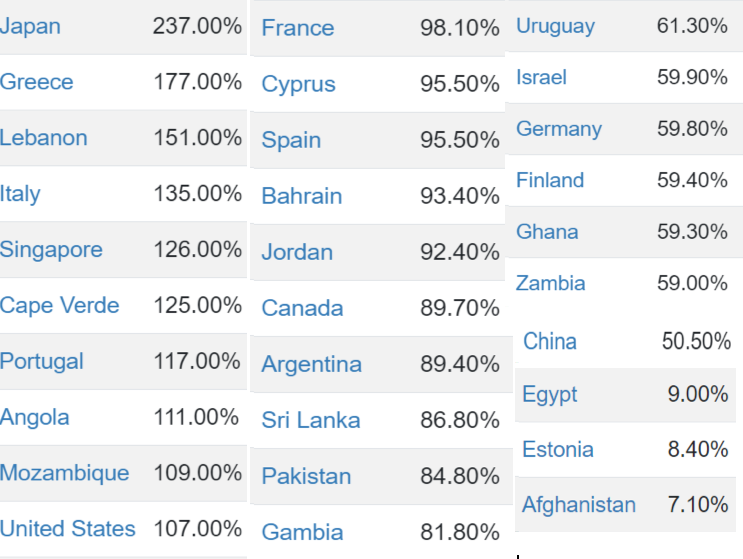
Why the 100% figure? There’s no reason for it other than ignorance. The ratio of federal debt to GDP has absolutely no significance regarding the health of the U.S. economy. It’s a useless, meaningless ratio that gets fire-breathed with alarm by those who either know nothing about economics, or worse, want you to know nothing about economics. If (Republican) Senator Rick Scott is right, you would expect the sickest, weakest economies to have the highest Debt/GDP ratios, while the healthiest, weakest economics have the lowest Debt/GDP ratios. But what do we find? Here are some examples:

Sample Nations: DEBT / GDP Ratios

Based on the above ratios, which nations would you say have the strongest, healthiest economies, and which have the weakest, sickest economies? Right. The Debt/GDP ratio tells you exactly nothing about the health or strength of a nation’s economy. But Republican Senator Rick Scott wants to cut federal spending as soon as our ratio hits the arbitrary and meaningless number: 100% (which it already did way back in the 4th qtr of 2012 — blue line). And by the way, inflation (red line), the current Republican excuse for cutting benefits for the poor, has averaged below the Fed’s 2% target.
This emergency designation would trigger several provisions to help control and reduce the federal debt to levels below 100% of GDP, including: Terminating any unobligated funding from the American Rescue Plan Act, and any previous stimulus bills, and sending it back to the Treasury General Fund immediately for deficit reduction.
He’s not specific about what should be cut. He just wants to cut “any unobligated funds,” no matter how vital to the economy and the people they may be. Exactly what is supposed to happen in the Treasury General Fund for deficit reduction? What is the “it” he wants to send back? Which dollars are not to be spent? The whole thing is financially senseless, but it is a classic right-wing approach. The American Rescue Plan Act and the previous stimulus bills rescued America from the severe recession that was exacerbated by Donald Trump’s incompetent and deadly COVID denial along with his economically damaging trade duty war against China. Scott is silent about that. Scott never says. Why? Because, being a Republican, he would cut all the spending that benefits the poor and middle classes, while falsely claiming that the rich are “job makers” who should be rewarded even more than they already are.
Requiring all legislation that increases the federal deficit, as determined by the Congressional Budget Office, to carry its own offsets.
This means running a balanced budget, perhaps the least intelligent idea ever to come out of any Congressperson’s mouth because: A balanced federal budget is absolutely, positively guaranteed to cause a deep recession if we are lucky, or a deep depression if we are not lucky. If you can find anyone on this planet who can demonstrate how running a balanced federal budget would allow for economic growth and/or prevent a depression, I would love to see the evidence. Perhaps the same person also can prove that global warming is a Chinese myth, and that Donald Trump actually won the election — two equally nutsy claims coming from the GOP.
If it does not, the legislation shall be considered out of order and will require at least two-thirds of all Senators to vote to increase federal debt before even being able to consider the bill.
Wait! What if two-thirds of all Senators were, by some miracle, to vote to increase the federal debt, would that mean it then becomes OK? Suddenly it would be within the government’s “means”? And, don’t we already have the ridiculous federal “debt limit,” that not only does the same thing, but is raised every time it’s reached? And why is the debt limit always raised? Because, Congress is well aware that limiting federal debt would destroy the U.S. economy.
Fast-tracking any legislation that would reduce the federal deficit by at least 5 percent over ten years.
Where did that 5% number come from? It surely wasn’t derived by any scientific method. Scott apparently thinks it’s a nice number, so he uses it. It reminds one of dearly departed Herman Cain’s meaningless “9-9-9” tax plan. Just numbers with no real reason. And where is the math that says reducing the federal deficit would benefit the economy in some way? Non-existent.
Senator Rick Scott said, “America is in a debt crisis. Our nation is barreling toward $30 trillion in debt – an unimaginable $233,000 in debt for every family in America.
It’s not that families owe that debt. The government does. But Scott tries to imply, falsely, that your family will have to pay for that debt.
It’s a crisis caused by decades of wasteful and reckless spending by Washington politicians. Now, President Biden is continuing this way of governing by pushing for trillions in wasteful spending, raising the U.S. federal debt by 60% to $39 trillion and the debt-to-GDP ratio to 117% in 2030, the highest level ever recorded in American history.
And what has been the result of all this “wasteful and reckless spending? Taxes are down and GDP is up. But Scott wants to fix that, by raising taxes and/or reducing GDP.
Spending beyond our means has consequences.
The federal government, being Monetarily Sovereign, has no “means.”
We’re already seeing rising inflation, which disproportionately hurts the poorest families, like mine growing up.
The “rising inflation,” which for decades has been below Federal goals, is the result of the pandemic, not the result of federal spending. It was the pandemic, and Trump’s atrocious handling of it, that led to the shortages of goods and services, that resulted in a thoroughly predictable inflation. Someone, please ask Sen. Scott, “Where was the inflation last year and the year before, and the decades before, when deficit spending was massive?” And yes, we caught that “I grew up poor” disgusting attempt at ingratiating yourself with the people you are trying to screw. But hey, as long as you’re talking about your history, let’s get into where your calculations might have come from:
In 1987, after serving in the United States Navy and becoming a law firm partner, Scott co-founded Columbia Hospital Corporation. Columbia later merged with another corporation to form Columbia/HCA, which eventually became the nation’s largest private for-profit health care company. Scott was pressured to resign as chief executive of Columbia/HCA in 1997. During his tenure as chief executive, the company defrauded Medicare, Medicaid and other federal programs. The Department of Justice ultimately fined the company $1.7 billion in what was at the time the largest health care fraud settlement in U.S. history.
And this fraudster is the guy who suddenly has become so concerned about the federal government’s “means” and its ability to pay its bills. No wonder this criminal is a Trumper. “Birds of a feather,” as they say. He must have envied Trump University.
I look forward to every fiscally responsible Republican and Democrat working with me to quickly pass the Federal Debt Emergency Control Act.”
Yes, do vote for good old “fiscally responsible” Rick Scott, who can hardly wait to cut benefits to the poor, while driving the economy into a depression, thus allowing his rich backers to buy up property and businesses at discount prices, while paying workers depression-era wages. And, there are people who actually believe this guy! Strange. Fortunately, with a currently Democratic Congress and President, this idiotic ploy has no chance to pass, and least not in the near future. And it wasn’t meant to pass. There isn’t a new idea in the entire proposal. It’s a rehash of all the discredited nonsense that has been floated by populists for decades.  It was assembled in a half-hour as a political stunt to show how fiscally sound is the do-nothing, historically crooked Senator from Columbia/HCA. Rodger Malcolm Mitchell Monetary Sovereignty Twitter: @rodgermitchell Search #monetarysovereignty Facebook: Rodger Malcolm Mitchell ………………………………………………………………………………………………………………………………

THE SOLE PURPOSE OF GOVERNMENT IS TO IMPROVE AND PROTECT THE LIVES OF THE PEOPLE.

The most important problems in economics involve:
  1. Monetary Sovereignty describes money creation and destruction.
  2. Gap Psychology describes the common desire to distance oneself from those “below” in any socio-economic ranking, and to come nearer those “above.” The socio-economic distance is referred to as “The Gap.”
Wide Gaps negatively affect poverty, health and longevity, education, housing, law and crime, war, leadership, ownership, bigotry, supply and demand, taxation, GDP, international relations, scientific advancement, the environment, human motivation and well-being, and virtually every other issue in economics. Implementation of Monetary Sovereignty and The Ten Steps To Prosperity can grow the economy and narrow the Gaps: Ten Steps To Prosperity:
  1. Eliminate FICA
  2. Federally funded Medicare — parts A, B & D, plus long-term care — for everyone
  3. Social Security for all
  4. Free education (including post-grad) for everyone
  5. Salary for attending school
  6. Eliminate federal taxes on business
  7. Increase the standard income tax deduction, annually. 
  8. Tax the very rich (the “.1%”) more, with higher progressive tax rates on all forms of income.
  9. Federal ownership of all banks
  10. Increase federal spending on the myriad initiatives that benefit America’s 99.9% 
The Ten Steps will grow the economy and narrow the income/wealth/power Gap between the rich and the rest. MONETARY SOVEREIGNTY