Remember that “ticking time bomb”? After 83 years it’s still ticking, and still a scam

The “ticking time bomb” is the federal debt that supposedly is so big as to be “unsustainable.” You remember. It’s the “bomb” that has been sustained for 84 years.

If someone is wrong every year for 84 years, would you believe them? Unfortunately, some still believe the federal debt is “unsustainable,” a “ticking time bomb,” and should be combated with a debt limit.

I have no polite words to describe those people. Sadly, I now must tell you about “the world’s largest Ponzi scheme,” which, by no coincidence, also is the federal debt.

RegInnovate – Regulatory Innovation through Technology | Peter Schiff ...
Peter Schiff

“Ponzi” is the latest term used by people who either don’t understand Monetary Sovereignty or don’t want you to understand Monetary Sovereignty.

‘The world’s largest Ponzi scheme’: Peter Schiff just blasted the US debt ceiling drama. Here are 3 assets he trusts amid major market uncertainty Story by Bethan Moorcraft A ticking time bomb in the U.S. economy is running perilously close to detonation.

With the U.S. reaching its debt limit of $31.4 trillion on Jan. 19, Treasury Secretary Janet Yellen urged lawmakers to increase or suspend the debt ceiling.

Janet Yellen reveals that she knows the debt ceiling is unnecessary, useless, and harmful. Otherwise, she would ask that the debt be paid off.

She knows, however, that federal finance makes that not just unnecessary but impossible simply because the federal government is not the debtor.

That thing called “federal debt” isn’t federal debt. The actual federal debt is the amount the federal government owes to vendors of goods and services purchased by the federal government but not yet paid for.

In short, the real federal debt also is known as “Accounts Payable” plus Interest Payable.
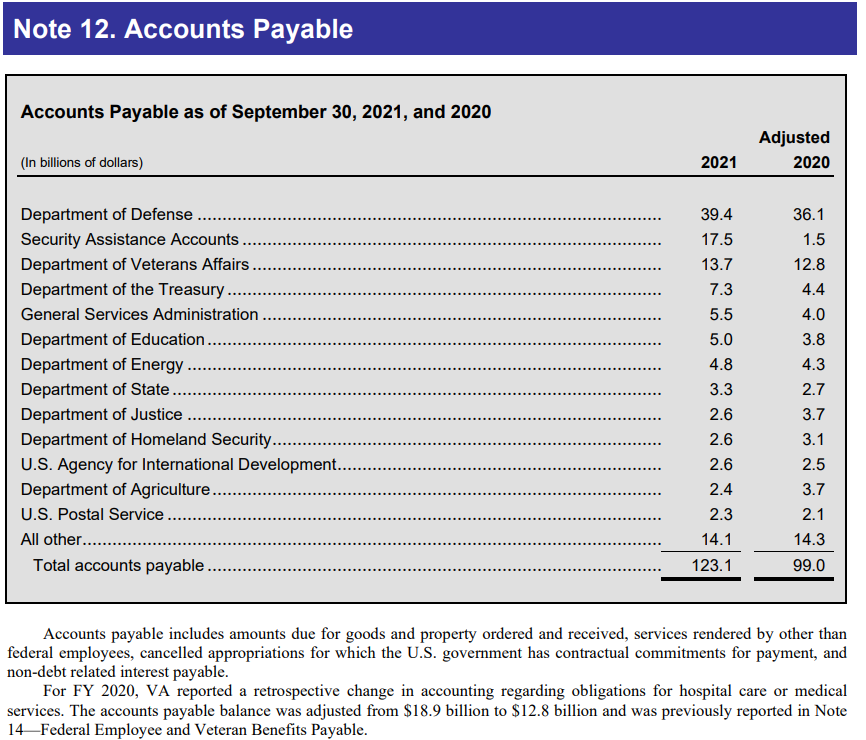
The actual federal debt is in the billions, not the trillions, and it is paid reliably every day.

Treasury securities, T-bills, T-notes, and T-bonds are deposit accounts, similar to bank safe deposit accounts that the government never touches.

When you invest in a T-security, you put dollars into your account from which only you can withdraw. Just as the contents of your bank safe deposit box are not the debt of your bank, the contents of your T-security account are not the debt of your federal government.

The government didn’t borrow those dollars. It merely holds them separately for safekeeping until you take them back.

Her plea was taken by Peter Schiff, famed investor, and market commentator, as an “official admission that the U.S. is running the world’s largest Ponzi scheme.”

Sadly, Schiff doesn’t seem to know what a “Ponzi scheme is. Quoting from Wikipedia:

Ponzi scheme is a form of fraud that lures investors and pays profits to earlier investors with funds from more recent investors.

The scheme leads victims to believe that profits come from legitimate business activity (e.g., product sales or successful investments), and they remain unaware that other investors are the source of funds.

A Ponzi scheme can maintain the illusion of a sustainable business if new investors contribute new funds. Most investors do not demand full repayment and still believe in the non-existent assets they purported to own.

Federal T-securities have none of these characteristics.

  1. They are not fraud.
  2. Payment does not come from more recent investors but rather from each depositor’s own deposits and the federal government’s infinite ability to create its sovereign currency.
  3. There is no claim that funds come from any business activity, legitimate or otherwise.
  4. The government does not rely on new investors, nor does it rely on new depositors. The government does not have to accept deposits. Even if every T-security owner demanded payment, the government could comply today.

Peter Schiff merely is using a scare tactic to fool the public. Rather than being a Ponzi scheme, U.S. T-securities are the safest investments known to the world and will continue to be safe so long as no political party is foolish enough to enforce the ridiculous debt limit (aka the “screw-depositors-to-make-political-points” action).

A political stand-off over the debt ceiling has been raging since Republicans regained control of the House of Representatives in the 2022 midterm elections.

President Joe Biden beseeched Congress not to hold the item hostage, suggesting a default could be “calamitous.”

His warnings hit deaf ears in the case of opposing Republicans who used their votes on an extension as leverage to seek spending cuts.

The debt limit has nothing to do with spending cuts because it deals with past spending, not future spending.

The Republican extortion attempt just as easily could be directed at any federal laws, even those having nothing to do with federal finances.

How about enforcing the debt limit unless women Senators wear long dresses, Trump’s rioters are released from prison, or the Capital is painted purple.

All of those have as much relevance to a debt limit as demanding cuts to future spending. The debt limit is a child’s game of, “I’ll hold my breath until I get my way.”

The Treasury can use “extraordinary measures” in the coming months to cover its many financial obligations, including Social Security and Medicare disbursements, but these emergency funds are limited.

At the end of the day, the U.S. simply must borrow more money, as it has done many times before.

The notion that the creator of the U.S. dollar needs to borrow dollars from the people who use the dollar is obviously ridiculous. Where would the so-called “lenders” get the dollars to “lend” if the creator is precluded from creating dollars?

Congress has set the limit for federal borrowing since 1917, raising it over time as government spending and borrowing needs have increased.

Notice the arbitrariness of the above sentence. It correctly assumes Congress can, at its discretion, increase the “debt limit” without regard to the wishes of so-called lenders.” If it were a real debt, the “borrower” could not, at whim, decide to borrow unlimited amounts.

“The U.S. Treas. Sec. has admitted the only way to avoid a default on the National Debt is to raise the #DebtCeiling so the Govt. can borrow from new lenders to repay existing lenders,” Schiff, CEO and chief global strategist at Euro Pacific Capital tweeted on Jan. 16.

“This is an official admission that the U.S. is running the world’s largest Ponzi scheme.”

Oh, the ignorance! Oh, the lies. The “U.S. Treas. Sec.” admitted no such thing. The real way to avoid default is to eliminate the useless debt ceiling. We didn’t always have a debt ceiling. Why do we have one now? Taken from Wikipedia:

In 1979, noting the potential problems of hitting a default, Dick Gephardt imposed the “Gephardt Rule,” a parliamentary rule that deemed the debt ceiling raised when a budget was passed.

This resolved the contradiction in voting for appropriations but not voting to fund them. The rule stood until it was repealed by Congress in 1995.

Get it? When Congress voted for an appropriation, it also voted to fund them.

So, if Congress said, “We authorize spending a billion dollars on a dam,” that meant a billion dollars immediately became available to build a dam.

Makes sense to any normal person. Apparently, though, it was too logical for Congress.

In 1995, Congress said, “When we authorize spending a billion dollars to build a dam, we really don’t authorize paying a billion dollars to build the dam.”

And if that makes sense to you, you should run for Congress. Since that convulsion of childish illogic, Congress has plagued the nation with repeated debt limit crises.

The US raised its debt ceiling (in some form or other) at least 90 times in the 20th century.

The debt ceiling was raised 74 times from March 1962 to May 2011, including 18 times under Ronald Reagan, eight times under Bill Clinton, seven times under George W. Bush, and five times under Barack Obama.

In practice, the debt ceiling has never been reduced, even though the public debt itself may have been reduced.

It should be noted that never has the arbitrary increase of the debt ceiling caused any sort of financial difficulty. There has been no time bomb explosion, fraud, or Ponzi scheme.

In his podcast, Schiff claimed the U.S. government is in a doom spiral where it cannot pay its current lenders back, so it borrows from new lenders repeatedly.

And, oh yes, no “doom spiral.” Though the so-called “debt” has risen from $40 billion to $26 trillion, a 65,000% increase, the federal government still has no difficulty paying its bills.

“Why do people willingly participate? It’s because they don’t realize it’s a Ponzi scheme,” Schiff says.

It’s not.

“They think they’re going to get paid back. When they realize they’re going to be paid back in monopoly money, they’re not going to want to lend.

“Monopoly money”? Is that a scare term like “Ponzi scheme” and “ticking time bomb”?

“In fact, they’re not going to want to hold on to these Treasuries, and the only buyer is going to be the Federal Reserve. And that’s when the printing press is going to overdrive, and the dollar is going to fall through the floor.”

Gee, Schiff, exactly when is that going to happen. It didn’t happen while the printing press was running every day, every week, every month, and every year for the past 84 years. Why are things different now?

As Congress fights over the debt ceiling extension, U.S. credit rating and financial markets are at risk – but here are three assets that Schiff likes as hedges against economic volatility.

And here it comes, the real reason Schiff is serving up bushels of BS:

Wealthy young Americans have lost confidence in the stock market — and are betting on these assets instead. Get in now for strong long-term tailwinds.

Gold. Schiff has long been a fan of the yellow metal.

“The problem with the dollar is it has no intrinsic value,” he once said. “Gold will store its value, and you’ll always be able to buy more food with your gold.”

Except, Schiff neglects to tell you that gold has very little intrinsic value. Gold has less intrinsic value than aluminum, iron, copper, or paper. Gold isn’t used for much other than decoration.

A few teeth fillings, some electronics, that’s about it. Rather than intrinsic value, gold has demand value. People want the stuff mainly because it’s pretty.

As always, he’s putting his money where his mouth is.

Euro Pacific Asset Management’s latest 13F filing shows that as of Sept. 30, Schiff’s company held 1.655 million shares of Barrick Gold (GOLD), 431,952 shares of Agnico Eagle Mines (AEM), and 317,495 shares of Newmont (NEM).

In fact, Barrick was the firm’s top holding, representing 6.8% of its portfolio. Agnico and Newmont were the third and sixth-largest holdings, respectively.

Right. He’s promoting his holdings, trying to get suckers to buy gold.

Gold can’t be printed out of thin air like fiat money, and its safe-haven status means demand typically increases during times of uncertainty.

Except, we always are in times of uncertainty, and gold can be mined out of thin air.

The biggest problem with gold is it costs money to ship, costs more money to store, and costs even more money to insure. And the stuff pays no interest or dividends.

Gold is the classic “bigger fool” investment. Fools buy it hoping to sell it to bigger fools. If you are looking for absolute safety, with no shipping, storage, or insurance costs, plus income, buy T-securities.

Other than that, your best bet is one of the big stock funds. based on the S&P index or similar. And stop worrying about the misnamed federal “debt.” It’s not federal, and it’s not debt, and it’s not a ticking time bomb.

It’s just privately owned, federally guaranteed depositories of U.S. dollars. The only way the “ticking time bomb” can explode is if the debt nuts push the “debt limit” button.

The cure for the “debt limit crisis:” Simply return to the Gephardt Rule.  Simple.

Rodger Malcolm Mitchell Monetary Sovereignty Twitter: @rodgermitchell Search #monetarysovereignty Facebook: Rodger Malcolm Mitchell

……………………………………………………………………..

The Sole Purpose of Government Is to Improve and Protect the Lives of the People.

MONETARY SOVEREIGNTY
Federal debt, myths and facts: What you’ve been told vs. the facts.

Here is what the St. Louis Fed says:

Debt-to-GDP Ratio: How High Is Too High? It Depends October 07, 2020, By Heather Hennerich

How much federal debt is too much? Is there a tipping point at which it becomes a big problem for a country?

One way to gauge the size of a country’s national debt is to compare it with the size of its economy—the ratio of debt to GDP. (GDP serves as a measure of an economy’s overall size and health, measuring the total market value of all of a country’s goods and services produced in a given year.)

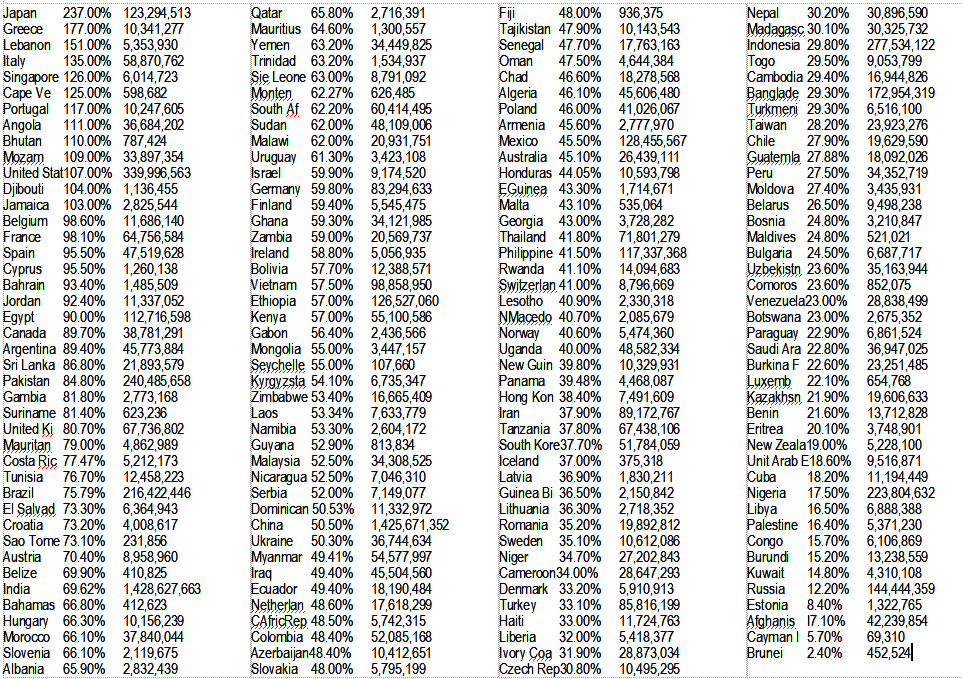
Gross Domestic Product (GDP) is one measure of size, but it is not a measure of health. There is no relationship between the health of an economy and the Debt/GDP ratio. Heather Hennerich’s claim that “GDP serves as a measure of an economy’s overall size and health” simply is false. In fact, the Debt/GDP ratio signifies nothing, nothing at all. Yes, it’s a fraction that is quoted all the time by people who should know better. But you might as well quote an apples/Apple phones comparison. Debt is a cumulative measure of federal government deficits since the beginning of time. GDP is a one year measure of an entire nation’s spending. If you want a similar comparison try the total amount of water a city has wasted vs. the amount of orange juice the mayor drank, yesterday. Call it the “waste/OJ” ratio, and claim it means something. Skim the following list of Debt/GDP ratios, and see if you can find any relationship between the Debt/GDP ratio, the population of the nation, and what you know about the health of its economy. Begin with the fact that wealthy, powerful Japan and weak, impoverished Greece are 1,2 on the list. The United States falls right between Mozambique and Djbouti on the list. Russia has one of the lowest ratios, indicating the “health” of its economy.

NATION — DEBT/GDP RATIO — POPULATION

The Debt/GDP ratio does not measure the health of an economy.
The next time you hear or read some pundit’s concerns about America’s Debt/GDP ratio, you will know that pundit does not know what he/she is talking about.

The U.S. federal debt-to-GDP ratio was 107% late last year, and it went up to nearly 136% in the second quarter of 2020 with the passage of a coronavirus relief package.

By comparison, Japan’s ratio at the end of 2019 was higher: about 200%, according to data from the Bank of Japan and Japan’s Ministry of Foreign Affairs and calculations by St. Louis Fed Economist Miguel Faria-e-Castro.

By comparing the total federal debt to the size of a country’s economy, we can see how that government can use the resources at hand to finance the debt, according to Your Guide to America’s Finances from the U.S. Department of Treasury.

This wrongly assumes that federal (Monetarily Sovereign) finances are like personal (monetarily non-sovereign) finances. The federal government does not “finance” its debt. (Here the word “finance” seems to mean pay it off or perhaps pay interest on it.) The so-called “debt” is nothing more than deposits into privately owned, Treasury Security accounts. We say “privately owned” because the federal government never touches those dollars. As a depositor, you alone decide when to take dollars out or leave them in (following certain initial rules). The dollars are yours when you deposit them and when you retrieve them. That’s why they are not a “loan.” If they were a loan, the borrower would control them. But there is no borrower. The federal government never borrows dollars. These accounts are similar to safe deposit boxes into which you place your valuables. Just as the bank never touches those valuables, the federal government, being Monetarily Sovereign, never needs to touch your deposited money. To pay off the so-called “debt” the government merely returns your dollars to you, the depositor. As for the “resources at hand,” we assume this means that in some mysterious way, the government supposedly uses GDP or perhaps Lake Michigan, to pay off T-securities. No one knows how that works. It’s all gibberish and nonsensical.

In his research, Faria-e-Castro explores big questions about the economy, so we asked him about this issue last year. 

Deficit spending means that a government is choosing not to raise taxes today to pay for that spending but is choosing to wait until tomorrow, Faria-e-Castro said.

Monetarily non-sovereign governments (state, local, euro) use taxes to fund spending. But Monetarily Sovereign governments (US, Canada, Japan, Australia, et al) do not use taxes to fund spending. A huge difference Faria-e-Castro seems not to understand. (And he’s an economist for the St. Louis Fed!!) Monetarily Sovereign governments use taxes to direct their economies by taxing what they want to discourage and giving tax breaks to what they want to encourage. There is scant similarity between federal finances and state/local government finances. Those who do not understand the difference should not be writing for the Federal Reserve. While state/local governments rely on tax income, the federal government could continue spending, forever, with no tax income at all.

Ben Bernanke: “The U.S. government has a technology, called a printing press (or, today, its electronic equivalent), that allows it to produce as many U.S. dollars as it wishes at essentially no cost.”

Then we come to this bit of misinformation, that applies to state/local governments, but not to the federal government:

When federal spending exceeds revenue, the difference is a deficit. The government mostly borrows money to make up the difference.

The federal government doesn’t borrow dollars. Why would it, given its infinite ability to create new dollars?

Alan Greenspan: “There is nothing to prevent the federal government from creating as much money as it wants and paying it to somebody.”

Greenspan understood Monetary Sovereignty. Too bad he didn’t make his knowledge clear so we no longer would have ridiculous laws mandating a “debt ceiling.” Now, again, the nation is paralyzed by the useless debt ceiling while the GOP demands spending cuts though they have no idea what they want to cut. (They don’t have the courage to admit they really would like to cut Social Security and Medicare, so as to help the rich become richer.)

The total national debt is an accumulation of federal deficits over time, minus any repayments of debt, among other factors.

By law, the federal government accepts deposits into T-security accounts equal to the accumulation of federal deficits. This is a point of confusion, because people mistakenly are led to believe that the deposits pay for the deficits. They don’t. The deposits pay for nothing. The purpose of deposits (i.e. T-securities) is to provide a safe place to store dollars, which stabilizes the dollar.

A big consequence of deficit spending is that the fiscal burden shifts from one generation to the next, Faria-e-Castro said.

This is entirely wrong. You never have endured a “fiscal burden” for previous deficits. The government pays for all its deficits by creating new dollars from thin air. This is not a burden on anyone, not on you and not on the government. The “fiscal burden” myth, promulgated through the decades, is a result of ignorance about Monetary Sovereignty.

That’s fine if a country’s economy is growing, because you know that the next generation will, on average, be better off than the current one, and likely able to pay a little more in taxes to decrease the debt, Faria-e-Castro said.

But if a country’s economy is slowing and economic growth rates are lower than they used to be, “this starts becoming a more divisive issue.”

It’s only divisive for those who are ignorant about federal finances. “The next generation” doesn’t pay for back debt. The taxes paid by every generation see the same fate: All federal taxes are destroyed upon receipt. Tax dollars are paid from what is known as “the M2 money supply measure.” The moment they are received by the Treasury, they cease to be part of any money supply measure. In short, they are destroyed.

Say the government of “Country X” borrows money to cover its deficits, Faria-e-Castro said. Investors—many of them international—buy that debt and then want to be repaid.

“One day, the president of Country X can just organize a press conference and just tell people, ‘OK. We’re not paying,’” Faria-e-Castro said. “That’s an outright hard default.”

But countries that take that action will have trouble borrowing again. Lenders will be less willing to lend to them and will charge higher interest rates.

Here, Faria-e-Castro displays remarkable ignorance of national finance because he doesn’t differentiate between Monetarily Sovereign governments and monetarily non-sovereign governments. The monetarily non-sovereign governments borrow money because they have no sovereign currency.

“The president of Country X can call the governor of the central bank and say, ‘OK, you have to print money to pay for this debt,’” Faria-e-Castro said.

In a country where the central bank is not an independent authority, the central bank can be pressured more easily by politicians to start printing money to pay for the country’s debt, he said.

But the flow of new money will invariably lead to high inflation in that country. That erases the value of the debt—a “soft default”—but it also typically kicks off hyperinflation, Faria-e-Castro said.

Astoundingly, that is precisely what does not happen, and the evidence is there for all to see. Whether one views federal debt as “Federal Debt Held by The Public” (first graph below) or as “Federal Debt as a Percent of Gross Domestic Product” (2nd graph below), there is no relationship between federal debt and inflation.  
There is no relationship between federal debt held by the public and inflation. Peaks and valleys do not correspond.
 
There is no relationship between the Debt/GDP ratio and inflation. Peaks an valleys do not correspond.
It never ceases to amaze that obvious and readily available statistics are ignored by so-called “experts” in favor of hand-me-down beliefs having no basis in fact. Inflation is not related to federal spending because inflation is caused by shortages of key goods and services. Some claim that federal deficit spending causes those shortages, but for years and years, we’d seen massive federal spending, with low inflation. The federal dollars that led to increased demand also facilitated increased supply. That is how capitalism works; supply rises to meet demand. But suddenly, in 2020, we began to see inflation. What suddenly changed in 2020? COVID. The inflation that came suddenly in 2020, an inflation we still endure, was caused by COVID-related shortages of oil, food, computer chips, lumber, steel, shipping, labor, etc. There is no statistical relationship between federal deficit spending and inflation. But would you like to see something that does have a relationship with inflation?
Shortages of key goods and services (most often oil) cause inflation. Oil prices are closely related to supply. The peaks and valleys correspond between oil supply and inflation.
Yes, if you’re looking for the primary cause of inflation, start with oil shortages, which then relate to other shortages. COVID was responsible for shortages of oil, food, etc. It would be hard to make the case that after decades of big deficits, suddenly federal spending caused an increase in oil demand. Inflations are supply-related. Federal spending actually can cure inflation if the spending is directed toward obtaining the scarce goods and services and distributing them to the public. Contrary to popular wisdom, restricting federal spending during an inflation is counterproductive. 

Hyperinflation is excessive inflation, with very rapid and out of control general price increases. Economists usually consider monthly inflation rates of above 50% as hyperinflation episodes, as noted in a 2018 On the Economy blog post.

Faria-e-Castro explained, countries that are not politically stable and don’t have independent central banks are not going to have very credible institutions. As a consequence, they can’t borrow easily: Investors won’t be willing to lend them that much for fear of future default.

But the debt of countries with strong institutions and independent central banks—like the U.S. and Japan—doesn’t present the same risks, Faria-e-Castro said.

He thinks the difference between countries has to do with a “strong, central bank.” Poppycock. The central bank of a Monetarily Sovereign nation is strong because Monetary Sovereignty makes it strong. It has the unlimited ability to create its nation’s sovereign currency. Monetarily non-sovereign nations also have central banks. Sadly, these banks are weak because they do not have the unlimited ability to create sovereign currency: They have no sovereign currency to create.

Few believe, for example, that the Japanese government will ever pressure the Bank of Japan to actually “print” money to pay for the country’s debt, Faria-e-Castro said.

First, the Bank of Japan “prints” (creates) yen all the time. No “pressure” needed. It’s a normal, daily process. And second, those yen do not pay for the country’s debt. They pay for the country’s purchases. Like the U.S., the Japanese government does not borrow to pay for anything. It creates yen to pay for everything.

“As a consequence, these countries can typically sustain very high levels of debt to GDP,” he said. “Because people really believe that they will be repaid, so they can keep lending.”

There’s that phony Debt/GDP ratio, again. The U.S. doesn’t borrow.  It issues Treasury bills, notes, and bonds, and if not enough are issued to satisfy the law, the Federal Reserve Bank simply buys the rest.

The strength of institutions also affects interest rates on the debt, which is another factor in determining the sustainability of high debt-to-GDP ratios.

No, the Fed determines short-term interest rates by fiat. And that meaningless Debt/GDP ratio is infinitely sustainable.

If a country has strong institutions, interest rates on the debt will be low, which means the cost of borrowing will be low, Faria-e-Castro said.

When he talks about the “cost of borrowing,” he mistakenly believes government T-securities represent borrowing. They don’t. They represent deposits. These deposits are paid off, not with taxes but by returning the dollars that are in the accounts. And whether interest rates are high or low is irrelevant to a Monetarily Sovereign nation having the infinite ability to create the currency to pay interest.

Because the institutional strength and riskiness of countries varies, there’s no rule of thumb for how high a debt-to-GDP ratio can be before it poses a risk to a country’s economy.

“At the end of the day, it all boils down to strong and independent institutions,” Faria-e-Castro said.

“A lot of economists try to study this. There’s no single measure that we can come up with… Measuring institutional strength is not obvious.”

It’s not obvious because Faria-e-Castro is confusing federal financing with private financing. He doesn’t understand the difference between Monetary Sovereignty and monetary non-sovereignty. And he’s speaking for the Federal Reserve!? Yikes! He falls in line with the current mistaken belief that fighting inflations requires the pain of recession that cuts in federal spending beget. That is the kind of leadership that destroys nations. Rodger Malcolm Mitchell Monetary Sovereignty Twitter: @rodgermitchell Search #monetarysovereignty Facebook: Rodger Malcolm Mitchell

……………………………………………………………………..

The Sole Purpose of Government Is to Improve and Protect the Lives of the People.

MONETARY SOVEREIGNTY

Oh, Veronique, you write so much and seem to know so little about America’s #1 scam.

Veronique de Rugy
Veronique d Rugy. Is she lying or does she really not understand federal finance? Or?

VERONIQUE DE RUGY is a contributing editor at Reason.

She is a senior research fellow at the Mercatus Center at George Mason University.

According to the 2017 Global Go To Think Tank Index Report (Think Tanks and Civil Societies ProgramUniversity of Pennsylvania), Mercatus is number 39 in the “Top Think Tanks in the United States” and number 18 of the “Best University-Affiliated Think Tanks”. 

The Koch family has been a major financial supporter of the organization since the mid-1980s. Charles Koch serves on the group’s board of directors.

The following is Ms. de Rugy’s article from the Libertarian website, REASON.com.

Social Security Is on the Brink of Collapse. The GOP Won’t Touch It. In 1950, there were more than 16 workers for every beneficiary. In 2035, that ratio will be only 2.3 workers per retiree. VERONIQUE DE RUGY | 1.26.2023 12:01 AM

If you follow policy debates long enough, arguments you never thought you’d hear can become key components of the two parties’ policy platforms.

That’s certainly the case when it comes to some Republicans, and their new “never touch Social Security and Medicare” position.

Over the weekend, newly elected Sen. J.D. Vance (R–Ohio) tweeted that former President Donald Trump was 100 percent correct to demand that “under no circumstances should Republicans vote to cut a single penny from Medicare or Social Security.”

Vance’s tweet was issued amid the debt ceiling fight, but Trump has long held this position.

The Republicans would love to cut Medicare and Social Security benefits because that would increase the income/wealth/power Gap between the rich and the rest. The Gap is what makes the rich rich. If not for the Gap, no one would be rich. We all would be the same. The wider the Gap, the richer are the rich. The GOP, the party of the rich, is always ready to help make the rich richer. Their big tax reduction during the Trump years enriched the rich and did nothing for the middle and poor. The GOP complaints about funding the IRS had to do with protecting the rich. So long as the IRS is underfunded, they don’t have the manpower to investigate the complex tax returns of the rich, so currently, they focus on the middle and lower levels. The only reason the GOP won’t try to cut Medicare and Social Security benefits is that they would be punished at the polls, not because they care about the health and well-being of the middle or poor. They don’t. Watch for the GOP “solution” to the non-problem of Social Security and Medicare finances to be something that doesn’t hurt the rich, such as increasing the FICA income limit. Rich people aren’t worried about paying FICA taxes on an above $150M salary. Not only is that chump change for the rich, but many don’t pay any FICA because they aren’t salaried.

Now, to be fair, the GOP’s well-intentioned engagement in the overall debt ceiling dispute is limited by the short time Congress has to raise the limit, all but ruling out credible reforms of Medicare or Social Security.

GOP’s “well-intentioned” engagement in the debt ceiling dispute?? I didn’t realize Veronique was a humor writer. Or perhaps she believes her readers are fools.

Reforming these two programs will take a considerable amount of time and requires bipartisan action. However, this reality is no reason to assert that the programs’ benefits should never be touched.

In right-wing speak (Yes, Libertarians are closet right-wingers), “reform” Social Security and Medicare means cut benefits to the middle class and the poor.

I cannot wait to hear the grand plan that the “don’t touch Social Security and Medicare” Republican caucus has to address the $116 trillion over 30-year shortfall—that’s 6 percent of U.S. GDP—facing the two programs.

No action from Congress means no money to pay for all the benefits. That means enormous cuts that will hurt the low-income seniors who depend on the programs.

That is a bald-faced lie. The federal government could double, triple, or quadruple benefits for both programs while eliminating all FICA collections and still have money to pay Congressional, Presidential, and SCOTUS salaries. Contrary to popular myth, FICA pays for nothing. Every FICA dollar ripped from your paycheck and sent to the U.S. Treasury is destroyed upon receipt. The dollars come from the M2 money supply, so when you pay $1 in federal taxes, the M2 money supply declines by $1. But when those M2 dollars reach the Treasury, they instantly cease to exist in any money supply measure. There is no money supply measure for federal funds simply because the federal government has the infinite ability to create dollars. Thus, the federal government, being Monetarily Sovereign, has infinite dollars. Adding your tax dollars to infinity doesn’t change infinity.

Of course, if Vance and friends insist on not touching benefits, they could address the Social Security and Medicare shortfalls with enormous tax hikes.

Federal taxes don’t fund federal spending, so they can’t “address Social Security and Medicare shortfalls.”

For Social Security alone, when the trust fund dries out, they will have to agree to immediately raise the payroll tax from 12.4 percent to 15.64 percent—or close to a 25 percent tax increase.

Add to that the tax hike necessary for Medicare and then repeat the exercise over the years to fill the entire shortfall.

The tax hikes would have no effect on Social Security and Medicare solvency. These federal agencies and all other federal agencies are solvent because they are funded by the infinitely solvent U.S. government. The misnamed federal “debt” is not a debt of the federal government. The government has paid all its debt the same way: By creating dollars from thin air. The federal debt is the net total of all federal deficits — the difference between total spending and total taxing. That difference is bridged by federal money creation so that all obligations are paid on time. Have you ever wondered how the federal government can raise the debt ceiling whenever it wishes? According to the U.S. Department of the Treasury, the debt ceiling has been raised, extended, or revised 78 separate times since 1960. And all these increases were done without tax increases (otherwise, the debt ceiling would not have been reached) because federal taxes don’t fund anything. (State and local governments (unlike the federal government) are monetarily NON-sovereign. They don’t have the unlimited ability to create dollars, so their taxes do fund their spending.)

It’s not as if we haven’t been warning politicians that these troubles were brewing. Back in 2000, roughly when I started working on fiscal issues, experts already warned that the Social Security trust fund would run out of assets by 2037, triggering painful benefit cuts.

Not only does the Social Security trust fund not pay SS benefits, but it isn’t even a trust fund. To quote right-winger Pete Peterson:

WHAT ARE FEDERAL TRUST FUNDS? Sep 20, 2016, Peter G. Peterson Foundation

A federal trust fund is an accounting mechanism used by the federal government to track earmarked receipts (money designated for a specific purpose or program) and corresponding expenditures.

The largest and best-known funds finance Social Security, Medicare, highways and mass transit, and pensions for government employees.

Federal trust funds bear little resemblance to their private-sector counterparts.

In private-sector trust funds, receipts are deposited and assets are held and invested by trustees on behalf of the stated beneficiaries.

In federal trust funds, the federal government does not set aside the receipts or invest them in private assets.

Rather, the receipts are recorded as accounting credits in the trust funds, and the receipts themselves are comingled with other receipts that Treasury collects and spends.

The misnamed trust funds are wholly owned and controlled by the federal government. It can add to them, subtract from them or do whatever else it wishes with them. The notion that the trust funds will run out of money and so can’t pay Social Security or Medicare benefits is ridiculous on its face. The federal government pays whatever benefits it wishes, regardless of so-called “trust funds.’ Further, the government has the unlimited power to add to, or subtract from those fake trust funds whenever it wishes. The whole Social Security/Medicare trust fund fiction is a giant scam to make you believe the government can’t afford SS and Medicare benefits. When politicians whined that Medicare for All or Social Security for All needed to be “paid for” by tax increases or benefit cuts, the sole purpose was to make you agree to widening the income/wealth/power Gap between you and the rich. It is America’s biggest, most crooked scam, and you have been falling for it since Social Security began on August 14, 1935. And you still fall for it without complaint. It’s a scam that makes Bernie Madoff look like an angel. One wonders why you don’t fret about the White House trust fund, the SCOTUS trust fund, the Congress trust fund, the Bureau of Labor Statistics trust fund, the Capitol Police trust fund, the Army trust fund, the Coast Guard trust fund, and all the other federal department and agency trust funds. Oh, they don’t have trust funds? So where do they get their money? Ah, the federal government simply pays the bills by creating dollars from thin air. Just pay thepreciselyand stop lying about “trust funds.” that is exactly what the federal government should do about Social Security and Medicare.

Today, the situation has deteriorated further, with the trust fund now on track to run dry in 2035, along with any practicable hope for fixing the problem.

The fake “trust fund” will run dry only if Congress and the President want it to run dry.

In other words, these problems shouldn’t surprise anyone. When Social Security started, life expectancies were lower. In 1950, there were more than 16 workers for every beneficiary. That ratio is now below three workers per retiree and will be only 2.3 workers per retiree by 2035.

The number of workers per beneficiary is completely irrelevant. Workers do not pay for beneficiaries. FICA does not pay for anything. It’s destroyed. It exists only to con you. Period.

Add to this trend decades of politicians buying votes by expanding benefits beyond incoming payroll taxes, and you have a true fiscal crisis.

To the Libertains’ sneering and twisted minds, giving the populace benefits is “buying votes.” But the sole purpose of any government is to protect and enhance the people’s lives.  If any government doesn’t provide benefits, it’s not doing what it was created to do.

That’s why it’s so alarming that so many in the GOP are giving up on educating a public that’s been brainwashed for years with misleading soundbites like “You earned your Social Security benefits, so you are entitled to the benefits now promised,” or “There’s an account with your name on it.”

There is, in fact, an account with your name on it, and it’s called a T-security account. If you have deposited money into a T-bill, T-note, or a T-bond, you have put dollars into your T-security account. Those dollars belong to you. The federal government never touches them. When your account matures, the government returns the dollars in your account. The total of dollars in all T-security accounts is erroneously termed, “the federal debt.” But it not federal and it is not debt. Your dollars belong to you, not the federal government, and there is no debt. Your dollars are safe and comfortably resting in your account just as though they were in your pocket or safe deposit box. Just as the contents of bank safe deposit boxes are not bank debt, the contents of T-security accounts are not federal debt.

Such misinformation has made serious discussion of reform very difficult.

Yes, that is exactly what misinformation has done.

There’s no question that retirees deserve fair treatment, but the facts are that the Supreme Court ruled in 1960 that workers do not have a legally binding right to Social Security benefits, and if Congress cuts benefits even by, say, 50 percent, it can do so—no matter how much anyone has paid into the program.

And so goes the “trust fund” myth. If they were trust funds, you would have a legal right to those benefits, but you don’t and SCOTUS has said so. And they are not trust funds. Congress and the President have 100% control over benefits, which can be raised or cut, arbitrarily, as can the amount of money claimed to be in those fake “trust funds.” What does that say about the mythical trust funds? What does that say about Veronique de Rugy’s claims?

It won’t come to that, but the ruling still stands. It’s also fiction that all the benefits that have been promised were earned by workers—they weren’t.

That’s in part because current retirees are paid with taxes from current workers, not from funds saved out of the payroll taxes retirees paid when they were in the workforce.

No, no, no. Current retirees are not paid with federal taxes. They are paid by the federal government’s infinite ability to create dollars. The purpose of federal taxes is not to fund federal spending. The purpose of federal taxes is to control the economy by punishing what the government wishes to discourage and by rewarding (via tax breaks) what the government wishes to encourage.

It’s magical thinking to say that touching Social Security and Medicare is a nonstarter.

Touching Social Security and Medicare is not a financial nonstarter. The government could increase or decrease benefits at will. But decreasing benefits could be a voter nonstarter and increasing benefits could a rich-donor nonstarter. That rug-of-war is the called the “debt-limit-debate. It’s a debate between the rich and the rest, except the “rest” don’t even know there is a debate, much less a solution.

Even more strange, many of the same Republicans want to spare these two programs while still putting Medicaid on the chopping block. Medicaid should be reformed too, but at least that program serves poor people.

By contrast, the seniors who receive Social Security and Medicare today are overrepresented in the top income quintile while younger Americans are overrepresented in the bottom quintile.

So these guys want to cut benefits for poor people on Medicaid while subsidizing relatively wealthy boomers with taxes taken from relatively poor youngsters.

Yikes.

No, the real “yikes” to to writers like Veroique de Rugy who repeatedly promulgate misinformation about the federal “debt” and the fictional Social Security and Medicare “trust funds.” YIKES!!!!!

The GOP’s transformation into the party of big and fiscally reckless government is proceeding apace.

We agree there. Rodger Malcolm Mitchell Monetary Sovereignty Twitter: @rodgermitchell Search #monetarysovereignty Facebook: Rodger Malcolm Mitchell

……………………………………………………………………..

The Sole Purpose of Government Is to Improve and Protect the Lives of the People.

MONETARY SOVEREIGNTY

 
CONGRESS, GOVERNMENT SPENDING, SOCIAL SECURITY, MEDICARE, MEDICAID, DONALD TRUMP, ENTITLEMENTS, POLICY, FISCAL POLICY, OHIO, DEBT, NATIONAL DEBT, DEBT CEILING, REPUBLICAN PARTY, DEMOCRATIC PARTY, GDP, INCOME, POVERTY, TAXES, PAYROLL TAX, POLITICS, RETIREMENT, RETIREMENT BENEFITS, EMPLOYMENT, MISINFORMATION, SUPREME COURT, WEALTH, GOVERNMENT, FEDERAL GOVERNMENT, BIG GOVERNMENT, ECONOMY, ECONOMICS

The CRFB gives you Social Security choices. Hello, sucker.

The mouthpiece for the rich, the Committee for a Responsible Federal Budget, has a web site that says this:

Social Security provides vital income security to millions of beneficiaries but is on a road toward insolvency.

The Social Security program currently pays more in benefits than it collects in revenue, and under the latest official projections, its trust funds will run out in 2035.

At that point, all beneficiaries regardless of age and income will face an immediate 20 percent benefit cut.

CRFB’s “The Reformer” allows users to choose from a number of options to modify Social Security tax and benefit levels in order to close the program’s 75-year shortfall and keep it sustainable for future generations.

See how your choices stack up!

The truth: The federal government cannot become insolvent. SS is a federal agency. Like the government, SS can’t become insolvent unless Congress and the President want it to. The so-called SS “trust funds” are not real trust funds. They are line items on balance sheets that the federal government can control at will. They can increase or decrease the balances just by pressing computer keys. The non-issue of sustainability is to make you believe you have to give up benefits so that by comparison, the rich get richer. Then, the CRFB gives you a little online game that shows you how much to cut your benefits so that the federal government won’t run out of dollars. Of course, it’s all a lie. As you (and they, surely) know, our Monetarily Sovereign government, the creator of the dollar, cannot run out of the dollars it freely creates every minute of every day.

Alan Greenspan: “A government cannot become insolvent with respect to obligations in its own currency.”

Ben Bernanke: “The U.S. government has a technology, called a printing press (or, today, its electronic equivalent), that allows it to produce as many U.S. dollars as it wishes at essentially no cost.”

But the CRFB doesn’t provide that information. Instead, it provides the following choices, which ask you how much less you would like to receive from Social Security:

Increase (+) / Reduce (-) Initial Benefits Slow Benefit Growth for Top 70% of Earners Slow Benefit Growth for Top Half of Earners Slow Benefit Growth for Top 20% Of Earners

Increase Retirement Age Raise Age from 67 to 68 Index Age to Longevity After it Reaches 67 Raise Age to 69 then index to Longevity

Modify Cost of Living Adjustments (COLAs) Index COLAs to “Chained CPI” Index COLAs to “Chained CPI” and Means-Test Them Index COLAs to “CPI-E”

Then, the CRFB asks how much more you would like to pay to our poor, destitute federal government:
Increase (+) / Reduce (-) Payroll Tax Rate by: Increase Taxable Maximum Subject All Wages to Payroll Tax Subject 90% of Wages to Payroll Tax Tax All Wages Above $400,000
Raise Additional Revenue Cover Newly-Hired State & Local Workers Apply the Payroll Tax to “Cafeteria Plans” Increase Taxation of Benefits Invest in the Stock Market Diversify the Trust Fund to Increase Returns Divert 2% of Payroll Tax to “Carve-Out” Accounts Allow Contributions into “Add-on” Accounts
And some other ideas that pretend to “save” Social Security but really are to make you believe the U.S. federal government is running short of the dollars it originally created from thin air, and still creates from thin air.
The one alternative the CRFB doesn’t provide is the correct one:
Provide Social Security benefits to every man, woman, and child in America, paid for by the federal government which has the unlimited power to create dollars.
Don’t be fooled by the CRFB and others of their ilk. Neither America nor Social Security can become insolvent unless that is what Congress and the President want.
The U.S. federal government has the infinite ability to pay for things, which it has been proving since 1940, when the net total of federal deficits was just $40 billion.
Today, the net total of federal deficits is more than $25 TRILLION, and there still is zero insolvency on the horizon.
A government never can run short of its own currency.
If you believe the answers to America’s financial questions are more taxes or lower benefits, and you don’t know who the sucker is, you are the sucker.
Rodger Malcolm Mitchell Monetary Sovereignty Twitter: @rodgermitchell Search #monetarysovereignty Facebook: Rodger Malcolm Mitchell

……………………………………………………………………..

The Sole Purpose of Government Is to Improve and Protect the Lives of the People.

MONETARY SOVEREIGNTY