Imagine you own a Las Vegas casino, but instead of running it yourself, you hire a management firm to run it.
After a while, you discover that the management firm was incompetent or crooked.
Their incompetence was costing you money, and their stealing was costing you even more money.
What would you do?
Would you fire the management firm and hire a new one?
Would you vow to create stricter rules and to supervise them more closely, only to discover the same thing happening again?
And again.
And again.
Even Adam yielded to temptation.
At what point would you finally realize that the combination of incompetence and the powerfultemptation to steal simply are too great for you to supervise someone else running your casino?
At what point would you run the casino yourself?
That is the question the federal government again has before it.
The effort, led by the Federal Deposit Insurance Corporation, comes after First Republic’s shares tumbled 75 percent since Monday, when the bank disclosed that customers had withdrawn more than half of its deposits.
It became clear this past week that nobody was willing to ride to First Republic’s rescue before a government seizure because larger banks were worried that buying the company would saddle them with billions of dollars in losses.
At the beginning of what we call “America,” the government wrote laws, among which were laws that created the U.S. dollar.
Because the federal government created the U.S. dollar, you might think the federal government would understand that U.S. dollar banking is the responsibility of the dollar’s creator.
But, seemingly, the federal government (and the public) don’t get it. Allowing for-profit, private banks to handle that responsibility, competently and without stealing, requires an impossible level of supervision along with a naive belief in the purity of the human spirit.
The words, “for-profit” are key.
Instead of their goal being the efficient and honest distribution of dollars, according to the rules and safeguards established by the government, the goal of the for-profit banks is, of course, profits.
Each time the government sees that incompetence combined with dishonesty and the easy availability of billions of dollars leads to losses for the public, new, stricter rules are created, followed by promises of even stricter supervision.
But temptation and incompetence, along with the bribing of lawmakers proves that even the strictest supervision never can overcome human nature to prevent further incompetence and larceny.
So, the government created Federal Deposit Insurance.
This, in effect, said,
“We never will be able to stop these incompetent miscreants from stealing or otherwise losing depositors’ money, so we might as well, just reimburse depositors for the money that was stolen or lost.
“At least that will prevent panicky runs on the banks.”
But even that was not sufficient to guarantee the survival of the most crooked and incompetent banks, which repeatedly tended to fail, leaving the question, “Who will run the bank after it fails, but still has assets and liabilities?”
The F.D.I.C. has been talking with banks that include JPMorgan Chase and PNC Financial Services about a potential deal, two of the people said.
A deal could be announced as soon as Sunday, these people said, cautioning the situation was rapidly evolving and might still change.
Any buyer would most likely assume the deposits of First Republic, eliminating the need for a government guarantee of deposits in excess of $250,000 — the limit for deposit insurance.
It’s difficult to justify the $250,000 limit (which the FDIC can and does ignore, at its whim). The Monetarily Sovereign federal government could, with equal ease, insure any limit. Why not $500,000? Or a trillion?
But here is where we are:
Private, for-profit banks will continue to bend the rules, cheat the public, and fail, after which the federal government will enter cure-and-recover mode by passing new laws, later to rescind them.
In many cases, the federal government will runa failed bank until another for-profit entity can be found to take it over. The federal government knows how to run banks and needs no profit motive.
The federal government will absorb all the losses, up to certain limits (that $250,00 per account, except when the government decides to absorb more than that. It’s all at the discretion of the government which has the unlimited ability to absorb losses.)
Nothing changes. The “solution” will be stricter regulations until Congress is again bribed to loosen the regulations. Typically, Democrats get tougher, and Republicans get looser, but no one is willing to explain the obvious solution*.
The Federal Reserve is considering stricter regulations for banks after an internal review found that looser rules were one key culprit behind Silicon Valley Bank’s collapse — the second-largest bank failure in U.S. history.
Why it matters: The review, released Friday, lays blame on the bank itself, as well as Fed supervisors charged with overseeing it and a regulation rollback, for the failure. The episode forced the government to take extraordinary action to backstop the banking system.
And here we go again. The rules are tightened until again, they are loosened.
But rules don’t just “get” loosened. Politicians loosen them
What they’re saying: “SVB’s failure demonstrates that there are weaknesses in regulation sand supervision that must be addressed,” Michael Barr, the Fed’s vice chair for supervision who led the review, said in a statement.
Nothing learned. No amount of regulation and supervision can prevent a profit-motivated organization, with its sticky fingers on billions of dollars, from stretching the rules or outright stealing.
In a press release, Fed chair Jerome Powell endorsed that takeaway, saying he supported “recommendations to address our rules and supervisory practices.”
Details: The 114-page report, completed in a little over a month, is the most comprehensive look so far at the failures on the parts of supervisors and bank executives that led to the collapse of the bank.
Why did the supervisors and bank executives “fail”? The profit motive impelled them to fail. Adam failed that test. Humanity fails that test.
But underpinning those failures are 2019 changes that loosened regulations and requirements for financial institutions similarly sized to Silicon Valley Bank, Barr said.
Which party was in charge in 2019? The party that boasts how “good for business” it is. (“Good for business,” is another way to say, “You boys do whatever you want, and if get caught, you won’t be prosecuted, and the government will mop up the mess you made.“)
Where it stands: Those rule changes, which came in response to federal legislation, and a “shift in the stance of supervisory policy impeded effective supervision by reducing standards, increasing complexity, and promoting a less assertive supervisory approach,” Barr said.
Barr said that the Fed plans to reevaluate those rule changes, which applied to banks with $100 billion or more in assets.
The big picture: Barr also proposed tougher rules related to capital and liquidity requirements, as well as the format of periodic stress tests — all of which had been under consideration before Silicon Valley Bank’s failure.
The event, however, intensified the urgency for review, according to senior Fed officials.
Barr is also looking to improve “speed, force, and agility of supervision,” all of which he said appeared to fall short in the case of Silicon Valley Bank.
Of note: A senior Fed official was confident the recommendations would be approved. But even if that’s the case, the process is lengthy so any new rules — particularly those related to liquidity requirements — likely wouldn’t take effect for several years.
So, for “several more years” (i.e. forever) it will be business as usual, because no one is willing to admit there is one solution* to the entire mess.
Between the lines: The report details the extent to which some of Silicon Valley Bank’s troubles were identified by Fed supervisors but not followed up on.
Silicon Valley Bank’s “foundational problems were widespread and well-known, yet core issues were not resolved, and stronger oversight was not put in place,” the report says.
For instance, by the time Silicon Valley Bank failed, it had accumulated 31 supervisory warnings — triple the average received by peers — about a list of issues that ultimately led to the bank’s demise.
No one did anything about those warnings, because being “good for business,” they had been bribed to do nothing.
The bank’s supervisors also identified problems in the bank’s interest rate risk management in annual exams dating back to 2020, but did not issue findings until 2022.
Supervisors “planned” to downgrade a key rating for the Silicon Valley Bank, but the bank collapsed before that rating was finalized.
Sure, they were “planning” to do something at some time in the distant future, but somehow, never managed to do it in time.
Meanwhile: The FDIC on Friday released a report of its own, on the failure of Signature Bank. This agency, too, highlights weaknesses in its supervision — but it blames those failings in part on being under-staffed.
Why are they “understaffed”? Could it be for the same reason the IRS is understaffed? The rich don’t want regulators to function so they bribe Congress to withhold funds from regulators, then claim this is good for business.
The document also reads as a scathing report card on Signature Bank’s management and board, who the FDIC says are ultimately to blame for the bank’s failure.
Private bankers succomb to the profit-motive.
Management “did not prioritize good corporate governance practices, did not always heed FDIC examiner concerns, and was not always responsive or timely in addressing FDIC supervisory recommendations,” according to the report.
Why should management do any of those things? Crooked bank managers don’t serve jail time. That’s reserved for shoplifters and other petty crooks.
They also dropped the ball when it comes to crypto, the report finds. “[Signature] failed to understand the risk of its association with and reliance on crypto industry deposits or its vulnerability to contagion from crypto industry turmoil that occurred in late 2022 and into 2023,” it said.
Worth noting: A separate report from the GAO, also issued Friday, highlights inadequate bank supervision in both banks’ failures.
The bottom line: The regulatory response to this year’s bank failures — which may soon include another one — is only just beginning.
That is exactly what was said following the Great Recession of 2008, which was caused in part, by bankers’ thievery. No bankers went to jail, though their stunning criminality cost America trillions.
The regulatory response is always “just beginning.” Five years, and ten years, and fifty years from now, after numerous more bank failures, there will be regulatory responses that are “just beginning.”
THE SOLUTION*
There is a solution, though because the rich hate it, it never will happen unless the public catches on to the swindle.
The problem lies with the profit motive. Remember “Lead me not to temptation”? Hang millions of dollars in front of even the most honest man’s nose, and he will graduate from stealing office pencils to stealing everything. Period.
The solution is:
The federal government knows how to run banks.
The federal government creates the lending rules.
The federal government creates the bank investing rules.
The federal government determines the bank security rules.
The federal government determines interest rates
The federal government is the one entity in America that has no profit motive.
The federal government cannot go bankrupt.
The federal government insures the banks’ customer against loss.
The federal government supervises the banks
The solution to private bank insolvency is for private banking to end. The federal government should own and manage all the banks.
There is no public purpose served by allowing the private sector to run banking. The federal government should run the banking industry itself. No other “solution” will work.
This is not difficult to see, unless one if being bribed not to see it.
Donald Trump complains about being witch-hunted, but not many people really understand that a witch-hunt is not just something Trump doesn’t like being done to him (he claims).
Ron DeSantis has instituted his own version of witch-hunting with his battle against “grooming,” the hair-brained, fact-devoid belief that gay people try to influence otherwise straight children to become gay.
The similarities between 14th through 20th-century actual witch-hunting and today’s GOP “woke-hunting” are frightening.
Edet Eyo, a 69-year-old woman from Cross River State in Nigeria, and four others were murdered in October 2022, allegedly by a group of young men who charged that her witchcraft had caused a recent motorcycle crash.
Her family says that suspicions had been dogging her for years, arising from jealousy of her prosperity. It is also the tale of Martha Carrier, who was hanged in Salem, Mass., in 1692.
Punishment for witches
Of the accusations against her, one of the most salient was by a neighbor with whom her family had a property dispute.
Carrier became one of 35 people executed for witchcraft in the British colonies of New England—“crimes” of which some of them still have not been exonerated.
Every year more than 1,000 people around the world, including men and children, are tortured, expelled from their homes or killed after being charged with witchcraft—using magic, usually to cause harm.
Far from declining with modernization, as some 20th-century scholars predicted, witch hunts are holding steady in some places and may be happening more often in others.
Multiple roots entwine to produce a witch hunt. A belief in sorcery, a patriarchal society, sudden and a paucity of health care, inaccessible justice systems that give impunity to attackers, a triggering disaster—all of these contribute.
But as Silvia Federici has argued in her 2004 book Caliban and the Witch and subsequent publications, what sustained periods of witch-hunting have in common, across time, space and culture, is a backdrop of social and economic dislocation.
Today’s triggering disaster was the COVID pandemic exacerbated by the Trump (“It will just go away) adminstration’s incompetence and lying, leading to more than a million American deaths.
Although popular imagination regards the trials as outbreaks of mass delusion or superstition, the fact that they peaked between the 1580s and the 1630s, a time of massive upheaval as a capitalist economy emerged, suggests a different story.
Church leaders had initiated witch huntsin the late 15th century, in part as a way of policing social mores.
Now the state, which was closely allied with religious, political and economic elites, took the lead.
In the 16th century rulers across Europe introduced new laws to make sorcery punishable by death—and the trials moved from ecclesiastical to secular courts, such as in duchies and towns.
Historian Christina Larner writes that in Scotland, authorities systematically incited panic against witches, traveling from village to village to instruct people on how to recognize them and sometimes even bringing along lists of women to denounce.
In sum, witch-hunting was a systematic campaign of terror that eliminated the resistance to dispossession that had simmered for decades after the peasant protests were crushed.
The accusations and persecution died down only in the latter half of the 18th century. Historical records indicate that by that time, roughly 50,000 people had been executed for sorcery.
That was then. Now, review what a modern witch-hunt looks like. Here are excerpts from a July 1, 2022 article in Vanity Fair Magazine:
Ron DeSantis has a not-insignificant chance of becoming president in 2024.
Like Trump, the Florida governor takes immense pride in being a bully; he bullied the Special Olympics, he bullied Disney, he bullies anyone who disagrees with him.
What might the country look like should DeSantis ascend to the White House? It’ll be the kind of place where teachers are warned not to display rainbow flags for fear of being prosecuted.
On Friday, Desantis’s Parental Rights in Education Act, a.k.a. the “Don’t Say Gay” law, went into effect in Florida, and it’s hard to overstate how terrifying this whole thing is.
In addition to banning any talk of gender identity and sexual orientation in kindergarten through third grade, it also prohibits such discussions all the way through high school, saying that such topics cannot be discussed in any grade in a manner that is not “age-appropriate or developmentally appropriate.”
(Naturally, the law does not specify what is considered “appropriate”; that definition may not come from the state’s Department of Education until next summer.)
Critics believe the law was written in an intentionally broad manner to scare school districts, which parents can sue if they believe the measure has been violated.
“When we talk about the culture of fear that this bill has created and the chilling effect, we’re talking about the fact that educators and school districts are scared to approach anything related to LGBTQ people or issues out of fear of lawsuits and professional ruin,” said Florida representative Carlos Guillermo Smith.
Ironically, the law is based on not wanting students to “feel uncomfortable.” Instead, it makes teachers and gay students terrified, and the rest of the students, vigilantes.
The common elements between the earlier witch-hunts and today’s GOP witch hunts are:
Politically powerful bigots who amass power by appealing to the ignorance, hatred and fears of the common populace.
The article continues:
For instance, the Orange County Classroom Teachers Association accused school officials this week of telling teachers not to wear clothing with rainbows on them and to get rid of “safe space” stickers and photos of their same-sex spouses.
Last month, according to Palm Beach County high school special education teacher Michael Woods, the Palm Beach County School District “sent out a questionnaire asking its teachers to review all course material and flag any books with references to sexual orientation, gender identity or race.”
Hitler would be proud.
The district removed the books I Am Jazz and Call Me Max, for seemingly referencing gender identity.
Medieval mask of shame
And, the Leon County School Board approved a “LGBTQ Inclusive Guide,” which includes a clause that says parents must be informed if a student who is “open about their gender identity” is in their child’s gym class or with them on an overnight school trip.
Apparently, that gay child represents some sort of threat to other children. (In reality, the other children represent a threat to a gay child.)
“Upon notification or determination of a student who is open about their gender identity, parents of the affected students will be notified of reasonable accommodation options available,” the guidelines state.
“Reasonable accommodations” for the gay child? For the straight children? What does that mean”
“Parents or students who have concerns about rooming assignments for their student’s upcoming overnight event based on religious or privacy concerns may request an accommodation.”
Because, as “everyone” knows, gay children have a reputation for attacking straight children. I never heard of that happening — the straights usually attack the gays — but one can’t be too careful because rooming with a gay child might turn a straight child gay. Right?
The “badge of shame” during the Holocaust
At any rate, we have done our job by stigmatizing the gay children, thus assuring they will be bullied in school, which is exactly what any God-fearing parent should want. Right?
What next? Brand gay students with a “G” on their foreheads? Make them wear yellow armbands as the Jews had to, during the German Nazi period? Make them play in a separate schoolyard, so they don’t contaminate the “normal” kids?
From Wikipedia: In England, under the Poor Act 1697, paupers in receipt of parish relief were required to wear a badge of blue or red clothon the shoulder of the right sleeve in an open and visible manner, in order to discourage people from collecting relief unless they were desperate, as while many would be willing to collect relief, few would be willing to do so if required to wear the “shameful” mark of the poor in public
Brandon Wolf,press secretary for Equality Florida, said, “We’ve always understood what we’re up against in the state of Florida. We know these lawmakers, we know the rightward shift that has happened under Governor Ron DeSantis.”
He fears the measure will only increase anti-LGBTQ+ violence, which increased from 2020 to 2021 and is on track to be worse in 2022, according to the Armed Conflict Location & Event Data Project.
But we DeSantis supporters don’t care about anti-LGBTQ+ violence, do we. Those gay kids have it coming for violating my religious beliefs. Right?
The scarlet letter
“It feels very ominous that in a state that saw the deadliest attack on LGBTQ people in this nation’s history…that we would be having conversations about erasing our history, our lives, our lived experiences from classrooms,” Wolf said.
Meanwhile, in Texas… A group of “educators” proposed that slavery should be called “involuntary relocation.”
Yes, really!
Opposition to the suggested change, which would sort of be like calling Hitler’s systemic murder of 6 million Jews “population downsizing,”apparently came up during a June 15 meeting, at which a Democrat who represents Dallas and Fort Worth noted that the new wording would not be a “fair representation” of the slave trade.
How about calling the Romans’ feeding of Christians to lions, “animal welfare nourishment”?
And then there was this bit of witch-hunt bigotry, courtesy of religion (Why isbigotry so often based on supposed religious belief?)
The Department of Health and Human Services (HHS) issued a final rule earlier this week expanding health care workers’ ability to refuse services on religious grounds.
How about, “My religion doesn’t recognize Jews, so no service for you.”
Or, “My religion tells me that blacks are evil, so you can’t rent in my building”?
Or, “My religion says gay people are breaking God’s laws, so off to jail with you?”
Or, “My religion says abortion is murder, so despite what your religion says, all abortions will be prosecuted as capital crimes, and everyone involved — doctors, lawyers, those facilitating travel for abortions, everyone — will be punished by death?”
That ought to do it.
A number of LGBTQ advocates and health care experts have warned the measure could have a negative impact on the lesbian, gay, bisexual, transgender and queer community.
That’s the whole point. Why do you think we made you queers scapegoats? We’re trying to get the bigot vote in America.
The rule, Protecting Statutory Conscience Rights in Health Care, revises existing HHS regulations to ensure “vigorous enforcement of Federal conscience and anti-discrimination laws” and strengthens health care workers rights so they are “free from coercion or discrimination” on account of their “religious beliefs or moral convictions.”
The measure, first proposed over a year ago, “fulfills President Trump’s promise to promote and protect the fundamental and unalienable rights of conscience and religious liberty,” according to a statement issued by the HHS.
What we mean is the “fundamental and unalianable rights of me,” not the rights of anyone who thinks differently, looks different or acts differently from me.
See it’s like this: Any person’s claimed religious beliefs are more important than the actual health and lives of gay people.
Yes, in the latest round of the Florida governor versus the state’s largest employer, DeSantis threatenedon Monday to punish the company through any array of absurd measures, including building a prison complex next to the theme park.
(DeSantis’s threats were obvious retribution for the way Disney outmaneuvered him by passing covenants that rendered his handpicked governing board basically powerless.)
At a press conference held near Disney World, DeSantis sneered and spoke of the company: “They are not superior to the laws that are enacted by the people of the state of Florida. That’s not going to work, that’s not going to fly.”
Actually, the laws were not enacted by the people. They were enacted by DeSantis and his flunkees, who care only about their power, and nothing about innocent gay people.
Then, after announcing that the Republican-controlled legislature would try to change state law in order to subject the theme park to new inspections, he suggested that the land next to Disney World might be turned into a rival park or perhaps a state prison.
Oh, and the board he personally installed may look into raising Disney’s taxes too.
But that’s not the “weaponizing of the government against political opponents” that the GOP loves to whine about.
As a reminder, all of this is happening because Disney dared to criticizethe wildly bigoted, DeSantis-backed “Don’t Say Gay”legislation last year in Florida, where you’re apparently not allowed to disagree with the authoritarian governor.
Even former New Jersey governor and potential 2024 Republican candidate for president Chris Christie recognized the lunacy of DeSantis’s antics, asking, “Where are we headed here now, that if you express disagreement in this country, the government is allowed to punish you?”
On Monday, Disney seemingly responded to DeSantis’s threats by publicizing “Disneyland After Dark: Pride Nite,” a two-night event that will be held in June to celebrate the LGBTQ+ community and its allies.
Oh, that does it. No doubt the “Disneyland After Dark: Pride Nite” will “groom” dozens if not thousands of straight kids to convert to a lifestyle that guarantees they forever will be scapegoat for the religious. Who could resist such an option?
We’re assuming that didn’t go over so great in the governor’s mansion, and that DeSantis is currently asking his lawyers to look into whether he can have Mickey executed.
DeSantis probably doesn’t harbor a true hatred of gays, blacks, Mexicans, immigrants, Muslims et al. He is just trying to live off the precudices of Florida voters.
Presumably, his massive victory in the most recent elections indicated he judged his constituency correctly.
Fortunately, the rest of America is not Florida, and DeSantis’s national polling number are dropping.
But unfortuately, that leaves the bigoted GOP with Donald Trump, the guy who whines about witch-hunting while endorsing it.
Get the ducking stools and yellow arm bands, ready.
Imagine witnessing an argument between two people. Person #1 says, “A stork delivers babies.” Person #2 says, “FedEx delivers babies.”
What would you say about that argument? That it’s so ignorant as to be beyond words?
It’s pretty much what I say about arguments concerning the U.S. federal “debt.”
Dems, Republicans Far Apart On Soaring U.S. Debt: I&I/TIPP Poll, Terry Jones,April 17, 2023
The perennial dance between the president and Congress over the budget and raising America’s debt ceiling is a widely reported but much-ignored, event. This time around, it shouldn’t be.
Even as our national debt soars, Americans are split over how serious the problem is, the latest I&I/TIPP Poll shows. Meanwhile, a government shutdown, or even possibly default, looms.
At the last official count, federal debt totaled about $31.5 trillion. Looked at from a different perspective, $31.5 trillion means each American household is now responsible for roughly $237,500 in U.S. debt.
There is the Big Lie in all its glory. As an American, you are responsible for exactly $0 of the so-called “debt” (that isn’t even a real debt).
And it’s getting bigger fast, posing a threat to both the economy and the financial system. If Congress and President Joe Biden can’t make a deal soon, a government shutdown, or worse, possible default, loom.
What exactly is the “threat”? Is it that our Monetarily Sovereign government, which has the infinite ability to create its sovereign currency, the dollar, will be unable to service the “debt”?
No, as previous Federal Reserve Chairs have said:
Alan Greenspan:“A government cannot become insolvent with respect to obligations in its own currency.”
Ben Bernanke:“The U.S. government has a technology, called a printing press (or, today, its electronic equivalent), that allows it to produce as many U.S. dollars as it wishes at essentially no cost.”
Will the interest on the “debt” bankrupt the government?
No:
Alan Greenspan:“There is nothing to prevent the federal government from creating as much money as it wants and paying it to somebody.”
The federal “debt” isn’t even federal debt. It is the net total of deposits into T-security accounts held at the Federal Reserve. Each account resembles a safe deposit box.
The depositor owns the contents. When each account matures, the contents are returned to the owner by transference to the owner’s checking account. It’s a simple asset transfer that does not involve you — not as a debtor, taxpayer, or American citizen — not in any way.
So you can forget about the $237,500 Terry Jones, the author, claims you owe. You don’t.
How does the public feel about this? The online I&I/TIPP Poll for April, taken from March 29-31 from 1,365 Americans across the country, asked the following question: “Some say that the debt is not sustainable.
Others say that the debt is manageable relative to the size of the American economy. Which is closer to your viewpoint?”
The respondents were given the false choice of two wrong answers. The “debt” is neither sustainable nor “manageable.” It is meaningless.
The size of the economy is not the point. So long as America’s obligation to creditors is in U.S. dollars, it is totally under the control of the U.S. government.
Governments get into financial trouble when:
They are monetarily non-sovereign, so they cannot create whatever currency they use (Examples are cities, counties, states, and euro nations) or
They are Monetarily Sovereign but still trade and borrow in U.S. dollars or some other currency, not their own (Examples are Argentina, Russia, Venezuela).
Overall, voters saying the debt is “not sustainable” totaled 48%, a plurality, compared to those who called the debt “manageable relative to the size of the economy” at 35%. (The poll’s margin of error is +/-2.8 percentage points.)
It was a meaningless poll. The public believes what they are told, and they are wrongly told that federal (Monetarily Sovereign) financing is like personal (monetarily non-sovereign) financing.
The political breakdown, however, is telling and perhaps explains why the debt debate each year gets increasingly divisive and angry: Republicans (74%) and independents (50%) overwhelmingly call the debt unsustainable, compared to Democrats at just 32%.
Only 14% of Republicans and 28% of independents call the debt “manageable,” versus 51% of Democrats who do.
This huge split between Democrats on one side, and Republicans and independents on the other, will make it hard to forge a deal satisfactory to both sides. Failure to do so risks a financial cataclysm.
It isn’t the split that makes it hard to forge a satisfactory deal. It’s just that the two alternatives are of the “stork vs. angel” variety. The third alternative — that the so-called “debt” (i.e., deposits) is meaningless — was not offered.
What can be done? On Jan. 19, the debt ceiling was hit, meaning the government has had to play a kind of fiscal shell gameto pay its bills.
As though the use of the term “debt” to mean “deposits” and the wrongheaded worries about “sustainability” (whatever that means) weren’t enough, the not-a-debt also repeatedly has been called a “ticking time bomb” every year since 1940.
In 1940 the Gross Federal Debt was $51 Billion. By 2022, it was $31 Trillion, an astounding 60,000% increase. Annual predictions have been made that the “debt” is not sustainable, and every year America sustains it.
Although it is the slowest time bomb in history, you can rely on this year’s repeat of the annual predictions that the “debt” is “unsustainable.”
And as for that “shell game,” it’s the result of a strange law that essentially says, “We will punish our creditors unless they immediately return the dollars that T-security account owners have deposited.”
House Republicans, negotiating with the Biden administration, have put forward a plan to temporarily raise the debt ceiling until May of next year. In exchange for avoiding a possible federal default, they seek caps on federal spending,
The argument is this. The debt is unsustainable, but we’ll raise this unsustainable ceiling if you take dollars from the middle classes and the poor. Yes, really.
“The GOP proposal would call for a cap on either non-defense discretionary spending or overall discretionary spending after paring the federal budget back to 2022 levels,” the Washington Times reported last week.
What exactly is “non-defense discretionary spending“?
In 2019, non-defense discretionary (NDD) spending totaled $661 billion, or 14 percent of federal spending. That same year, the federal “debt” was $23 Trillion. The entire NND was less than 3% of the so-called “debt.”
Would you be willing to see every dollar cut from health care and health research, diplomacy, science, environment, energy, transportation, economic development, law enforcement and governance, education and training, and economic security?
Oh, but that’s not all.
“The proposal would also claw back unspent COVID-19 funds, block President Biden’s student loan forgiveness plan that is currently tied up in a Supreme Court battle, institute work requirements for social welfare programs and implement the Republican plan to lower energy costs, which passed the House but is expected to languish in the Senate,” the report said.
Essentially, the GOP’s idea is to punish the poor and middle classes and reward the military-industrial complex, all for the dubious accomplishment of immediately returning the deposits in T-security accounts.
Of course, the GOP doesn’t have a real plan. Those were some general suggestions. They have refused to devise an actual plan because their only thought is to negate anything Biden suggests and exact Trumpian revenge by investigating Democrats.
It’s the failed Benghazi investigation all over again.
And the White House’s position has always been: No preconditions. Just raise the debt ceiling.
The real position should be “No preconditions. Just eliminate the debt ceiling. But, the public has been imbued with the notion that having a debt ceiling makes for prudent finance.
So flat-out elimination only can be accomplished when the public is educated that the “debt” is meaningless for a Monetarily Sovereign government.
Strangely, the public doesn’t complain when the ceiling arbitrarily is raised — 90 times — but probably would object to it being eliminated. That’s human thought.
Fresh from his April 11-14 trip to Ireland, Biden had this to say when asked if he would talk to McCarthy:
“Of course, I’ll speak to him. Show me his budget,” Biden told reporters. “That old expression — ‘show me your budget.’ You know, he — we agreed early on, I’d lay down a budget, which I did on March 9th, and he’d lay down a budget.”
“I don’t know what we’re negotiating if I don’t know what they want,” Biden added.
Sunday was the deadline for Congress to agree on a new budget. For the 20th year in a row, it failed in that responsibility. No surprise there since the Senate is controlled by the Democrats and the House by Republicans, who remain far apart in their priorities.
What should be done?
It’s not a difficult question. The debt ceiling should be eliminated. Period.
The Biden Administration believes the solution to America’s economic woes is more federal spending and higher taxes.
Having increased federal spending by nearly $5 trillion in its first two years, the Biden administration now proposes additional tax and spending increases totaling $4.7 trillion and $1.9 trillion, respectively.
Those who understand Monetary Sovereignty know that our Monetarily Sovereign government has no need or use for taxes. It has the infinite ability to create dollars at the touch of a computer key.
Monetary Sovereignty became a reality in 1971 — the “Nixon Shock” — when President Nixon made the most significant move of his administration: He divorced the U.S. dollar from gold.
We no longer needed to match the value of gold (which changed daily) to any fixed number of dollars. We could create dollars at will as we needed them.
The debt ceiling was created in 1917 to allay fears about dollar acceptance. It tried to make lenders and users confident that the dollar would not suddenly lose value.
Today, the debt ceiling is laughably useless.
Depending on who is doing the research, it is said that the US raised its debt ceiling (in some form or other) at least 90 times in the 20th century.
Anyone with at least half a brain would understand that if any limit is increased 90 times, it has served no useful purpose. The sole purpose is to give the party that is not in power some leverage over the party in power. It’s a foolish idea, which is why Congress loves it.
The debt ceiling was raised 74 times from March 1962 to May 2011,[14] including 18 times under Ronald Reagan, eight times under Bill Clinton, seven times under George W. Bush, and five times under Barack Obama. The debt ceiling has never been reduced, even though the public debt itself may have been reduced.
Congress has raised the debt ceiling 14 times from 2001 to 2016. The debt ceiling was raised a total of 7 times during Pres. Bush’s eight-year term, and it was raised 11 times during Pres. Obama’s eight years in office.
Meanwhile, White House assertions that it will actually cut deficits over the next decade by $3 trillion have been roundly criticized by budget hawks. In fact, projections from the nonpartisan Congressional Budget Office show annual deficits growing from $1.4 trillion this year to $2.7 trillion in 2033, while as a result total federal debt will soar from $32.4 trillion at the end of this year to $52 trillion in 2033.
The White House, the entire Democratic Party, and the entire Republican Party (with the possible exception of Marjorie Taylor Greene) understands the debt ceiling is a fraud. But the public doesn’t understand it, so all politicians suck up the “fiscal responsibility” of the debt ceiling.
In a way, it’s something like the GOP denying that Donald Trump is a criminal or the Democrats saying that a tax increase on the rich would “pay for” something.
The IMF’s Fiscal Affairs Director Vitor Gaspar recently told Yahoo Finance that it is clear “that from the viewpoint of medium- and long-term prospects, there is a very strong case for fiscal adjustment in the U.S.”
Actually, “there is a very strong case for” Gaspar lying or ignorant of Monetary Sovereignty.
Of greater concern is what would happen if foreign holders of U.S. government debt suddenly get spooked and start to sell their holdings of U.S. securities.
Officially, foreign treasuries and investors own about $7.6 trillion of U.S. government debt. Bad news here, such as a default on U.S. debt this summer, could spark a run on the dollar and cause interest rates to surge, sending a recessionary shock wave through the U.S. and global economies.bad news
If Congress would forget about the phony debt ceiling, it could, if it wished, pay off the federal “debt” tomorrow simply by returning the dollars sitting in T-security accounts.
The purpose of those accounts is not to provide the U.S. government with spending dollars. It has infinite amounts of those. T-bills, T-notes, and T-bonds, the purpose of which is to provide a safe, interest-paying place to store unused dollars. This stabilizes the dollar.
All this nonsense about debt ceilings is about to do exactly what the debt Henny Pennys fear: Cause a run on the dollar.
Recent deals among the Russians, Chinese, and Saudis to create alternatives to the world’s dollar-based trade are already threatening the dollar’s preeminent position as the No. 1 global currency.
A debt panic might push the dollar to the brink, bringing inflation and perhaps eventually forcing the U.S. to do something it hasn’t had to since before World War II — pay some, if not most, of its bills in someone else’s currency, a huge disadvantage.
No, the Russians, Chinese, and Saudis won’t cause a run on the dollar, but this year the Republican Party might do just that.
Americans’ complacency about our growing fiscal problems has so far not hurt us too badly. That might not always be the case, however.
Complacency won’t hurt us. The nutty debt ceiling eventually might, however. We should get rid of the damn thing before it causes real damage.
I&I/TIPP publishes timely, unique, and informative data each month on topics of public interest. TIPP’s reputation for polling excellence comes from being the most accurate pollster for the past five presidential elections.
Terry Jones is an editor of Issues & Insights. His four decades of journalism experience include serving as national issues editor, economics editor, and editorial page editor for Investor’s Business Daily.
And by the way, when the federal debt doesn’t rise enough, we have recessions.
When federal debt growth falls, we have recessions (vertical gray bars.) Recessions are cured by increased federal debt growth.
It’s pretty simple. A growing economy requires a growing supply of money. Federal deficit spending adds money to the economy. Not enough federal money = recessions. Add federal money = recessions cured.
Does it get simpler than that?
Rodger Malcolm Mitchell
Monetary SovereigntyTwitter: @rodgermitchellSearch #monetarysovereigntyFacebook: Rodger Malcolm Mitchell
……………………………………………………………………..
The Sole Purpose of Government Is to Improve and Protect the Lives of the People.
This is not hyperbole. The Republican party literally is killing Americans.
Column: America’s decline in life expectancy speaks volumes about our problems U.S. average life expectancies are lowest in the Southeast, highest on the West Coast and the Northeast. But why?(Jeremy Ney / American Inequality), BY MICHAEL HILTZIK, BUSINESS COLUMNIST, APRIL 5, 2023 5 AM PT
Years of widening economic inequality, compounded by the pandemic and political storm and stress, have given Americans the impression that the country is on the wrong track. Now there’s empirical data to show just how far the country has run off the rails: Life expectancies have been falling.
The Centers for Disease Control and Prevention reported last year that life expectancy at birth fell in 2021 to its lowest level since 1996, a decline of nearly a year on average from 2020. That was after a decline by 1.8 years from 2019 to 2020, producing the worst two-year decline since 1921-23.
These figures open a window on a set of pathologies unique to America among developed countries.
America is seeing the greatest gap in life expectancy across regions in the last 40 years.
COVID-19 is the most obvious and convenient culprit, both for the absolute decline in life expectancy and the divergence between the experiences of the U.S. and its economic peers.
Most developed countries have begun to recover the longevity losses they experienced during the pandemic; thus far, there’s scant evidence that the U.S. is following the trend.
The U.S. suffered a greater rise in mortality and premature deaths than its peer countries during the pandemic years of 2019-21, according to the Peterson-Kaiser Family Foundation Health System Tracker.
Remember how initially President Donald Trump denied the severity of COVID, and said it would “just go away.” He lied. It didn’t.
His public attitude led to Republicans refusing masks, refusing vaccination, chasing fake cures like hydroxychloroquine, and foolishly gathering in crowds that spread the infection.
Loyalty to Trump over America demanded a cavalier attitude about contagion and healthcare.
“COVID-19 has erased two decades of life expectancy growth in the U.S., whereas the average life expectancy for comparable countries has decreased only marginally, to 2018 levels,” the Health System Tracker found.
That may not be surprising. Few developed countries other than the U.S. turned COVID and anti-pandemic options into political issues, converting such proven treatments as vaccines into partisan litmus tests.
Hundreds of thousands (!) of Americans died needlessly because of Trump’s lies and the Republican party’s obsequence.
Unvaccinated people were 6.1 times more likely than fully vaccinated people to test positive for COVID-19 and 11.3 times more likely to die from it.
The GOP ignored warnings from legitimate sources like Dr. Anthony Fauci, who ironically, now is being vilified for not claiming the COVID virus came from a Chinese lab.
Rather than blaming Trump for his role in causing the lethal spread of COVID, the GOP blames Fauci, who repeatedly warned about the dangers of the disease. Such is the GOP mentality.
But COVID is far from the only explanation for America’s dismal trend line.
The pandemic accounted for about half the decline in life expectancy, according to the CDC. “Unintentional injuries,” a category that includes drug overdoses, contributed an additional 16%, followed by heart disease (4.1%), chronic liver disease and cirrhosis (3%) and suicide (2.1%).
Those factors are connected to economic policies and systems, development agendas, social norms, social policies, racism, climate change and political systems.
All of the above are denied and/or exacerbated by the Republican party.
The GOP is the party that wishes to cut Medicare, Medicaid, and Social Security benefits, increase FICA taxes on salaried workers, eliminate the Affordable Care Act (Obamacare), reduce the Child Tax Credit, cut the SNAP (food stamp) program, and reduce unemployment compensation.
As an overall goal, the GOP does everything possible to make the poor poorer and the rich richer.
The GOP values dollars over human life, so any Democratic effort to reduce air or water pollution, increase benefits to the poor, or to reduce gun violence, is met by GOP resistance.
Americans with the shortest life expectancies “tend to have the most poverty, face the most food insecurity, and have less or no access to healthcare,” Robert H. Shmerling of Harvard Medical School wrote in October.
“Additionally, groups with lower life expectancy tend to have higher-risk jobs that can’t be performed virtually, live in more crowded settings, and have less access to vaccination, which increases the risk of becoming sick with or dying of COVID-19.”
The most important governing factor is economics,observes Jeremy Ney, an expert in graphically displaying social and economic disparities.
“There’s a really strong relationship between life expectancy and income,” Ney told me. “Income is tied in with a lot of other things, like your ability to afford healthcare, your housing security, your distance from a toxic chemical site, things like that.”
“America is seeing the greatest gap in life expectancy across regions in the last 40 years,” Ney says.
America’s life expectancy is falling behind its international peers, including all high-income countries and Japan. China’s life expectancy outstripped the U.S. in 2020.
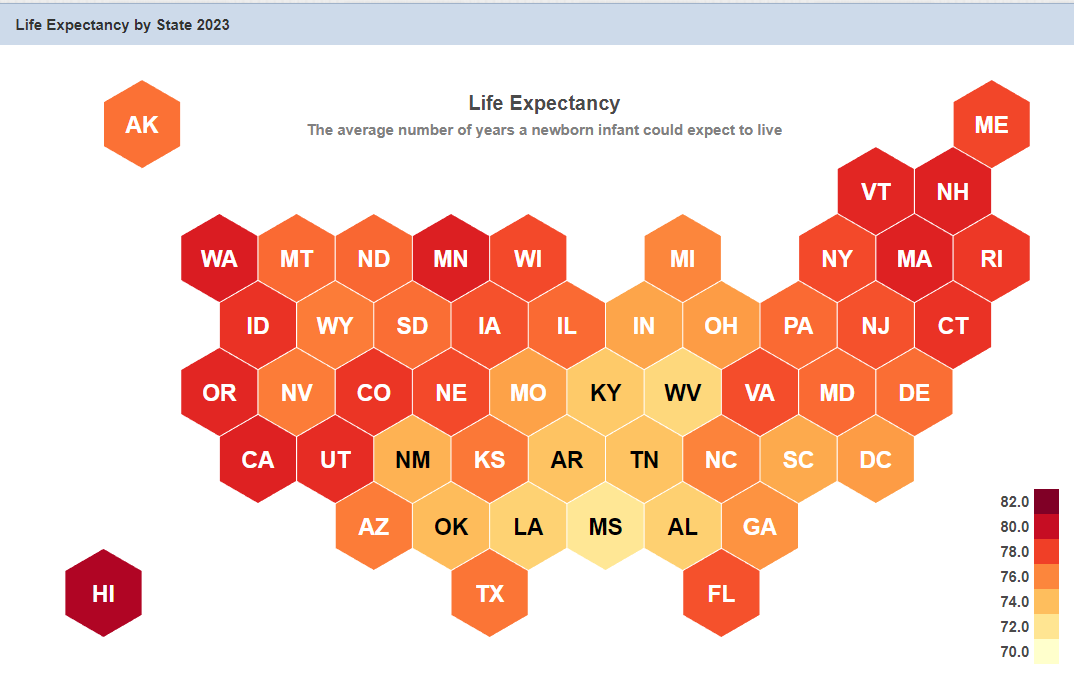
That tells only part of the story. The lowest average life expectancies are seen in the states of the Southeast (the so-called “red states): South Carolina, Oklahoma, Arkansas, Tennessee, Kentucky, Alabama, Louisiana, West Virginia and Mississippi all had average life expectancies from birth of less than 75 years.
The highest life expectancies were generally in states on the West Coast, the northern Midwest and the Northeast. Hawaii ranks first at 80.7, followed by Washington, Minnesota, California, New Hampshire and Massachusetts, all with average life expectancies of 79 or higher.
These geographical disparities aren’t artifacts of pure geography or demographics; they’re the consequences of policy decisions at the state level.
On average, the citizens of solid Republican states have the shortest lives. This is not a coincidence.
Of the 20 states with the worst life expectancies, eight are among the 12 that have not implemented Medicaid expansion under the Affordable Care Act.
The consequences of this obstinate Republican-driven resistance to a program whose expense is more than 90% covered by the federal government include closures of rural hospitals and high rates of uninsured residents.
In 1995, U.S. life expectancy was about six months less than those of high-income countries; by 2020 it was about three years, according to the World Bank.
In 1995, the U.S. had a commanding lead over China, which was about 5 1/2 years behind the U.S.; China then roared ahead, outstripping the U.S. in 2020, when its average life expectancy clocked in at 78.08 years, compared with America’s 77.28.
— The enhanced credit, enacted in March 2021 as part of the American Rescue Plan, the government’s pandemic relief package, reduced the child poverty rate by about 30%, keeping as many as 3.7 million children out of poverty by the end of that year.
— When the enhancements expired in January, the child poverty rate spiked to 17% from 12.1%, plunging 3.7 million children back under the poverty line.
When one examines the factors exerting the greatest influence on longevity, the issue comes sharply into focus.
“Inequality in America is about so much more than income,” Ney says. “It’s healthcare and housing and education and taxes and race and gender and location.
Life-expectancy inequality in America is tied up in all these very different factors. “
At this moment, the quest for solutions appears to be moving in reverse. Consider the Supreme Court’s 2022 decision in Dobbs vs. Jackson Women’s Health Organization, which overturned nearly half a century of federal safeguards of abortion rights and has opened the door to punitive attacks on women’s reproductive health care in dozens of states.
Even before Dobbs, health outcomes in Mississippi, the state whose antiabortion statute led to the decision, were “abysmal for both women and children,” the dissent by Justices Stephen Breyer, Sonia Sotomayor and Elena Kagan observed.
“Mississippi has the highest infant mortality rate in the country, and some of the highest rates for preterm birth, low birthweight, cesarean section, and maternal death,” they wrote. “It is approximately 75 times more dangerous for a woman in the state to carry a pregnancy to term than to have an abortion.”
Not only do red states refuse to participate in ACA (which gives each state a financial profit), but they actively try to prevent their citizens from avoiding illness.
State seeks to ban mask, COVID testing rules by businessesA House committee Monday approved a bill that would prohibit businesses from requiring people to wear masks or take COVID-19 tests to enter their facilities.By Ryan Dailey News Service of Florida
TALLAHASSEE — A House committee on Monday approved a bill that would prohibit businesses and government agencies from requiring people to take COVID-19 tests or wear masks to enter their facilities, with the measure’s sponsor calling such mandates “discriminatory practices.”
The proposal would build on prohibitions passed by the Florida Legislature earlier in the pandemic regarding health measures such as vaccination requirements, which are top priorities of Gov. Ron DeSantis.
The Republican-dominated committee approved the bill (HB 1013) in a 12-5 vote Monday, with Democrats decrying its potential impact on private companies.
“The keyword is private. Private businesses have the right to make their own decisions,” Rep. Marie Woodson, D-Hollywood, said before voting against the proposal.
The measure also would impose similar prohibitions on educational institutions, including provisions that would bar institutions from requiring COVID-19 tests or imposing mask requirements.
Under the bill, educational institutions also could face $5,000 fines for violations.
Then we move from the cruel and misguided to the absolute crazy:
The measure also would would require healthcare practitioners to “obtain the informed consent” of a patient or their legal representative before prescribing any medications to treat coronavirus.
Under the bill, informed consent would include an “explanation of alternative medications” for treating COVID-19 and the “relative advantages, disadvantages, and risks” associated with those drugs.
A House staff analysis of the measure included Hydroxychloroquine, Ivermectin, Methanol and herbal medicines as examples of such “alternative” medications.
Use of drugs such as Hydroxychloroquine and Ivermectin sparked nationwide debates during the pandemic, with DeSantis in 2020 backing the state’s bulk purchase of Hydroxychloroquine, despite research that showed it didn’t work on the coronavirus.
Under the 2021 laws, Florida private-sector workers can avoid vaccination requirements if they provide medical reasons, religious reasons or can demonstrate “COVID-19 immunity.”
In short, the Republican party discourages vaccination but encourages Hydroxychloroquine.
Lawmakers in 2021 also barred government agencies from requiring workers to be vaccinated and reinforced a law known as the “Parents’ Bill of Rights” that banned student mask and vaccination requirements in public schools.
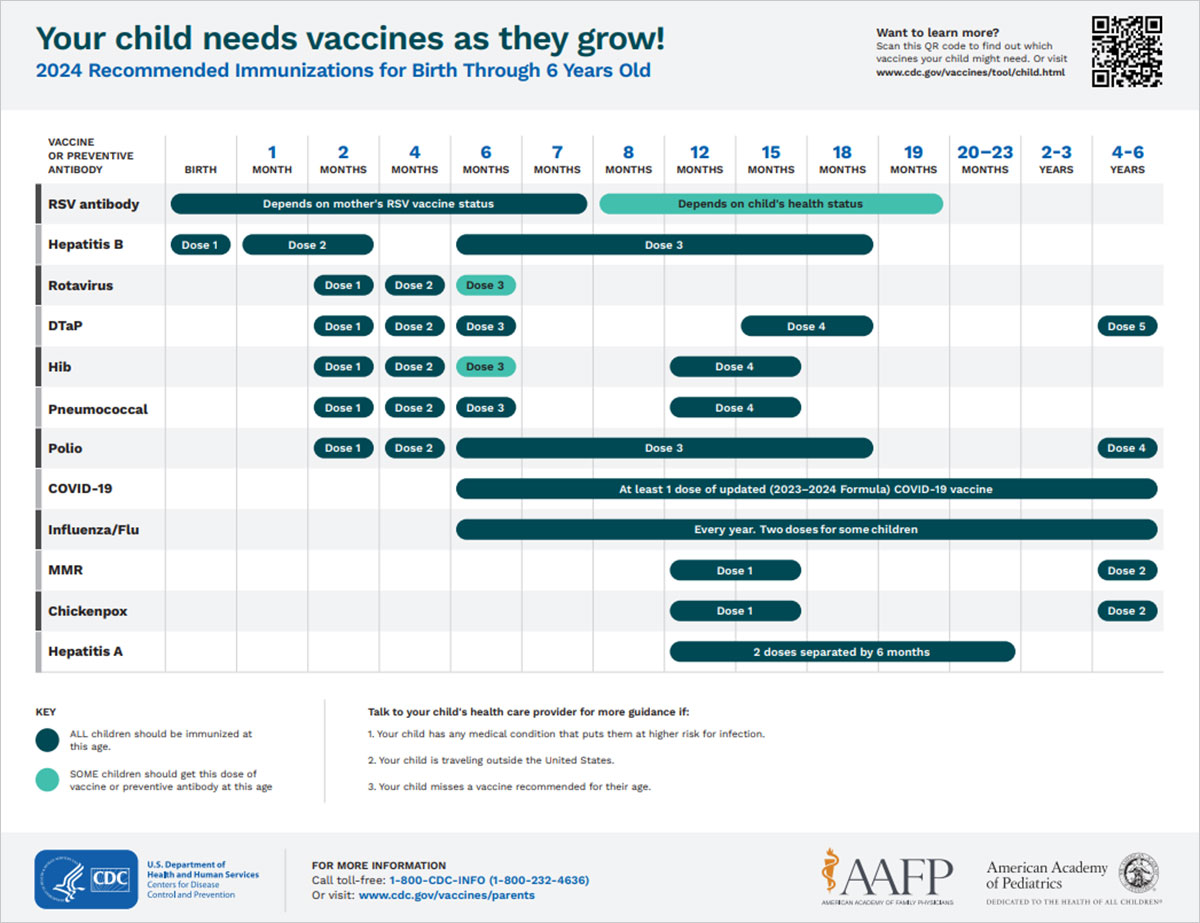
Mandatory vaccination in schools has helped prevent the transmission of childhood diseases, many of which are potentially fatal.
Somehow, refusing vaccination has become a test of one’s loyalty to Donald Trump (who has had all his vaccinations) and to the Republican Party.
To avoid being branded a RINO (Republican In Name Only), one is expected to refuse vaccination on the basis of “freedom,” fake articles about the dangers of vaccination, or manliness.
The GOP has become the “We want you to die young” party. Its followers are paying the price.
In summary, richer people live longer than poorer people, and the GOP is devoted to widening the Gap between the rich and the rest.
In addition to denying the results of elections they lose, the GOP denies science, healthcare, poverty, and via gerrymandering, denies the will of the people. It even attempted a coup, a denial of the people’s voting rights.
In a clear case of “you get what you vote for,” the GOP counts millions of poor people among its voters. And yet, they are the ones who suffer from their vote.
At its core the appeal of the GOP is hatred for, and fear of, the poor, blacks, browns, yellows, reds, gays, Jews, Muslims, foreigners, and the educated.



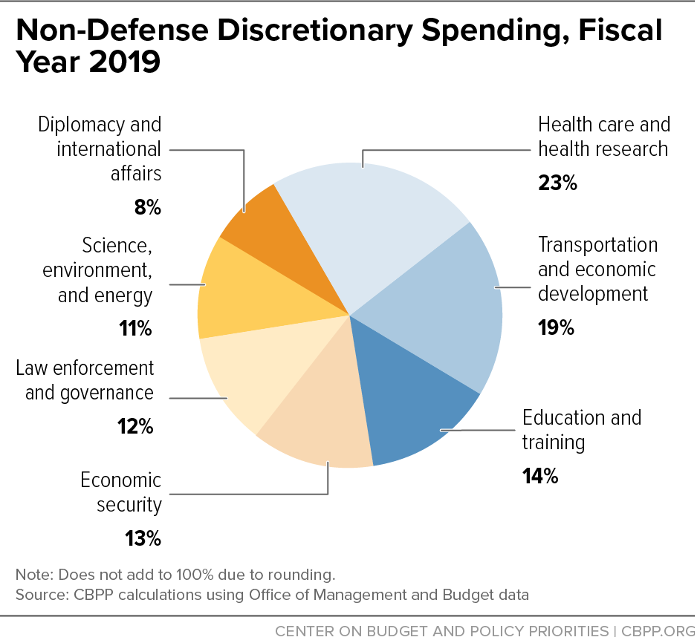 In 2019, non-defense discretionary (NDD) spending totaled $661 billion, or 14 percent of federal spending. That same year, the federal “debt” was $23 Trillion. The entire NND was less than 3% of the so-called “debt.”
Would you be willing to see every dollar cut from health care and health research, diplomacy, science, environment, energy, transportation, economic development, law enforcement and governance, education and training, and economic security?
Oh, but that’s not all.
In 2019, non-defense discretionary (NDD) spending totaled $661 billion, or 14 percent of federal spending. That same year, the federal “debt” was $23 Trillion. The entire NND was less than 3% of the so-called “debt.”
Would you be willing to see every dollar cut from health care and health research, diplomacy, science, environment, energy, transportation, economic development, law enforcement and governance, education and training, and economic security?
Oh, but that’s not all.