The U.S. federal government is Monetarily Sovereign. It has several powers we monetarily non-sovereign folks don’t have.
Unlike you and me, and unlike state and local governments, and unlike businesses, the federal government:
Can create unlimited U.S. dollars, at will.
Never, unwillingly, can run short of dollars.
Can pay any financial debt, of any size, instantly.
Never needs to borrow dollars.
Neither needs nor uses tax dollars, or any other income, to pay its obligations.
Can control the value of the dollar, vs. other currencies, by fiat.
Determines the interest it will pay on deposits into T-security accounts.
There are other features to Monetary Sovereignty, but the above make a fundamental point: Being sovereign over its currency, the federal government can do anything it pleases, with regard to dollars.
Ben Bernanke: “The U.S. government has a technology, called a printing press (or, today, its electronic equivalent), that allows it to produce as many U.S. dollars as it wishes at essentially no cost.”
Unfortunately, the federal government is ruled by people who don’t want you to understand it.
They want you to believe federal finances are like personal finances, where money is scarce, and debts are a burden, and you sometimes need to borrow, and you need income to survive.
Why don’t so many in the government want you to understand truth? Because of Gap Psychology, the human desire to approach those who are “better” on any given scale, and to distance oneself from those who are “inferior”
The federal government is run at the behest of the rich, and the rich do not want you to demand and receive the benefits the government could fund, if only it chose to.
If you were to receive those benefits, you “inferior” souls would come closer to the rich, and the rich do not want that. They want the Gap to widen. They want to distance themselves from you.
So you are told that Social Security and Medicare soon will be bankrupt, and Medicare for All is unaffordable, and the federal “debt” is unsustainable, and federal Monetarily Sovereign finances are like your monetarily non–sovereign finances.
And this brings us to the U.S. Postal Service.
There are few things more important to the efficient operation of a nation than its postal service. So one might think that the federal government would want to build the best postal service, possible.
Sadly, that is not the case in the U.S. The government withholds funds from the Postal Service to help make you believe money is scarce to the government:
Postal officials said they expected next year’s finances to be helped by a strong holiday season of package deliveries and a just-approved increase to the price of its first-class stamp, from 50 cents to 55 cents.
But they pleaded anew for help from Congress to relieve the Postal Service of onerous health and pension prepayments and for help from regulators to grant the agency more flexibility to increase prices so it can return to profitability.
“Absent legislative and regulatory change, we cannot generate enough revenue or cut enough costs to pay off our bills,” said Postmaster General and CEO Megan J. Brennan.
“The flawed business model imposed by law continues to be the root cause of our financial instability.”
You financially “inferior” people might be upset about having to pay more than a half buck, every time you send a letter. The rich are not bothered at all. Postage means nothing to them, and anyway, their companies pay for their tax-deductible postage.
Alan Greenspan: “A government cannot become insolvent with respect to obligations in its own currency.”
And why should a federal agency return to “profitability“? That would mean taking money from the private sector, which needs dollars to grow, while giving dollars to the federal government that has no need for income — exactly the opposite of what the economy needs.
The Postal Service reported a loss of $3.9 billion for the budget year that ended Sept. 30, compared with a $2.7 billion loss the year before.
Trump in recent months has asserted without evidence that the Postal Service is “losing a fortune” and reporting annual losses because it is not charging higher shipping rates for online retailers such as Amazon, whose founder, Jeff Bezos, owns The Washington Post.
The backstory is that Trump hates the Washington Post, and therefore hates Bezos and Amazon, so he wishes to use his political power to destroy private businesses that may oppose him.
In April, Trump issued an executive order demanding a review of the Postal Service’s finances.
Package delivery has been a bright spot although its growth is slowing, and regulators have found its contract with Amazon to be profitable.
The Postal Service, an independent agency, is trying to stay financially afloat as it seeks to invest billions in new delivery trucks to get packages more nimbly to American homes.
Regulators this week approved the Postal Service’s request to increase the price of its first-class stamp by 5 cents. The 10 percent increase to the cost of mailing a 1-ounce letter is the biggest since 1991. The price of each additional ounce will drop from 21 cents to 15 cents. The rate increase takes effect on Jan. 27.
The bottom line is:
The federal government, and its agencies, can run short of dollars only if Congress wills it.g
The federal government neither needs nor uses tax dollars; it creates new dollars, ad hoc, by paying creditors.
An effective postal service is as vital to America as are roads, bridges, dams, the military.
The federal government has the unlimited financial power to pay for an effective postal service, rather than squeezing it and forcing it to cut services while raising prices.
Because of Gap Psychology, the rich do not want you to understand this.
The single most important problems in economics involve the excessive income/wealth/power Gaps between the have-mores and the have-less.
Wide Gaps negatively affect poverty, health and longevity, education, housing, law and crime, war, leadership, ownership, bigotry, supply and demand, taxation, GDP, international relations, scientific advancement, the environment, human motivation and well-being, and virtually every other issue in economics.
Implementation of The Ten Steps To Prosperity can narrow the Gaps:
Ben Bernanke: “The U.S. government has a technology, called a printing press (or, today, its electronic equivalent), that allows it to produce as many U.S. dollars as it wishes at essentially no cost.”
Would someone please tell her the US doesn’t need to borrow dollars.
Alan Greenspan: “Central banks can issue currency, a non-interest-bearing claim on the government, effectively without limit. A government cannot become insolvent with respect to obligations in its own currency.”
St. Louis Federal Reserve: “As the sole manufacturer of dollars, whose debt is denominated in dollars, the U.S. government can never become insolvent, i.e.,unable to pay its bills. In this sense, the government is not dependent on credit markets to remain operational.
—————————————————————————————————————
Reader Koen Hoefgeest kindly called my attention to this article: The myth of monetary sovereignty
By Frances Coppola – November 02, 2018
Here are some excerpts from an article that “proves” Monetary Sovereignty (MS) is a myth:
How many countries can really claim to have full monetary sovereignty?
The simplistic answer is “any country which issues its own currency, has free movement of capital and a floating exchange rate.”
I have seen this trotted out MANY times, particularly by non-economists of the MMT persuasion. It is, unfortunately, wrong.
“Trotted out” is a pejorative, that immediately displays a supercilious contempt for the many economists who each day provide ample proof of Monetary Sovereignty’s existence.
In any event (spoiler alert), at no time will Ms. Coppola prove the above-mentioned “simplistic answer” is wrong.
Instead, she will attack another “more complex” definition, from a “prominent MMT economist.”
This is a more complex definition from a prominent MMT economist:
1. Issues its own currency exclusively
2. Requires all taxes and related obligations to be extinguished in that currency
3. Can purchase anything that is for sale in that currency at any time it chooses, without financial constraints. That includes all idle labour
4. Its central bank sets the interest rate
5. The currency floats
6. The Government does not borrow in any currency other than its own.
This appears solid. But in fact, it too is wrong.
The big hole in this is the external borrowing constraint – item 6 in the list. If a government genuinely could purchase everything the country needed in its own currency, then it would indeed be monetarily sovereign.
But no country is self-sufficient. All countries need imports. So item 3 on the list is a red herring.
Hmmm . . . The “big hole” is #6, but #3 is a “red herring”?
Actually, #6 is not a requirement for Monetary Sovereignty, partly because MS nations do not borrow their own currency. They have no need to, because they have the unlimited ability to create their own currency.
(See the Bernanke, Greenspan, Federal Reserve comments above.
And #3, the “without financial constraint” definition, is absolutely, 100% correct. An MS nation cannot unintentionally run short of its own sovereign currency.
A government may be able to buy anything that is for sale in its own currency, but that doesn’t include oil, or gas, or raw materials for industrial production, or basic foodstuffs.
To buy those, you need US dollars. Indeed, these days, you need dollars for most imports. Most global trade is conducted in US dollars.
Here, Ms. Coppola displays ignorance of foreign exchange, which is the device all nations use for imports.
Even the mighty U.S. cannot purchase all its goods and services using U.S. dollars. It exchanges its sovereign currency for the exporting nation’s currency.
Perhaps this would be clearer to her if #3 read, “Can purchase anything that is for sale in exchange for its sovereign currency at any time it chooses, without financial constraints.”
The only country in the world that can always buy everything the country needs in its own currency, and therefore never needs to borrow in another currency, is the United States, because it is the sole issuer of the US dollar.
Completely wrong. Again she ignores the FX issue. Perhaps she never has traveled abroad, but what is the first thing many Americans do, when landing on foreign soil? Right. They exchange their dollars for the local currency.
Contrary to popular opinion, the United States government does not borrow, not dollars and not any other currency.
What erroneously is termed “borrowing,” actually is the acceptance of deposits into T-security accounts. The purpose of these accounts is not to provide the federal government with the dollars it can produce at essentially no cost (See Bernanke, above), but rather to:
Provide a safe depository for dollars, which stabilizes the dollar, and
Assist the Fed’s interest rate control, which helps it control inflation
The dollars deposited into those T-security accounts remain there — they are not used by the federal government — until the accounts mature, at which time the dollars are returned to the account owners.
Having the unlimited ability to create dollars, the U.S. has no need to borrow. It creates dollars ad hoc, by paying creditors.
The dollar creation system is this:
In paying creditors, each federal agency sends instructions (not dollars) to each creditor’s bank, instructing the bank to increase the balance in the creditor’s checking account. The instructions can be in the form of a check or wire (“Pay to the order of . . .”)
At the instant the bank obeys those instructions, and not before, brand new dollars are created and added tothe nation’s M1 money supply.
The instructions then are cleared through the Fed.
This, by the way, is identical with how you pay your bills. You send instructions (checks) to creditors’ banks, and at the moment the bank obeys your instructions, new dollars are created.
Then, when your check clears, your bank deducts them from your checking account, and M1 dollars are destroyed.
The difference is the no dollars are destroyed when the Fed clears federal government checks, which is why federal paying of bills creates net dollars.
However, the dark side of this is that the US is obliged to run wide current account and fiscal deficits, because global demand for the dollar far exceeds US production.
When it attempts to close these deficits, global trade and investment shrinks, causing market crashes and triggering recessions around the world.
Sometimes, there is even a recession in the US itself. The US’s last attempt to run a fiscal surplus ended in the 2001 market crash and recession:
Not understanding the differences between federal financing and personal financing, Ms. Coppola believes the U.S. federal government needs to “close those deficits.”
But why would a nation, having the unlimited ability to create dollars, need to “close deficits”? What is wrong with deficits? America’s deficits already have accumulated to $15 Trillion in debt, and despite hand-wringing from debt hawks, the U.S. economy has not suffered.
For individuals and others in the private sector, deficits and debt are burdens. For the U.S. government, they are no burden on the government or on taxpayers.
As stated, that thing erroneously termed U.S. “debt,” actually is the total of deposits into T-security accounts, somewhat similar to bank savings accounts.
To pay off the so-called “debt,” the federal government merely returns the dollars in those accounts. It does this every day. No tax dollars are involved in paying off U.S. “debt” (deposits).
MMT adherents like to cite this as evidence that eliminating the government deficit in any country will result in a recession. But this is stretching things considerably.
FRED shows us that even in the U.S., only one recession in the last century has been preceded by a government surplus.
Ms. Coppola is confused again, this time between reducing deficits (while still increasing debt) and reducing debt (i.e running surpluses).
Here is what happens when the federal government runs a surplus:
U.S. depressions tend to come on the heels of federal surpluses.
1804-1812: U. S. Federal Debtreduced 48%. Depression began 1807.
1817-1821: U. S. Federal Debt reduced 29%. Depression began 1819.
1823-1836: U. S. Federal Debtreduced 99%. Depression began 1837.
1852-1857: U. S. Federal Debt reduced 59%. Depression began 1857.
1867-1873: U. S. Federal Debtreduced 27%. Depression began 1873.
1880-1893: U. S. Federal Debtreduced 57%. Depressionbegan 1893.
1920-1930: U. S. Federal Debt reduced 36%. Depression began 1929.
1997-2001: U. S. Federal Debt reduced 15%. Recession began 2001.
While reducing federal debt tends to cause depressions, reducing deficit growth tends to cause recessions.
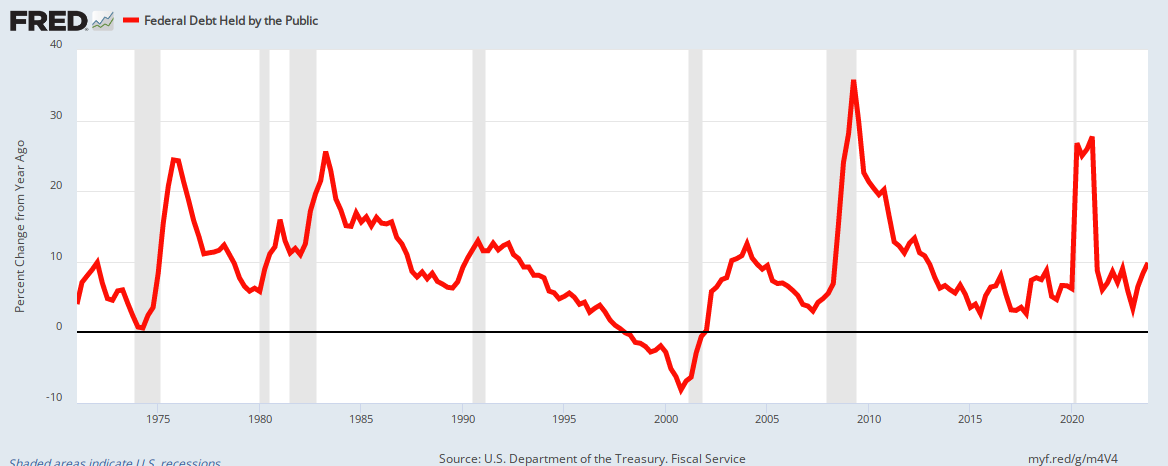
Reduced deficit growth leads to recessions (vertical gray bars), while increased deficit growth cures recessions.
The reason is rather simple. An economy either grows or shrinks. A growing economy requires a growing supply of money.
By definition: GDP = Federal Spending + Non-federal Spending + Net Exports. Thus, a growing GDP involves a growing money supply.
Federal deficit spending grows the money supply, which increases both Federal Spending and Non-federal Spending, thus increasing GDP.
Of course, many developed countries do in practice pay for imports in their own currencies. Governments, banks and corporations meet dollar funding requirements by borrowing in their own currency and swapping into dollars in the financial markets.
This diminishes the need for dollar-denominated borrowing, either by government or the private sector. These countries therefore have a considerable degree of monetary sovereignty. But it is not absolute as it is in the United States.
Whether or not nations pay for imports in their own currencies is irrelevant to the question of Monetary Sovereignty. Of real importance is whether they have their own currencies, which they produce at will.
The euro nations do not. Cities, counties, and states do not. Businesses do not. You, and I, and Ms. Coppela do not. We all are monetarily non-sovereign.
We monetarily non-sovereign entities can run short of currency. Monetarily Sovereign entities cannot.
Sadly, Ms. Coppola does not seem to understand this fundamental difference.
It crucially depends on the stability of their currencies and the creditworthiness of their borrowers, both of which are a matter of market confidence.
For most countries, the need for external borrowing crucially depends on the external balance. If the current account is balanced or in surplus, then they will earn the dollars they need to pay for essential imports. But any country that runs a current account deficit inevitably borrows dollars.
Wrong. A Monetarily Sovereign nation creates its own currency, which if it chooses, it can exchange for dollars or other currencies. Stability and creditworthiness, merely influence exchange rates, not the fact of Monetary Sovereignty.
If the local currency depreciates significantly (see item 5 in the list), local banks and corporations can find themselves unable to service dollar debts, because dollars become far more expensive.
No. “Local banks and corporations” are monetarily non-sovereign. A Monetarily Sovereign nation can service any amount of dollar debts, merely by exchanging their unlimited sovereign currency for dollars.
If banks stop lending cross-border, as they did in 2008, local banks and corporations can find themselves unable to refinance dollar debts.
. . . because “local banks and corporations” are monetarily non-sovereign entities. They can run short of money. A Monetarily Sovereign nation cannot.
During the “Great Recession” of 2008, monetarily non-sovereign Greece, France, and Portugal ran short of euros. But MS Canada, China, and Australia never ran short of their own sovereign currencies.
The world is littered with examples of countries that have had to run down public sector FX reserves to provide dollar liquidity to local banks and corporations after they are effectively shut out of global markets by local currency depreciation.
A Monetarily Sovereign nation cannot unintentionally “run down” public sector FX reserves. It has the unlimited ability to create its sovereign currency. It can create all the reserves it wishes.
If the public sector doesn’t have sufficient dollar reserves, it must borrow them, or face financial crisis, widespread debt defaults and economic recession.
In an FX crisis, private sector external debt becomes public sector external debt.
Nonsense. The entire world running short of dollar reserves?? (Where would those dollars be???) In any event, the Bernanke “printing press” would immediately solve the problem.
Thus, when currencies are allowed to float freely (item 5), no government that runs a current account deficit can possibly guarantee that it will never borrow in any currency other than its own (item 6).
The list therefore contains an internal contradiction.
Again, she is confusing between a Monetarily Sovereign nation, which never needs to borrow its own currency, and a monetarily non-sovereign entity, which never can borrow its own currency (It doesn’t have one.)
Monetary sovereignty is perhaps best regarded as a spectrum.
No country on earth is completely monetarily sovereign: the closest is the US, because of its “exorbitant privilege”, but even the US cannot completely ignore the effect of its government’s policies on international demand for its currency and its debt.
She is correct that Monetary Sovereignty is a spectrum, but not because of the demand for dollars. Instead, the spectrum has to do with the nation’s own laws.
For instance, even the U.S. is not absolutely Monetarily Sovereign. We are hamstrung by our own ridiculous “debt limit” laws, which have the potential of reducing our ability to create dollars.
In general, the major reserve currency issuers tend to have more monetary sovereignty than other countries, because there is international demand for their currencies and their debt.
The primary reserve currency issuer is the US, but the Eurozone (for which Germany is the primary safe asset issuer), the UK, Japan, Switzerland, Canada, and – now – China, all fall into this category.
However, there is a hierarchy even among reserve currency issuers. High on the list comes Japan, because its debt is held almost exclusively by its own citizens (and its central bank), and investors regard it as a “safe haven” in troubled times.
There is a heirarchy, but it has nothing to do with Japan’s citizens. It has to do with usage. The U.S. economy is the largest in the world, so all international banks must hold dollars in reserve, to facilitate international trade.
That is why the U.S. dollar is the world’s premier reserve currency, though other currencies also are reserve currencies.
But the ostensibly similar Switzerland has less monetary sovereignty than Japan, because it has extensive trade and financial ties to its much larger neighbour the Eurozone.
The above borders on the silly. “Trade and financial ties” have nothing to do with Monetary Sovereignty.
The Eurozone countries have relinquished their monetary sovereignty in the interests of developing ever-closer links. However, the Eurozone as a bloc has a high degree of monetary sovereignty, because its currency is the second most widely used currency for trade after the dollar.
The European Union is MS because it, not its member nations, has the unlimited ability to create euros.
Ms. Coppola confuses Monetary Sovereignty with credit rating and currency demand.
The fact that Japan’s yen may or may not have a better credit rating than China’s yuan has absolutely nothing to do with the degree to which either nation is Monetarily Sovereign.
Both are sovereign over their own currencies, subject to their own laws regarding the creation of those currencies.
The rest of her article drifts into further musing about “more or less Monetary Sovereignty” when she really means better or worse credit.
Bottom line: Monetary Sovereignty means exactly what it says: Being sovereign over a currency. The U.S., Australia, Canada, China, the UK et al are sovereign over their currencies. Germany, France, and Italy are not.
And by the way, a very good example of Monetary Sovereignty is the Bank in the game of Monopoly. By rule, it too cannot run short of Monopoly dollars, and never needs to borrow dollars or to obtain dollars from any source.
Contrary to the title of Ms. Coppola’s paper, Monetary Sovereignty not only is not a myth, but it is the foundation of economics.
If one does not understand Monetary Sovereignty, one simply cannot understand economics.
The single most important problems in economics involve the excessive income/wealth/power Gaps between the have-mores and the have-less.
Wide Gaps negatively affect poverty, health and longevity, education, housing, law and crime, war, leadership, ownership, bigotry, supply and demand, taxation, GDP, international relations, scientific advancement, the environment, human motivation and well-being, and virtually every other issue in economics.
Implementation of The Ten Steps To Prosperity can narrow the Gaps:
The rich don’t want us to let the rest know that federal taxes don’t fund federal spending.
Ben Bernanke: “The U.S. government has a technology, called a printing press (or, today, its electronic equivalent), that allows it to produce as many U.S. dollars as it wishes at essentially no cost.”
Alan Greenspan: “Central banks can issue currency, a non-interest-bearing claim on the government, effectively without limit. A government cannot become insolvent with respect to obligations in its own currency.”
St. Louis Federal Reserve: “As the sole manufacturer of dollars, whose debt is denominated in dollars, the U.S. government can never become insolvent, i.e.,unable to pay its bills. In this sense, the government is not dependent on credit markets to remain operational.
—————————————————————————————————————
To understand liars you must listen to (or read) liars, which is why I read Breitbart, the ultimate in prevarication and exaggeration. In Breitbart, you sometimes can uncover a tiny nugget of truth from the vast supplies of bovine excrement, or at least acquire a better understanding of fool’s thinking.
Here is a Breitbart story which I found both fascinating and disturbing, because amazingly, it contained what appears to be the abovementioned nugget:
Democratic National Committee (DNC) chief executive officer Seema Nanda admitted on Tuesday she does not know how to pay for the socialized medicine scheme known as Medicare for All, estimates of which are somewhere between $32 and $38 trillion.
Nanda, during Yahoo Finance’s “All Markets Summit: America’s Financial Future” event in Washington, DC, on Tuesday, the interviewer asked:
It would be very expensive, so, if this is going to be a winning issue for Democrats in 2020, how do you answer the question of how are you going to pay for this? Because there have been studies, credible studies that say it would cost three trillion dollars a year, you would have to double everybody’s taxes or maybe triple everybody’s taxes.
How do you answer the cost question?
“So, you know, your answer is I don’t know how we’re going to get there, but these are all big conversations that we need to be engaged in,” Nanda added.
Perhaps Nanda does know but doesn’t wish to give away the Democrat’s plans just yet. Or, more likely, she is as clueless as Sen. Bernie Sanders was when he first proposed Medicare for All.
Virtually everyone, left and right, believes that having medical insurance is important. Today’s medicine simply is so expensive that only the richest among us could risk not having a backup plan to pay.
So, the question becomes a simple one: Who should pay for medical insurance, the public or the federal government?
“The public,” which consists of people, businesses and local governments, is financially constrained. It does not have unlimited funds. The public can, and often does, run short of dollars. It is what is known as monetarily non-sovereign.
By contrast, the federal government is not financially constrained. It has the unlimited ability to create its own sovereign currency, the U.S. dollar. It is Monetarily Sovereign.
The U.S. government never can run short of dollars.Even if all federal taxing totaled $0, the federal government could continue spending, forever.
In fact, the federal government’s method for creating dollars and adding them to the economy, is to pay creditors.
So, before we continue with the Breitbart article, think about the answer to this basic question:
Who should pay for healthcare, the public which does not have unlimited money or the federal government which does have unlimited money?
Paying for Medicare for All remains a daunting task for Democrats. Multiple studies have estimated that the plan would cost between $32 and $38 trillion over the next ten years, contrary to Sen. Bernie Sanders’ (I-VT) claim that the plan would save America money.
In the unlikely event that the $38 trillion over ten years turns out to be correct, what does the seemingly simple term “save America money” mean?
If the federal government were to fund for Medicare for All, that indeed would save the American people money.
And the federal government has no need to save money, because it has the unlimited ability to create dollars.
So yes, Medicare for All would save America money.
The Associated Press (AP) even noted that the socialized medicine proposal would require “historic” tax increases to pay for the single-payer healthcare proposal.
Note the pejorative and incorrect term “socialized medicine.” In socialized medicine, the government would ownall the medical facilities and employ all the medical workers.
I know of no one who suggests that. It’s a fake objection by Breitbart, the home of fake objections to anything that benefits the middle classes and the poor.
In Medicare for All, as with today’s Medicare, the federal government merely takes the place of private insurance carriers.
It does not own the hospital and clinics and pharmaceutical companies.e It does not employ the doctors, nurses and other personnel. It merely writes checks, which it can do endlessly.
Sen. Bill Cassidy (R-LA) said that Medicare will soon become bankrupt and that adding half of the country to the government health care program will not improve anyone’s health care.
Because the U.S. federal government has the unlimited ability to create U.S. dollars, it cannot unintentionally go bankrupt.
And because the federal government cannot go bankrupt, no agency of the federal government unintentionally can go bankrupt.
Even if all FICA taxes disappeared, the federal government could support Medicare for All forever, and I suspect Cassidy knows this.
“My point is Medicare for All is Medicare for none,” Cassidy told Breitbart News in October.
“Medicare is actually going bankrupt in eight years, and now Bernie Sanders wants to put 150 million more people into a system going bankrupt in eight years?”
No, Medicare will not go bankrupt in eight years or in eighty years, unless Congress wishes it.
Many in Congress do not understand the differences between federal financing and personal financing. They think federal debt is like personal debt, and is a burden on the government or on taxpayers.
It is neither.
Many others in Congress are well aware that the federal government has the unlimited ability to fund Medicare for All, and in fact, adding trillions of dollars would provide a dramatic stimulus to the overall economy.
These members of Congress do not want you to know this for fear you will make “unreasonable” demands on the government.
What is an “unreasonable” demand? Anything that narrows the Gap between the rich and the rest. (See: Gap Psychology)
In summary: Every person in America should be able to afford health care, and not to be financially devastated by illness. But someone has to pay for such insurance.
The public’s funds are limited, but the federal government’s funds are unlimited. The only logical solution is for the federal government to pay for Medicare for every man, woman, and child in America — which the federal government easily can do.
The single most important problems in economics involve the excessive income/wealth/power Gaps between the have-mores and the have-less.
Wide Gaps negatively affect poverty, health and longevity, education, housing, law and crime, war, leadership, ownership, bigotry, supply and demand, taxation, GDP, international relations, scientific advancement, the environment, human motivation and well-being, and virtually every other issue in economics.
Implementation of The Ten Steps To Prosperity can narrow the Gaps:
In this era of fake news, where a President can lie with impunity, and face zero concern from his followers, nothing surprises.
For instance, we are told the Saudis did not murder a journalist in their Istanbul consulate.
Instead, he merely was tortured to death by “rogue killers” during an “investigation gone wrong.”
Presumably, these are the same “rogue killers” President Trump blames when excusing Putin’s many murders.
And these are the same “rogue killers” Trump’s latest lover, Kim Jong Un (“We fell in love.”) has used to murder thousands, including family members. (What’s not to love?)
And then, there were the “rogue: hackers who, behind Putin’s back, hacked into the U.S. election.
This time, the fake news doesn’t come only from Trump, but from the real news. And, this time the fake news has historical precedents, going back at least 78 documented years, and many more in reality.
WASHINGTON (Reuters) – The U.S. government closed the 2018 fiscal year $779 billion in the red, its highest deficit in six years, as Republican-led tax cuts pinched revenues and expenses rose on a growing national debt, according to data released on Monday by the Treasury Department.
New government spending also expanded the federal deficit for the 12 months through September, the first full annual budget on the watch of U.S. President Donald Trump. It was the largest deficit since 2012.
“In the red” implies some sort of economic negative. You and I never want to be “in the red.”
However, the federal government is different from you and me. BeingMonetarily Sovereign, it uniquely has the unlimited ability to create its own sovereign currency, the U.S. dollar, which it has been doing since the early 1780s.
What does “in the red” mean for a government that can create infinite dollars, and never can run short of dollars?
The purpose of the Reuters article is to make you believe the federal government cannot afford to provide you with free Medicare and free education, and must charge you taxes to pay for any benefits it does provide.
It’s a gigantic, and long-lived con job, orchestrated by the rich, to widen the Gap between the rich and the rest.
Consider two groups: Group A can run short of dollars (i.e. you and me). Group B never can run short of dollars (the federal government).
By what perverse logic would Group A ever give dollars to Group B?
Now for the bad “good” news:
The data also showed a $119 billion budget surplus in September, which was larger than expected and a record for the month.
“Surplus” is such a wonderful word. You and I love to have a surplus, especially a surplus of money.
But, what does a dollar surplus mean to an entity that has the unlimited ability to create new dollars, and never, never, never unintentionally can run short of dollars? Why would such an entity even want a surplus?
While a surplus has no value to the U.S. federal government, it has a strong, negative effect on the economy. When the federal government runs a surplus, the dollars come from the economy, and that depresses the economy.
U.S. depressions tend to come on the heels of federal surpluses.
1804-1812: U. S. Federal Debt reduced 48%. Depression began 1807.
1817-1821: U. S. Federal Debt reduced 29%. Depression began 1819.
1823-1836: U. S. Federal Debt reduced 99%. Depression began 1837.
1852-1857: U. S. Federal Debt reduced 59%. Depression began 1857.
1867-1873: U. S. Federal Debt reduced 27%. Depression began 1873.
1880-1893: U. S. Federal Debt reduced 57%. Depression began 1893.
1920-1930: U. S. Federal Debt reduced 36%. Depression began 1929.
1997-2001: U. S. Federal Debt reduced 15%. Recession began 2001.
The reason is quite obvious. A large economy has more money than does a small economy, so for an economy to grow, its money supply must grow.
Gross Domestic Product = Federal + Nonfederal Spending + Net Exports
When deficit growth declines, economic growth declines:
Recessions (vertical gray lines) begin with a decline in federal debt growth (red line) and are cured by an increase in federal debt growth.
But wait, here’s some good “bad” news.
A senior Treasury official said the monthly surplus was smallerwhen adjusted for calendar shifts.
Are you confused? That’s the whole point. The rich, who run America, want you to be confused. They want you to believe that the federal deficit is “unaffordable” and the federal debt is “unsustainable.”
Here’s where it gets truly weird:
Economists generally view the corporate and individual tax cuts passed by the Republican-controlled U.S. Congress late last year and an increase in government spending agreed in early February as likely to balloon the nation’s deficit.
Trump and his fellow Republicans have touted the tax cuts as a boost to growth and jobs.
Think about it. The tax cuts will balloon the nation’s deficit, which will boost growth and jobs. Why? Because tax cuts and deficits leave more money in the economy.That’s a good thing, right?
Not according to Office of Management and Budget Director Mick Mulvaney:
“America’s booming economy will create increased government revenues – an important step toward long-term fiscal sustainability,” Mulvaney said in a statement accompanying the data.
America’s economy will boom as a result of tax cuts, and that will create increased government revenues. That’s the old Laffer curve, showing that tax cuts “pay for themselves” by increasing tax collections.
The problem is that federal taxes, being financially unnecessary, don’t need to be paid for by taxes. The bottom line is the amount of money coming into the economy.
The more dollars entering the economy, the greater the growth.
You see, Mulvaney doesn’t agree that leaving more money in the economy is a good thing. He thinks (claims) taking more money out of the economy is a good thing.
Mulvany’s “logic,” if it can be called that, is:
We’ll leave more dollars in the economy, which will grow the economy, so we can take more dollars out of the economy (which will shrink the economy) and give them to the government, which doesn’t need them.
If you believe the way to grow the economy is by shrinking the economy, you are ready to be the next Office of Management and Budget Director.
But Mulvany isn’t alone:
The Bipartisan Policy Center called the report “a wake up call” for policymakers to turn things around. “The fact that our government is closing in on trillion-dollar deficits in the midst of an economic expansion should be a serious issue for voters and candidates.”
William Hoagland, its senior vice president, said of next month’s U.S. congressional elections.
Hoagland’s comment reminds me of a similar comment by Robert M. Hanes, president of the American Bankers Association:
New York Times: Hanes: “. . . unless an end is put to deficit financing, to profligate spending and to indifference as to the nature and extent of governmental borrowing, the nation will surely take the road to dictatorship. . . insolvency is the time-bomb which can eventually destroy the American system . . . the Federal debt . . . threatens the solvency of the entire economy.”
Oh, did I mention that Hanes made his comment on September 26, 1940, when the federal debt was only $40 Billion? It’s $15 Trillion today, and the fake, time-bomb, con job warnings haven’t changed.
Seventy-eight years, year-after-year of “boy who cried wolf” warnings, and nothing has changed and nothing has been learned. The public still believes, and is frightened by, the same old lies.
And then the weirdness reaches its pinnacle:
Much of the widening of the deficit came from more spending on interest payments on the national debt.
Borrowing has increased over the past year, partially to make up for slower growth in tax revenues because of the tax cuts, while military spending has also risen.
Interest payments are an example of a government, which has infinite dollars, pumping dollars into an economy that needs dollars to grow. This is supposed to be a bad thing??
And finally, “borrowing.” The federal government does not borrow. Having the unlimited ability to create dollars, why would the federal government need to borrow?
It doesn’t borrow, but instead, it accepts deposits into Treasury Security accounts.
The purpose of these accounts is not to provide the government with spending funds, of which it has infinite. The dollars deposited into T-security accounts are not touched. In fact, they are added to periodically, by interest payments.
When T-securities mature, the dollars in them are returned to the depositors. The dollars are not used by the federal government.
Why does the government accept T-security deposits, if not to use the dollars ? The real purpose of T-securities is:
To provide a safe place to hold dollars, which increases the stability of the dollar and,
To assist the Federal Reserve in controlling interest rates and thereby to control inflation.
We conclude with this last bit on nonsense from the Reuters article:
Adding debt servicing costs, the U.S. Federal Reserve is raising interest rates roughly once per quarter in the face of a hot labor market and some signs of inflation.
Some Fed officials have warned that rising U.S. deficits could hamper any U.S. fiscal response to a downturn.
Whenever there are signs of inflation, the Fed increases interest rates. This increases the Demand for dollars, which increases the Value of dollars, thereby stopping inflation. (Value = Demand/Supply).
There is no mechanism by which rising deficits can “hamper any U.S. fiscal response to a downturn.” Quite the opposite, rising deficits help prevent a downturn by adding dollars to the economy.
We’ll end with economics expert, Donald Trump, criticizing the Fed about something of which he knows nothing.
Trump has in turn criticized the Fed’s monetary tightening, saying last week that the central bank had “gone crazy.”
“Gone crazy” means preventing inflation by increasing the value of a dollar, while also requiring the Treasury to pump more stimulus interest dollars into the economy.
Bottom line: For more than 78 years you have been told the same “boy-cries-wolf'” warning, and every year, no wolf shows up. Seventy-eight years!
In the story, the villagers stopped believing the boy, and didn’t come running when a real wolf appeared and the boy cried, “Wolf!”
The last line in the story was, “Nobody believes a liar…even when he is telling the truth!”
This year, you again are being told the same lie — and this year again there will be no wolf.
The only question: Will you again believe the liars?
The single most important problems in economics involve the excessive income/wealth/power Gaps between the have-mores and the have-less.
Wide Gaps negatively affect poverty, health and longevity, education, housing, law and crime, war, leadership, ownership, bigotry, supply and demand, taxation, GDP, international relations, scientific advancement, the environment, human motivation and well-being, and virtually every other issue in economics.
Implementation of The Ten Steps To Prosperity can narrow the Gaps: