Finally, a faint ray of hope about the federal deficit

In what may seem to be a strange result, we may be seeing a faint ray of hope about the U.S. federal deficit. Read the following excerpt:

Caring about the budget deficit cost George H.W. Bush the presidency; his successors took note
By DAVID LAUTER, DEC 07, 2018 | 5:10 AM

At the funeral for President George H.W. Bush, former Sen. Alan Simpson recalled his friend’s reaction when Simpson and other allies urged him to go along with a tax increase to shrink the budget deficit.

“OK, go for it, but it will be a real punch in the gut,” Bush said, knowing the political heat he would take.

“When the really tough choices come, it’s the country, not me,” Bush said, according to Simpson. “It’s not about Democrats or Republicans, it’s for our country that I fought for.”

We venerate that “country first” attitude in theory, but in practice, it likely cost Bush the presidency: The tax increase, as Simpson said, sparked a revolt within the Republican party that was “one of the main factors assuring his return to private life.”

SILENCE OF THE DEFICIT HAWKS
A generation later, Bush’s successors, especially his Republican successors, have learned that lesson: Voters say they care about reducing the national debt, but more often than not, they punish politicians who do it.

Bush’s immediate successor, President Clinton, built on the budget he inherited, adding an upper-income tax increase of his own. By the end of Clinton’s term, with the help of an economic boom, the federal budget was in surplus.

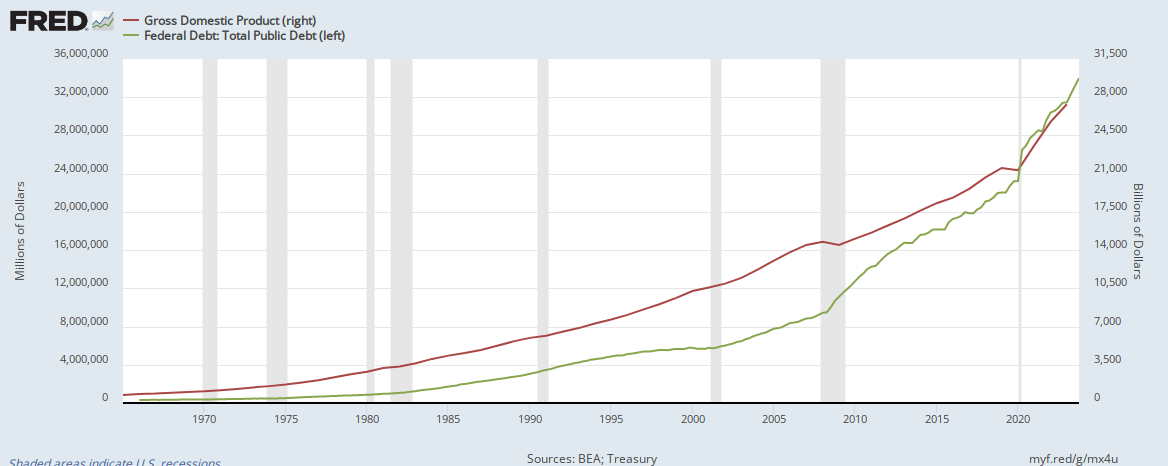
And that budget surplus helped cause the recession of 2001. In fact, virtually all recessions are caused by reductions in federal debt growth, while actual reductions in federal debt most often cause depressions.

Recessions (vertical gray bars) come on the heels of federal deficit reductions and are cured by federal deficit increases.

U.S. depressions tend to come on the heels of federal debt reductions.
1804-1812: U. S. Federal Debt reduced 48%. Depression began 1807.
1817-1821: U. S. Federal Debt reduced 29%. Depression began 1819.
1823-1836: U. S. Federal Debt reduced 99%. Depression began 1837.
1852-1857: U. S. Federal Debt reduced 59%. Depression began 1857.
1867-1873: U. S. Federal Debt reduced 27%. Depression began 1873.
1880-1893: U. S. Federal Debt reduced 57%. Depression began 1893.
1920-1930: U. S. Federal Debt reduced 36%. Depression began 1929.
1997-2001: U. S. Federal Debt reduced 15%. Recession began 2001.

Bush’s son, President George W. Bush, promptly pushed the government back into deficit with two large tax cuts. The financial crisis at the end of Bush’s presidency caused the deficit to rocket upward.

Republicans objected loudly to the deficit while President Obama was in office, even as he steadily brought it under control in his second term. But the deficit hawks have been mostly silent under President Trump as the red ink has once again spread.

And that is our ray of hope:. The deficit hawks, who tend to be right-wingers, being silent about debt.

No, it isn’t that they have learned why federal deficit spending is necessary for economic growth.

And no, they may not understand that the federal government is Monetarily Sovereign and never can run short of dollars to pay its financial obligations.

But, at least they are keeping their mouths closed for political reasons, and that will make it at least a bit more difficult for them to object to future federal deficits. Maybe.

This past year, the annual deficit hit $779 billion, despite a healthy economy. A big tax cut, combined with spending increases on the military and some domestic programs have pushed it higher.

By the time Trump’s current term ends, the deficit will likely have hit $1 trillion a year.

No one in either party claims that big deficits in healthy economic times are a good idea. But Republicans resist any tax increases, and neither side has much interest in cutting the biggest categories of federal spending — social security, the military, Medicare.

Perhaps “no one in either party claims that big deficits in healthy economic times are a good idea,” but the people who understand economic reality know that deficits grow the economy.

And no, deficits don’t cause Zimbabwe hyperinflations. (All hyperinflations in history have been caused by shortages, most often shortages of food.)

As Sarah Wire reported, Congress and the administration have a budget deadline right before Christmas that could cause a partial government shutdown.

But it’s not the rising deficit that’s at issue but, instead, whether to provide money for Trump’s wall along the Mexican border.

As much as anything else, Bush’s willingness to take political heat for a balanced budget marks him as a political figure from a bygone era.

We can hope Bush’s loss also set the stage for the realization that deficits are necessary for economic growth, and the federal debt is no burden on the federal government or on future taxpayers. (While state and local taxes fund state and local debt, federal taxes do not fund federal debt. That is the meaning of federal Monetary Sovereignty.)

Image result for bernanke and greenspan
It’s our little secret. Don’t tell the people we don’t use their tax dollars.

Ben Bernanke: “The U.S. government has a technology, called a printing press (or, today, its electronic equivalent), that allows it to produce as many U.S. dollars as it wishes at essentially no cost.”

Alan Greenspan: “Central banks can issue currency, a non-interest-bearing claim on the government, effectively without limit. A government cannot become insolvent with respect to obligations in its own currency.”

St. Louis Federal Reserve: “As the sole manufacturer of dollars, whose debt is denominated in dollars, the U.S. government can never become insolvent, i.e.,unable to pay its bills. In this sense, the government is not dependent on credit markets to remain operational.

Rodger Malcolm Mitchell
Monetary Sovereignty
Twitter: @rodgermitchell; Search #monetarysovereignty
Facebook: Rodger Malcolm Mitchell

…………………………………………………………………………………………………………………………………………………………………………………………………………………………………………………………………………………………..

The single most important problems in economics involve the excessive income/wealth/power Gaps between the have-mores and the have-less.

Wide Gaps negatively affect poverty, health and longevity, education, housing, law and crime, war, leadership, ownership, bigotry, supply and demand, taxation, GDP, international relations, scientific advancement, the environment, human motivation and well-being, and virtually every other issue in economics.

Implementation of The Ten Steps To Prosperity can narrow the Gaps:

Ten Steps To Prosperity:
1. Eliminate FICA

2. Federally funded medicare — parts a, b & d, plus long-term care — for everyone

3. Provide a monthly economic bonus to every man, woman and child in America (similar to social security for all)

4. Free education (including post-grad) for everyone

5. Salary for attending school

6. Eliminate federal taxes on business

7. Increase the standard income tax deduction, annually. 

8. Tax the very rich (the “.1%) more, with higher progressive tax rates on all forms of income.

9. Federal ownership of all banks

10. Increase federal spending on the myriad initiatives that benefit America’s 99.9% 

The Ten Steps will grow the economy, and narrow the income/wealth/power Gap between the rich and you.

MONETARY SOVEREIGNTY

The tariff nose-cutting, pissing contest

From THE WEEK Magazine:

“President Trump on Tuesday tweeted that trade negotiations with China are “ongoing.”

“Trump said he wants countries who “come in to raid the great wealth of our Nation” to “pay for the privilege of doing so,” arguing that tariffs will “always be the best way to max out our economic power.”

“Dubbing himself ‘a Tariff Man,’ the president threatened to impose tariffs once again if the two nations can’t reach a “fair” agreement in the next 90 days.”

The above, in typical Trumpian style, demonstrates either abject ignorance or intentional perfidy. Tariffs never have been even a good way, never mind “the best way,” to “max out economic power.”

And by calling himself “a Tariff Man,” Trump merely is saying, “I am willing to punish Americans so I can fool them into thinking they are winning.”

Let’s examine tariff reality.  The idea behind tariffs can be visualized by this invented example:

China, because of low local wages or material costs, and/or superior manufacturing skills, is able to produce a pot that is significantly cheaper than, or superior to, similar pots produced in the U.S.

So to protect the U.S. pot industry, and the jobs therein, the U.S. levies a tariff on pots imported from China.

The President then boasts that he has saved the U.S. pot industry and prevented China from “taking advantage of us.”

What really has happened?

  1. The U.S. government has levied a tax on Americans, punishing people who buy Chinese pots.
  2. The U.S. consumers’ cost of all pots has been increased, which is inflationary.
  3. Dollars have flowed from the U.S. private sector to the U.S. government. Taking dollars from the private sector is recessionary.
  4. The U.S. pot industry, being protected from foreign competition, does not need to strive for efficiency, and thereby stagnates, while other nations improve their pot-making efficiency.
  5. China retaliates by levying an import tariff on American pans, which hurts the U.S. pan industry, thereby costing jobs in the U.S. pan industry.

    Image result for water fight
    Trump says we’re winning.

Bottom line results for the trade war: Taxes on Americans have increased; inflation has been stimulated; the pot industry has been protected, but the pan industry has been hurt; and no net jobs are produced.

Trump, and most Americans, do not understand, that punishing Americans with higher taxes, is not a good way to protect Americans. The irony is that Trump boasts about cutting taxes, while his tariffs increase taxes.

If Americans’ income and jobs, and/or a particular American industry, need to be protected, there are far better ways than the self-destructive, pissing contest that Trump and his predecessors have initiated over the years. To:

I. Increase and Protect Americans’ Income: Initiate the Ten Steps to Prosperity (below). Step #1 alone (Eliminate the FICA tax) would increase the incomes of all salaried people. The other Steps would protect the incomes of Americans’

II. Protect Americans’ jobs: The elimination of FICA would cut employment costs, thereby encouraging employment in all industries, not just specific industries.

III Protect American Industries: Step 6. (Eliminate federal taxes on business) would benefit American businesses at no cost to anyone. The U.S. government, being Monetarily Sovereign, neither needs nor uses tax dollars. It creates new dollars, ad hoc, every time it pays a creditor.

Additionally, the federal government could assist vital industries via direct subsidy.

In summary, all tariffs, whether import or export, hurt all nations involved. They are inflationary and recessionary, and being protectionist, they inhibit innovation.

Our Monetarily Sovereign federal government has the unlimited power to protect its citizens, not by punishing them, but by rewarding them. This is a lesson yet to be learned by politicians and the American people.

Tariffs never, never, ever are a good solution to any Monetarily Sovereign government’s trade problem. Tariffs always are harmful to the  people. They are the ultimate nose-cutting, pissing contest.

Rodger Malcolm Mitchell
Monetary Sovereignty
Twitter: @rodgermitchell; Search #monetarysovereignty
Facebook: Rodger Malcolm Mitchell

…………………………………………………………………………………………………………………………………………………………………………………………………………………………………………………………………………………………..

The single most important problems in economics involve the excessive income/wealth/power Gaps between the have-mores and the have-less.

Wide Gaps negatively affect poverty, health and longevity, education, housing, law and crime, war, leadership, ownership, bigotry, supply and demand, taxation, GDP, international relations, scientific advancement, the environment, human motivation and well-being, and virtually every other issue in economics.

Implementation of The Ten Steps To Prosperity can narrow the Gaps:

Ten Steps To Prosperity:
1. Eliminate FICA

2. Federally funded medicare — parts a, b & d, plus long-term care — for everyone

3. Provide a monthly economic bonus to every man, woman and child in America (similar to social security for all)

4. Free education (including post-grad) for everyone

5. Salary for attending school

6. Eliminate federal taxes on business

7. Increase the standard income tax deduction, annually. 

8. Tax the very rich (the “.1%) more, with higher progressive tax rates on all forms of income.

9. Federal ownership of all banks

10. Increase federal spending on the myriad initiatives that benefit America’s 99.9% 

The Ten Steps will grow the economy, and narrow the income/wealth/power Gap between the rich and you.

MONETARY SOVEREIGNTY

Why does Trump get away with lying?

An article titled, “Why does President Trump get away with lying?,” recently appeared in the November 20, 2018 Newsweek.

Written by Lee McIntyre, the article focused on Trump’s motivation. Some excerpts:

Most politicians lie. And if most politicians lie, then why are some Americans so hard on President Donald Trump?

According to The Washington Post, Trump has told 6,420 lies so far in his presidency. In the seven weeks leading up to the midterms, his rate increased to 30 per day.

That’s a lot, but isn’t this a difference in degree and not a difference in kind with other politicians?

Every human being on earth has told lies. The difference between Trump and normal human beings is both in degree and in kind.

Yet the difference in Trump’s prevarication seems to be found not in the quantity or enormity of his lies, but in the way that Trump uses his lies in service to a proto-authoritarian political ideology.

I recently wrote a book, titled Post-Truth, about what happens when “alternative facts” replace actual facts, and feelings have more weight than evidence. Looked at from this perspective, calling Trump a liar fails to capture his key strategic purpose.

Any amateur politician can engage in lying. Trump is engaging in “post-truth.”

Ideology, in other words, takes precedence over reality.

As Yale philosopher Jason Stanley argues, “The key thing is that fascist politics is about identifying enemies, appealing to the in-group (usually the majority group), and smashing truth and replacing it with power.”

Consider the example of Trump’s recent decision not to cancel two political rallies on the same day as the Pittsburgh massacre. He said that this was based on the fact that the New York Stock Exchange was open the day after 9/11.

This isn’t true. The stock exchange stayed closed for six days after 9/11.

So was this a mistake? A lie? Trump didn’t seem to treat it so. In fact, he repeated the falsehood later in the same day.

Why would he do this?

The point of a lie is to convince someone that a falsehood is true. But the point of post-truth is domination. 

When Trump lies he does so not to get someone to accept what he’s saying as true, but to show that he is powerful enough to say it.

Just to remind you, the title of McIntyre’s article is, “Why does President Trump get away with lying.”

Unfortunately, the article does not address that question.

The words, “get away with,” do not ask why Trump lies. They ask why his lying goes unpunished.

Those who see Trump not only as a liar, but as a dangerous, incompetent, immoral psychopath — an obvious, and dangerous, incompetent, immoral psychopath — are mystified that millions of people willingly ignore and even defend his lies, the danger, his incompetence, and his psychotic behavior. 

“How can they be oblivious to what he is?” some ask. “Are they stupid? Are they immoral, themselves?”

There is an answer.

Imagine you are married to a plain looking woman, but when she wakes up in the morning, her hair askew and her face creased by pillow wrinkles, you kiss her and tell her she is the most beautiful woman in the world.

She knows you are lying, but she enjoys your lie. She married you to protect her from the pain of reality, and from the danger of the truth. She is soothed by your lies.

The conservatives’ perfect, white America


If they are poor, they want to be told it is not their fault, but rather the fault lies with immigrants who steal jobs and change America from the beautiful place it once was.

If they are rich, they want someone to tell them he will distance them from life’s dangers by applying Gap Psychology, and keeping down the madding crowd.

If they have lost hope, they want someone to give them hope that “something will be done” about “aliens” — Muslims, Mexicans, gays, browns, yellows or blacks, who commit crimes, rape, pillage, and murder.

They don’t care that Trump boasts virtually every awful characteristic a human can have.

Trump doesn’t just “get away”  with lying. His followers are not shocked by his lies.  Like the “white” lies you told the plain-looking woman:

Trump’s lies are what his followers want.

If Trump stopped lying — if he opened his followers’ eyes to reality — they would abandon him. Reality is an anathema to Trump’s followers. 

What’s important to Trump’s followers is that he hates the same people they hate. Like Hitler’s, Trump’s following is based on hatred.

It is no surprise that Trump, formerly a liberal, has been adopted by conservatives. They are the people who abhor progress. They want to conserve things as they were in some make-believe version of 1950s America.

Thus the slogan, “Make America Great Again.” The key word, is “again.”

A conservative wants to conserve the innocent past, when things were blissful, and “aliens” did not have so much power — when these people knew “their place.”

Conservatives do not dream. They do not send men to the moon, nor dream of Mars. They do not wish to learn of other cultures. They do not try to reduce poverty with a “Social Security” or “Medicare for all plan.” They do not open their arms to the “tired, the poor, the huddled masses yearning to breathe free.”

Conservatives abhor the liberal dream of equality and prosperity for all, not because the dream is unrealistic — the “Ten Steps to Prosperity” could take us there — but because the dream is a danger to the illusory past. 

Trump and his lies protect them from that.

Ironically, Trump imprisons his followers in his cage of lies. He wants to build walls, to create fortress America, to lock up his followers, and make their lives worse, ever worse.

While he and his family and his minions gain power, the rest will lose it.

Today’s politicians have lost the ability to dream for America. For them, no progress is possible. Cut budgets for science, while abusing it. No help for education or the arts.

Trump:

The federal government needs to get out of the education business and let the states, local districts and parents determine what is taught in our schools.”

Re. the National Endowment for the Arts: “The Congress, as representatives of the people, make the determination as to what the spending priorities ought to be.”

“The (Trump) administration often disregards science in and excludes agency scientific staff from decisionmaking even when legally bound to consider such evidence. The Trump administration is sidelining science from decisionmaking and weakening the federal scientific enterprise.” (A survey of scientists at 16 federal agencies.)” 
 

Now fifty years have passed since Americans have touched the moon, and we have no more dreams. We pull each other down, like lobsters in a bucket. Every dream is sneered at as being “unaffordable” and “unsustainable.”

Instead of free education for all people, we give tax cuts to the rich. We send troops to the border to protect us from foreigners who dream of creating a better world. 

America was populated and built by dreamers, who came from other lands and other cultures. Together, they are what really made America great. 

Together.

Now, instead of dreams, we settle for a despot’s lies to a stagnant old America. Rather than accepting the challenge to climb and grow, we want only to keep what we have, away from change and mythical invaders.

That is how Trump gets away with lying. Progressives imagine a better tomorrow. Conservatives imagine a better yesterday.

Rodger Malcolm Mitchell

Monetary SovereigntyTwitter: @rodgermitchell; Search #monetarysovereigntyFacebook: Rodger Malcolm Mitchell


…………………………………………………………………………………………………………………………………………………………………………………………………………………………………………………………………………………………..

The single most important problems in economics involve the excessive income/wealth/power Gaps between the have-mores and the have-less.

Wide Gaps negatively affect poverty, health and longevity, education, housing, law and crime, war, leadership, ownership, bigotry, supply and demand, taxation, GDP, international relations, scientific advancement, the environment, human motivation and well-being, and virtually every other issue in economics.

Implementation of The Ten Steps To Prosperity can narrow the Gaps:

Ten Steps To Prosperity:
1. Eliminate FICA

2. Federally funded medicare — parts a, b & d, plus long-term care — for everyone

3. Provide a monthly economic bonus to every man, woman and child in America (similar to social security for all)

4. Free education (including post-grad) for everyone

5. Salary for attending school

6. Eliminate federal taxes on business

7. Increase the standard income tax deduction, annually. 

8. Tax the very rich (the “.1%) more, with higher progressive tax rates on all forms of income.

9. Federal ownership of all banks

10.Increase federal spending on the myriad initiatives that benefit America’s 99.9%  

The Ten Steps will grow the economy, and narrow the income/wealth/power Gap between the rich and you.

MONETARY SOVEREIGNTY

About not using our Monetary Sovereignty: Postal edition

The U.S. federal government is Monetarily Sovereign. It has several powers we monetarily non-sovereign folks don’t have.

Unlike you and me, and unlike state and local governments, and unlike businesses, the federal government:

  1. Can create unlimited U.S. dollars, at will.
  2. Never, unwillingly, can run short of dollars.
  3. Can pay any financial debt, of any size, instantly.
  4. Never needs to borrow dollars.
  5. Neither needs nor uses tax dollars, or any other income, to pay its obligations.
  6. Can control the value of the dollar, vs. other currencies, by fiat.
  7. Determines the interest it will pay on deposits into T-security accounts.

There are other features to Monetary Sovereignty, but the above make a fundamental point: Being sovereign over its currency, the federal government can do anything it pleases, with regard to dollars.

Image result for ben bernanke
Ben Bernanke: “The U.S. government has a technology, called a printing press (or, today, its electronic equivalent), that allows it to produce as many U.S. dollars as it wishes at essentially no cost.”

Unfortunately, the federal government is ruled by people who don’t want you to understand it.

They want you to believe federal finances are like personal finances, where money is scarce, and debts are a burden, and you sometimes need to borrow, and you need income to survive.

Why don’t so many in the government want you to understand truth? Because of  Gap Psychology, the human desire to approach those who are “better” on any given scale, and to distance oneself from those who are “inferior”

The federal government is run at the behest of the rich, and the rich do not want you to demand and receive the benefits the government could fund, if only it chose to.  

If you were to receive those benefits, you “inferior” souls would come closer to the rich, and the rich do not want that.  They want the Gap to widen. They want to distance themselves from you.

So you are told that Social Security and Medicare soon will be bankrupt, and Medicare for All is unaffordable, and the federal “debt” is unsustainable, and federal Monetarily Sovereign finances are like your monetarily nonsovereign finances. 

And this brings us to the U.S. Postal Service.

There are few things more important to the efficient operation of a nation than its postal service. So one might think that the federal government would want to build the best postal service, possible.

Sadly, that is not the case in the U.S. The government withholds funds from the Postal Service to help make you believe money is scarce to the government:

Postal officials said they expected next year’s finances to be helped by a strong holiday season of package deliveries and a just-approved increase to the price of its first-class stamp, from 50 cents to 55 cents. 

But they pleaded anew for help from Congress to relieve the Postal Service of onerous health and pension prepayments and for help from regulators to grant the agency more flexibility to increase prices so it can return to profitability.

“Absent legislative and regulatory change, we cannot generate enough revenue or cut enough costs to pay off our bills,” said Postmaster General and CEO Megan J. Brennan.

The flawed business model imposed by law continues to be the root cause of our financial instability.”

You financially “inferior” people might be upset about having to pay more than a half buck, every time you send a letter. The rich are not bothered at all. Postage means nothing to them, and anyway, their companies pay for their tax-deductible postage.

Alan Greenspan: “A government cannot become insolvent with respect to obligations in its own currency.”

And why should a federal agency return to “profitability“? That would mean taking money from the private sector, which needs dollars to grow, while giving dollars to the federal government that has no need for income — exactly the opposite of what the economy needs.

The “flawed business model” begins with you paying an increased tax (aka “postage”) to a government that destroys all the dollars it receives. (Yes, it’s true. To see why, click the link.)

The Postal Service reported a loss of $3.9 billion for the budget year that ended Sept. 30, compared with a $2.7 billion loss the year before.

Trump in recent months has asserted without evidence that the Postal Service is “losing a fortune” and reporting annual losses because it is not charging higher shipping rates for online retailers such as Amazon, whose founder, Jeff Bezos, owns The Washington Post.

The backstory is that Trump hates the Washington Post, and therefore hates Bezos and Amazon, so he wishes to use his political power to destroy private businesses that may oppose him.

In April, Trump issued an executive order demanding a review of the Postal Service’s finances.

Package delivery has been a bright spot although its growth is slowing, and regulators have found its contract with Amazon to be profitable.

The Postal Service, an independent agency, is trying to stay financially afloat as it seeks to invest billions in new delivery trucks to get packages more nimbly to American homes.

Regulators this week approved the Postal Service’s request to increase the price of its first-class stamp by 5 cents. The 10 percent increase to the cost of mailing a 1-ounce letter is the biggest since 1991. The price of each additional ounce will drop from 21 cents to 15 cents. The rate increase takes effect on Jan. 27.

The bottom line is:

  1. The federal government, and its agencies, can run short of dollars only if Congress wills it.g
  2. The federal government neither needs nor uses tax dollars; it creates new dollars, ad hoc, by paying creditors.
  3. An effective postal service is as vital to America as are roads, bridges, dams, the military.
  4. The federal government has the unlimited financial power to pay for an effective postal service, rather than squeezing it and forcing it to cut services while raising prices.
  5. Because of Gap Psychology, the rich do not want you to understand this.


Rodger Malcolm Mitchell
Monetary Sovereignty
Twitter: @rodgermitchell; Search #monetarysovereignty
Facebook: Rodger Malcolm Mitchell

…………………………………………………………………………………………………………………………………………………………………………………………………………………………………………………………………………………………..

The single most important problems in economics involve the excessive income/wealth/power Gaps between the have-mores and the have-less.

Wide Gaps negatively affect poverty, health and longevity, education, housing, law and crime, war, leadership, ownership, bigotry, supply and demand, taxation, GDP, international relations, scientific advancement, the environment, human motivation and well-being, and virtually every other issue in economics.

Implementation of The Ten Steps To Prosperity can narrow the Gaps:

Ten Steps To Prosperity:
1. Eliminate FICA

2. Federally funded medicare — parts a, b & d, plus long-term care — for everyone

3. Provide a monthly economic bonus to every man, woman and child in America (similar to social security for all)

4. Free education (including post-grad) for everyone

5. Salary for attending school

6. Eliminate federal taxes on business

7. Increase the standard income tax deduction, annually. 

8. Tax the very rich (the “.1%) more, with higher progressive tax rates on all forms of income.

9. Federal ownership of all banks

10. Increase federal spending on the myriad initiatives that benefit America’s 99.9% 

The Ten Steps will grow the economy, and narrow the income/wealth/power Gap between the rich and you.

MONETARY SOVEREIGNTY