Why the truth is a victim of the well-meaning.

No, no, no, no, no, no, no, no! NO!

Ryan Cooper, a well-meaning, national correspondent at TheWeek.com, whose work has appeared in the Washington MonthlyThe New Republic, and the Washington Post, wrote:

“. . . taxes are always a net cost by definition — something that is taken from the American citizenry and spent on government boondoggles or welfare for poor people.”

And, “. . . while Medicare-for-all would require some additional taxes on the middle class, those increases would be more than compensated for by zeroing out premiums, co-pays, and deductibles.”

And, “As economist Gabriel Zucman explains: ‘Note how Warren and Sanders actually cut taxes for the bottom 95%. That’s because they abolish mandatory private health insurance premiums, which are in effect a huge poll tax.'”

NO, Mr. Cooper, and NO, Mr. Zucman. NO. While state taxes fund state spending, and county taxes fund county spending, and city taxes fund city spending,

FEDERAL TAXES DO NOT FUND FEDERAL SPENDING.

The federal government may claim that FICA funds Social Security and Medicare. The federal government may claim that income taxes fund the military and the myriad other federal spending. But, it simply is not true.

There is zero relationship between federal spending and federal taxing. Federal taxes (unlike state and local taxes) are not “spent on” anything. They are destroyed upon receipt.

And, Medicare-for-all would not require some additional taxes. Medicare for all will be funded entirely by deficit spending, regardless of what tax schemes are implemented.

And, Warren and Sanders do not cut taxes for the bottom 95%, because they abolish mandatory private health insurance premiums. No, they will raise taxes unnecessarily, and also will cut premiums.

The tax increase and the premium decrease mathematically may or may not offset, but in either event, they have nothing to do with one another.

The federal government, being Monetarily Sovereign, creates brand new dollars every time it pays a creditor. It works like this:

When anyone — you, me, any business and any government agency — pays a creditor, it sends instructions to the creditor’s bank instructing the bank to increase the balance in the creditor’s checking account.

At that instant, brand new dollars are created. To pay for those new dollars, the checking accounts of the payors are debited.

But here is the huge difference: The checking accounts of the aforementioned you, me, any business and any government agency all are part of the money supply (mostly M1). So those checks contribute a net $0 to the money supply.

The only checking account that is not part of the money supply is the federal government’s account. So its checks add to the money supply.

Why are government checking accounts not part of the money supply? Because the federal government has the unlimited ability to add to its checking accounts any time it wishes. So whatever amounts are shown in the government’s checking accounts have no meaning.

The federal government dips into an infinite pond. There is no dollar answer to the question: “How much money does the federal government have?”

The answer is, “Infinite.”

Sadly, Mr. Cooper’s article continues:

“Bernie Sanders forthrightly admits that Medicare-for-all would require some additional taxation on the average citizen.”

Professor Kelton

gain, no. Sanders is not being “forthright.” He is being cowardly. He knows full well that additional taxes are not necessary. He had Professor Stephanie Kelton as his economic advisor, and she told him.

But, in typical politician fashion, he either didn’t understand it or more likely, was too afraid voters wouldn’t believe it.

Where does that leave us? Pretty much where we always have been, because Mr. Cooper’s article demonstrates the misinformation distributed by the public’s three main sources of knowledge: The politicians, the media, and the academics.

The politicians misinform you because they are bribed by the rich via campaign contributions and promises of future lucrative employment. The media misinform you because they are bribed via ownership and advertising dollars.

And most of the academics misinform you because they are bribed via university grants and think tank employment.

You understand this, but what of the rest of the public?

Driven by Gap Psychology (the desire to distance oneself from those “below” in any status measure), the rich want to keep the middle class from realizing that the Ten Steps to Prosperity (below) are easily provided, and without increasing taxes even one cent.

The rich wish to become ever richer, and that requires widening the Gap between them and those “below” them.

And that leads to the fourth main source of misinformation, the public itself. Having been brainwashed by the politicians, the media, and the academics, the public takes over spreading misinformation about federal financing until it becomes perceived as “common knowledge.”

It is “common knowledge” that one should live within one’s means, and that debt should be avoided, and that budgets should be balanced — except that “common knowledge” does not apply to Monetarily Sovereign governments.

Misinformation often may come from the well-meaning, but it remains misinformation, and even more harmful than misinformation from the ill-meaning.

Rodger Malcolm Mitchell
Monetary Sovereignty
Twitter: @rodgermitchell
Search #monetarysovereignty Facebook: Rodger Malcolm Mitchell

Alan Greenspan: “A government cannot become insolvent with respect to obligations in its own currency.”

Ben Bernanke: “The U.S. government has a technology, called a printing press (or, today, its electronic equivalent), that allows it to produce as many U.S. dollars as it wishes at essentially no cost.”

St. Louis Federal Reserve: “As the sole manufacturer of dollars, whose debt is denominated in dollars, the U.S. government can never become insolvent, i.e.,unable to pay its bills. In this sense, the government is not dependent on credit markets to remain operational.

…………………………………………………………………………………………………………………………………………………………………………………………………………………………………………………………………………………………..

The most important problems in economics involve:

  1. Monetary Sovereignty describes money creation and destruction.
  2. Gap Psychology describes the common desire to distance oneself from those “below” in any socio-economic ranking, and to come nearer those “above.” The socio-economic distance is referred to as “The Gap.”

Wide Gaps negatively affect poverty, health and longevity, education, housing, law and crime, war, leadership, ownership, bigotry, supply and demand, taxation, GDP, international relations, scientific advancement, the environment, human motivation and well-being, and virtually every other issue in economics.

Implementation of Monetary Sovereignty and The Ten Steps To Prosperity can grow the economy and narrow the Gaps:

Ten Steps To Prosperity:

1. Eliminate FICA

2. Federally funded Medicare — parts a, b & d, plus long-term care — for everyone

3. Provide a monthly economic bonus to every man, woman and child in America (similar to social security for all)

4. Free education (including post-grad) for everyone

5. Salary for attending school

6. Eliminate federal taxes on business

7. Increase the standard income tax deduction, annually. 

8. Tax the very rich (the “.1%”) more, with higher progressive tax rates on all forms of income.

9. Federal ownership of all banks

10. Increase federal spending on the myriad initiatives that benefit America’s 99.9% 

The Ten Steps will grow the economy and narrow the income/wealth/power Gap between the rich and the rest.

MONETARY SOVEREIGNTY


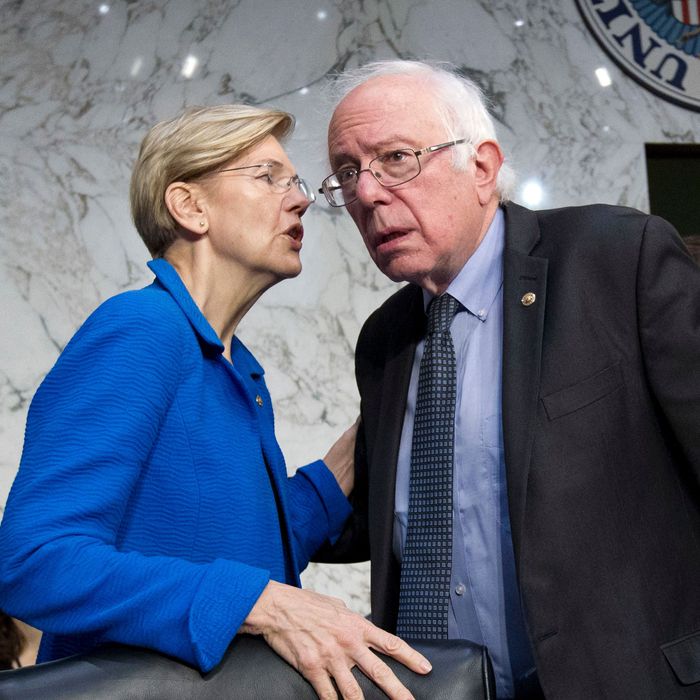
Sanders and Warren: Still great ideas; still afraid speak the truth.

Image result for cowardly lion“Ignorance is the parent of fear.” Herman Melville
“Instead of worrying about what people say of you, why not spend time trying to accomplish something they will admire.” Dale Carnegie
“The only thing we have to fear is fear itself.” Franklin D. Roosevelt
“Avoiding danger is no safer in the long run than outright exposure. The fearful are caught as often as the bold.” Helen Keller
“Fear is the lengthened shadow of ignorance.” Arnold Glasow
“Fear defeats more people than any other one thing in the world.” Ralph Waldo Emerson
“The cave you fear to enter holds the treasure you seek.” Joseph Campbell
“Everything you want is on the other side of fear.” Jack Canfield
“Don’t fear failure so much that you refuse to try new things. The saddest summary of a life contains three descriptions: could have, might have, and should have.” Louis E. Boone

………………………………………………………………………………………………………………………………………….

The U.S. government is Monetarily Sovereign. It never can run short of its own sovereign currency, the U.S. dollar.

Even if all federal tax collections totaled $0, the federal government could spend unlimited amounts, forever, and without causing inflation.

Elizabeth Warren and Bernie Sanders and the rest of the Democrats know this. They have had expert advice.

Yet they are afraid to say it. They cower at the notion that voters will not believe them. They fear even to hint at the truth.

So despite offering great ideas, they won’t tell you exactly how these ideas will be paid for. And that, more than any other thing, will destroy what they propose.

Majority in US Back Free College Tuition and Student Debt Cancellation, New Poll Finds
Posted on September 14, 2019 by Yves Smith,  [By Judy Conley, staff writer at Common Dreams. Originally published at Common Dreams]

A majority of voters support the bold proposals for free college tuition and the wiping out of student debt put forward by Sens. Bernie Sanders and Elizabeth Warren, according to a new Hill-HarrisX poll out Friday.

The survey found that out of more than 1,000 respondents, 58 percent of people said they support government-funded public college tuition and the cancellation of student debt for the more than 44 million Americans who currently hold it.

“We will make public colleges and universities and HBCUs debt-free. And what we will always also do, because this is an incredible burden on millions and millions of young people who did nothing wrong except try to get the education they need, we are going to cancel all student debt in this country.” —Sen. Bernie Sanders (I-Vt.)

The student debt crisis has left young Americans as a group owing more than 1.5 trillion for their college and graduate educations, and is largely blamed for keeping millennials from being able to buy homes and start families.

“What we will also do is not only have universal pre-K, we will make public colleges and universities and HBCUs debt-free,” the Vermont independent senator said. “And what we will always also do, because this is an incredible burden on millions and millions of young people who did nothing wrong except try to get the education they need, we are going to cancel all student debt in this country.”

According to the Hill-HarrisX poll, 72 percent of Democrats and 58 percent of independent voters support free college tuition and student debt cancellation, while 40 percent of Republicans back the plans.

Free college. Eliminate student debt. They are excellent ideas.  But . . .Related image

While both Sanders and Warren have proposed offering free public college to all Americans, Warren’s debt cancellation program would only be offered to families who earn under $250,000 per year—the bottom 95 percent of earners. Sanders has proposed wiping out student debt for all those who carry it.

Sanders would fund his plan by imposing a speculation tax on stock trades, raising an estimated $2.4 trillion over 10 years, while Warren’s Ultra-Millionaires Tax would fund her proposal.

Question: Why $250K? Why not offer it to everyone?

Answer: It’s an unnecessary attempt to reduce the cost.

More importantly, why propose a “speculation tax” and why propose an “Ultra-Millionaires tax”? Elizabeth, Bernie, and the rest of the Democrats (and the Republicans, too) know full well that:

Federal taxes do not fund federal spending.

There is plenty of evidence that this is true. The U.S. government never has failed to pay its debts.  It creates all the dollars it needs, when it needs them.

A politician who offers brave ideas, should not fear to tell how these ideas will be paid for.

At the Democratic debate, Sen. Amy Klobuchar (D-Minn.) suggested progressive candidates are “extreme” and have made “promises [they] can’t keep,” while South Bend, Indiana Mayor Pete Buttigieg said in an earlier debate only that he supports “reducing” student debt and addressing college “affordability.”

Promises they can’t keep”? Oh, the trepidation. Why can’t those promises be kept? Only fear stands in the way.

On MSNBC Thursday, Sanders campaign co-chair Nina Turner said that while poll numbers have fluctuated slightly for the top candidates in recent weeks, surveys have consistently shown that Americans support free college tuition and student debt forgiveness.

The ideas are good. The voters are in favor. Why the fear by the politicians?

Turner told Katy Tur, Sanders “understands the cries, the fears, the needs, and the dreams of the American people in this country. Hello Green New Deal, hello college for all, canceling student debt, standing up for the working people of this country.”

Image result for warren and sanders
We don’t dare tell them the truth about paying for our ideas.

Yes, he understands the needs full well. He also understands how the proposed solutions easily could be funded.

Finally, he knows how to explain Monetary Sovereignty.

If only he and Warren and the rest of the Democrats had the courage.

Rodger Malcolm Mitchell
Monetary Sovereignty
Twitter: @rodgermitchell
Search #monetarysovereignty Facebook: Rodger Malcolm Mitchell

…………………………………………………………………………………………………………………………………………………………………………………………………………………………………………………………………………………………..

The most important problems in economics involve the excessive income/wealth/power Gaps between the richer and the poorer.

Wide Gaps negatively affect poverty, health and longevity, education, housing, law and crime, war, leadership, ownership, bigotry, supply and demand, taxation, GDP, international relations, scientific advancement, the environment, human motivation and well-being, and virtually every other issue in economics.

Implementation of The Ten Steps To Prosperity can narrow the Gaps:

Ten Steps To Prosperity:

1. Eliminate FICA

2. Federally funded Medicare — parts a, b & d, plus long-term care — for everyone

3. Provide a monthly economic bonus to every man, woman and child in America (similar to social security for all)

4. Free education (including post-grad) for everyone

5. Salary for attending school

6. Eliminate federal taxes on business

7. Increase the standard income tax deduction, annually. 

8. Tax the very rich (the “.1%”) more, with higher progressive tax rates on all forms of income.

9. Federal ownership of all banks

10. Increase federal spending on the myriad initiatives that benefit America’s 99.9% 

The Ten Steps will grow the economy, and narrow the income/wealth/power Gap between the rich and you.

MONETARY SOVEREIGNTY

Congress re. Medicare and the deficit: The easy we make impossible, but it takes longer

We already have created Medicare for seniors. The hard work was accomplished years ago. And in those years since, we have accumulated excellent knowledge in how to run a Medicare program.

Now, to create Medicare for All, we need only to do three simple things:

I. Eliminate FICA
The U.S. federal government is Monetarily Sovereign. It has the unlimited ability to create its sovereign currency, the U.S. dollar.

Unlike state and local governments, the federal government never can run short of dollars. Even if all federal tax collections fell to $0, the federal government could continue spending and paying its bills, forever.

Alan Greenspan: A government cannot become insolvent with respect to obligations in its own currency.”
Ben Bernanke: “The U.S. government has a technology, called a printing press (or, today, its electronic equivalent), that allows it to produce as many U.S. dollars as it wishes at essentially no cost.”
St. Louis Federal Reserve: “As the sole manufacturer of dollars, whose debt is denominated in dollars, the U.S. government can never become insolvent, i.e., unable to pay its bills. In this sense, the government is not dependent on credit markets (borrowing) to remain operational.”

Contrary to the popular myth, FICA does not fund Medicare. The dollars collected for FICA (and indeed, all federal tax dollars) are destroyed by the U.S. Treasury upon receipt.

The federal government creates brand new dollars, each time it pays a creditor.

And lest you believe increased deficit spending (necessitated by the elimination of FICA) would cause inflation, history says that is not so.

Federal deficit spending (red) does not cause inflations (blue)

Most inflations and all hyperinflations have been caused by shortages, (usually shortages of food and/or energy), not by excess money. These shortages often are caused by insufficient federal deficit spending.Image result for german money in a wheelbarrow

The “money-in-a-wheelbarrow” meme demonstrates a government’s response to inflation, not the cause of inflation.

1804-1812: U. S. Federal Debt reduced 48%. Depression began 1807.
1817-1821: U. S. Federal Debt reduced 29%. Depression began 1819.
1823-1836: U. S. Federal Debt reduced 99%. Depression began 1837.
1852-1857: U. S. Federal Debt reduced 59%. Depression began 1857.
1867-1873: U. S. Federal Debt reduced 27%. Depression began 1873.
1880-1893: U. S. Federal Debt reduced 57%. Depression began 1893.
1920-1930: U. S. Federal Debt reduced 36%. Depression began 1929.

II. Expand Medicare to include all age groups. This does not require a fundamental change, but rather an expansion of the already existing program, so that it covers everyone.

III. Make it more inclusive by removing deductibles and covering long-term care. The theoretical purpose of deductibles is to dissuade people from over-using Medicare.

But because Medicare costs taxpayers nothing, even possible over-use would pump growth dollars into the economy — a benefit to all Americans.

Further, long-term care eventually is needed by a high percentage of people, but it is unaffordable for many. Having the federal government pay would remove a great burden from most American families.

I was reminded of the above by the following article that appeared in the 8/1/19 Chicago Tribune (excerpts follow).

Many in GOP-led Senate torn over pact to boost debt limit
By Andrew Taylor Associated Press

WASHINGTON — A hard-won, warts-and-all budget pact between House Speaker Nancy Pelosi and President Donald Trump is facing a key vote in the GOP-held Senate, with many conservatives torn between supporting the president and risking their political brand with an unpopular vote to add $2 trillion or more to the government’s credit card.

Credit cards are, for you and me, a method of short-term borrowing. But unlike you and me, and state/local governments,  the federal government does not borrow.

Given its unlimited ability to create dollars, it has no reason to borrow dollars. What often and misleadingly is termed federal “borrowing,” actually is the acceptance of deposits into Treasury-security (T-bill, T-note, T-bond) accounts.

The federal government, being Monetarily Sovereign has no need for the dollars in those accounts, so does not touch them. Rather, the dollars remain in the accounts until maturity, at which time they, together with interest, are returned to the depositor.

The purposes of T-securities are to:

  1. Provide a safe depository for unused dollars, which stabilizes the dollar, and
  2. Assist the Fed in controlling interest rates.

They do not help the federal government pay its bills.

The Trump-supported legislation backed by the Democratic speaker would stave off a government shutdown and protect budget gains for the Pentagon and popular domestic programs.

It’s attached to a must-do measure to lift the so-called debt limit to permit the government to borrow freely to pay its bills.

The so-called debt limit is akin to burning your wallet to prevent you from paying your exisiting creditors. It is not “financial prudence,” as many politicians would have you believe.

The vote, expected Thursday, is a politically tough one for many Republicans.

The tea party-driven House GOP conference broke against it by a 2-1 ratio, but most pragmatists see the measure as preferable to an alternative fall landscape of high-wire deadlines and potential chaos.

The government otherwise would face a potential debt default, an Oct. 1 shutdown deadline, and the return in January of across-the-board spending cuts known as sequestration.

Hmmm . . . The choice is between high-wire deadlines, potential chaos, debt default, an Oct. 1 shutdown, and sequestration,  vs. simply eliminating the useless debt ceiling.

For new arrivals to the Senate, particularly those who ran against a broken Washington culture, the sweeping measure represents a lot of what they ran against: unrestrained borrowing and trillion-dollar deficits, fueled by a bipartisan thirst for new spending.

Unrestrained borrowing” does not exist, simply because the federal government (unlike state and local governments) does not borrow.Image result for nasa

Trillion-dollar deficits” add trillions of growth dollars to the economy.

New spending” is the method by which the federal government benefits Americans via spending for the military, health-care, anti-poverty efforts, science and technology, education,, anti-global warming, medical advances, national parks, disaster recovery, and the myriad other benefits we Americans expect and rely upon.

“This budget process, if we can even call it a process, put taxpayers at the mercy of a House speaker who has no interest in prudent budgeting,” said freshman Sen. Josh Hawley, R-Mo.

State and local taxpayers fund state and local government spending. But, contrary to popular myth, federal taxpayers do not fund federal spending.

To cut federal growth spending is not “prudent.” It demonstrates ignorance of federal financing and national needs.

Rand Paul, R-Ky., said the deal “marks the death of the tea party movement in America.”

Good riddance to the tea party, the party of austerity and hatred of the poor and middle-classes.

The pact is a victory for pragmatists eager to avert chaos caused by a potential government shutdown, a possible debt crisis, or a freeze to agency budgets — including the massive Pentagon budget — at current levels.

The agreement lifts the limit on the government’s $22 trillion debt for two years and averts the risk of the Pentagon and domestic agencies from being hit with $125 billion in automatic spending cuts that are the last gasp of the 2011 Budget Control Act.

Every debt crisis ends the same way: After ignorant statements about faux “prudence,” and ignorantly equating federal finances to personal finances, and falsly claiming that federal taxpayers will foot the bill, Congress and the President agree on a temporary fix.

This assures that, having learned nothing and proved nothing, Congress will expose the public to the same ignorance and chaos a few more months down the line.

And these are the people to whom we trust our futures.

Rodger Malcolm Mitchell
Monetary Sovereignty
Twitter: @rodgermitchell
Search #monetarysovereigntyFacebook: Rodger Malcolm Mitchell

…………………………………………………………………………………………………………………………………………………………………………………………………………………………………………………………………………………………..

The most important problems in economics involve the excessive income/wealth/power Gaps between the richer and the poorer.

Wide Gaps negatively affect poverty, health and longevity, education, housing, law and crime, war, leadership, ownership, bigotry, supply and demand, taxation, GDP, international relations, scientific advancement, the environment, human motivation and well-being, and virtually every other issue in economics.

Implementation of The Ten Steps To Prosperity can narrow the Gaps:

Ten Steps To Prosperity:

1. Eliminate FICA

2. Federally funded Medicare — parts a, b & d, plus long-term care — for everyone

3. Provide a monthly economic bonus to every man, woman and child in America (similar to social security for all)

4. Free education (including post-grad) for everyone

5. Salary for attending school

6. Eliminate federal taxes on business

7. Increase the standard income tax deduction, annually. 

8. Tax the very rich (the “.1%”) more, with higher progressive tax rates on all forms of income.

9. Federal ownership of all banks

10. Increase federal spending on the myriad initiatives that benefit America’s 99.9% 

The Ten Steps will grow the economy, and narrow the income/wealth/power Gap between the rich and you.

MONETARY SOVEREIGNTY

Democrats’ political suicide

There were times when I thought Donald Trump was politically suicidal with his public philandering, his easily disproved lies, his blatant ignorance, his financial profiting from the Presidency, his nepotism, his sucking up to communists, and on and on.

But apparently, his “religious” followers admire philandering, lying, ignorance, criminal profiting, nepotism, communism, etc. So Trump survives.

Lately, I have realized that it is the Democrats who are politically suicidal. The Democrats have the marvelous ability to take a good idea, a popular idea — health care for everyone — and muck it up into a barely recognizable mess, until they now are on the defensive about something that should be a lay-down winner for them.

As readers of this blog well know: The federal government’s finances are not like state and local governments’ finances. 

Image result for bernanke and greenspan
It’s our little secret. Don’t tell the people we don’t use their tax dollars.

Ben Bernanke: “The U.S. government (can) produce as many U.S. dollars as it wishes at essentially no cost.”

Alan Greenspan: “A government cannot become insolvent with respect to obligations in its own currency.”

St. Louis Federal Reserve: “As the sole manufacturer of dollars, whose debt is denominated in dollars, the U.S. government can never become insolvent, i.e.,unable to pay its bills. In this sense, the government is not dependent on (borrowing) to remain operational.”

Unlike state and local governments: 

  1. The federal government has a sovereign currency, the U.S. dollar, over which it has total control.
  2. The federal government cannot unintentionally run short of its own sovereign currency.
  3. The federal government neither needs nor uses tax dollars.
  4. The federal government does not borrow.

Those four, simple truths are absolutely basic to economics. Yet they seem not to be understood by the vast majority of Americans, even including media writers and university economists — and especially not understood by the legions of Democrats chasing glory via the Presidency.

The following article demonstrates the Democrats’ suicidal ignorance:

Sanders admits he would raise taxes on the middle class to pay for programs
Kadia TubmanReporter,Yahoo News•June 27, 2019

Sen. Bernie Sanders, challenged at Thursday night’s Democratic presidential debate on how he would pay for universal health care and his other proposed programs, admitted income taxes on the middle class would have to go up — but maintained that the savings in medical expenses would more than offset the tax hike.

Sanders, who took the first question from NBC correspondent Savannah Guthrie, talked about his Medicare for All proposal for his allotted minute.

But when Guthrie followed up and pressed him about taxes on the middle class, he conceded, “Yes, they will pay more in taxes.”

If Sanders’s version (or any other candidate’s version) of Medicare for All were proposed by a state governor or a city mayor, the above answer would be correct. Additional taxes would be needed to pay the cost of the medical services.

But apparently, neither Sanders nor any other candidate (nor any Republican, for that matter) knows or admits to knowing that federal finances are completely, totally, 180 degrees different from state and city finances.

The federal government uniquely has total control over the U.S. dollar, cannot unintentionally run short of dollars, neither needs nor uses tax dollars, and does not borrow.

The U.S. federal government could finance even the most liberal, generous version of Medicare for All, at the tap of a computer key. No tax dollars involved.

Sanders said, “Health care in my view is a human right and we have got to pass a Medicare for All single-payer system. “Under that system, [the] vast majority of the people in this country will be paying significantly less for health care than they are right now.”

Not only is health care a “human right,” but it is an economic imperative for any nation hoping to compete and grow — certainly as much an imperative as military defense and effective government.

Yet there is Sanders, essentially hat in hand, pleading for universal health care on the basis of cost savings, when in reality cost is not a real issue. It is a fake issue put forth either in ignorance or in malicious intent, depending on one’s politics.

Quite simply, there is no financial reason why any American should be forced to pay one cent for health care insurance — either via taxes or via premium payments.

And if after all these months of researching and developing his Medicare for All plans, Sanders still has not learned this, he is mentally unfit to be left alone with a sharp object.

But it continues. Sanders also said:

“I believe that education is the future for this country and that is why I believe we must make public colleges and universities tuition-free and eliminate student debt, and we do that by placing a tax on Wall Street.”

“Every proposal that I have brought forth is fully paid for.”

Sanders believes (!) education is the future for this county?  He believes so? What a relief that he believes something so obvious, that American states, counties, and cities have been funding elementary, high school, and even some college education, for centuries.

Unfortunately, states, counties, and cities are not Monetarily Sovereign, so they must have some form of income (taxes, fees, tourism, borrowing, etc.) in order to spend.

The federal government, being unique, is not similarly constrained. Yet Sanders, a federal politician, doesn’t recognize this difference. Tragic.

Sanders babbled on:

“People who have health care under Medicare for All will have no premiums, no deductibles, no copayments, no out of pocket expenses. Yes, they will pay more in taxes, but less in health care for what they get.”

Then the Yahoo News reporter added her dollop of economic ignorance by quoting the Associated Press:

Still, taxes would significantly increase as “the government takes on trillions of dollars in health care costs now covered by employers and individuals, the Associated Press fact-checked.

“Independent studies estimate the government would be spending an additional $28 trillion to $36 trillion over 10 years, although Medicare for All supporters say that’s overstating it.

How those tax increases would be divvied up remains to be seen, as Sanders has not released a blueprint for how to finance his plan.

Note how the media automatically and wrongly translate “spending an additional $28 trillion to $36 trillion” into “tax increases.”

(Does that also mean federal tax cuts require federal spending cuts?)

There is zero relationship between federal spending and taxes. Again, the pretense is that federal finances are like state and local finances, where spending is funded by taxes.

Sen. Michael Bennet, who was the last candidate to earn a spot on the debate stage, took a shot at Sanders on taxes.

Bennet said he believed in getting to universal health care. “I believe the way to do that is by finishing the work we started with Obamacare and creating a public option that every family and every person in America can make a choice for their family about whether they want a public option which for them would be like having Medicare for All or whether they want to keep their private insurance. I believe we will get there much more quickly if we do that.”

“Bernie mentioned the taxes that we would have to pay, because of those taxes, Vermont rejected Medicare for All,” he added. Sanders shook his head in response.

If by “public option” Bennet means people should be given the choice between free, comprehensive, no deductible Medicare and long-term care vs. paying for private insurance, sure. Why not? That is exactly the choice people should be given.

Of course, the result is a given. Perhaps a dozen people in America would choose to pay for private insurance.

But then, the Democrats’ stupidity continues:

When asked which candidates would abolish private health insurance in favor of a government-run plan, only Sanders and Harris raised their hands.

Since the words “abolish private health care insurance” instantly click the insanity button in America, two Democrats dive right in and say, “Yes, that is what we would do.”

OMG! Why?

“Everybody who says Medicare for All, every person in politics who allows that phrase to escape their lips has a responsibility to explain how you’re actually supposed to get from here to there,” said South Bend, Ind., Mayor Pete Buttigieg.

“I would call it Medicare for All Who Want It.”

Buttigieg said he would take parts of Medicare and give people an option to buy into it, providing “a very natural glide path to the single-payer environment.”

“Parts of Medicare”? Which parts would you leave out? Even Medicare itself is insufficient.

It has deductibles and partial payments, which are why many people pay for Medicare Supplement insurance. And it doesn’t cover pharmaceuticals, which is why people pay for Part D coverage.

And don’t even mention long-term care coverage, which Medicare doesn’t provide, and which even frightfully expensive private insurance covers only partially.

So add Buttigieg to the list of politicians who either don’t know what they are talking about or don’t want to give you the facts.

Bottom line, the federal government has the unlimited power to pay for comprehensive, no deductible health care insurance, including pharmaceuticals and long term care — and it can do so by pressing a computer key.

This whole charade results from the mean-spirited, selfishness of Gap Psychology  (see: https://mythfighter.com/2018/04/06/how-does-gap-psychology-affect-you/) combined with flat-out ignorance of federal finances, and you, the public, are the patsies.

Cost is not the issue. Coverage is the issue — the only issue.

Even if you have no background in economics you should realize that federal spending is not funded by taxes. Didn’t the GOP massively cut taxes on the rich while increasing federal spending. That alone should have given you a clue.

Sorry folks, but ignorance has its penalties. Pay up.

Rodger Malcolm Mitchell
Monetary Sovereignty
Twitter: @rodgermitchell
Search #monetarysovereigntyFacebook: Rodger Malcolm Mitchell

…………………………………………………………………………………………………………………………………………………………………………………………………………………………………………………………………………………………..

The most important problems in economics involve the excessive income/wealth/power Gaps between the richer and the poorer.

Wide Gaps negatively affect poverty, health and longevity, education, housing, law and crime, war, leadership, ownership, bigotry, supply and demand, taxation, GDP, international relations, scientific advancement, the environment, human motivation and well-being, and virtually every other issue in economics.

Implementation of The Ten Steps To Prosperity can narrow the Gaps:

Ten Steps To Prosperity:

1. Eliminate FICA

2. Federally funded Medicare — parts a, b & d, plus long-term care — for everyone

3. Provide a monthly economic bonus to every man, woman and child in America (similar to social security for all)

4. Free education (including post-grad) for everyone

5. Salary for attending school

6. Eliminate federal taxes on business

7. Increase the standard income tax deduction, annually. 

8. Tax the very rich (the “.1%”) more, with higher progressive tax rates on all forms of income.

9. Federal ownership of all banks

10. Increase federal spending on the myriad initiatives that benefit America’s 99.9% 

The Ten Steps will grow the economy, and narrow the income/wealth/power Gap between the rich and you.

MONETARY SOVEREIGNTY