The difference between misinformation and disinformation is that the former can be accidental and unintentional, while the latter is intentional.
While the Libertarian website, Reason.com, always has spewed wrong ideas, I have come to believe they now are well into the disinformation stage.
In short, they have transitioned from loud-mouth, bar-stool buffoons to louder-mouth Tucker Carlson.
I admitted that even I don’t believe what I say. Why should you?
Here is the latest headline:
I caught up with the 96-year-old recently in Southern California and conducted a long interview about his life and work that will appear as a Reason podcast.
Here’s part of our conversation about President Joe Biden’s massive $6.8 trillion budget plan, the role of government spending and Federal Reserve policy in causing inflation, the bailout of Silicon Valley Bank, and why Smith believes “it’s very hard to keep Democrats [from] wanting to make the world better by spending other people’s money.“
I must admit that the headline and the introductory paragraphs told me I would not be able to stomach listening to the entire drivel. Here are my comments based on just the above:
Greenspan: A government cannot become insolvent with respect to obligations in its own currency.
Starting with the simplest, there is no Nobel Prize in economics, nor should there be. It’s called The Sveriges Riksbank Prize in Economic Sciences in Memory of Alfred Nobel.
It’s like me injuring myself and awarding me the Rodger Mitchell medal in memory of the Military Order of the Purple Heart.
Or, having taking some pictures at my family Thanksgiving dinner, I award myself the Mitchell Award for Best Picture in memory of the Academy of Motion Pictures Arts and Sciences Awards for Best Pictures.
Also, there should be no real Nobel Prize in economics because economics has not yet graduated to science levels. It is a philosophy that lacks proof, but exists on intuition and belief.
Sciences make verifiable predictions. Economics makes predictions that can’t be verified. They are little more than hunches.
Economists are like stock market chartists with their “head and shoulders” graphs, histograms, and MACDs, all of which sound scientific but in reality are balderdash.
“GOVERNMENT SPENDING CAUSING INFLATION”
Next, there is no evidence that federal spending causes inflation. It is a common belief in economics circles, but it is based on the logical intuition that if you have more of something its value declines.
Sadly, Facts don’t agree with intuition.
Money is unlike other commodities. It always is in demand.
If we have plenty of oil, we don’t use more. There becomes a surfeit that needs to be stored at a significant cost. The price goes down. When there is too much, production can’t be shut down in and instant; when there is a shortage, production can’t be started instantly.
If we have plenty of food, we don’t begin to eat more. The extra must expensively be stored or allowed to rot. The the price goes down. When there is too much or too little, production can’t respond quickly.
By contrast, the federal government quickly can produce more dollars when needed, simply by giving them away or spending them. In the unlikely event there ever are too many dollars, the government could tax them away.
Another major reason why money is unique: If you have plenty of money, you still want more. Storage not only is free, but receives interest. The usual rules of supply and demand don’t operate.
Having plenty of money does not reduce the price of money. It actually can increase the value of money, because investing opens new areas for more investing.
That is why we see graphs like this:
There is no relationship between federal debt (red line) and inflation (blue line).
The peaks and valleys in the above graph do not match. There is no cause/effect relationship.
There is a strong relationship between inflation and oil supplies (green, as evidenced by oil prices).
The peaks and valleys match. There is a cause/effect relationship.
“BAILOUT OF SILICON VALLEY BANK”
The bailout of the Silicon Valley Bank (SVP) was necessary to prevent massive losses to the economy and to individual depositors.
Bernanke: The U.S. government has a technology, called a printing press (or, today, its electronic equivalent), that allows it to produce as many U.S. dollars as it wishes at essentially no cost.
Gross Domestic Product (GDP) is a measure of the economy by being a measure of spending (GDP = Federal and Nonfederal Spending + Net Exports).
Adding dollars to the economy increases GDP; taking dollars from the economy reduces GDP.
Dollars held by banks are dollars in the economy as part of the M2 money supply measure. Allowing SVP depositors to lose money would reduce GDP, which would be recessionary.
Gillespie and Zuckerman advocate punishing the bank and those responsible by allowing them to fail, the classic “cut one’s nose to spite one’s face” situation.
Because banks operate under a profit motive, their leaders face the ongoing temptation to engage in higher-risk activities. When these activities fail, the banks, not having infinite funds with which to pay off depositors, fail.
The prevention and cure is to have all banks owned by the federal government, an entity that is not motivated to take higher risks and has the infinite ability to pay depositors. There is no public purpose for banks to be privately owned.
Bank depositors already are insured (up to $250,000) by the federal government. Federal ownership would expand that protection while decreasing risk.
“SPENDING OTHER PEOPLE’S MONEY”
This pejorative trope, though often expressed, is based on the false notion that the federal government spends federal tax dollars.
While state and local governments, being monetarily non-sovereign, do spend taxpayer dollars, the federal government operates differently.
Greenspan: There is nothing to prevent the federal government from creating as much money as it wants and paying it to somebody.
Being Monetarily Sovereign, the federal government has the infinite ability to create dollars.
Alan Greenspan: “A government cannot become insolvent with respect to obligations in its own currency.”Ben Bernanke: “The U.S. government has a technology, called a printing press (or, today, its electronic equivalent), that allows it to produce as many U.S. dollars as it wishes at essentially no cost.”Alan Greenspan: “There is nothing to prevent the federal government from creating as much money as it wants and paying it to somebody.”Alan Greenspan: “The United States can pay any debt it has because we can always print the money to do that.”
The federal government neither needs nor uses tax dollars. Even if it stopped collecting taxes, the federal government could continue spending forever.
The primary purpose of federal taxes is to control the economy by taxing what the government wishes to discourage and by giving tax breaks to what the government wishes to encourage. A secondary purpose is to insure acceptance of US dollars by requiring them to be used for taxes and other payments.
Reason.com, that Libertarian, anarchist organization, has become more far right-wing of late, and following in the Fox News / Tucker Carlson tradition, has resorted to exaggeration and outright lies — i.e misinformation and disinformation — to push its anti-government agenda.
The federal government is very good at one thing: Creating dollars. Thus it has no profit motive. Its motives revolve around its voter constituency. The more it can do to please its voters, the more votes it can acquire.
The Republican constituency is the rich, and the Republicans know it.
The Democrats’ constituency is the not-rich, but the Democrats don’t understand economics. So, despite creating such social programs as Social Security, Medicare, Medicaid, and poverty-fighting plans, the Democrats repeatedly fall into the trap of not recognizing Monetary Sovereignty.
Thus, they go along with the “can’t afford it” excuses for not implementing Medicare for All, Social Security for All, free college for all and other social programs that would benefit America.
Meanwhile, the Libertarians join hands with the Republicans to widen the Gap between the rich and the rest. Disgraceful.
The next time you read any Libertarian or Republican wish list, ask yourself, does this help the not-rich or does it widen the Gap between the rich and the rest? Then vote accordingly.
Rodger Malcolm Mitchell
Monetary SovereigntyTwitter: @rodgermitchellSearch #monetarysovereigntyFacebook: Rodger Malcolm Mitchell
……………………………………………………………………..
The Sole Purpose of Government Is to Improve and Protect the Lives of the People.
Here is what former Federal Reserve Chairmen said when they were being honest:
Ben Bernanke: “The U.S. government has a technology, called a printing press (or, today, its electronic equivalent), that allows it to produce as many U.S. dollars as it wishes at essentially no cost.”
Alan Greenspan: “A government cannot become insolvent with respect to obligations in its own currency.”
On 60 Minutes Ben Bernanke explained that federal tax money is not spent: Scott Pelley: “Is that tax money the Fed is spending?” Bernanke: “It’s not tax money . . . We simply use the computer to mark up the account.”
Get it? The U.S. government cannot run short of dollars unless it wants to.
Now mull that over and explain to yourself why the federal government, having the infinite ability to create dollars, should be concerned about the dollars it supposedly owes.
Read the following articles as you keep that infinite ability in mind:
Treasury Secretary Janet Yellen said the U.S. is projected to reach its roughly $31.4 trillion borrowing limit in less than a week.
The question, “Why does the U.S. government have a borrowing limit?” leads to two questions:
Why does the U.S. government, which is Monetarily Sovereign (i.e., having that infinite ability to create its own sovereign currency), borrow dollars?Answer: The U.S. government never borrows dollars. It accepts deposits into Treasury Security accounts, the purpose of which is not to supply the government with its own dollars (The government never touches those deposits.)The purpose of T-bills, T-notes, and T-bonds is to provide a safe place for dollar users to store unused dollars. This helps stabilize the dollar.
Why does the U.S. government limit acceptance of deposits into T-security accounts (aka “debt”).Answer: There is no rational financial reason. The con is to make the public believe falsely that federal finances are like personal finances, where spending must be limited to income.But federal finances are entirely different.The federal government cannot run short of dollars.The con goes something like this:Congress cannot control its spending, so to be “prudent,” a law that limits spending is needed. Unfortunately, this is all hogwash. Spending does not need to be controlled (as demonstrated by the repeated increases in the “debt limit)
the debt limit law does not control spending. It controls paying for what already has been spent.
Yellen shared the estimate in a letter to Speaker Kevin McCarthy (R-Calif.) on Friday. She also warned the department would soon have to begin taking “extraordinary measures” to stave off a default to buy time for Congress to find a bipartisan solution.
Those measures include temporarily redeeming existing and suspending new investments of the Civil Service, Retirement and Disability Fund and the Postal Service Retiree Health Benefits Fund, as well as suspending reinvestment of the Government Securities Investment Fund of the Federal Employees Retirement System Thrift Savings Plan.
We’ve accented the word “temporarily” to demonstrate that Yellen, Congress, and the world know the debt limit will be raised.
It will happen only after the Republican Representatives have had their chance to parade their fake thrift by giving speeches about spending cuts
Then, they will return to spending. It’s all a charade for the benefit of you, the voting public.
Yellen added that the funds would be “made whole” after the debt limit impasse has ended.
“Impasse has ended” means the limit will be raised again after all the lies have been told.
How will the funds be made “whole?” The government will do what it always has done: It will create new dollars from thin air, to pay all its bills.
That is precisely what the government has done every year of the phony debt ceiling and will continue to do in the future.
While the secretary said it’s unlikely cash and extraordinary measures will run out before early June, she stressed the measures will only last for “a limited amount of time” and pressed for Congress to “act in a timely manner” to raise or suspend the ceiling.
The letter to McCarthy comes as a high-stakes fight over raising the debt ceiling looms over the further Congress after Republicans took back control of the lower chamber last week.
McCarthy has pressed for any action to address the debt ceiling to be tied to spending cuts sought by Republicans.
The “spending cuts sought by Republicans are cuts to social programs — Medicare, Social Security, poverty aids — whatever helps those who are not rich. Benefits to the rich will not be cut, as the rich are the main contributors to the Republican party.
Also, anything that will help grow the economy will be cut because, in advance of the next elections, the Republicans want the Biden administration to be blamed for a weak economy.
However, proposals for significant cuts are likely to find trouble in the Senate, where Democrats still hold control.
“If you’re going to ask for an increase in the limit, at some point in time, you’ve got to sit down and say why are we hitting the limit? Why are we maxing out the credit card?”
The “credit card” analogy often is used. It is a false analogy, and anyone using it is ignorant about federal finance, a liar, or both.
The federal government does not use anything even remotely resembling a credit card. It pays all its financial obligations the same way: It creates new dollars, ad hoc.
There is no credit card. There is no borrowing. In fact, the federal “debt” isn’t even a real debt.
The T-security accounts are mere dollar storage — similar to bank safe deposit boxes. The government never touches those dollars. It creates all the dollars it uses. The dollars remain the property of the depositors.
Just as your bank does not count what you have in your bank safe deposit box as “debt,” the federal government does not owe the contents of T-security accounts. To pay off this misnamed “debt,” the government merely returns the contents of those accounts.
This is not a burden on the government or on taxpayers or on T-security holders.
Previous Fed Chairmen have testified that the federal government cannot run short of dollars. Even if the government collected $0 in taxes, it still could continue spending forever.
It’s a little-known secret that federal taxes are unlike state/local government taxes. All taxes are paid with dollars from the M2 money supply measure, but when federal tax dollars hit the U.S. Treasury, they disappear from any money supply measure.They effectively are destroyed.
Yes, those tax dollars you work so hard to earn and you waste so much time and money calculating and paying are destroyed upon receipt by the federal government.
Never used, never needed, the purpose of federal taxes is not to fund federal spending. They help the government control the economy by punishing what the government doesn’t like and by rewarding, via tax breaks, what the government wishes to aid.
(By contrast, state/local tax dollars remain in the economy as part of one or more money supply measures.)
The entire “debt limit” scene is a kabuki play designed to impress you. The Republicans want to make the rich richer by widening the Gap between the rich and the rest.
The Gap is what makes the rich richer. Without the Gap, no one would be rich — we all would be the same — and the wider the Gap, the richer are the rich.
To widen the Gap, the Republicans try to cut benefits to the populace, all in the name of “prudence.”
The Democrats try to demonstrate their frugality chops by pushing the “debt limit” button, but only when they are out of office, so the Republicans can be blamed for a weakened economy.
This con has been running for your amusement since 1939 when the so-called debt was called a “ticking time bomb.” That bomb has been ticking for 84 years and presumably will continue ticking as long as liars are in Congress, i.e., forever.
Here is another article on the same subject:
Congress has made many attempts to lower the national debt, but it hasn’t been able to reduce the growth of what the nation owes.
Yes, Congress has made many attempts to lower the federal debt.
For clarity, federal debtis not real debt. It is the net total of depositsinto Treasury security accounts — T-bills, T-notes, T-bonds — since the nation’s founding. To pay off this “debt,” the government merely returns the accounts’ balances.
The national debtis a nonsensical figure that totals the above T-security accounts plus all U.S. private debt (mortgages, credit card debt, etc.) It’s something like adding water in the lakes to alcohol to find the total amount of liquid in America.
The U.S. debt is the outstanding obligation owed by the federal government.
Now, the author refers confusingly to “U.S. debt.” Presumably, she means federal debt, though it is not owed by the federal government any more than the contents of a bank safe deposit box are owed by the bank.
Those deposits are owned by the depositors and are merely held for security by the U.S. Treasury.
It exceeded $31 trillion in for the first time on Oct. 4, 2022, and it has increased by at least $1 trillion each year since 2016.1
Federal debt is at its highest point in American history. Raising taxes and cutting spending are two of the most popular solutions for reducing debt, but politicians may be hesitant to do both.
The word “solutions” indicates that the writer believes the federal “debt” is a problem. It isn’t. The federal government quickly could pay off the entire federal “debt” today merely by returning all the dollars that exist in T-security accounts.
This would cost America and American taxpayers $0.
Sadly, the “solutions” for reducing the federal “debt” often involve reducing federal deficit growth or even running federal surpluses.
This is what happens when the government reduces deficit growth:
Reductions in federal deficit growth introduce recessions, which then must be cured by increases in deficit spending. The red line is federal deficit growth. Vertical gray bars are recessions.
This is what happens when the federal government reduces the federal “debt” by running surpluses:
1804-1812: U. S. Federal Debt reduced 48%. Depression began 1807.
1817-1821: U. S. Federal Debt reduced 29%. Depression began 1819.
1823-1836: U. S. Federal Debt reduced 99%. Depression began 1837.
1852-1857: U. S. Federal Debt reduced 59%. Depression began 1857.
1867-1873: U. S. Federal Debt reduced 27%. Depression began 1873.
1880-1893: U. S. Federal Debt reduced 57%. Depression began 1893.
1920-1930: U. S. Federal Debt reduced 36%. Depression began 1929.
1997-2001: U. S. Federal Debt reduced 15%. Recession began 2001.
When the federal government runs a surplus (taxes exceed spending), we usually have a depression.
The reason: Recessions and depressions are measured by decreases in Gross Domestic Product, which is:
GDP = Federal Spending + Non-federal spending + Net Exports
Federal spending decreases also cause non-federal spending decreases in an overall decrease in money creation. The economy shrinks and, in an endless feedback loop, will continue to shrink unless the federal government cures the depression or recession with a healthy dose of deficit spending.
The author posts this illustration that is utter nonsense:
She begins with “Cut government spending” and “raise taxes,” i.e., reduce deficit growth — precisely what we see causes recessions.
Then she adds, “Drive economic growth at a faster rate,” but does not say how to do that when government spending falls and taxes rise.
Finally, she says, “Shift spending to areas that create the most jobs.”
Again, she doesn’t explain how that would be done with less spending and higher taxes, but spending in areas that have more jobs may not be efficient, economically.
Diverting spending from the military to other sectors may boost job growth, which could spur consumer spending and help the economy.
She doesn’t explain why diverting spending from the military boosts job growth. The military not only is a massive employer, but far more importantly is a massive consumer.
It purchases everything from weapons to research to all sorts of ancillary products and services, many of which transition to non-military use (think GPS, etc.)
And of course, the military defends us, but hey, when you’re cutting deficits, who cares about defense. Right?
What’s Stopping the U.S. From Paying Down Its Debt?
Most creditors don’t worry about a nation’s debt, also known as “sovereign debt,” until it’s more than 77% of gross domestic product (GDP).
That’s the point at which added debt cuts into annual economic growth, according to the World Bank.
When economists don’t know what they are talking about, it usually is because they don’t understand Monetary Sovereignty.
There is a vast, sometimes diametric, difference between a Monetarily Sovereign government and a monetarily non-sovereign government. Studies that lump the two usually come to wrong conclusions. It’s like lumping professional football and backyard croquet into a study of athletics on health.
The above-referenced World Bank study is a classic example:
Public debt has surged during the current global economic crisis and is expected to increase further. This development has raised concerns whether public debt is starting to hit levels where it might negatively affect economic growth.
Does such a tipping point in public debt exist? How severe would the impact of public debt be on growth beyond this threshold? What happens if debt stays above this threshold for an extended period of time?
The present study addresses these questions with the help of threshold estimations based on a yearly dataset of 101 developing and developed economies spanning a time period from 1980 to 2008.
Of the “101 developing and developed economies” few would be massive, developed, Monetarily Sovereign. Perhaps, three or four, and none of those is like the United States.
It’s a phony study that ignores reality, namely the non-effect of the “Debt”/GDP ratio on GDP growth in America.A comparison of GDP growth (red) vs. “debt”/GDP (blue). There is no evidence that high “debt/GDP levels adversely affect GDP growth.
In America at least, no evidence points to the assumption that a high “debt”/GDP ratio negatively affects GDP growth. It’s just a belief unfounded in data.
At the end of the second quarter of 2021, the U.S. debt-to-GDP ratio was 125%.3 That’s much higher than the tipping point and is a concern for many.
“Much higher than the (fake) tipping point and a concern for many (unsupported by data).
Over $22 trillion of that national debt is public debt, which is what the government owes to investors and taxpayers.
“Owed to investors” are the dollars deposited into T-security accounts, which the government could pay off tomorrow simply by returning those dollars.
“Owed to taxpayers” are tax overpayments, which the government could pay off tomorrow simply by creating dollars ad hoc.
Congress places a limit on public debt. It increased the limit by $2.5 trillion in December 2021 to nearly $31.4 million.
Why isn’t the U.S. eliminating its debt and paying people back? There are a few reasons.
U.S. economic growth has historically outpaced its debt. The U.S. debt was $258.68 billion in August 1945, but the economy outgrew that in a few years. GDP more than doubled by 1960. Congress believes that today’s debt will be dwarfed by tomorrow’s economic growth.
As always, remember that federal “debt” is the total of deposits into T-security accounts. Whether economic growth is greater or less than deposit growth says nothing about the economy’s health.
The federal government has the right to stop accepting deposits. This would not injure economic health.
Members of Congress have a lot to lose by cutting spending. They could lose their next election if they cut Social Security or Medicare benefits.
Yes, they could, and well deservedly so. Also, tarred and feathered might be appropriate because it would be an unnecessary penalty for the non-rich.
Raising taxes can be politically unpopular. Experts believe President George H.W. Bush lost reelection because he raised taxes after promising he wouldn’t at the 1988 Republican convention.
He raised taxes in 1990 to reduce the deficit, and voters remembered.
He lost because he broke his promise. But he should have lost because the federal government neither needs nor uses tax dollars. As described earlier, federal tax dollars (unlike state/local tax dollars) are destroyed upon receipt by the Treasury.
Bush unnecessarily impoverished the private sector (aka “the economy”). He deserved to lose his job.
There are two main themes in most discussions about paying off the national debt: cutting spending and raising taxes.
There are other options that might not enter most conversations but can aid in debt reduction, too.
The 2010 bipartisan Simpson-Bowles report is a good example of how the government could cut spending to reduce debt.
The report proposed balancing the budget through a mix of spending cuts and tax reform.
Congress didn’t adopt the complete plan, but the government did implement parts of it with some success. Note A 2015 report from the Committee for a Responsible Federal Budget indicated that although a piecemeal approach reduced debt, full-fledged adoption of the Simpson-Bowles plan may have produced a significantly lower debt-to-GDP ratio.
It also would have produced a depression, which we have discussed here: Hoover, Smoot and Hawley reincarnated as Obama, Bowles and Simpson and here: Erskine Bowles and Alan Simpson reveal why the nation is in trouble: Them.
Very simply, Simpson-Bowles suggested cutting Social Security and Medicare while increasing FICA in order to impoverish the working class at the behest of the rich.
And for what purpose? To reduce the so-called “debt” which as we repeatedly have seen has no adverse effects on the economy. None.
(The real purpose is to widen the Gap between the rich and the rest. Enriching the rich is what the bribed economists, media, and politicians are paid to do.)
Raising taxes can generate revenue that the government can use to pay down debt as well as invest in programs that support the economy.
But it can cut into tax revenue and hurt the economy if the government raises taxes too high.
Finding the correct balance is expressed by a concept known as the “Laffer Curve.”
Wrong on so many fronts. First, the government does not use taxes to pay down “debt,” i.e. deposits in T-security accounts. It merely returns the dollars already exisiting in those accounts.
Second, federal tax revenue is destroyed upon receipt.
Third, the Laffer Curve is a case of BBB (Bullsh*t baffles brains). You can click the above link to understand why, but it is telling that the author, Kimberly Amadeo, mentions this discredited hypothesis. It’s especially telling that she thinks the Laffer Curve finds “the correct balance,” which it absolutely does not do.
Increasing the GDP has a twofold benefit: It generates extra revenue to pay down debt, and it reduces the debt-to-GDP ratio if GDP growth outpaces debt growth.
Federal revenue does not pay down anything. All federal revenue is destroyed. All payments are made with newly created dollars.
The debt-to-GDP ratio is meaningless.
Driving economic growth is one way to reduce the national debt, but Congress tends to disagree on how to create that growth.
Most Democrats push increased spending, while most Republicans champion lower taxes.
Both are correct. Increased spending adds more growth dollars to the economy. Lower taxes remove fewer growth dollars from the economy.
However, unlimited growth is an unrealistic goal, so growth alone can’t solve the federal debt.
Spending Congress could shift spending from defense to job-creation areas like infrastructure and education. Almost 15% of government spending goes to the military. But past studies indicate that money spent on the military is less effective in creating jobs than money spent in other areas.
According to a report from the Political Economy Research Institute at the University of Massachusetts, Amherst, $1 billion in education and mass transit spending could produce more than twice the jobs created by military spending.
Job creation can help boost the GDP, which can help lower the nation’s debt-to-GDP ratio in many cases.
Job creation does not rely on reduced military spending. The federal government has the infinite ability to spend.
What is the U.S. debt limit? The debt ceiling is the limit on what the U.S. government can borrow to pay bills that have come due. Congress puts this limit in place each year.
The debt limit isn’t about future debt. Instead, it’s about paying for spending that Congress authorized in previous years. If Congress does not raise the federal debt as needed, then the U.S. government cannot pay its bills and will default.
The final paragraph further demonstrates the ridiculousness of the “debt ceiling.” Either it will be raised or it won’t.
If it’s raised, that merely proves it’s a sham. If it isn’t raised, the U.S. will become a deadbeat nation and the world’s financial systems will fall into chaos.
Given that those are its only two possible outcomes, which fool would like it to continue?
Rodger Malcolm Mitchell
Monetary SovereigntyTwitter: @rodgermitchellSearch #monetarysovereigntyFacebook: Rodger Malcolm Mitchell
……………………………………………………………………..
The Sole Purpose of Government Is to Improve and Protect the Lives of the People.
Are you in one of these positions? You want to ask for a raise, but you fear you could get fired. Or, you would like to change jobs or quit working altogether.
But you are held captive by your health care insurance. Your company pays some of the premiums, and you can’t afford to pay the total amount yourself.
Or you have a pre-existing condition and will not be able to find another policy. It’s about to get even worse for you and for your company:
It cost an average of $22,463 to cover a family through employer-sponsored health insurance in 2022, according to an annual benefits survey from the Kaiser Family Foundation.
Though your employer may seem to pay the $22,463, you actually pay it. Your employer figures those dollars as part of your employment cost and your salary, sick days, vacation days, lunchroom, and any other perks you receive.
If there were no healthcare costs, your employer could raise your salary by that average of $22,463. Instead of paying it to you, he pays it to the health care insurance company.
Why it matters: Nearly 159 million Americans get health coverage through work, and coverage costs and benefits have become a critical factor in a tight labor market.
While families and individuals paid similar amounts for coverage in 2022 and 2021, premiums have increased by 20% over the past five years, KFF said.
And because many premiums for 2022 were finalized in the fall of 2021, before the effects of inflation were clear, KFF expects a higher increase in average premiums for 2023 than what’s been observed in recent years.
A single person paid $7,911 on premiums in a year for their employer health plan in 2022.
Again, while it may seem that you only paid “only” $7,911, you actually paid the full premium in lost wages — wages you should have received, but didn’t.
Between the lines: Employers are making tough choices in a competitive labor market and in some instances, absorbing rising costs of coverage instead of passing them on to workers.
An October survey of 1,200 small businesses found that nearly half of them have increased the cost of their goods or services to offset the rising costs of health care. Four in 10 businesses surveyed stopped offering health insurance altogether.
Angry about inflation? Much of the blame goes to the ballooning cost of health care. You pay inflated costs directly via premiums and insurance deductibles, and indirectly via the lost wages your employer would have paid you.
In fact, why do you or your company pay anyone, when the federal government is perfectly capable of paying your doctor, hospital, nurses, pharmaceutical company, and medical equipment manufacturer with no help from you?
You also pay the inflated costs of the goods and services you purchase from companies that have had to raise their prices to cover increased insurance costs.
In short, employer-supplied health care insurance is a net loser for everyone except for the insurance companies.
It cuts your salary while increasing what you pay for goods and services.
When the federal government pays, you get more and it costs you nothing.
The cost of care is expected to continue to increase in the coming years, putting added pressure on employers to offer competitive benefits packages.
Employer-sponsored plans have seen increased demand for mental health services, and 44% of companies surveyed with 200 or more employees offered mental health or self-care apps as benefits, accompanying research in Health Affairs says.
Covered workers are picking up a portion of the cost when they visit in-network physicians: Average copayments were $27 for primary care and $44 for specialty care, and there was even more cost-sharing for hospital admissions or outpatient procedures.
A large majority of firms with 50 or more employees cover some telemedicine in their largest health plan.What’s next: Premiums are likely to surge next year as inflation persists.
“Premium increases may be even higher than the 3–4 percentage points that we have seen in recent years,” the Health Affairs study authors write.
It’s the classic vicious circle. The cost of health care goes up which directly increases inflation, Then, inflation pushes the cost of insurance up, which impacts your net salary. And ’round and ’round we go.
Your net take-home pay is numerically reduced by the insurance premiums, while it is functionallyreduced by inflation.
Employer-provided health care insurance costs you both ways.
THE SOLUTION The U.S. federal government has infinite dollars. It neither needs nor uses tax dollars to pay its bills. Even if all federal tax collections totaled $0, the government could continue spending any amount, forever.
Without collecting a penny in taxes, the federal government could provide you and your family with free, comprehensive, no-limit health care insurance,that includes everything you can imagine — eyes, dental, psychiatric, every form of health-related equipment, etc.
Your healthcare could cost you nothing, either for services or for premiums. It could be Medicare for All only much, much better. And it wouldn’t increase the cost of goods and services, because, unlike employer-provided insurance, it wouldn’t increase employers’ costs.
Unlike employer-funded medical insurance, which does nothing for the economy, federally funded Medicare for All would grow the economy by adding stimulus dollars.
SO WHY NOT? Why don’t you have this plan, already?
Because you have been led to believe three lies.
Lie #1. You shouldn’t trust the government to provide health care.
But, a comprehensive Medicare for All plan would not involve the government providinghealth care. The plan would involve the government only paying for health care.
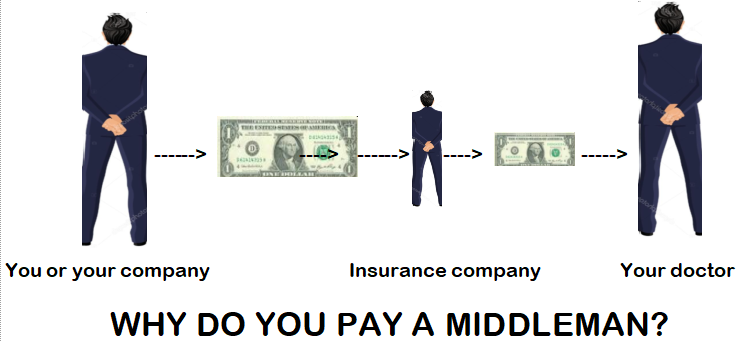
The actual care still would be provided by your same doctors, nurses, hospitals, therapists, and equipment manufacturers. It merely would cut out the wholly unnecessary and costly middlemen, the insurance companies.
The insurance companies provide no medical function. They merely collect your dollars, take some for themselves, and pass the rest on to the real medical practitioners.
The government would function as your insurance company. The big differences would be no dollars would be taken from you, and the government never can run short of dollars.
Lie #2. Your taxes would go up.
The U.S. federal government, unlike state and local governments, is Monetarily Sovereign. It cannot unintentionally run short of U.S. dollars.
It can spend forever without collecting any tax dollars.
Compare the federal government to state and local governments. They are monetarily non-sovereign. While state and local taxes fund state and local spending, federal taxes do not fund federal spending.
The purpose of federal taxes is not to help the government spend, but rather:
a. To control the economy by taxing what the government wishes to reduce and giving tax breaks to what the government wishes to reward.
b. To create demand for the U.S. dollar by requiring taxes to be paid in dollars.
c. To reduce your demand for services (like free health care insurance), by making you believe taxes are necessary to pay for benefits.
Lie #3. Federal spending causes inflation.
No inflation ever has been caused by spending. All inflations, including the current one, are caused by shortages of key goods and services, most often oil and food.
During and after the Great Recession of 2008, we had massive government spending without inflation. We only experienced inflation when COVID caused shortages of oil, food, lumber, computer chips, shipping, labor and other products and services.
Inflation (red line) doesn’t parallel federal deficit spending (blue line).
If you understood that the federal government has infinite money and does not need or use taxes, you would demand Medicare for All, Social Security for All, College for All, Food Assistance for All, Housing Assistance for All, etc.
Why don’t we have it?
The very rich, who run America, don’t want it. They are rich because of the income/wealth/power Gap between them and you. The wider the Gap, the richer they are. But the more free benefits you receive, the narrower the Gap becomes.
Your free benefits actually make the rich less rich.
So the rich bribe the politicians (via campaign contributions and promises of employment), the media (via advertising dollars and media ownership), and the economists (via donations to schools and employment in think tanks).
The rich bribe these people to tell you “the Big Lie” that federal taxes fund federal spending, and if you want more benefits you’ll have to pay for them.
It’s all a con to keep you ignorant. An ignorant public is a docile public, which is exactly what the rich want. It keeps them rich.
Sen. Bernie Sanders recommended a Medicare for All plan, but his plan had three serious faults:
Fault #1. It claimed to rely on tax collections, the same fault current Medicare has. So Sanders struggled to show how it was tax-neutral.
That was unnecessary. He should have explained that federal taxes do not fund federal spending and that the federal government would do what it always does: Create dollars, ad hoc, to pay every bill.
Fault #2. It was not comprehensive. It still required co-pays and didn’t cover many medical problems. This was done to save money and balance against tax collections — an unnecessary step.
The federal government does not need to save dollars. It has infinite dollars. It never can run short of dollars, even if it collects zero taxes.
Former Federal Reserve Chairman Alan Greenspan: “A government cannot become insolvent with respect to obligations in its own currency.”
Former Federal Reserve Chairman Ben Bernanke: “The U.S. government has a technology, called a printing press (or, today, its electronic equivalent), that allows it to produce as many U.S. dollars as it wishes at essentially no cost.”
The scare stories about federal “debt” and deficits are just that: Scare stories. False scare stories.
So called federal “debt” and deficits are no burden on a government with the infinite ability to pay its bills. If the federal government and your political representatives were doing their job, you would have free, comprehensive Medicare for All right now.
Why do you pay a middleman when the government can provide better service, free?
O.K., it’s not precisely the Nobel Prize. It’s the Sveriges Riksbank Prize in Economic Sciences in Memory of Alfred Nobel. So, it’s something like winning the McDonald Hamburger Football Inflation Prize in Honor of John Heisman instead of the Heisman Trophy.
But hey, it’s worth $885,000, so just call me “jealous.”
My only question is, why didn’t John Maynard Keynes win it? Or, perhaps Warren Mosler and Bill Mitchell (no relation) for founding Modern Monetary Theory?
Ah, but I digress. I really want to talk about this article:
Bernanke shares economics Nobel Prize for crisis research Ott Ummelas and Niclas Rolander, Bloomberg News
Former Federal Reserve Chair Ben S. Bernanke and two U.S.-based colleagues won the 2022 Nobel Prize in economics for their research into banking and financial crises.
Douglas Diamond, Philip Dybvig and the one-time central banker will share the 10-million-kronor ($885,000) award, the Royal Swedish Academy of Sciences announced in Stockholm on Monday.
“The laureates have provided a foundation for our modern understanding of why banks are needed, why they are vulnerable and what to do about it,” John Hassler, professor of economics and member of the prize committee, told reporters in Stockholm.
“In the laureates’ work, it is shown that deposit insurance is a way of short-circuiting the dynamics behind bank runs. With deposit insurance, there is no need to run to the bank.”
And there it is, the startling discovery that deposit insurance helps prevent bank runs by reassuring depositors their money is safe. Who’da thunk?
Diamond and Dybvig were lauded for their research identifying the vulnerability of banks to rumors of collapse, and how governments can prevent that. Bernanke’s studies meanwhile analyzed the Great Depression, and how bank runs ensured that crisis became so extended.
“Prior to Bernanke’s study, the general perception was that the banking crisis was a consequence of a declining economy, rather than a cause of it,” the committee said. “Bernanke established that bank collapses were decisive for the recession developing into deep and prolonged depression.
Bernanke demonstrated that the economy did not start to recover until the state finally implemented powerful measures to prevent additional bank panics.”
While Bernanke, Diamond, and Dybvig rush to the bank with their winnings, I will tell you, in just three words, the real cause of the Great Depression:
LACK OF FEDERAL DEFICITS
And what cured the Great Depression?
FEDERAL DEFICITS
O.K., will you send me my Sveriges Riksbank Prize in Economic Sciences in Memory of Alfred Nobel money, or must I travel to Sweden to pick it up/
Ask most people what caused the Great Depression, and they will answer:
I have no idea
Stock market speculation
Bank failures
Unemployment
I still have no idea
Numbers 1 and 5 are the most accurate, while numbers 2, 3, and 4 are small parts of the problem. But the Depression actually was caused by a lack of money.
Readers of this blog have seen these numbers:
1804-1812: U. S. Federal Debt reduced 48%. Depression began 1807. 1817-1821: U. S. Federal Debt reduced 29%. Depression began 1819. 1823-1836: U. S. Federal Debt reduced 99%. Depression began 1837. 1852-1857: U. S. Federal Debt reduced 59%. Depression began 1857. 1867-1873: U. S. Federal Debt reduced 27%. Depression began 1873. 1880-1893: U. S. Federal Debt reduced 57%. Depression began 1893. 1920-1930: U. S. Federal Debt reduced 36%. Depression began 1929. 1997-2001: U. S. Federal Debt reduced 15%. Recession began 2001.
And this graph:
The blue line shows the annual percentage of economic growth. The red line shows the rate of money growth. Note how parallel they are.
Calvin Coolidge and Warren Harding did exactly what today’s economists would have told them to do: Eliminate federal deficits and run federal surpluses. It all sounds so economically prudent, doesn’t it?
I’m not sure what they thought taking more than $7 billion out of the economy would accomplish, but perhaps “thought” isn’t the appropriate word.
And who should get credit for ending the Great Depression:
Yes, the much despised Herbert Hoover actually, sort of, kind of was on the right track, but it was the much beloved Franklin D. Roosevelt who understood that what the economy really needed was money, lots of money.
Fortunately for the execution of that realization, Hitler and Hirohito gave Roosevelt the excuse to run a monster (for those days) $236 billion deficit. The economy recovered big time.
For the past 82 years, we endured the continual warnings that the federal debt is a “ticking time bomb,” while the economy grew when the government continued to run ever bigger deficits and only has faltered when deficit growth was insufficient.
Do economists learn from experience? Uh, not so much.
:
Annual percentage changes in federal debt. Recessions are vertical gray bars
Here is a stunning visual showing that federal debt growth falls before every recession. That’s called “lack of money.”
Further, because the cure for lack of money is more money, federal debt growth increases during recessions. That’s when the federal government pumps money into the economy to cure the recession.
Odd, isn’t it, that Congress and the President seem to understand that the cure for a recession is increased federal deficit spending, but don’t seem to understand that the cause of recessions is insufficient federal deficit spending.
It boggles.
It’s as though someone knows that the cure for starvation is food, but doesn’t understand that the cause of starvation is lack of food.
Anyway, back to Bernanke and his award-winning realization that people trust the federal government’s finances more than they trust the private banks’ finances.
The former Fed chief, who pioneered the use of unconventional monetary policies, in particular deploying large-scale asset purchases, is now at the Brookings Institution in Washington. Diamond is at the University of Chicago, while Dybvig is at Washington University in St. Louis.
Under Bernanke’s tenure, the Fed’s balance sheet soared to more than $4 trillion from less than $1 trillion as the central bank sought to foster growth in the U.S. economy pummeled by the global financial crisis.
Diamond explained what his research showed about financial turmoil, and how to avoid it. Crises happen “when people start to lose faith in the stability of the system,” he said.
“The best advice is to be prepared for making sure that your part of the banking sector is both perceived to be healthy and to stay healthy, and respond in a measured and transparent way to changes in monetary policy.”
He didn’t explain specifically how depositors, banks, or the government are supposed to “be prepared.” Amazingly:
He added that the world is “certainly much better prepared” for any new crises than in 2008.
“Since then, both recent memories of that crisis and improvements of the regulatory policies around the world have left the system much less vulnerable.”
He said that at a time when the Republican Party, which could win the House and the Senate, is 100% opposed to federal spending (though perhaps that is only because a Democrat is President).
Frankly, recent memories and long-term memories don’t seem to be working, or else the politicians would remember the events that preceded every recession and every Depression in U.S. history.
The entire Congress seems hypnotized by the false notion that federal deficits (which add dollars to the economy) are bad and federal debt should be reduced, if not eliminated by federal surpluses (which take dollars from the economy).
In some respects, the risk of such turmoil is even necessary for the financial sector to provide vital functions to society.
“It’s possible, but it’s not necessarily desirable, to never have a financial crisis,” Diamond said. “I think we will probably always be subject to low-probability unexpected crises.”
If he is referring to a recession, we have one of those “low-probability unexpected crises” about every five years on average and are entering one right now.
But let’s get back to his prize-winning discovery that the federal government has more money than any bank and that banks having government-funded deposit insurance are more trusted than were banks without government aid.
It’s a truly revolutionary idea, but here’s another revolutionary idea: Rather than having the federal government go to all the trouble of financially supporting banks, insuring banks, and regulating banks, by investigating and prosecuting bad banks,
Why not just have the federal government own all the banks?
Private banking is having the great Michael Jordan on your basketball team, but instead of letting him play, you tell him to sit in the stands and critique.
The federal government already does the important things. It sets the banking rules. It sets the interest rates, and it manages the nation’s money supply.
It essentially does everything except extract money from suckers who buy into crazy bank derivatives. The ostensible purpose of derivatives is to spread risk, which wouldn’t be necessary if the government were taking on all the risk.
There is no economic purpose served in putting the nation’s finances into the greedy hands of private bankers. “Lead us not to temptation . . .” indicates that humans have difficulty resisting temptation. Where is the temptation greater than managing a bank and all that money?
Banks should be non-profit, infinitely solvent banks, with most services free to the public, i.e., Federally owned banks.




:max_bytes(150000):strip_icc():format(webp)/will-the-u-s-debt-ever-be-paid-off-3970473-finalv2-acb523b4dacf43529f4915254c600777-64dc8c15fa3345438ef293f439a58046.jpg) She begins with “Cut government spending” and “raise taxes,” i.e., reduce deficit growth — precisely what we see causes recessions.
Then she adds, “Drive economic growth at a faster rate,” but does not say how to do that when government spending falls and taxes rise.
Finally, she says, “Shift spending to areas that create the most jobs.”
Again, she doesn’t explain how that would be done with less spending and higher taxes, but spending in areas that have more jobs may not be efficient, economically.
She begins with “Cut government spending” and “raise taxes,” i.e., reduce deficit growth — precisely what we see causes recessions.
Then she adds, “Drive economic growth at a faster rate,” but does not say how to do that when government spending falls and taxes rise.
Finally, she says, “Shift spending to areas that create the most jobs.”
Again, she doesn’t explain how that would be done with less spending and higher taxes, but spending in areas that have more jobs may not be efficient, economically.