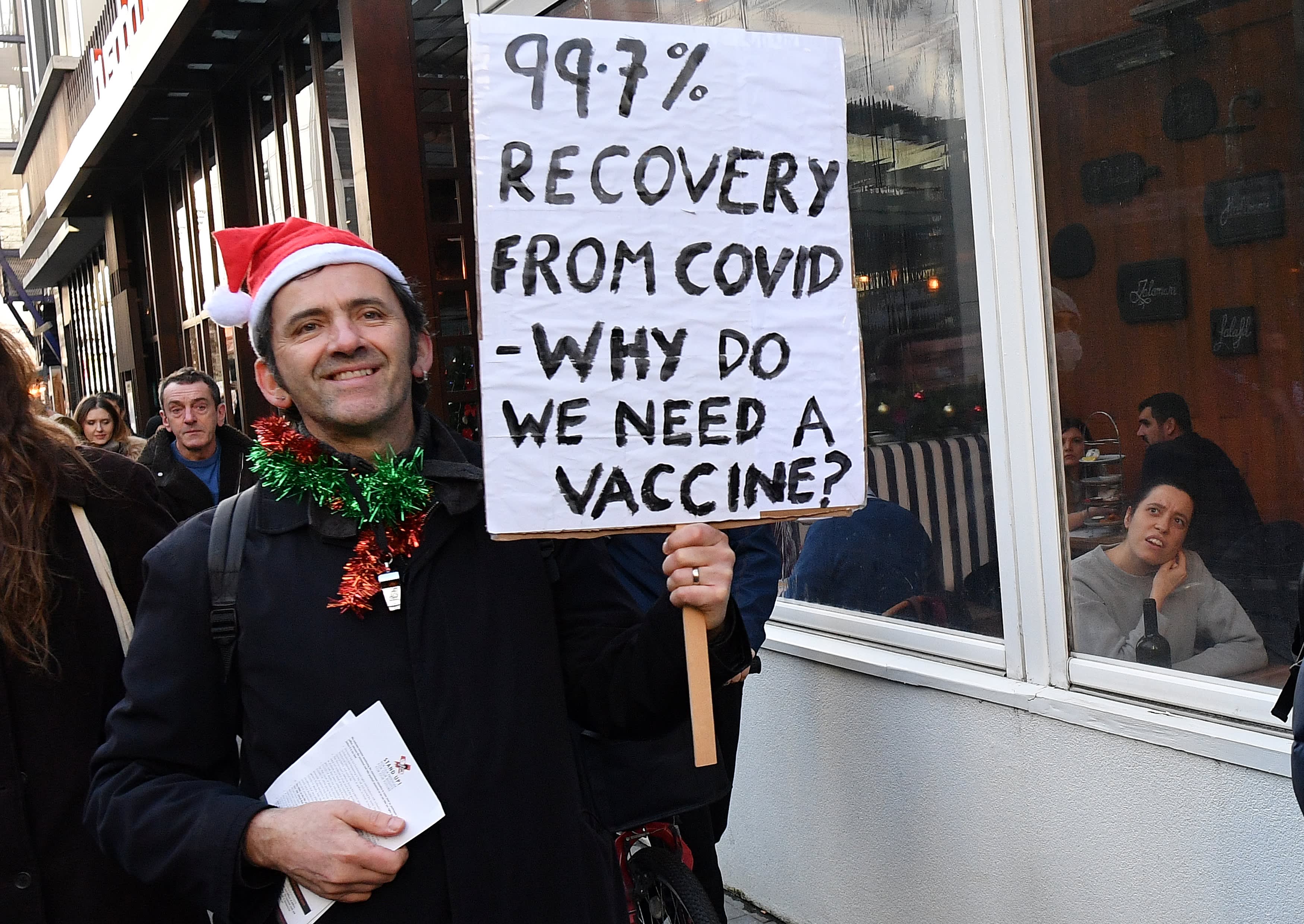
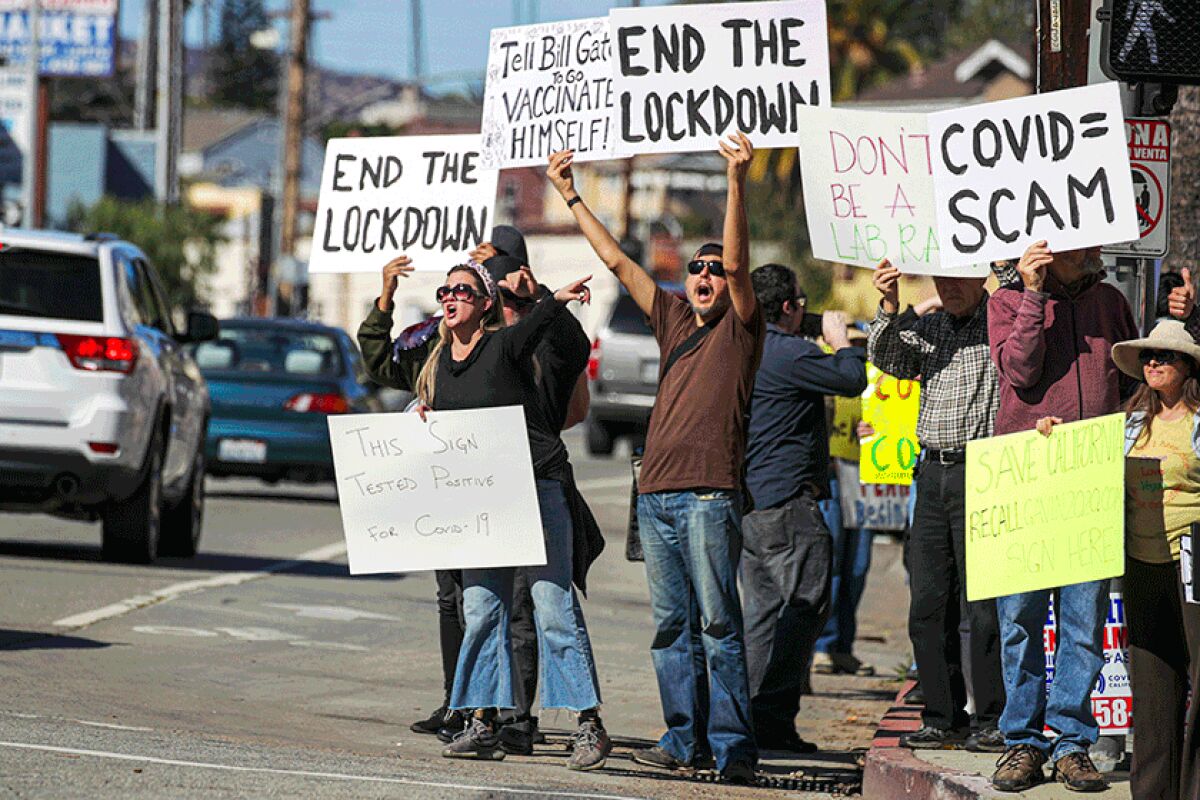
There is a strange confluence among Trump’s MAGAs, QAnons, COVID deniers, coup deniers, election deniers, mask deniers, pro-gunners, and anti-vaxxers.
They all receive their information and beliefs from right-wing-owned media and social media. They trust conspiracy theories more than actual data. They learn by rumor. They lack compassion for others. And many die from or for their beliefs.
Anti-vaxxers: The November 19 edition of Science News contained an article about Louis Pasteur, “the father of microbiology.” The article included the following excerpts:
Pasteur not only made milk safe to drink, but also rescued the beer and wine industry.
He established the germ theory of disease, saved the French silkworm population, confronted the scourges of anthrax and rabies, and transformed the curiosity of vaccination against smallpox into a general strategy for treating and preventing human diseases.
He invented microbiology and established the foundations for immunology.
Vaccination, of course, had been invented eight decades earlier, when British physician Edward Jenner protected people from smallpox by first exposing them to cowpox, a similar disease acquired from cows.
Later Pasteur confronted an even more difficult microscopic foe, the virus that causes rabies, a horrifying disease that’s almost always fatal.
He decided to grow the disease-causing agent in living tissue — the spinal cords of rabbits. He used dried-out strips of spinal cord from infected rabbits to vaccinate other animals that then survived rabies injections.
In 1885 when a mother brought to his lab a 9-year-old boy who had been badly bitten by a rabid dog, Pasteur agreed to administer the new vaccine.
After a series of injections, the boy recovered fully.
Soon more requests came for the rabies vaccine, and by early the next year over 300 rabies patients had received the vaccine and survived, with only one death among them.
Popularly hailed as a hero, Pasteur was also vilified by some hostile doctors. Vaccine opponents complained that his vaccine was an untested method that might itself cause death.
Vaccines, though, have substantially reduced the risks from COVID-19, extending the record of successful vaccines that have already tamed not only smallpox and rabies, but alsopolio, measles and a host of other once deadly maladies.
Yet even though vaccines have saved countless millions of lives, some politicians and so-called scientists who deny or ignore overwhelming evidencecontinue to condemn vaccines as more dangerous than the diseases they prevent.
Dick Farrel, conservative talk show host and avid Trump supporter, changed his mind about the vaccine after he fell sick, but too late. He died of COVID after a two-week battle.
True, some vaccines can induce bad reactions, even fatal in a few cases out of millions of vaccinations.
But shunning vaccines today, as advocated in artificially amplified social media outrage, is like refusing to eat because some people choke to death on sandwiches.
The website “Notable Anti-Vaxxers Who Have Died From COVID-19”, lists just a handful of the many thousands who denied the efficacy of vaccination and paid for their denial with their lives.
They had what they claimed to be “good” reasons for not vaxxing, but they denied the clear facts.
They claimed not to trust an “unproven” drug that had millions of success stories but instead trusted unproven conspiracy theorists who had no successes.
By failing to vaccinate, they helped spread the disease among all those with whom they came into contact. This did not concern them.
Relatives of the anti-vaxxers are the anti-maskers. The primary purpose of masks is to help prevent COVID from drifting to others. It’s why surgeons and nurses wear masks in operating rooms — not to protect themselves, but to protect patients.
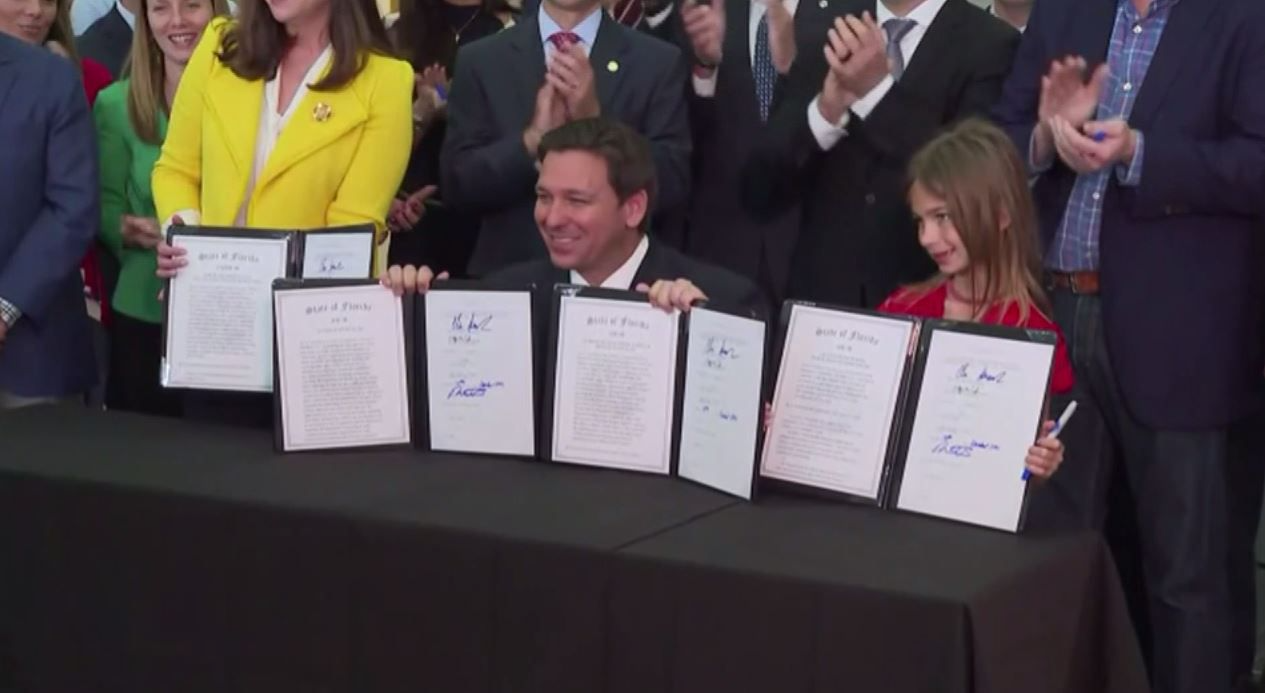
Anti-maskers do not care about protecting others. They want their “freedom.” This selfishness is personified by such as Gov. Ron DeSantis, who never shows concern for COVID victims, but only for people who must “suffer the hardship” of wearing a mask. To him, protecting others is a hardship that impinges of freedom.
To support the lie, he promulgates the myth that masks don’t work. One wonders whether he would feel comfortable being operated on by a surgical team that goes maskless.
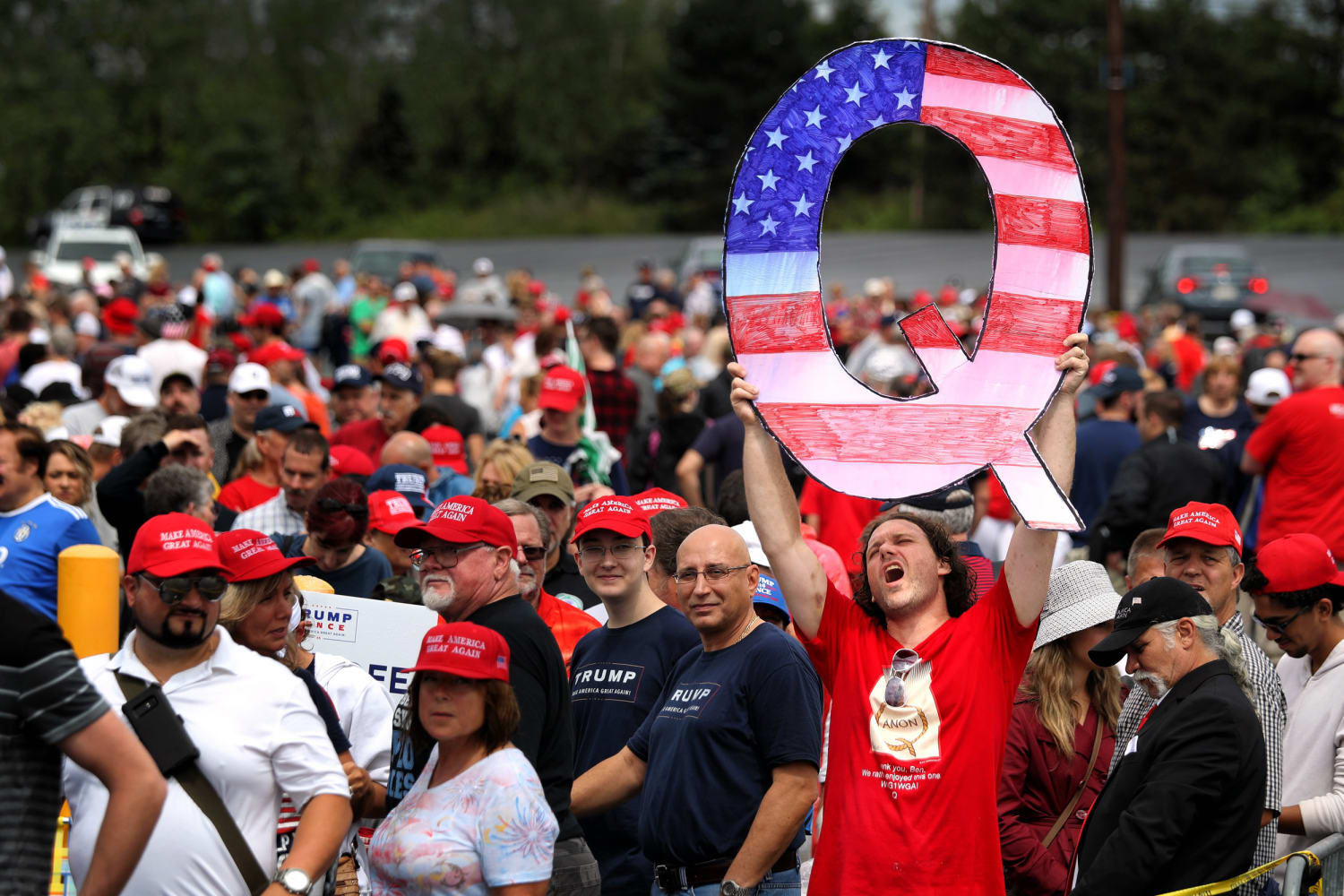
Anti-vaxers and anti-makers are similar to QAnonbelievers, in that both groups blindly accept the words of unreliable sources.
The more outrageous (even hilarious) the claims, the more fervently they are believed.
For example, here is the utter nonsense, invented out of whole cloth, that the brainless not only believe but promulgate:
I believe because I believe.
The core QAnon theory is that a cabal of Satanic, cannibalistic sexual abusers of children operating a global child sex trafficking ring conspired against former U.S. President Donald Trump during his term in office.
Followers of the conspiracy theorists say that the Trump administration secretly fought the cabal of pedophiles, and would conduct mass arrests and executions of thousands of cabal members on a day known as “the Storm” or “the Event”.
QAnon has also claimed that Trump stimulated the conspiracy of Russian interference in the 2016 U.S. presidential election to enlist Robert Mueller to join him in exposing the sex trafficking ring, and to prevent a coup d’état by Barack Obama, Hillary Clinton, and George Soros.
QAnon is described as antisemitic or rooted in antisemitic tropes, due to its fixation on Jewish financier George Soros and conspiracy theories about the Rothschild family, and the myth that Jews harvest the blood of children for ritual.
Unlike the anti-vaxxers, the QAnons have not been killed by their beliefs. They merely have lost years of their lives wandering in the diseased labyrinth of misinformation — years they never will recover.
They also had no concern for the people their bigotry would hurt, the millions of people they want to be arrested and executed because of their mythical “cabal” identification.
Entering Congress in an orderly fashion. A normal tourist visit.
In a similar vein, coup deniers will not accept what their eyes tell them.
Rep. Andrew Clyde, R-Ga.: “Watching the TV footage of those who entered the Capitol and walked through Statuary Hall, showed people in an orderly fashion in between the stanchions and ropes taking pictures.
“If you didn’t know the footage was from January 6, you would actually think it was a normal tourist visit.”
And people actually believed him.
Hundreds of coup participants now have lost their freedom, their jobs, and their friends because of their beliefs. To rot in a jail cell, your reputation gone, and eventually to realize you have been taken by a con artist, must be a terrible fate. Whether it will be a lesson learned still remains a question.
The fact that the manymillionsmore who voted for Biden than voted for Trump would have had their votes invalidated did not bother the rioters, whose only concern was the happiness of one man.
Then there are the MAGAs:
Surveys of hundreds of fervent Trump voters, whom researchers refer to as Make American Great Again (MAGA) supporters, reveal strong beliefs that the election was stolen; that COVID-19 is a bioweapon from China; and that the riot was the work of Antifa.
Why do they believe? Not because of any facts, which repeatedly demonstrate the lie, but rather because:
These people feel like they’re losing their country and their identity. They feel like they’re being displaced by communities of color, by feminists and by immigrants.
They do not care about people of color, women or immigrants. They care only about themselves.
So they send Donald Trump, the billionaire, their money — dollars that could have been put to good purpose; dollars for which they worked much harder than Trump did — and they see those dollars used to defend a criminal against justice.
Finally, we come to the pro-gunners. They consistently vote against any restrictions on gun ownership.
They claim to believe in the incredibly brainless proposition that giving everyone easily obtainable guns, including high-powered, exceptionally lethal guns, makes America safer.
Not only does this deny all data, but common sense, too. The notion that “guns-for-all” makes us safer it is illogical on its face. Statistics show that if you own a gun you are more likely to be shot than if you didn’t own a gun.
Most American gun owners say they own firearms to protect themselves and their loved ones, but a study published this week suggests people who live with handgun owners are shot to death at a higher rate than those who don’t have such weapons at home.
“We found zero evidence of any kind of protective effects” from living in a home with a handgun, said David Studdert, a Stanford University researcher who was the lead author of the Annals of Internal Medicine study.
The study followed nearly 600,000 Californians who did not own handguns but began living in homes with handguns between October 2004 and December 2016, either because they started living with someone who owned one or because someone in their household bought one.
Living with a handgun owner particularly increased the risk of being shot to death in a domestic violence incident, and it did not provide any protection against being killed at home by a stranger, the researchers found.
The pro-gunners don’t care about the lost lives and health due to the continual shootings, so long as guns remain available for hunting and personal use.
SUMMARYBelieving conspiracy theories can be hazardous to your health. Believers are more likely to waste years of their lives, be injured, or die from their beliefs.
People who are more susceptible to myths and tales fall into several categories:
White supremacists. They secretly feel weak or fearful; they hope to find protection as members of the cult
Those who resist taking direction from accepted authority; it makes them feel impotent.
Those who want to be “in the know” regard non-believers as uninformed and gullible.
Those who lack empathy and compassion: As psychopaths, they are inward-directed. Others’ pain and sorrow does not affect them.
Republican Trumpers: They have been trained to support only what Trump tells them, not reality.
We do not have laws against cruel stupidity. In the land of the free, even such as Herschel Walker can walk the streets, mouth ignorance, lie with impunity, and still attract votes from his peers
The “messiness” of democracy is simultaneously its weakness and its strength. The genius and the fool each have one vote. But I sure wish the voting public was at least a little bit smarter.
Rodger Malcolm Mitchell
Monetary SovereigntyTwitter: @rodgermitchellSearch #monetarysovereigntyFacebook: Rodger Malcolm Mitchell
……………………………………………………………………..
The Sole Purpose of Government Is to Improve and Protect the Lives of the People.
So-called federal “debt” isn’t real debt. It is the net total of all deficits, i.e., the net difference between all federal income and outgo.
Because, by law, the federal government does not run a negative balance in its basic checking account (The Treasury General Account), it offsets the bookkeeping “debt” by accepting deposits into Treasury Security accounts (wrongly termed “borrowing”).
This is nothing more than a technical bookkeeping convention. The government does not actually use those deposits to pay its bills. Instead, it creates new dollars, ad hoc, to pay all creditors.
The T-security deposits remain where they are, safe in their accounts. That is what makes them the safest place to deposit unused dollars.
The fundamental purpose of T-securities: To provide an absolutely safe place to store unused dollars, and this safety adds to the stability and worldwide acceptance of dollars.
If the dollars were used, their safety would be compromised, and the fundamental purpose of T-securities would be lost.
There is a widespread belief that deficit spending causes inflation. No evidence exists for that belief. It simply is an article of faith supported by . . . faith.
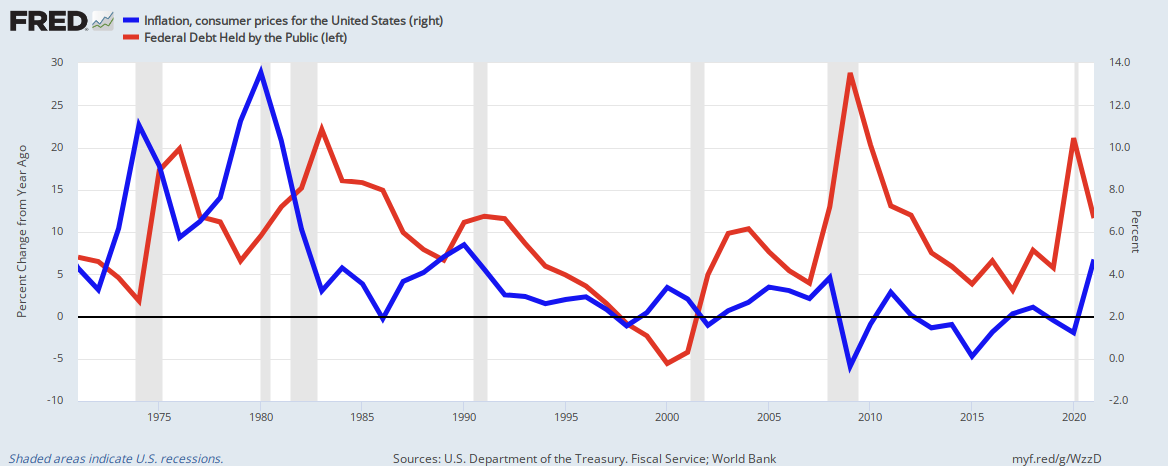
Here is a comparison of federal deficits (which total to federal “debt”) vs. inflation.
The highs and lows of federal deficits (red) do not correspond to the highs and lows of inflation (blue). No cause/effect relationship can be found.
There have been many periods of high federal deficits that correspond to low inflation. There also have been many periods of low deficits and high inflation. This effect could not exist if federal deficit spending caused inflation.
So what does cause inflation?
All inflations are caused by shortages of critical goods and services, the most important of which is oil. The oil price, which is reflected in supply and demand, affects the prices of almost all goods and services.
An oil shortage affects manufacturing costs, agriculture costs, shipping costs, and heating costs. Oil prices affect inflation dramatically:
When the price of oil (green — reflected by supply and demand) goes up, inflation (blue) goes up, and when shortages ease, inflation goes down). Oil prices are the primary drivers of inflation.
The other significant driver of inflation is food, which also is affected by supply and demand:
The price of food (black) closely parallels inflation (blue).
The need for food does not vary significantly. The price of food is affected by supply and production costs.
The supply of food primarily is caused by weather and disease. Production costs especially relate to oil prices which affect shipping, planting, harvesting, and other manufacturing costs.
Finally, lest someone argue that federal deficit spending causes oil prices to rise, we offer the following graph:
There is no historical relationship between federal deficit spending and oil prices. The highs and lows of each do not correspond.
The resistance to federal deficit spending primarily is based on two false premises:
–That our Monetarily Sovereign government somehow could run short of its own sovereign currency, and
–That federal deficit spending causes inflation
Wrong and wrong.
The real reason for complaints about federal deficits is different: Most deficit spending supports the middle- and lower-income groups (Medicare, Medicaid, Obamacare, and the many anti-poverty initiatives).
The income/wealth/power Gap between the rich and the rest makes the rich rich. The wider the Gap, the richer are the rich. Without the Gap, no one would be rich; we all would be the same.
So the rich, who run America, want to widen the Gap by reducing Medicare, Medicaid, and other deficit spending.
To widen the Gap, the rich spread the disinformation that deficit spending causes inflation. And that mantra has become accepted knowledge by the media, politicians, and economists.
And it simply is wrong.
SUMMARY
There is a strong historical relationship between the price of oil (which reflects supply/demand) and inflation
There is a strong historical relationship between food prices (which reflect oil prices, weather, and disease).
There is a strong historical relationship between oil prices and food prices.
May we please, at long last, put to bed the unsupported notion that federal deficit spending causes inflation?
Replace it with a factual basis that inflation is caused by shortages, most often shortages of oil, which lead also to shortages of food and other goods and services.
Shortages actually can be cured by federal deficit spending to acquire or produce the scarce goods and services. For example:
The shortage of oil can be reduced by federal spending to advance the use of renewable energy sources.
The shortage of labor can be reduced by lowering labor costs: Federally funded Medicare for All, the elimination of the FICA tax. and federal support for job training.
The shortage of food can be moderated by government support for better farming practices.
Federal deficit spending is necessary for a healthy economy. Trying to cure inflation by recessing the economy is a fool’s mission, but that is exactly what Congress is trying to do.
In the science of economics, let us finally accept fact over intuition.
Liars, fakers, and fear-mongers lurk among us. They masquerade as prudent economics advisors. They sell you their snake oil linament to cure your . . . whatever.
That brings us to one of America’s most prominent snake oil sales groups, the CRFB (Committee for a Responsible Federal Budget).
They have been selling the same nonsense for many years. Their president even testified before Congress, with all those old, sage heads nodding dumbly in agreement at the foolishness she was spouting.
The CRFB is trying to sell you this.
We’ve spoken of the CRFB many times, but they keep selling the same lies.
The nation’s fiscal and economic outlook has deteriorated substantially since the lastCongressional Budget Office (CBO) baselinein May, when CBO projected debt would reach a record 110 percent of Gross Domestic Product (GDP)by 2032.
Under an updated current law baseline, we now project debt in 2032 will reach 116 percent of GDP, deficits will reach 6.6 percent of GDP, and interest will reach a record 3.4 percent of GDP.
Under a more pessimistic (and in many ways realistic) scenario, debt in 2032 would reach 138 percent of GDP, deficits would reach 10.1 percent, and interest would total 4.4 percent of GDP.
These projections suggest an unsustainable fiscal trajectory.
Oh, horrors. Federal “debt” will exceed GDP. And federal interest payments will be some “high” percentage of GDP. How awful. Right? WRONG!
The innocent reader would be led to believe there must be some crucial connection between so-called “debt” and GDP. Is it that GDP pays for “debt” so that when “debt” exceeds GDP, the “debt” can’t be paid?
That’s what the liars, fakers, and fear-mongers want you to believe. However, no such connection exists. None. Here’s why:
First: The so-called “federal debt” isn’t a federal debt. The federal government doesn’t owe it.
GDP is the one-year total of national spending (federal + non-federal) + net exports. It’s just the cumulative net difference between federal taxes and federal spending for at least 30 years. So the CRFB is comparing a 30-year (apples) total to a 1-year (oranges) total. Apples and oranges.
What commonly is called “debt” actually equals the total dollars invested into Treasury Security accounts. The vast majority of these accounts are owned by the public and foreign nations.
You first open a T-security account when you invest in a T-bill, T-note, or T-bond. You own that account. The dollars you invest go into your account and stay there until maturity.
Second: The federal government does not touch your dollars. The federal government does not use your dollars to pay its bills. Your dollars just sit there, accumulating interest.
The closest corollary would be a bank safe deposit box. The bank does not owe you the contents of your safe deposit box. The contents belong to you and are unrelated to the bank’s finances.
Similarly, the contents of T-security accounts are unrelated to federal finances. As with safe deposit boxes, the government pays off those accounts simply by returning the contents to you.
Third: The sole purposes of T-bills, T-notes, and T-bonds are to provide a safe storage place for unused dollars and to help the Fed control interest rates. This helps stabilize the dollar.
T-security accounts do not, in any way, help the federal government pay its bills. The federal government could stop accepting deposits into T-security accounts today and still pay all its bills forever. People, businesses, and nations would need to find some other places to store unused dollars, which for nations like China could be inconvenient.
Fourth: Even if the misnamed “federal debt” were actually debt, that still would have nothing to do with Gross Domestic Product. GDP doesn’t pay for any debts, not yours, mine, or the federal government’s.
GDP is not even a measure of federal income. GDP is just a one-year measure of all the spending in the economy, federal and non-federal.
Fifth: Even if the federal government owed the so-called “federal debt,” that would not be a problem. The federal government pays all its debts by creating new dollars ad hoc.
To pay a creditor, the federal government sends instructions, not dollars, to the creditor’s bank, instructing the bank to increase the balance in the creditor’s checking account. When the creditor’s bank obeys those instructions, it creates new dollars, which are added to the money supply measure, M2.
The instructions then are cleared by the Fed, an agency of the U.S. government. Thus, the government approves its own money-creation instructions.
The government doesn’t use tax dollars. It destroys tax dollars upon receipt by the Treasury. To pay you taxes you take M2 money supply dollars from your checking and send them to the Treasury. When your M2 dollars reach the Treasury, they cease to be part of any money supply measure.
Because the U.S. government has infinite dollars, there can be no measure of its dollar supply, so your tax dollars effectively are destroyed.
The U.S. government never borrows dollars. What erroneously is termed “borrowing” merely is the acceptance of deposits into those T-security accounts that the government never touches.
The government doesn’t use any form of income. Even if the federal government collected $0 taxes, it could continue paying its financial obligations forever.
None of the above applies to state and local governments, which are monetarily non-sovereign. They do use tax receipts and other forms of income with which to pay their bills. They do not destroy tax dollars; they store them in bank accounts, just like you do.
Side note: Some European nations are monetarily non-sovereign, and some are Monetarily Sovereign. This difference often is not recognized by economists, the media, and politicians. Often you will read papers that purport to prove U.S. federal debt is dangerous because “look at Greece, Italy, France, et al.”
This is a false comparison, Monetary Sovereignty vs. monetary non-sovereignty. The two are diametrically opposed, which also is why your debt can be overwhelming while the federal government’s never is.
Being Monetarily Sovereign, the federal government has the infinite ability to create dollars just by pressing computer keys.
Alan Greenspan: “A government cannot become insolvent with respect to obligations in its own currency.”
Ben Bernanke: “The U.S. government has a technology, called a printing press (or, today, its electronic equivalent), that allows it to produce as many U.S. dollars as it wishes at essentially no cost.”
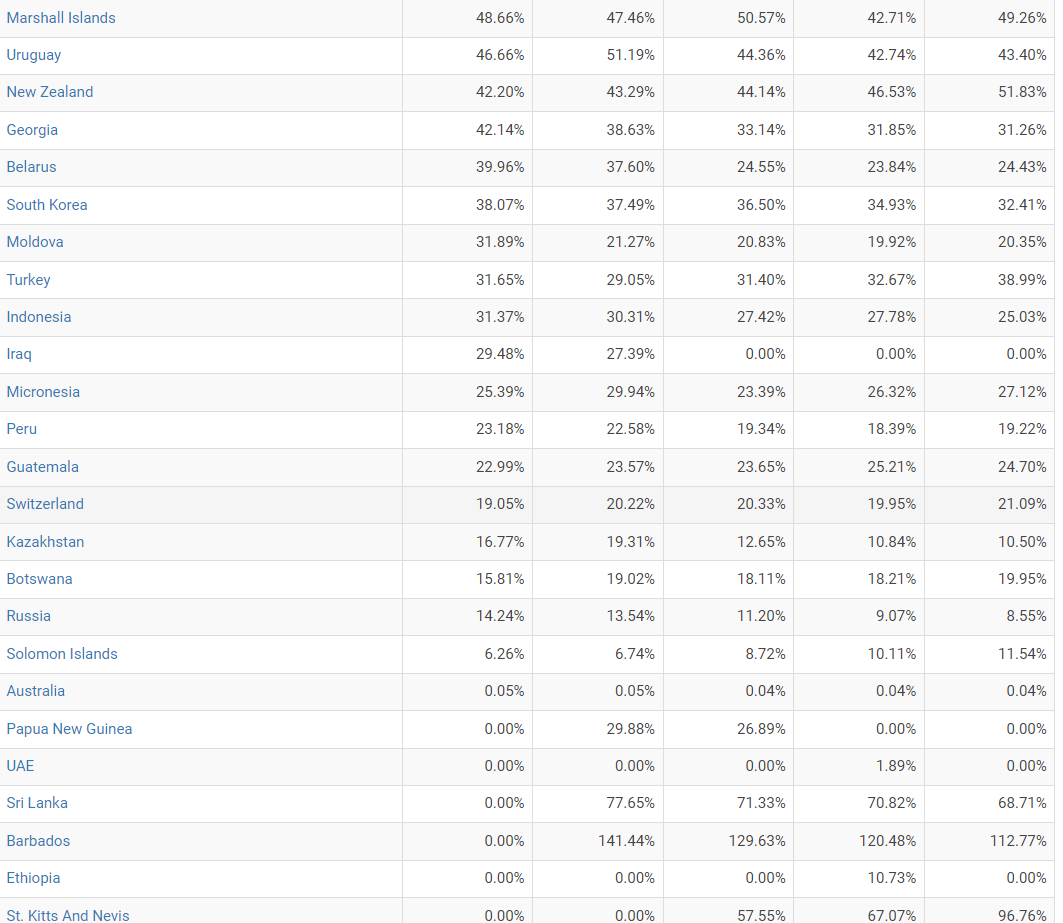
Finally: The proof is in the results. If the CRFB were telling the truth, you would see the nations with the highest Debt/GDP ratio having what the CRFB calls a “financially unstable trajectory,” while the countries with the lowest Debt/GDP ratio would be the most “financially stable.”
Study this list from Macrotrends, and using it as a guide, tell me which nations are more financially stable and which are less financially stable:
Was Jamaica more or less financially stable than Japan and the United Kingdom? What about the United States vs. Russia? South Korea vs. St. Lucia? The U.K. vs. Jordan?
As you can see, Debt/GDP means nothing concerning “financial stability.” The whole concept is a giant lie foisted upon the American public by mouthpieces for the rich.
The federal “debt” (that isn’t a real debt) grew from $222 BILLION in 1951 to more than $26 TRILLION in 2022 — an 11,000 percent increase — and our Monetarily sovereign government has no problem paying its bills. Today, it is as “financially stable” as it ever has been and ever will be.
Those are the facts. The federal “debt” (that isn’t a debt of the federal government) grew eleven thousand percent since 1951. Is today’s America more financially unstable than it was after WWII?
And there’s this:
There is no relationship between the Debt/GDP ratio (green) and inflation (purple).
If a high Debt/GDP ratio caused inflation, one would expect some correspondence between the peaks and valleys of Debt/GDP and inflation. No such parallel exists.
What does cause inflation?
Inflation (purple) mainly is caused by the price of oil (black).
The price of oil, not the Debt/GDP ratio, is the prime driver of inflation. The peaks and valleys of the Oil Price / Inflationratio correspond.
The RBFB’s B.S. continues:
Perhaps most troubling is the effect of these changes on interest spending.
Under CBO’s baseline, interest costs were already projected to triple from roughly $400 billion in 2022 to $1.2 trillion in 2032.
As a result of higher debt and higher interest rates, we now expect them to rise to $1.3 trillion in our baseline scenario, $1.4 trillion in our intermediate scenario, and $1.6 trillion in our high-cost alternate scenario.
As a share of the economy, interest costs would be in uncharted territory. In all of American history, federal interest costs have never exceeded 3.2 percent of GDP.
We project interest costs will reach 3.4 percent of GDP by 2032 under our baseline scenario, 3.9 percent under the intermediate alternate scenario, and 4.4 percent under the high-cost alternate scenario.
And why is this a problem? It isn’t. The U.S. federal government never, never, never can run short of dollars to pay interest. And those dollars go right into Gross Domestic Product.
Federal interest payments add directly to GDP. They stimulate economic growth. They make the private sector richer.
GDP = FEDERAL SPENDING + NON-FEDERAL SPENDING + NET EXPORTS
Objecting to federal spending is objecting to GDP growth. Why does the CRFB object to that?
There is a reason, which I will get to shortly.
At the same time as inflation is surging and interest rates are rising, our new projections show that the United States faces an unsustainable fiscal outlook.
Liars like the CRFB have called the federal debt “unsustainable” (and a ticking time bomb) every year since the 1940s. Yet, here we are. Sustaining. We are “sustaining” an eleven thousand percent increase in federal “debt” (that isn’t debt) very nicely, thank you.
Year, after year, for 75 years, liars, fakers, and fear-mongers have been wrong. Again. Again. Again. How stupid do we have to be to keep believing the same lie when every scary prediction fails?
We laugh when the Peanuts character Lucy keeps pulling the football away, and Charlie Brown keeps believing. But we are the Charlie Browns, the CRFB, and all the other lying pundits are Lucy. They keep “pulling the football away,” and we keep believing that next time . . . but next time never comes.
And the beat goes on: The lies just keep coming:
The following is a statement from Maya MacGuineas, president of the Committee for a Responsible Federal Budget:
We are asking lawmakers to take one small step towards fiscal responsibility and agree there should be no new borrowing for the remainder of 2022. There is not one single economic justification to borrow rather than pay for any new priorities.
This is only 46 days, and it will be good practice for politicians to break their addiction to debt. Those who are being negatively affected by high levels of inflation – as in, all of us – should ask any policymaker who votes for new borrowing why they are choosing to make inflationary conditions worse rather than better.
The last thing this country needs is a Christmas Tree package full of unpaid-fortax breaks and spending hikes.
Any policymaker who votes for new borrowing instead of paid-forlegislation under these economic conditions is not taking the hardships they are creating on working families seriously enough.
What’s wrong with it? It’s all a lie.
First,the U.S. government never borrows dollars. Why should it, given that it can create dollars simply by pressing computer keys.
Statement from the St. Louis Fed: “As the sole manufacturer of dollars, whose debt is denominated in dollars, the U.S. government can never become insolvent, i.e., unable to pay its bills. In this sense, the government is not dependent on credit markets to remain operational.”
That thing erroneously called “borrowing” is the acceptance of deposits into T-security accounts, and the federal government never touches those dollars. It’s like accepting deposits into safe deposit boxes. Is that bank borrowing?
Second,tax breaks are nothing more than dollars not taken from the economy. Tax breaks are economically stimulative. Leaving money in the private sector is the only way the economy can grow.
Third, no one ever pays for tax breaks. The only thing paid for is taxes, which take growth dollars out of the economy.
Fourth,all legislation that requires spending dollars is “paid for.” The federal government pays all its bills by creating new dollars ad hoc. It never fails to pay, despite all the hand-wringing about “unsustainability.”
And finally, federal deficit spending never causes inflation.The sole cause of all inflations and hyperinflations throughout history is the scarcity of critical goods and services, usually oil and food, but additionally, computer chips, shipping, rare earths, labor, water, etc.
What caused these shortages? Not federal spending. Federal spending didn’t cause the oil shortage, or the food shortages, or the lumber shortage. Primarily, COVID caused the shortages that caused inflation.
Before COVID, we had massive annual deficit spending and near-zero inflation.
WHY DO THEY LIE, AND WHY DO WE BELIEVE?
Some in the CRFB, the media, economists, and politicians may lie out of ignorance. But many lie because they are bribed by the rich to lie.
The rich bribe the media via advertising dollars and ownership. The rich bribe the politicians via campaign contributions and promises of lucrative employment later. The rich bribe the economists via university contributions and promises of lucrative jobs in think tanks.
The CRFB is supported by rich people who want nothing more than to see benefits to the middle and the poor cut.
Raising taxes or cutting federal spending are recessionary steps that affect middle- and lower-income people. This is particularly true because the cuts always focus on Medicare, Social Security, Medicaid, and other benefits for those who are not rich.
Those cuts widen the Gap between the rich and the rest. Widening the Gap makes the rich richer. The Gap is what makes the rich rich.
In Summary
The Debt/GDP ratio is comparable to a Contents-of-Bank- Safe-Deposit-Boxes / Bank Spending ratio. It’s a meaningless nonsense ratio that predicts nothing, demonstrates nothing, and reveals nothing but the ignorance of those who quote it.
The ratio tells you nothing about the health of a nation’s finances or its ability to pay its obligations. It is a ratio quoted by those who are ignorant of economics or are lying about economics. No other alternatives.
To paraphrase, “There are lies, damned lies, and the Federal Debt / GDP liars, the damnedest liars of all.
Animation of a double-rod pendulum showing chaotic behavior. Starting the pendulum from a slightly different initial condition results in a vastly different trajectory.
Here is why the economy is devilishly hard to predict. Think first of the weather. We all agree it’s hard to predict, though it’s based on just a few simple facts:
The sun is essentially a point source of our heat that heats the ground and water and, to a lesser degree, the air.
Hot air rises; cool air falls; the earth’s uneven surface turns, and all that motion creates wind.
Warm water evaporates, forms clouds, and comes down as windblown rain or snow when it cools.
Add in a few other things like cloud covers, volcanos, and the human creation of CO2, and that’s about it. The whole thing, though complex and chaotic, can be described mathematically.
You could predict the weather with sufficient data, the proper formulas, and the fastest supercomputers. It’s just numbers.
Now consider economics, the science of money. It’s a bifurcated science, part Monetary Sovereignty and part Gap Psychology. The Monetary Sovereignty part is similar to the weather in that it can be described mathematically.
A monetarily sovereign entity creates laws from thin air, and these laws create money from thin air.
Money is scarce to users but never scarce to issuers. Being able to create infinite laws, the monetarily sovereign entity can issue unlimited money. It never can run short, even without collecting taxes.
All money is a form of debt; it’s the issuer’s debt in that the demand for any one form of money is based on the issuer’s full faith and credit. If the issuer has good credit: People want that money. Bad credit: No one wants that money.
Because money is an infinitely available exchange medium, money’s value is generally based on the scarcity of the goods and servicesfor which it is exchanged. Scarcity makes goods more valuable, thus requiring more money in exchange.
Like the weather, Monetary Sovereignty, though complex and chaotic, can be described mathematically. Given sufficient data, one could predict the flow and value of money.
Except . . .
Except for Gap Psychology, the human desire to widen the income/wealth/power Gap below and to narrow the Gap above. We want to distance ourselves from those below us and come closer to those above us.
Gap Psychology is based on human emotions about comparisons. Consider a middle-income, middle-wealth person today. He (she) has much more and much better “stuff” than even a wealthy person of yesteryear.
Today’s “middle” people have air-conditioned, heated homes and cars, televisions, cell phones, computers, and indoor flush toilets. They drink purified water, eat purified foods, and receive painless (relatively) dentistry. They have modern medical care paid for by insurance. Vaccination protects them from dozens of diseases, many fatal.
They fly or drive hundreds of miles in a few hours on paved roads. They ride escalators and elevators up tall buildings.
They are middle-income, middle-wealth, but by the standards of yesteryear, they are fabulously wealthy. Even John D. Rockefeller, possibly the richest person in history, didn’t have what the average Joe in America has now.
You would feel poor if you had smelly plumbing, mud streets, no air conditioning, and a horse-drawn buggy to get around.
Gap Psychology creates the appeal of lotteries and Las Vegas, expensive cars, natural diamonds rather than fake ones, and celebrities. Gap Psychology is the genuine desire to earn more money, own more wealth, and have more power, in short, to be more prosperous.
“Rich” is not absolute. It is a comparative.
There are two ways for you to become more prosperous, i.e., to widen the Gap below or narrow the Gap above. You either must acquire more income, wealth, and/or power for yourself, or others must lose income, wealth, and power.
And this is where economics becomes hard to predict. It is based on human psychology, which devolves into individual psychology and often into one person’s psychology.
Gap Psychology causes people to vote against poverty aid lest it narrows the Gap below. That narrowing would make you feel poorer. Gap Psychology encourages people to vote against their freedoms if that vote would restrict the poor even more, thus widening the Gap.
There is no mathematics to predict that an incompetent psychopathic President would receive enough votes to be elected. And there is no mathematics to measure what that incapable psychopath would do to the economy.
One such President added duties on Chinese goods (for which you paid and which raised prices). COVID came along, and its denial caused hundreds of thousands of Americans to die and raised prices further. Shortages and inflation were direct results.
There is no mathematics to reveal that millions would ignore their eyes, ears, and brains to continue believing the most recent election was stolen. A mob is chaotic.
It took losing a war, but the German people finally understood what Hitler had done to them, and belatedly they rejected white supremacy and fascist hatred. The Italians hung Mussolini by his heels.
Recently, Italy elected a pro-Russia, anti-gay conservative to be Speaker of their lower house of Parliament.
One day earlier, an ultra-conservative lawmaker, who collects fascist memorabilia, became their Senate Speaker; a month earlier, a neo-fascist conservative became Prime Minister.
Mussolini must be laughing (upside down) in his grave. Who could have predicted post World War II Italy’s (and America’s) failure to learn where extreme conservatism leads?
IN SUMMARYChaos theory describes the difficulty of predicting some events because of the “butterfly effect.” Some small events can multiply upon themselves until a butterfly flapping its wings in Brazil eventually results in a hurricane over Florida — or an extreme conservative being re-elected.
Edward Lorenz described chaos this way: “When the present determines the future, but the approximate present does not approximately determine the future.”
American economics is a blend of Monetary Sovereignty and Gap Psychology.
The former is a factual and mathematical description of money. It could allow us to predict our economic future if we were logical machines having sufficient data.
The latter results from human psychology, individual and herd, which is chaotic. Here, logic disappears, as witness the likes of Donald Trump, Herschel Walker, Lauren Boebert, Marjorie Greene, Ted Cruz, Matt Gaetz, Jim Jordan, et all, intentionally being chosen by many voters.
Think about it. These politicians, and others of their ilk with economic and political power, actually received votes from sentient human beings. It boggles.
For the same reasons why Psychology is not a science, Economics, which relies on psychology, is not a science. They are beauty contests with results in the eyes of the beholders.
And as with beauty contests, where no strict criteria are possible, everyone is absolutely, positively, unequivocally sure about the correctness of their opinions.
Now, try to predict who the next U.S. President will be and what effects she will have on the economy.
Rodger Malcolm Mitchell
Monetary SovereigntyTwitter: @rodgermitchellSearch #monetarysovereigntyFacebook: Rodger Malcolm Mitchell
……………………………………………………………………..
The Sole Purpose of Government Is to Improve and Protect the Lives of the People.






 #Monetary Sovereignty - Mitchell