If you’ve wondered why I’ve not posted recently, my excuse is that I’ve had a knee replacement, which has sapped some of my energy. A (pardon me) lame excuse.
Nevertheless, the world moves on, and this world is moving in a bad direction I cannot ignore.
America has a President who encourages dictators (Putin, Kim, Duterte), encourages misogyny and infidelity (Hello Ivana, Marla, Melania). He encourages lying and criminality (Trump University and Trump Foundation).
Mostly, Trump is a hate monger, who encourages hatred of Mexicans, South Americans, the Chinese, Muslims, immigrants, gays, the media, and the poor.
Trump is as unAmerican as anyone you know — a traitor to American values.
When a leader approves of hatred, his followers will hate.
Sadly, hatred has no boundaries. Hatred is a communicable disease. Encouraging hatred of one group also encourages hatred of other groups. No one is immune.
When a leader exhibits hatred, his followers will hate, for hatred has official approval.
Thus does hate mongering encourage the mailing of pipe bombs by an ardent Trump supporter.
And, thus does hate mongering encourage fanatics who hate Jews online and make anti-Semitic comments, while shooting Jews in Pittsburgh.
Trump combines immorality with abject ignorance and an unwillingness to learn. He takes great pride in not reading and not taking advice from anyone.
And all of this is excused by Trump followers because he supposedly is “good for the economy. ” It’s a lie.
All Trump followers are haters. They hate the same people he hates, otherwise they would not put up with his hatred.
And Trump is not good for the economy.
The “economy thing” is just a handy excuse. Hitler knew that well. It was the excuse he used. Today, you can tell your Trump-following friends that even the “economy” excuse now is fading. Very soon, the Trump recession will begin.
Note to Trump followers: Import taxes hurt all nations; no one wins trade wars. Everyone loses.
A trade war is a peeing contest. Everyone is peed on.
When hatred is official policy.
Trump, who only takes credit, and never accepts blame, will blame the Fed for his recession. Some of Trump’s followers will blame Hillary; some will blame the Democrats. Many will blame the Jews. None will blame Trump.
Trump now blames immigrants, so he sends the army to stop all immigration. This is how he changes the subject. This is how all dictators change the subject.
Stupidity and bigotry have their punishments.
Question for Ivanka Trump: How does it feel to be hated for your religion? Your father encourages that hatred.
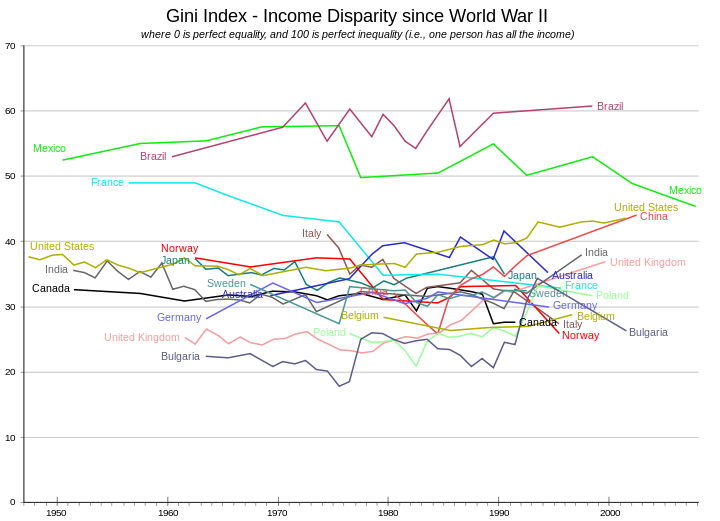
The single most important problems in economics involve the excessive income/wealth/power Gaps between the have-mores and the have-less.
Wide Gaps negatively affect poverty, health and longevity, education, housing, law and crime, war, leadership, ownership, bigotry, supply and demand, taxation, GDP, international relations, scientific advancement, the environment, human motivation and well-being, and virtually every other issue in economics.
Implementation of The Ten Steps To Prosperity can narrow the Gaps:
In this era of fake news, where a President can lie with impunity, and face zero concern from his followers, nothing surprises.
For instance, we are told the Saudis did not murder a journalist in their Istanbul consulate.
Instead, he merely was tortured to death by “rogue killers” during an “investigation gone wrong.”
Presumably, these are the same “rogue killers” President Trump blames when excusing Putin’s many murders.
And these are the same “rogue killers” Trump’s latest lover, Kim Jong Un (“We fell in love.”) has used to murder thousands, including family members. (What’s not to love?)
And then, there were the “rogue: hackers who, behind Putin’s back, hacked into the U.S. election.
This time, the fake news doesn’t come only from Trump, but from the real news. And, this time the fake news has historical precedents, going back at least 78 documented years, and many more in reality.
WASHINGTON (Reuters) – The U.S. government closed the 2018 fiscal year $779 billion in the red, its highest deficit in six years, as Republican-led tax cuts pinched revenues and expenses rose on a growing national debt, according to data released on Monday by the Treasury Department.
New government spending also expanded the federal deficit for the 12 months through September, the first full annual budget on the watch of U.S. President Donald Trump. It was the largest deficit since 2012.
“In the red” implies some sort of economic negative. You and I never want to be “in the red.”
However, the federal government is different from you and me. BeingMonetarily Sovereign, it uniquely has the unlimited ability to create its own sovereign currency, the U.S. dollar, which it has been doing since the early 1780s.
What does “in the red” mean for a government that can create infinite dollars, and never can run short of dollars?
The purpose of the Reuters article is to make you believe the federal government cannot afford to provide you with free Medicare and free education, and must charge you taxes to pay for any benefits it does provide.
It’s a gigantic, and long-lived con job, orchestrated by the rich, to widen the Gap between the rich and the rest.
Consider two groups: Group A can run short of dollars (i.e. you and me). Group B never can run short of dollars (the federal government).
By what perverse logic would Group A ever give dollars to Group B?
Now for the bad “good” news:
The data also showed a $119 billion budget surplus in September, which was larger than expected and a record for the month.
“Surplus” is such a wonderful word. You and I love to have a surplus, especially a surplus of money.
But, what does a dollar surplus mean to an entity that has the unlimited ability to create new dollars, and never, never, never unintentionally can run short of dollars? Why would such an entity even want a surplus?
While a surplus has no value to the U.S. federal government, it has a strong, negative effect on the economy. When the federal government runs a surplus, the dollars come from the economy, and that depresses the economy.
U.S. depressions tend to come on the heels of federal surpluses.
1804-1812: U. S. Federal Debt reduced 48%. Depression began 1807.
1817-1821: U. S. Federal Debt reduced 29%. Depression began 1819.
1823-1836: U. S. Federal Debt reduced 99%. Depression began 1837.
1852-1857: U. S. Federal Debt reduced 59%. Depression began 1857.
1867-1873: U. S. Federal Debt reduced 27%. Depression began 1873.
1880-1893: U. S. Federal Debt reduced 57%. Depression began 1893.
1920-1930: U. S. Federal Debt reduced 36%. Depression began 1929.
1997-2001: U. S. Federal Debt reduced 15%. Recession began 2001.
The reason is quite obvious. A large economy has more money than does a small economy, so for an economy to grow, its money supply must grow.
Gross Domestic Product = Federal + Nonfederal Spending + Net Exports
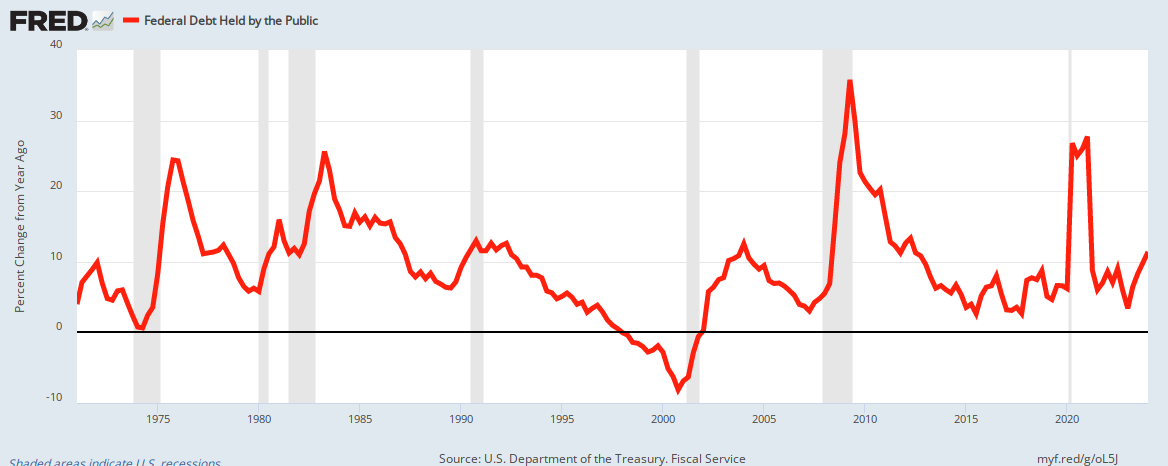
When deficit growth declines, economic growth declines:
Recessions (vertical gray lines) begin with a decline in federal debt growth (red line) and are cured by an increase in federal debt growth.
But wait, here’s some good “bad” news.
A senior Treasury official said the monthly surplus was smallerwhen adjusted for calendar shifts.
Are you confused? That’s the whole point. The rich, who run America, want you to be confused. They want you to believe that the federal deficit is “unaffordable” and the federal debt is “unsustainable.”
Here’s where it gets truly weird:
Economists generally view the corporate and individual tax cuts passed by the Republican-controlled U.S. Congress late last year and an increase in government spending agreed in early February as likely to balloon the nation’s deficit.
Trump and his fellow Republicans have touted the tax cuts as a boost to growth and jobs.
Think about it. The tax cuts will balloon the nation’s deficit, which will boost growth and jobs. Why? Because tax cuts and deficits leave more money in the economy.That’s a good thing, right?
Not according to Office of Management and Budget Director Mick Mulvaney:
“America’s booming economy will create increased government revenues – an important step toward long-term fiscal sustainability,” Mulvaney said in a statement accompanying the data.
America’s economy will boom as a result of tax cuts, and that will create increased government revenues. That’s the old Laffer curve, showing that tax cuts “pay for themselves” by increasing tax collections.
The problem is that federal taxes, being financially unnecessary, don’t need to be paid for by taxes. The bottom line is the amount of money coming into the economy.
The more dollars entering the economy, the greater the growth.
You see, Mulvaney doesn’t agree that leaving more money in the economy is a good thing. He thinks (claims) taking more money out of the economy is a good thing.
Mulvany’s “logic,” if it can be called that, is:
We’ll leave more dollars in the economy, which will grow the economy, so we can take more dollars out of the economy (which will shrink the economy) and give them to the government, which doesn’t need them.
If you believe the way to grow the economy is by shrinking the economy, you are ready to be the next Office of Management and Budget Director.
But Mulvany isn’t alone:
The Bipartisan Policy Center called the report “a wake up call” for policymakers to turn things around. “The fact that our government is closing in on trillion-dollar deficits in the midst of an economic expansion should be a serious issue for voters and candidates.”
William Hoagland, its senior vice president, said of next month’s U.S. congressional elections.
Hoagland’s comment reminds me of a similar comment by Robert M. Hanes, president of the American Bankers Association:
New York Times: Hanes: “. . . unless an end is put to deficit financing, to profligate spending and to indifference as to the nature and extent of governmental borrowing, the nation will surely take the road to dictatorship. . . insolvency is the time-bomb which can eventually destroy the American system . . . the Federal debt . . . threatens the solvency of the entire economy.”
Oh, did I mention that Hanes made his comment on September 26, 1940, when the federal debt was only $40 Billion? It’s $15 Trillion today, and the fake, time-bomb, con job warnings haven’t changed.
Seventy-eight years, year-after-year of “boy who cried wolf” warnings, and nothing has changed and nothing has been learned. The public still believes, and is frightened by, the same old lies.
And then the weirdness reaches its pinnacle:
Much of the widening of the deficit came from more spending on interest payments on the national debt.
Borrowing has increased over the past year, partially to make up for slower growth in tax revenues because of the tax cuts, while military spending has also risen.
Interest payments are an example of a government, which has infinite dollars, pumping dollars into an economy that needs dollars to grow. This is supposed to be a bad thing??
And finally, “borrowing.” The federal government does not borrow. Having the unlimited ability to create dollars, why would the federal government need to borrow?
It doesn’t borrow, but instead, it accepts deposits into Treasury Security accounts.
The purpose of these accounts is not to provide the government with spending funds, of which it has infinite. The dollars deposited into T-security accounts are not touched. In fact, they are added to periodically, by interest payments.
When T-securities mature, the dollars in them are returned to the depositors. The dollars are not used by the federal government.
Why does the government accept T-security deposits, if not to use the dollars ? The real purpose of T-securities is:
To provide a safe place to hold dollars, which increases the stability of the dollar and,
To assist the Federal Reserve in controlling interest rates and thereby to control inflation.
We conclude with this last bit on nonsense from the Reuters article:
Adding debt servicing costs, the U.S. Federal Reserve is raising interest rates roughly once per quarter in the face of a hot labor market and some signs of inflation.
Some Fed officials have warned that rising U.S. deficits could hamper any U.S. fiscal response to a downturn.
Whenever there are signs of inflation, the Fed increases interest rates. This increases the Demand for dollars, which increases the Value of dollars, thereby stopping inflation. (Value = Demand/Supply).
There is no mechanism by which rising deficits can “hamper any U.S. fiscal response to a downturn.” Quite the opposite, rising deficits help prevent a downturn by adding dollars to the economy.
We’ll end with economics expert, Donald Trump, criticizing the Fed about something of which he knows nothing.
Trump has in turn criticized the Fed’s monetary tightening, saying last week that the central bank had “gone crazy.”
“Gone crazy” means preventing inflation by increasing the value of a dollar, while also requiring the Treasury to pump more stimulus interest dollars into the economy.
Bottom line: For more than 78 years you have been told the same “boy-cries-wolf'” warning, and every year, no wolf shows up. Seventy-eight years!
In the story, the villagers stopped believing the boy, and didn’t come running when a real wolf appeared and the boy cried, “Wolf!”
The last line in the story was, “Nobody believes a liar…even when he is telling the truth!”
This year, you again are being told the same lie — and this year again there will be no wolf.
The only question: Will you again believe the liars?
The single most important problems in economics involve the excessive income/wealth/power Gaps between the have-mores and the have-less.
Wide Gaps negatively affect poverty, health and longevity, education, housing, law and crime, war, leadership, ownership, bigotry, supply and demand, taxation, GDP, international relations, scientific advancement, the environment, human motivation and well-being, and virtually every other issue in economics.
Implementation of The Ten Steps To Prosperity can narrow the Gaps:
You may find it strange that two economics philosophies – Modern Monetary Theory (MMT) and Monetary Sovereignty (MS) – can agree on the same, fundamental truth, and yet diverge into markedly dissimilar paths.
The fundamental truth of both MMT and MS is:
A money issuer cannot unintentionally run short of its own sovereign currency.
The U.S. government is a money issuer. It issues U.S. dollars. In the early 1780s, the U.S. government created laws from thin air, and some of those laws created the U.S. dollar, also from thin air.
The government created as many dollars as it wished, and it arbitrarily gave those dollars a value it related to an arbitrary number of ounces of silver. Subsequently, the federal government arbitrarily has changed the value of the U.S. dollar several times.
This unlimited power to issue unlimited money and to change its value, is known as Monetary Sovereignty. The federal government is sovereign over the dollar.
U.S. cities, counties, and states use dollars, but they are not the issuers of the U.S. dollar. They are not Monetarily Sovereign. They can run short of dollars.
Similarly, the euro nations, France, Germany, Italy, et al use the euro, but they are not the issuers of the euro, so they can run short of euros. The issuer of the euro is the European Union, which being Monetarily Sovereign, cannot unintentionally run short of euros.
Every form of money, including the U.S. dollar, is a form of debt.
All debt requires collateral. The collateral for federal money/debt is “full faith and credit.”
This may sound nebulous to some, but it actually involves certain, specific and valuable guarantees. For the U.S. dollar, these guarantees include:
A. –The government will accept only U.S. currency in payment of debts to the government
B. –It unfailingly will pay all it’s dollar debts with U.S. dollars and will not default
C. –It will force all your domestic creditors to accept U.S. dollars, if you offer them, to satisfy your debt.
D. –It will not require domestic creditors to accept any other money
E. –It will take action to protect the value of the dollar.
F. –It will maintain a market for U.S. currency
G. –It will continue to use U.S. currency and will not change to another currency.
H. –All forms of U.S. currency will be reciprocal, that is five $1 bills always will equal one $5 bill and vice versa.
Laws have no physical existence. You cannot see, hear, taste, smell, or touch a law. Having no physical existence, the creation of laws is unlimited. The government could create a billion laws tomorrow, if it so chose.
Every form of money in history has been created by laws, written, oral, or understood.
No money in history has had a physical existence.Gold, for instance, which does have a physical existence, is not and never has been, money.
In its raw form gold merely is a barter commodity, no different from any other material that is bartered. When gold is stamped into coins, the face value of the coins represents money, as a title to money, while the physical gold remains a barter commodity.
It is quite normal for a coin’s face value and the barter value to differ. This is true, not only of gold coins but of all coins — copper, nickel, silver, etc.
When the barter value exceeds the face value, coins often are melted down or simply sold by weight. At one time this even was happening to copper pennies.
Because gold has a physical existence, it cannot be created in unlimited amounts. Unlike U.S. dollars, gold coins cannot be created in unlimited amounts.
Just as a house title is not a house, and a car title is not a car, a paper dollar is not a dollar. Having no physical existence, dollars can be created in unlimited amounts by our Monetarily Sovereign federal government.
If it wished, the U.S. federal government could create many, many trillions of dollars today, at the stroke of a computer key.
“It’s our little secret. Don’t tell the people we don’t need or use their tax dollars.”
Ben Bernanke: “The U.S. government has a technology, called a printing press (or, today, its electronic equivalent), that allows it to produce as many U.S. dollars as it wishes at essentially no cost.”
Alan Greenspan: “Central banks can issue currency, a non-interest-bearing claim on the government, effectively without limit. A government cannot become insolvent with respect to obligations in its own currency.”
St. Louis Federal Reserve: “As the sole manufacturer of dollars, whose debt is denominated in dollars, the U.S. government can never become insolvent, i.e.,unable to pay its bills. In this sense, the government is not dependent on credit markets to remain operational.
Even entities that are not Monetarily Sovereign — banks, businesses, people, euro nations — have the power to create dollars, though this power is limited. Since all money is debt, all creators of debt can create money.
When you borrow from a bank, the bank credits your checking account, which increases the M1 money supply. Bank assets are not used for lending. The dollars you borrow are newly created.
By law, a bank cannot create unlimited dollars. It is limited to a percentage of its capital. (Contrary to popular myth, reserves do not limit bank lending, since reserves are freely available from the federal government.)
Even you can create dollars. When you use your credit card, the merchant receives new dollars, while you still retain your dollars until you pay the credit card bill.
Money is created in two ways and destroyed in two ways:
Dollars are created by:
A. Federal bill paying
B. All forms of dollar lending (mortgages, bank loans, credit card spending)
Dollars are destroyed by:
A. Federal Taxing
B. Repayment of loans
Given its unlimited ability to create U.S. dollars, the U.S. government has no need to ask anyone for dollars — not you, not me, not China.
This means the U.S. neither levies taxes nor borrows for the sake of obtaining dollars to spend.
Even if all its tax collections and all so-called “borrowing” totaled $0, the U.S. government could spend unlimited amounts and pay unlimited creditors, forever.
What wrongly is termed “federal debt” actually is the total of depositsinto T-security accounts. When T-securities mature, the federal government pays them off by returning the dollars in them to the T-security owner. No tax dollars are involved.
Neither you nor your grandchildren are liable for the federal “debt” (deposits). Federal taxes do not pay for federal deposits.
The government creates new dollars by the very act of paying creditors. To pay a creditor, the federal government sends to the creditor’s bank instructions, telling the bank to increase the balance in the creditor’s checking account.
At the moment the bank obeys those instructions, new dollars are created and added to the money supply measure called, “M1.”
If the federal government creates new dollars by paying bills, and so does not need to tax, why indeed does it levy taxes?
MMT and MS agree on three reasons why the federal government levies taxes:
1. To control the economy by making some products, services, and activities more or less expensive.
2. To give the appearance that the government does not have the unlimited ability to create dollars, and therefore to discourage the populace from demanding unlimited benefits.
3. To force the populace to demand dollars, and given that Value = Demand/Supply, taxes provide value to money. This latter reason is stressed by MMT and minimized by MS.
All of the above constitutes part of the underlying truths with which both MMT and MS agree.
WHERE MMT AND MS DIVERGE
It is from here, that the two philosophies diverge, and that divergence begins with reason #3, above.
A title to money, supported by taxes and by the full faith and credit of the government.
MMT claims that taxes are necessaryto create demand, and thus give value to money.
A leader of MMT, Professor Randall Wray has written: “Taxes or other obligations (fees, fines, tribute, tithes) drive the currency.”
MS agrees that while taxes do create demand and do give value, they are not necessary.
It is quite possible for money to have value without the need for taxes.
There are, in fact, thousands of money examples that have demand unsupported by any form of tax. Some are listed here.
Additionally, product and service coupons represent money for which there is no tax. And, there are currencies in which taxes are collected, but have scant value.
A title to money, not supported by taxes but only by the full faith and credit of the manufacturer.
Many currencies have been used for tax payments, but yet are subject to hyperinflation. Taxes did not rescue those currencies from value loss.
What then “drives” the demand for a currency? As with every other thing, Reward and Risk drive demand. (Demand=Reward/Risk)
For money, Reward is the acceptance by others, plus the interest paid to the holder of a currency.
That is why the Federal Reserve increases interest rates when it wishes to fight inflation (i.e, to increase the value of a dollar). Risk is the threat of inflation and the full faith and credit of the issuer.
Initially, the demand for a currency relies on the perceived value of the full faith and credit supporting the currency.
When you borrow, your note is a form of money, the demand for which is determined by your full faith and credit. Your lender considers your note to be money; your full faith and credit, not federal taxes, are key determinants of your note’s acceptance as money.
The question about whether taxes are necessary to provide demand for a currency, is one area of divergence between MMT and MS. But there is a far more important conflict, and it involves the most fundamental goals of each discipline.
The stated fundamental goal of MMT is to achieve full employment and price stability.
To achieve its goal, MMT proposes the Jobs Guarantee (JG). Supposedly, price stability is achieved by considering unemployed people as “buffer stock,” i.e. interchangeable pieces to be slotted into vacant jobs.
As Professor Bill Mitchell (no relation) inimitably describes it:
“The MMT Job Guarantee . . . is a buffer stock mechanism which unconditionally hires at a fixed priced in order to redistribute labour resources from an inflating sector to a fixed price sector or from a zero bid state to a fixed price state.“
To an MMT economist, these are not viewed as people, but rather as minimum-wage, “labor resources” to be “redistributed.”
A full-time minimum wage isn’t enough money to rent an averagely priced one-bedroom home anywhere in the U.S., according to an annual report issued this week by the National Low Income Housing Coalition.
An “inflating sector” is one in which salaries are rising. MMT wishes to “redistribute” “labor resources” to a sector where salaries are stagnant.
The idea is that when workers are scarce, salaries ordinarily would rise, hypothetically causing inflation. But the government’s minimum-wage, “buffer stock” would come to the rescue of businesses, and hold salaries down.
And when workers are plentiful, salaries normally would fall, causing some element of deflation, but the buffer stock would receive minimum wages, which would mitigate the reduction in salaries.
But workers still would be stuck with minimum-wage salaries.
The MMT approach has problems, among which are:
1. There is no clear relationship among unemployment, inflation, and salaries. U.S. inflations have been related to oil prices.
2. The term “buffer stock,” implies a monolithic, machine-like workforce, where “labor resources” (aka “people”) can be slotted-in wherever needed, like dumb pegs in a business board. The term does not include such human variables as age, income requirements, job skills and requirements, geography and numerous other human preferential factors.
To MMT, you are not a person; you are “buffer stock” and a “labor resource.”
3. The easy availability of minimum-wage jobs discourages above-minimum-wage job availabilities, People would not be paid extra for above minimum-wage effort, so effort is discouraged.
The MMT’s JG proposes offering federal, state, local government and private sector jobs (an unknown percentage of each) to all those who want minimum-wage jobs.
Presumably, by adjusting the minimum wage, some measure of full employment can be achieved. “Full employment” does not mean total employment, but rather, everyone who wants a job that the government offers, gets one.
While the goal of MMT is full employment and price stability, MS suggests a far different direction.
The goal of MS economics is not to force people to labor, but rather to improve people’s lives.
This requires narrowing the Gaps between the various income/wealth/power groups, as expressed by Gap Psychology.
“Rich” is a comparative concept. You are “rich” if you have $100, and the rest of the population has only $10, but you are poor if you have $1,000 and the rest of the population has $100,000.
So the two ways to become “rich,” are to receive more for yourself, or to force others to receive less. Either way will do.
It is a rule of human psychology that we want the income/wealth/power Gap below us to widen and the Gap above us to narrow.
Said another way, we wish to distance ourselves from lower income/wealth/power people, while coming closer to the higher income/wealth/power people.
This accounts for middle-income people resenting lower-income people receiving government benefits, even when those benefits cost the middle-income nothing.
Visceral hatred of immigrants is due to Gap Psychology — the fear that the poor are coming closer to us.
Rather than forcing people to work in order to receive minimum wages, the Ten Steps to Prosperity provides a path and a means to a better life.
The Ten Steps give people the time and incentive to become educated in the area of their own choice, to work or not, where pleasant and convenient, and to become truly productive rather than toiling in a dead-end, make-work job.
While MMT’s JG views people as “buffer stock,” MS’s Ten Steps view people as human beings, with preferences, goals, and desires, who will contribute more to America in a meaningful job that pleases them, rather than in a mind-numbing task.
SUMMARY
In summary, MMT and MS begin at the same factual place, but then wildly diverge.
Modern Monetary Theory (MMT) promotes the economist’s business view that “buffer stock” (aka “people”) must labor and accede to redistribution, in order to receive government benefits.
Perhaps the fundamental error of MMT’s JG is the tacit and false belief that there are not enough minimum-wage jobs in America.
The economists of MMT seem to believe that a significant number unemployed people want, but are unable to find,minimum wage work at restaurants, casinos, beauty shops, amusement parks, landscapers, garment factories, as cashiers, ushers, hosts, farm workers, home cleaners, etc.
Monetary Sovereignty (MS) promotes the humane view that the role of government is to improve people’s lives, and this does not require people to labor for minimum wages at onerous tasks.
The single most important problems in economics involve the excessive income/wealth/power Gaps between the have-mores and the have-less.
Wide Gaps negatively affect poverty, health and longevity, education, housing, law and crime, war, leadership, ownership, bigotry, supply and demand, taxation, GDP, international relations, scientific advancement, the environment, human motivation and well-being, and virtually every other issue in economics.
Implementation of The Ten Steps To Prosperity can narrow the Gaps:
What if I told you of a deadly disease that will kill more and more people every year? Yes, it’s true.
Though your government previously denied the disease even existed (they called it a “hoax”), now your government, in a stunning political reversal, not only admits the disease exists but predicts that within a hundred years, the disease will kill most, if not all, of the people on earth.
And what if you learned that your government will do nothing about this disease because the leaders believe our fate is sealed. They say, no matter what we do, our descendants will die from this disease?
Because they say humanity is doomed, the government will make no further efforts to stop the disease. Rather than “waste” any more money, the government will cut back on research, and not even try to reduce the spread of the disease.
Most medical doctors and researchers think the government should keep trying. No one knows what future technological advances could emerge from research, and meanwhile, we should try to protect as many people as possible.
Do you agree with the government or with the doctors?
I ask because we actually are living that scenario – a predicted end of the world and a government unwilling to do anything about it.
The disease is called, “global warming.”
Chicago Tribune, 10/5/18 As global temps rise, calls to action fall Trump administration notes 7-degree rise by 2100 but thinks planet’s fate already sealed
By Juliet Eilperin, Brady Dennis and Chris Mooney The Washington Post
WASHINGTON — Deep in a 500-page environmental impact statement released in August, the Trump administration made a startling assumption: On its current course, the planet will warm 7 degrees by the end of this century.
A rise of 7 degrees Fahrenheit compared with pre-industrial levels would be catastrophic, according to scientists.
Many coral reefs would dissolve in increasingly acidic oceans. Parts of Manhattan and Miami would be underwater without costly coastal defenses. Extreme heat waves would routinely smother large parts of the globe.
But the administration did not offer this dire forecast as part of an argument to combat climate change. Just the opposite: The analysis assumes the planet’s fate is already sealed.
The draft statement, issued by the National Highway Traffic Safety Administration, was written to justify President Donald Trump’s decision to freeze federal fuel efficiency standards for cars and light trucks built after 2020.
While the proposal would increase greenhouse gas emissions, the impact statement says, that policy would add just a very small drop to a very big, hot bucket.
“The amazing thing they’re saying is human activities are going to lead to this rise of carbon dioxide that is disastrous for the environment and society. And then they’re saying they’re not going to do anything about it,” said Michael MacCracken, who served as a senior scientist at the U.S. Global Change Research Program from 1993 to 2002.
The world would have to make deep cuts in carbon emissions to avoid this drastic warming, the analysis states.
And that “would require substantial increases in technology innovation and adoption compared to today’s levels and would require the economy and the vehicle fleet to move away from the use of fossil fuels, which is not currently technologically feasible or economically feasible.”
The key words are, “substantial increases in technology innovation” and “not currently technologically feasible or economically feasible.”
We humans can take one of two directions. We can say:
Humanity is going to die, and there’s nothing we can do about it, so don’t we won’t even try to save ourselves. We’ll just let it happen, or
We will not surrender. We’ll do whatever it takes to save the world for our future generations.
The Trump administration has chosen course #1. To increase short-term profits for the automobile and oil industries, the government will do nothing to prevent the eradication of the human species.
Trump has vowed to exit the Paris climate accord and called climate change a hoax.
In the past two months, the White House has pushed to dismantle nearly six major rules aimed at reducing greenhouse gases, deregulatory moves intended to save companies hundreds of millions of dollars.
Trump claims that climate change is a Chinese hoax while simultaneously claiming climate change not only exists but is unstoppable.
The only people not confused by this are Trump’s blind-loyal acolytes who will follow him over a cliff because their love for him exceeds their love for their own children and grandchildren.
If enacted, the administration’s proposals would give new life to aging coal plants; allow oil and gas operations to release more methane into the atmosphere; and prevent new curbs on greenhouse gases used in refrigerators and air-conditioning units.
The vehicle rule alone would put 8 billion additional tons of carbon dioxide in the atmosphere this century, more than a year’s worth of total U.S. emissions, according to the government’s own analysis.
Despite Trump’s skepticism, federal agencies conducting scientific research have often reaffirmed that humans are causing climate change, including in a major 2017 report that found “no convincing alternative explanation.”
In one internal White House memo, officials wondered whether it would be best to simply “ignore” such analyses.
Essentially, Trump tells you that nothing should be done; on the contrary, we should increase CO2 and methane to bolster corporate profits, because we don’t know how to prevent humanity from dying in a hundred years anyway.
Remember the words “not currently technologically feasible or economically feasible.”
Here are some of the things that were not “currently or economically feasible” in the past hundred years: Electronic computers, jet planes, the internet, smartphones, Voice recognition, digital cameras. television, microwave ovens, space travel, organ transplants, Global Positioning System (GPS), LED bulbs, 3D printers, kidney dialysis machines, pacemakers, lithium batteries, DVDs, the atomic bomb, CRISPR technique for gene splicing.
More than a hundred years ago, few people could have foreseen these developments. Today, Trump and his followers cannot foresee a solution to global warming, so they wish to stop trying, and allow the world to end.
This is the tradeoff: The future of humanity vs. the profits of the auto and oil businesses. Predictably, Donald Trump made the ghastly decision to favor profits over life.
The GOP, which claims to be concerned about the future of a fetus, seems to have no concern about the survival of the entire human race.
Considering Trump’s and the GOP’s many other failings, facilitating the end of the world seems to be part of the pattern.